Magazine
Ceramic artists list
> Ceramic artists list 97. Ryan Blackwell 96. Ellen Schön 95. Francesco Ardini 94. David Gallagher 93. Elizabeth Shriver 92. Jason Hackett 91. Patricia Sannit 90. Bente Skjøttgaard 89. Steve Belz 88. Ruth Power 87. Jenni Ward 86. Liliana Folta 85. Kira O'Brien 84. Annie Woodford 83. Kwok-Pong Bobby Tso 82. Bogdan Teodorescu 81. Kimberly Cook 80. Paula Bellacera 79. Debra Fleury 78. Cindy Billingsley 77. David Gilbaugh 76. Teresa & Helena Jané 75. Marianne McGrath 74. Suzanne Stumpf 73. Deborah Britt 72. Kathy Pallie 71. Els Wenselaers 70. Kjersti Lunde 69. Brian Kakas 68. Marie T. Hermann 67. Mark Goudy 66. Susan Meyer 65. Simcha Even-Chen 64. Barbara Fehrs 63. Shamai Gibsh 62. Natalia Dias 61. Bethany Krull 60. Amanda Simmons 59. Arthur Gonzalez 58. Chris Riccardo 57. Akiko Hirai W 56. Johannes Nagel 55. Rika Herbst 54. Liza Riddle 53. Chang Hyun Bang 52. Virginie Besengez 51. Jasmin Rowlandson 50. Chris Wight 49. Wim Borst 48. Rafael Peréz 47. Guðný Hafsteinsdóttir 46. Cathy Coëz 45. Merete Rasmussen 44. Carol Gouthro 43. JoAnn Axford 42. David Carlsson 41. Margrieta Jeltema 40. David Roberts 39. Patrick Colhoun 38. Abigail Simpson 37. Signe Schjøth 36. Katharine Morling 35. Dryden Wells 34. Antonella Cimatti 33. Cynthia Lahti 32. Carole Epp 31. Blaine Avery 30. Ian Shelly 29. Jim Kraft 28. Wesley Anderegg 27. Connie Norman 26. Arlene Shechet 25. Young Mi Kim 24. Jason Walker 23. Peter Meanley 22. Shane Porter 21. Jennifer McCurdy 20. Yoichiro Kamei 19. Debbie Quick 18. Ian F Thomas 17. John Shirley 16. Grayson Perry 15. Vivika & Otto Heino 14. Georges Jeanclos 13. Daniel Kavanagh 12. Nagae Shigekazu 11. Matthew Chambers 10. Tim Andrews 9. Claire Muckian 8. Adam Frew 7. Maciej Kasperski 6. Roxanne Jackson 5. Keith Schneider 4. Celeste Bouvier 3. Tim Scull 2. Kim Westad 1. Sara Paloma

featured artists

Ryan Blackwell

Ryan Blackwell Ceramics, Featured on Ceramics Now Magazine - Contemporary ceramics

Ryan Blackwell’s profile on Ceramics Now Magazine - View his works

Ryan Blackwell was born and raised in Indiana — receiving a BA in Studio Art from DePauw University in 2009. Expecting to graduate from the University of Massachusetts Dartmouth in the spring of 2013 with an MFA, Ryan intends to move to Brooklyn and continue his journey as an emerging artist.

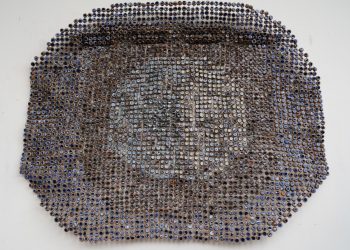
“My practice is rooted in material investigation. I find my work in a consistent state of flux. Processes change and evolve, imagery comes and goes. This minute I’m steeped in symbolism, say, through the repetition of thousands of dustpans, while the other I’m firmly rooted in geometric abstraction.

My fluid framework reflects my experience of American culture—a place where I navigate free choice and inherent socio-political and economic constraints. Through symbols and materials of domesticity my works find some continuity. It is my intention to create works that, in relation to each other, seem as dichotomous as they are connected. Although materials and processes may seem disparate, they find connection through aesthetics and systematic repetition. It is through a controlled failure of my materials and systems that I find consistency. But of course, inconsistency is always present.” Ryan Blackwell

Follow Ceramics Now Magazine on Facebook and Twitter.

Read More

  • Ellen Schön

    Ellen Schon ceramics, Featured artist on Ceramics Now Magazine

    Ellen Schön’s profile on Ceramics Now Magazine - View her works

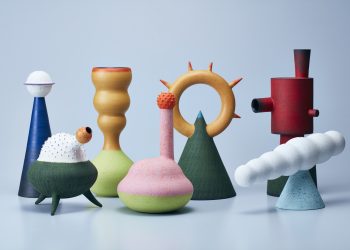
    “I have always been interested in the ability of a ceramic vessel to point to something beyond itself—to function as metaphor. Ceramic vessels, physically structured with necks, shoulders, bellies, and feet, can evoke the gesture and anthropomorphized stance of the human body; they also reveal deep aspects of human experience and of the natural world.

    My fervent interest in clay vessels has led me to explore new territories in form and surface. Recent work explores three variations on the ceramic vessel form:

    The ceramic vessel as a Wellspring or Womb, with possibilities of both fecundity and barrenness;
    The vessel as Bottle, whose forms evoke the elongated posture of Cycladic idols and the scarified texture of Yoruba terracotta heads;
    The Planet Series explores swirling colored surfaces on rounded orbs, suggesting planets and depths of earthly strata.

    These series represent different but related expressive interests. Each piece in a series is part of a continually evolving solution to a set of questions or parameters I have chosen to work within. The parameters, themselves, may change as the series evolve.

    Through spontaneous handling of inanimate clay, I attempt to find and breathe life into form. My creative process is grounded in reflective practice—imposing ideas on and listening to the material in cycles of learning. The material directs me as I direct it. We are in a reciprocal relationship.” Ellen Schon

    Follow Ceramics Now Magazine on Facebook and Twitter.

    Read More

  • Francesco Ardini

    Francesco Ardini Contemporary Ceramics - Italian ceramic artist featured on Ceramics Now Magazine

    Francesco Ardini’s profile on Ceramics Now Magazine - View his works

    Francesco Ardini was born in Padua, Italy, and graduated in Landscape Architecture at the IUAV, Venice, in 2011. He discovered ceramics during the study years. Currently works in Padua and Nove.

    The vision of reality in Ardini’s studies relates to broken objects, uneven surfaces, the apparent dissolution, the linearity undermined by failure. All these lead to a naturalism where the works provide biological cycles in which the dissolution is always followed by a formal definition.

    Francesco Ardini understands the scientific course that begins with Einstein’s relativity, Max Planck’s quantum theory, going on with the Hubble’s discovery of galaxies, to land - in the second half of the twentieth century - within an epistemological revolution that places the possibility/probability above the necessity. Ardini accepts the idea that a large part of reality is not linear, but chaotic, and has a view of a universe development which will end in a cosmic catastrophe. These ideas place Ardini’s work in the sphere of conceptual art.

    Read More

  • David Gallagher

    David Gallagher Contemporary ceramic installations

    David Gallagher’s profile on Ceramics Now Magazine - View his works

    David Gallagher is a ceramic artist from Philadelphia who completed his undergraduate work at the Tyler School of Art-Temple University. He is currently pursuing his Masters of Fine Arts at Kansas State University in Manhattan, Kansas.

    Research Statement
    In our current epoch of ever more rapid invention it becomes paramount to analyze our relationships to the technology we produce. Systems are created on the foundations of existing technology and are tied to the accepted modes of history and the present.  These technologies mediate our experiences with the physical world. We no longer have hundreds of years to determine appropriate uses for the technology we create. In many cases this time frame can be compressed to months or even weeks, with the only criteria for its evaluation being its novelty. These tools we create enter our perception with singularity of purpose, and yet cause repercussions though out our whole cultural existence.

    The primary focus of my artistic practice is the systems we create to manage our society. I am constantly investigating our understanding of the physical and psychological environments we construct. Humanity is driven to invent; to create tools that aid in the managing of society’s existence. Our instinctual proclivity to transcend what exists, to constantly refine and redefine our own existence is the central idea that drives my research. My work is a simulation and examination of systems that function within the constructs of social environments. These systems provide a framework for the investigation of the possibilities of context, specific iterations of conventional relationships.

    Read More

  • Elizabeth Shriver

    Elizabeth Shriver Ceramics

    Elizabeth Shriver’s profile on Ceramics Now Magazine - View her works

    “I work with clay to create an array of graceful, sensuous, organic forms. These pieces are made through a variety of hand-building methods such as slab-building, coiling, pinching, and forming with molds. Rarely relying on glaze, I use textures, stains, and colored clay to add visual and tactile interest. I am drawn toward neutral earth tones that complement rather than distract from my intricate sculptural vessels.

    The curving lines and interplay of light and shadow in my work generate an illusion of movement, giving each piece an almost lifelike quality. A successful piece is one that begs to be touched as well as explored visually.” Elizabeth Shriver

    Read More

  • Jason Hackett

    Jason Hackett Contemporary Ceramics - featured on Ceramics Now Magazine

    Jason Hackett’s profile on Ceramics Now Magazine - View his works

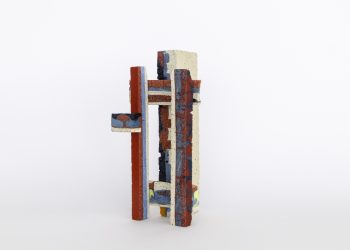
    “I understand the world in an evocative fashion and view my artworks as both physical and philosophical memorials to ‘Closeness’. During the construction of new works in series, I commonly consider ideas such as the value of community and family, the honesty of both gross and tedious labor, and the mysteriousness of the metaphysical.

    I primarily construct pieces using my hands and molding methods while also using found manufactured ceramics. Captured materials, images and forms; of man and of machine; from immediate and distant pasts are merged in commemorative context where contemplation defines their functional nature. Individually they are cups, plaques, and cultural icons made in clay. Collectively, they express proximity and distance, material and immaterial, and both the tangible and intangible.” Jason Hackett

    Read More

  • Patricia Sannit

    Patricia Sannit Contemporary Ceramics featured on Ceramics Now Magazine

    Patricia Sannit’s profile on Ceramics Now Magazine - View her works

    “The impulse to decorate is strong. The push to create a border or impose a structured order on the already beautiful order of the (chaotic) natural world is compelling. Humans have always done so.

    My work draws from and responds to visual idioms found throughout human history. Visual languages flow from culture to culture and through time; I explore how the changes of motifs and technologies show development and transformation in societies. I draw from our species’ long and intimate relationship with our surroundings, both natural and man-made. To that end, I use a variety of mostly found and repurposed clays to refer to both the contributions of previous makers in our collective art history and the stratigraphy of the Earth. My work is influenced by archaeology, geology, industry and the commonality of human experience through time and across culture.” Patricia Sannit

    Born in Cleveland, Ohio, Patricia Sannit received her BA in ceramics, Art History and Norwegian from the University of Minnesota and her MFA from the California College of Arts. She now lives in Phoenix, Arizona. Sannit’s work is influenced by her experiences excavating in the Near East and Ethiopia. Sannit’s most recent project is a large-scale ceramic installation, Citadel, based on an archeological site in Iraq. “I am interested in the story of the earth, our species, and pots. History is manifest in the scarred and worn surface of our planet and in a pot well made and well used.”

    Read More

  • Bente Skjøttgaard

    Bente Skjottgaard Contemporary Danish Ceramics

    Bente Skjøttgaard’s profile on Ceramics Now Magazine - View her works

    “The basic elements in my work are the materials: clay and glaze. I enjoy engaging in expressive ceramic experiments that test the boundaries of material and form.
    I often take my point of departure in nature’s principles and regularities of form. This results in strange inscrutable sculptural growths and large wild and amorphous nature abstractions that may be both lush and melancholic with an expression of beauty in both growth and decay.” Bente Skjøttgaard

    “Bente Skjøttgaard is a ceramist: she was born in 1961. In much the same manner as a runner or an existential philosopher, she is cultivating her material, which is clay overcoated with an application of glaze. She is a master of her field and she is “inside” the clay in the sense that she is challenging herself each and every time she creates a new work. The glazed pieces are constantly becoming larger and more voluminous, with interiors consisting of complicated constructions, as is the case inside a person or an animal, a prehistoric creature or another biological phenomenon. And the beauty cannot be mistaken. It is a kind of primeval nature, but accordingly a nature that is created both from within and from without, in the course of a protracted reciprocal interplay.” Excerpt from “Elements in white”, a text By Erik Steffensen - Professor at The Royal Academy of Fine Arts, Copenhagen.

    Read More

  • Steve Belz

    Steve Belz Ceramics - Featured ceramic artist

    Steve Belz’s profile on Ceramics Now Magazine - View his works

    “The environment is in a delicate balance between well-being and decline. For a healthy society, we must be responsive to the fact that all of our activities affect the Earth. My sculptures express the beauty of nature and the tension created by man’s manipulation of our environment. I use the beauty of form to increase the viewer’s emotional connection with nature. This connection to nature can expand one person’s, and ultimately our society’s compassion for the natural world.

    Historically we have manipulated plants by gathering seeds, grafting limbs, and controlling pollination of plants with traits we find favorable. These qualities were gradually developed over countless generations. What is different about our more recent modification of plants is the far-reaching selection of traits from organisms that would not be accessible without genetic engineering. For instance, splicing a fish gene with a strawberry to make the strawberry more resistant to cold could not occur if not for techniques developed by scientists. This kind of manipulation is dramatically different from our prior system of plant selection and has potentially profound effects on the Earth.

    I use manufactured elements in my work to create a tension meant to bring about a consciousness within the viewer, to open a dialogue about contemporary society’s association with nature. This discussion can raise awareness of the danger that our current situation poses. A lack of responsibility and stewardship for the Earth creates many problems for the planet, among them degradation of our basic life support systems, as reflected in the loss of biodiversity, increased toxicity of our food systems, inefficient use of natural resources and global climate change. I hope that my art will encourage viewers to educate themselves and become increasingly proactive in assuring a sustainable future.” Steve Belz

    Read More

  • Ruth Power

    Ruth Power Contemporary Ceramics

    Ruth Power’s profile on Ceramics Now Magazine - View her works

    “My work is strongly political and inspired by the invention of Japanese tentacle pornography.

    It all began when I typed in ‘tentacle’ to Google Images. 90% of the images that showed up consisted of violent tentacle porn. Tentacle porn has been around for centuries, but only became hugely popular in 1980, when a Japanese animator named Maeda wanted to make an erotic anime called Urotsuki. However, at the time, Japanese law forbade anatomically explicit pornographic drawings. Illustrators were always looking for ways to get around the law, so, instead of depicting an erect penis, Maeda depicted brutal tentacles.

    Moreover, it was illegal to show couples taking part in sex where the man penetrates the woman with his penis for mutual pleasure, but it was perfectly legal to show tentacle rape. This contradiction of censorship fascinated me. The restrictions on the latter substantially caused the former: the return of the repressed as huge, aggressive tentacles…and this is what I found to be most fascinating.

    Thus, the tentacles in my work symbolize sexual repression. I am very worried about contemporary sexuality, with women still derogated for acting sexual and mainstream pornography becoming more and more brutal. I pay a lot of attention to the media, which further influences my work. I use casts of my own body parts to express how this state of deformed sexuality is affecting me.” Ruth Power

    Read More

  • Jenni Ward

    Jenni Ward Contemporary Ceramics

    Jenni Ward’s profile on Ceramics Now Magazine - View her works

    Jenni Ward is a sculptor, art instructor and owner of Earth Art Studio in Aptos CA. In 2005, she opened Earth Art Studio; a sculpture studio offering clay and mixed media sculpture classes and workshops for children, teens and adults. Throughout her teaching career she has worked extensively with many youth and senior art programs. She is also the creative engine behind the humanitarian group; HOPE Art which brings art to the youth of Haiti. In addition to teaching, she has been creating, showing and selling her own sculptures since graduating from University of Hartford-Hartford Art School with a Bachelor of Fine Arts degree in 1998. She exhibits her sculptures locally and nationally.

    “My work focuses on how organic forms interact and engage with the space they encompass. I create abstract arrangements reflecting the biological world of seeds, pollens, bones, shells and entomology.

    My pieces explore the tensions of opposing forces with results that evoke contrary feelings of unshackled captivity, organized randomness and the density of negative space. At times I work in multiples; the forms are often configured in simple geometric compositions to counter their organic nature. Using clay as my primary medium, I develop these pieces with commonalities of shape, color, texture and movement. The results are a series of work that strive to achieve a sense of beauty in their asymmetrical balance.” Jenni Ward

    Read More

  • ©2013 Ceramics Now. All Rights Reserved. Website by Thomas Cullen. Powered by Tumblr.