
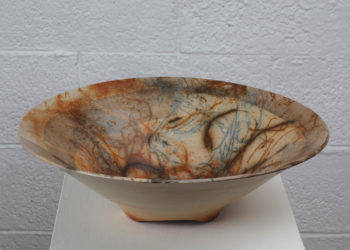


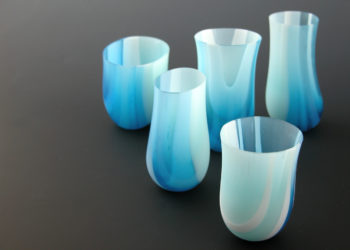
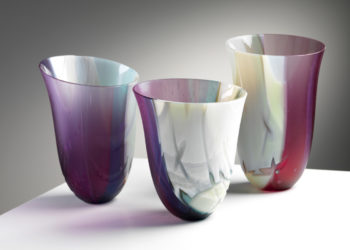
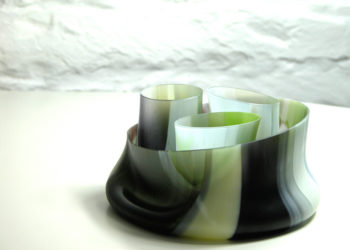
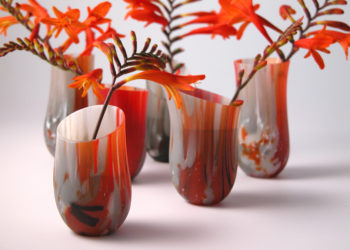
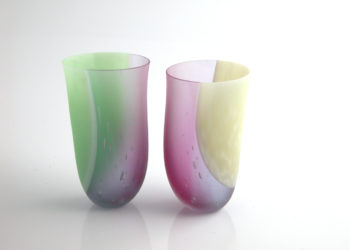
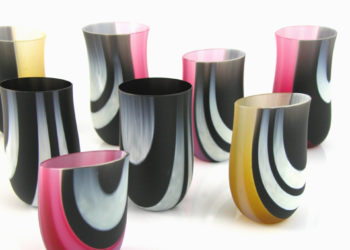
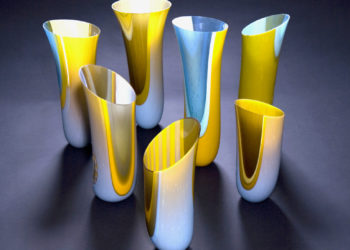
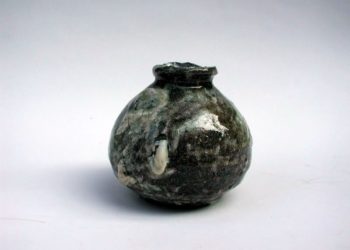
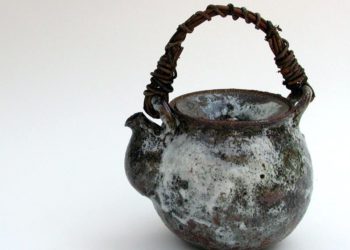
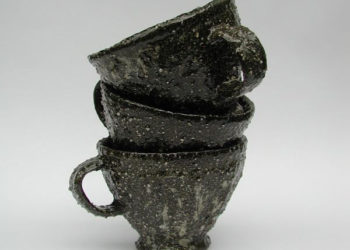
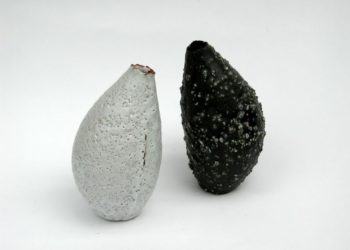
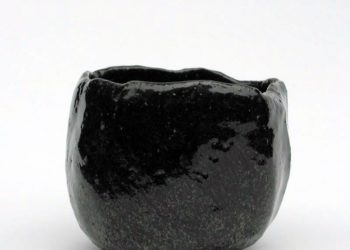
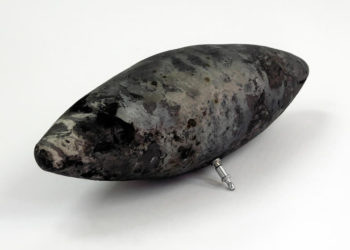
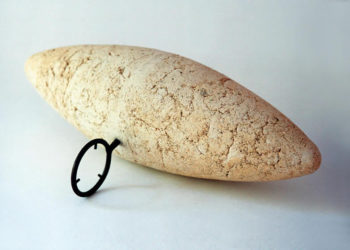
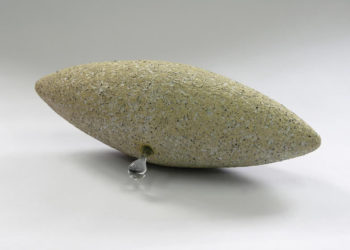


Barbara Fehrs: Faux Pitcher with Leaves #2
functional
Johannes Nagel
Johannes Nagel’s profile on Ceramics Now Magazine - View his works
“A vessel has as its reference its own stylistic history and the function. To conserve, or serve out or to present a certain content, is an orientation towards basic human needs. The necessity of producing the form in order to protect contents, meets up with the need to express oneself and to consecrate things and attribute a value to them. From the outset vessels were always designed. The forms emerged from out of the technical capabilities, the practical necessities and a sense for rituals. Rituals are the source of civilization and culture. They bestow a form upon what is lacking in design. A shared meaning develops in them, which goes above and beyond what is merely necessary to life and relates towards what is sublime and greater. From the need to represent and pay homage to this, all art has developed.
The rituals have changed, civilization has brought forth many flowers, art is ever the mirror. The manufacture of vessels is a self-evident cultural technique for all of mankind, and analogue to the role of the figure in sculpture, we can maintain that the ritual is the concrete opposite of the vessel.
And so the „vessel“ can today be a theme, in which function and ritual, our own history and the future may be reflected.
Do rituals relate to something sublime? Can they create a shared meaning? What sort of a function do vessels have today?”
“In the original axiom the form follows the function, as the shape which corresponds to the purpose. The functionality in this work is not related to the potential of a thing to be useful, but rather to the logic involved in its manufacture.
The necessary work steps to make a form mould with which objects can be reproduced in porcelain, are subject to specific preconditions. A sort of three dimensional stereotype has to be made in plaster, which forms a closed volume, or receptacle for the liquid porcelain. The usually many-pieced stereotypes must then be capable of being taken apart, so that the model around which they have arisen, and subsequently the reproduced object shall not be damaged.
I interrupt this process before it is finished and use the stereotype incompletely. The function of (pouring) the form is extended. As a fragment it becomes part of the object and forms a threshold, a border, like the frame which separates the picture from the wall.” Johannes Nagel
Akiko Hirai
Akiko Hirai’s profile on Ceramics Now Magazine - View his works
“Things that are completely perfect and things that are completely broken appear to be in two opposite conditions, yet two conditions are the same concept as a form of completion. There is no movement in these two conditions.
The waxing and the waning moon contain an expectation of completion whether it is going to be the start or the end. We are seeing the moon at the same time we are seeing our perception of time or whatever it is, we see something progressing.
To some my work may appear to be imperfect because perfection contains only one message which is clearly defined by the maker. My attempt is to create the condition of progress in my work. Something ambiguous, unsettled and imaginative so that the user of my work sees many different aspects from the object.”
“My preference of choosing types of clay when making white ware is the dark and coarse clay most of the time. The whiteness acts as a membrane or a veil. The hints of the true nature of the material appear slightly on the surface. Dark clay which consists of many impurities induces strong chemical changes in heat and the trace of events remains under the veil when it cools down. White, on the other hand, is more stable because of its purity. It is already settled and has a feeling of “stillness”.
Superficially my work appears to be quiet in white. It does not show the rawness of Mother Nature directly. A symbolic figure always looks more perfect than the actual person he/she is. Imagination and fantasy always reinforce the imperfection and achieve the perfection with its own originality.
Therefore the completion of my work is done by the viewers. My work is a creation on its own.”
Antonella Cimatti
Antonella Cimatti’s profile on Ceramics Now Magazine - View her works
“I believe that the greatest undertaking of the artist is that of professional maintenance. As a matter of fact, along with spontaneous creativity, you indissolubly must add an elevated professional competence regarding technique; through reading and observation, the joy of experimentation, of combining, and of moving forward.
My design is born from a rereading of past artistic production through a filter of formal personal sensibility directed towards the making of a functional or sculptural object. The forms generated are aesthetically accurate and display a strong sense of the real feminine character, of grace, of elegance and of attention to detail.
Thus, “Crespines”, objects originally of Faentinian tradition that were used in the grand European courts of the 16th and 17th centuries, have been remade in porcelain paper clay for a new collection which began in 2005.
It was challenging and exciting to create forms derivative of the past, but reconsidered with completely new techniques and philosophies.
These pieces have been formed using an incredibly thin decorative weft that ultimately creates their supporting structure: it’s an art of addition, not of subtraction, as was commonly done in the original renaissance crespines, where the perforations were created by piercing and cutting out shapes from the existing closed forms. The procedure anticipates the moulding with a freehand syringe on concave or convex refractory supports and requires a high temperature firing. Sometimes the forms are then mounted on hand-blown glass bases, which have been designed and commissioned in Tuscany. The round shape is prevalent in my work, which can often be found in Italian Renaissance architecture.
They present themselves in this way, like ample goblets in ceramic filigree, a type of interwoven lace of overlapping spirals in precious porcelain “thread”, an effect absolutely unobtainable without the help of paperclay. Objects of light and vulnerability, which live in illumination and shadow, in tactility, in supreme whiteness and imperceptible vibrations.” Antonella Cimatti
Antonella Cimatti was born in Faenza in 1956. One of Carlo Zauli’s pupils at the Istituto d’Arte (State School of Ceramics) in Faenza, she went on to obtain a degree with distinction from the Accademia di Belle Arti (Fine Arts Academy) in Bologna. She has been teaching Design at the Istituto d’Arte (State School of Ceramics) in Faenza since 1979.


