Magazine
Ceramic artists list
> Ceramic artists list 97. Ryan Blackwell 96. Ellen Schön 95. Francesco Ardini 94. David Gallagher 93. Elizabeth Shriver 92. Jason Hackett 91. Patricia Sannit 90. Bente Skjøttgaard 89. Steve Belz 88. Ruth Power 87. Jenni Ward 86. Liliana Folta 85. Kira O'Brien 84. Annie Woodford 83. Kwok-Pong Bobby Tso 82. Bogdan Teodorescu 81. Kimberly Cook 80. Paula Bellacera 79. Debra Fleury 78. Cindy Billingsley 77. David Gilbaugh 76. Teresa & Helena Jané 75. Marianne McGrath 74. Suzanne Stumpf 73. Deborah Britt 72. Kathy Pallie 71. Els Wenselaers 70. Kjersti Lunde 69. Brian Kakas 68. Marie T. Hermann 67. Mark Goudy 66. Susan Meyer 65. Simcha Even-Chen 64. Barbara Fehrs 63. Shamai Gibsh 62. Natalia Dias 61. Bethany Krull 60. Amanda Simmons 59. Arthur Gonzalez 58. Chris Riccardo 57. Akiko Hirai W 56. Johannes Nagel 55. Rika Herbst 54. Liza Riddle 53. Chang Hyun Bang 52. Virginie Besengez 51. Jasmin Rowlandson 50. Chris Wight 49. Wim Borst 48. Rafael Peréz 47. Guðný Hafsteinsdóttir 46. Cathy Coëz 45. Merete Rasmussen 44. Carol Gouthro 43. JoAnn Axford 42. David Carlsson 41. Margrieta Jeltema 40. David Roberts 39. Patrick Colhoun 38. Abigail Simpson 37. Signe Schjøth 36. Katharine Morling 35. Dryden Wells 34. Antonella Cimatti 33. Cynthia Lahti 32. Carole Epp 31. Blaine Avery 30. Ian Shelly 29. Jim Kraft 28. Wesley Anderegg 27. Connie Norman 26. Arlene Shechet 25. Young Mi Kim 24. Jason Walker 23. Peter Meanley 22. Shane Porter 21. Jennifer McCurdy 20. Yoichiro Kamei 19. Debbie Quick 18. Ian F Thomas 17. John Shirley 16. Grayson Perry 15. Vivika & Otto Heino 14. Georges Jeanclos 13. Daniel Kavanagh 12. Nagae Shigekazu 11. Matthew Chambers 10. Tim Andrews 9. Claire Muckian 8. Adam Frew 7. Maciej Kasperski 6. Roxanne Jackson 5. Keith Schneider 4. Celeste Bouvier 3. Tim Scull 2. Kim Westad 1. Sara Paloma

history of ceramics

Patricia Sannit - Artist of the month, October 2012

ARTIST OF THE MONTH, October 2012: Patricia Sannit

Patricia Sannit - Artist of the month on Ceramics Now Magazine

Interview by Ileana Surducan for Ceramics Now Magazine - Issue Two

How did your experience in working on archeological sites in Jordan and Ethiopia influenced your work?

My work in Jordan and Ethiopia profoundly changed my work. I went to Jordan between my undergraduate degree and my graduate degree. At that point, I was already serious about clay, and although my early training had a functional emphasis (the well known American potter Warren Mackenzie was a teacher and influence), I had become more interested in sculpture. But my work had little focus and I was frustrated by what I saw as the triviality of my work. It didn’t seem to have a core or substance.

Before University, I had been an exchange student in Norway and had learned a lot about history, arts and culture there, but had not put it to any good use. However, when I went to Jordan, two things happened. I traveled all over the region - into Syria and Israel, and throughout Jordan, notable the amazing Petra. I was deeply impressed by the ancient culture and the design of the buildings and tombs and the handmade objects resonated with me. I understood finally that there was a connection between people and cultures and it was in a way manifested through the visual vocabulary around me. It related to the textiles of Scandinavia and the work that I had done as a kid. The desire to create some order, through geometry, on the natural world, and on roughly hewn stone and constructions seemed universal.

My other experience there that had a huge and lasting impact on me was the excavation itself. At Ain Ghazal, working in a “square” (archeological sites are frequently divided into precise squares so as to map out the location of a find onto three points in space) and seeing how the layers of the earth marked time and culture, hiding, or harboring, the evidence of past people was exciting to me. I recognized and felt awed by all of the people who had come before me. Ain Ghazal was first settled about 7250 B.C., during the so-called Pre-Pottery Neolithic B (PPNB) period. The result of our excavation was the discovery of a diverse assemblage of symbols including tokens of many shapes, animal and human figurines, modeled human skulls, “monumental” statues and mural and floor paintings. My square had a beautiful floor painting of iron oxide on plaster. During the final days of the field season, I worked to uncover the floor. As a ceramic artist, discovering a plaster floor painted with iron oxide, the same Iron oxide that I used so often in my work, was a thrill. But more significantly, as I knelt, sweeping the dust from the floor, I felt a profound sense of connection to the women who had lived there 9000 plus years before. I knew that we had shared many of the same feelings and concerns; I felt connected and understood that there was a huge chain of humanity of which I was a part. I still get goose bumps thinking of it. And that sense of our common humanity is what still informs my work today.

My subsequent adventure was in Ethiopia. I am very fortunate to have married a man who works at what is called the “Lucy” site in the Afar region of Ethiopia. Lucy is an Australopithicus afarensis, and her species populated that part of Africa between 3 and 4 million years ago. She is pat of our species ancestry. As one scans the ground for fossils, walking in the same rough wadis where our earliest ancestors walked, the sense of our history coming to surface is very powerful. It’s a beautiful place, though drier now than it was when Lucy lived there. It is very quiet and empty, and potent with history.

Patricia Sannit Ceramics - Artist of the month on Ceramics Now Magazine
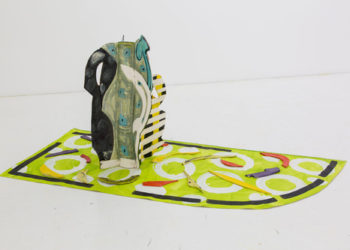
Patricia Sannit, Cradle, 2010, hand-built, carved and incised reclaimed clays, slip and stain, 21”x32”x12” - View Patricia’s works

Read More

  • Langenthal retrospective / Musée Ariana, Geneva, Switzerland

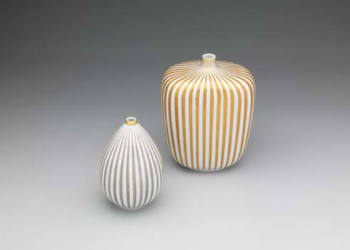
    The Langenthal porcelain manufactory. From industrial design to Sunday china, Musee Ariana, Geneva

    Langenthal retrospective / Musée Ariana, Geneva, Switzerland
    May 23 - November 25, 2012

    Opening reception: Wednesday, May 22 at 6.30 pm.

    #1
    The Langenthal porcelain manufactory. From industrial design to Sunday china

    The fascinating history of the only 20th century Swiss porcelain factory began in 1906 in the Bernese town of Langenthal. Deeply rooted in the Swiss identity, the porcelain manufactory Langenthal SA – affectionately known by its workers as the “Porzi” – became noted for its cutting-edge technology, the diversity of its products as well as the quality of its porcelain. The artistic output followed the dominant aesthetic currents of the century while still preserving its local character. From Art Nouveau and Art Deco to the deliciously “vintage” designs of the 1950s and 1960s, from pseudo-rustic to avant-garde propositions, from collaborations with artists and designers to the influence of the artistic directors of the manufactory, the history of Langenthal is closely linked to the evolution of taste.

    This collaboration with the Langenthal manufactory has been an opportunity to update the rich archives : hand-painted design books, catalogues of forms and motifs, publicity leaflets and brochures, archive photos. Loans from public and private institutions enrich and complete the important collection of the Musée Ariana (over 1000 pieces). All the conditions have been met to allow a portrait to be drawn of 20th century industrial porcelain in Switzerland.

    The History of A Courageous Project
    When some notables of the Bernese town of Langenthal decided to found a porcelain manufactory in July 1906, they were armed with a good dose of courage and staunch enthusiasm. Indeed, after a century without any porcelain manufacture in Switzerland, there were no raw materials and, more particularly, no specialized local workforce available. They had to start completely from scratch in order to rewrite Switzerland into the porcelain history books.

    After a chaotic start, production became more organized and the manufactory began displaying its goods in specialized exhibitions and fairs with encouraging success. The outbreak of the First World War curbed this momentum. In 1937, in order to reduce its dependence on imported coal, the manufactory constructed the first 24-hour electric tunnel kiln. This technological breakthrough allowed the company to increase and diversify its production.
    After the Second World War, the manufactory enjoyed a heyday. The remarkable quality of the Swiss-made products enabled it to fight off the competitors. In 1964, the firm recorded the highest number of employees in its history, with 950 workers.

    Read More

  • ©2013 Ceramics Now. All Rights Reserved. Website by Thomas Cullen. Powered by Tumblr.