

Magazine
Ceramic artists list
> Ceramic artists list 97. Ryan Blackwell 96. Ellen Schön 95. Francesco Ardini 94. David Gallagher 93. Elizabeth Shriver 92. Jason Hackett 91. Patricia Sannit 90. Bente Skjøttgaard 89. Steve Belz 88. Ruth Power 87. Jenni Ward 86. Liliana Folta 85. Kira O'Brien 84. Annie Woodford 83. Kwok-Pong Bobby Tso 82. Bogdan Teodorescu 81. Kimberly Cook 80. Paula Bellacera 79. Debra Fleury 78. Cindy Billingsley 77. David Gilbaugh 76. Teresa & Helena Jané 75. Marianne McGrath 74. Suzanne Stumpf 73. Deborah Britt 72. Kathy Pallie 71. Els Wenselaers 70. Kjersti Lunde 69. Brian Kakas 68. Marie T. Hermann 67. Mark Goudy 66. Susan Meyer 65. Simcha Even-Chen 64. Barbara Fehrs 63. Shamai Gibsh 62. Natalia Dias 61. Bethany Krull 60. Amanda Simmons 59. Arthur Gonzalez 58. Chris Riccardo 57. Akiko Hirai W 56. Johannes Nagel 55. Rika Herbst 54. Liza Riddle 53. Chang Hyun Bang 52. Virginie Besengez 51. Jasmin Rowlandson 50. Chris Wight 49. Wim Borst 48. Rafael Peréz 47. Guðný Hafsteinsdóttir 46. Cathy Coëz 45. Merete Rasmussen 44. Carol Gouthro 43. JoAnn Axford 42. David Carlsson 41. Margrieta Jeltema 40. David Roberts 39. Patrick Colhoun 38. Abigail Simpson 37. Signe Schjøth 36. Katharine Morling 35. Dryden Wells 34. Antonella Cimatti 33. Cynthia Lahti 32. Carole Epp 31. Blaine Avery 30. Ian Shelly 29. Jim Kraft 28. Wesley Anderegg 27. Connie Norman 26. Arlene Shechet 25. Young Mi Kim 24. Jason Walker 23. Peter Meanley 22. Shane Porter 21. Jennifer McCurdy 20. Yoichiro Kamei 19. Debbie Quick 18. Ian F Thomas 17. John Shirley 16. Grayson Perry 15. Vivika & Otto Heino 14. Georges Jeanclos 13. Daniel Kavanagh 12. Nagae Shigekazu 11. Matthew Chambers 10. Tim Andrews 9. Claire Muckian 8. Adam Frew 7. Maciej Kasperski 6. Roxanne Jackson 5. Keith Schneider 4. Celeste Bouvier 3. Tim Scull 2. Kim Westad 1. Sara Paloma

installation

Turi Heisselberg Pedersen: My Garden / Copenhagen Ceramics, Denmark

Turi Heisselberg Pedersen: My Garden exhibition at Copenhagen Ceramics, Denmark

Turi Heisselberg Pedersen: My Garden / Copenhagen Ceramics, Denmark
March 29 - April 21, 2012

Opening reception with Garth Clark, New York-based critic, writer and gallerist: Thursday, March 29, 5–8 pm.
Artist Talk with Turi Heisselberg Pedersen: Saturday, March 31 at 2 pm.

“I love my garden, its plants and vigorous growths. Its potency of growth that within one season can produce an enormous plant from a tiny seed. It contains such a wealth of amazing and strange shapes, textures and colours. Furthermore it is a curious mix of nature and cultivation, of something dirty or beautiful, of poetry and ugliness. Certain things bloom and grow, some go wrong, unsuccessfully. It is a world of controlled nature, which is shaped, trimmed and reworked, not unlike the world of clay” Turi Heisselberg Pedersen explains on the inspiration for her show. Her garden can be experienced at Copenhagen Ceramics from 29 March through 21 April 2012.

For the exhibition My Garden Turi Hesisselberg Pedersen has created a new series of works inspired by the patterns, textures and structures in her garden. In the process of transforming this into ceramics works, two overall themes have emerged:

Vases inspired by buds and growths
On one hand you find a group of precise, simple and cultivated shapes. For example vases inspired by the tautness of swelling flower buds – formal expressions that may seem almost vulgar. Or abstract, simple vase-shapes miming the upward, rhythmic patterns of plant-growth. Both act as ceramic equivalents to the trimmed and cultivated nature of gardens and an interpretation of the underlying order.

The opposite theme renders visible the sprouting life under ground. Out of this, works in the shape of organic, bulbous forms and seed capsules emerge with coarse, expressive surfaces or fluted structures. Careless growths and root-like forms, testifying to the more unruly forces of the garden.

In her new exhibition, Turi Heisselberg Pedersen will be showing some all-new, expressive and asymmetric works, where she explores the inherent character and textural freshness of the clay. Other pieces are more typical of her and display her mastery of simplified sculptural vessels, where rhythm, lines and the interplay between forms are recurrent themes.

Read More

  • Richard Slee: Camp Futility / Studio Voltaire, London

    Richard Slee: Camp Futility exhibition at Studio Voltaire, London

    Richard Slee: Camp Futility / Studio Voltaire, London
    April 25 – May 26, 2012

    Opening reception: Tuesday, April 24, 7–9 pm

    Studio Voltaire presents a new commission by Richard Slee, comprising of a series of objects and installations made specifically for the exhibition. Slee is an important figure within contemporary ceramics and the exhibition will be his first presentation in a public gallery since From Utility to Futility, a solo exhibition at the Victoria and Albert Museum in 2010.

    Central to Slee’s exhibition at Studio Voltaire is a number of works based on vernacular objects such as wood saws, hammers, pick axes and camping equipment. Inspired by a recent residency at Alfred University, in upstate New York, the works investigate particular myths and the symbolism of our ideas of America such as the great outdoors and the pioneer spirit. Lashed together workbenches that refer to old mining equipment, various scattered tools and an abandoned camp-fire can be read as an allegory to abandoned industries where whole communities move on to find employment elsewhere.

    Ideas challenging the economy of productive labor are implicit in Slee’s combination of the hand-made and the found object. The uncanny hybrid of the de-skilled ready-made and the crafted object convey a subversive humourous vision that playfully investigates the limits of the ceramic tradition. Mass produced, everyday objects are meticulously realized with highly glazed, bright colors. These seductive surfaces recall a Pop or post-modern aesthetic that belies the more psychological, underlying cultural references of an object’s utility.

    Slee (born 1946, Carlisle) works and lives in London. He studied Ceramics at Central School of Art & Design and the Royal College of Art. Until last year, he was a senior Professor at the University of the Arts in London. His work has been shown in London and internationally since the late 1970s and recent exhibitions include Postmodernism: Style and Subversion 1970 – 1990, V&A Museum, London (2011-12), The Peir Arts Centre, Stromness (Solo, 2004) and Tate St Ives (Solo, 2003). Slee is represented by Hales Gallery, London.

    Sponsored by SIMONE.
    Supported by The Henry Moore Foundation.

    Read More

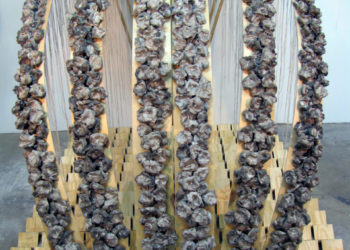
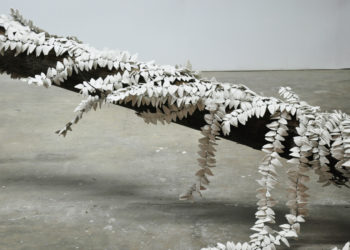
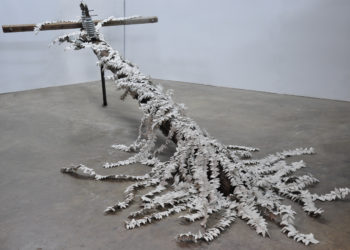
  • Jenni Ward: Branch Series (installation), 2011, ceramic & high temperature, wire, variable dimensions

  • Dimitrios Antonitsis: Sarmale with Ketchup / SABOT Gallery, Cluj-Napoca, Romania

    Dimitrios Antonitsis: Sarmale with Ketchup exhibition at SABOT Gallery, Cluj-Napoca, Romania

    Dimitrios Antonitsis: Sarmale with Ketchup / SABOT Gallery, Cluj-Napoca, Romania
    March 21 – May 5, 2012

    Sleek show fitting the sleek space of Sabot and breathing contemporary air into the Transylvanian folklore.

    A graduate of the New York Film Academy and a former fashion photographer, Antonitsis is keenly aware of the different ways reality can be manipulated or exaggerated. (Tina Sotiriadi | Art in America, April 2002)

    The Folklore, as a term of Dimitrios Antonitsis’ personal vocabulary, is invariably concerned with the practice of handcrafts. Always manifesting a soft spot for the discarded and the rejected, the artist easily fell for the triviality of Romanian fleamarket-stands, where he purchased used ceramic pots and vessels, woven rugs and bedspreads, and even some coarse wood-crafted decorative objects. These forsaken, modest artifacts became the chosen ingredients for his challenging task of pursuing a juicy aesthetical discourse and transforming them into his own contemporary dish.
    The mundane titles “Sarmale with Ketchup” (for his solo show at Sabot), and “Panache de Papanași” (for the concomitant exhibition at the Museum of Art in Cluj-Napoca), should be therefore read as an act of resisting social formatting.

    Antonitsis uses his latest sculptural work as a sharp metaphor for leisure, fun and luxurious consumption. Bonus, a giant canine treat in aluminum and Bunny Labyrinth, a kids game silk-screened on a woven rug comment on our complicated and troublesome relation with over-achievement, social power and reward. His aesthetic language stretches from an attractive and minimal object making to an overcharged and exaggerated folklore design, always responding to the goal of articulating the concepts as accurately as possible. After all, Antonitsis is an artist who feels responsible for bringing truth to his audience. He can be wrong or misunderstood, but he must struggle to reflect reality in a way that speaks out the truth, whether we comprehend it or not.

    Artist and curator, Dimitrios Antonitsis is the founder of Hydra School Projects, a cutting edge international platform for the visual arts set up in an elementary school on the Greek island of Hydra.

    Read More

  • Liliana Folta: An Abstract Poem of Freedom, 2009, (on going) traveling/interaction/installation: ceramic chain, bullets & bowl; white gesso, ink, wooden chair, white sheets, rug, soldier boots, paper, high temp wire, 3x7x2 ft.

  • Liliana Folta: Oíd el Ruido de Rotas Cadenas (Hear the Sounds of Broken Chains), 2010, Installation for the 1st Biennial of the Americas, unglazed ceramic chains, cotton canvas chains, wood, mirror, iron, high temp wire, 13ft. x 56in Diam.

  • Liliana Folta: Oíd el Ruido de Rotas Cadenas (Hear the Sounds of Broken Chains), detail, 2010

  • Liliana Folta: Inhale-Exhale-Explode, 2009/10, ceramic installation, oxides, glazes, wood, high temp wire, 14x12x4in (each)

  • Annie Woodford: Piercing Rim, detail, 2007

  • Ebru Özseçen: True Love Soul Mate / RAMPA Istanbul, Turkey

    Ebru Özseçen: True Love Soul Mate exhibition at RAMPA Istanbul, Turkey

    Ebru Özseçen: True Love Soul Mate / RAMPA İstanbul, Turkey
    March 02 — April 07, 2012

    Ebru Özseçen combines her experience in the fields of architecture, design and contemporary art to explore different aspects of psychological and sociological relationship between space and body. Her work presents great diversity; ranging from urban intervention to sculpture and objects, from photography to video, from film installations to drawings. The artist is concerned with the dualities of inside/ outside and public/private; and explores individual memory in contemporary society. Ebru Özseçen investigates the seemingly mundane to expose its magical and unseen aspects. She reveals a space where fantasy and memory hide in plain sight.

    It is impossible to disregard the gender aspect in Özseçen’s work, in which she indiscriminately plays with the androgynous form – the phallus, vulva, uterus or scrotum. At times pushing the boundaries of pornographic obscenity, the artist always places erotic intensity in the foreground. On the other hand, in many of her works it is possible to see Özseçen driven by her deep-seated admiration for the tradition of artisanship. The artist is drawn to the sensual quality of the form and the beauty of a well-accomplished object. This approach invites us to interpret the artist’s practice from a new perspective. Özseçen’s sharp gaze on the form, and her romantic obsession with the beautiful, the pure, and the unsoiled confront us as sharp yet sensitive, violent yet graceful works that have been refined in the hands of a craftsman.

    Özseçen’s new work, Gerçek Aşk Gönül Eşi / True Love Soul Mate (2011), which will constitute the backbone of the exhibition at Rampa, is comprised of over 100 separate glass pieces. This work is realized in collaboration with Mayer of Munich and Glasshütte Lamberts, which are among the most prominent handmade glass studios of the world that has for the first time opened its doors to contemporary arts for this work. Each piece is produced in different sizes and forms with hours of effort in 1450-degree ovens. Recalling many of Özseçen’s work, heat once more emerges as a dominating component in this work, both as a physical force and as an allegory. For this work, the artist divulges that “the concept of true love and soul mate employed in the title should be sought not in the realm of romantic love, but rather in companionship, camaraderie as signified in the craftsman’s delicate touch on the objects he has amorously devoted himself to.” Installing two of her works of the same form together, one from the beginning and the other from the most recent phase of her career, Özseçen incites the audience to trace a playful phantom form.

    Read More


  • Seiko Mikami - Desire of Codes

    This installation by Seiko Mikami, consisting of three parts, is currently set up in YCAM - Yamaguchi Center for Arts and Media. Large number of tentacles-like devices with built-in cameras are placed across a huge wall, while six robotic “search arms” equipped with cameras and projectors are suspended from the ceiling tracking the visitors. Data is collected and assembled, presenting elements of past and present back to the viewer. Video

    (via best-likes)

  • ©2013 Ceramics Now. All Rights Reserved. Website by Thomas Cullen. Powered by Tumblr.