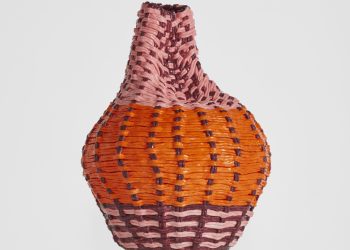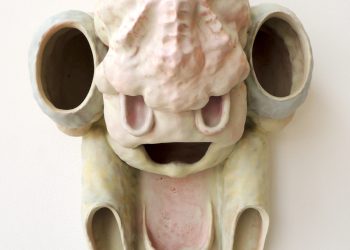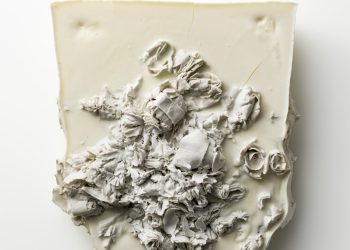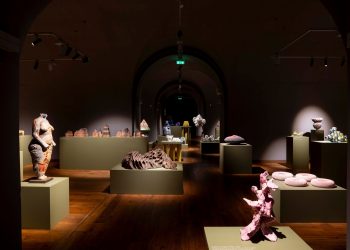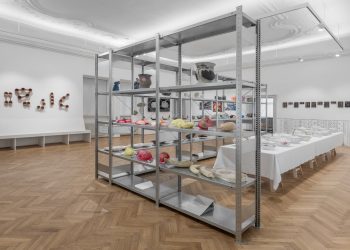
Arina Antonova (b. 1980, Sevastopol) is an artist working between Spain and Switzerland. Her practice focuses on sculpture and installation, using clay as her primary material. Through her work, she explores the body—especially the female—as something lived, remembered, and shaped by power, control, and daily rituals. Food and craft traditions are key in her work, connecting personal memory with broader cultural histories. Antonova’s sculptures often become wearable or body-related objects, inviting intimate connection and physical engagement.
Antonova studied art history and archaeology in St. Petersburg and Hamburg. After moving to Spain, she began working with clay, shifting from two-dimensional media to a more physical, tactile process. In 2016, she opened her studio in Palma de Mallorca, where she continued developing her sculptural language.
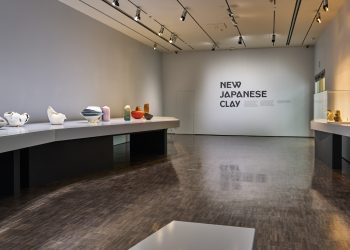
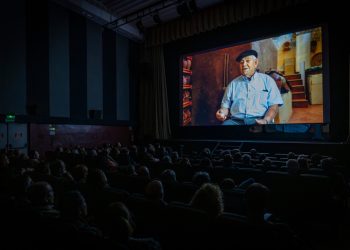
Her work has been shown internationally in exhibitions across Spain, France, Italy, Switzerland, and the United States. She received second prize in the Traditional Ceramics category in La Rambla, Spain (2022), and was nominated for the Martinson’s Award at the 4th Latvia Ceramics Biennale (2023). In 2024, she was invited as a panel member for Crafting Change at the Royal Danish Academy, a European initiative on innovation and sustainability in ceramics.
In 2023, she founded AAA Studio, an artist-run space in Palma’s Old Town. More than just her workplace, the studio has grown into a platform for exhibitions, conversations, and collaboration. Focusing on sculpture and contemporary ceramics, AAA Studio showcases work by women artists. It’s a space for visibility and exchange—supporting emerging voices, nurturing community, and opening up dialogue between local and international perspectives.
Visit Arina Antonova’s website and Instagram page.
Featured work
Selected works, 2021-2024


I work with sculpture and installation; my material is clay. What matters here is the contact itself. Clay is about the body. I feel it through my hands, which is my way of processing reality—a method to relive memory and transform personal experience. Moving to Spain was a turning point; it shifted everything. Clay replaced the flat surface, and I immersed myself in its density and weight. The material took control—it was never just about form but about boundaries and how far I could push them.
The body is central to everything I do. Not as an abstract idea but as something tangible, moving through space and society—the female body, lived and remembered. Power and control are embedded in every gesture, every daily ritual, inscribed into the tiniest motions of our lives. The relationship between women and food is also a ritual, a form of power. I’m fascinated by how our relationship with food—the act of preparation— becomes part of women’s craft, tied to ceramics and the vessels used to store it. My experience of emigration taught me to feel culture through language, food, and local traditions. In each country, the “language” of food speaks differently.
My sculptures are bodies—some can be worn, like clothing or accessories, becoming part of the skin. I aim to dissolve the distance to allow the viewer to observe, experience, and connect. Something ancient in ceramics pulls us back in time—a craft, a labor that has always been hidden, always female. For me, sculpture isn’t just an object—it’s a body. It takes up space, collides with other bodies, and something shifts in that moment of contact. That intersection becomes a new story, a new way of being.