By Beth Williamson
Julia Phillips’ Inside, Before They Speak in The Curve at London’s Barbican is surely as sparse as exhibitions get. It is with great economy that Phillips populates the space with objects exuding a spine-tingling strangeness that simultaneously attracts and repels the viewer. This dual effect is not surprising when you understand the deep psychoanalytic roots of the artist’s practice, her fascination with the inside surfaces of things and a desire to explore what we might project onto the object, perhaps even into the negative space it creates. Of course, this is not simply about surfaces, but an insightful and utterly thrilling interrogation that exposes interior depths in an extraordinarily original fashion. Inside, Before They Speak also asks who is speaking. For Phillips, there are a broad range of possible voices in her work ¬– a spiritual or ancestral presence, an infantile pre-speech presence and other subjects that cannot speak, or choose not to. The charged silence speaks loudly in this space.
With ceramics firmly at the heart of her sculptural practice, Phillips uses casting and hand building techniques to create moulds from parts of her own body, or to form uncanny objects that cast fear and doubt in the beholder. Clay elements are fired and glazed in electric kilns (using cone 6 for glaze firing) to create vibrant surface effects. Applying a variety of underglazes, raw pigments and glazes, Phillips explains that multiple layers of underglaze and glazes are applied and refired, up to twelve times, until the desired depth and colour tone of the surface is achieved. It is only then that the artist incorporates metal hardware such as clasps and springs. Together these components imbue the objects with the possibility of movement where clasps can be fastened and unfastened and springs can be compressed or extended. For Phillips, this also acts as a metaphor for human relations (bonds and attachments in psychoanalytic terms) and the degree of strength or weakness with which they are wrought. It is a delicate balance to be achieved between the fragility of the ceramic elements and the strength of the associated metal hardware elements. Often held in acute tension, it is as if they are in exact equilibrium, the product of precision, yet the tiniest recalibration could destroy each and every meticulously established bond and attachment. These relationships under pressure are also metaphors for human relations.
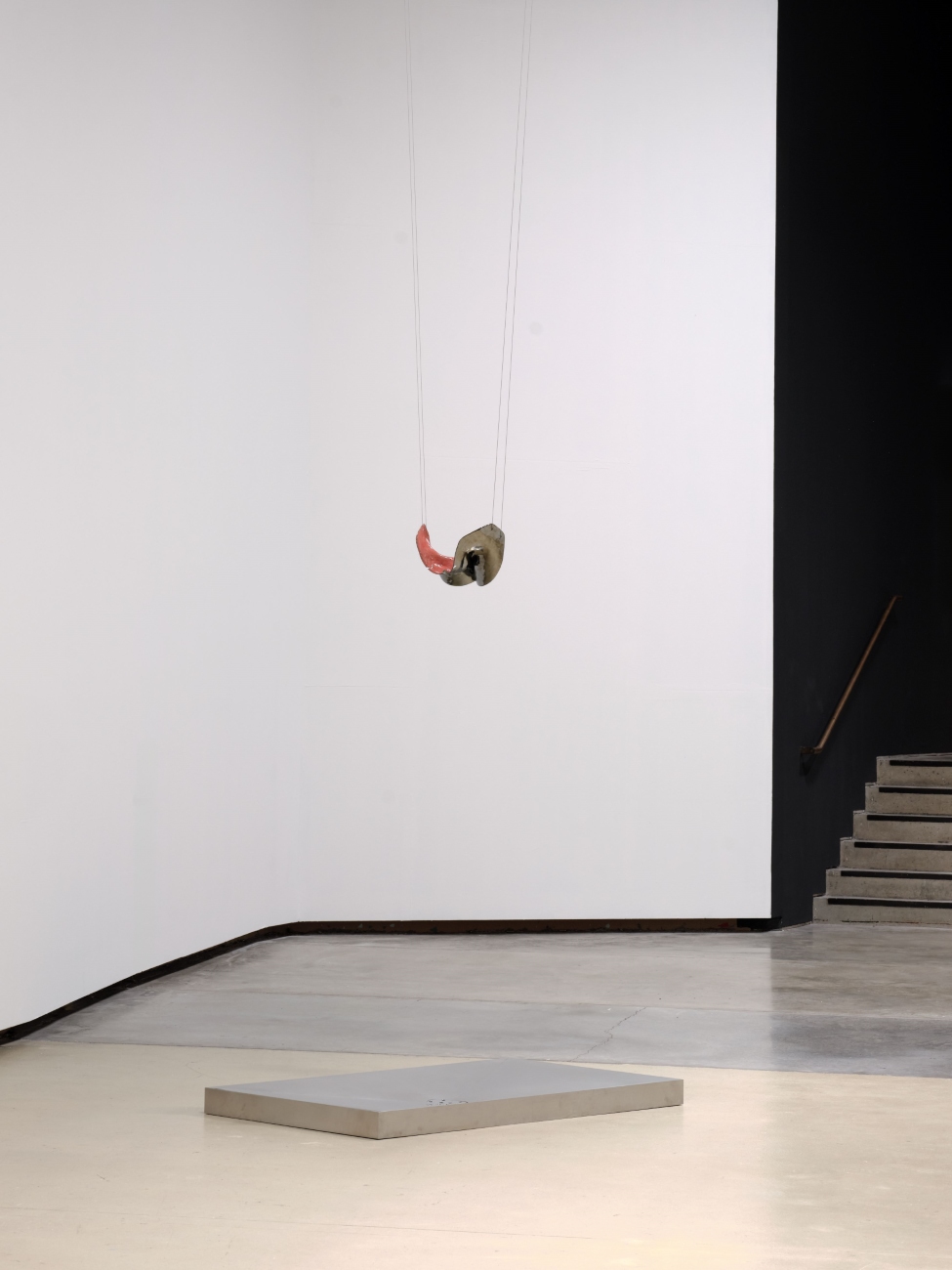
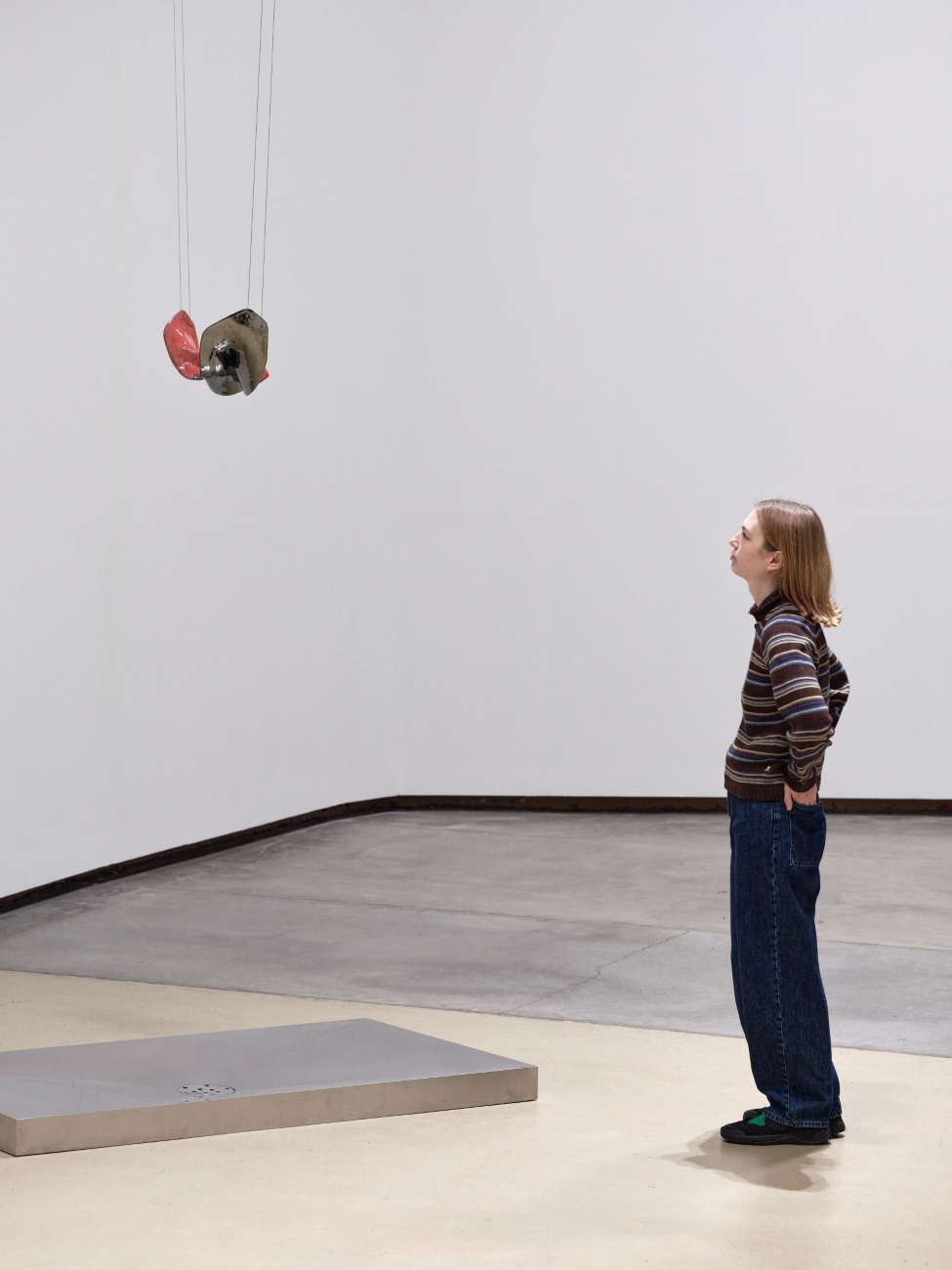
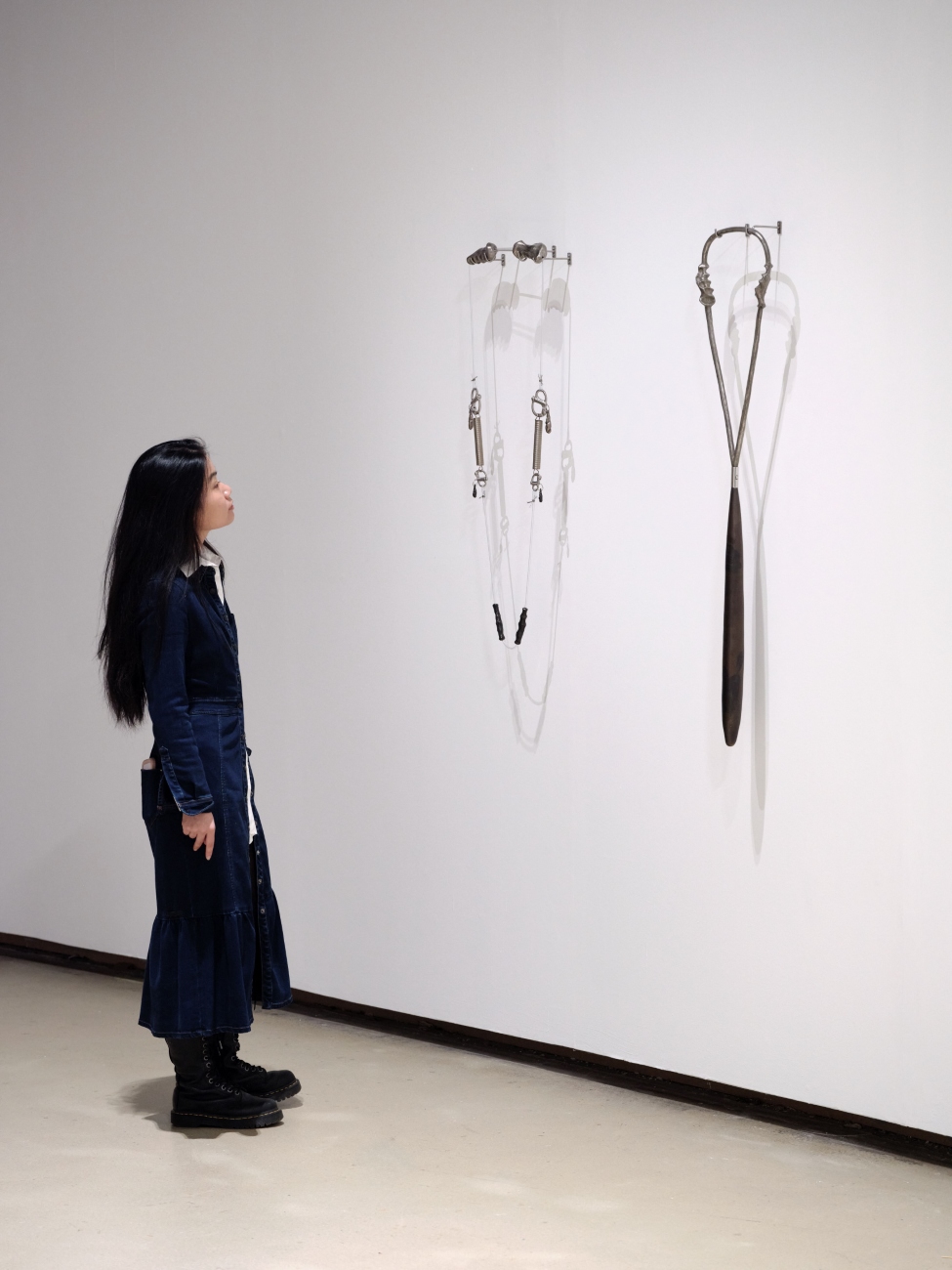
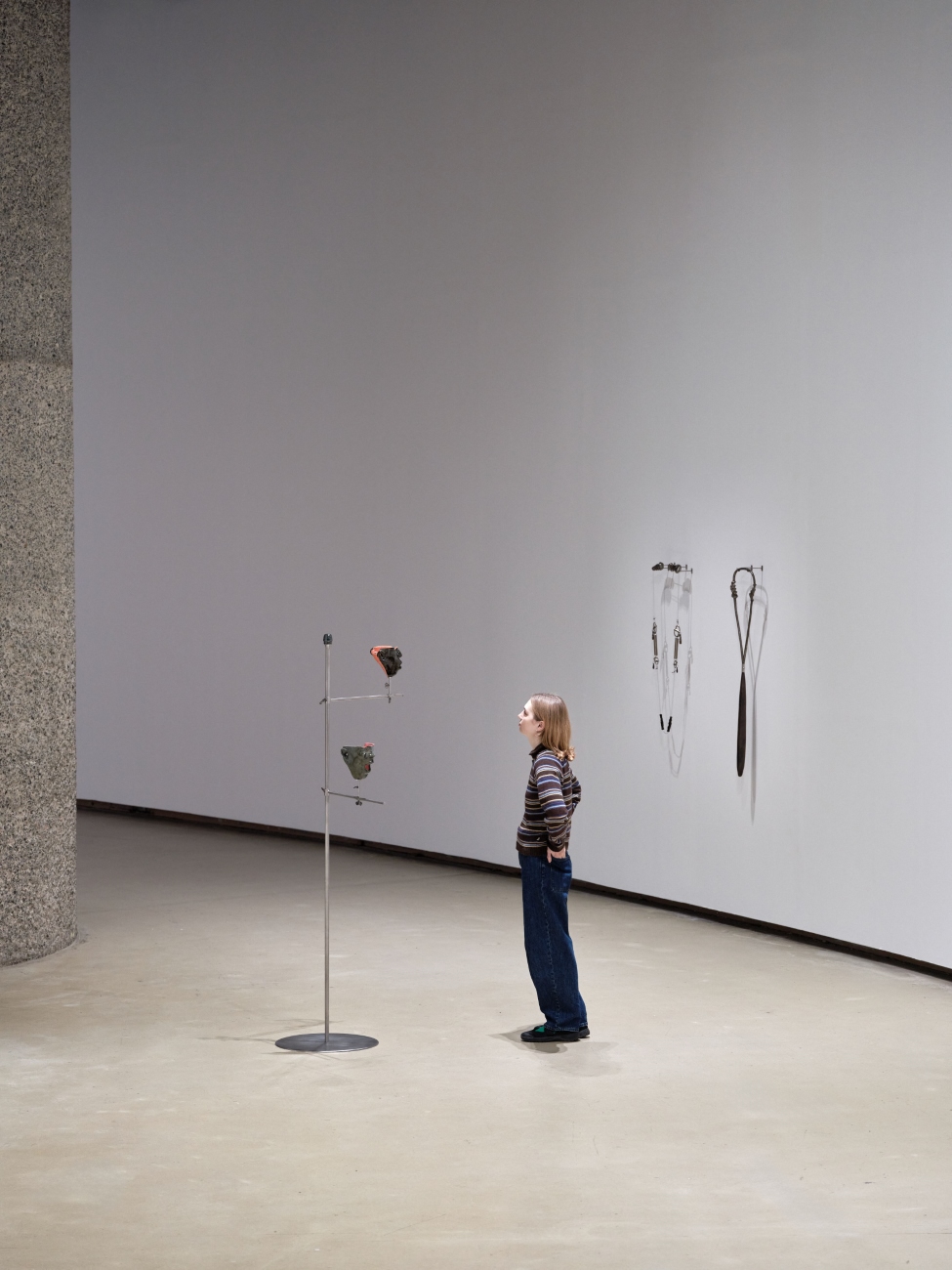
Walking along the full arc of The Curve, it becomes clear that the exhibition falls into three distinct areas. The first section contains four works: Drainer III (2026), Harmonizer (2026), Attachment I with Ball Detent (2023) and Attachment V, Flexible with Quick Release (2024). As Phillips explains in an interview with psychoanalytic psychotherapist Dr Gail Lewis, she glazes skin surfaces in palladium, a shiny silver glaze that is applied in layers in order to attain the required tone, or degree of silver. This is particularly noticeable in Drainer III. A thin slab of clay was pushed and pressed against the artist’s body to create a moulded fragment that follows the underside of upper legs, the curve of buttocks and more intimate details. The process involves the artist remaining in contact with the clay until it is dry enough to hold its own weight and shape to allow firing and glazing to take place. Suspended above average head-height by two stainless steel cables, the piece hangs over a stainless-steel base with a central drain hole – the titular drainer. In previous iterations – Drainer I (2018) and Drainer II (2021) – the base was constructed from concrete and limestone respectively, both porous materials. Now, against the Brutalist concrete of the Barbican’s interior, a fabricated stainless steel base lends further interest and strangeness to Drainer III and a non-porous and chillingly clinical character that is unique to this new iteration. We might imagine the broken body leaking into the drainer. The exposed interior of the ceramic fragment, thick and fleshy and vital, turns our imaginings to the medicalized body, and the medicalized female body in particular. Sliced open and exposed, with little context, this broken body leaks fluids and ideas, and reflects our own mental and physical infirmities. It is at the fault-lines, or points of weakness, that we perhaps identify most with other human beings. In Phillips’s work, we recognise those fault lines, but not as flaws. Rather, the human response is to soften, to project comfort and healing. In this way, we gaze upon and speak to the sculpture, just as it gazes at and speaks back to us.
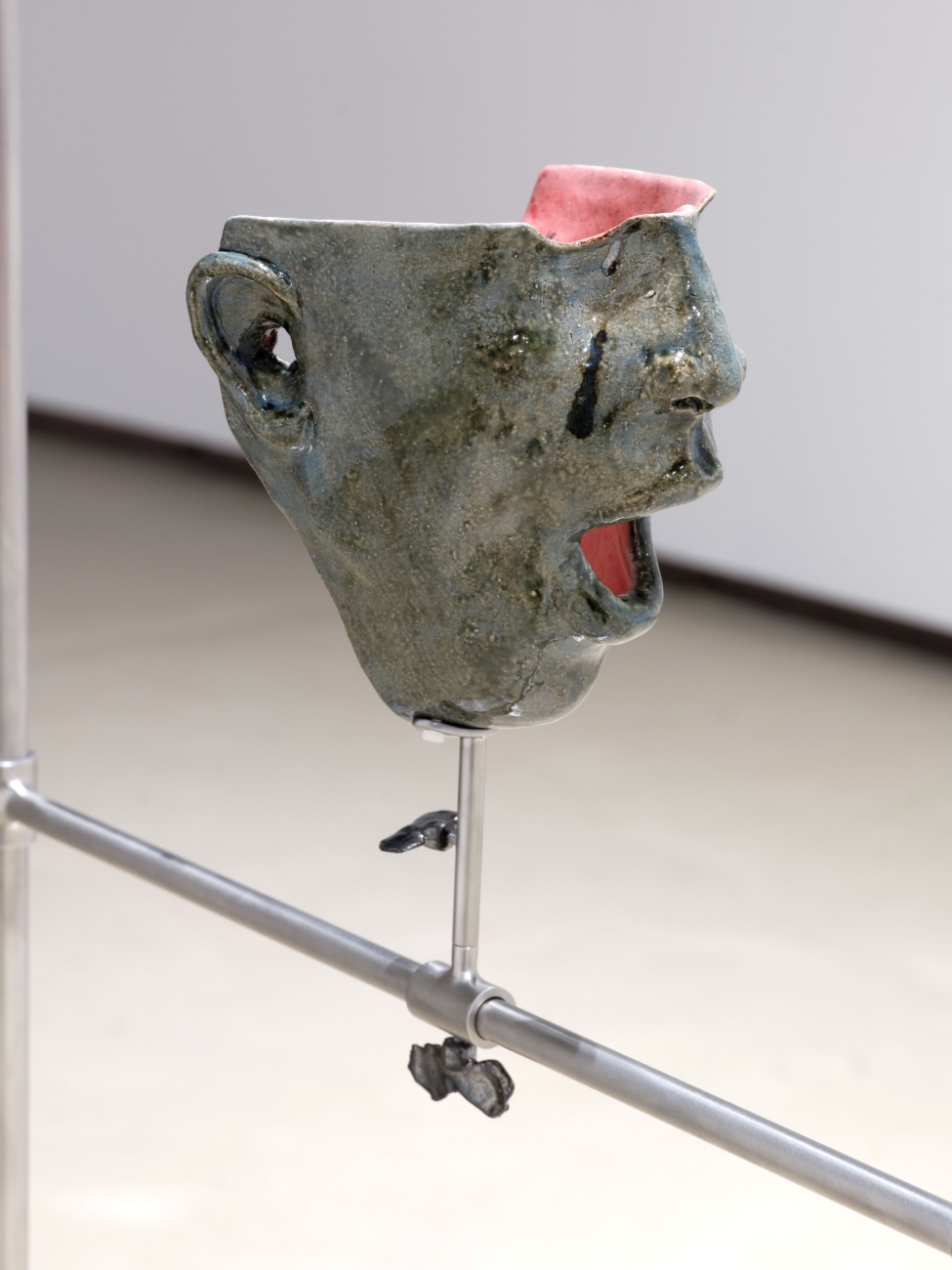
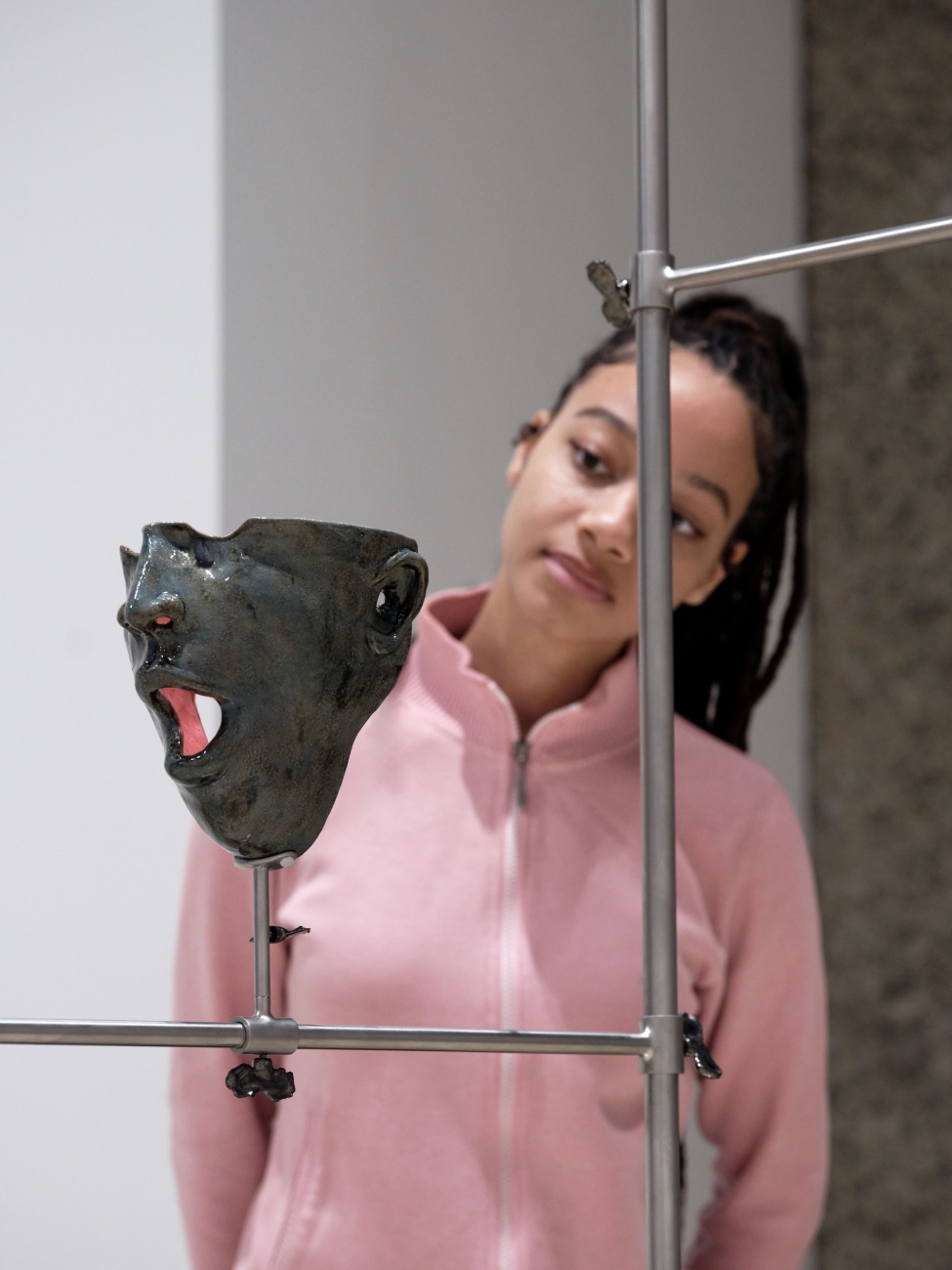
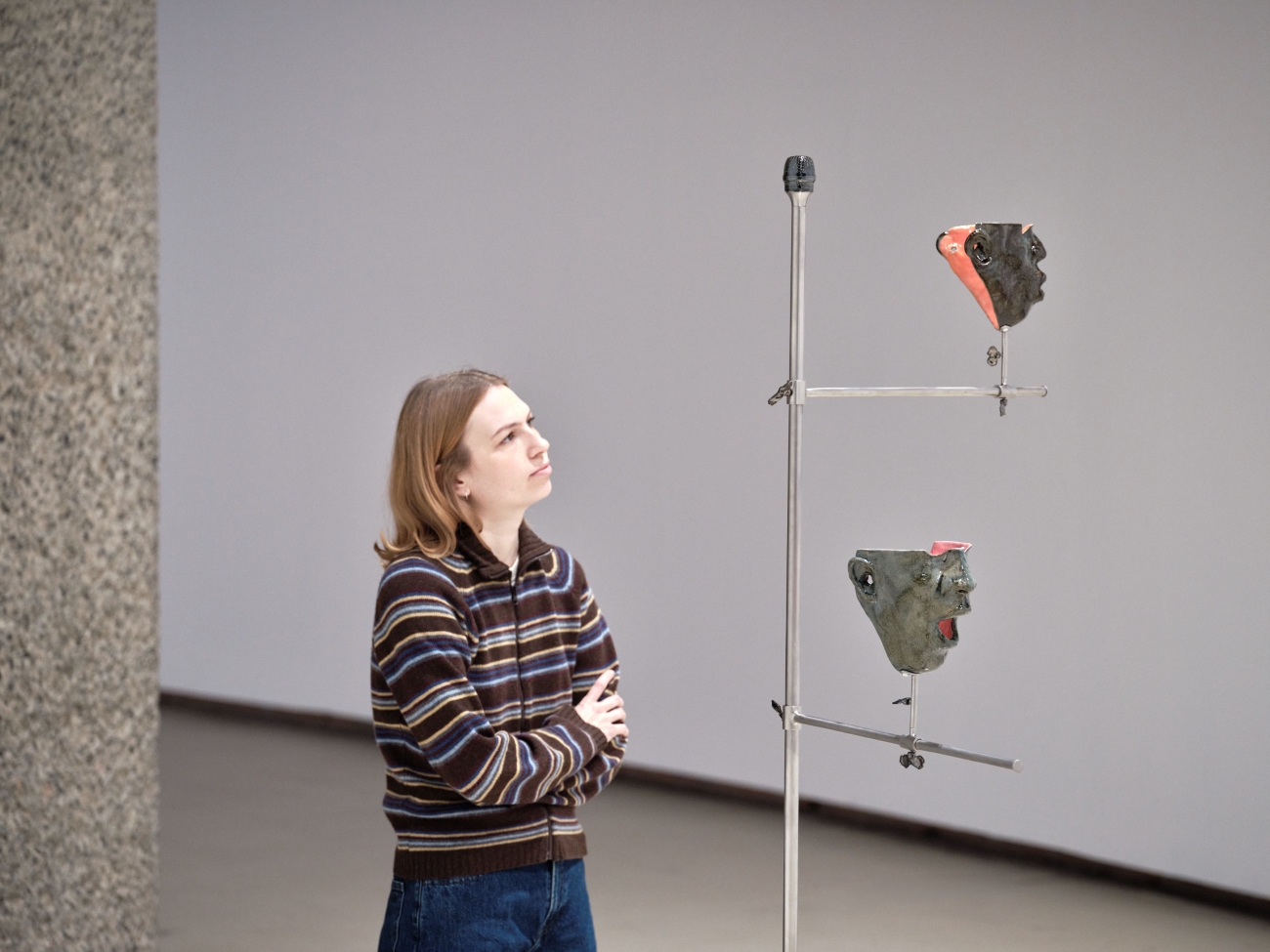
Harmonizer (2026) consists primarily of two partial clay moulds of the artist’s face. Mask-like in form, they are glazed in a similar fashion to Drainer III with reflective palladium glaze on the exterior surface and a fleshy finish of reds and pinks inside. In this instance, however, the pinkness is visible through the mouth, bringing the inside out and imbuing the work with a sense of vulnerability. The faces are mounted at differing heights and angles on a stainless steel armature. On top of the central supporting column is a ceramic microphone, ready to harmonise voices and ideas. Further, despite its solid armature, there is the possibility of sudden movement contained within this object as its freely adjustable wingnuts might be manipulated at any moment. This risk, for it feels risky, is further underlined by the ceramic faces whose open mouths and blank eyes (both simple matters of the casting process) appear as expressions of shock and its attendant emotions, both requiring our remediation.
This first section of the show is completed with two rather menacing works which, nonetheless, speak to questions of human attachment, as indeed their titles indicate. Attachment I with Ball Detent (2023) and Attachment V, Flexible with Quick Release (2024), as with earlier works in this exhibition, include stainless steel elements such as hooks, screws, and other hardware. The bronze elements of these two objects suggest grips, places to hold and attach to, or to let go and release. Attachment V is particularly interesting since, despite its alarming appearance, it includes one pair of adult-size grips and a much smaller pair of child-sized grips. Perhaps these works gesture to the emotional, if not physical, brutality that can be present within adult-child relationships of all sorts. A previous iteration of this work from 2022 included coloured ceramic grips rather than brass ones. In that instance the ceramic adult grips were glazed in matt purple while the child-sized grips were glazed in matt lemon-yellow. Both the 2022 and 2024 iterations included medical PVC tubes forming part of the physical connection between adult and child but in each they create a very different sense of their function. In the 2022 iteration with its brightly coloured ceramic grips, the PVC tubes suggest something supportive and life-giving. In the more recent brass-grip work, as shown in this exhibition, the PVC tubes appear less nourishing than draining, and demonstrate something of the power of materials in meaning-making.
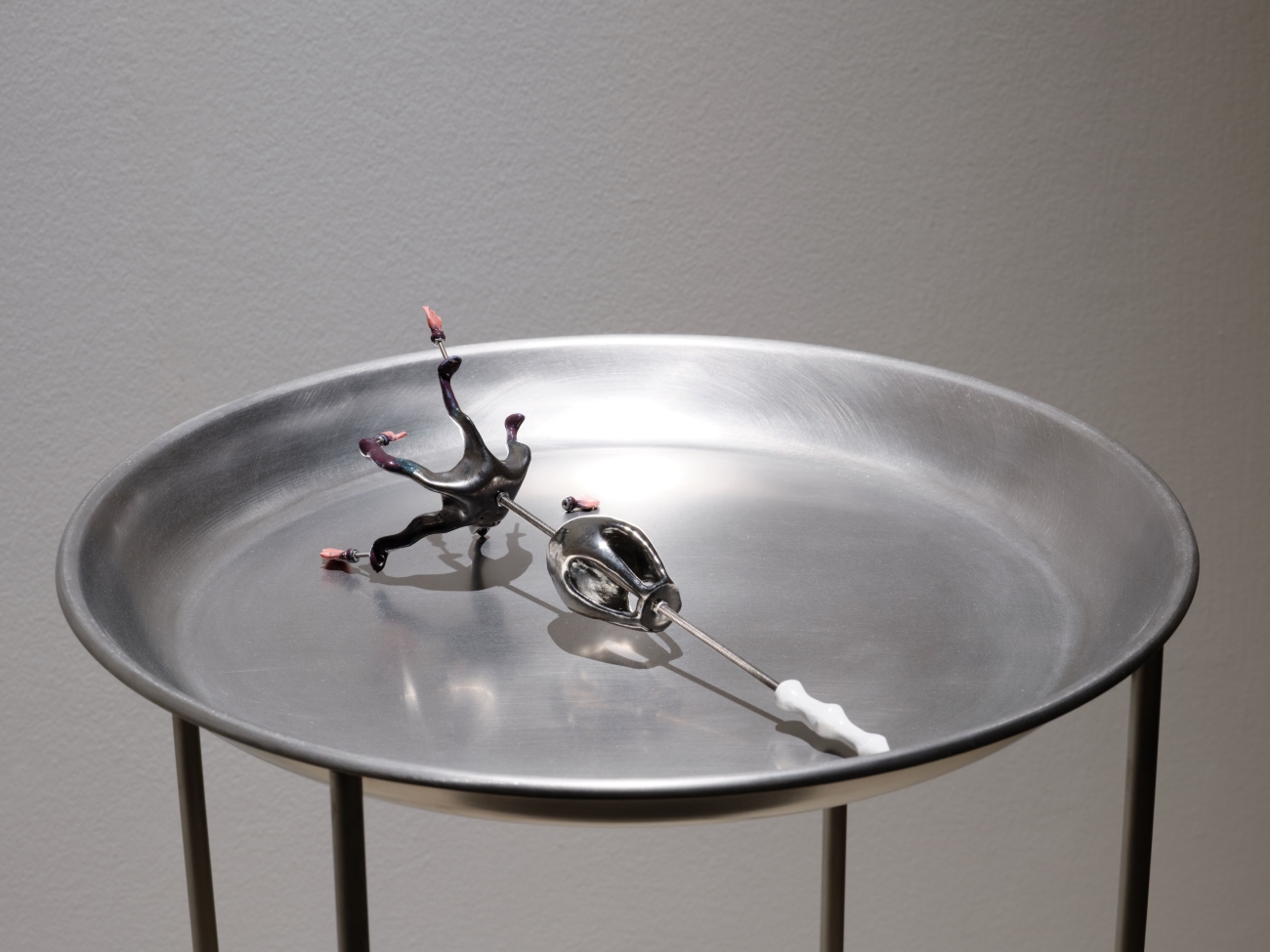
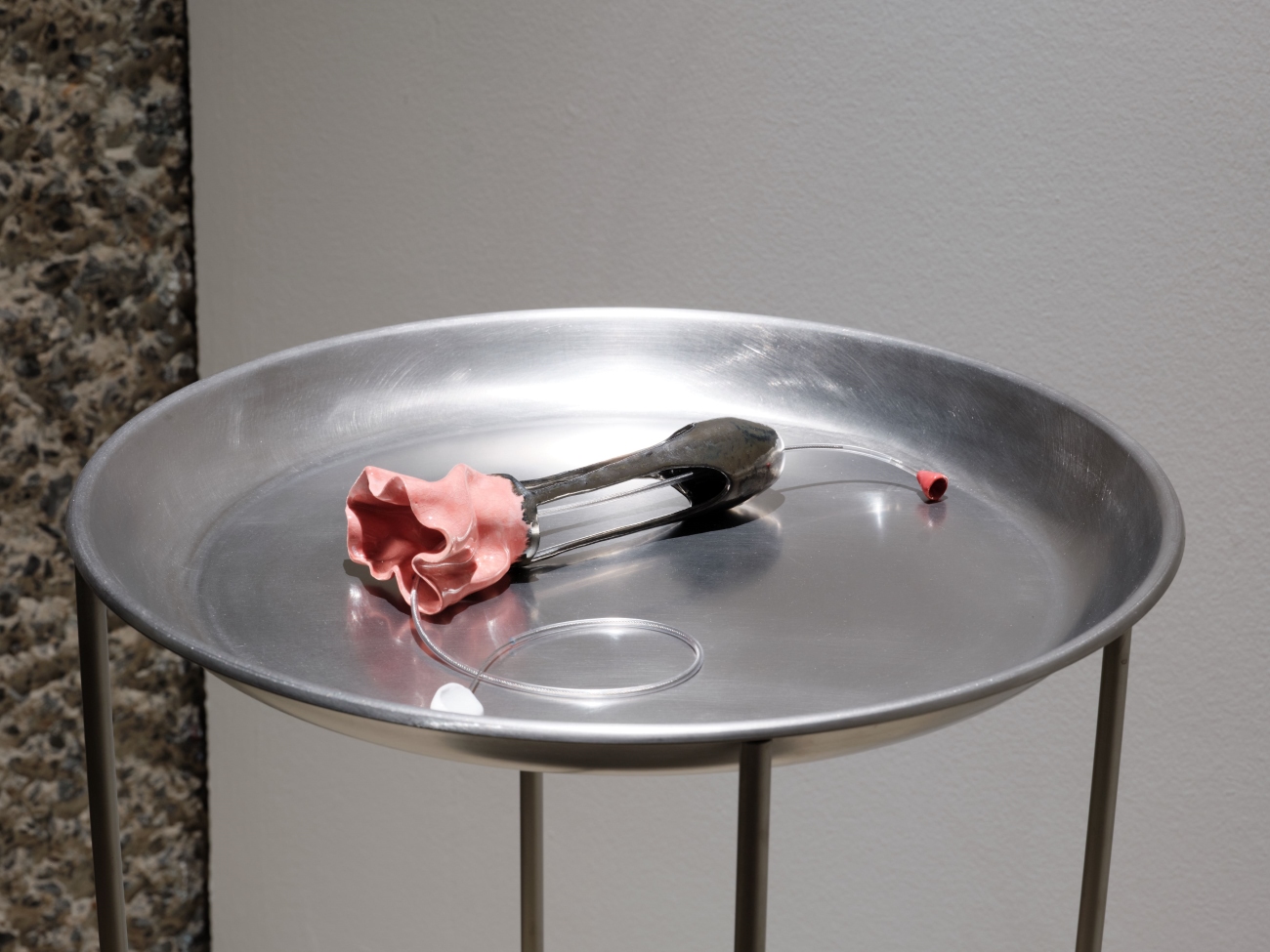
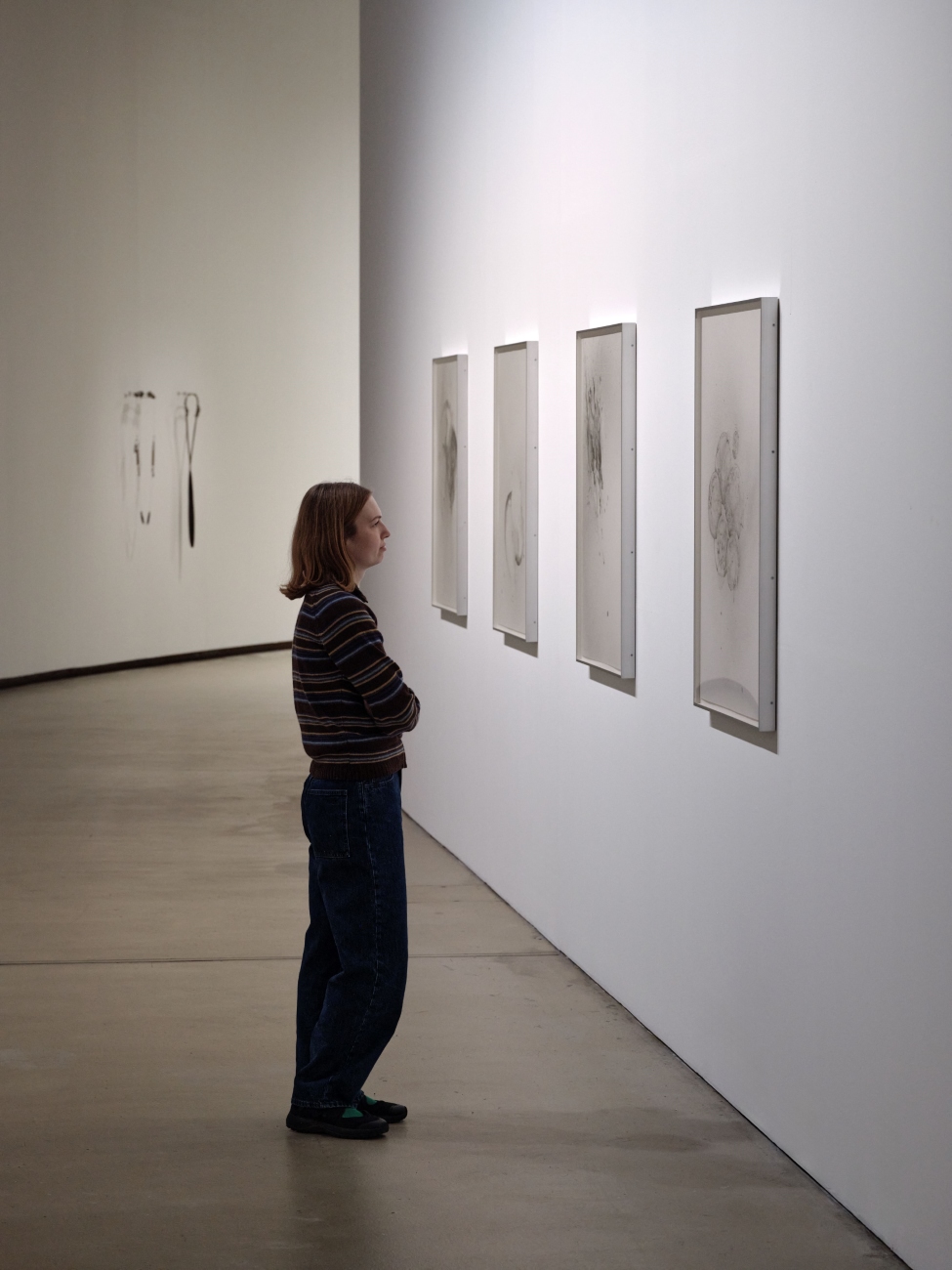
The focus shifts in the middle section of this exhibition where a pair of floor-standing sculptures ¬– Inseminator and Fertilizer, both from 2026 – flank a series of drawings, Assisted Conception Drawings (I–IV): I (Un)viable Embryo, II Double Zygote, III Fresh Transfer, and IV Cryopreserved Embryo, all (2025–26). These potent works were created by the artist while in conversation with a friend who is undergoing donor-assisted artificial conception. The titles of the drawings are taken from terms used in in vitro fertilisation (IVF) technology. These are techniques that occur at a microscopic scale but Phillips draws them much enlarged. There is also a balance of chance and engineering, or precision, in the artist’s techniques that echoes the IVF methods, meticulously carried out but ultimately reliant on chance and natural process. Inseminator and Fertilizer, the two sculptural works that flank the display of drawings, are astounding examples of Phillips’s ability to evoke the uncanny and unsettle the viewer with one tiny detail after another. Both works include a specially fabricated stainless steel table with a round tray top and four thin legs that slope inward as they descend to form a four-point base that supports everything. If this was made of wood, we might expect it to be positioned beside an armchair and holding a cup of coffee. In this instance, however, each table top supports a strange object, something that appears, to all intents and purposes, an instrument of gynecological torture. The objects combine stainless steel hardware with ceramic elements that appear to be moveable. The titles of these two works, Inseminator and Fertilizer, and their size and portability suggest they could be manipulated and pressed into the service of IVF, despite the obvious impracticalities of their aesthetic condition.
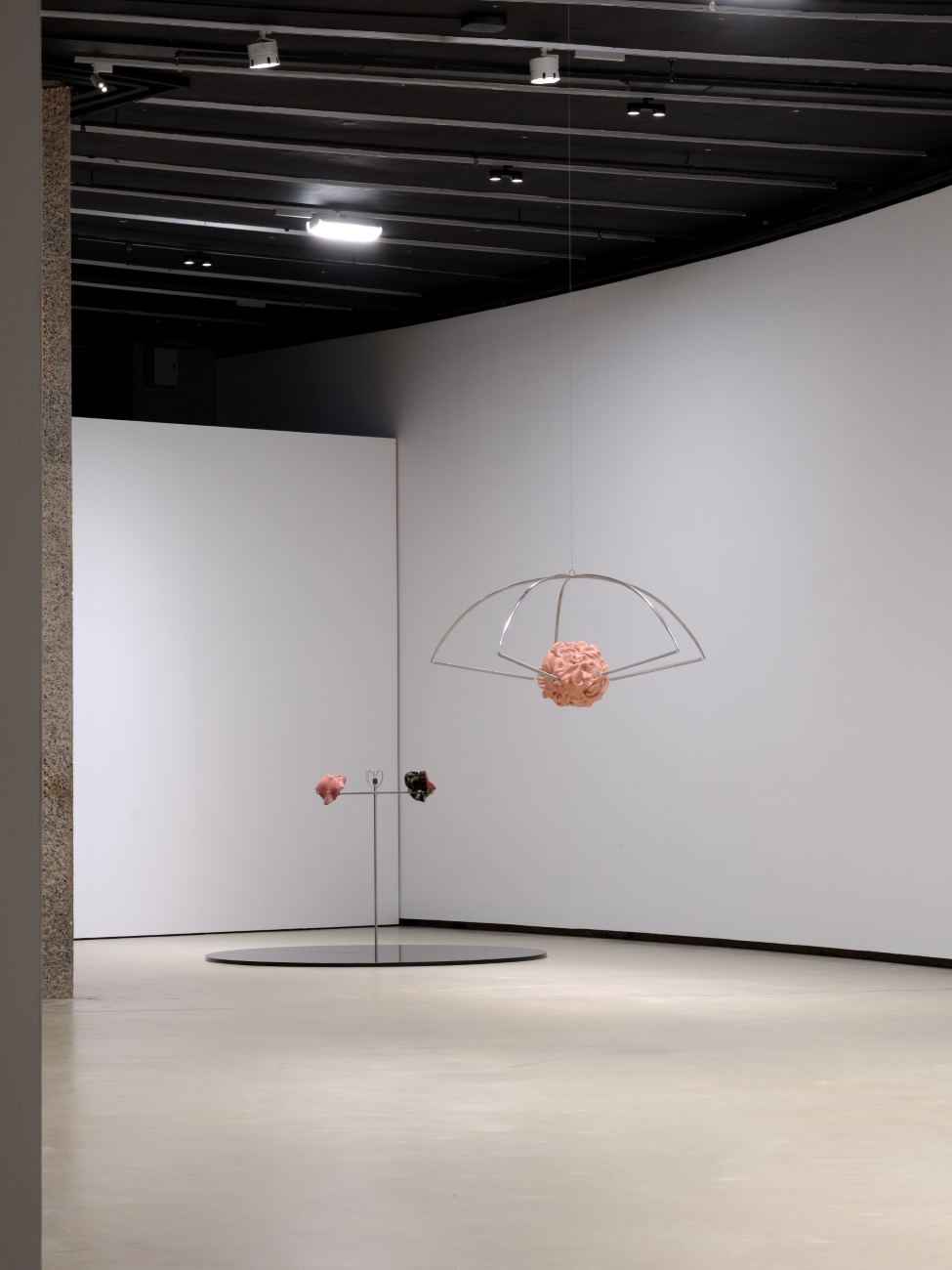
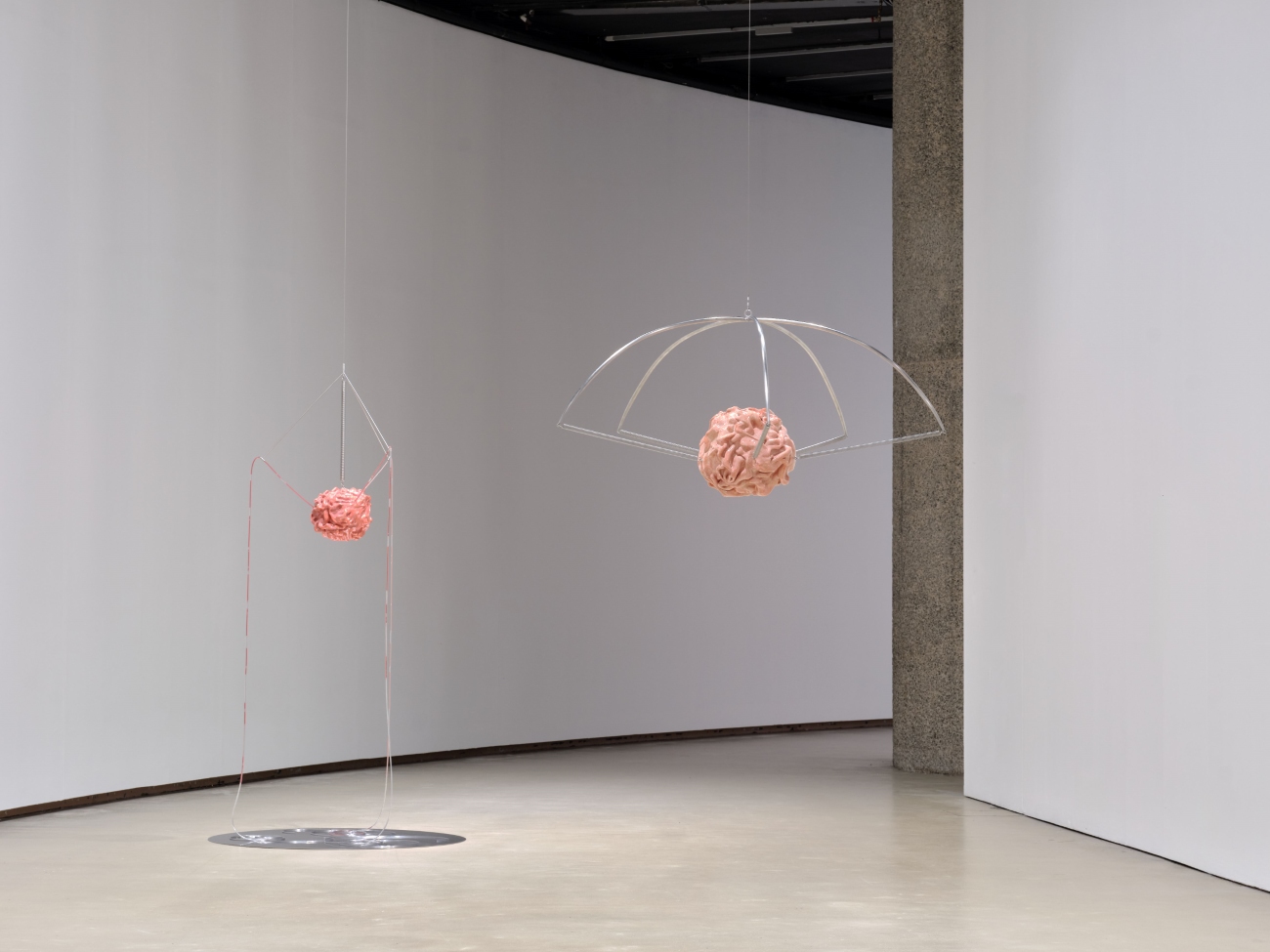
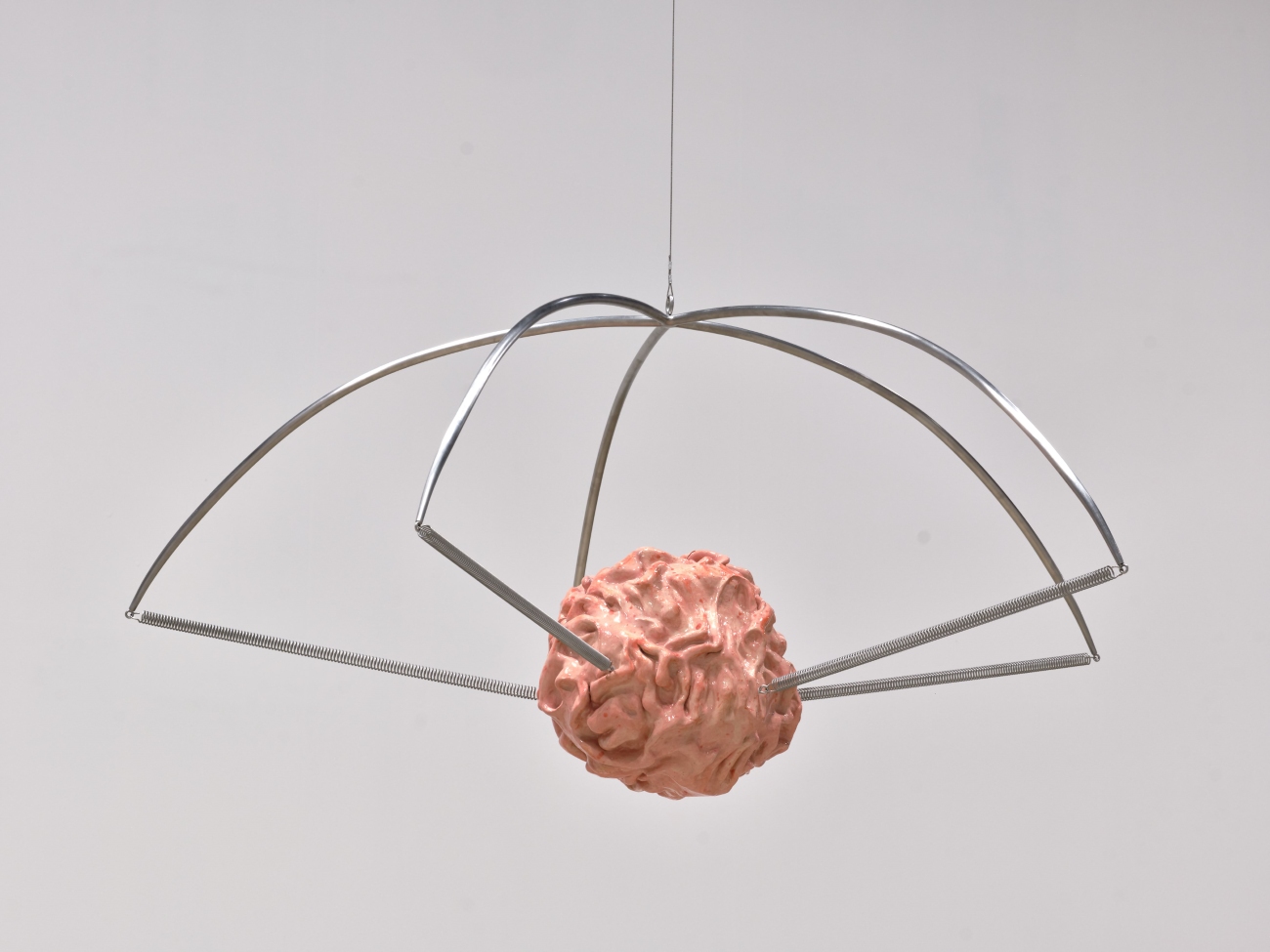
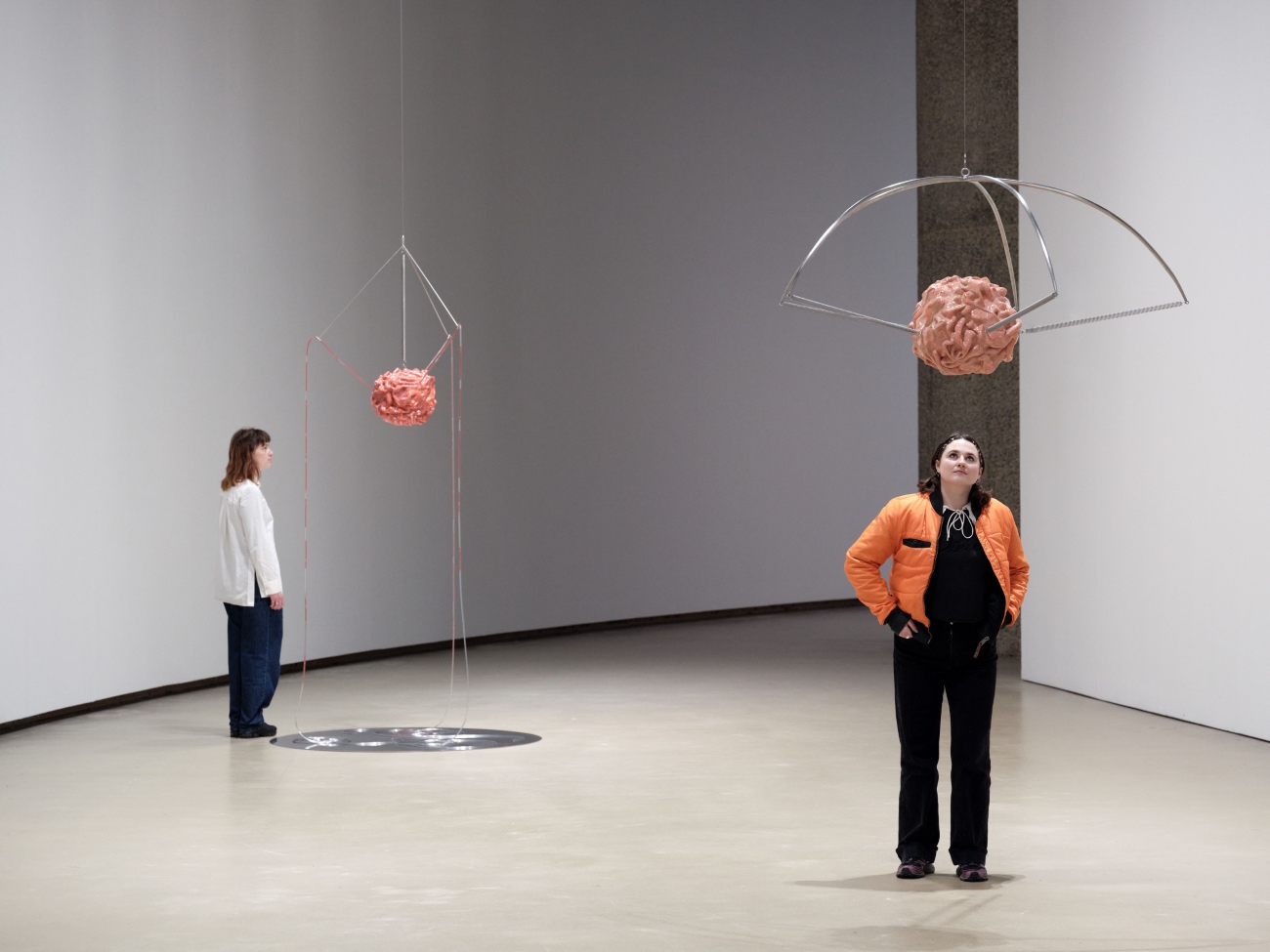
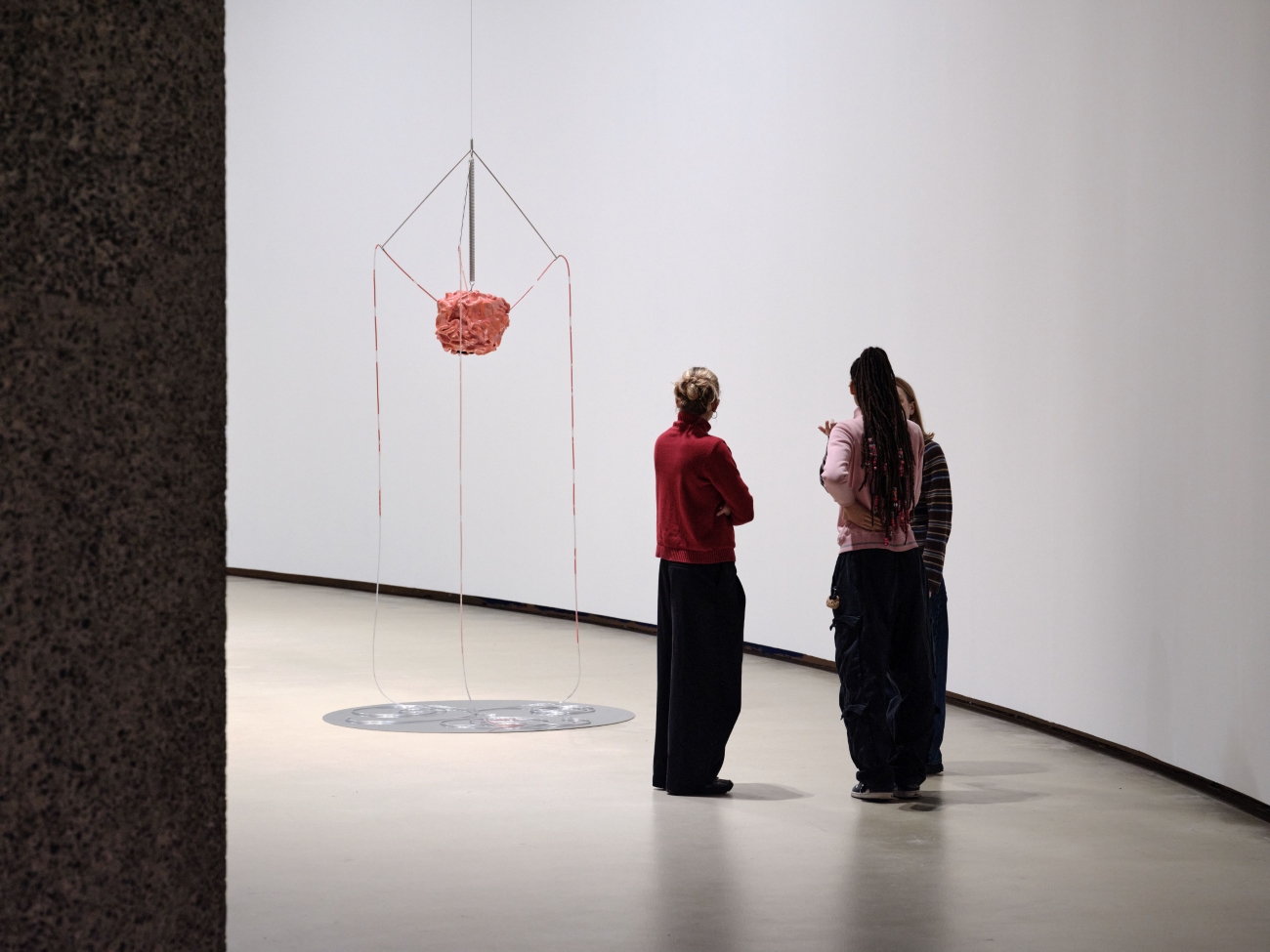
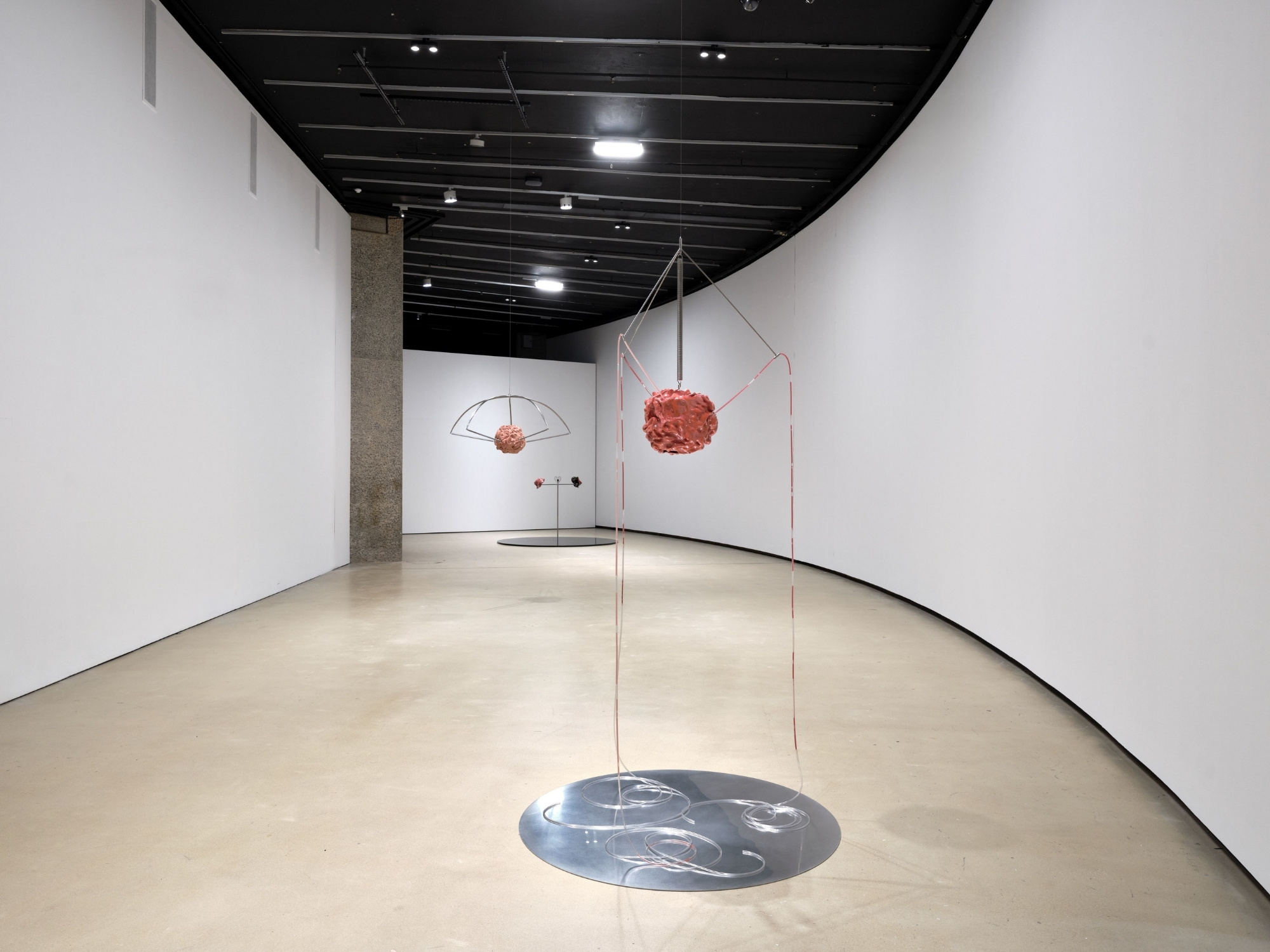
The final section of the exhibition contains three works – the superbly fleshy Suspended Interior I (2026) and Suspended Interior II (2026), alongside Mediator III (2025–26). The two Suspended Interior pieces appear to be of human origin, despite being larger than life in scale. Recalling intestinal folds, tumorous masses and fleshy forms, these hollow hanging objects include the partial imprint of the artist’s hand grip within them, as if hanging on for dear life. Suspended Interior I hangs from a single heavy spring and is connected to three plastic tubes which could equally indicate nourishment or depletion. Suspended Interior II hangs from four springs in tension with a fixed metal armature. The multiple tensions at play here suggest an object poised to disintegrate under the pressures imposed upon it.
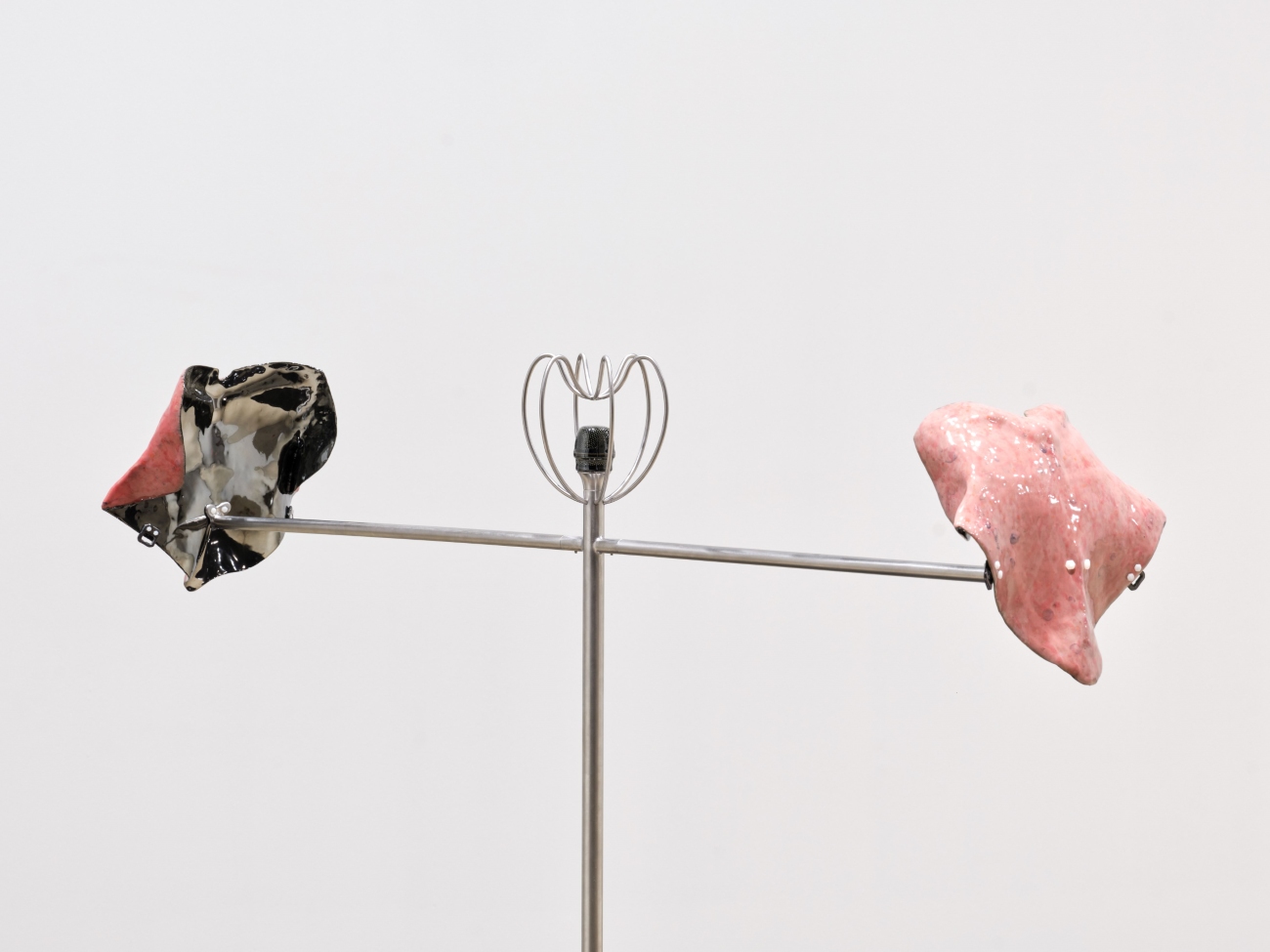
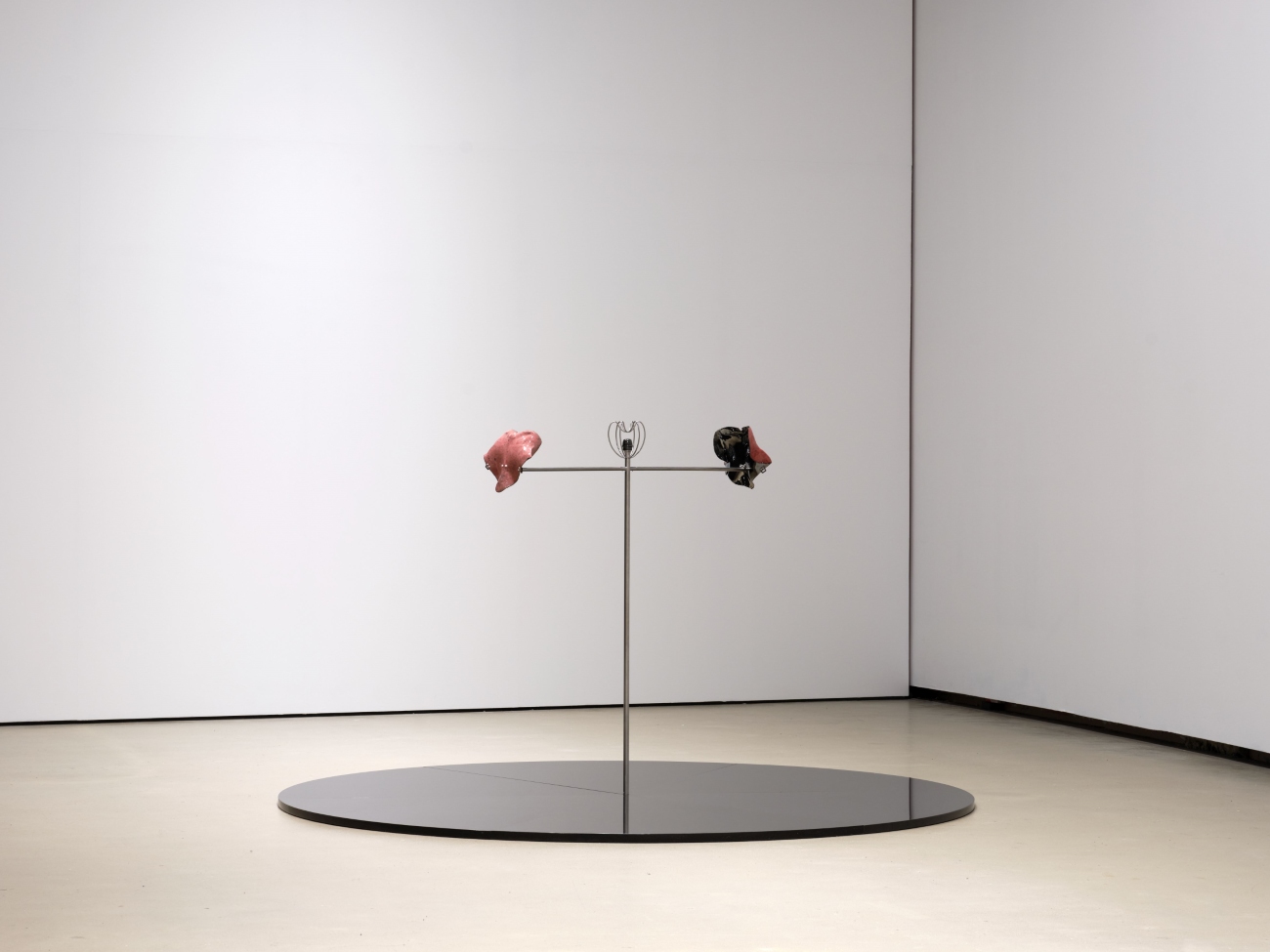
Mediator III, the final object in the exhibition, sees two ceramic partial chest moulds mounted at opposite ends of a stainless steel T-bar and held in place with nylon hardware studs. The entire structure is mounted on a circular slab of granite. The moulds are of the artist’s concave chest, the body shape that is formed when you stretch both arms forwards and the chest is forced to recede, or hollow out. (It is worth noting that in previous iterations such as Mediator (2020) the chest is in its convex form, pushing forward, not back.) In the centre of the T-bar, a ceramic microphone is mounted on the top-most point and acts, in some strange way, as a grounding element. This makes sense if we think of the microphone as a metaphor for communication and as a mode of mediation between the opposing human elements – the ceramic chest fragments. The sense of momentum between them and the circular granite base spin us around to face back where we came from and survey the show in reverse.
Ultimately, Phillips’ works in this exhibition concern human relationships, communication and mediation. What stories do we tell each other without words? How does our gaze fall on others and theirs fall on us? How does our internal psychic apparatus project upon other people and objects? And how do they project upon to us? How to we engage with the negative space in the work? As Phillips anticipates, “I’m hoping the viewer will complete the work for themselves and fit their realities.” It is a generous intention.
Beth Williamson is an art historian and writer specialising in modern and contemporary art in Britain, with a particular interest in art education, craft, and ceramics. A former Research Fellow at Tate, she co-curated the exhibition Basic Design at Tate Britain in 2013 and has written widely on British art and pedagogy. Her essays and reviews on art, craft and ceramics have appeared in publications such as The Art Newspaper, Sculpture magazine, Studio International, and Ceramic Review.
Julia Phillips: Inside, Before They Speak is on view at the Barbican, London, between January 30 and April 19, 2026.
Subscribe to Ceramics Now to read similar articles, essays, reviews and critical reflections on contemporary ceramics. Subscriptions enable us to feature a wider range of voices, perspectives, and expertise within the ceramics community.
Captions
- Featured image: Julia Phillips: Inside, Before They Speak. Installation View of Julia Phillips: Inside, Before They Speak, Fri 30 Jan—Sun 19 Apr 2026 © Thomas Adank & Barbican Art Gallery
- Julia Phillips: Inside, Before They Speak. Drainer III, 2026 by Julia Phillips. Julia Phillips: Inside, Before They Speak Installation View, Fri 30 Jan—Sun 19 Apr 2026 © Thomas Adank & Barbican Art Gallery
- Julia Phillips: Inside, Before They Speak. Harmonizer, 2026 by Julia Phillips. Julia Phillips: Inside, Before They Speak Installation View, Fri 30 Jan—Sun 19 Apr 2026 © Thomas Adank & Barbican Art Gallery
- Julia Phillips: Inside, Before They Speak. Attachment I with Ball Detent, 2023 and Attachment V, Flexible with Quick Release, 2024 by Julia Phillips. Julia Phillips: Inside, Before They Speak Installation View © Thomas Adank & Barbican Art Gallery
- Julia Phillips: Inside, Before They Speak. Installation View of Julia Phillips: Inside, Before They Speak, Fri 30 Jan—Sun 19 Apr 2026 © Thomas Adank & Barbican Art Gallery
- Julia Phillips: Inside, Before They Speak. Harmonizer, 2026 by Julia Phillips. Julia Phillips: Inside, Before They Speak Installation View, Fri 30 Jan—Sun 19 Apr 2026 © Thomas Adank & Barbican Art Gallery
- Julia Phillips: Inside, Before They Speak. Fertilizer, 2026 by Julia Phillips. Julia Phillips: Inside, Before They Speak Installation View, Fri 30 Jan—Sun 19 Apr 2026 © Thomas Adank & Barbican Art Gallery
- Julia Phillips: Inside, Before They Speak. Inseminator, 2026 by Julia Phillips. Julia Phillips: Inside, Before They Speak Installation View, Fri 30 Jan—Sun 19 Apr 2026 © Thomas Adank & Barbican Art Gallery
- Julia Phillips: Inside, Before They Speak. Assisted Conception Drawings (I–IV) by Julia Phillips. Julia Phillips: Inside, Before They Speak Installation View, Fri 30 Jan—Sun 19 Apr 2026 © Thomas Adank & Barbican Art Gallery
- Julia Phillips: Inside, Before They Speak. Suspended Interior II, 2026 and Mediator III, 2025–26 by Julia Phillips. Julia Phillips: Inside, Before They Speak Installation View, Fri 30 Jan—Sun 19 Apr 2026 © Thomas Adank & Barbican Art Gallery
- Julia Phillips: Inside, Before They Speak. Suspended Interior II, 2026 and Suspended Interior I, 2026 by Julia Phillips. Julia Phillips: Inside, Before They Speak Installation View, Fri 30 Jan—Sun 19 Apr 2026 © Thomas Adank & Barbican Art Gallery
- Julia Phillips: Inside, Before They Speak. Suspended Interior II, 2026 by Julia Phillips. Julia Phillips: Inside, Before They Speak Installation View, Fri 30 Jan—Sun 19 Apr 2026 © Thomas Adank & Barbican Art Gallery
- Julia Phillips: Inside, Before They Speak. Suspended Interior I, 2026 by Julia Phillips. Julia Phillips: Inside, Before They Speak Installation View, Fri 30 Jan—Sun 19 Apr 2026 © Thomas Adank & Barbican Art Gallery
- Julia Phillips: Inside, Before They Speak. Mediator III, 2025–26 by Julia Phillips. Julia Phillips: Inside, Before They Speak Installation View, Fri 30 Jan—Sun 19 Apr 2026 © Thomas Adank & Barbican Art Gallery