By Chenoa Baker
Across institutions in Philadelphia, Syd Carpenter’s work is currently presented through a rare, collaborative model that resists the isolating logic of the solo exhibition. Rather than positioning her practice as singular or retrospective, these concurrent exhibitions frame Carpenter’s ceramics as part of a larger conversation about land, memory, and collective care. This moment feels particularly charged in Philadelphia, a city preparing for the United States’ 250th anniversary while continuing to grapple with the erasure of African American histories from its public narratives. Carpenter’s sustained focus on organic forms: roots, stems, vessels, and cultivated landscapes. These forms offer a counter-archive, one that insists on preserving ancestral knowledge through material and process. As the participating institutions collectively note, the “manipulation of clay is tied to empathy for the physicality of the human condition,” positioning ceramics as embodiments of lived experience.
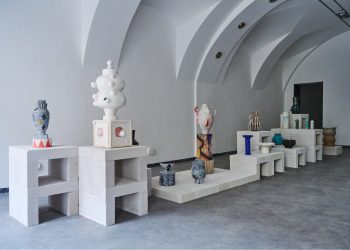
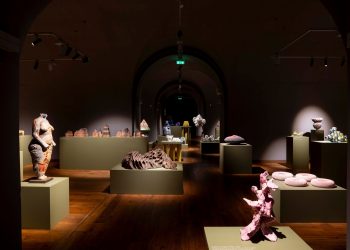
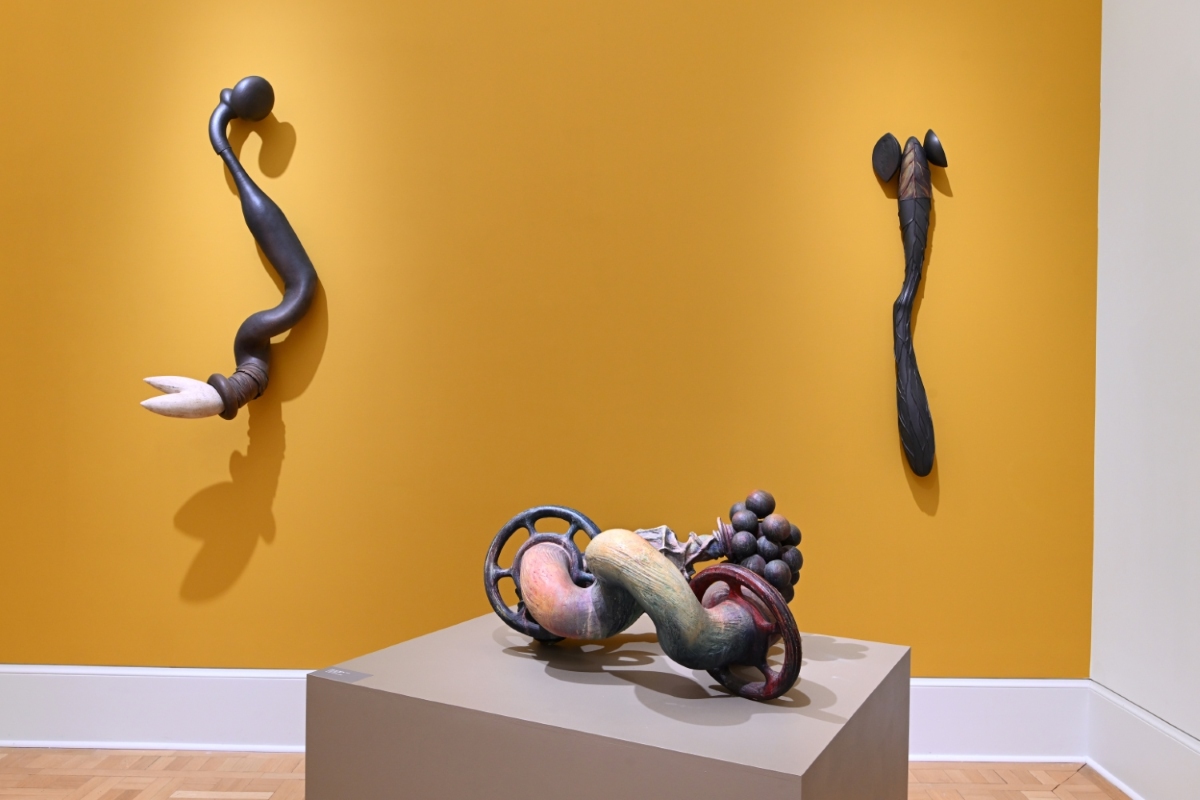
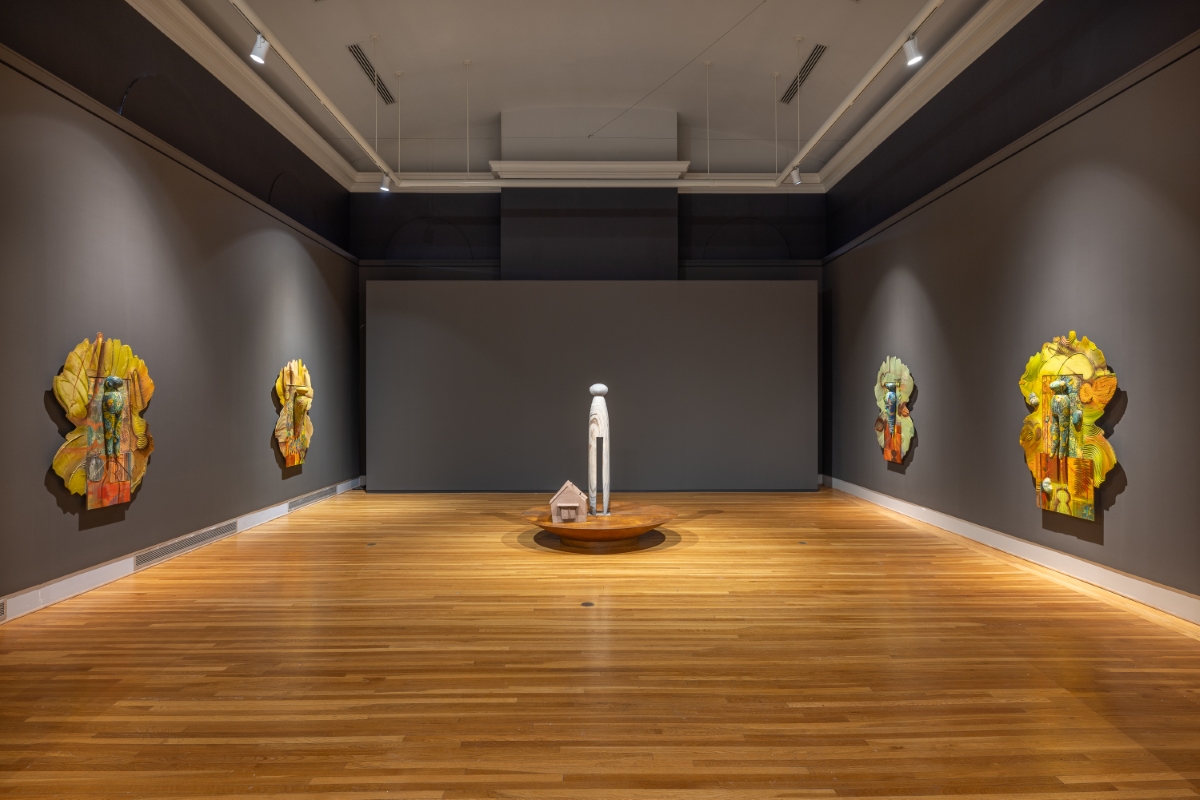
Seen together, these exhibitions suggest that Carpenter’s prominence is through a deep investment in community. It’s the first time that Carpenter’s work has been shown with the included contemporaries. At the Frances M. Maguire Art Museum, Re-Union underscores this ethos by situating Carpenter’s work in dialogue with that of her contemporaries. Re-Union, a possible nod to foundational American ideals, means to unite again. Carpenter curates a show as part of her three-solo shows in the Philadelphia area: a selfless and uplifting move by the artist. Flanked on either side of the visitor’s center are two galleries with mustard yellow accent walls. The centerpiece of the exhibition, symmetrically on the far walls, and on pedestals below, are wall-hung and works on pedestals from Carpenter’s Stem series. Her Stem series takes on an organic, bodily, vessel-like form. Even their names have health connotations like Adjust Pressure to Normal (2005), Blood Ties (2005), Potion (2004), and Carrier (2005). Conflating the ecological with the medical emphasizes the relational importance of what happens beneath the ground and the body. “[The Spiral] was inspired by the natural growth patterns of many plants, which ascend vertically in a spiral fashion…,” she says. “My aim, therefore, was to translate this natural gesture into the sculptures, giving them muscularity and grace.” Their surface ranges from a graphite-sheen, crust, rust-like texture, and green-oxidized-looking patina that mimic environmental exposure.
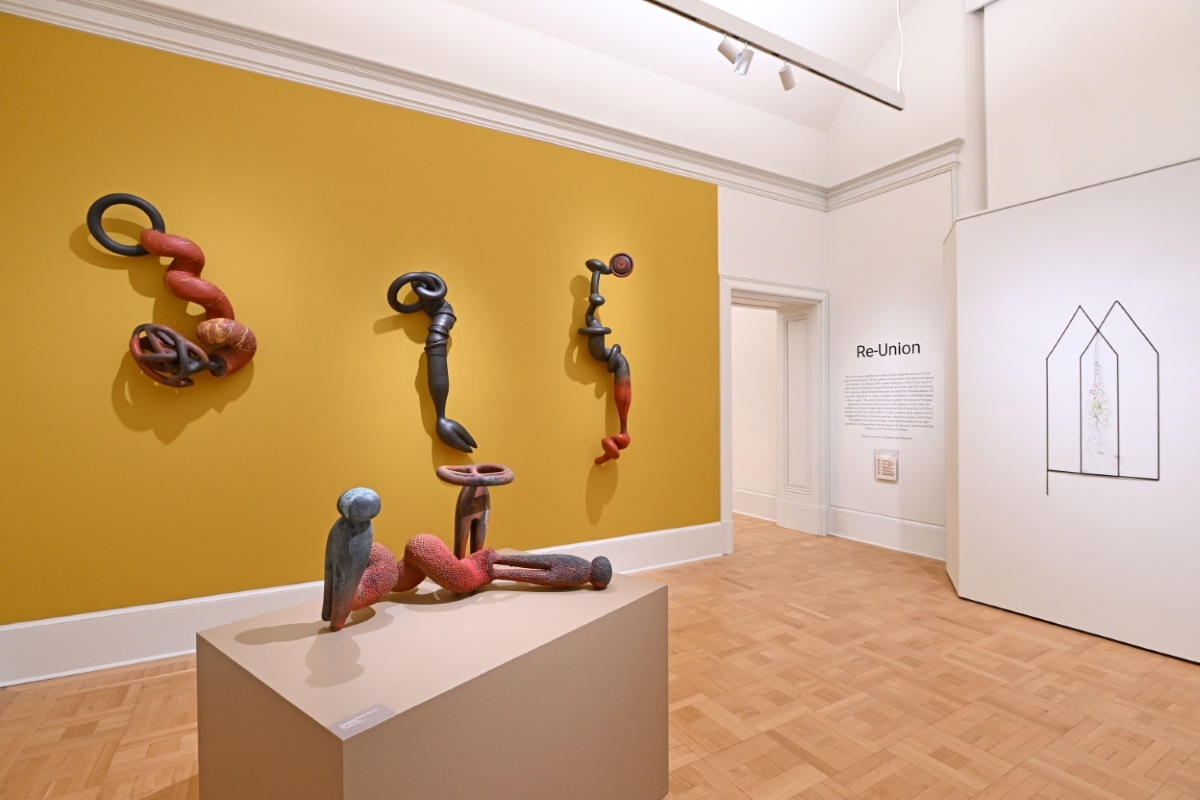
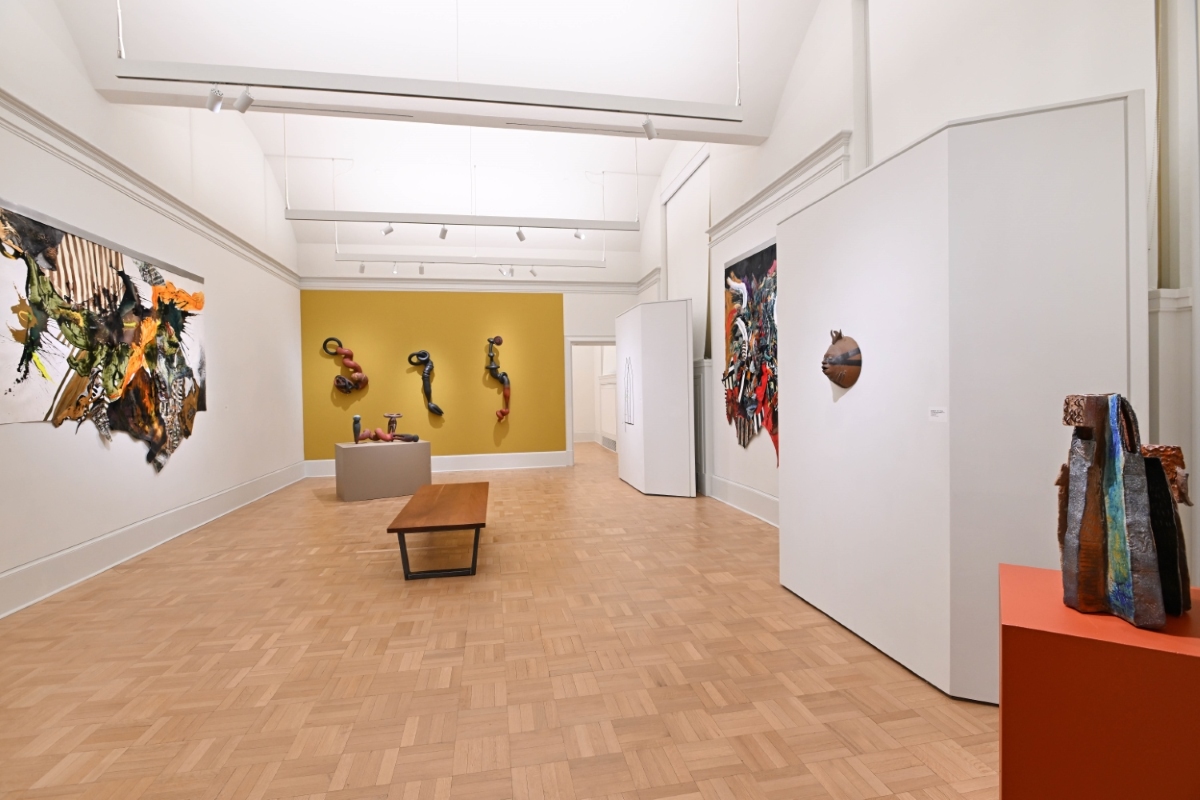
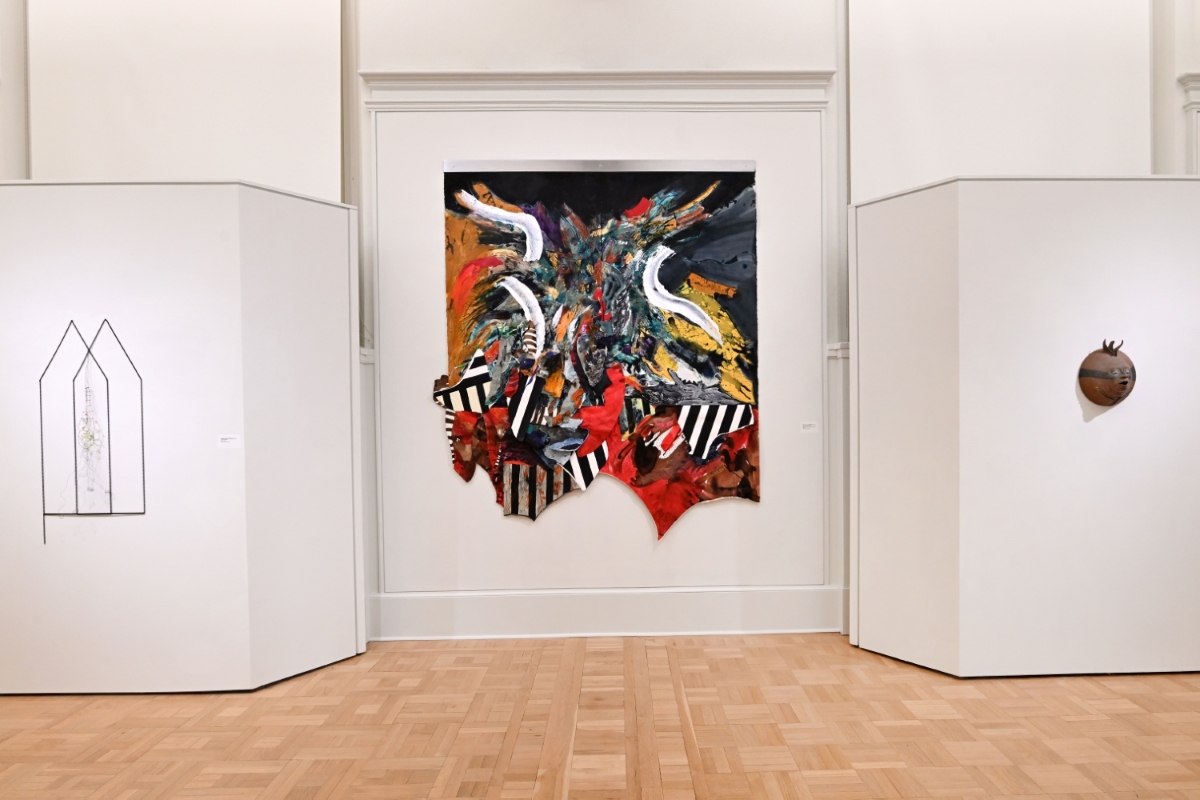
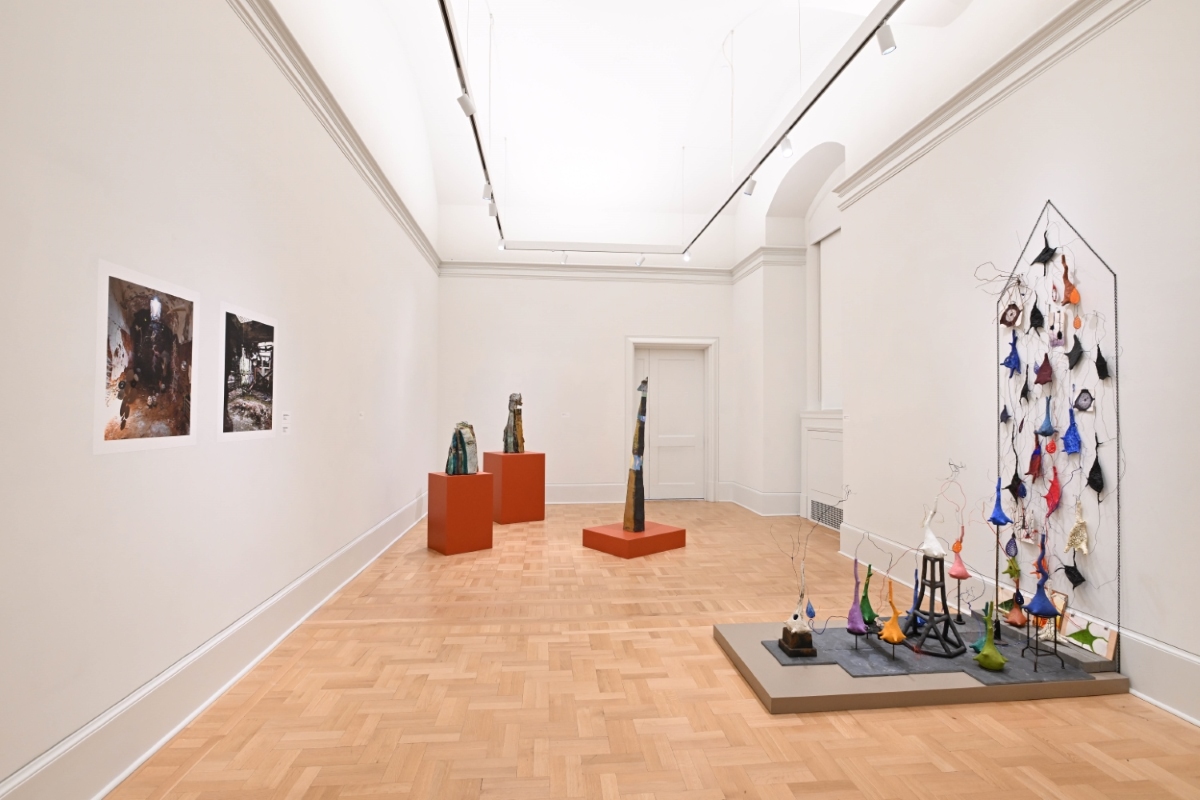
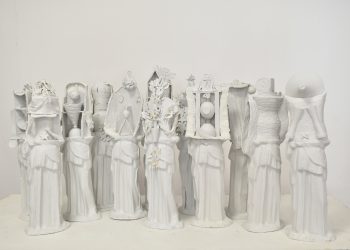
Judy Moonelis’s work introduces a different interpretation of the body. Neural Home and Neural Greenhouse function as altar-like structures: geometric frames animated by smaller ceramic forms that dangle, cluster, and hover. They have a weightlessness that wall-based or pedestal works don’t have. Undercurrents of the mystical combination of clay with mixed media bring another dimension to Carpenter’s exhibitions.
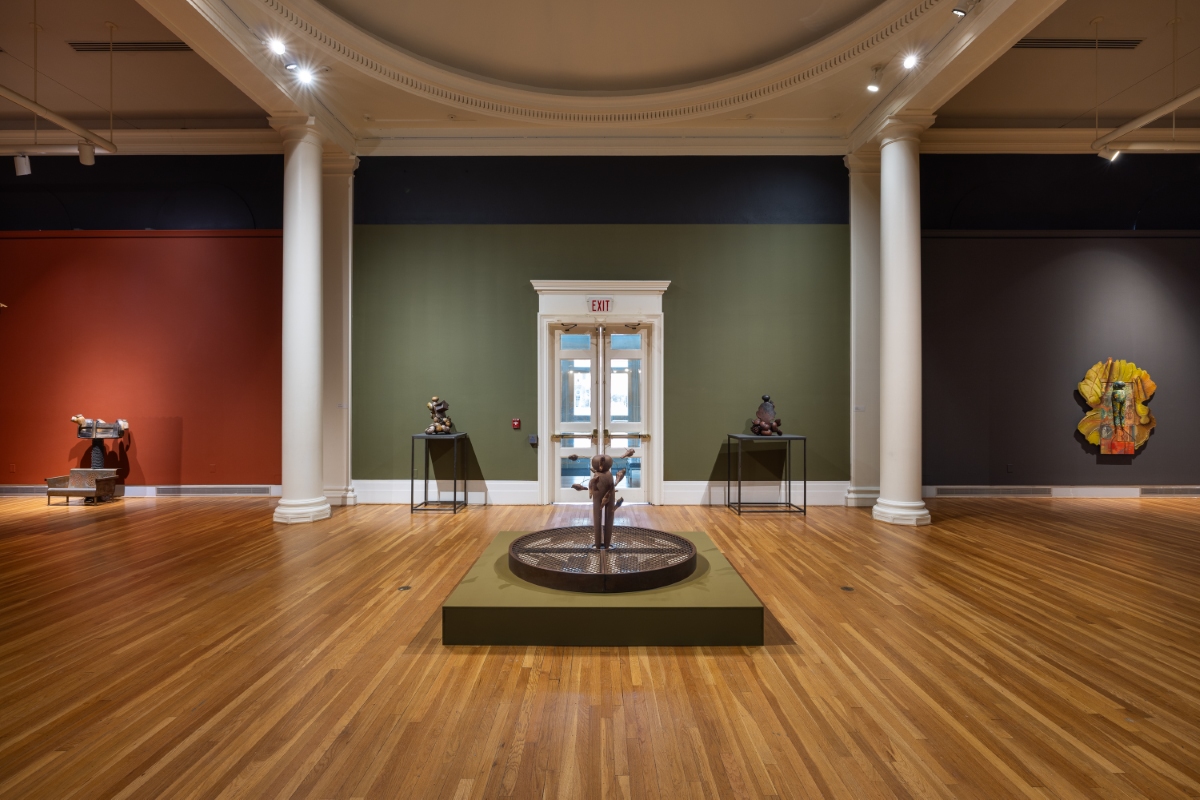
On the other hand, the only directly figurative work is by Winnie Owens Hart. Her work adds rounded forms and is the exhibition’s most explicit confrontation. There are two wall masks from her 1978 Scream… You’re Black and in America series. It is declarative and explicit in mining the Afro-Gothic. The masks have slit eyes and open mouths, similar to wide-ranging African traditions of performance-based emotive costuming or amulets for protection. This relates to the broader scope of the show that sculpts rage, refusal, and demands the need to be heard. That is an important part of memory and spiritual work that’s a part of Syd Carpenter’s cross-institutional shows.
Carpenter’s artistic affinity with Sana Musasama’s work feels clear in her construction of colorful houses. Musasama’s work ranges from these totemic structures to these intimate scenes of house interiors as if they were bisected down the middle and opened up for the viewer to see inside.
Lastly, Martha Jackson Jarvis offers non-clay materials (oil, acrylic, black walnut ink, watercolor, and paper) into the conversation. Her abstract, mixed media paintings exemplify the ecological attunement in her practice to organic forms, and materiality orbits that of Carpenter’s interests, as well. In the paintings by Jarvis, they evoke the journey of her ancestor, Luke Valentine, who fought in the American Revolutionary War. While not explicit in the exhibition signage, it appears in the brochure accompanying the show, and it relates to the interrogation of memorykeeping of the 250 years of American history.
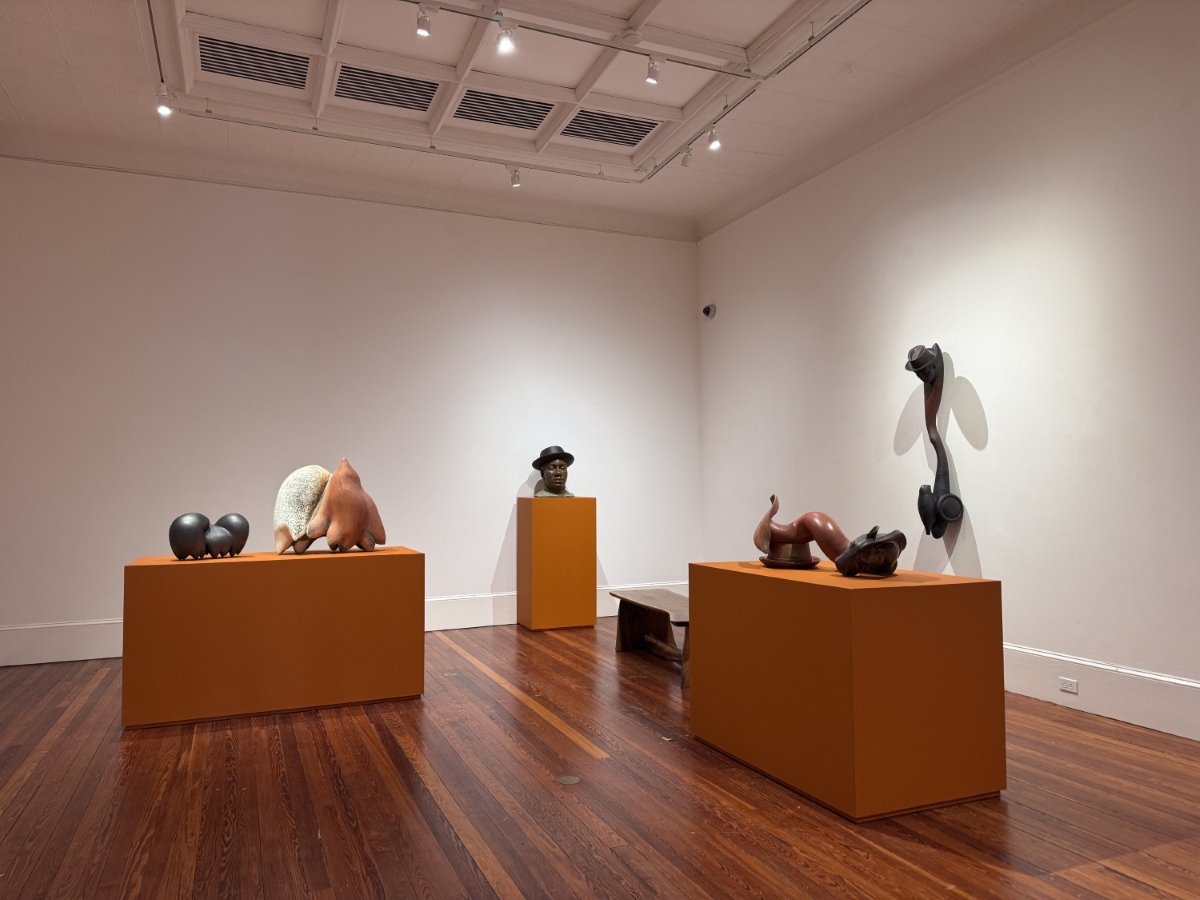
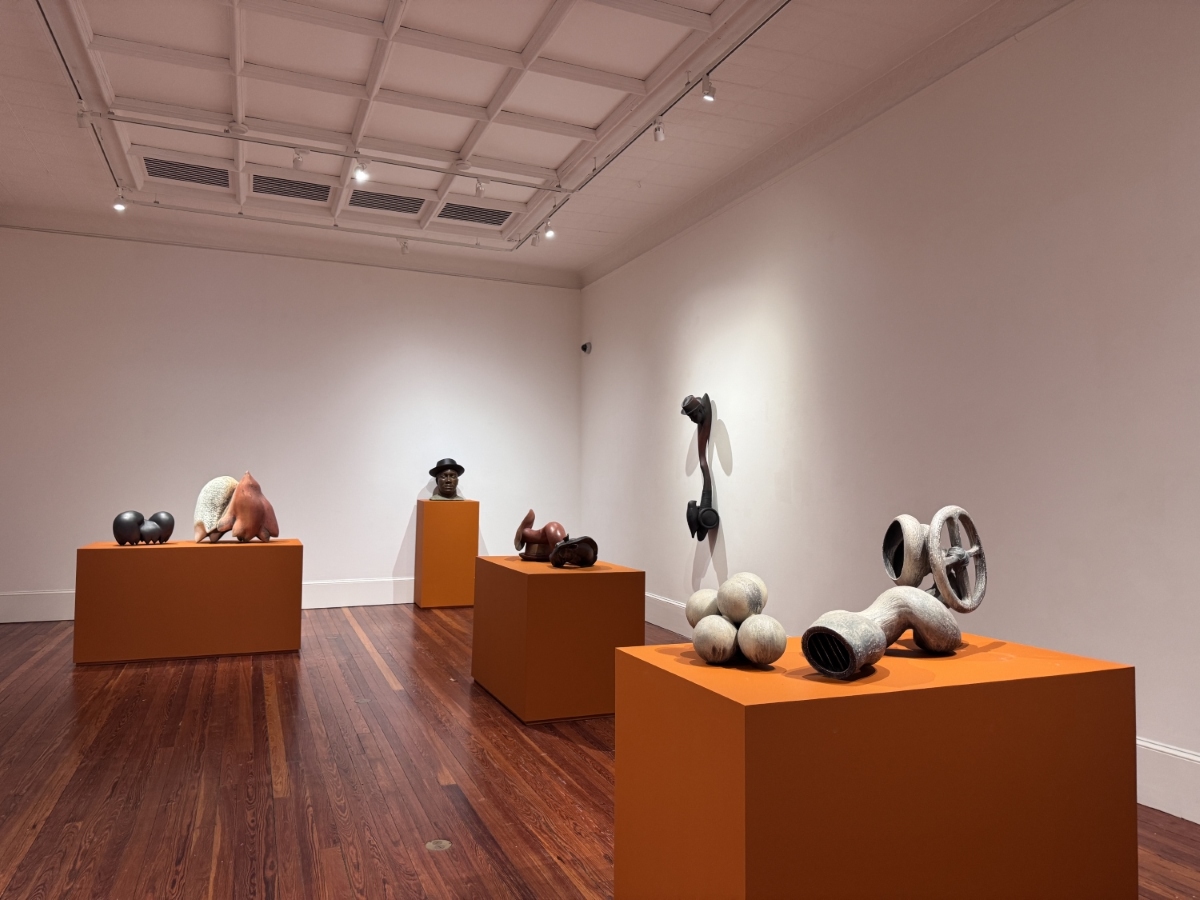
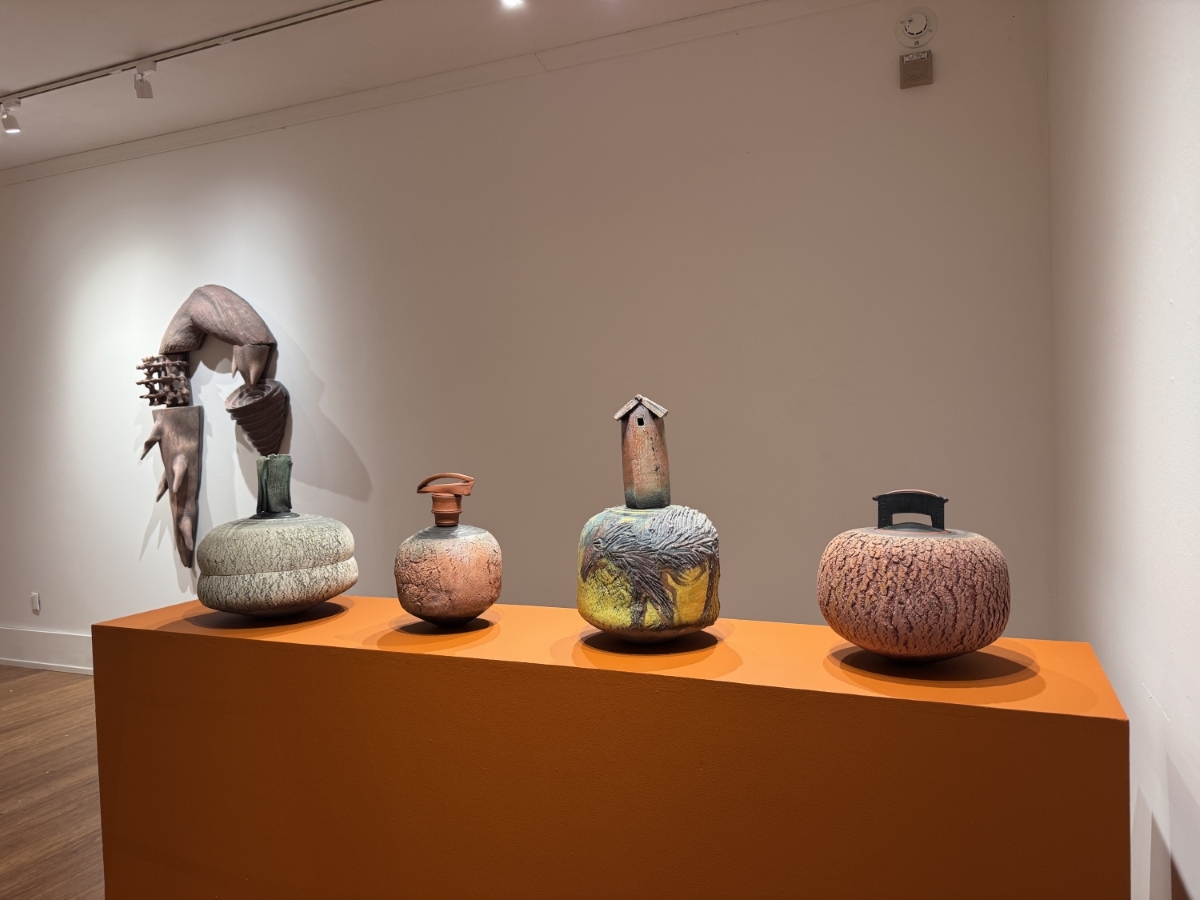
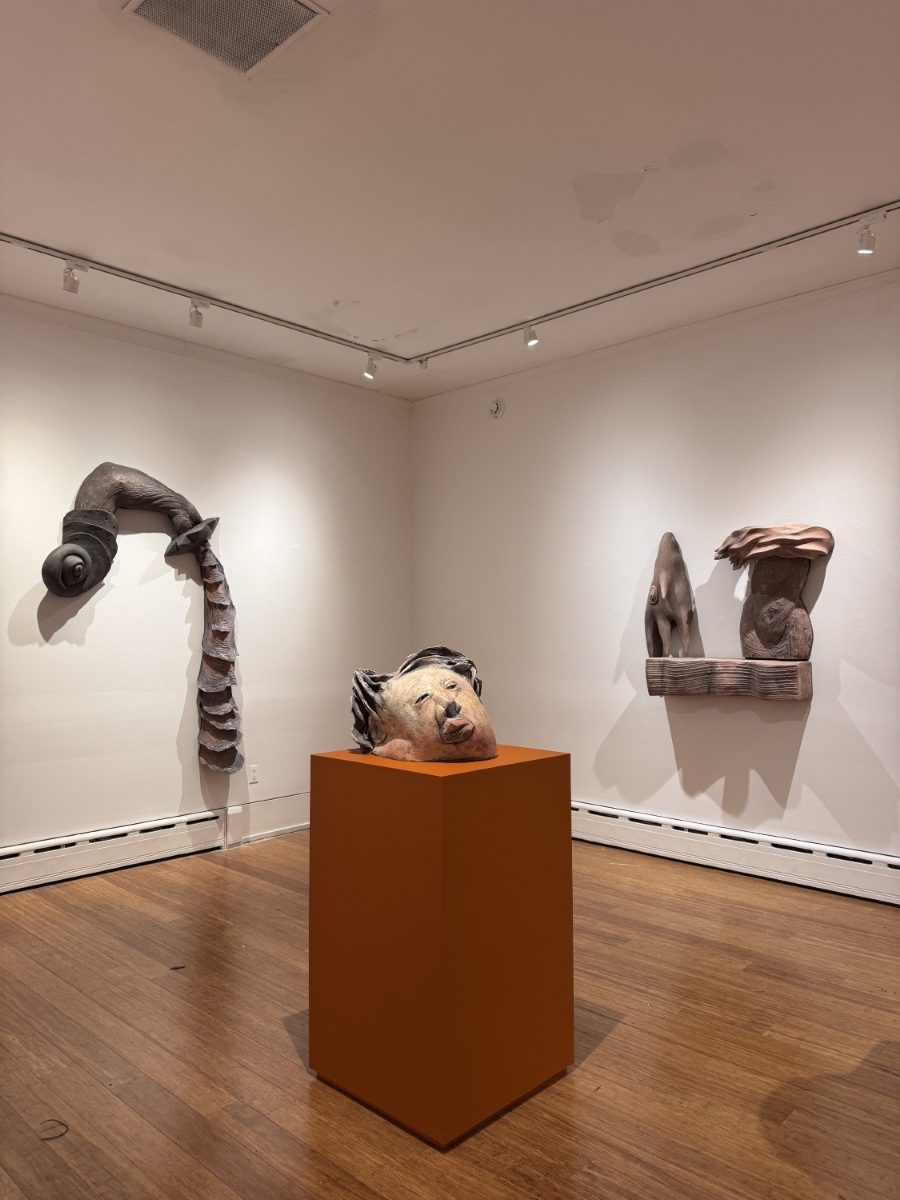
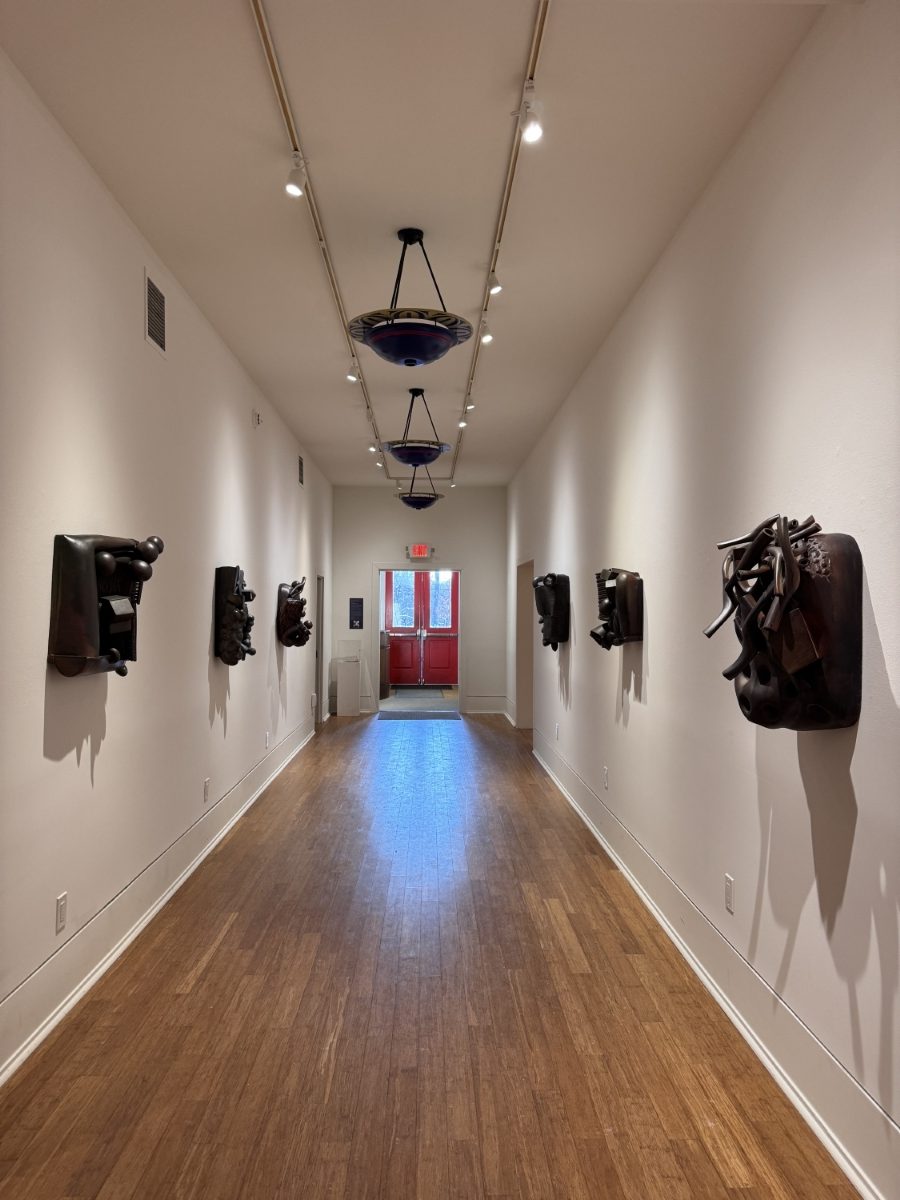
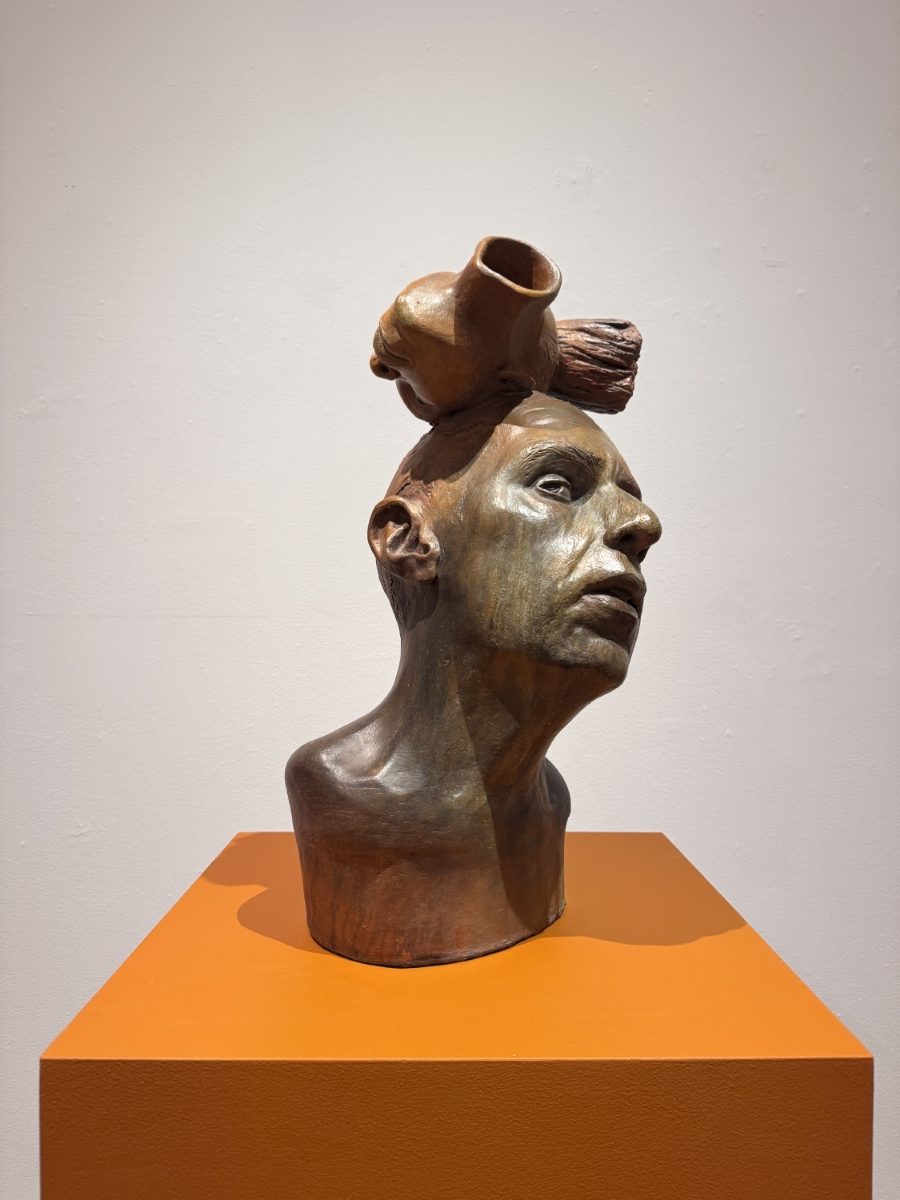
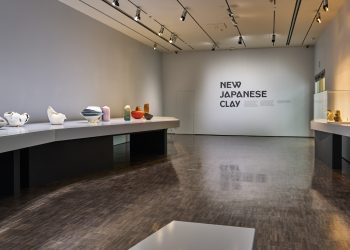
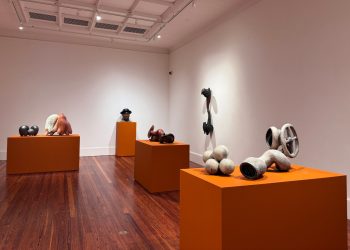
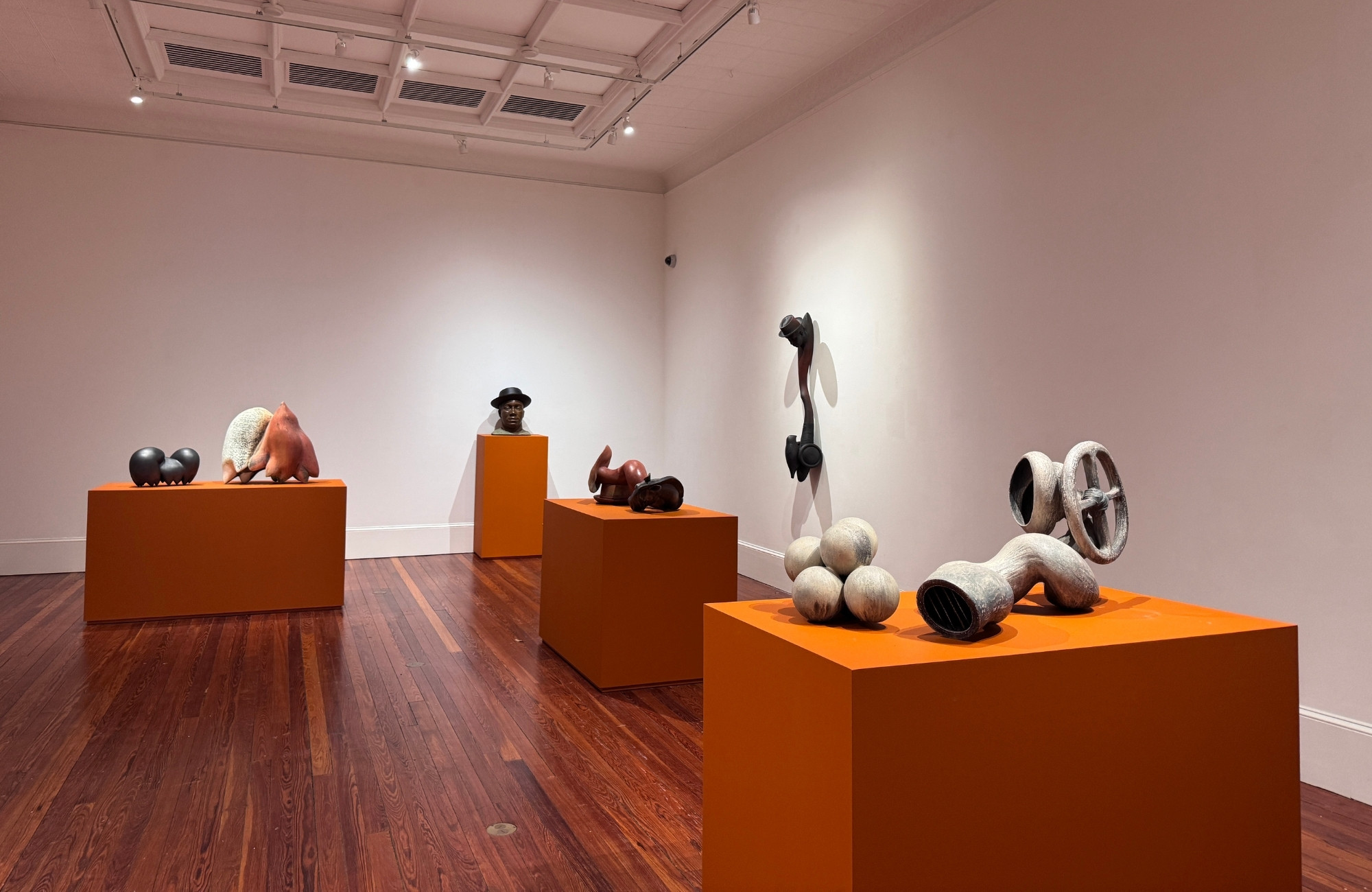
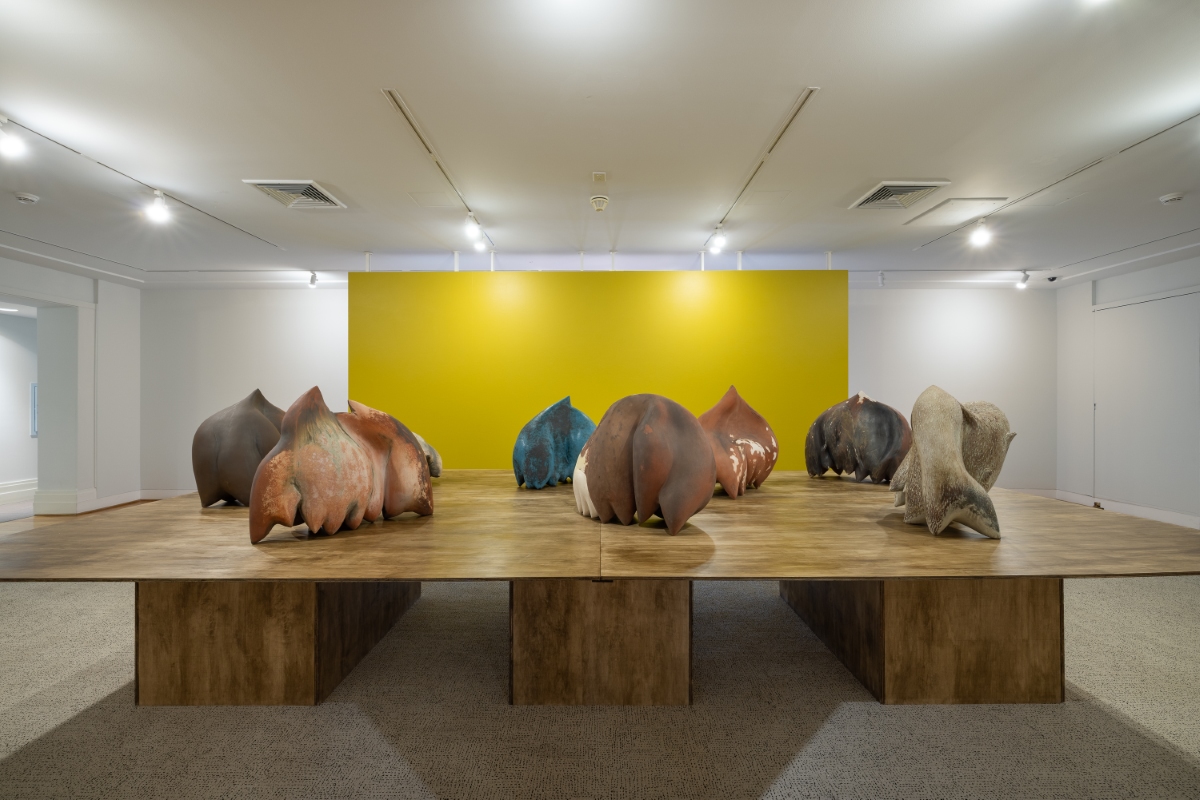
The Woodmere’s presentation of her work takes on a more traditional retrospective style. Planting in Place, Time, and Memory ushers the viewer into a large hallway that curves into an L-shape to the right with the Farm Portraits lining the walls, and that slight bend features her Mother Pin series, and throughout the artery that the visitor travels, there are two pocket galleries on the left-hand side and a final gallery toward the end. The first one depicts her early work, where she experiments with various forms before settling on her distinct visual language and color palette. Through ceramics, Carpenter creates vessels and sculptures that symbolize the deep connection between African American culture and the land, addressing themes of displacement, memory, and the erasure of Black history from the natural landscape. Her exploration of race, land, and history is a nuanced conversation about land stewardship and cultural recognition. Each gallery has an accent wall, and throughout are orange pedestals. These orange accents in the space are reminiscent of the underpainting of Carpenter’s work. She starts with gray stoneware, shapes it into her form of choice, paints it red or orange to start, and then, after the bisque firing process, she makes homemade gesso, then combines watercolor and graphite, which allows some of the red or orange to peek through.
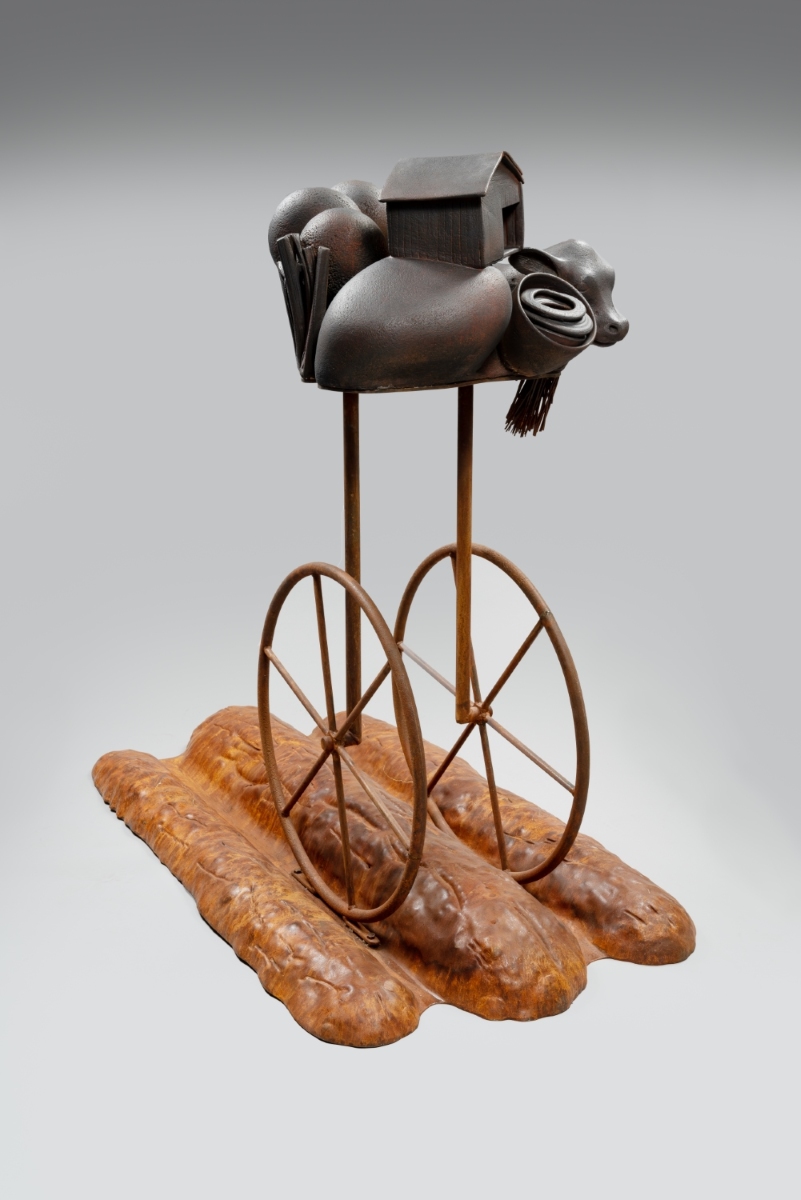
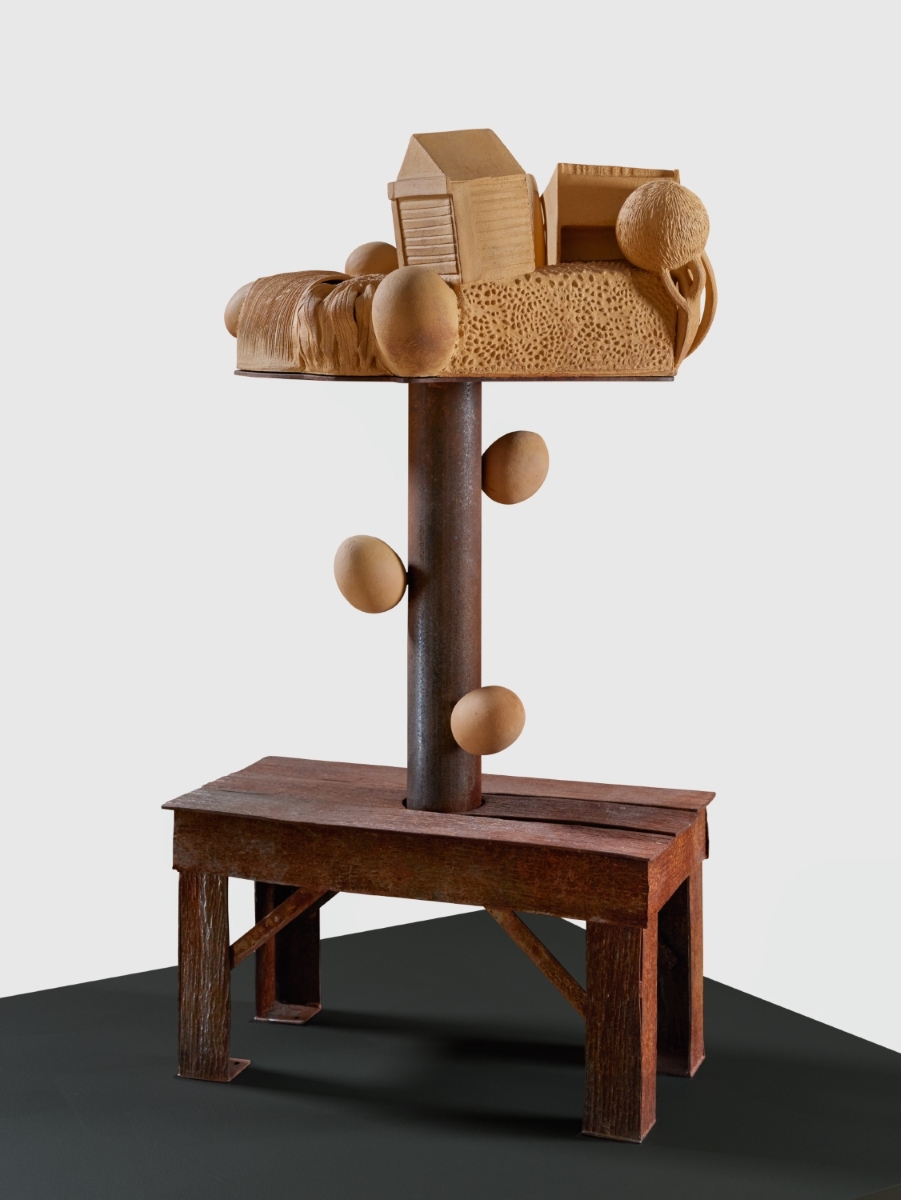
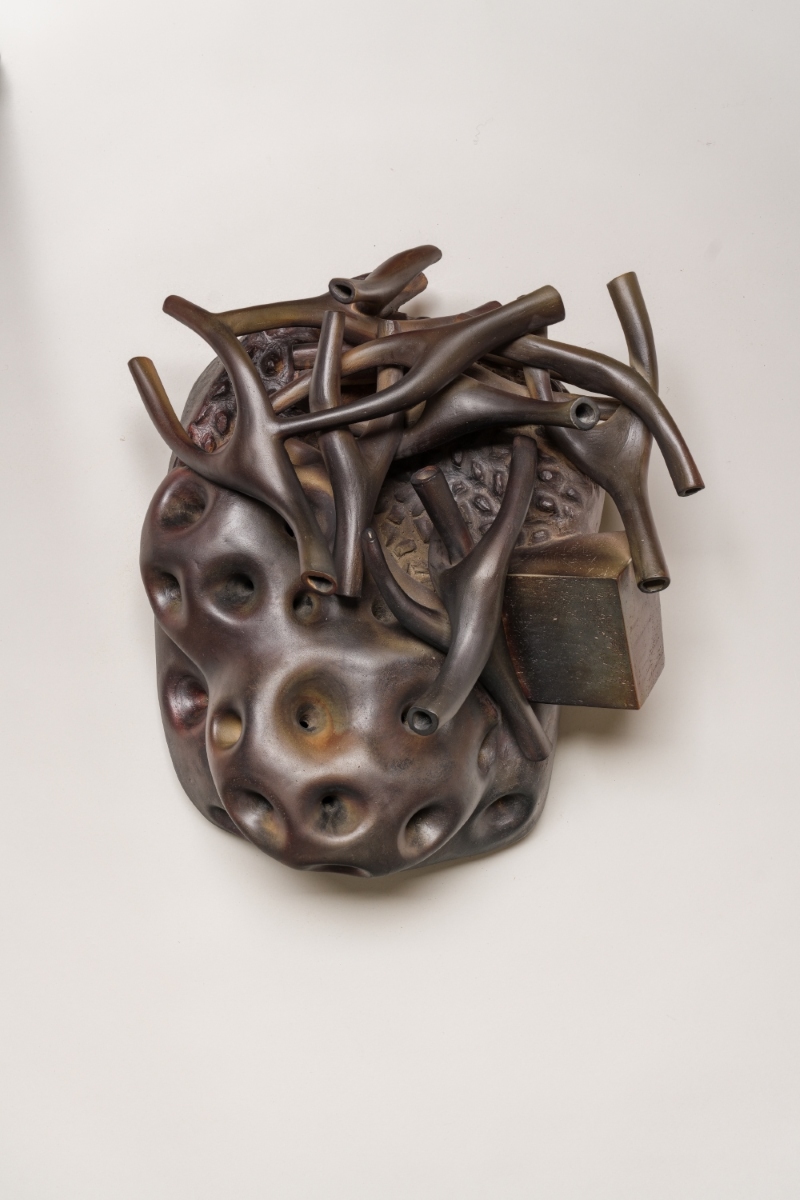
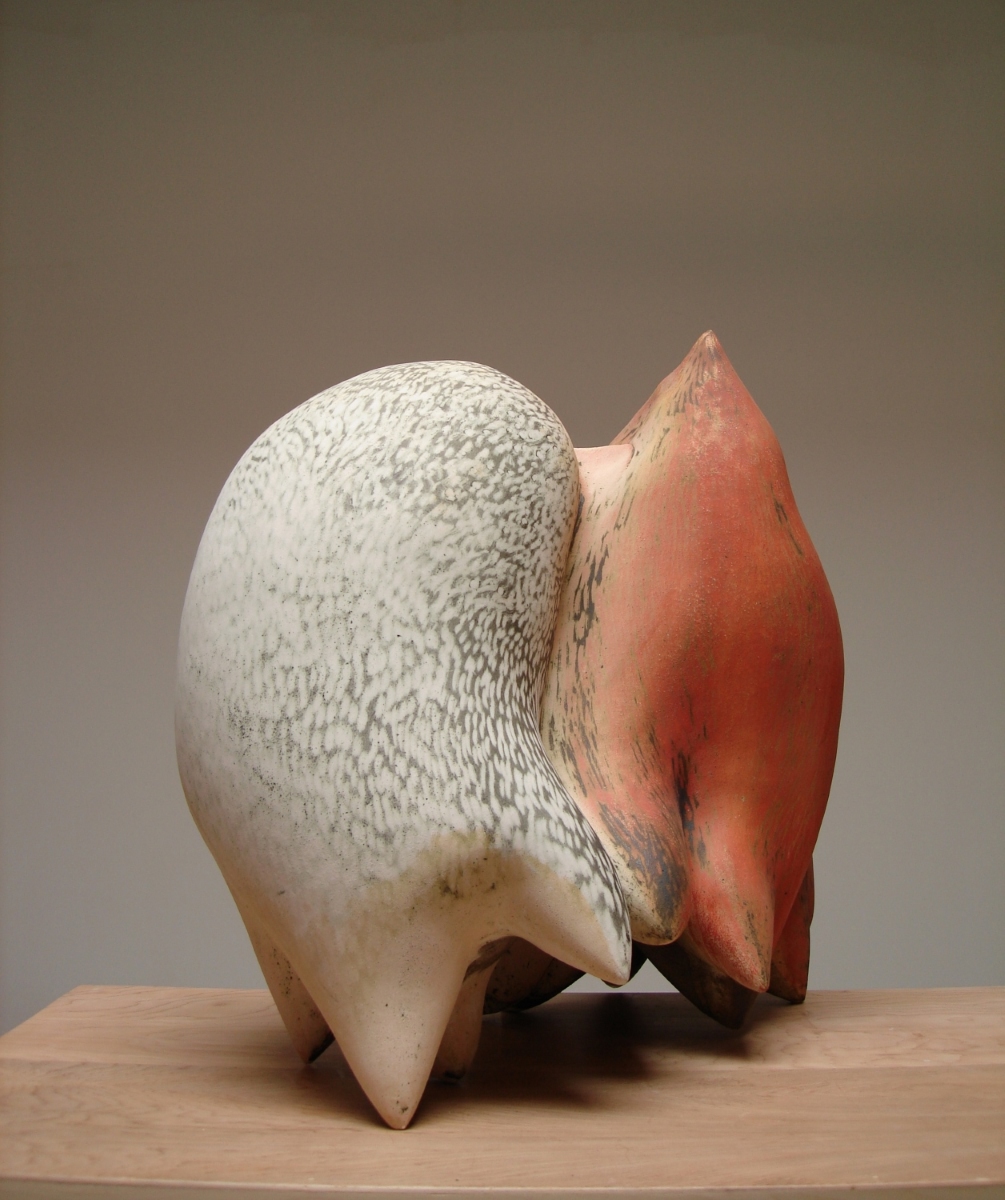
This material and conceptual foundation finds its clearest articulation in Carpenter’s ongoing Farm Portraits series. The Farm Portraits (starting in 2010) are based on the memory-keeping in African American Yards and Gardens in the Rural South by landscape architect Richard Westmacott. The author creates maps of gardens created by Black people residing on their land in the South for generations. Drawing from Westmacott’s topographical studies, Carpenter retains those citational ethics by naming each work after a specific person who created a garden, referenced in the book. To further imbue them with personhood, she employs the most brilliant matte sheen and rusting-metallic effect with the graphite to represent the skin for the owners of the gardens that she’s depicting. From a formalist perspective, lines entangle over hilly landscapes with houses, rounded parts that look like eggs or bushels, with textured sections giving the work a Surrealist presence. This reclamation of space and names reaffirms, as each portrait gazes at each other, exemplifying what the artist says: “they stayed on their land when everything around them said to get off.”
Eventually, in the last gallery to the left, she showcases work based on gardens she was able to visit in the Gullah Islands, South Carolina, etc. She relates to this practice of starting a garden because many African Americans who migrated north during the Great Migration first established gardens, keeping that literal and spiritual tether to the land beyond histories of duress.
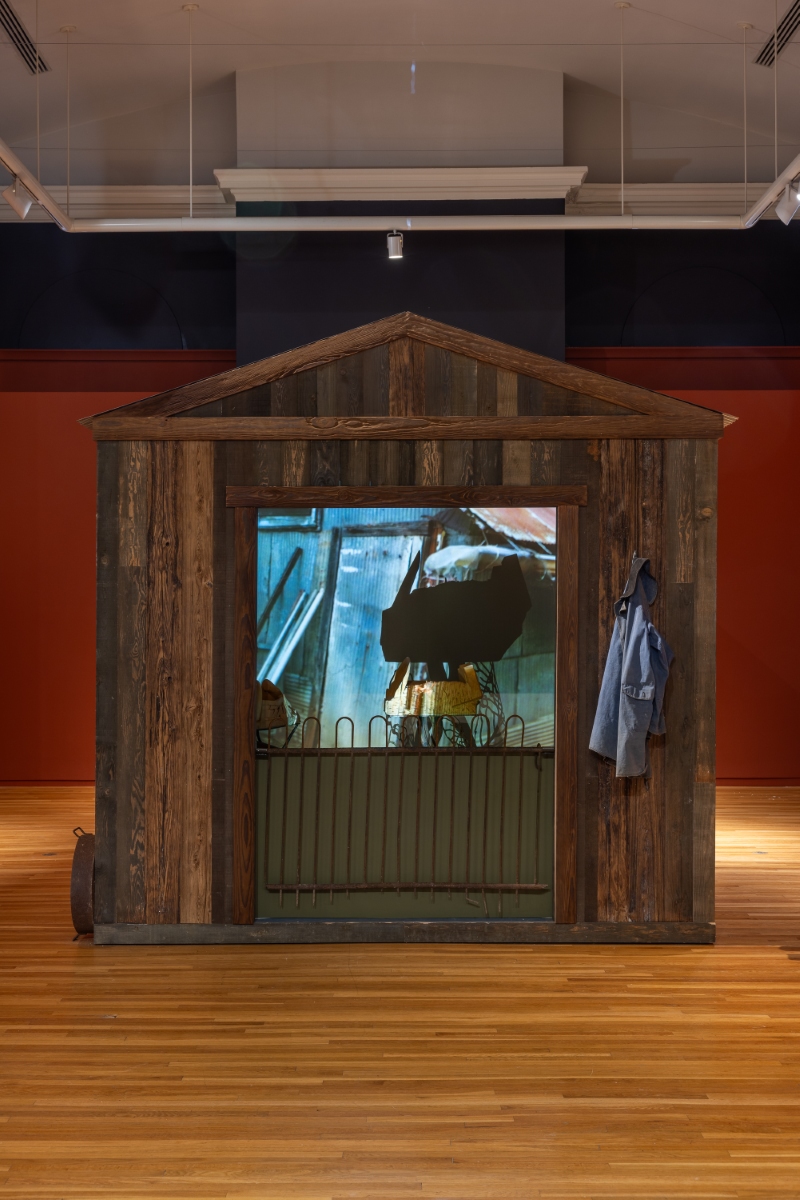
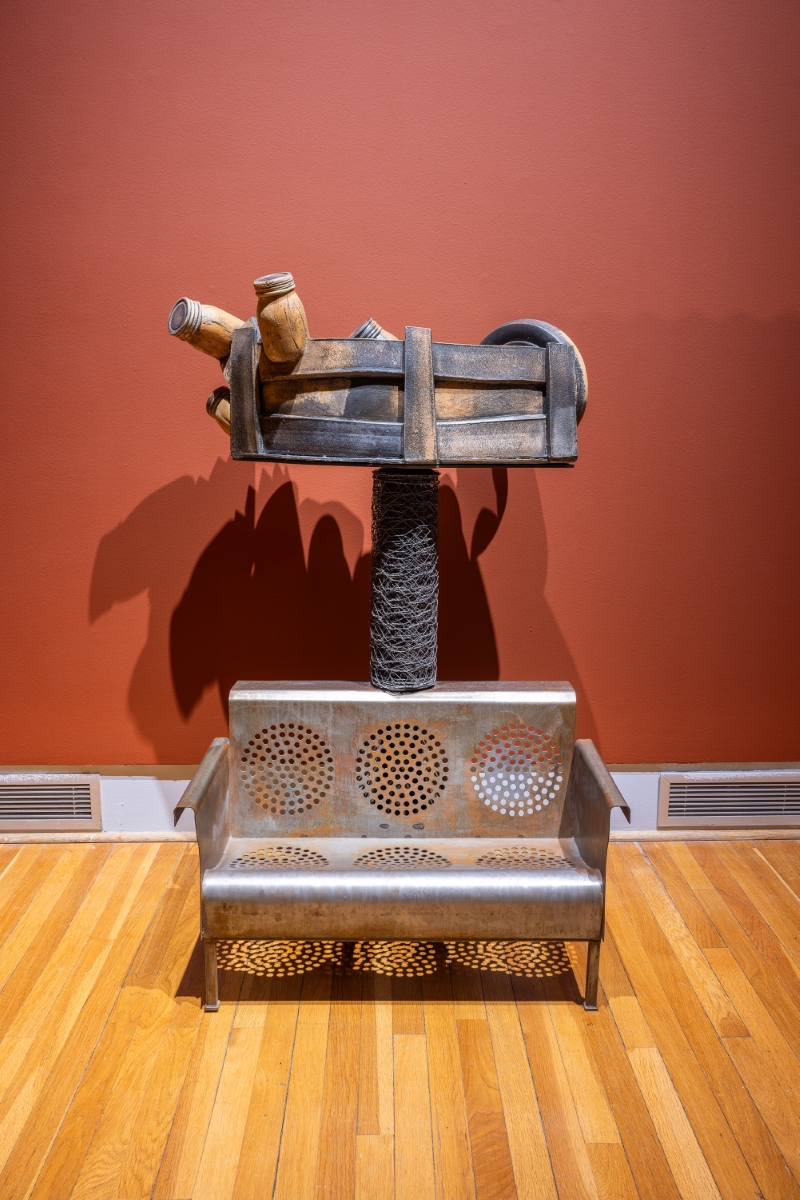
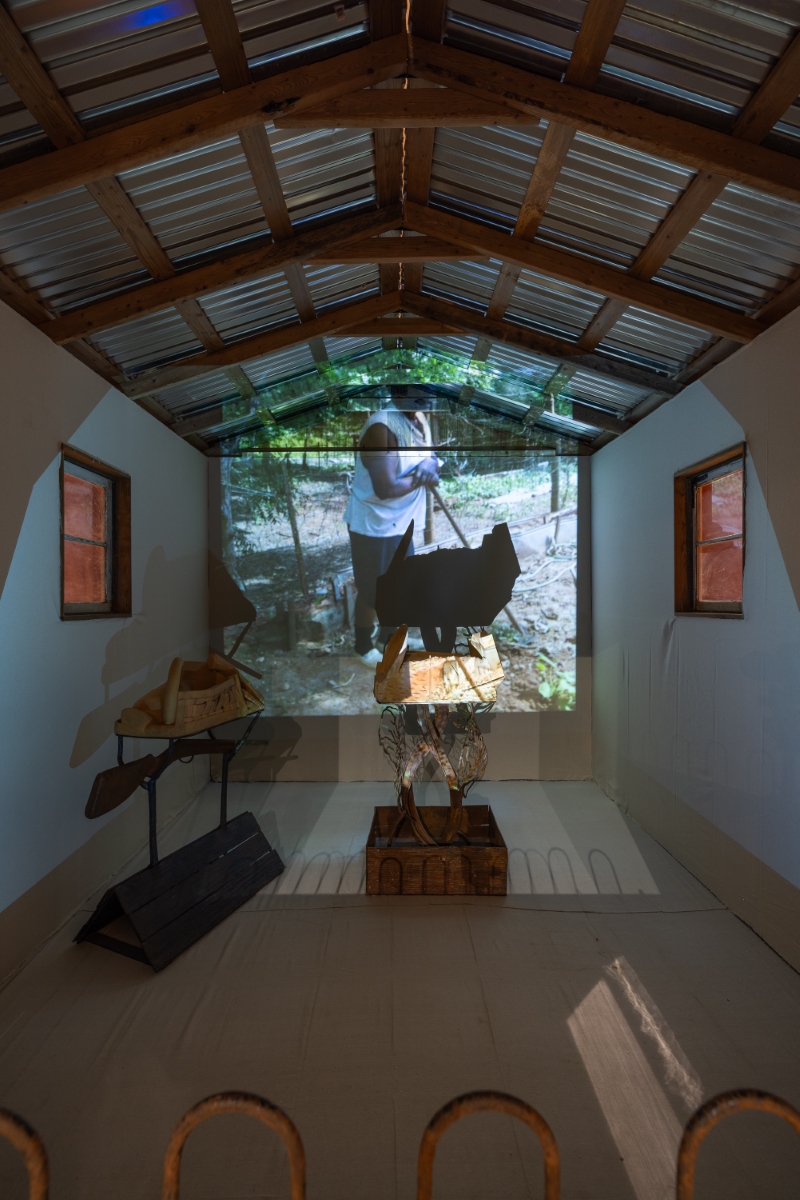
Other sculptural works throughout the exhibition further articulate these themes of memory and inheritance through vernacular everyday objects. Mother pins Series are sleek bodies that evoke the feminine form. The artist remembers her mother using these and thus represents her through recreating the clothespin form. Ramshackle fence (2008-12) is a makeshift structure that Carpenter encountered during her travels in the South. As the magnum opus of the show, it restates her focus on everyday objects: motherpins, bottles, a shotgun house, a shirt hanging up, and a bucket. This is an emblem of the resourcefulness of African Americans. The Table Farm Bowls series delineates specific names like the farm portraits, but arranges them in a way as if to offer or provide those folks a seat at the table, and repetition of her motifs of eggs, houses, and kidney beans, but also adds a cow’s head.
Across each exhibition site, Carpenter’s sculptures remain unencumbered by vitrines, positioned openly on pedestals rather than sealed behind glass. This curatorial choice resists the distancing effects of museological containment, inviting viewers into a more intimate encounter with the work. In doing so, Carpenter’s ceramics assert themselves as living forms. Taken together, these exhibitions reveal a practice rooted in care, collaboration, and refusal: a commitment to staying with the land, to naming what has been obscured, and to cultivating memory through clay.
Check out Re-Union: Syd Carpenter, Martha Jackson Jarvis, Judy Moonelis, Sana Musasama, and Winnie Owens at the Frances M. Maguire Art Museum, St. Joseph’s University, January 14–March 29, 2026; Syd Carpenter: Planting in Place, Time, and Memory at The Woodmere, January 24–May 24, 2026; Syd Carpenter: Home Bound in Wood, Steel, and Clay at Berman Museum at Ursinus College, January 22–April 5, 2026. Another site that showcases Carpenter’s work as a permanent installation is The Colored Girls Museum, where Carpenter curated the outdoor sculpture garden that is an entrance to the museum. Also, published by the University of Pennsylvania Press is the monograph that connects the sites of Carpenter’s works. The book is entitled: Syd Carpenter: Planting in Place, Time, and Memory.
Chenoa Baker (she/her) is an independent curator, adjunct, and arts writer. She has contributed to major exhibitions, including Gio Swaby: Fresh Up at the Peabody Essex Museum, Touching Roots: Black Ancestral Legacies in the Americas at the MFA/Boston, Simone Leigh at the ICA/Boston, and Simone Leigh: Sovereignty at the Venice Biennale. Through her experience, she specializes in African diasporic craftways. In recognition of her community-based curatorial work, she won the WBUR Maker Award in 2024 and was featured on NPR’s All Things Considered. Her next show is a retrospective of Ifé Franklin at the Fuller Craft Museum in 2027. Similarly, her writing is internationally recognized. In 2023, she won the AICA Young Art Critics Prize and writes for Hyperallergic, The Observer, The Brooklyn Rail, Material Intelligence, and Studio Potter, among others.
Captions
- Installation views, Re-Union: Syd Carpenter, Martha Jackson Jarvis, Judy Moonelis, Sana Musasama, and Winnie Owens at the Frances M. Maguire Art Museum, St. Joseph’s University, Merion, PA. January 14–March 29, 2026. Photos by Todd Rothstein.
- Installation views, Syd Carpenter: Planting in Place, Time, and Memory at The Woodmere Art Museum, Philadelphia, PA. January 24–May 24, 2026. Photos courtesy of Woodmere.
- Installation views, Syd Carpenter: Home Bound in Wood, Steel, and Clay at Berman Museum at Ursinus College, Anniston, AL. January 22–April 5, 2026. Photos courtesy of Berman Museum
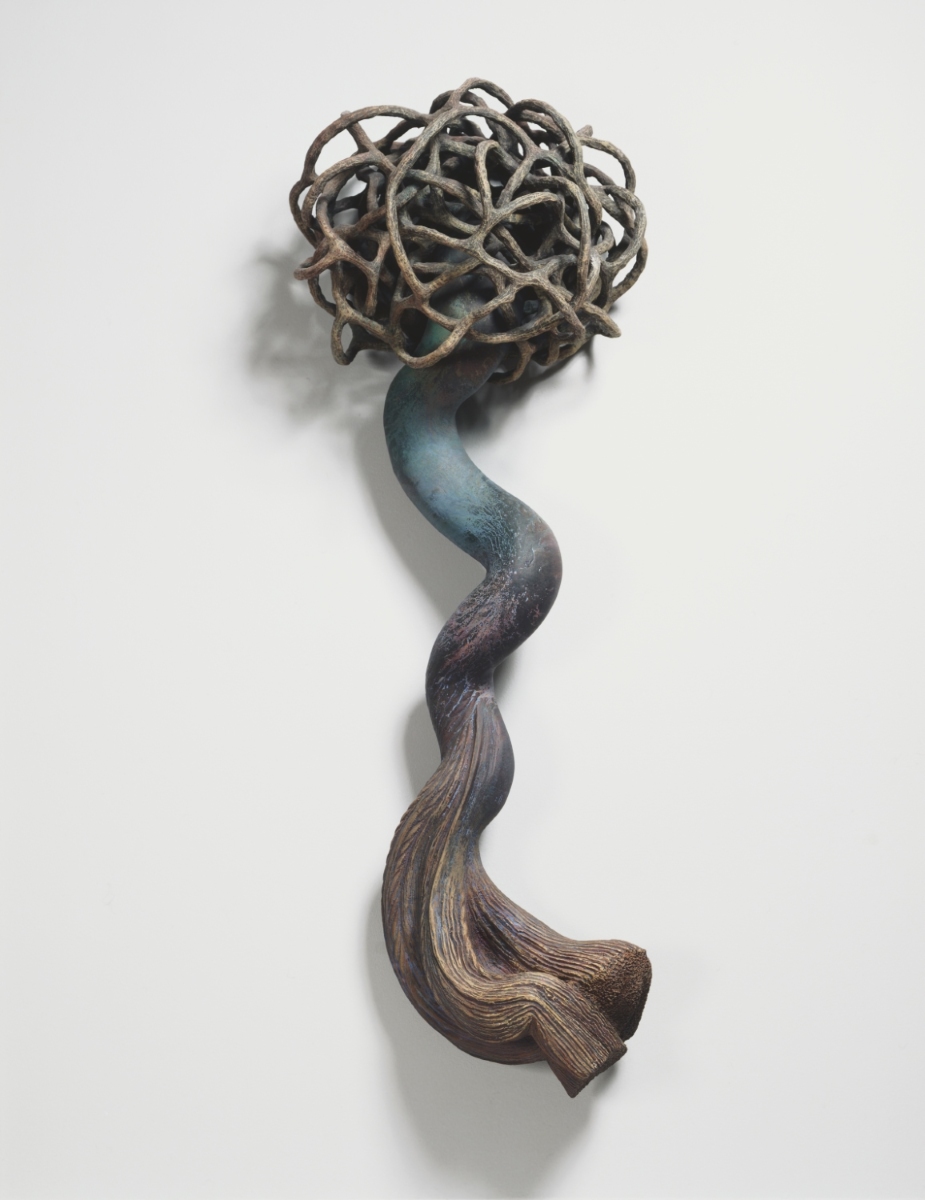
- A Snake without a Head is Just a Rope, 1994, Glazed earthenware, 59 x 20 x 16 in. Philadelphia Museum of Art. Purchased with funds contributed by The Women’s Committee and the Craft Show Committee of the Philadelphia Museum of Art, 1995. Photo by Jack Ramsdale.
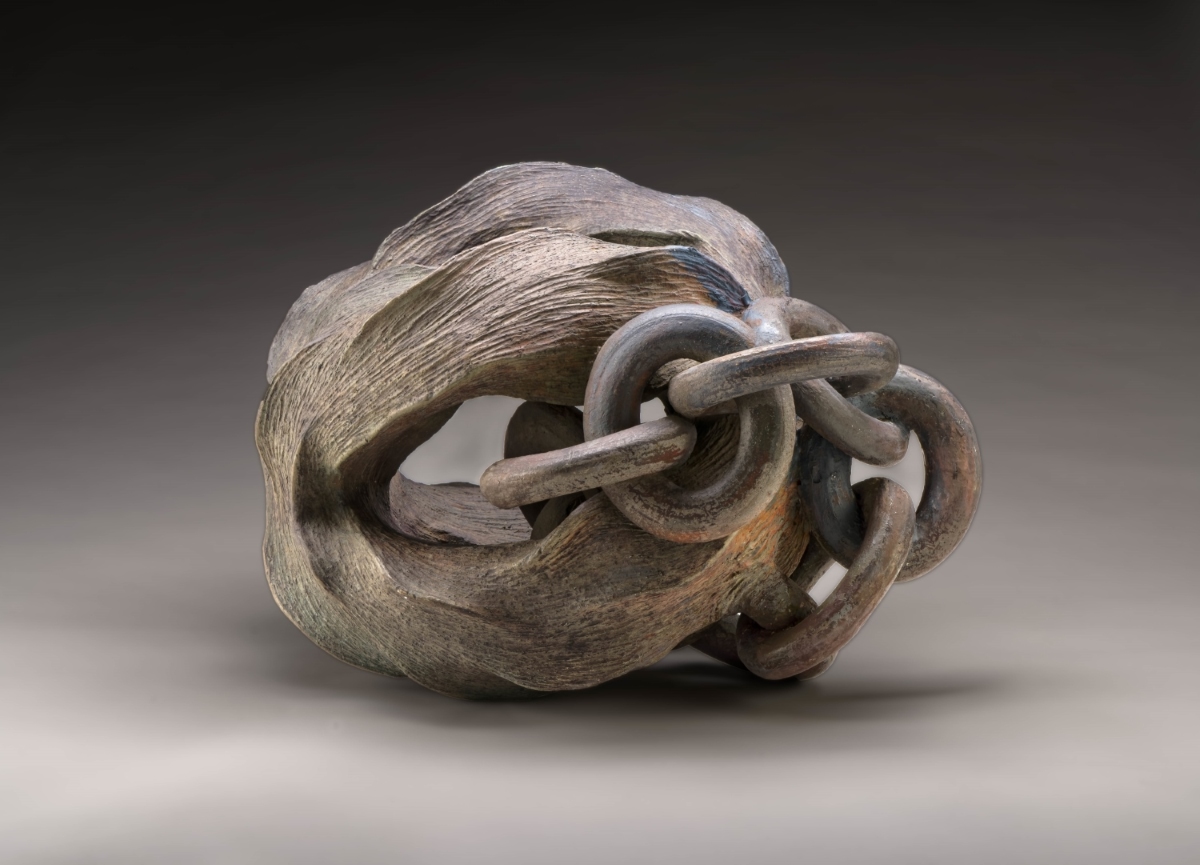
- Albert and Elbert Howard, 2014, Clay, steel, graphite, 49 x 42 x 27 in. Courtesy of the Petrucci Family Foundation Collection of African American Art. Photo by Jack Ramsdale.
- Sara Reynolds, 2014, Clay and steel, 50 x 27 x 26 in. James A. Michener Art Museum. Gift of the artist, 2021. Photo by Jack Ramsdale.
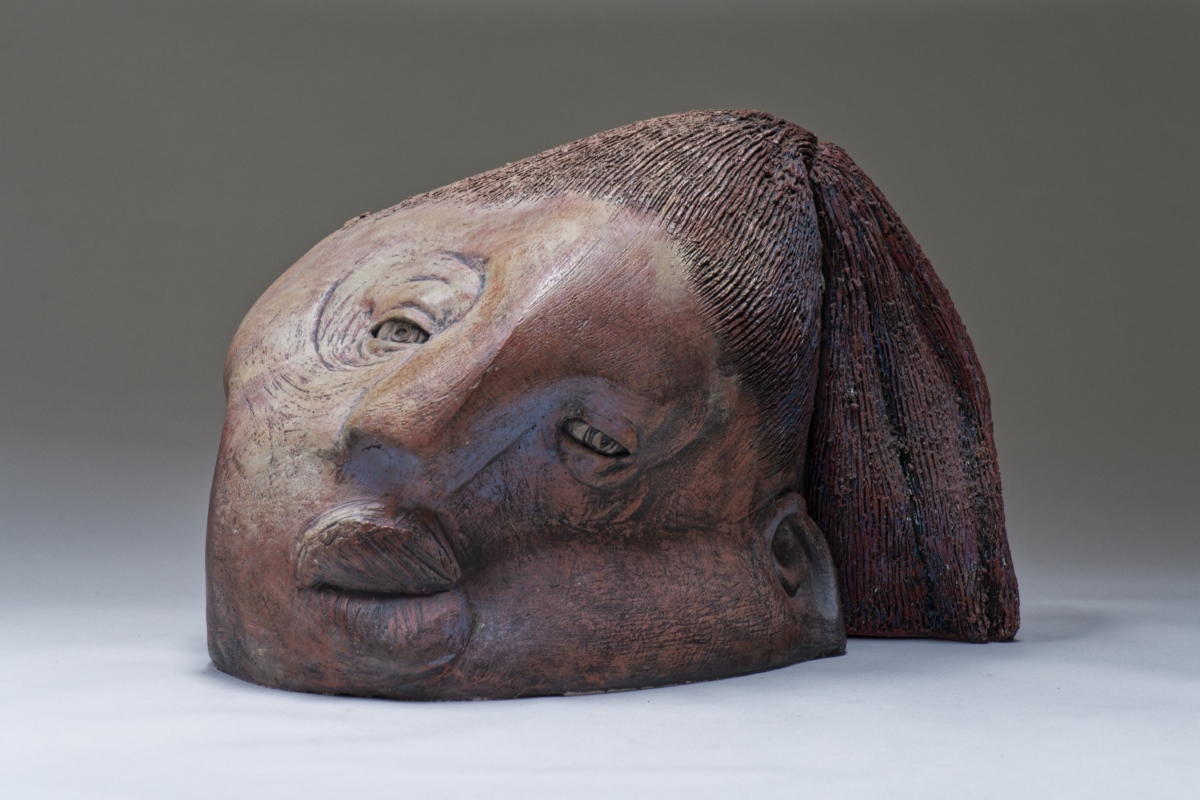
- Child #3, 1990, Clay and terra sigillata, 17 x 21 x 16 in. Collection of the artist. Photo by Jack Ramsdale.
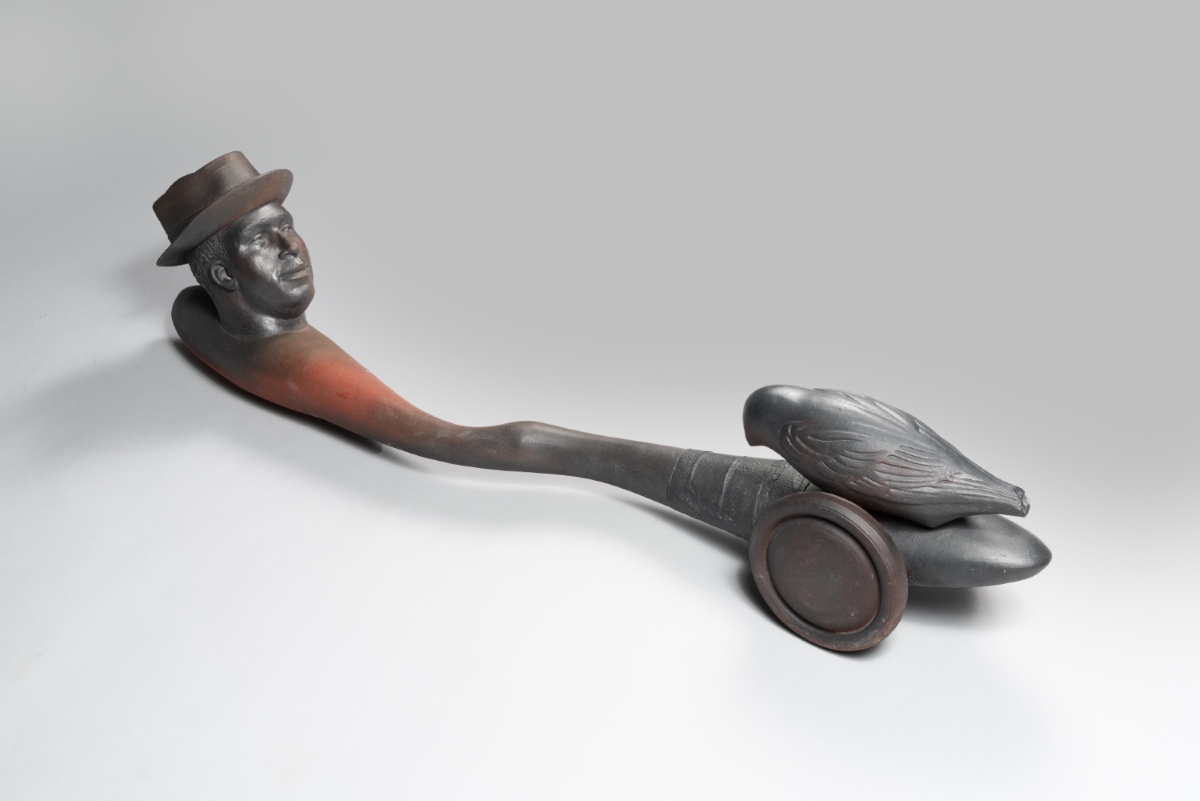
- Frank in Tow, 2008, Graphite on clay, 12 x 52 x 8 in. Courtesy of the Petrucci Family Foundation Collection of African American Art. Photo by Jack Ramsdale.
- Untitled, date unknown, Ceramic with glaze, 15 x 20 x 20 in. Collection of Danny Simmons. Photo by Jack Ramsdale.
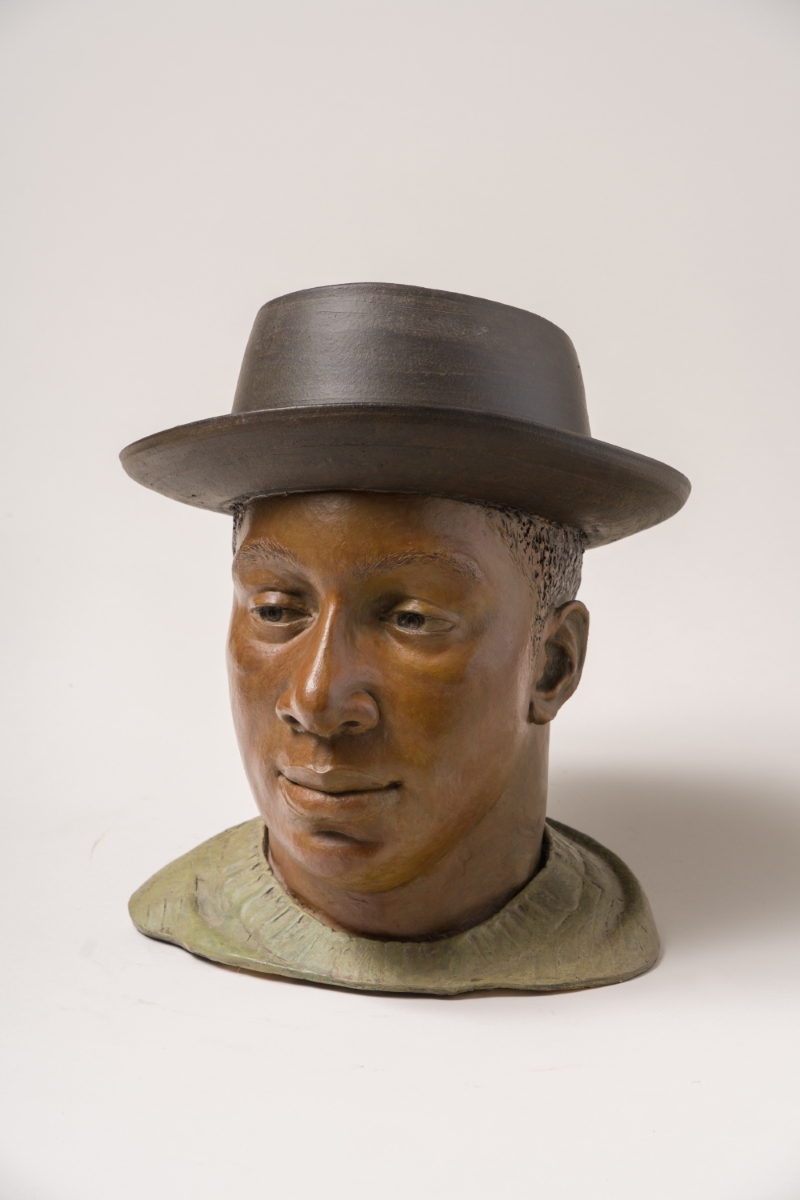
- Frank Portrait, 2007, Clay and watercolor, 15 x 15 x 10 in. Collection of the artist. Photo by Jack Ramsdale.
- Inez Faust, 2009, Clay, watercolor, graphite, 28 x 24 x 8 in. Collection of the artist. Photo by Jack Ramsdale.
- Two Birds Dancing, 2007, Clay, slip, oxide, 26 x 24 x 12 in. Collection of Andrea Packard. Photo by Jack Ramsdale.