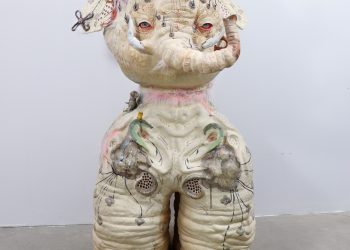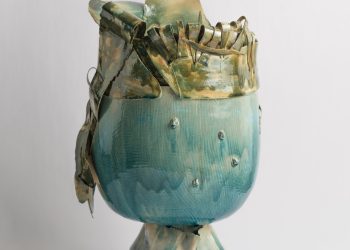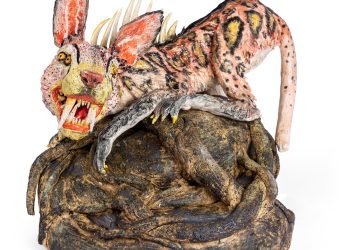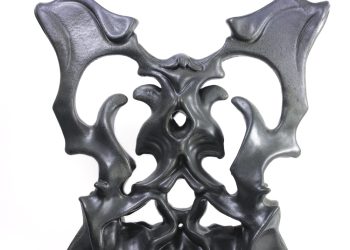
Eva Zethraeus (b. 1971, Sweden) is a ceramic artist based in Gothenburg, whose work investigates the intersections between nature, transformation, and materiality. Her sculptures, often inspired by organic growth, cellular structures, and imagined life forms, explore the tension between beauty and decay, fragility and resilience.
Zethraeus studied Ceramic Art at HDK-Valand Academy of Art and Design in Gothenburg, receiving an MFA in 1998. Over the past two decades, she has established a distinct voice within contemporary ceramics, known for her intricate, handthrown structures that suggest organic systems in flux. Her works frequently appear in clusters or as modular installations, evoking the dynamic, interdependent relationships found in nature.
Her practice has been presented in solo and group exhibitions in Sweden and internationally. Exhibitions include various curated shows and Art Fairs in Europe, Asia, and the USA including Design Miami, The Fogfair, TEFAF in New York, and Art Basel Miami. In 2026, she exhibited new works at HB381 Gallery in New York.
Eva Zethraeus’s work is represented in several prominent public collections, including the Röhsska Museum, Nationalmuseum and The High Museum in Atlanta, USA and the Public Art Agency Sweden (Statens konstråd), Västra Götalandsregionen, and several Swedish Embassies.
Throughout her career, she has been awarded numerous grants and residencies, including three work grants from the Swedish Arts Grants Committee (Konstnärsnämnden). She has also participated in masterclasses and residencies in Europe, Japan and the USA where she has continued to refine her experimental techniques with clay, glaze, and firing processes.
Eva Zethraeus continues to live and work in Gothenburg, Sweden, where she maintains her studio practice at Konstepidemin and participates actively in the contemporary ceramic art community.
Visit Eva Zethraeus’s website and Instagram page.
Featured work
Selected works, 2025-2026
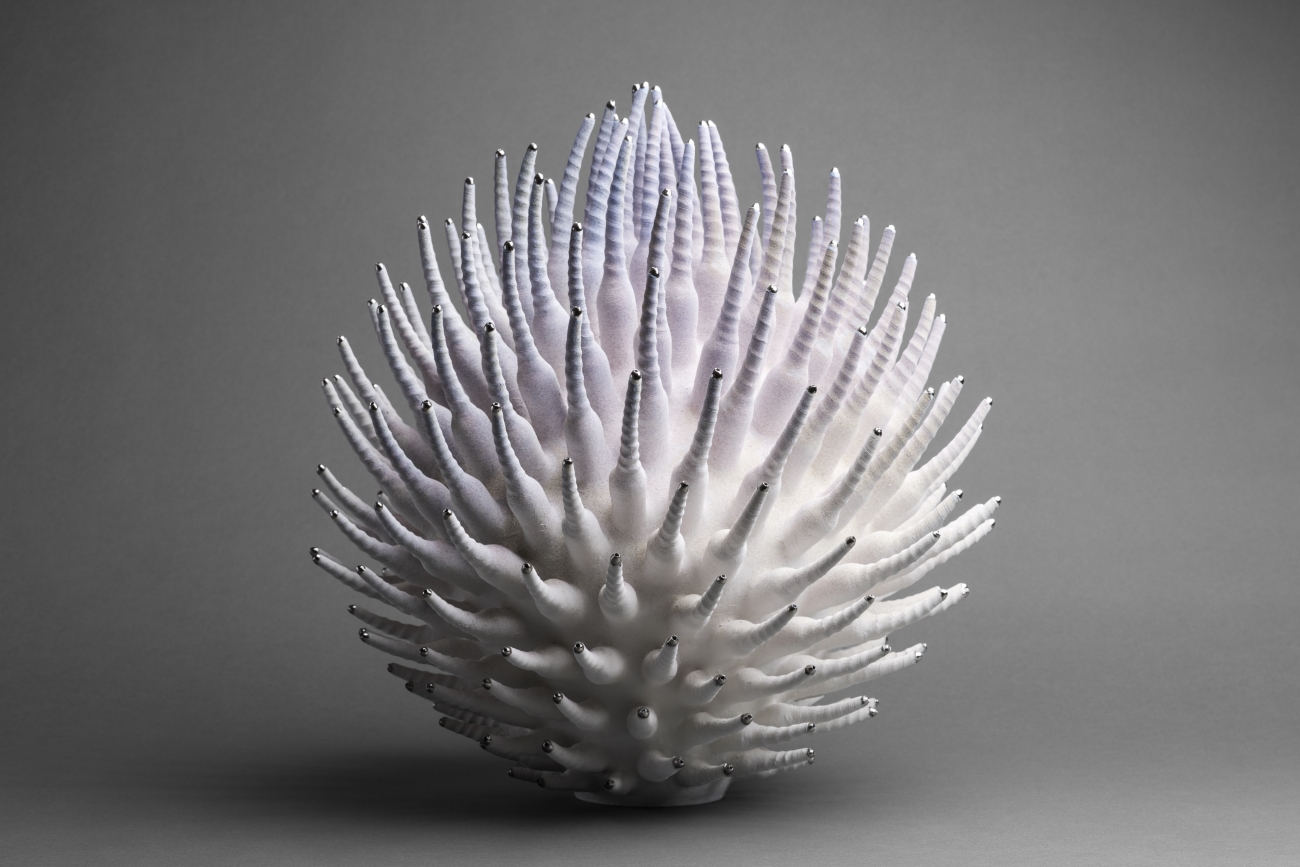
My work as a ceramic artist is deeply rooted in an exploration of nature’s processes — its capacity for growth, transformation, decay, and regeneration. I am fascinated by the complex dualities that define the natural world: the balance between fragility and resilience, chaos and order, beauty and destruction. Through the medium of ceramics, I seek to create sculptural forms that inhabit this tension, embodying the subtle, often unpredictable forces that shape both organic and human-made systems.
The foundation of my practice lies in an intimate relationship with clay. I am drawn to its primal, tactile nature — its ability to record every touch, every manipulation, every intention. Clay is both immediate and meditative; it demands physical engagement while inviting a state of reflection. Working with this material, I enter into a dialogue with process and time, where the outcomes are never fully controllable. Clay responds to pressure, moisture, and heat in ways that mirror the mutability of life itself. In embracing these inherent uncertainties, I allow the material to assert its own voice within the work.
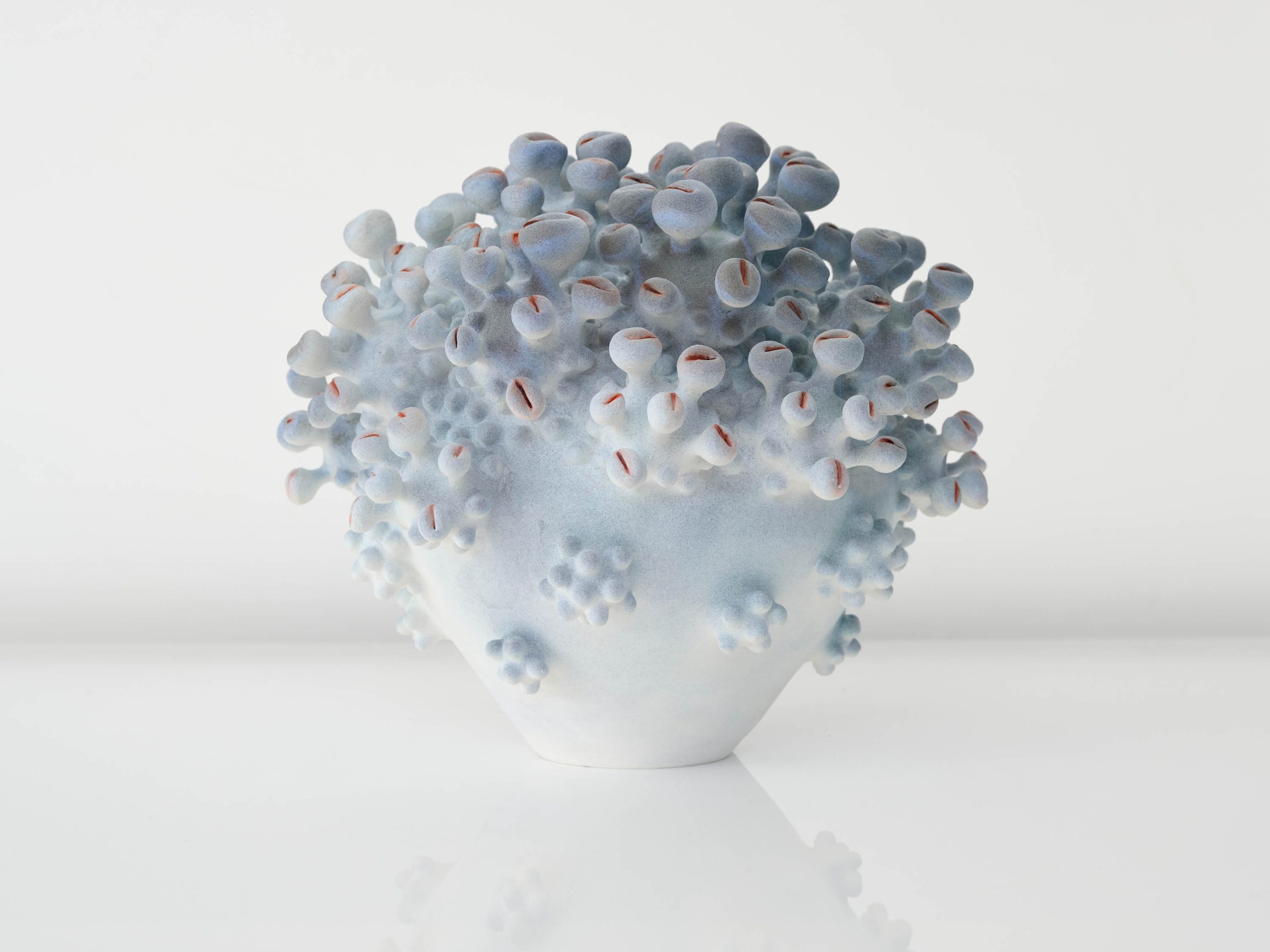
My sculptural language emerges through a combination of handthrowing, layering, and assembling smaller parts into complex structures. Many of my forms suggest cellular life, coral reefs, fungal networks, or imaginary botanical organisms. They are neither strict representations of nature nor purely abstract inventions — rather, they inhabit a space in between, where the familiar and the alien intersect.
Nature’s double aspect — its beauty and its threat — has always captivated me. My sculptures reflect not only nature’s visible surfaces but its internal, often hidden structures. Growth patterns in biology are not random; they are governed by underlying mathematical principles like fractals and repetition. Yet despite their order, they allow for mutation, variation, and failure. I find a profound poetry in this interplay between strict structure and wild deviation, and I strive to embed this same dynamic into my work.
Themes of transformation and the passage of time are constant undercurrents in my practice. I am interested in the ways that matter reshapes itself, slowly or violently, over time. My forms often seem caught mid-process — swelling, collapsing, branching outward. They suggest organisms caught between flourishing and decay. This ambiguity — are they growing, or dying? — is important to me. It reflects not only ecological realities but also deeper existential rhythms of loss, resilience, and renewal.
Beyond the purely formal and material aspects, my work also addresses broader questions about humanity’s relationship with the environment. We are part of nature, yet we often experience it as something separate or even subordinate. In an era of ecological uncertainty, the fragility and interdependence of living systems have become increasingly urgent concerns. Through the intimate scale and tactile presence of ceramics, I hope to evoke a sense of connection and empathy toward these larger cycles — to remind viewers of both the beauty and the precarity inherent in the world we inhabit.
Over the years, I have developed a personal visual language rooted in a close observation of natural forms, yet filtered through imagination and material experimentation. I often work in series, allowing ideas to evolve organically across multiple pieces. In some works, the surfaces are left raw and textured, emphasizing the tactile origins of the clay; in others, glazes create unexpected surfaces, introducing iridescence, opacity, or fragility. Color is used sparingly and deliberately, often suggesting mineral, aquatic, or biological references rather than vivid spectacle.
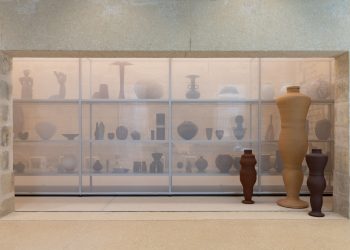
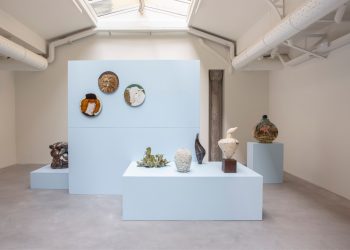
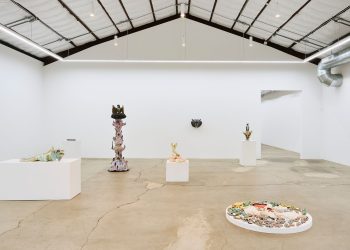
Although each sculpture can stand alone, I am increasingly interested in how groups of works can create environments — immersive spaces where multiple forms interact like ecosystems. In exhibition contexts, I often install works in relation to one another, creating subtle narratives of proximity, interaction, and mutual influence.