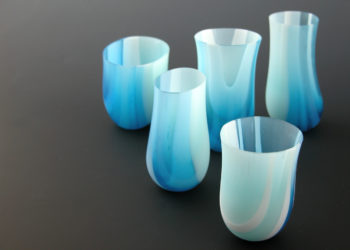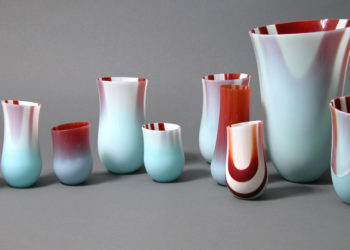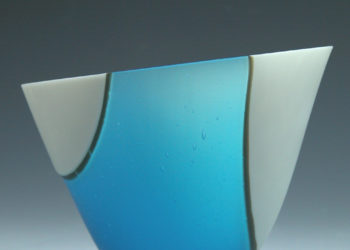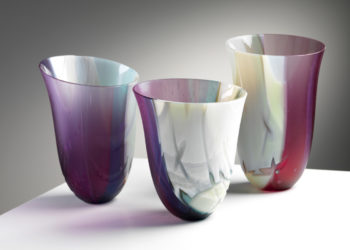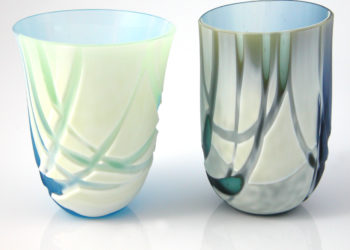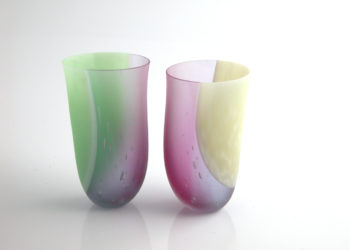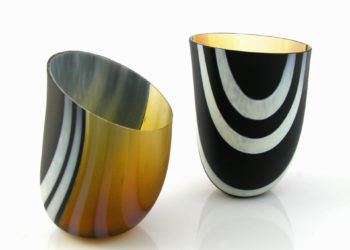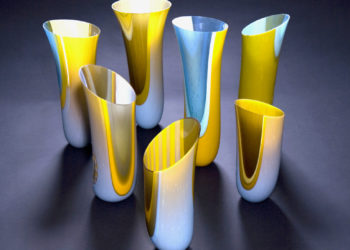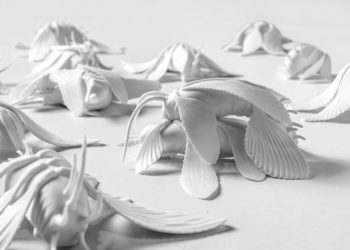
Simcha Even-Chen: Waves
magazine
Chris Wight: Organic Modular Construction, Slip-cast hand-carved and glaze-bonded bone china. Materials: Bone china, silver, concrete. Dimensions: w21 x d8 x h20 cm
Wim Borst
Wim Borst’s profile on Ceramics Now Magazine - View his works
→ Read the interview with Wim Borst, New Artist - May 2011
Wim Borst became a professional ceramist at a rather advanced age. At the age of 31 he exhibited for the first time. As a self taught artist he took lessons in ceramics from Ru de Boer and Emmy van Deventer a.o.
His oeuvre and career are characterized by a great accuracy and a persistent mentality. His ceramics has its roots in the Dutch geometrical abstract tradition, although he uses the idiom in a non-academic, refreshing way. Within the boundaries of the self chosen restrictions of the geometric abstraction, he takes liberties with colors, materials and themes. His objects are (generally) made up of different parts.
Wim Borst is exhibiting regularly in the Netherlands and abroad. He is a member of the NVK (the Dutch Society of Ceramic artists) and of ‘de Vishal’, (a local society of artists in Haarlem, his native town).
He is part of a group of Dutch ceramists, CeramiCVision.nl who regularly join to discuss their profession; they are looking for opportunities to attract the attention of the public for their works and they are organizing exhibitions as a group.
His work is in private collections and in museum collections in the Netherlands and abroad, such as Museum Boijmans Van Beuningen in Rotterdam, Boston Museum of Fine Arts in Boston USA, Frans Halsmuseum in Haarlem, Museum Keramion in Frechen Germany, ‘Magnelli Museum’, the Ceramics Museum of Vallauris, France, Museum Het Princessehof in Leeuwarden, and Stedelijk Museum Schiedam.
Guðný Hafsteinsdóttir
Guðný Hafsteinsdóttir’s profile on Ceramics Now Magazine - View her works
“I divide my time between teaching and working in my studio. I am a teacher and I’ve emphasised on texile and history in my profession. I believe my current works are inspired by and reflect my educational backdrop. My objects often carry a historical and ethnical connotation.
My inspirations are gathered from all over; my environment, the newspapers, books, fashion and the people around me. My students too are a source of inspiration because of their joyful and ingenuous worldview.
As a ceramist I have specialised in casted forms and the recycling of glass. I especially use old bottles, for which I create a new context and give a new usage. The glides is a design serie I’ve been developing the last few years. I gather their basic structure from gutter- and drainpipes. The serie consists of cups, small containers, candleholders and wall/table vases in various forms and sizes.” Guðný Hafsteinsdóttir
“Guðný Hafsteinsdóttir is a ceramic artist whose medium is not limited to clay. As her works show, her background is first and foremost Icelandic, but in addition to her studies at the Icelandic School of Art and Craft, Guðný has also studied and experienced ceramics in Denmark, Finland and Hungary.
Iceland has a great story-telling tradition and the works of Icelandic artists are often characterised by story-telling features. This also applies to Guðný’s work. Motifs of ancient traditional beliefs are reborn in her beautifully formed freedom stones. Such stones were traditionally used to help women during childbirth. Poems sometimes accompany her works, which make them more personal and add a level of sincerity. Heads of characters from the Viking era appear from glass bottles that have been given a new costume, and in similar works, Guðný flies the flag for Icelandic women. Contemporary recycling gets a new role through Guðný’s works.
But the feeling is far from one where the weight of history rests on the works. On the contrary, her newest works are characterised by lightness and gaiety. Guðný often looks to form in everyday life for inspiration for her craft works. So for example, roof gutters and raindrops are the inspiration for her newest line in cups, trays and breadboards. Here one can find both the form of raindrops and the colour of blue skies. Guðný’s work is characterised by imagination, variety, an awareness of the past and a sensitive perception of the present. Together, these qualities create colourful and thought-provoking art.” Ragna Sigurðardóttir
Merete Rasmussen
Merete Rasmussen’s profile on Ceramics Now Magazine - View her works
“I work with abstract sculptural form. I am interested in the idea of one continuous surface, with one connected edge or line running through the whole form. Clear, clean shapes; soft smooth curves in contrast to sharp edges; concave and convex surfaces; the discovery and strength of an inner/negative space - these are all form expressions that appeal to me and results in my continuous exploration and expression in many different variations.
My sculptures are either asymmetrical or with a repetition of form:
- Asymmetrical where I mainly work with the idea of continuous surface. The form has only one side and one edge connected throughout the shape.
- Repetition of form with three symmetrical parts that are connected; three being both a strong number and a balanced repetition of form. The negative space - the shape of the space in between, is equally important.
My work is hand built in coiling technique. Stoneware is my chosen material for its qualities - I like to challenge the material and my own skills by building complicated shapes; fragile in the building, drying and firing process which upon firing attain the strength to be handled and positioned without support.
I often get an idea for a new form while working on another. I also find my inspiration in form I see in nature as well as architecture and design; clean curves, sparse decoration, simplicity. To emphasize the form I use a matt surface and monochrome colours.
I was born in Denmark but grew up in Sweden. I returned to Denmark to study at Design School Kolding in 2000, and moved to London in 2005 after graduating. I have since then predominately worked with sculptural forms.” Merete Rasmussen