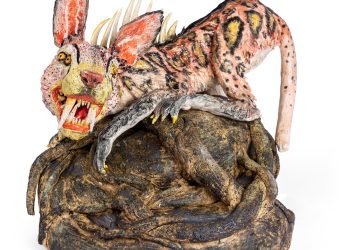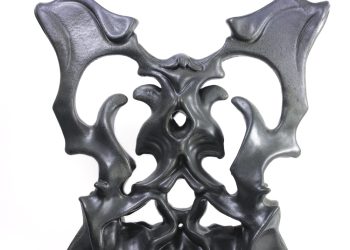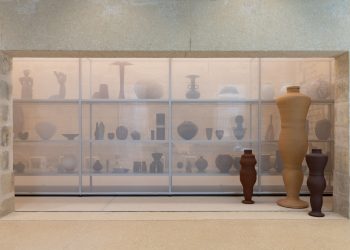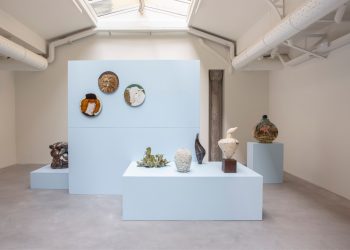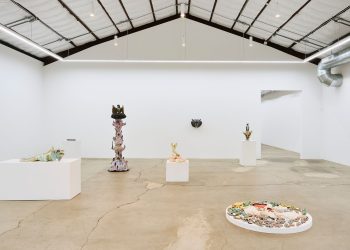
Carolein Smit is a Dutch artist based in Riemst, Belgium, internationally recognized for her detailed and symbolically rich ceramic sculptures. Born in Amersfoort in 1960, she studied at the Academy of Fine Arts Sint Joost in Breda, the Netherlands (1979–1984), specializing in graphics and lithography. Originally trained as a lithographer, she began working with clay in 1996 during a three-month residency at the European Ceramics Work Centre in ‘s-Hertogenbosch, the Netherlands.
Working outside the conventions of traditional ceramic training, Smit approaches the medium without technical boundaries, combining hand-building with press-moulded details. Her intricate glazing process involves multiple firings, layering glazes and lustres to achieve complex surfaces and colour effects.
Since the early 2000s, Smit has exhibited widely in museums, galleries, and art fairs across Europe and beyond. Her major solo exhibitions include Myth and Mortality: The Fairytale World of Carolein Smit at the Victoria and Albert Museum, London (2018); L’Amour Fou at the Grassi Museum, Leipzig (2018); Secret Garden at the Stedelijk Museum Kampen (2022); and Dents! Crocs! Griffes! at the Musée de la Chasse et de la Nature, Paris (2022). Her work has also been presented at the Kunsthal Rotterdam, Drents Museum, and numerous galleries in Amsterdam, Berlin, Paris, and beyond. She is a regular participant in international art fairs such as TEFAF Maastricht, PAD Paris, Art Paris, and Collect London.
Her sculptures are held in prominent public collections, including the Victoria and Albert Museum (London), Musée de la Chasse et de la Nature (Paris), Museum Boijmans Van Beuningen (Rotterdam), Grassi Museum (Leipzig), Drents Museum (Assen), Museum MORE (Gorssel), Badisches Landesmuseum (Karlsruhe), Museum Beelden aan Zee (Scheveningen), and the FLICAM International Museum (Fuping, China), as well as numerous corporate and private collections worldwide.
Visit Carolein Smit’s website and Instagram page.
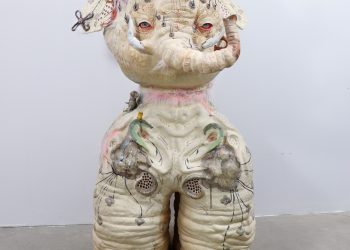
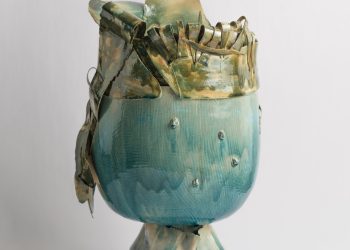
Featured work
Selected works, 2021-2025

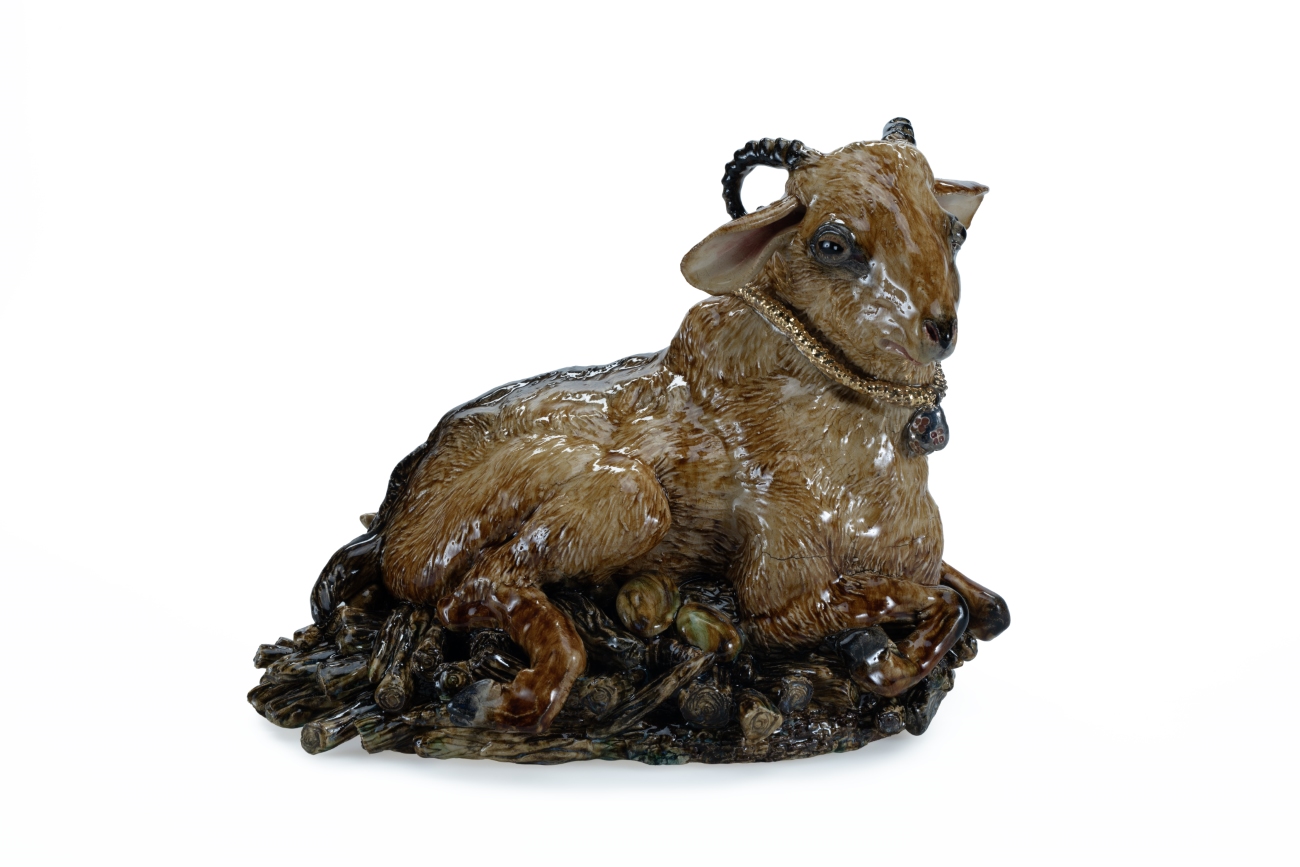
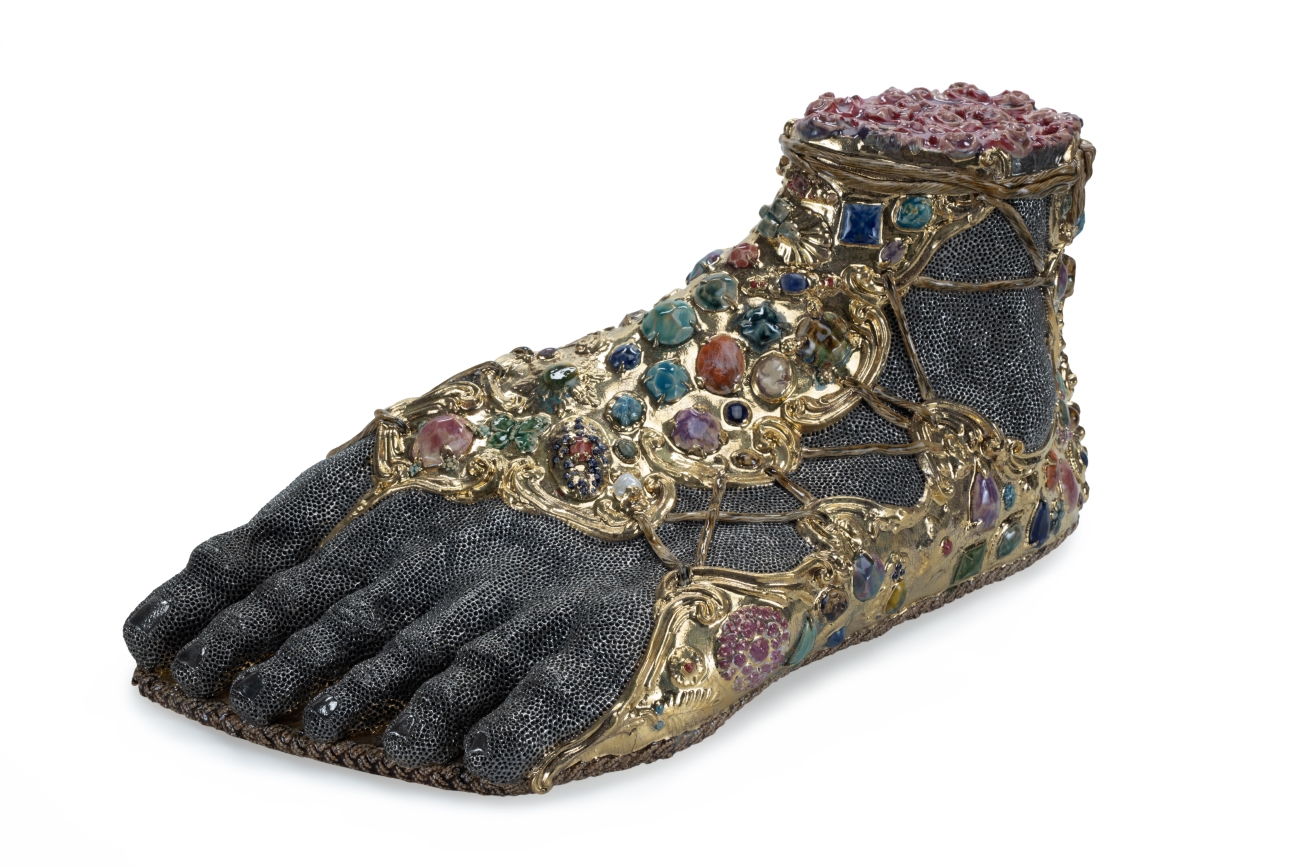
It is not very difficult to like my work. Everything shines and glitters, is adorable, and the details of eyes, tongues, noses, and ears are endearing. People love that kind of refinement; it can bring back memories of precious Meissen porcelain. That’s just the way I like it. I want people to love my sculptures. I want them to lose their hearts to them, and I use all I can to make them do so. At the same time, I want to make this loving not too easy. It’s painful, fragile, unfulfilled, and sometimes downright dangerous. Where are the boundaries? Where does innocence become guilt, or life become death? That is what my work is about.
The tension comes from emotional dilemmas, trying to separate right from wrong, where everything evolves out of clumsiness, coincidence, and misunderstanding. In my work, these dilemmas exist as a complicated knot of conflicting messages. I think that the turning point where seriousness becomes melodrama, beauty turns into overkill, and love becomes hate creates a subtle balance that is both annoying and very interesting. Humor often sneaks into my work as I am making it. I never make sketches before I start; I need it to be an adventure.
The highly detailed works allow my thoughts to wander and combine things that may not be very logical together but make sense in the end. When I work in my studio, I go from one piece to the next, combining several thoughts and fascinations. I love cabinets of curiosity, Wunderkammern, scientific collections, and museums with devotionalia. All these collections contain images that are related to art, but also to other areas. They show the exceptional, the strange, the rare, to secure the scientific order. They uplift the supernatural to restrain the whims of nature, suggesting order and security. At the same time, they warn us of the chaos that will occur as soon as we let go of this proposed order. They are images that scare us and also restrain that fear. This ambivalence makes us look with both admiration and disgust.