By Anisio Veloso
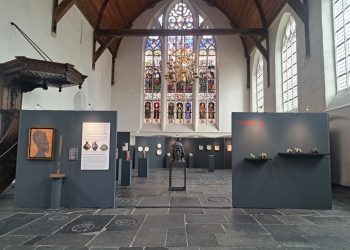
From the doorway, the room looked almost too composed.
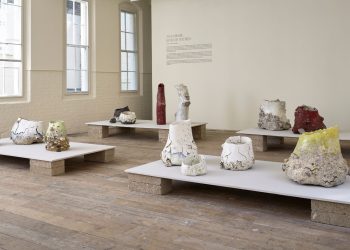
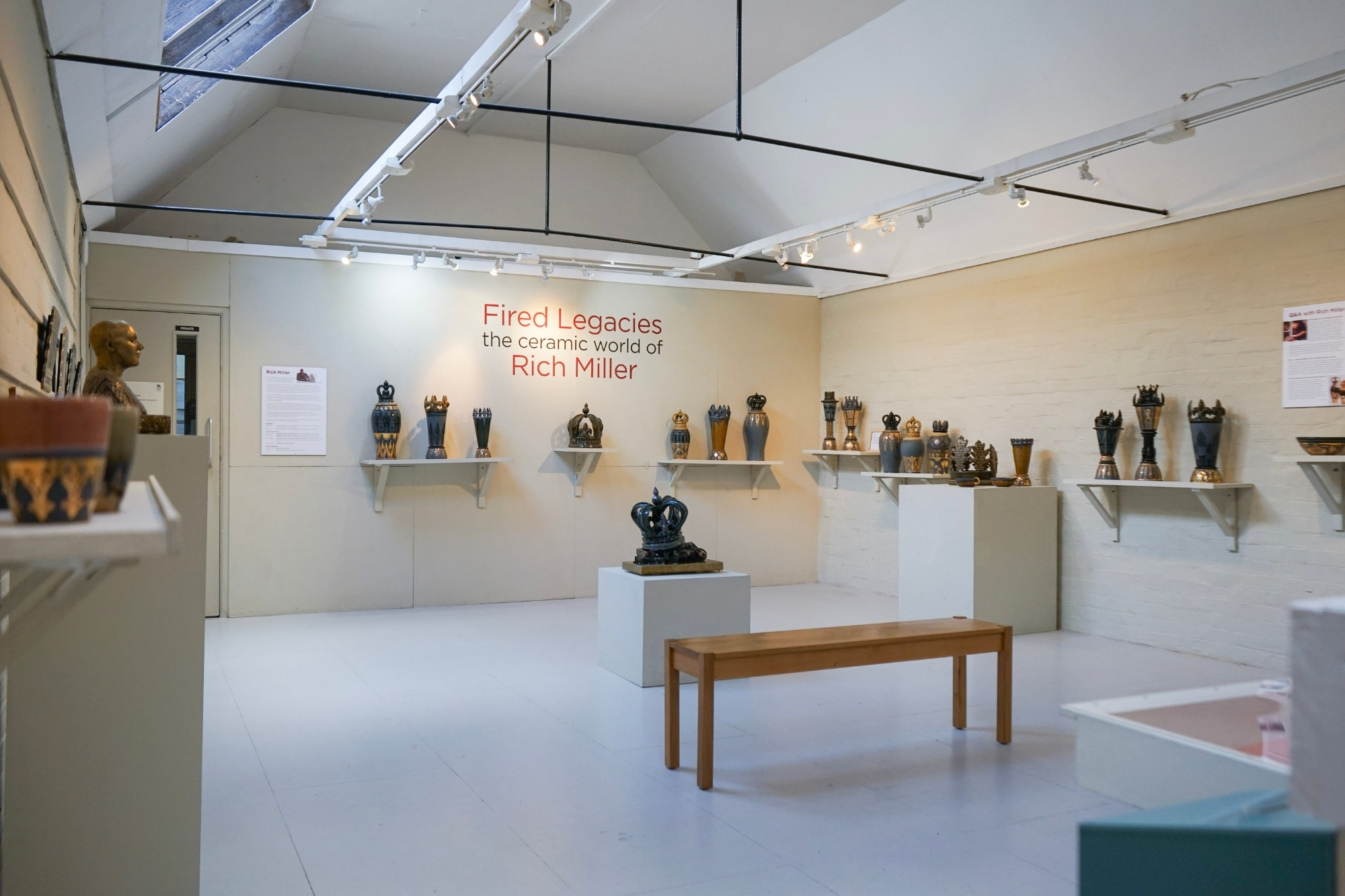
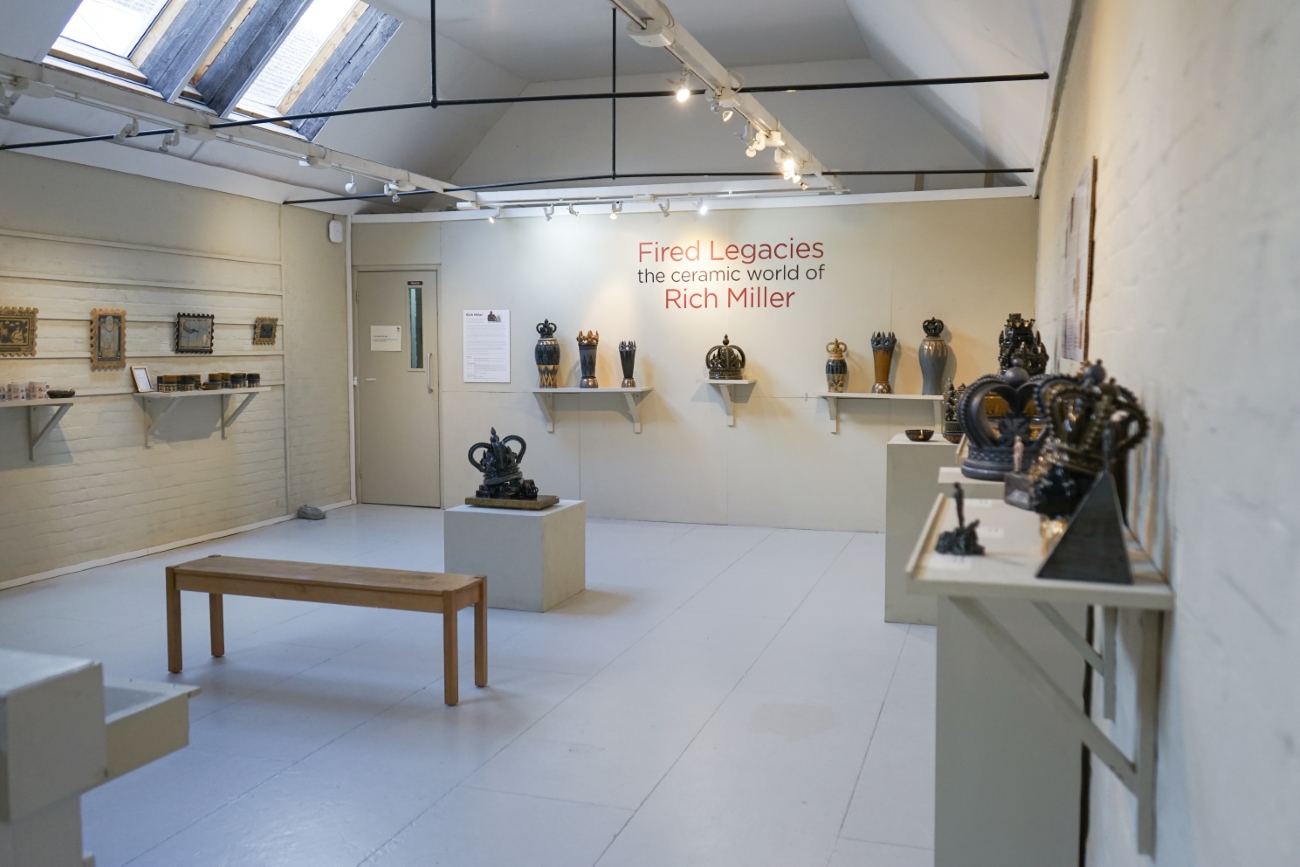
White shelves ran cleanly along the walls. A central plinth held a dark crown with the gravity of a ceremonial object. Bottles stood upright in a disciplined row. Smaller pieces, jewel-like or badge-like, sat in careful relation to one another. Nothing pushed itself forward. Nothing performed urgency. For a moment I wondered whether the exhibition would settle for elegance.
It did not. On view at Watts Gallery from 16 April to 28 June 2026, Fired Legacies: the ceramic world of Rich Miller does something more difficult than scale or spectacle. It gathers crowns, bottles, busts and transfer-derived fragments into a field of memory that grows stranger the longer one looks. The first impression is order; the second is burden.
The room is not crowded, but it is full of loaded things: crowns, heraldic signs, transferware echoes, vessels that carry more than surface pattern, a bust with closed eyes, ceramic fragments in which Britishness has not disappeared so much as curdled. What begins as composure gradually reveals itself as something tighter and stranger. The exhibition asks what happens when symbols of nation, monarchy, and inheritance are returned to clay and made to live there again.
What gives the exhibition its critical interest is that it does not require Rich Miller’s importance to be assumed in advance. He is not presented here as a figure whose place in British ceramics is already settled beyond question, and the show is stronger for that. Instead, it asks whether his work can carry a larger historical burden than the rhetoric of heritage ceramics usually allows — whether crowns, bottles, transfer-derived fragments, and figurative form can sustain questions of inheritance, empire, migration, and decorative power without collapsing into statement. At its best, the answer is yes. At weaker moments, one feels the strain. But that tension is precisely what makes the exhibition worth taking seriously.
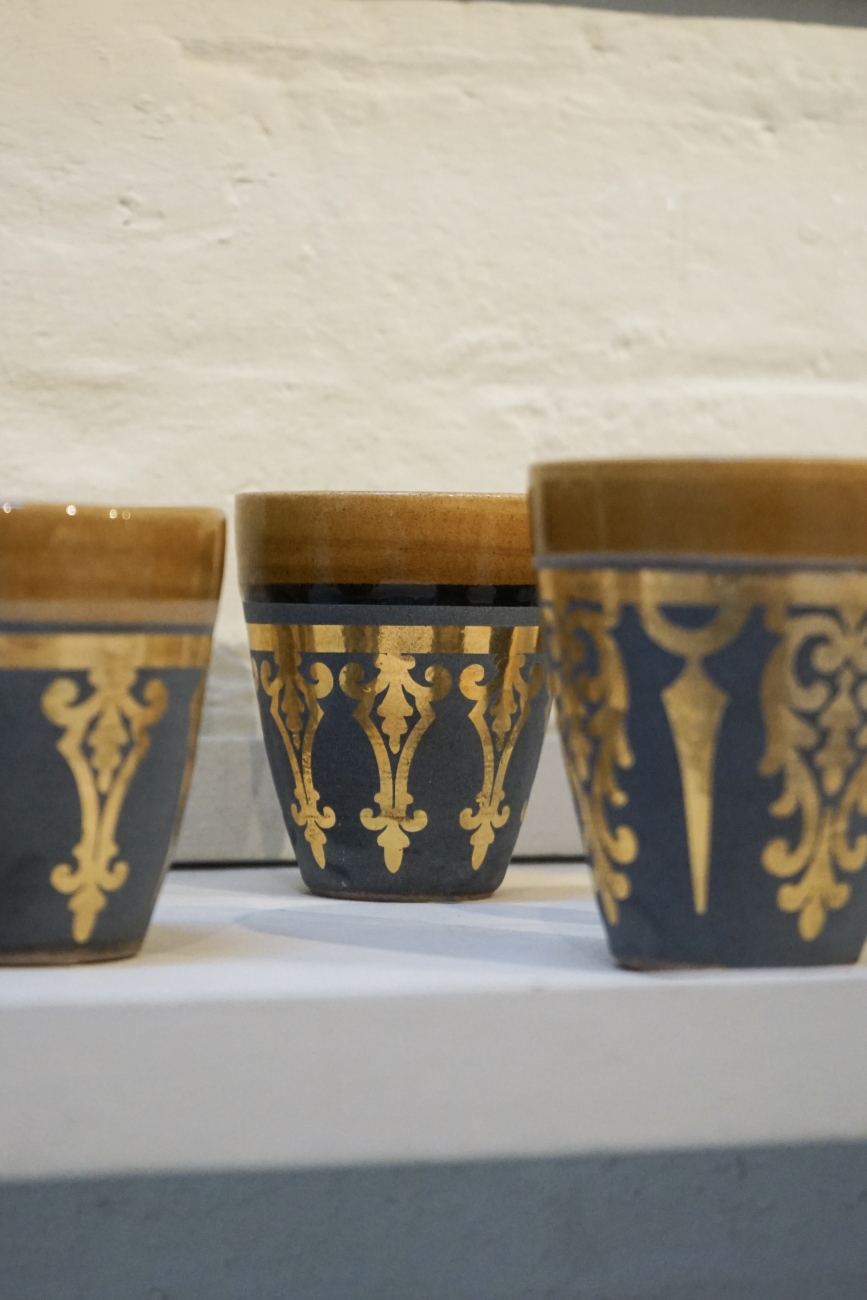
The bottles, including Bottle, were where the show first sharpened for me. Seen from a distance, they had the authority of repeated form: upright, balanced, dignified, their silhouettes almost classical in their steadiness. Long necks, swelling shoulders, broad bodies. But as I moved along the shelf, the surfaces started to complicate that calm. Each bottle carried a contained field of imagery. A gold silhouette, a geometric chevron, a heraldic interruption, a visual sign that felt at once decorative and official. Their repetition steadied the eye, but the imagery kept troubling the steadiness. They stopped reading as variations on a vessel type and started to feel more like a procession, or a line of testimony.
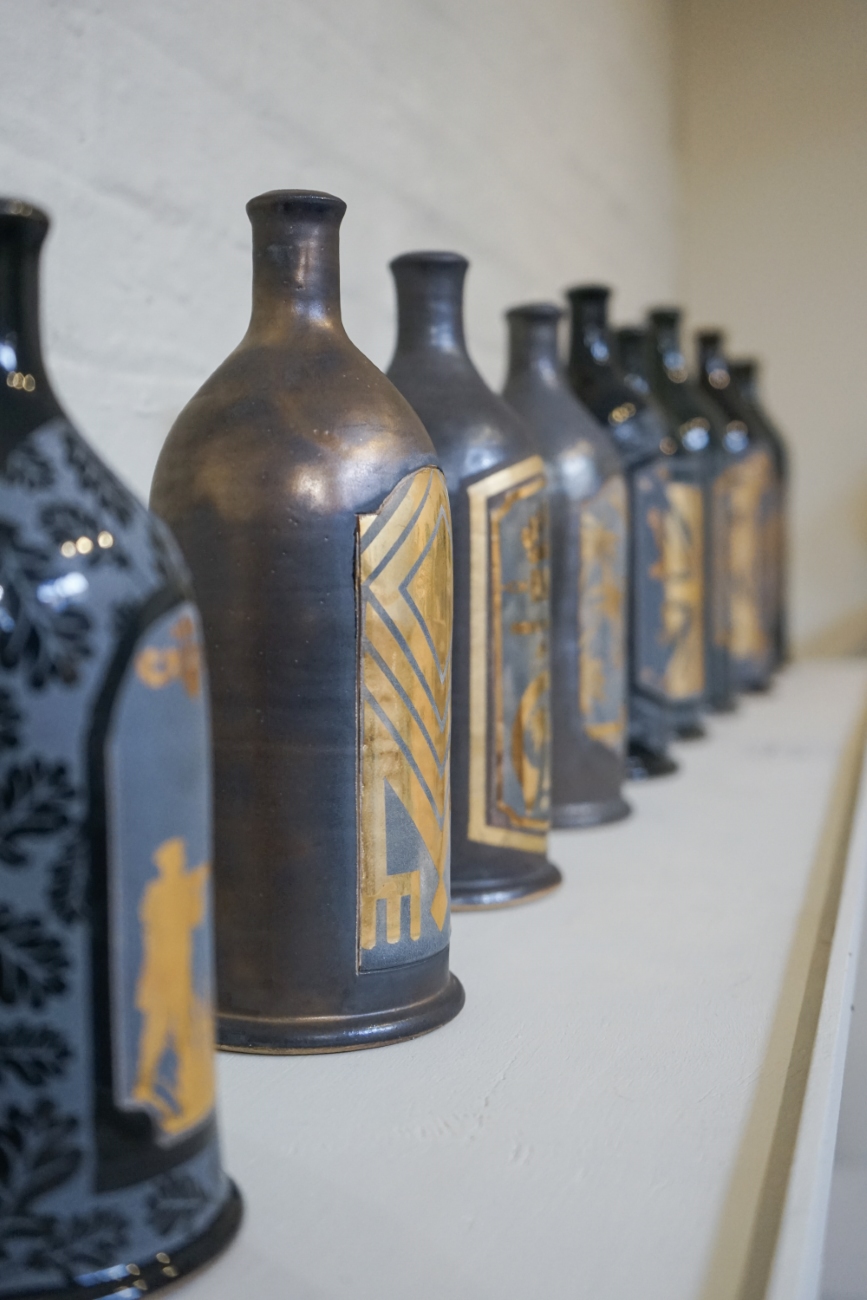
That shift matters. The bottle is a form of circulation: liquid, trade, storage, passage, use. Here it becomes something closer to a vertical archive. Not noisy, not overworked, but quietly insistent. Miller lets the dignity of the form do part of the work for him. The bottles stand well. They are beautiful. That beauty is exactly what makes them dangerous. They show how symbols settle most deeply when carried by objects that appear stable enough not to need questioning.
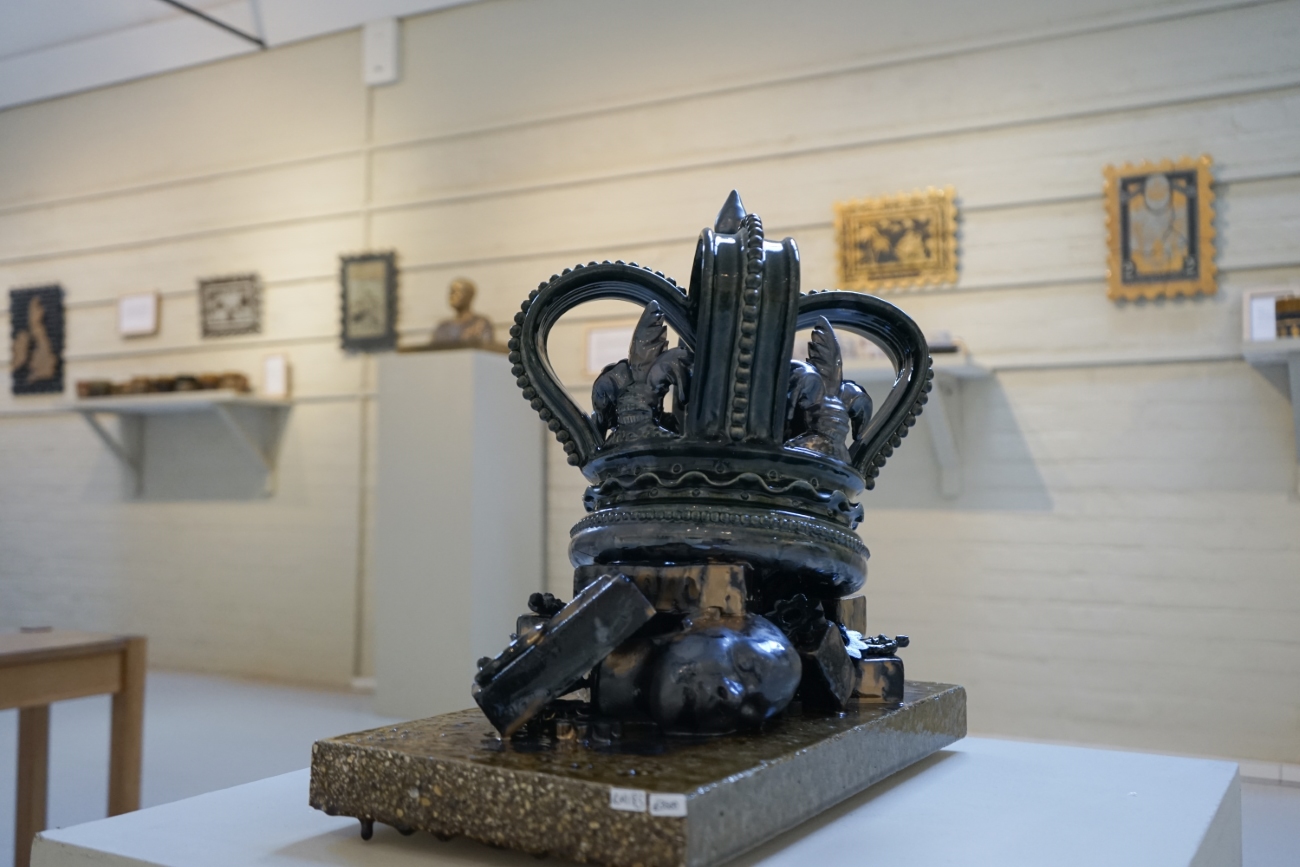
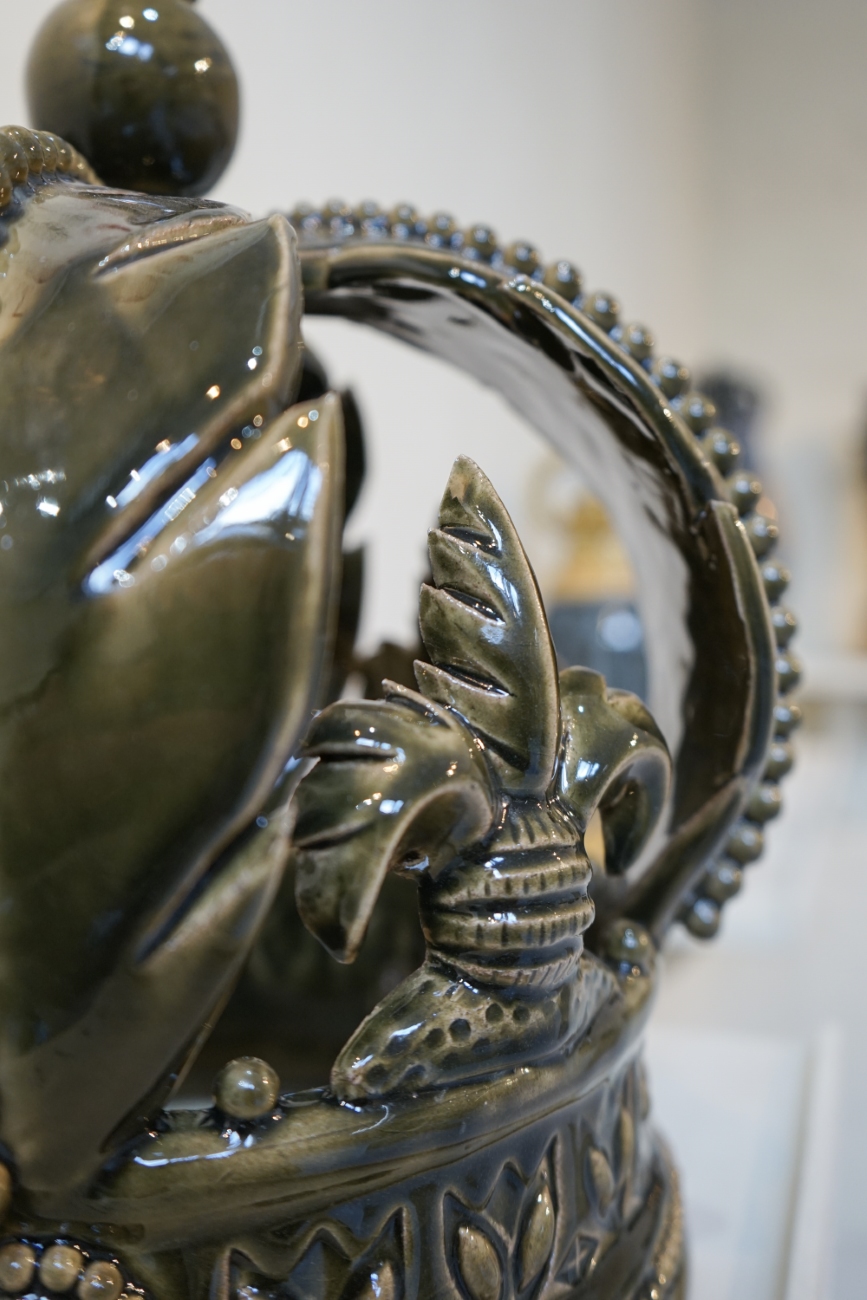
The crowns are a harder problem, because they begin so close to their own meaning. A crown is already an argument. It risks exhausting itself at first glance. Some of Miller’s crown works come near that danger. They can feel almost too available in their symbolism, too ready to announce what they stand for. But the strongest of them resist easy reading through material presence. The large dark crown, Black Crown, on the central plinth held much longer than I expected. It is glossy, perforated, heavy without becoming monumental, at once ceremonious and slightly hollowed out by its own theatricality. It sits in the room like an emblem that has survived its certainty.
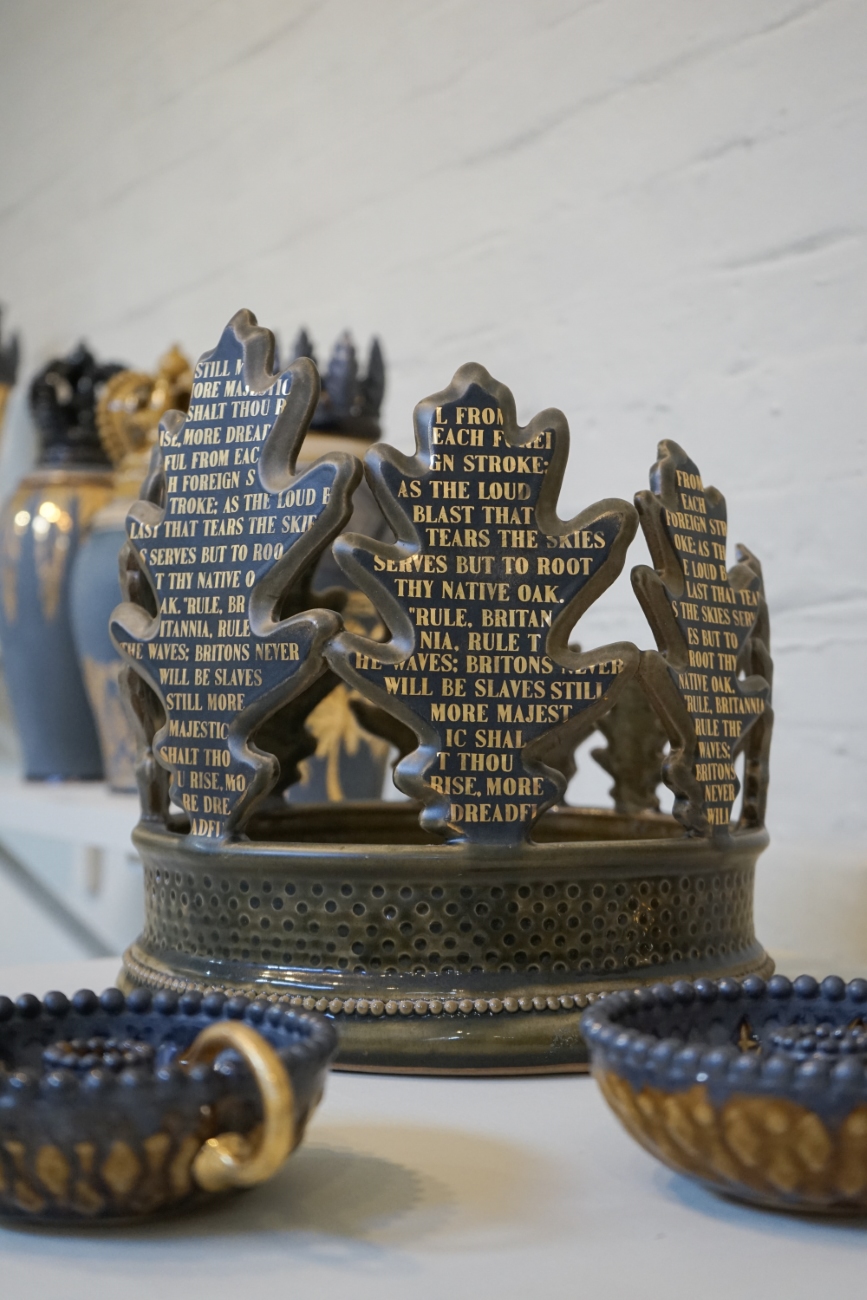
Another crown-like form, Crown Topped Jar, carries fragments of “Rule, Britannia!” across its rising surfaces. That could easily have tipped into bluntness. Instead, the broken distribution of the words across the ceramic edges does something more uneasy. Patriotic language becomes decorative and strained at the same time. The phrase is still there, but its confidence has thinned. One reads not authority exactly, but the afterlife of authority: rhetoric persisting after belief has lost its ease.
That, for me, is the exhibition’s real subject. Not monarchy in any straightforward sense, and not nostalgia either. What the best works keep returning to is the decorative persistence of power: how authority survives in beautiful things, in repeated symbols, in surfaces that remain attractive long after the systems behind them have become harder to defend.
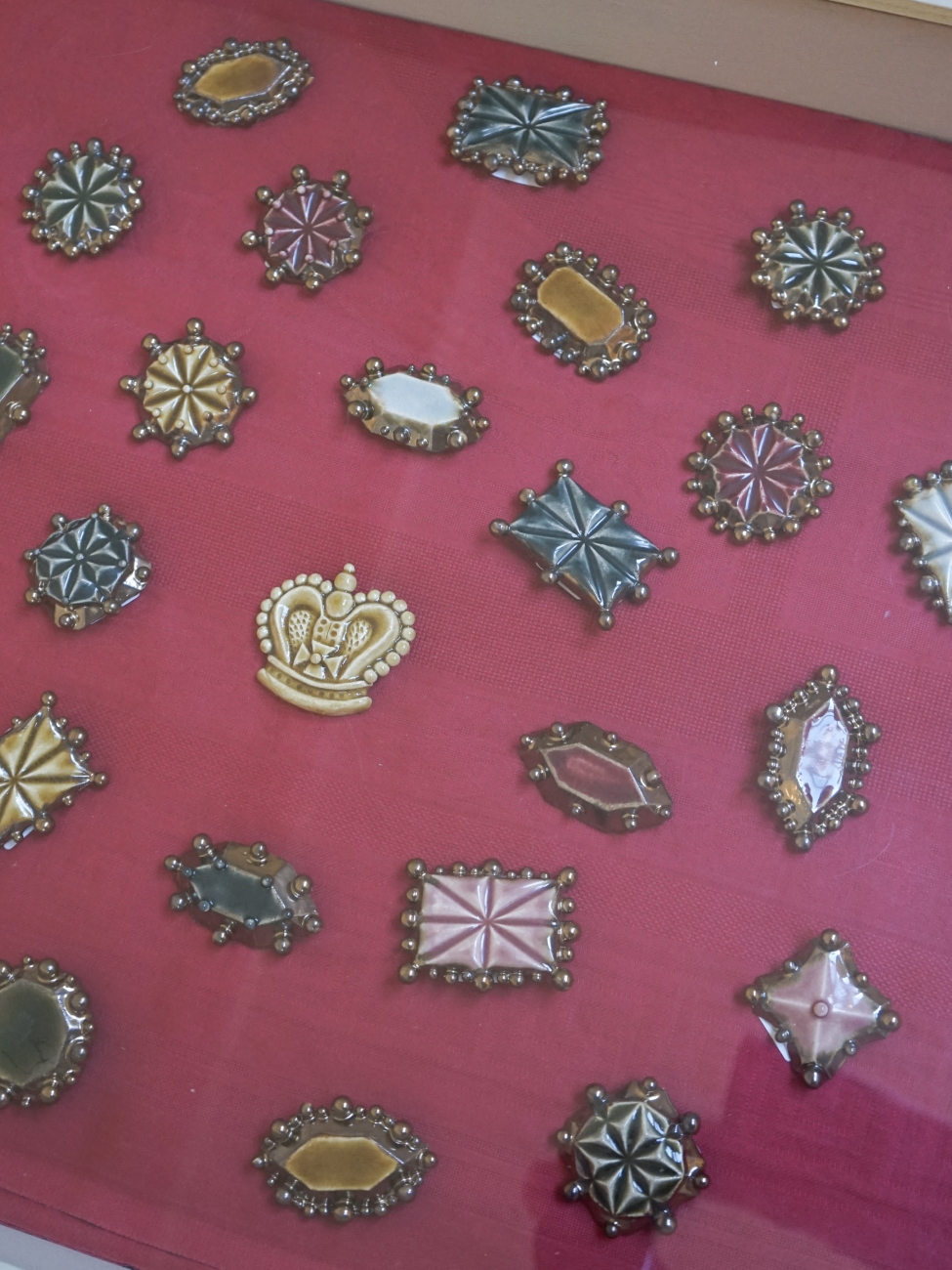
A smaller grouping of lustrous, jewel-like pieces, Brooch, against a vivid pink ground made that especially clear. They looked almost celebratory at first, like insignia, ornaments, or honours set out for admiration. The colour was lively, the arrangement playful enough to invite delight. But the longer I looked, the less innocent they became. They suggested a system of reward, rank, miniature prestige — an ornamental grammar of belonging. Their charm was real. So was their discipline.
The bust changed the room. Up to that point, much of the exhibition had worked through symbol: crown, bottle, insignia, heraldic citation, transfer-derived image. Then suddenly there was a face. Eyes closed, surface glinting, torso patterned, the bust introduced a different kind of silence. It did not ask to be read quickly. It withdrew from the exhibition’s more public rhetoric and held itself inwardly. That inwardness was important. It reminded me that inheritance is not only institutional or national. It passes through bodies. It settles in posture, clothing, memory, accent, belonging, estrangement. The closed eyes refused performance. The work did not explain. It absorbed.
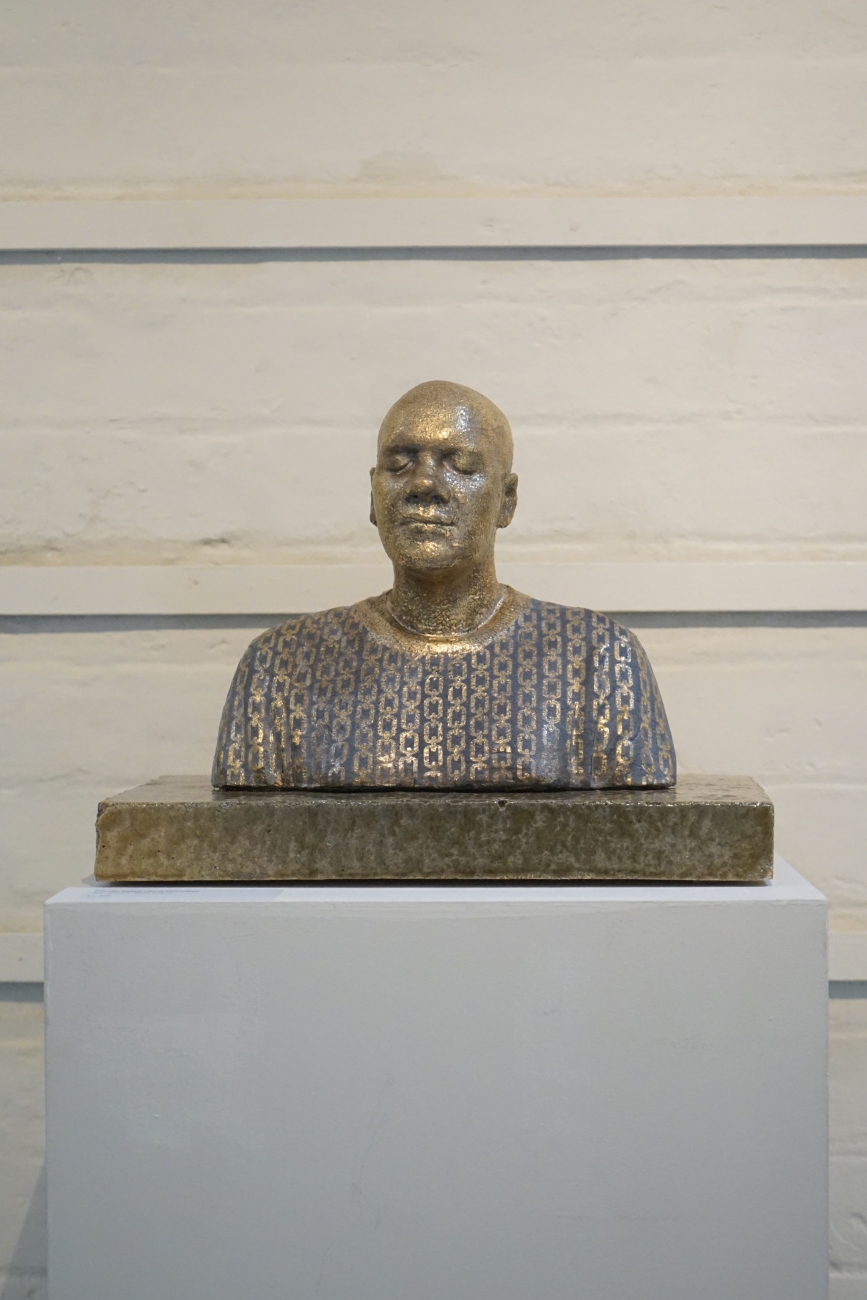
This was one of the strongest turns in the exhibition, because it gave the room a centre of gravity beyond emblem. I found myself returning to it after the more declarative works. The crowns and transfer motifs carried the larger argument, but the bust made the argument human enough to matter.
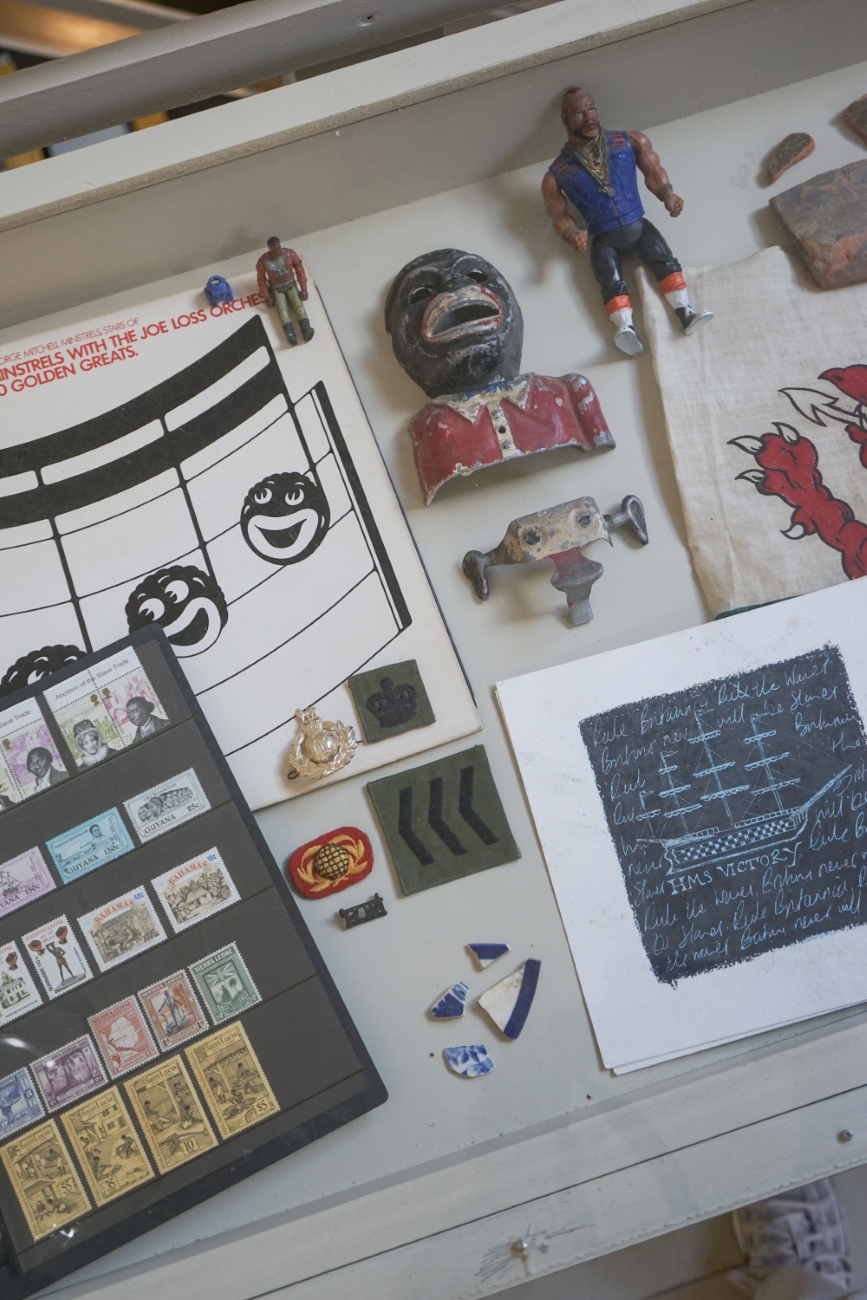
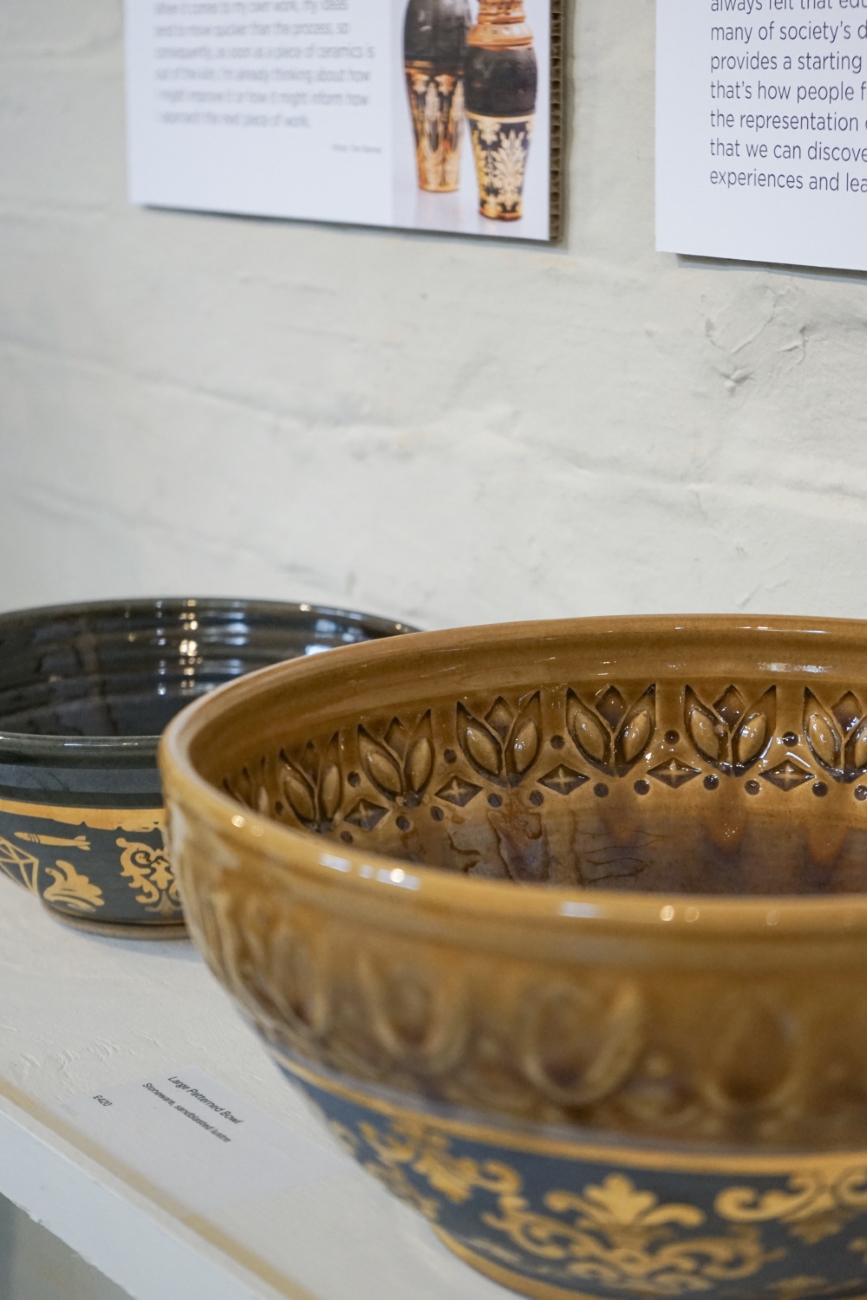
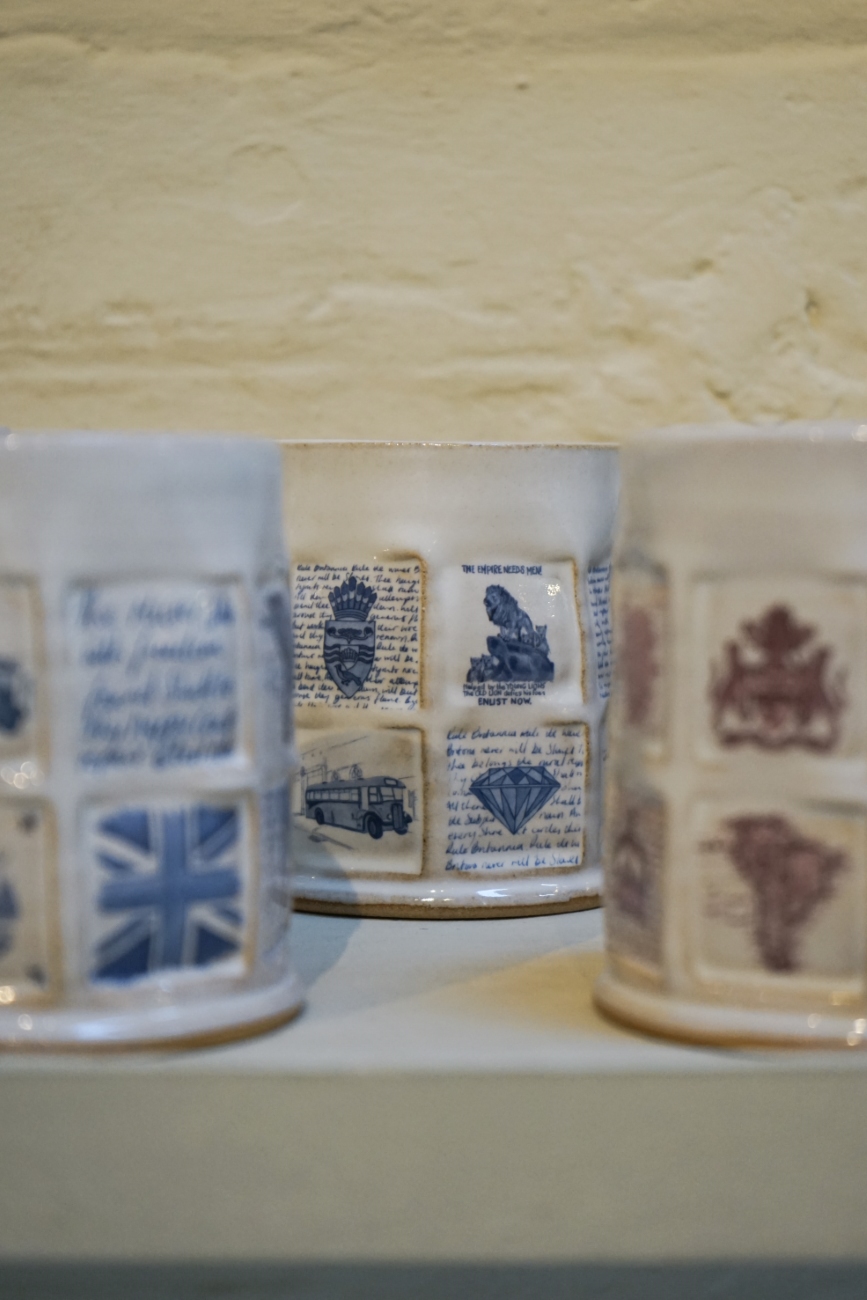
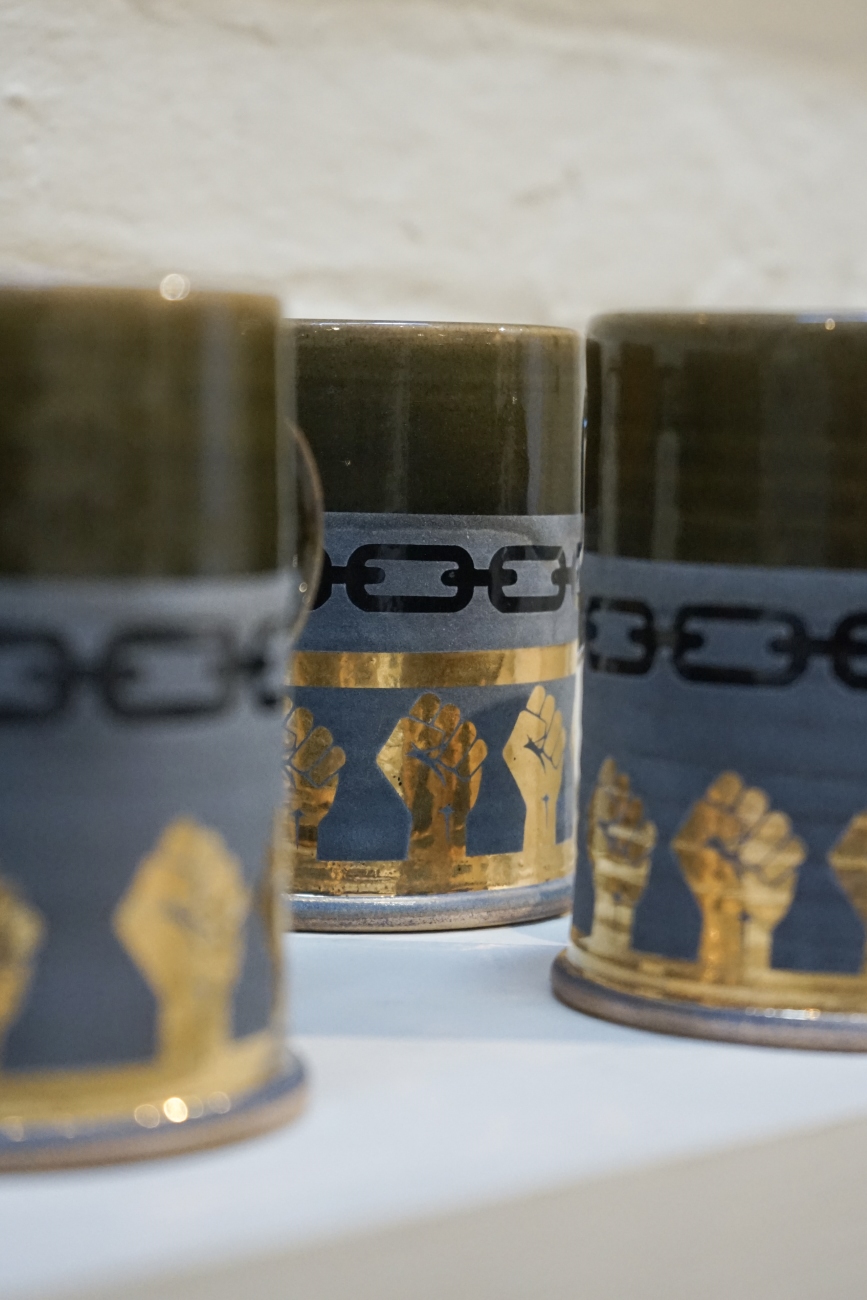
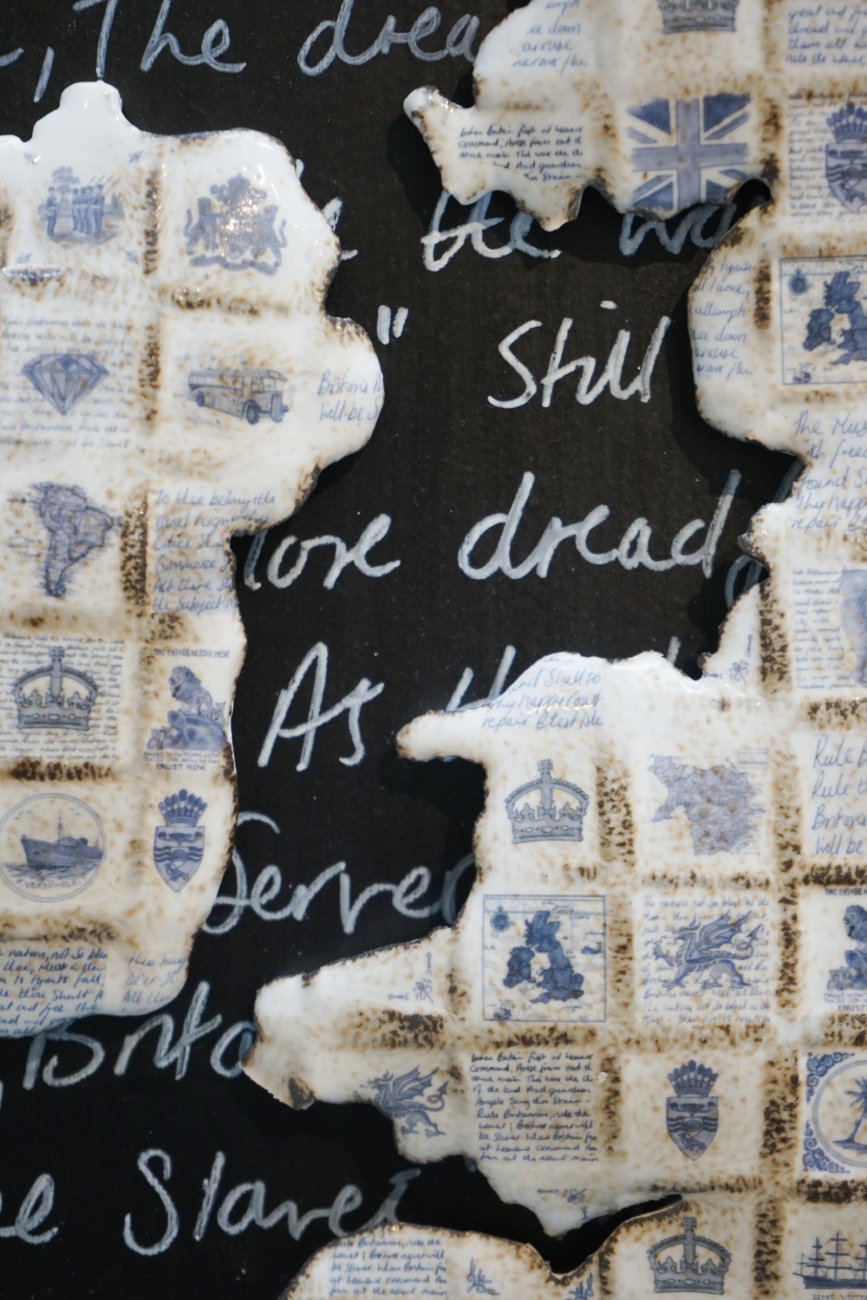
The transferware pieces were the hardest to evade. Blue-and-white ceramic language carries so much history so quietly that one can almost forget how political it has always been. In Miller’s hands, that language comes back damaged: maps, flags, lions, script, buses, crowns, all broken across charred-looking fragments and cup-like forms whose edges refuse neat completion. They do not present Britishness as a stable set of signs. They show it as residue. Something inherited, handled, cracked, kept.
These works understood the domestic life of empire. Power does not only survive in statues, speeches, and institutions. It lingers in cups, plates, patterns, souvenirs, little systems of taste and display that become ordinary enough to pass beneath notice.
Miller is very good on this point. He does not need to illustrate colonial history directly. He lets image, fragment, and ceramic form do quieter work. The result is more unsettling than a straightforward denunciation would have been.
The exhibition’s wider programme includes a conversation with Magdalene Odundo, though in the room I found myself thinking more often of Clare Twomey, whose work has also asked ceramics to carry social, historical, and institutional meaning beyond the vessel alone. Miller’s most persuasive works are not primarily about contour, balance, or the vessel’s bodily self-possession. They approach history from another direction: through emblem, repetition, ceremony, and the decorative afterlife of power. The link is not one of formal resemblance, but of shared seriousness about what ceramic form can be asked to carry.
That difference mattered to me with particular force because I do not stand outside these histories. I am Brazilian and British, with Portuguese and Dutch ancestry, and I cannot look at an exhibition like this without feeling the wider Atlantic weight inside it. Trade, migration, extraction, imitation, ceremony, the movement of goods and symbols – ceramics is bound up with all of that. Porcelain especially cannot be separated from the routes of commerce and desire that helped shape colonial modernity. To work with porcelain now is to touch, however indirectly, a material history shaped by global exchange and imperial appetite.
This is why the exhibition is more persuasive than its own theme might sound on paper. If one described it simply as a show about British colonial history, migration, and identity, one might expect work that was worthy but predictable, or too dependent on wall text to do its job. In the room, the better works avoid that fate because they are first of all objects – exact, attractive, disciplined objects that allow discomfort to emerge from form rather than slogan.
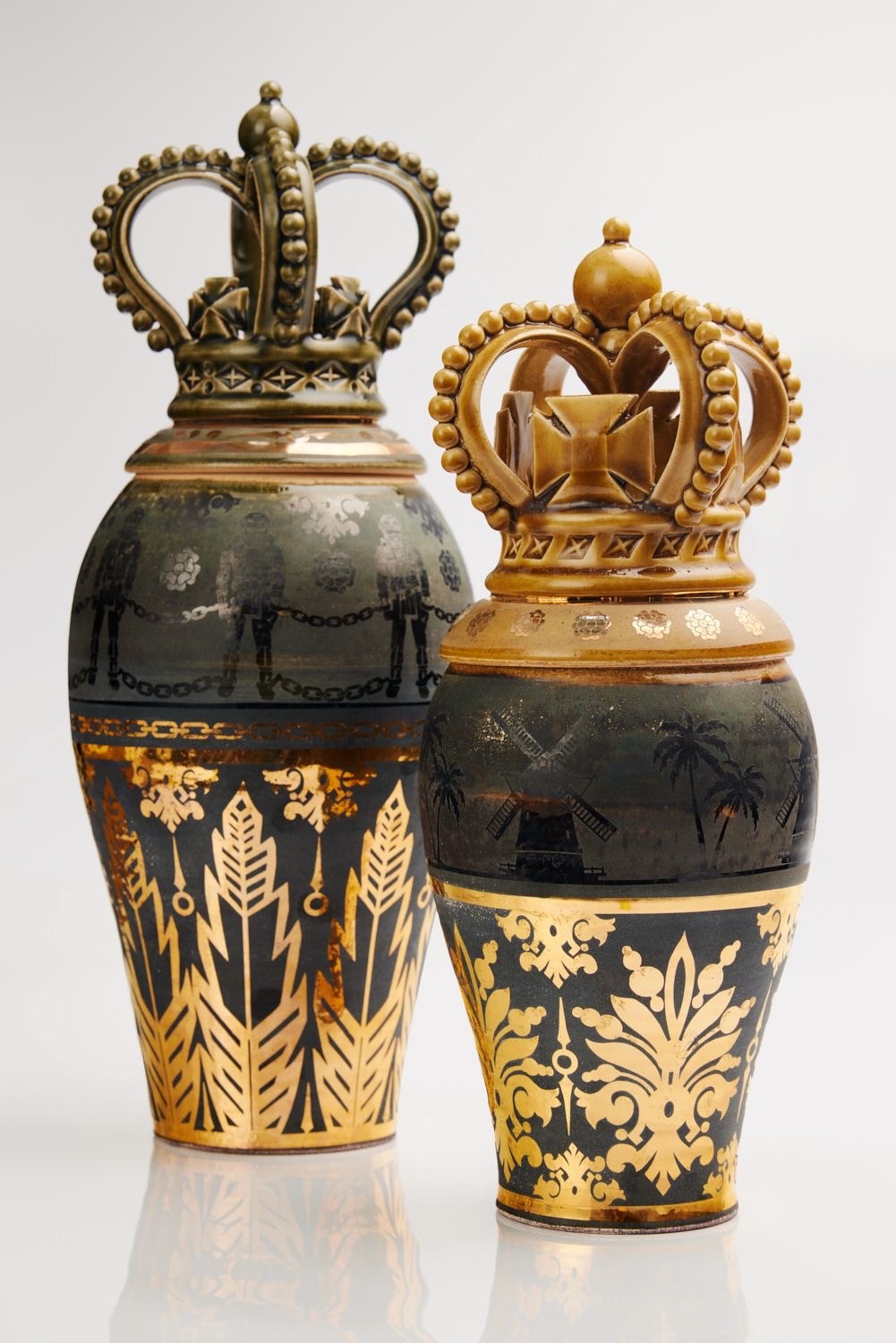
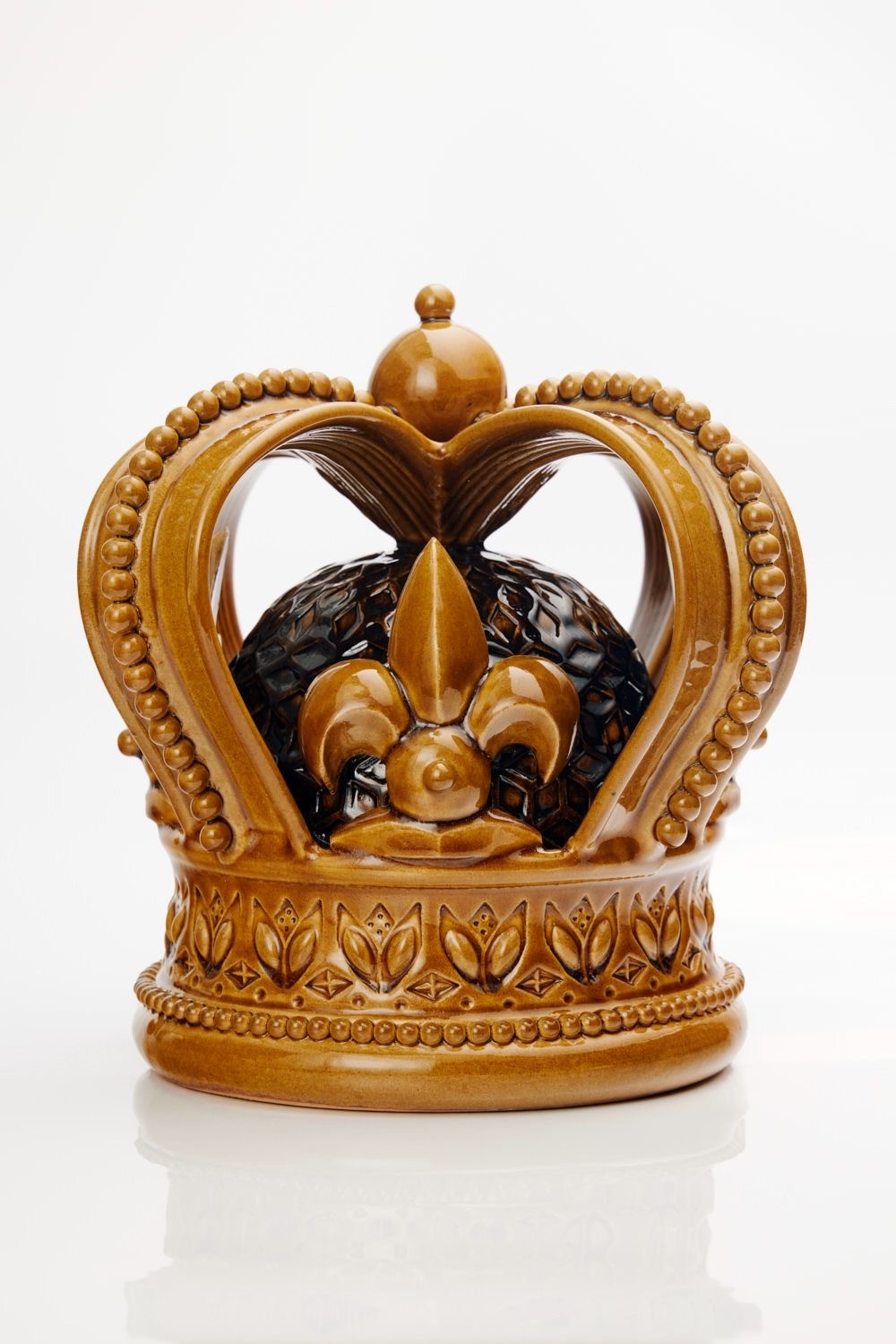
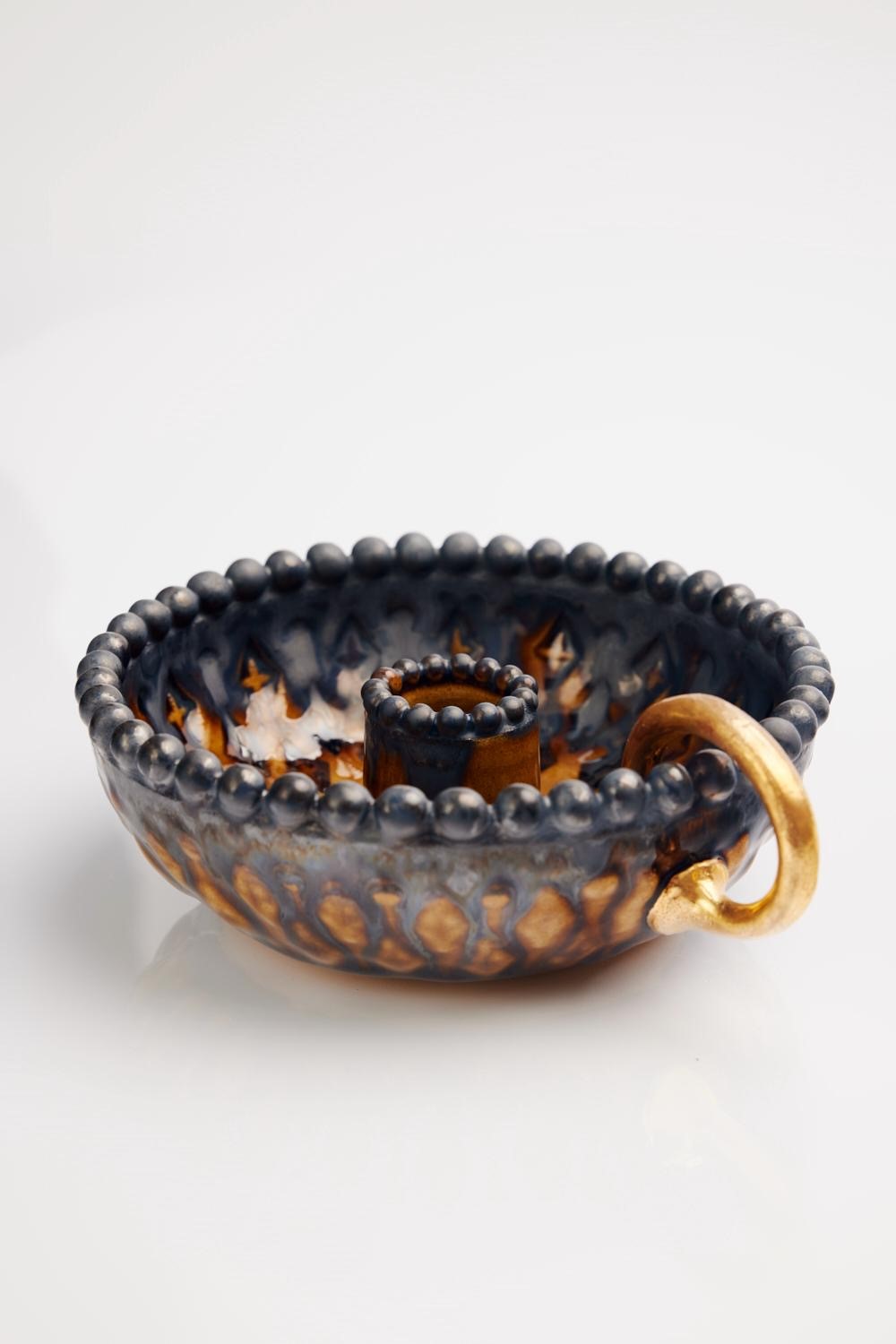
That is not true of every piece equally. There are moments where the crown motif, in particular, risks becoming too legible too quickly. Some works carry their symbolism openly enough that they do not continue to deepen after the first encounter. But even that unevenness is useful. It clarifies where Miller’s practice has most force. He is strongest when symbol has been made to pass through repetition, fracture, or bodily inwardness, the bottles, the transferware pieces, the bust, and weaker when the emblem is left to carry too much on its own. The exhibition does not hide those limits, and to its credit, it does not need to. A serious show need not make every work equally persuasive; it needs to reveal where the artist’s real pressure lies.
The exhibition also helped me think again about seriousness in ceramics. There is a temptation, especially for those of us working through porcelain and through questions of fragility, to assume that quietness is the more intelligent mode. Muted surfaces, reduced forms, moral tactility, anti-ornamental restraint – all of that can become a kind of default virtue. Miller complicates that. He shows that decoration and historical charge can also be handled critically, provided the form is exact enough to bear them. That is not an easier discipline than reduction. In some ways it is riskier. Excess collapses into noise very quickly. Miller’s best works stay just on the right side of that danger.
What remained with me after leaving was not one dominant piece but a sequence of returns: the line of bottles becoming more accusatory as I moved along it; the dark crown holding its theatricality without quite surrendering to it; the transfer-derived works making Britishness feel less symbolic than domestic and inherited; the bust changing the room from emblem to body. That is why the exhibition stayed with me. It did not simply make an argument about history. It altered the speed and quality of looking.
Fired Legacies succeeds because it understands that empire rarely leaves cleanly. It remains in ornament, on shelves, in ceremony, in repeatable forms of beauty, in objects handed down or bought or displayed without quite knowing what they still carry. Ceramics is one of the places where those residues remain closest to hand. Miller knows this, and he is at his best when he trusts the object enough to let it disclose that burden slowly.
The room begins in poise. It ends somewhere else: not in certainty, but in the recognition that decorative form can hold far more history than it first admits.
Anisio Veloso is a Brazilian-born British doctor, ceramic artist, and independent visual arts scholar based in the UK. He is currently working on a book, Where Error Does Not Injure: Medicine, Porcelain, and the Ethics of Attention.
Fired Legacies: The Ceramic World of Rich Miller is on view between April 16 and June 28, 2026, at Watts Gallery, Compton, Surrey.
Subscribe to Ceramics Now to read similar articles, essays, reviews and critical reflections on contemporary ceramics. Subscriptions enable us to feature a wider range of voices, perspectives, and expertise within the ceramics community.
Photos by Libby Whyte, except otherwise noted