By Stephen F. Eisenman
Belated discovery of a mature artist
I first came across Charles Bound’s work in September 2024, at Contemporary Ceramics on Great Russell Street in London, opposite the British Museum. I’d visited the gallery from time to time over the years, but after I moved to England in Spring 2024, my attendance was more frequent. Because they change exhibitions often, it’s a good place to gain perspective on the state of British studio ceramics and see the work of both new and veteran artists.
On this occasion, the gallery dedicated its back room – the gallery’s special sanctum — to Bound, who has been making wood-fired stoneware for some 45 years. The works stood apart from those by others then on display at the gallery including Clive Bowen, Sotis Filippedes, Doug Fitch, Jane Hamlyn, Walter Keeler, and Stephen Parry. Bound’s ceramics, unlike theirs, are thick-walled, dark and irregularly shaped. Though nearly all works in the exhibition were vessels of some kind — amphorae, urns, plates and bowls – many approached what I would call informe, “the formless,” to borrow the phrase of the Surrealist author, Georges Bataille. That’s what made them so compelling.
The large plates were coarse and irregular, with gouges, gaps, and crevices. I’d recently seen some like them by the American Peter Voulkos in the Victoria & Albert Museum. They dated from the 1970s and featured porcelain infusions that exploded during firing, creating blackened holes. Bound’s plates, both thrown and coiled were even coarser and more dangerous looking – as if scarred by volcanic eruption rather than pistol shots.
The vases or urns on exhibition also had gaps, holes, or small loops (ears) that mocked function. Several of the bowls were so rough — with infused, pitted or irregular rims — you’d never dare put them to your lips. A few pots were blackened, reminding me of George Ohr – the Mad Potter of Biloxi — and his “burned babies,” earthenware rescued from the fire that destroyed his studio in 1894. Bound uses a slip made of manganese dioxide and copper carbonate to achieve a charcoal black.
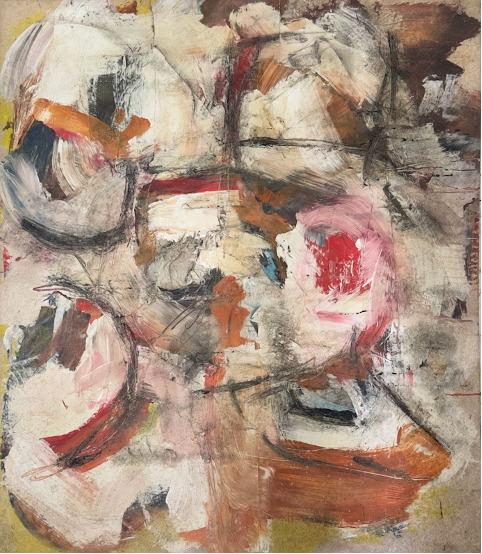
Also on exhibition were a few abstract works on paper –- charcoal, acrylic, gouache and collage. They were both a contrast to and an extension of the ceramics. Some were black and gestural, recalling Richard Serra’s drawings with paint stick. Most were colorful – white, yellow and red predominated — and thus unlike the tonally variegated, but largely achromic pots. Their broad, densely packed, looping and irregularly shaped brushstrokes however, featured the same kind of expressive – almost accidental — compositions as the clay works. They suggested Abstract Expressionist Willem De Kooning’s later, lyrical abstractions, such as Untitled XI (1975, Art Institute of Chicago), as well as Art Informel painter Antoni Tàpies’s works on paper and canvas. In ceramic as well as paint, Bound’s work were expressive and reticent; assertive and informe. Who was this mature, American-British artist, till then unknown to me, who exhibited such a cogent and paradoxical body of work?
Studio visit
I resolved that day in London to visit Bound’s studio and learn more. Last January my wife Harriet and I drove the five hours from our flat in Norwich to Bound’s home and studio near Welshpool, Powys, Wales. The weather started out cold and gray with occasional spits of rain – typical for the location and time of year – and perfect for observing the subtle tones and muted colors of ash glazed pottery. Later, sun broke through and highlighted the contours and variegated surfaces of the works.
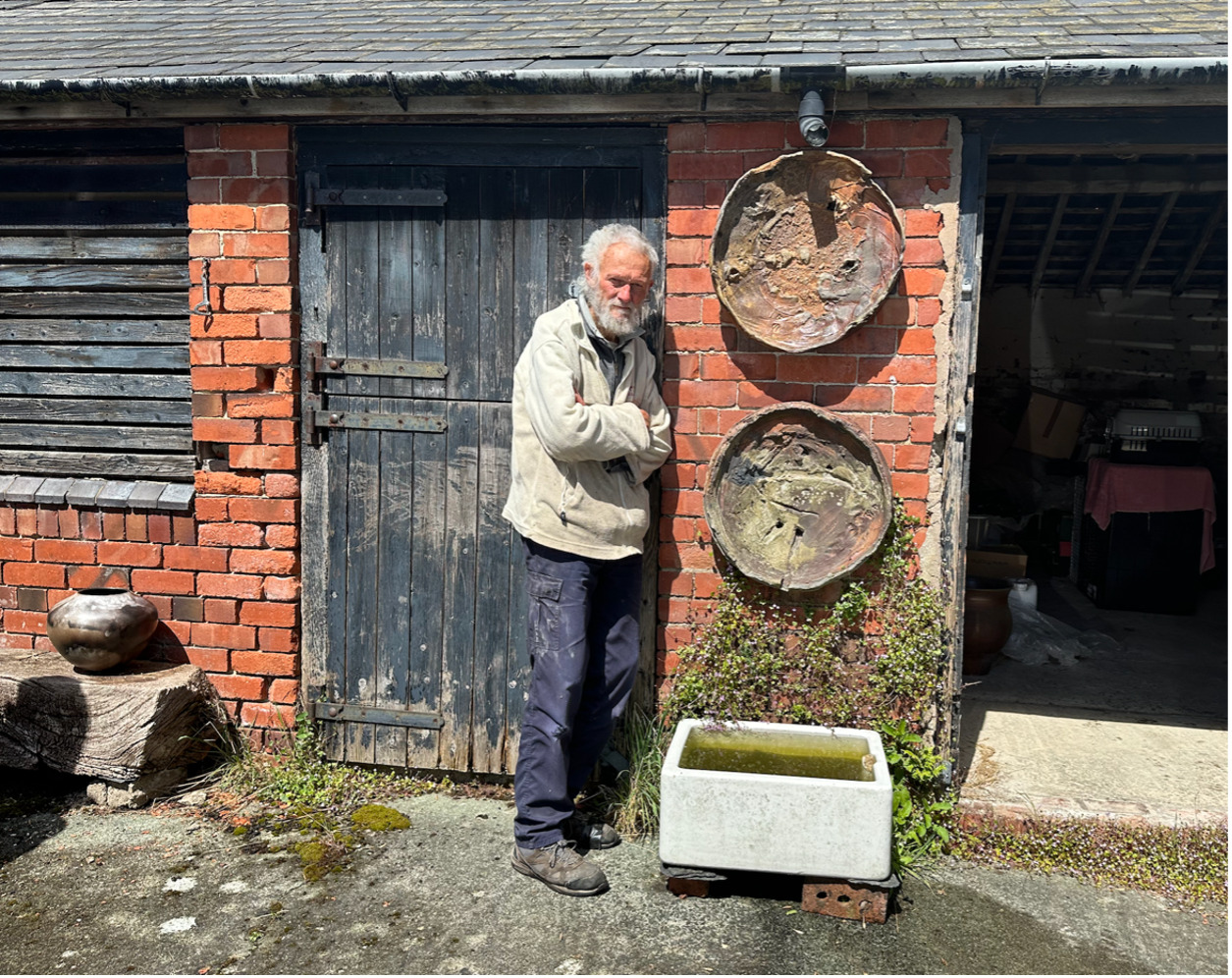
Upon arriving at Bound’s property, the last farm on a winding, narrow road, we parked in a courtyard with brick storage barns in front and to the left of us, and a neat, 17thC, half-timbered cottage to the right. Almost at once, a tall, rangy man sprang out to greet us. At 86 y.o., Bound is still ruggedly handsome with a shock of white hair and beard recalling Sterling Hayden in the film The Long Goodbye (1973). Though his agility is slightly hindered by age and a banged-up knee, he was enthusiastic to guide us across his seven-acre property.
Pottery was everywhere. On the brick wall in front of us were attached a pair of plates, two feet in diameter, one above the other between weathered, barn doors. They were out of round, warped, scraped, spalled, and pierced with three and four holes each, like the Voulkos plates mentioned earlier. I thought at once of targets at a shooting range and hex signs on the sides of Pennsylvania Dutch (German) farmhouses and barns. The worn and scoured half-doors resembled the surface of the plates, suggesting that some of Bound’s ceramics are best seen in situ; they function as installation or site-specific art.
Passing between the barn and the house, we approached a large, brick shed with pitched, metal roof – Bound’s main studio – with six or eight big urns leaning against it. Bound directed us to two with crusty, or sandy shoulders that were also partly coated with moss and grey-green lichens. He patted them approvingly. “I can’t rival this,” he said, pointing to the lichens. “In another couple of years, they will be even better.” Bound embraces aspects of wabi-sabi – the Japanese aesthetic of transience, rusticity, imperfection and the patina of time.
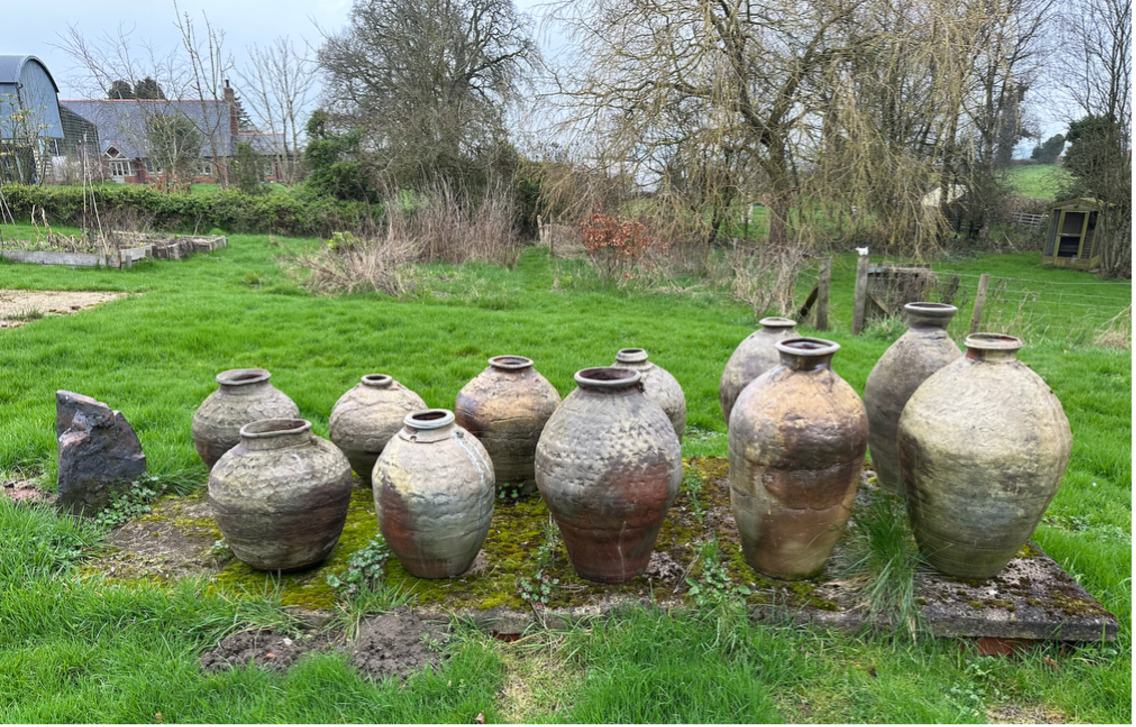
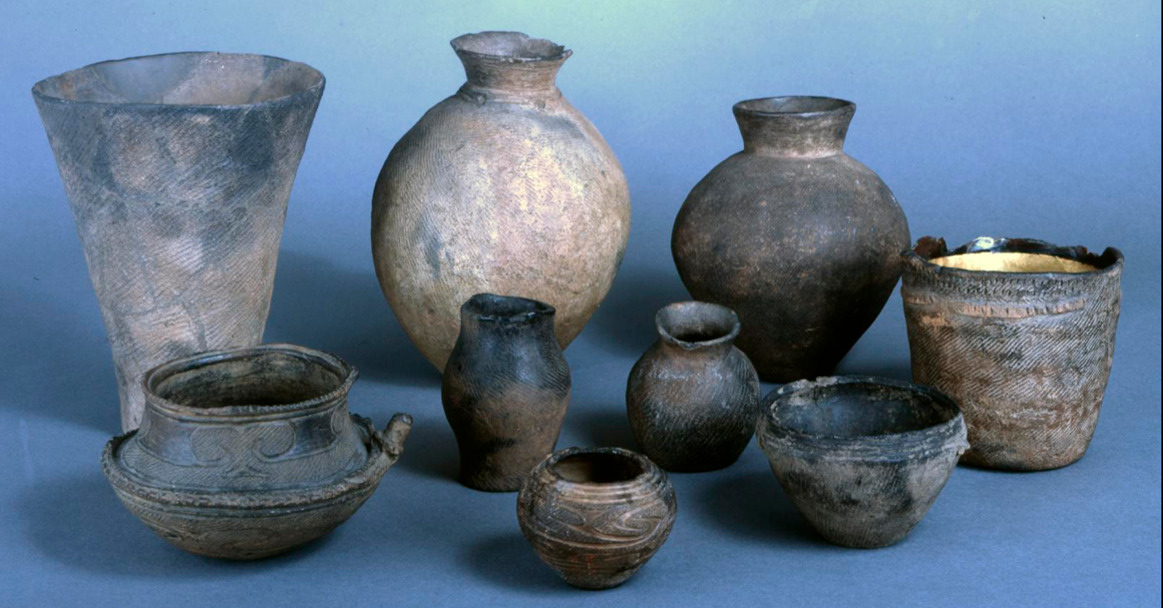
On a moss-covered slab in the middle of a grassy field to our left were eleven more urns of varied heights with different diameter necks. They were lined up like school children, tallest in the back. In their shape and surface, they recalled Japanese Tanba and Tsubo storage jars from the 14th Century, though with more matte, pitted, patterned and expressive surfaces. They look back as well to Chinese funerary urns from the Jin Dynasty (c. 350 CE) and even to Jamon pottery from Japan, dating from as early as circa 15,000 BCE, the veritable dawn of ceramics. (Some modern Japanese potters, including Kiyotsugu Sawa and Kobayahsi Yūchō, have also revived these ancient, Shigaraki-styled ceramics.) The pots by Bound therefore raise the question: Is there a fundamental type-form of pottery that can be found in many times and places? Is there a ceramic equivalent to “Lucy”, the Australopithecus from whom homo sapiens evolved?
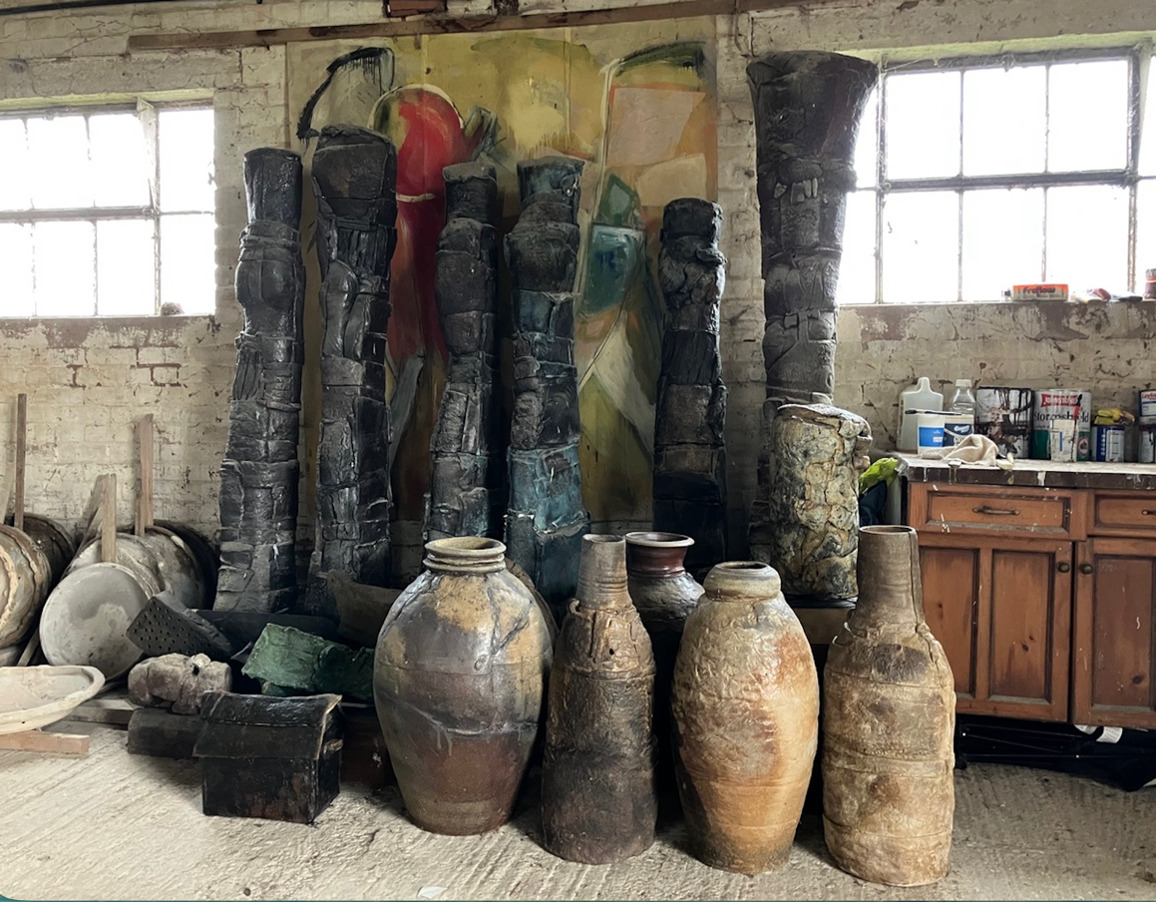
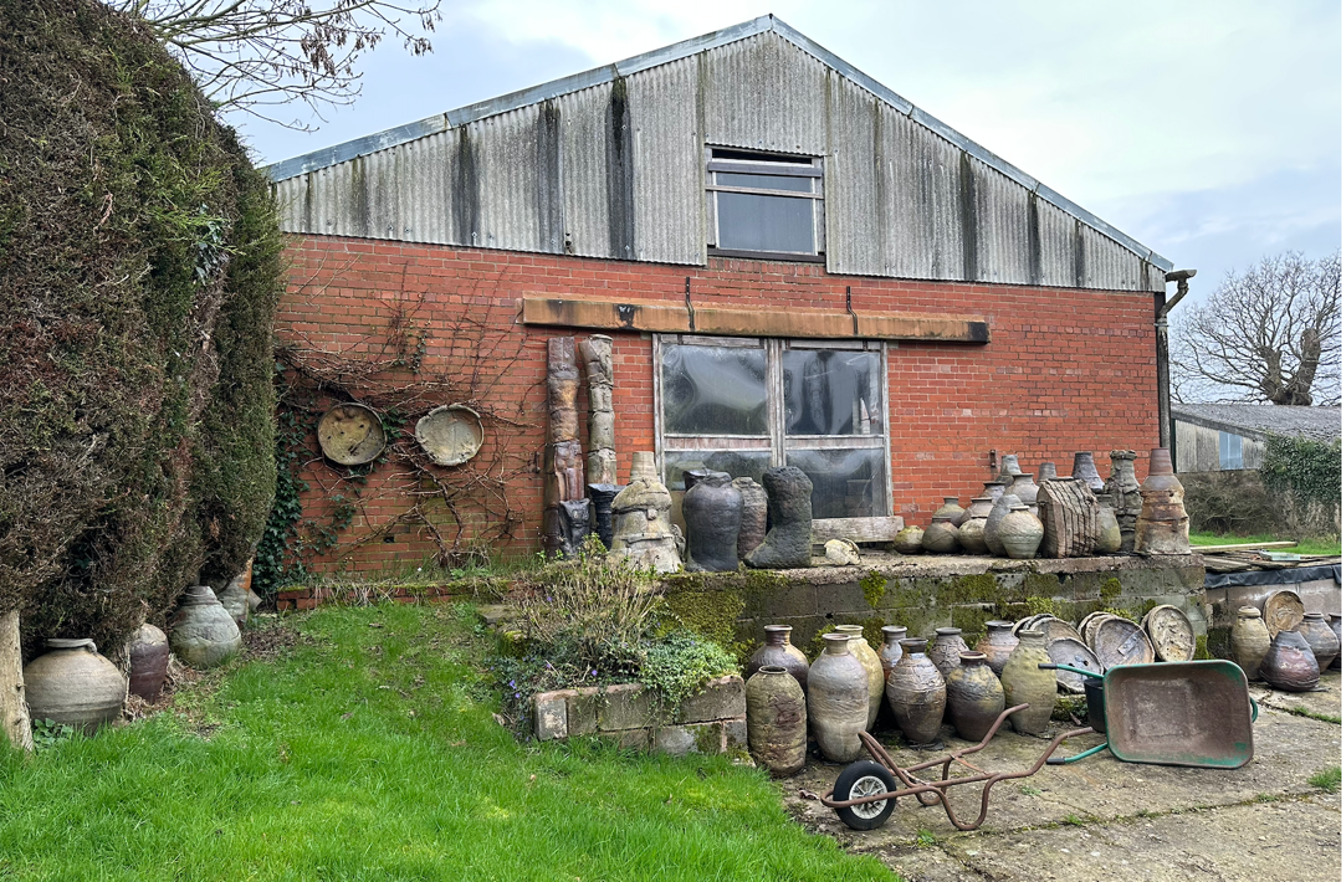
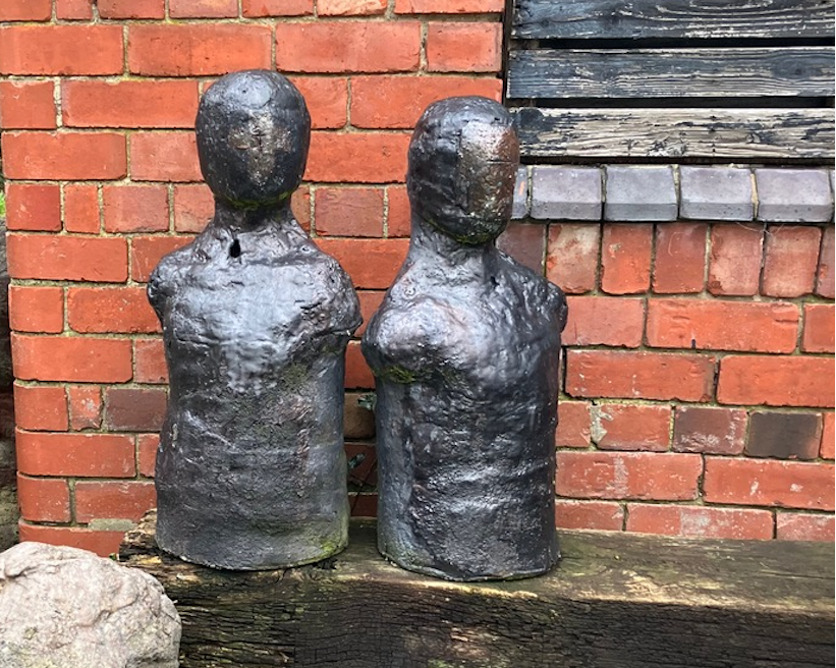
On another concrete platform, this one about a meter and a half off the ground and attached to the back of the studio – it serves as both loading dock and stage — were about 25 amphorae, urns and other forms. To the far right on the stage were five ceramic bottles, more than a meter high. Below were about 50 other ceramics of multiple sizes and shapes including stacked plates. To the left were a pair of blackened, ceramic torsos about a meter tall, beside another oversized, ceramic bottle, its neck and shoulder collapsed into its body. These three staged an Ovidian metamorphosis — human to pot, and pot to human. Then I remembered two blackened heads and torsos I saw when I first drove in. They were like the figures by the British sculptor Anthony Gormly, but legless, and featureless, Golems created by God from mud or clay, lacking speech or a soul. A Golem may be benevolent, offering service and protection to their human companion, or malignant, like Frankenstein’s monster. Had these clay figures and vessels by Bound been tormented by the flames of Bound’s wood-fired, Anagama kiln, or given life by them?
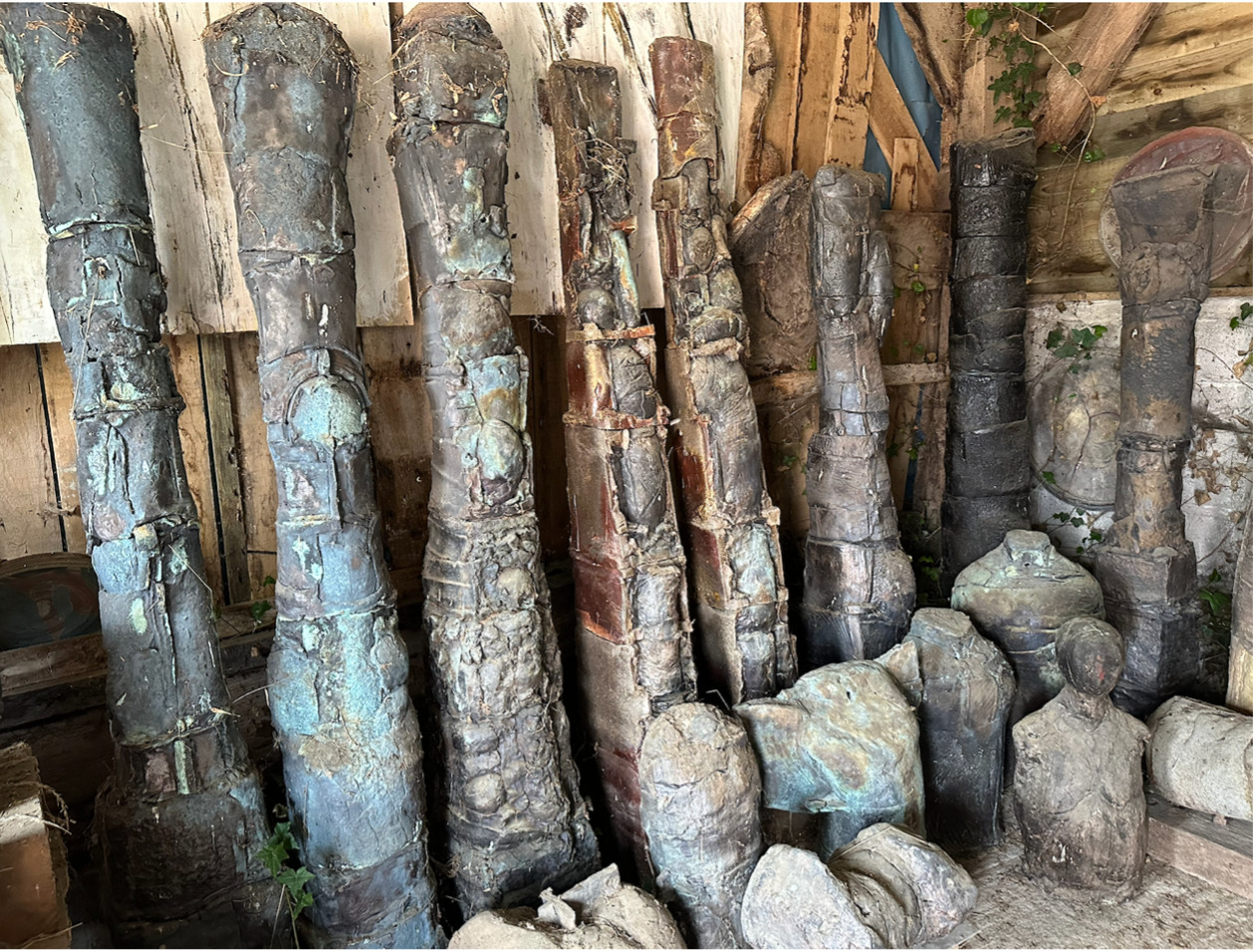
On the far left of the stage were tall, columnar, works, some blackened and others the natural umber of clay. The artist calls them “stelae”, a word that designates upright monuments, taller than they are wide. There exist ancient Egyptian, Mayan, and Chinese stelae, and more familiarly in Britain, gravestones, way markers and milestones. Bound’s however, are segmented, like human vertebrae or totem poles from the American Pacific Northwest Coast. When I asked the artist about these, he cited as influence the American ceramic artist Stephen De Staebler, who in the 1970s, began to make tall, slender, segmented bodies – “stelae” he also called them – that looked like reliefs from Palenque, only battered, broken and emaciated.
There is more than a hint of Giacometti in Bound’s stelae; they are similarly primal – bare life or informe emerging from inanimate clay. Like Voulkos, De Staebler was an important figure in the California Clay Movement (American Clay Revolution), that pushed ceramics away from function and toward Abstract Expressionism and Art Informel. He studied at Black Mountain College in 1951, where he learned about figure drawing from Ben Shahn and ceramics at the “pot shop” established by Robert Turner. (Voulkos came to Black Mountain in 1952 and joined Shoji Hamada’s seminar.) Like Turner, De Staebler, and Voulkos, Bound embraces raw or scarred surfaces, expression, intuition, accident and informe. He’s a latter-day exponent of “Abstract Expressionism in Ceramics.”
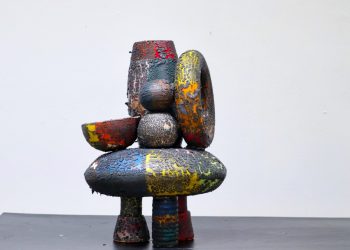
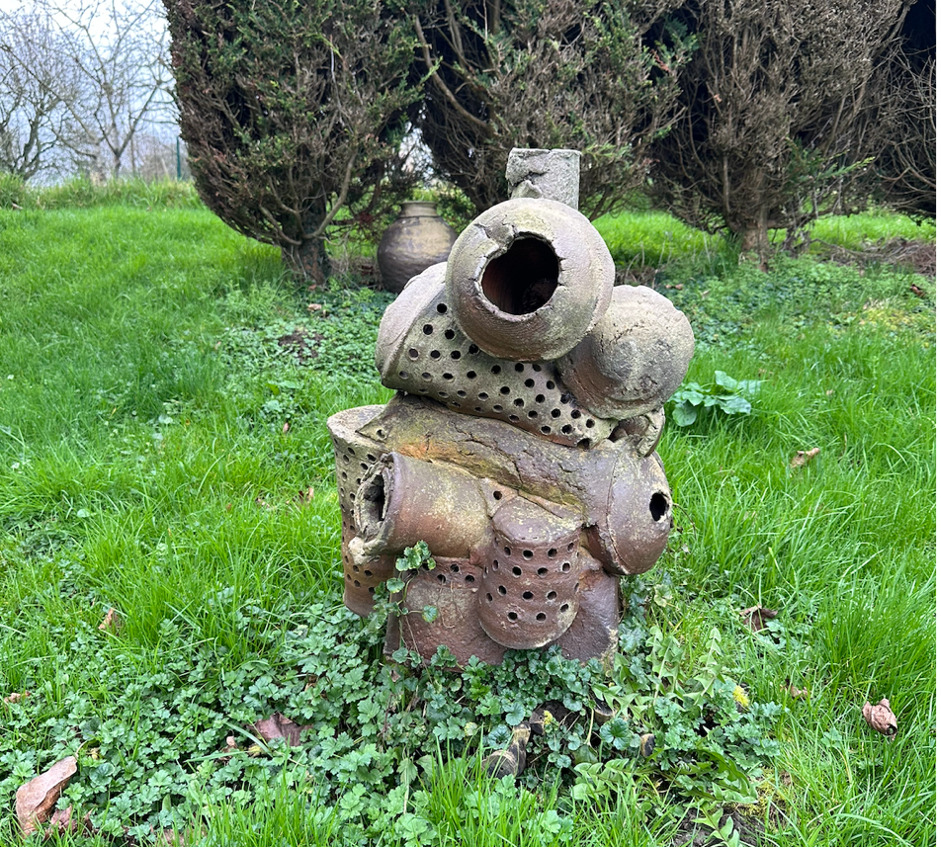
In an un-mowed patch of grass and clover behind us, about 20 yards from the concrete stage, I saw a clay construction about three foot high – an assemblage Bound calls a “teapot” as big as a dog on its haunches. It’s made of urns, perforated amphoras, and cylinder forms melded together. It called to mind Louise Bourgeois’ bulbous costumes and sculptures, Richard Stankiewicz’ “junk sculpture” and George Herms’ funk constructions. Alternatively, they seemed like natural forms, fossil conglomerates found in tidal pools.
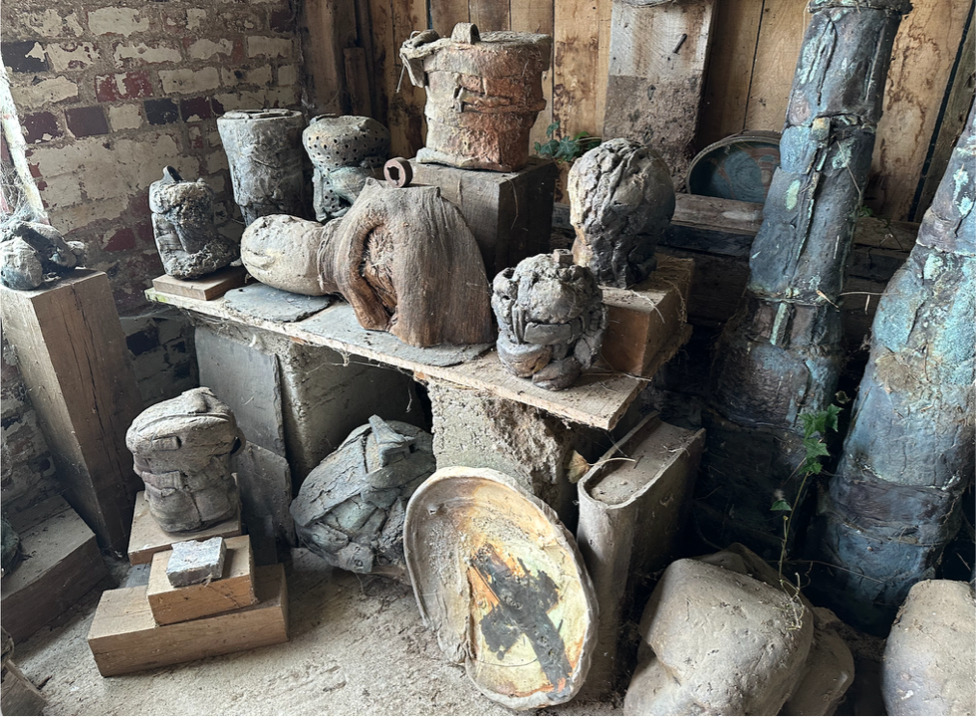
Another sculpture I saw was an oval mass of blackened clay, the size of a skull. In the right light, you can just see eyes, mouth and crooked nose, like an aged prizefighter’s face. Still another sculpture I admired is convex on one side and concave on the other, with a vertical cavity stuffed with brick-shaped clay — like a punch in the mouth.
Bound’s formation
Charles Bound was born in New York City in 1939, the year of the New York World’s Fair, a recovering U.S. economy, and the start of war in Europe. In his teens, Eisenhower was president, the Abstract Expressionists were in their heyday, and social movements were forming to uphold civil rights and reject the conformism of the era. Rebelling against his privileged upbringing on Manhattan’s upper East Side, Bound enrolled at Occidental College in Los Angles in 1959, but dropped out after just a semester. He bounced around for a few years, teaching at primary schools in Texas and Colorado, working in a road gang, and finally in 1962, applying to join the Peace Corps, created by Kennedy the year before. His new wife’s pregnancy however, scotched those plans, so instead he found a sales job for a university book publisher. When an opportunity arose to travel to Africa to compete for the textbook market in newly liberated British colonies, he leapt at it. Given his early restlessness, I asked him if he was ever a beatnik like Kerouac. Answer, “No.” Given his subsequent international travel and apparent financial independence, was he then a spook – a spy? “No,” he said. “The only CIA my wife and I knew was “Charles In Africa.”
In Nigeria and later Kenya, Bound gained an appreciation of indigenous art and culture, including Ife and Benin bronzes, and functional pottery made by women of the Gwari community in Nigeria. That’s where, in 1951, Michael Cardew, supported by the Colonial Service, established a pottery in Suleja, (then called Abuja) with the goal of combining local talent, studio-ceramic refinement, and British marketing skills. The results were mixed: Cardew produced some of his best work and a few students, notably Ladi Kwali (1925-1984), created ceramics that rivalled if not exceeded in skill and beauty those of her teacher. But by encouraging already skilled local potters to produce heavily glazed and decorated, kiln-fired pots for the European market, Cardew effectively killed off the tradition of hand-made Gwari pottery for daily use.
During his time in Africa, Charles and his wife had little sympathy with the ex-colonial and development officials they met. Their aloofness and racism – sometimes masked by noblesse oblige — linked them to a long tradition of colonial exploitation and comprador corruption. In conversation, Bound registered to me his disgust at the looting of African art by European and American collectors and curators, and the loss of cultural heritage following independence (Nigeria, 1960; Kenya (1963). He recalled a small museum of Ife (Yoruba) bronzes and shared with me fragments of a prose-poem he wrote about it while there in the early 1970s:
…chickens disappearing to an insane safety under houses,
and the building – only different for having been painted
more recently than the others around it – that housed the
small residue of unearthed bronzes that hadn’t gone off
into some distant museum: like a family’s remains
after an unnatural disaster or a ravaging.
A decade after writing this, Charles moved to the U.K with his new wife Joy, and began making pottery at Jacob Kramer Art College (now Leeds Arts University). There, he reckoned with the achievements of Bernard Leach, Hamada and the tradition of British studio ceramics. Hamada’s works especially appealed because of the spontaneity of their decoration – part brushed on and part spilled, like paintings by Pollock. But almost from the beginning, Bound rejected the wider studio pottery movement for its insistence on function and embrace of refinement and control: tenmoku and celadon glazes, painting or pouring slip to create glassy surfaces, impossibly slender bowls (Lucie Rie), and reduction firing for strong colors and durability. Bound learned about Voulkos from magazines and books, about Abstract Expressionism and Art Informel (especially Antoni Tàpies) and gradually discovered for himself the joy and freedom of “whacking something thrown, [and] picking up and reusing parts of something that collapsed.” Living in England, he was discovering in a sense, his own New York roots; He was becoming a latter-day Abstract Expressionist and embracing accident and impulse. That awakening, Bound now reflects, came with its own political contradictions:
Certainly, that particular American assertiveness, however muted/suppressed, the assumption of right that comes with the passport, has always been part of my baggage. Though aware of the work of Voulkos & Co, what evolved with me was primarily the engagement with a material (technically, aesthetically) in combination with what else was going on, like having a workshop/kiln on a farm where I helped out as was feasible, seeing varied ways of dealing with problems and finding solutions.
Willem de Kooning, the Abstract Expressionist artist whose paintings Bound’s own resemble, shared that political perspective. “It’s a certain burden,” De Kooning said, as the Vietnam War raged, “this American-ness.” Bound expressed to me his own exasperation with his birth-country in a time of war. The blackened surfaces, vehemence, roughness, collapse, and informe in his art, may be in part an expression of national and political alienation and negation.
Bound’s achievement
50 years after he began to make ceramics, Bound remains committed to his craft and his vision. Even as more ceramic artists pursue brilliant color, exotic shapes and blemish-free surfaces, Bound’s art remains rebarbative – his art, like that of many modernists before him, is about intuition, accident and formlessness. He takes inspiration from fine and decorative art outside the European canon – Japanese, Chinese and especially indigenous, African ceramics – and alludes to pre-modern myth and magic, such the story of the Golem and Ovid’s Metamorphoses. He exhibits and sells his ceramics when he can, and his work can be found in in the collections of the Fitzwilliam Museum in Cambridge and Sainsbury Center for Visual Art in Norwich. But has not yet had a major museum exhibition, and at 86, no longer expect recognition beyond what he has already received. If he’s correct in that view, he’ll nevertheless have left behind – in those barns and across some fields in Powys, Wales – a legacy of works that summarize several thousand years of ceramic tradition and challenge the comfortable refinement and ingenuity of much contemporary practice.
Stephen F. Eisenman is Professor Emeritus of Art History at Northwestern University and Honorary Research Fellow at the University of East Anglia. He’s author of 11 books, including Gauguin’s Skirt (Thames and Hudson, 1997), The Abu Ghraib Effect (Reaktion, 2004), and (with artist Sue Coe) The Young Person’s Illustrated Guide to American Fascism (OR Books, 2025). Eisenman is a columnist for Counterpunch and lives with his wife, the environmentalist Harriet Fetsing, in Norwich, England. He can be reached at s-eisenman@northwestern.edu
Subscribe to Ceramics Now to read similar articles, essays, reviews and critical reflections on contemporary ceramics. Subscriptions help us feature a wider range of voices, perspectives, and expertise in the ceramics community.