By Kelly Parks
I’ve spent twenty years watching ground-nesting bees on my Montana property, observing how they select sites, assess soil conditions, and engineer their brood chambers with a precision that rivals any studio potter I know. When I learned that paleontologists recently discovered 20,000-year-old bee nests preserved inside fossilized bones in a Dominican cave—tiny clay structures with smooth, waterproofed walls that predate human pottery by millennia—everything clicked into place (Viñola-López et al., 2024).
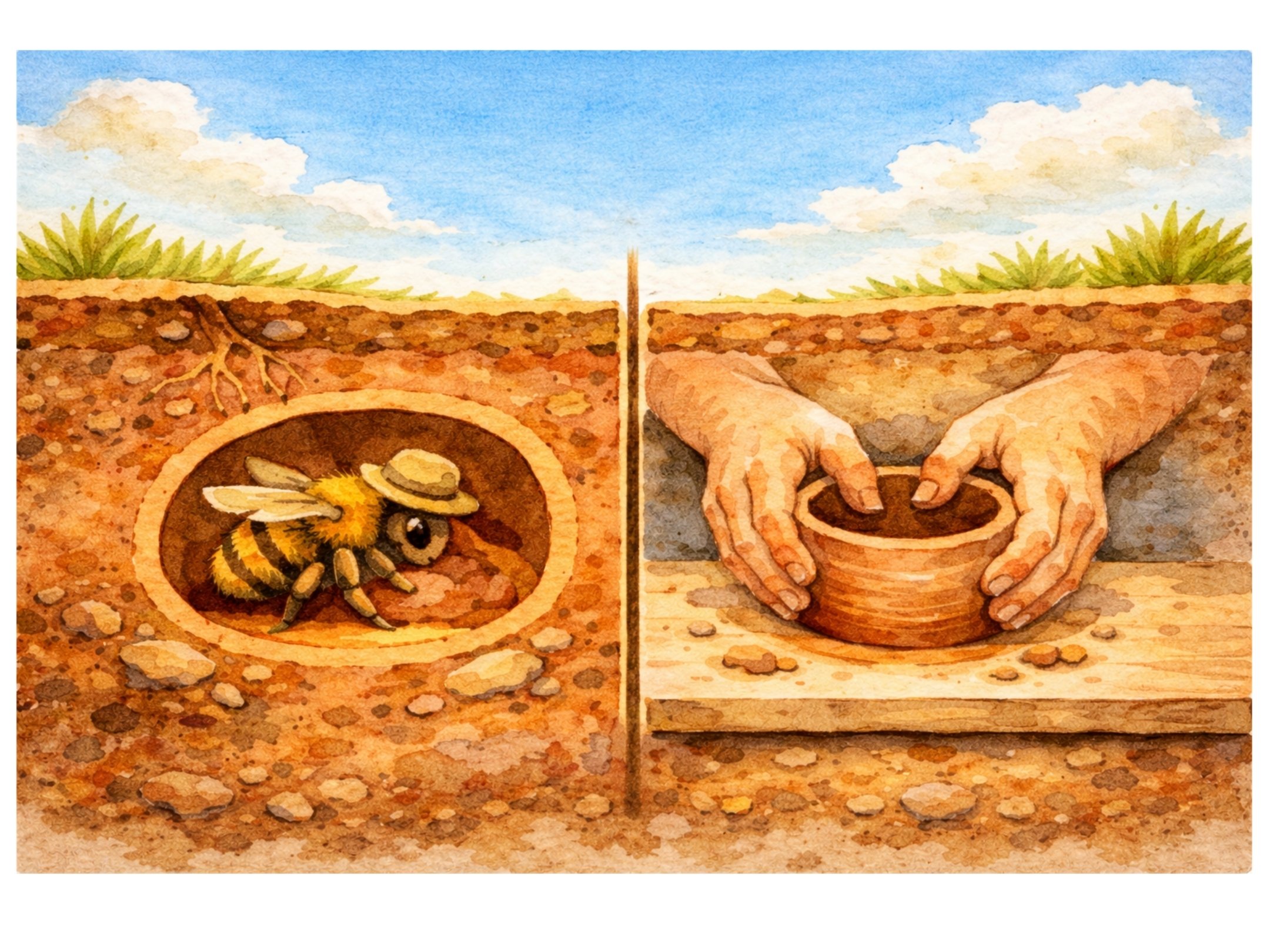
These ancient bees were ceramicists. Not metaphorically—literally. They were working clay, solving material problems, creating durable structures thousands of years before humans picked up their first handful of mud.
Bees as Material Specialists
Here’s what most people don’t realize: only about 10% of bee species build the wax honeycombs we picture when we think “beehive.” The other 90%—roughly 4,000 species in North America alone—are ground-nesters who excavate tunnels and shape brood chambers from clay-rich soils (Michener, 2007).
The recently discovered fossilized nests from Hispaniola’s Cueva de Mono tell us something profound about bee intelligence. Named Osnidum almontei by researchers, these 6-millimeter structures show smooth, multilayered walls created by compacted soil and sealed with a waxy secretion that waterproofed the clay—a technique so effective that CT scans revealed six generations of bees reusing the same cavities (Viñola-López et al., 2024). The bees didn’t just dig randomly. When they encountered fossilized rodent jawbones with empty tooth sockets, they adapted their plans and used these ready-made chambers instead of excavating new ones.
This adaptive behavior happened because the surrounding karst limestone landscape lacked the fine-grained, stable soil that ground-nesting bees typically need. So they moved underground, where owl pellets had accumulated sediment over thousands of years, creating workable clay deposits (Viñola-López et al., 2024). Material assessment. Site selection. Problem-solving.
And this isn’t recent evolution. The oldest preserved bee nests—from Patagonia’s Castillo Formation—date back 100-105 million years (Genise et al., 2021). These tunnels with their grape-shaped brood alcoves, built by ancestors of modern halictid bees in volcanic ash, prove that bee-clay relationships evolved alongside flowering plants during the Early Cretaceous. Bees have been master clay workers longer than flowering plants have existed in their current forms.
Parallel Discoveries in Human Pottery
Humans started experimenting with fired clay around 30,000 years ago, creating figurines like the Venus of Dolní Věstonice from moistened loess mixed with crushed mammoth bone (Vandiver et al., 1989). But these were art objects, not functional vessels. The first actual pottery appeared around 18,000-16,000 BCE in East Asia, coinciding with increasingly sedentary human settlements (Wu et al., 2012).
What strikes me is this: early human potters, like Japan’s Jomon people, sought out the same riverside clay deposits where ground-nesting bees build their most successful colonies. Both understood that particle size matters. Moisture retention matters. Not all earth is created equal.
Think about the parallels. Pottery clay must maintain consistent moisture to prevent cracking—wedge it too dry and it crumbles; too wet and it collapses. Mason bees face identical challenges when collecting mud for their nest partitions. They select material with precise water content, just as any hand-builder learns to do after years of trial and error.
The earliest pottery was hand-built using coiling and pinching—methods that mirror how bees compact and shape clay with their mandibles and bodies (Rice, 2015). Both create hollow structures that must support their own weight while protecting what’s inside. And here’s what fascinates me most: many ground-nesting bees secrete waxy linings to waterproof their chambers. Humans eventually developed ceramic glazes for exactly the same purpose—making porous earthenware hold water (Rice, 2015). We arrived at the same solution, just tens of millions of years later.
Traditional Ecological Knowledge
While Western science just discovered these fossilized bee nests, Indigenous communities have understood the bee-clay-pottery connection through Traditional Ecological Knowledge for generations.
Among the Kayapó people of the Brazilian Amazon, ancient shamans studied bee, wasp, and ant architecture to inform human settlement design. Their traditional circular villages deliberately echo the cross-sectional form of conical bee and wasp nests (Posey, 1983). This isn’t metaphor—it’s biomimicry practiced for centuries. Kayapó bee specialists were traditionally shamans who understood that observing insect construction techniques offered lessons for human builders (Posey, 1983). The relationship between people and social insects was considered sacred knowledge, passed down through careful observation and oral tradition.
The Ashaninka communities in Peru’s central Amazon identify over 14 plant species that stingless bees use for nest construction (Demetrio et al., 2024). They distinguish between species by nesting behavior and substrate preferences—the same observational skills that inform where to dig for pottery clay. Their knowledge extends to understanding seasonal patterns in bee activity, which plants provide nest-building resins, and how forest structure affects bee populations. This information, accumulated over generations, creates a sophisticated map of material resources that serves both bee conservation and human craft traditions.
In Ethiopia’s Sheka community, experienced honey hunters locate underground stingless bee nests by observing entrance structures and listening for colony sounds (Shenkute et al., 2021). These are the same indicators that tell you about soil structure, drainage, and stability. Hunters can distinguish between species by the acoustic signature of their colonies—different bees create different vibrational patterns in the soil (Shenkute et al., 2021). This auditory knowledge of underground activity parallels what potters need to know about clay bodies: how water moves through soil, where air pockets form, which substrates maintain structural integrity.
The Hopi people of the American Southwest revived ancient Sikyatki pottery traditions featuring prominent insect imagery. Archaeologist Jesse Walter Fewkes documented that “the butterfly, moth and dragonfly are among the most prominent insects figured on prehistoric Hopi pottery,” noting these designs appear constantly in both secular and ceremonial objects (Fewkes, 1919, p. 250). The famous potter Nampeyo and her descendants incorporated these insect motifs into their Sikyatki Revival work from the 1890s onward, demonstrating continuity between ancient pottery traditions and pollinator observation. These designs developed in desert environments where both bees and potters had to be exceptionally skilled at finding and working with limited clay resources.
What unites these diverse knowledge systems is a fundamental recognition: clay is not inert material waiting for human hands. It’s part of living ecosystems, shaped by water, roots, and insect activity. Where bees nest reveals information about soil health and microclimate—exactly the information ancient potters needed to know which clay deposits would fire successfully. Indigenous communities understood that reading landscapes through bee behavior provided essential information for ceramic practice, long before Western science documented the material properties bees select when building.
Implications for Contemporary Practice
Those preserved Hispaniola bee nests challenge how we think about ceramics today.
Temporal Intelligence: Bee structures last exactly as long as needed—one generation, maybe six, then they deteriorate or get repurposed. We prize permanence in ceramics, but what if we designed for appropriate temporality instead? Unfired vessels, natural sealants, forms that return to earth—these exist in craft traditions but remain marginal in contemporary practice.
Minimal Intervention: Bees create functional, durable structures without kilns, without external energy beyond their labor, without waste. They adapt techniques to what’s available rather than transforming materials to fit predetermined forms. That stands in stark contrast to high-temperature ceramic production with its massive carbon footprint.
Ecosystem Integration: Human pottery extraction often removes clay from one place for use elsewhere. Bee nests stay integrated in local cycles—excavated clay becomes structure, abandoned nests become substrate for other organisms. There’s no separation between source, construction, and return.
As someone who works with both clay and pollinator conservation, I’m increasingly interested in biomimetic approaches: natural waterproofing using waxes or oils, structural designs that don’t require firing, patterns that create thermal regulation through geometry alone.
Clay as Archive
The Hispaniola bee nests survived precisely because they were clay. The bees themselves decomposed in the cave’s humidity, but their compacted, mineral-rich brood chambers mineralized over millennia, transforming into trace fossils that preserve behavior rather than bodies (Viñola-López et al., 2024).
This preservation reveals clay’s unique archival properties. Unlike organic materials that decay or metals that corrode, clay transforms through mineralization into something more permanent than its original form. The bee nests became geological records, their smooth interior walls still showing the characteristic texture created by mandibles and bodies working the material. CT scans revealed not just the final structures but the entire sequence of construction—how bees assessed cavities, prepared surfaces, and applied waterproofing layers. Each generation’s modifications remained visible in the stratigraphic record (Viñola-López et al., 2024).
What the nests archived extends beyond construction technique. Trapped within the clay matrix were pollen grains representing the local flora when bees were active—a snapshot of the cave’s surrounding ecosystem 20,000 years ago. Fungal spores and microbial structures indicated the phosphate-rich conditions created by accumulated owl pellets, revealing the complex ecological relationships that made these nest sites possible (Viñola-López et al., 2024). The mineral composition of the clay itself recorded environmental conditions during deposition: pH levels, moisture patterns, seasonal flooding cycles. Every nest became a time capsule preserving not just bee behavior but an entire web of ecological relationships.
This archival function parallels human pottery in profound ways. Ancient ceramics preserve information about clay sources, firing technologies, and cultural practices. Fingerprints, tool marks, and fabric impressions record individual makers’ hands. Residue analysis reveals what vessels contained—ancient diets, trade goods, ceremonial substances. The clay remembers everything it touches.
For ceramic artists, understanding clay as archive raises crucial questions: What behaviors are we encoding in our work? What will surfaces reveal to future archaeologists—or to contemporary viewers willing to read closely? The marks we leave aren’t imperfections to smooth away but essential information about how forms came into being, who made them, and under what conditions. Every compression pattern, every tool mark, every firing signature becomes part of the permanent record.
The bee nests also demonstrate how clay archives can challenge assumptions. Before their discovery, no one expected to find bee nests in fossilized bones or to document such sophisticated material selection by insects. The preserved structures forced scientists to reconsider both bee behavior and the conditions under which trace fossils form. Similarly, human pottery continually reveals unexpected information—about ancient migration patterns, technological innovation, and social organization—precisely because clay preserves what other materials lose.
This recognition positions both bee and human clay work within deep time. When we shape clay today, we’re adding to an archive that extends back 100 million years, connecting our material practice to countless generations of clay-working species. The question becomes: what do we want this ancient material to remember about us?
Rethinking Ceramic Pedagogy
What happens when we position bees as our predecessors in clay work—as master craftspeople working with this material for 100 million years before humans arrived?
Observation-Based Learning: Ceramic education could begin not in the studio but in the field, watching ground-nesting bees select sites and construct chambers. What do they know about clay workability that takes us years to learn? Can we develop material literacy by studying insect architecture?
Material Reciprocity: If bees and humans both work clay, what ethical obligations arise? Studio practice that extracts clay without considering pollinator habitat perpetuates extractive relationships with materials. What if habitat conservation was foundational to ceramic education, not peripheral?
Alternative Methods: If bees create durable, waterproof structures without firing, what other options exist? Research into natural waterproofing—plant oils, waxes, mineral slips—could reduce ceramics’ carbon impact while expanding our material vocabulary.
Reciprocity and Recognition
The discovery of 20,000-year-old bee nests built from clay compels us to reimagine ceramic history—not as uniquely human invention but as material practice we share with species who worked clay long before we did.
This isn’t about romanticizing insects or diminishing human creativity. It’s about recognizing we’re latecomers to traditions with deep evolutionary histories. Ground-nesting bees have solved clay-working problems for over 100 million years (Genise et al., 2021). Their solutions, preserved in fossils and observable in living species, offer insights contemporary practice is only beginning to explore.
For ceramic artists and educators, this recognition opens new directions: biomimetic research studying insect construction; sustainable practices learning from unfired traditions; pedagogical approaches positioning field observation alongside studio work; ethical frameworks treating clay as shared resource rather than purely human material.
Most fundamentally, understanding bees as first ceramicists challenges us to approach materials with greater humility. Every lump of clay has been worked before—by water, by roots, by countless insect generations shaping forms that served their needs. We inherit these materials, these techniques, these possibilities. The question is whether we’ll work with them as respectfully and sustainably as our pollinator predecessors.
Kelly Parks, MS, is a Certified Pollinator Steward and published writer whose work has appeared in Gardening, Birding, and Outdoor Adventure. Based in Montana, she has spent two decades observing native ground-nesting bees. Kelly hosts The Secret Pollinators podcast, which reaches international audiences with education about North America’s 4,000+ native bee species. Her family heritage connects to the Chihuahuan region near Paquimé and the contemporary pottery traditions of Mata Ortiz, deepening her fascination with the relationship between Southwestern clay work and the natural world.
References
- Demetrio, W. C., Paciencia, G. P., Fuzari, L., & Rasmussen, C. (2024). Traditional ecological knowledge on stingless bees in two Ashaninka communities in the central rainforest of Peru. Ethnobiology and Conservation, 13, 1-18.
- Fewkes, J. W. (1919). Designs on prehistoric Hopi pottery. In Thirty-third Annual Report of the Bureau of American Ethnology (pp. 207-284). Government Printing Office.
- Genise, J. F., Sarzetti, L. C., Verde, M., Sánchez, M. V., & Krause, J. M. (2021). 100 million years of Meliponini (Apidae) nests. PLOS ONE, 16(1), e0244775.
- Michener, C. D. (2007). The bees of the world (2nd ed.). Johns Hopkins University Press.
- Posey, D. A. (1983). Indigenous knowledge and development: An ideological bridge to the future. Ciência e Cultura, 35(7), 877-894.
- Rice, P. M. (2015). Pottery analysis: A sourcebook (2nd ed.). University of Chicago Press.
- Shenkute, A. G., Getachew, Y., Assefa, D., Adgaba, N., Ganga, G., & Abebe, W. (2021). Indigenous knowledge of ground-nesting stingless bees in southwestern Ethiopia. International Journal of Tropical Insect Science, 41, 2835-2845.
- Vandiver, P. B., Soffer, O., Klima, B., & Svoboda, J. (1989). The origins of ceramic technology at Dolni Vestonice, Czechoslovakia. Science, 246(4933), 1002-1008.
- Viñola-López, L. W., Riegler, M., Bloch, J. I., & MacFadden, B. J. (2024). Trace fossils within mammal remains reveal novel bee nesting behaviour. Royal Society Open Science, 11, 241260.
- Wu, X., Zhang, C., Goldberg, P., Cohen, D., Pan, Y., Arpin, T., & Bar-Yosef, O. (2012). Early pottery at 20,000 years ago in Xianrendong Cave, China. Science, 336(6089), 1696-1700.
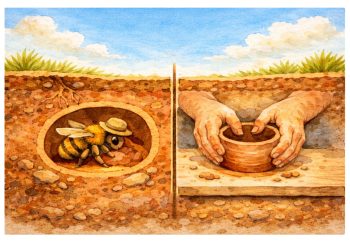
Illustration by Kelly Parks