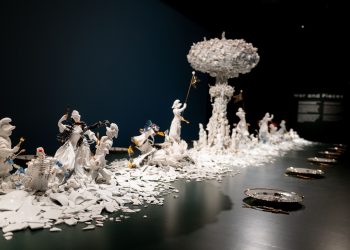


Martin Woll Godal: Sequence is on view at Bomuldsfabriken Kunsthall, Arendal
October 11 – December 30, 2025
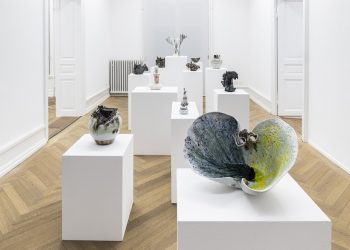
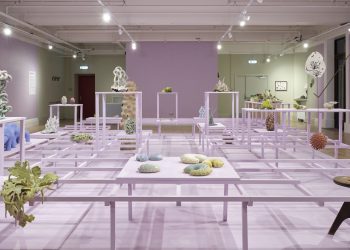
In each gallery room, large ceramic installations by Martin Woll Godal are presented, breaking with and challenging the material’s unique qualities, history, possibilities, and limitations.
Sequence is carefully composed by the artist, with each room inviting an unavoidable physical encounter. What is a space—mentally and physically? How do we navigate and interpret a room or a landscape where given perspectives shift? What happens to us when we stand beneath a porcelain sky or pass by a corridor of ceilings we would normally walk under?
Throughout his practice, Martin Woll Godal has consistently explored the materiality of clay and ceramics. He works empathetically with craft, art, and architecture as a whole—across both large and small formats.
The spatial memory of clay
Essay by Peder Valle, art historian
Scientists who study human memory explain it by saying that our sensory impressions are stored, retrieved and recognised, before being stored again – usually in a slightly modified version. A memory changes a little each time it is recalled. When we struggle to think of something, it is due to a lack of correspondence with stored memories. In the same way, the eureka moment we experience when the answer reveals itself is a sign that we actually recognise something we feel we have forgotten; we have basically “remembered” it all along.
Martin Woll Godal’s ceramics evoke the same recognition. Not only because they are reminiscent of shapes and constructions we have seen before, and which are part of our personal or collective memory. On the contrary, it is as if the clay itself remembers, evoking, imitating, and recalling images, figures, and installations that we recognise.
Ceiling
This is the case with the first artwork we encounter, Ceiling. One hundred and fifty hand-beaten porcelain tiles are mounted hanging from the ceiling, on steel wire, with porcelain fixing plugs. The soft, slightly wavy shape testifies to the work of the hand and the inherent imprecision of craftsmanship. The installation, as a whole, however, evokes associations with the ubiquitous ceiling tiles found in public spaces and offices; featureless architectural elements that anonymously form the framework for our routine daily lives. And at the same time, the shiny, glazed surface makes us recognise the Ceiling as porcelain; something handmade, shiny and alive within the framework of the predictable.
Front
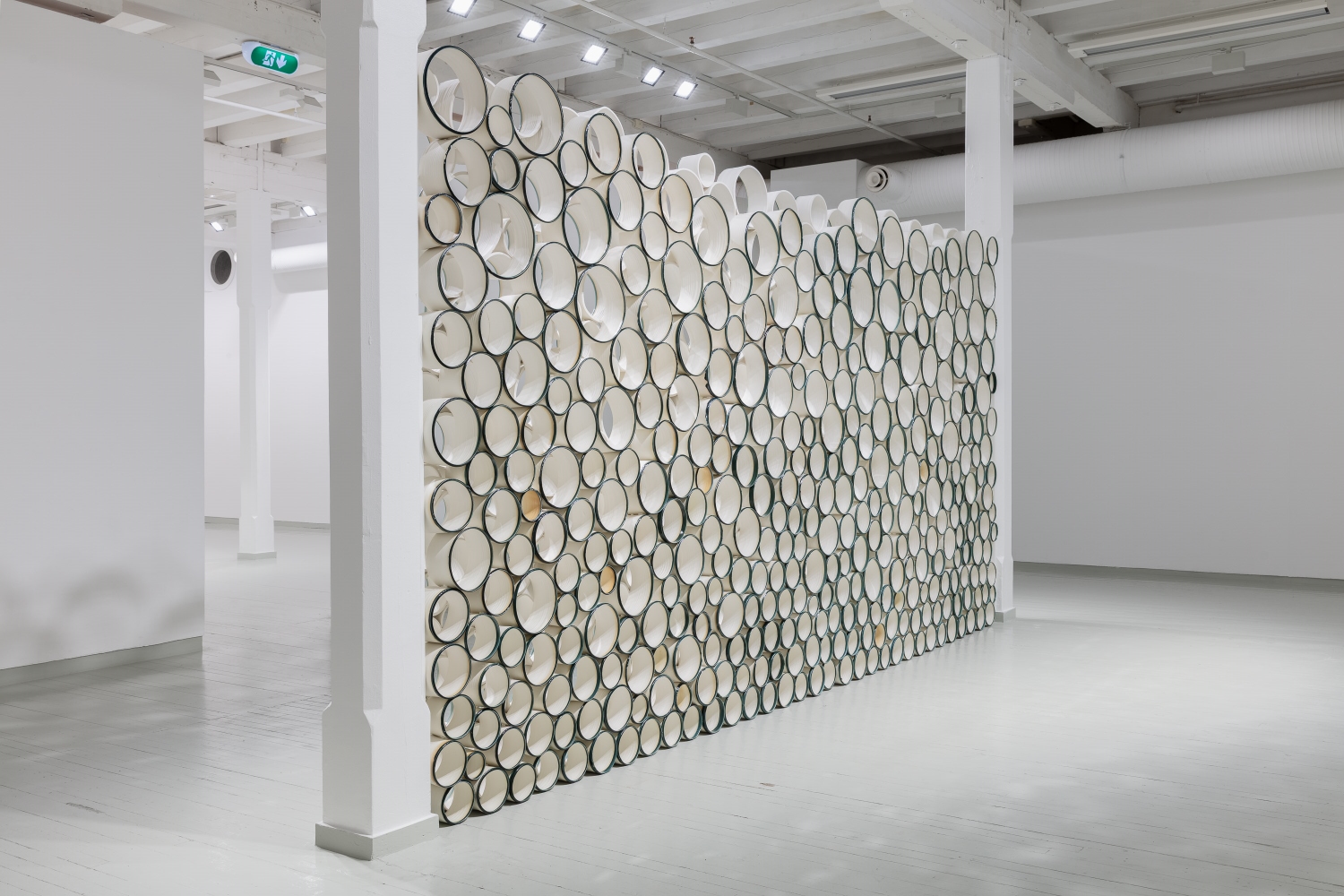
Martin Woll Godal’s ceramics assume architectural proportions. Not only in handmade ceilings, but also in height, as with the column of turned terracotta rings that he made for the Norwegian Association of Craft Artists’ Annual Exhibition in 2015. Now the rings are back, and more daring than before: In the work Front, they balance on edge, forming a high wall between the room’s two columns. At the same time, the open centre of the rings forms an airy and finely meshed construction: Almost like lace, the spaces become defining, emphasising the unbearable lightness of the ceramic wall. Closed, but still open.
Passage
Architecture is, like ceramics, a non-renewable resource. Architecture in the sense that what is demolished can never come back, just as ceramics can never return to its original state as clay. Many ceramics have also ended up on the scrap heap of history as discarded building material; old bricks and roof tiles with no future prospects, and no prospect of being reused.
Martin has done something about this. In the work Passasje, the old, single-curved roof tiles from his own workshop play a leading role, having previously served on the roof of an old house in Arendal, before being reused on the main house where Martin lives, and finally on the workshop building. To this cycle, the artist has added another chapter: Next to the stack of old roof tiles is a stack of roof tiles that are cast after one of them, one with damage, and made with reused stoneware clay. In this way, the ceramics imitate their own history, form, use, and material, creating a passage from what has been to what is.
Cavity/Beaker
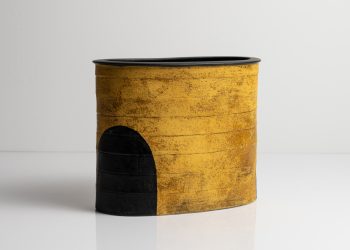
The cavity defines the plasticity, load-bearing capacity and form of ceramics. That is why the turned clay vessel contains an immortal ceramic truth, about structure and volume, about technique and materiality. In the work of the same name, the cavities are black-glazed, cocoon-shaped and assembled. As a visual reminder of the clay’s earthly origins, the vessels appear self-grown, organic, almost plant-like.
The ultimate hollow space, however, is the drinking vessel. The cup, the goblet – the ceramicist’s basic form and inevitable cliché, which is characterised by its boundlessly mundane task: to hold liquid. Martin Woll Godal devotes an entire room to this ceramic archetype, where three different sizes run all the way around the room – like the notes of a piece of music with a fixed rhythm and a recurring theme.
Structure III/Metropolis
The rhythm also characterises the work Structure III, where row after row of squares are formed from extruded square tubes. Here, the ceramics are industrial, regular, and metallic, while the handmade is limited to the memory of the malleability that lies in the clay’s essence. In more than 70 repetitions, the clay continues to insist on the sovereignty of ceramics as a material: Malleable, but still hard; light, but still firm. In the last room, the elements are united in a sculptural tribute to sculptor Arne Vinje Gunnerud’s Metropolis on Nygårdshøyden in Bergen, a miniature cityscape featuring slender skyscrapers that reach towards the sky.
Clay remembers where we have been before and where we come from. In Martin Woll Godal’s Forløp, we are confronted with new and old truths, and build a new understanding of the potential of ceramics. For in the space between construction and reproduction lies the potential – but also the memory.
About Martin Woll Godal
Martin Woll Godal (b. 1982, Bærum; raised in Trysil) lives and works in Arendal. He was educated at the Bergen Academy of Art and Design and has held several solo exhibitions as well as participated in national and international group shows. These include Uppsala Art Museum, CLAY Museum of Ceramic Art Denmark, Archangelsk Artist Union Gallery in Russia, and the Peder Balke Center. Woll Godal’s work is represented in the collections of the National Museum, Kunstsilo, Uppsala Art Museum, and KODE.
Contact
post@bomuldsfabriken.no
Bomuldsfabriken Kunsthall
Oddenveien 5
4847 Arendal
Norway
Photo credit: Tor Simen Ulstein, Kunstdok/Bomuldsfabriken