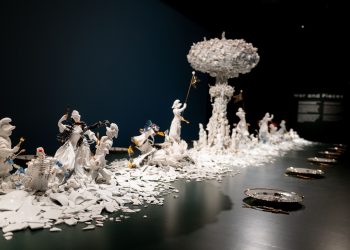


Pernille Pontoppidan Pedersen: Vous ne pouvez pas l’avoir comme papillon préféré s’il n’est plus là is on view at Galerie Maria Lund, Paris
September 11 – October 31, 2025
A questioning on the relationship between the self and the other: kinship and ways to “make with” are a common thread in Pernille Pontoppidan Pedersen’s recent works. The other here is taken in every sense of the word, including both the living, in all its forms, and the inanimate. Oscillating between observation, wonderment, and fiction —including science fiction—, her work draws from her double role as an artist and as farmhouse mother. Biologist, philosopher, and feminist Donna Haraway’s work is a major source of inspiration. Her central concepts —the notion of response-ability, her theories on significant otherness and kinship*— blur the traditional lines between matter and technology, between nature and culture. Pernille Pontoppidan Pedersen is also greatly interested in the work of her counterpart, Sonja Ferlov Mancoba (1911-1984). The Danish modernist’s universe is held by the idea of a human community, beyond cultures, mirroring her fascination for non-Western art, particularly African art.
At the beginning of her career, Pernille Pontoppidan Pedersen’s sculptures stood as accumulations-architecture-constructions, where functional objects of the widest variety joined ceramic waste and salvage to form some sort of human totems or mirror of our daily lives. Through her intimate knowledge of ceramics and her research, the artist developed very early on an aesthetic of her own, by weaving failure, attempts, and irreverence through her expressive sculptures in vivid primitive language of quirky accents. Art historian Glenn Adams uses the saying “much of a muchness” ** to describe her (often surprising) way of juxtaposing composites to create new narratives.
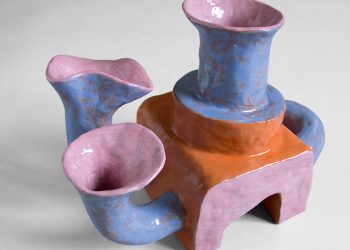
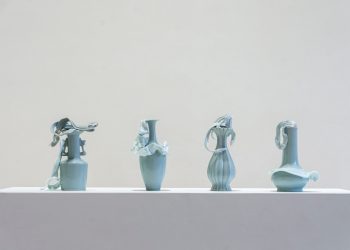
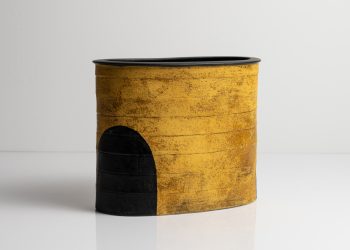
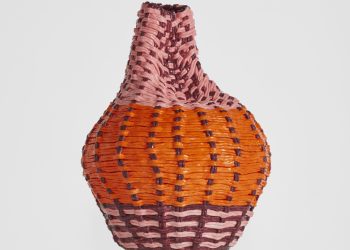
The heroine is a pitcher, states Pernille Pontoppidan Pedersen —not without humour— when evoking her latest work. This quintessential ceramic emblem throughout ages and cultures has often been a symbol of life —of what contains life— due to its curves echoing the female body and its hollowness meant to contain and preserve just like the womb. In the fauna and flora, a counterpart for the pitcher can be the cocoon, a nest of matter bound to transform into a chrysalis, then later again into an imago or a butterfly. From their symbolism and plurality, the cocoon, the butterfly, and the pitcher are often viewed as transcendental and find themselves in various mythologies.
Pernille Pontoppidan Pedersen studied butterflies —these “untethered flowers” as Gérard de Nerval called them—, their anatomy, the patterns on their wings, and the colours of their “clothes” (8, 2025 and Vous ne pouvez pas l’avoir comme papillon préféré, s’il n’est plus là [It cannot be your favourite butterfly if it is not there anymore], 2025). Her research focused on the notions of air and mass. Thus, the artist’s interest was directed both at the shape she created and at the surrounding void —for the void would allow the shape to take off, somewhere, just like a butterfly.
Her new works bring together elements of varied origins, interlocked by the modelling, where the artist seeks to blur transitions, to link, to create connections in places least expected.
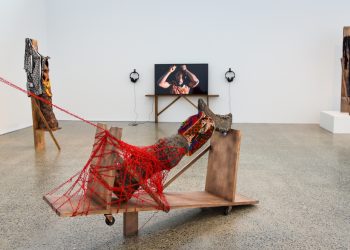
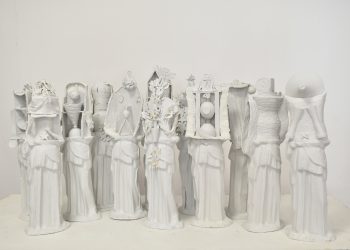
With her open structure in fragile equilibrium (Familie, 2025), her take on ready-mades with industrial jugs stacked topsy-turvy in infinite columns forming the seat of a small individual (Untitled, 2025), or her slender silhouettes (Terra United, 2025), Pernille Pontoppidan Pedersen goes by her intuition. She is concerned with moments, drives, trances —instances of movement, when things float, and thoughts and feelings stop.*** Her love for clay, on which the slightest touch impresses itself forever on the memory of the matter, is paralleled by her love for the accuracy of words. That love can be seen through the titles of her sculptures and her original way of using language. New knits for war(mer seasons) (2025) is a wall relief with glaze mimicking knit stitches. Wool comes up often in her work, as a reminder of her life at the farm. She used wool to weave a copy of her to-do list (Dosmerseddel, 2022), cramming a school meeting, a dentist appointment, the laundry, the cleaning of the henhouse, and parcels to pick up in one day. In her research, wool can also embroider incomplete sketches on canvas before clay comes to make it whole.
Pernille Pontoppidan Pedersen seeks alterity, imperfection, and a kind of chaos. By reunifying improbable elements, her works invite us both to discover what we have in common and to live the unpredictable and the trouble as a potential. With great humility, her works are an ode to boundless creativity and to the search for new ways to live together. Giving life, being, disappearing —all on the same level. The archaic rubs shoulders with the bare and the overflowing, the ugly can be beautiful, and the beautiful is constantly redefined.
About Pernille Pontoppidan Pedersen
At just 38, Pernille Pontoppidan Pedersen (born in 1987, Denmark) can already boast of a brilliant career. The artist lives and works in Denmark. She graduated from the Royal Danish Academy (design section, 2012) in Bornholm. The artist benefitted from the Danish Arts Foundation programme, The Young Artistic Elite (2021-2022) and received several grants: Martha og Paul René Gauguins Fond, Ole Haslunds Kunstnerlegat, Danish Arts Foundation, and Silkeborg Kunstnerlegat.
Pernille Pontoppidan Pedersen has also undertaken large-scale commissions. Her work is presented in several collections: at the MAD, Paris, at the Designmuseum Denmark, at the CLAY Museum of Ceramic Art Denmark, in the Erik Veistrup collection, and at the Danish Arts Foundation.
Since her beginnings, she has been exhibiting in galleries and art institutions in Denmark and abroad. Her work was presented in Everyday Life – Signs of Awareness, 21st Century Museum of Contemporary Art, Kanazawa, Japan (2017), Mindcraft17, Milan (2017), at the HB381 in New York and in Los Angeles (2021), in Ceramic Momentum – Staging the Object, CLAY Museum of Ceramic Art Denmark (2019), and in Alkymistisk Træf, Vejen Kunstmuseum, Denmark (2023).
The first presentation of Pernille Pontoppidan Pedersen’s work at Galerie Maria Lund dates to the collective show Terres (2013), followed by the duo show Chaotiquement vôtre with Esben Klemann (2014), and the solo show rv à l’air libre (2020). Galerie Maria Lund also presented her work at various fairs: Art Paris (2023) and Ceramic Brussels (2024). In 2023, mobil statue / sarkofag fartøj, a bilingual Danish-English monograph on her work, was published.
*Donna Haraway: Staying with the Trouble: Making Kin in the Chthulucene.
** Glenn Adams in the monograph mobil statue / sarkofag fartøj, 2023.
*** Pernille Pontoppidan Pedersen in the monograph mobil statue / sarkofag fartøj, 2023.
Contact
galerie@marialund.com
Galerie Maria Lund
48 Rue de Turenne
75003 Paris
France
Photos courtesy Pernille Pontoppidan Pedersen & Galerie Maria Lund
Captions
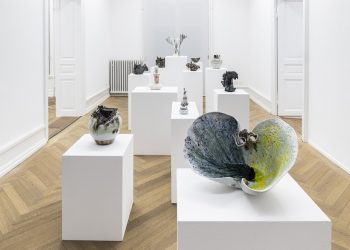
- Installation views, Pernille Pontoppidan Pedersen: Vous ne pouvez pas l’avoir comme papillon préféré s’il n’est plus là, Galerie Maria Lund, Paris, 2025. Photos © Céline Dominiak
- Vous ne pouvez pas l’avoir comme papillon préféré s’il n’est plus là, 2025, glazed ceramics, 16.54 x 13.78 x 9.45 in (42 x 35 x 24 cm). Photo © Jacob Friis-Holm Nielsen
- Drød (petit), 2025, glazed ceramics, 15.75 x 9.45 x 9.45 in 40 x 24 x 24 cm). Photo © Jacob Friis-Holm Nielsen
- sans titre, 2025, glazed ceramics and earthenware, 55.12 x 10.63 x 9.45 in (140 x 27 x 24 cm). Photo © Jacob Friis-Holm Nielsen
- Dosmerseddel (hverdag jeg har en liste der hedder hverdag) / Pense-bête, 2022, silk, wool, metal, clothes, wire and peg, 110.24 x 39.37 x 9.84 in (280 x 100 x 25 cm). Photo © Jacob Friis-Holm Nielsen
- Ordet for verden er skov (introvert) / Le mot pour monde est forêt (introverti), 2025, glazed ceramics, 33.07 x 23.23 x 1.57 in (84 x 59 x 4 cm). Photo © Jacob Friis-Holm Nielsen
- New knits for war (mer seasons) glat, 2025, glazed ceramics, 23.62 x 17.72 x 4.72 in (60 x 45 x 12 cm). Photo © Jacob Friis-Holm Nielsen
- Silkedragt (medium) / Habit de soie (medium), 2025, glazed ceramics, 19.69 x 8.66 x 8.66 in (50 x 22 x 22 cm). Photo © Jacob Friis-Holm Nielsen
- Familie, 2025, glazed ceramics, 17.32 x 13.39 x 6.69 in (44 x 34 x 17 cm). Photo © Jacob Friis-Holm Nielsen
- 8, 2025, glazed ceramics, 9.84 x 7.87 x 5.91 in (25 x 20 x 15 cm). Photo © Jacob Friis-Holm Nielsen