

Shahpour Pouyan: Winter in Paradise is on view at Frist Art Museum, Nashville
May 30 – August 25, 2024
The Frist Art Museum presents Shahpour Pouyan: Winter in Paradise, a multimedia exhibition of architectural drawings, ceramic sculptures, and an ambitious new virtual reality experience.
In contemplative works that are astonishing for their beauty and sophistication, Shahpour Pouyan critiques political power and expresses a poetic melancholy about the human condition. Born in Iran in 1979, Pouyan now divides his time between Tehran and London, and his work is in the permanent collections of the British Museum, Metropolitan Museum of Art, and Victoria and Albert Museum.
Winter in Paradise is the artist’s largest solo museum exhibition to date. “Conceived as a triptych in three galleries, the exhibition explores the architecture of power and its fragmentation and destruction,” writes Frist Art Museum curator at large Trinita Kennedy. “Three major projects from the past decade show Pouyan’s extraordinary mastery of a range of traditional and new media and his engagement with history and contemporary events.”
Politics and the weight of history have been inescapable forces throughout Pouyan’s life. Born during the fateful year when Iran’s last royal dynasty was overthrown in the Islamic Revolution, he grew up in Isfahan, a jewel-like city famous for its domed mosques and grand palaces built when it was the capital of the Seljuk and Safavid empires. His father worked as a military engineer and their family lived on an air force base, which became a target of nighttime bombings during the Iran-Iraq War (1980–89). In 1988 his family moved to Tehran, where Pouyan pursued a multidisciplinary education in mathematics, painting, philosophy, and physics. He continued his study of art in New York City, where he lived from 2011 to 2020.
Pouyan has traveled extensively in Iran, visiting the built remains of its past empires and observing the ruins of palaces and mosques. Domes and towers are recurring motifs, and his work carries a haunting sense of loss. “Imagining the flow of life in these places is a deeply melancholic experience,” he says.
The earliest works in the exhibition, Monday Recollections of the Muqarnas Dome, comprises 39 of Pouyan’s drawings of the Imam al-Dawr, an eleventh-century tomb monument built about one hundred miles north of Baghdad, Iraq, that had the earliest known muqarnas dome. Fascinated by its ornamental honeycomb-like geometric design, Pouyan had tacked a photograph of the structure to the wall of his studio, hoping to visit it one day. After surviving for almost a thousand years, however, the monument was destroyed by the Islamic State group in October 2014 before Pouyan was able to see it in person.
As a memory exercise and tribute, Pouyan made daily drawings of the building based on details he could recall without looking at his photograph, ranging from the decorative brickwork of its base to the interlocking tiers of the muqarnas. “Some forms are incomplete; some lines are faint. In each drawing there is a tension between his dedication to the monument and the fragility of memory,” writes Kennedy.
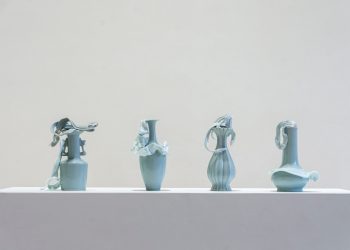
Since 2014, ceramic sculpture has been the focus of Pouyan’s practice. “He saw pottery advertised as therapeutic for people dealing with post-traumatic stress disorder and realized that, as a child of war, he suffered from PTSD himself,” writes Kennedy. “Pottery is also meaningful to him because of its venerable history in the Iranian plateau. While he works within that tradition, he expands its expressive possibilities to have contemporary resonances.”
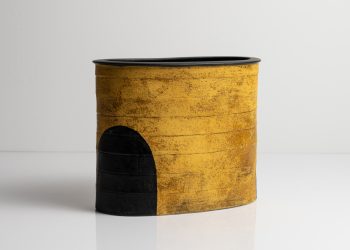
More recently, the artist has been revisiting the Imam al-Dawr by producing high fired ceramic sculptures that embody it. They are deliberately made to be strong and durable, but he notes that if handled carelessly, they too could be destroyed. “Less somber than the drawings, these reincarnations offer a way to see and experience the monument in three dimensions. Evocative containers of memory, they serve as time capsules preserving information about the tower for future generations.”
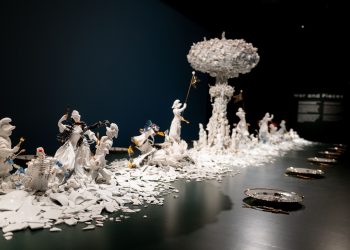
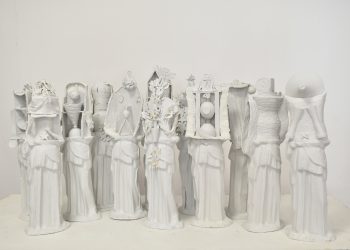
By contrast, the clay sculptures of uninviting buildings in the installation titled We Owe This Considerable Land to the Horizon Line communicate domination and subjugation. The works represent architectural motifs in the three dominant building styles in Iran: Islamic, fascist, and brutalist. “Many of the buildings lack doors or windows, granting no way in or out,” writes Kennedy. “Pouyan’s scene serves as a dystopian allegory for the dangers of totalitarianism, patriarchal rule, and the loss of individual freedoms.”
Finally, the VR installation—titled Winter in Paradise—is an immersive multisensory experience that invites viewers to explore the interior of a vast, well-preserved eleventh-century Persian mosque in which virtual snow mysteriously falls. “Rarely used today, as religion plays less of a role in daily life, the building is empty,” writes Kennedy. “Only the grandeur of the past remains.” Set in a chilled gallery, the VR installation is accompanied by a lush soundscape that includes a blowing wind, the crackle of a fire, a mysterious voice, and the plucking of a Persian stringed instrument. Outside the mosque, in a space visible through an arched door and window, the sun shines on a magnificent cypress—a sacred tree known as the Cypress of Abarkuh planted by the prophet Zoroaster, founder of Iran’s Zoroastrian religion. Cypress trees lined the walled gardens that ancient Iranians built in the desert and called paradise, and they are ubiquitous motifs in Iranian art. These trees embody many different meanings, including everlasting life, righteousness, truth, and, most importantly in this context, freedom. To realize the various components of this installation, Pouyan collaborated with artist and filmmaker Siavash Naghshbandi (b. 1987) and Saba Alizadeh (b. 1983), a leading figure in contemporary Iranian music recognized for his mastery of both musical traditions and technologies.
“Today, Iran as a whole is demonized by the West, but Pouyan complicates that narrative by reminding us with his VR installation how it has gifted the world with the concept of paradise,” writes Kennedy. Originating in ancient Iran, paradise is a word that later appears in such texts as the Book of Genesis to describe an eternal garden. “The artist presents us with a richer, more nuanced view of his country and cultural heritage. By situating his art at the meeting point of Eastern and Western ideas, Pouyan opens up new avenues of thought.”
While planning for this exhibition, the Frist was one of only six American art museums invited by the Foundation for Contemporary Art to submit a proposal for the prestigious Ellsworth Kelly Award. Kelly, a prominent American painter who died in 2015, recognized the transformative power of a solo museum exhibition in an artist’s career, and this prize was set up in his memory. The Frist received the 2022 award, which enabled Pouyan to realize this project.
About Shahpour Pouyan
Born in Isfahan, Iran, in 1979, Shahpour Pouyan earned an MFA degree in integrated practices and new forms at Pratt Institute, New York, and an MFA in painting from Tehran University of Art in Iran; he previously studied Neoplatonism at the Iranian Research Institute of Philosophy in Tehran. He now lives and works between Tehran, Iran, and London, United Kingdom, where he recently was the Middle East Ceramics Fellow at the Victoria and Albert Museum. In 2018 he was awarded the Civitella Ranieri Fellowship for Visual Arts in Umbria, Italy; from 2021 to 2023 he was the Kenneth Armitage Fellow in London; and recently he was shortlisted to design London’s first AIDS/HIV Memorial. In 2019 his solo exhibition Skyhigh Is My Place was presented at the Museum Dhondt-Dhaenens in Deurle, Belgium. He has participated in many major exhibitions, including Rebel, Jester, Mystic, Poet: Contemporary Persians (Aga Khan Museum, Toronto; Museum of Fine Arts, Houston; and Asia Society, New York); Strange Clay: Ceramics in Contemporary Art (Hayward Gallery, London); In the Field of Empty Days: The Intersection of Past and Present in Iranian Art (Los Angeles County Museum of Art); Clapping with Stones: Art and Acts of Resistance (Rubin Museum of Art, New York); and Contemporary Ceramic Art from the Middle East (Victoria and Albert Museum). He has also exhibited in biennials in Yinchuan, China; Kochi, India; and Jeddah, Saudi Arabia. His work is in the permanent collections of the British Museum; Cincinnati Art Museum; Herbert F. Johnson Museum of Art at Cornell University; Los Angeles County Museum of Art; Metropolitan Museum of Art; Museum of Fine Arts, Houston; Princessehof National Museum of Ceramics; Tehran Museum of Contemporary Art; and Victoria and Albert Museum, among others.
Shahpour Pouyan: Winter in Paradise is organized by the Frist Art Museum.
Contact
mail@FristArtMuseum.org
Frist Art Museum
919 Broadway
Nashville, TN 37203
United States
Photos by John Schweikert