Magazine
Ceramic artists list
> Ceramic artists list 97. Ryan Blackwell 96. Ellen Schön 95. Francesco Ardini 94. David Gallagher 93. Elizabeth Shriver 92. Jason Hackett 91. Patricia Sannit 90. Bente Skjøttgaard 89. Steve Belz 88. Ruth Power 87. Jenni Ward 86. Liliana Folta 85. Kira O'Brien 84. Annie Woodford 83. Kwok-Pong Bobby Tso 82. Bogdan Teodorescu 81. Kimberly Cook 80. Paula Bellacera 79. Debra Fleury 78. Cindy Billingsley 77. David Gilbaugh 76. Teresa & Helena Jané 75. Marianne McGrath 74. Suzanne Stumpf 73. Deborah Britt 72. Kathy Pallie 71. Els Wenselaers 70. Kjersti Lunde 69. Brian Kakas 68. Marie T. Hermann 67. Mark Goudy 66. Susan Meyer 65. Simcha Even-Chen 64. Barbara Fehrs 63. Shamai Gibsh 62. Natalia Dias 61. Bethany Krull 60. Amanda Simmons 59. Arthur Gonzalez 58. Chris Riccardo 57. Akiko Hirai W 56. Johannes Nagel 55. Rika Herbst 54. Liza Riddle 53. Chang Hyun Bang 52. Virginie Besengez 51. Jasmin Rowlandson 50. Chris Wight 49. Wim Borst 48. Rafael Peréz 47. Guðný Hafsteinsdóttir 46. Cathy Coëz 45. Merete Rasmussen 44. Carol Gouthro 43. JoAnn Axford 42. David Carlsson 41. Margrieta Jeltema 40. David Roberts 39. Patrick Colhoun 38. Abigail Simpson 37. Signe Schjøth 36. Katharine Morling 35. Dryden Wells 34. Antonella Cimatti 33. Cynthia Lahti 32. Carole Epp 31. Blaine Avery 30. Ian Shelly 29. Jim Kraft 28. Wesley Anderegg 27. Connie Norman 26. Arlene Shechet 25. Young Mi Kim 24. Jason Walker 23. Peter Meanley 22. Shane Porter 21. Jennifer McCurdy 20. Yoichiro Kamei 19. Debbie Quick 18. Ian F Thomas 17. John Shirley 16. Grayson Perry 15. Vivika & Otto Heino 14. Georges Jeanclos 13. Daniel Kavanagh 12. Nagae Shigekazu 11. Matthew Chambers 10. Tim Andrews 9. Claire Muckian 8. Adam Frew 7. Maciej Kasperski 6. Roxanne Jackson 5. Keith Schneider 4. Celeste Bouvier 3. Tim Scull 2. Kim Westad 1. Sara Paloma

Art

Patricia Sannit - Artist of the month, October 2012

ARTIST OF THE MONTH, October 2012: Patricia Sannit

Patricia Sannit - Artist of the month on Ceramics Now Magazine

Interview by Ileana Surducan for Ceramics Now Magazine - Issue Two

How did your experience in working on archeological sites in Jordan and Ethiopia influenced your work?

My work in Jordan and Ethiopia profoundly changed my work. I went to Jordan between my undergraduate degree and my graduate degree. At that point, I was already serious about clay, and although my early training had a functional emphasis (the well known American potter Warren Mackenzie was a teacher and influence), I had become more interested in sculpture. But my work had little focus and I was frustrated by what I saw as the triviality of my work. It didn’t seem to have a core or substance.

Before University, I had been an exchange student in Norway and had learned a lot about history, arts and culture there, but had not put it to any good use. However, when I went to Jordan, two things happened. I traveled all over the region - into Syria and Israel, and throughout Jordan, notable the amazing Petra. I was deeply impressed by the ancient culture and the design of the buildings and tombs and the handmade objects resonated with me. I understood finally that there was a connection between people and cultures and it was in a way manifested through the visual vocabulary around me. It related to the textiles of Scandinavia and the work that I had done as a kid. The desire to create some order, through geometry, on the natural world, and on roughly hewn stone and constructions seemed universal.

My other experience there that had a huge and lasting impact on me was the excavation itself. At Ain Ghazal, working in a “square” (archeological sites are frequently divided into precise squares so as to map out the location of a find onto three points in space) and seeing how the layers of the earth marked time and culture, hiding, or harboring, the evidence of past people was exciting to me. I recognized and felt awed by all of the people who had come before me. Ain Ghazal was first settled about 7250 B.C., during the so-called Pre-Pottery Neolithic B (PPNB) period. The result of our excavation was the discovery of a diverse assemblage of symbols including tokens of many shapes, animal and human figurines, modeled human skulls, “monumental” statues and mural and floor paintings. My square had a beautiful floor painting of iron oxide on plaster. During the final days of the field season, I worked to uncover the floor. As a ceramic artist, discovering a plaster floor painted with iron oxide, the same Iron oxide that I used so often in my work, was a thrill. But more significantly, as I knelt, sweeping the dust from the floor, I felt a profound sense of connection to the women who had lived there 9000 plus years before. I knew that we had shared many of the same feelings and concerns; I felt connected and understood that there was a huge chain of humanity of which I was a part. I still get goose bumps thinking of it. And that sense of our common humanity is what still informs my work today.

My subsequent adventure was in Ethiopia. I am very fortunate to have married a man who works at what is called the “Lucy” site in the Afar region of Ethiopia. Lucy is an Australopithicus afarensis, and her species populated that part of Africa between 3 and 4 million years ago. She is pat of our species ancestry. As one scans the ground for fossils, walking in the same rough wadis where our earliest ancestors walked, the sense of our history coming to surface is very powerful. It’s a beautiful place, though drier now than it was when Lucy lived there. It is very quiet and empty, and potent with history.

Patricia Sannit Ceramics - Artist of the month on Ceramics Now Magazine
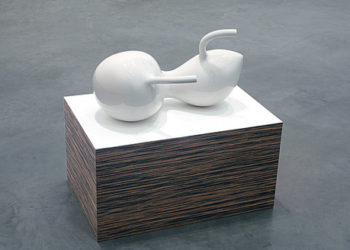
Patricia Sannit, Cradle, 2010, hand-built, carved and incised reclaimed clays, slip and stain, 21”x32”x12” - View Patricia’s works

Read More

  • Annie Woodford - Spotlight, October 2012

    SPOTLIGHT, October 2012: Annie Woodford

    Annie Woodford - Spotlight on Ceramics Now Magazine

    Interview by Ileana Surducan and Vasi Hîrdo for Ceramics Now Magazine - Issue Two

    You take your inspiration from nature. You are not just making a superficial observation, but you conduct a research of the things hidden to the naked eye. Tell us more about the universe you have discovered through your explorations.

    I am fascinated by the natural world in its widest sense and at all levels. An interest in the nature of time - the past, present and future has led me to investigate multiverse theory and hidden dimensions - concealed worlds. From there I began to examine nature on a microscopic and nano scale. I became fascinated by the concept of the unseen and rendering it seen.

    One of the subjects I investigated was that of diatoms, especially fossil diatoms. Invisible to the naked eye, beautiful and structurally complex I discovered them to bevery significanting the field of paleoclimatology - they are an important indicator of climate change.

    I like to select various aspects of the natural world and then examine them on both a macroscopic and microscopic level, considering them in terms of their relationship to time and how they relate to other parts of the universe.

    [] Read the full interview in Ceramics Now - Issue Two

    Intricate but also delicate, your work seems to be obtained through a very meticulous process. What materials and techniques do you use and how much time does it take to complete a new piece?

    Porcelain is the clay I favor - I particularly like ‘Southern Ice White’ which was developed by the Australian ceramicist Les Blakebrough. In general, the works are handbuilt; occasionally I use slip in a free but controlled way, sometimes combining it with fine glass fibre. I like to push the material beyond its perceived boundaries. The characteristics of porcelain mean that it requires careful handling throughout the making process and control and accuracy with firing and cooling.

    I often incorporate extraneous materials once the piece is fired such as metal, monofilament, fibre or horsehair. These elements add richness to the work.

    A new piece can take up to two weeks to make, depending on its complexity and it can take a further week or two to construct and apply other elements. I work intuitively when I am making, drawing on my research and bringing all the experiences together.

    [] Read the full interview in Ceramics Now - Issue Two

    Annie Woodford Contemporary Ceramics, Ceramics Now Magazine
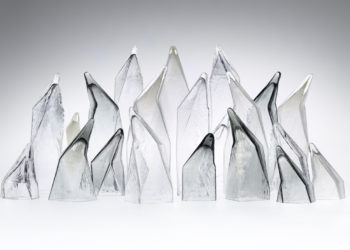
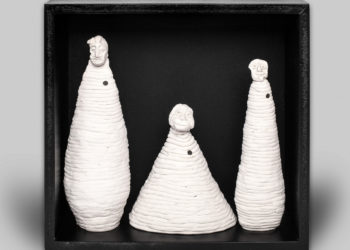
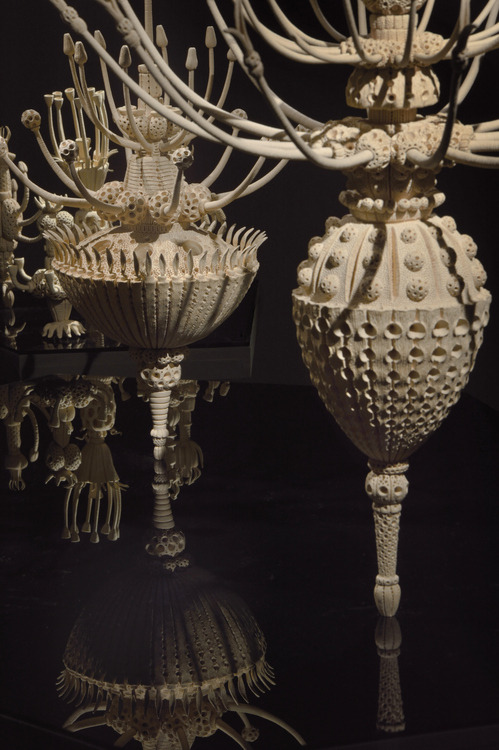
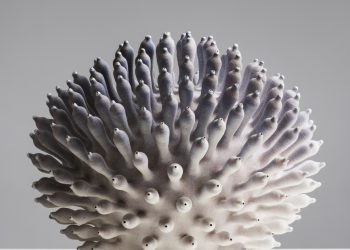
    Annie Woodford, Circlet, 2009, Porcelain, copper, stainless steel, 24 x 24 x 24 cm
    View Annie Woodford’s works

    Both science and art are a way of looking at the surrounding environment. What do you think is their meeting point? What kind of form of knowledge is art?

    I often find myself working with scientists on projects and I think the two disciplines have many aspects in common. They both help us to understand the world around us. They both rely on investigation and imagination – the ‘what if?’ principle.

    Read More

  • Kwok-Pong Bobby Tso - Spotlight, October 2012

    SPOTLIGHT, October 2012: Kwok-Pong Bobby Tso

    Kwok-Pong Bobby Tso - Spotlight on Ceramics Now Magazine

    Interview by Ileana Surducan for Ceramics Now Magazine - Issue Two

    Your work evokes artificial landscapes and strange architectural agglomerations. What is your source of inspiration?

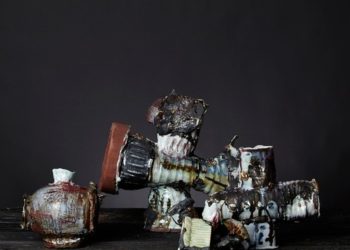
    Most of my work inspired by man-made objects; something like a view of building blocks from the sky, transformer boxes out in the field, and strange formations on the roof. Recently I started to add more abstracted objects, like the connection parts of an exhaust fan, pipe or even inside a lock. I am inspired by something that is recognizable but has an uncertain function.

    [] Read the full interview in Ceramics Now - Issue Two

    What technique do you use in order to achieve the monolithic, geometrical volumes that compose your work? Take us through the process of creating your work.

    For most of my work I combine hand building, slip casting, and wheel thrown techniques. In terms of surface, I achieve an ultra-smooth finish by using a range of sandpaper from 200-600 grit. I then use a marble polisher to sand the surface till it is as smooth as butter. For my industrial landscape series, “The View From Above,” I leave the clay surface as it is this emphasizes the unique qualities found within a raw clay body. For my “Industrial landscape series”; I apply glazes, sometimes paint or enamel to achieve the old sanded look.

    The Industrial Landscape series are exploring the mysterious relationship between how one object fits unexpectedly into another and becomes a whole new composition. Tell us more about this relationship.

    The mysterious relationship between space and curiosity has always influenced my work. I think those space redefine objects and give those objects meaning. For example, when you have a simple form like a cup, the space created by the handle defines the shape of the cup, when you added a saucer to this cup, the composition has changed. It redefines the function of this cup not only by adding more meaning to it, but also increasing the tension. I believe that one object needs another object and the space in between are the main reason why I am interested in this relationship, it is also what peaks my curiosity and motivates my work.

    Kwok-Pong Bobby Tso Contemporary Ceramics
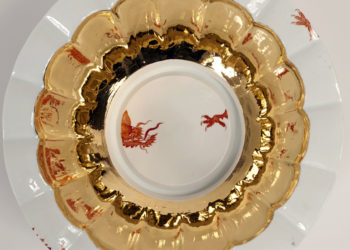
    Kwok-Pong Bobby Tso, Zeta, Industrial landscape Series, 2011, Porcelain, paint, wood, hobby paper and metal, H 13 1/4” x W 14” x D 6”
    View Kwok-Pong Bobby Tso’s works

    Read More

  • In memoriam Eugenia Pop / Interview

    ROMANIAN CONTEMPORARY CERAMICS, October 2012

    In memoriam Eugenia Pop
    Eugenia Pop lived and worked in Cluj-Napoca, Romania, where she graduated from the Ceramics Department of “Ion Andreescu” Arts Institute in 1971. Over the course of 40 years, she had exhibited in many countries and has been awarded for her career by the Romanian Government (Order of Cultural Merit) and the Fine Arts Union.

    Eugenia Pop Romanian ceramic artist

    Two days after our meeting in February, Eugenia Pop went to the Copăceni alms house, near Turda, to read in peace a book by Zhi Gang Sha. She wanted to learn how to communicate better with her guardian angel. She told us that the spirit must be cleaned more frequently.

    We thank Jeni Pop from our hearts and promise to carry her optimism out in the world.

    Interview by Alexandra Mureşan and Vasi Hîrdo for Ceramics Now Magazine, Issue Two
    February 2012

    How did the fascination for ceramics started?

    I graduated Ceramics at the Fine Arts Highschool in Cluj. In the twelfth grade I had an excessive curiosity to do work as much as possible, that’s why I chose ceramics. I was a colleague with Arina Ailincăi for 6 years. We were also six in the department. Our personalities were very different, and they remained the same. A sculptor inoculated me the idea of versions. He gave me a theme, a ceramic piece in an architectural environment. After a few sketches, he told me to do more versions. I didn’t like the idea – why make more versions when the first one was good enough? But, if the master told me, I had to do it. I did lots of versions and sketches, from bad to worse. He chose from the first two, and I remained very sad because I worked so hard on so many. After a while, the seed sprouted in my mind. I was at a Communist party meeting, and I got very bored. I had my sketchbook at me and I was doing all sorts of sketches and drawings. The expression was changing with little diversity if terms of form. I showed the sketches to my professor. It remained my method over the years.

    Now I stopped doing more versions on a theme. I read books, for example those written by Rudolf Steiner, and I make illustrations on the pages. When reading a book twice, the images speak to me a lot more and I feel the text very differently when it’s illustrated, just like a plastic commentary.

    What are your main sources of inspiration?

    I broke up with the illustrative image of the exterior form. I adhered to the archetypal forms, which are interior forms of the soul, forms that kids use when drawing, but also used in the antic culture.

    Mihai Oroveanu said “Look how monumental your works are,” even if they were very small. Dan Hăliucă said the contrary: “That’s how it should be – plenty and small.” I used this thing with plenty and small a lot, because that’s how the image of the soul is. The soul is very capacious. From it’s ampleness you can make plenty and small.

    A moment of crystallization appeared when I found my personality – when I said that this is how I want to express myself. It was the humanity theme, the man. The mother man, the old man, the child man. Mother Earth. These are themes that I feel I synthesized.
    When I was young, my mother used to call me “little golden thorn” – she couldn’t tell me that I was not right, but I was also very determined. I was telling the truth.

    Eugenia Pop - Mother Earth, ceramics
    Eugenia Pop, Mother Earth, 1985, Soft porcelain

    What is your dearest part in elaborating a new work?

    Each part has its own magic. The first one is sketching the idea and choosing the right drawing, then follows the modeling and making the negative. After that, the fascination of the firing starts. It is like when a mother gives birth – she doesn’t know how the child will look like or what color his eyes will be. It is just like that after the firing, when you remain charmed by an object, and you say to yourself that this is mine! – its color has changed and it shrank. After you inspect it for a while, you adopt it or not. Sometimes you have to say I’m sorry – this is not mine.

    Read More


  • Carsten Nicolai - Unidisplay

    “The installation unidisplay offers an examination of semiotics and the laws of perception. The work operates with a number of modules of different visual effects that interfere with the viewers’ perception, through optical illusion, jitter, flicker, after-image, movement, complementary colour effect, and so on. The installation unfolds against a long projection wall with two mirror walls on the side thus visually expanding like a universe. The basic visual, made up of sequences, motifs and graphic translations of various units of time measurement acts as a world clock and evokes the intertwining of time, between past, present and future. The installation is created with Derivatice’s TouchDesigner software which has been used for alva noto live performances with a triple-screen projection.” (via)

    More connections »

    (via rcruzniemiec-deactivated2013020)

  • The reopening of Fabrica de Pensule / Cluj-Napoca, Romania

    The reopening of the Paintbrush Factory Fabrica de Pensule, Cluj-Napoca, Romania

    The reopening of Fabrica de Pensule / Cluj-Napoca, Romania
    October 5, 2012
    - 7-10 PM


    Contemporary art exhibitions:
    SABOT
    / Paul Branca – L’origine de l’espace privée
    Plan B / Alexandra Croitoru – Do not forget you are an artist!
    Peleş Empire / Original/Copy III
    Lateral Art Space / Adrian Sabău – In-lined
    Baziş / Bandi Saşa – Persona non grătar
    Baril / Constantin Flondor – Sifting
    AltArt / Time’s Up (AT) – Unattended Luggage
    Intact Space / Fake it! Limited Edition
    Etaj III, corridor / Ana Adam – Drawings
    open studio / Istvan Cîmpan (first floow)
    open studio / George Crîngaşu (SABOT Residence Space, forth floor)

    + Divas at Sala Studio (8 pm). Directed by Ferenc Sinkó, GroundFloor Group.

    The exhibitions are part of the Contemporary Art Factory project organized by The Paintbrush Factory (Fabrica de Pensule) and financed by the Administration of the National Cultural Fund (AFCN).

    Fabrica de Pensule / The Paintbrush Factory is a collective space for contemporary arts in Cluj, Romania. The project started at the beginning of 2009, as an independent initiative to bring together ideas, events and projects of cultural organizations, galleries, producers and independent artists in Cluj and as a reaction to the local lack of production and exhibition spaces in the city.

    The artists, galleries and organizations – active in the fields of theater, contemporary dance, visual arts, arts in public space, music – are jointly engaged into delivering relevant cultural content, both for the artistic community and the wide audience. Besides artist studios and production spaces, Fabrica de Pensule also hosts events of local and international partners. It acts as a major player in cultural and urban policies in the Romanian context.

    Read More

  • Month in Review: September 2012

    Featured on Ceramics Now: Bertozzi & Casoni's Regeneration exhibition at All Visual Arts, London

    Hello everyone and welcome to our first Month in Review, a summary of the last month of activity on Ceramics Now. Subscribe to our monthly newsletter and follow us on Facebook and Twitter to receive the latest news.
    Check the Subscription offers on our Magazine shop.

    This month’s featured artists (view list):

    Elizabeth Shriver (works)
    David Gallagher (works)
    Francesco Ardini (works)
    Ellen Schön (works)

    This month’s featured exhibitions:

    Ceramics Now Team Exhibition / Europe Gallery, Brasov
    Contemporary Ceramics / Stremmel Gallery, Reno, NV
    Ellen Schön: Vessel Variations (x3) / Vessels Gallery
    Fragile! In Transit / Traveling exhibition around Europe
    Scandinavian Design / Museum of Fine Arts, Houston
    Marek Cecuła: SEEDS / Glass and Ceramics, Wrocław
    Rosemarie Trockel: A Cosmos / NEW MUSEUM, New York
    Bharti Kher / Parasol unit foundation for contemporary art
    Ruth Duckworth exhibition / Erskine Hall & Coe, London
    Contemporary Clay Invitational / j fergeson gallery
    Arina Ailincăi: In-Scripted Body / Art on the Avenue
    Scandinavian Ceramics Conference 2012 / Hjørring
    Clémence van Lunen exhibition / Galerie NeC, Hong Kong
    MOUNTED / Red Lodge Clay Center, Red Lodge, Montana
    CONCEPTION - Part Two / Canvas Galleries, Belfast
    Aneta Regel Deleu / Puls Contemporary Ceramics
    Liliana Folta / Amazing Things Art Center, Framingham
    Reviving the light: Zsolnay Ceramic Design / ILIAD, NY
    Bertozzi & Casoni: Regeneration / All Visual Arts, London

    This month’s featured connections:

    Daehyun Kim Illustrations
    Mimicry Chairs by Japanese design studio Nendo
    Martin Creed on My Modern Metropolis
    Leslie David - Painting Please!
    Tim Hawkinson - Mobius Ship
    Robert Montgomery: Echoes of Voices in the High Towers
    James Hoff: I’m Already a Has-Been / VI, VII, Oslo
    Anna Von Mertens - Portraits

    This month’s news on Ceramics Now:

    New publishing schedule for print and digital
    New magazine shop - 10% Sale ends December 31, 2012
    We hit 25000 followers on Tumblr (27600 now)
    Published Calendar of Ceramic Art Competitions for 2013

    Next month’s news: Ceramics Now Exhibition - 3rd edition

    For media partnerships or sponsorship please contact Vasi Hîrdo, Editor, at vasi@ceramicsnow.org
    Submissions and general info: office@ceramicsnow.org


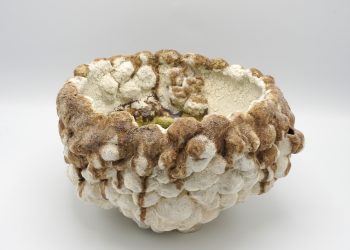
  • Carol Gouthro: Anthozoa gouthroii “Viridis”, 2012, Terrecotta clay with underglazes and glazes, 6”h. x 10.5”w .x  6.5”d


  • Carol Gouthro: Anthozoa gouthroii “Chromatella”, 2012, Terrecotta clay with underglazes and glazes, 6”h. x 10”w .x  6”d

  • Bertozzi & Casoni: Regeneration / All Visual Arts, London

    Bertozzi Casoni Regeneration exhibition, All Visual Arts, London

    Bertozzi & Casoni: Regeneration / All Visual Arts, London
    October 13 - November 10, 2012

    Private view: October 12, 7-9 pm.

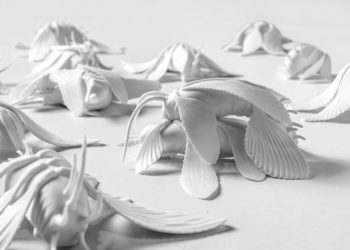
    All Visual Arts are proud to present Regeneration, a unique installation from Italian artists Bertozzi & Casoni. The artists are acclaimed for their delicate depictions of a culture in decay, deftly rendered in fragile ceramic clay. Their latest work Regeneration queries the hierarchy of aesthetics, revealing the beauty in the neglected and discarded ephemera of our seamless culture. The pieces compel the viewer to confront the visceral decay of contemporary society, to expose the cracks between the artifice of the world we are presented with and to explore what lies within these fissures. With this imaginative approach to their practice, Bertozzi and Casoni align the traditional with the experimental, and allow us to construct our own narrative around their evocative scenes.

    Bertozzi and Casoni manipulate the indistinction between the real and the simulacrum in their work, an obsession for detail which evokes the Decadent taste for imitation and crafted artifice as superior to the natural. In fabricating these visually and emotionally compelling still-lifes, the artists engage the viewer in deeper themes of impermanence and mortality. Through rendering the abject and overlooked in such exquisite detail, Bertozzi and Casoni signal the return of the repressed, the avoidance of our own mortality. In one piece in which the memento mori is explicitly rendered, an ox skull is dominated by a vivid monitor lizard, symbolic of both death and rebirth in its habitat across Asia and Australia. In the antonymously titled DisGRACE, vibrant blooms sprout from the polluted detritus of a decadent and avaricious society, a scene of nature triumphing over the excesses of hyper-capitalism.

    Regeneration contemplates the possibility of change through rebirth, rediscovery and reappropriation, manipulating earth into elegant and fragile structures. In one piece, a cluster of butterflies flock to raise the severed head of a deer from an ornamental platter, recalling the Renaissance representations of John the Baptist or Holofernes. In a similar echo of classical scenes, and dominating the Regeneration is the serene image of a silverback gorilla resting in the Buddhist lotus position on a bed of discarded mattresses. A roe deer lies prone across its body, while wrens and goldcrests commune around the pair. The piece is an evocation of symbolic power, from the visceral confrontation of our Darwinian descendent dying out in front of our eyes, to the shift between the viewer and sculpture, object and subject as we find ourselves caught in the compassionate gaze of the animals. Our own mortality is inscribed in the tableaux where urban structures, religion and the animal world collide to reveal the grace in disgrace which Bertozzi and Casoni seek to capture.

    It seems appropriate that the duo push their material to its limits and question the possibility of representation in their work at every turn. Their liberal accumulation and compilation of cultural references is evident in the playful amalgamation of objects in a work where a swordfish’s head juts from a guitar case; the shapes tessellating the natural with the cultural. Their curiosity and playful approach to objects creates a process of continual experimentation and discovery, freeing themselves from convention and the stereotypes of the ornamental and domestic associated with the ceramic medium, and producing unexpected moments of pathos and humour through their synthesis of past and present, nature and artifice. The artists subvert the established rules about the perception of applied arts through inverting the symbolic power of their traditional medium, exceeding the inherent conservativism of ceramics to sculpt fantastic and grotesque scenes that liberate both the artist and viewer’s imagination.

    Read More


  • Anna Von Mertens - Portraits

    “Odd avenues of knowledge and inquiry interest me. I research further and uncover phenomena in isolated fields of study that mirror information about my own private world. I then translate this empirical data into a subjective version to reflect the parallels I see.

    I have tracked how energy is dispersed in a nuclear explosion and how energy is stored in a cell; exposed hidden topographies (of the human body, of the ocean floor); contrasted migration routes of birds to the migration routes of humans; and shown the stars exactly as seen above violent moments in American history.

    These patterns reveal to me aspects of our existence, whether it is how we experience time and face the infinite - embedded in that is our own mortality - or how the boundary of the body is presented to others versus how it is felt internally.

    I use the stitch to follow these trails, tracing the paths with my fingers. The dotted line of hand-stitching is a marker of uncertainty, a way of exploring. The time invested in making the work, allowing for contemplation and internalizing, becomes a part of how the work is viewed.

    I see all of these elements as a form of mapping, reflecting the need to get my own bearings in this vast universe.” Anna Von Mertens (via)

    More connections »

  • ©2013 Ceramics Now. All Rights Reserved. Website by Thomas Cullen. Powered by Tumblr.