By Olivia Fero
What if the vessel-versus-sculpture debate that has preoccupied contemporary ceramics is not merely unresolved, but unanswerable? Not a genuine question at all, but a category mistake: the philosophical error of treating one kind of thing as if it were another.
The British philosopher Gilbert Ryle first deployed the category mistake in The Concept of Mind (1949) to demolish the mind-body dualism that had dominated Western discourse since Descartes, rejecting the idea of the mind as a “ghost in the machine” separate from the body. He uses a famous example to illustrate this error: a visitor is shown around Oxford, sees the colleges, libraries, playing fields, and professors, and then asks, “But where is the University?” His error lies in the assumption that the University is the same kind of thing as a building, when in fact it is an organising principle rather than a physical entity. I want to suggest that “vessel” and “sculpture” operate the same way. They are not properties inherent in clay; they are not physical attributes we can isolate. They are interpretive frameworks, or institutional filing systems, that we project onto objects to organise our understanding. When critics look at a ceramic object and ask, “I see the clay, the glaze, and the form, but is it a sculpture or a vessel?”, they are making the exact error of the visitor to Oxford. They are waiting for the “Art status” to appear as a distinct entity, when in reality, “sculpture” and “vessel” are simply the ways we organise our interactions with the material.
So, what is the persistent ontology of these objects? We discover this by looking at the “clayness” of the object itself. While critical frameworks shift, the materiality remains stubbornly fixed; it has its own tendencies to crack or warp and absolute limits like the thermal transformation of quartz inversion. That transformation happens at 573°C regardless of whether the object is destined for a museum or a kitchen table. This material stability creates a unique professional condition. While the sculptor operates with a fixed context of Fine Art and variable materials, the ceramicist operates under an inversion. For them, the medium is stable but the context is fluid. The ceramicist stays faithful to one material, but that material demands they walk through different institutional doors: the factory, the kitchen, the building site, and the museum. They are materially monogamous, but institutionally promiscuous.
These categories and hierarchies did not arrive with the clay. They were built into Western cultural institutions during the nineteenth and twentieth centuries: museum departments, funding bodies, degree programmes, professional organisations. The South Kensington Museum (later the V&A) was founded in 1852 explicitly to serve the “applied” and “decorative” arts, terms that encoded a secondary relationship to “Fine Art” from the start. A century and a half later, we still navigate museums whose floor plans make the category mistake concrete: turn left for painting and sculpture, turn right for ceramics and textiles. It is worth noting that the Cartesian dualism Ryle originally attacked, mind separated from body, thought from matter, and the aesthetic hierarchies it spawned are not universal. They are a specifically Western inheritance. Where Western aesthetics inherited a hierarchy that placed intellectual conception above manual execution, other ceramic lineages organised themselves around material transmission: technique passed from master to apprentice, knowledge held in the hands. The vessel/sculpture question simply does not arise in the same way when the framework was never dualist to begin with.
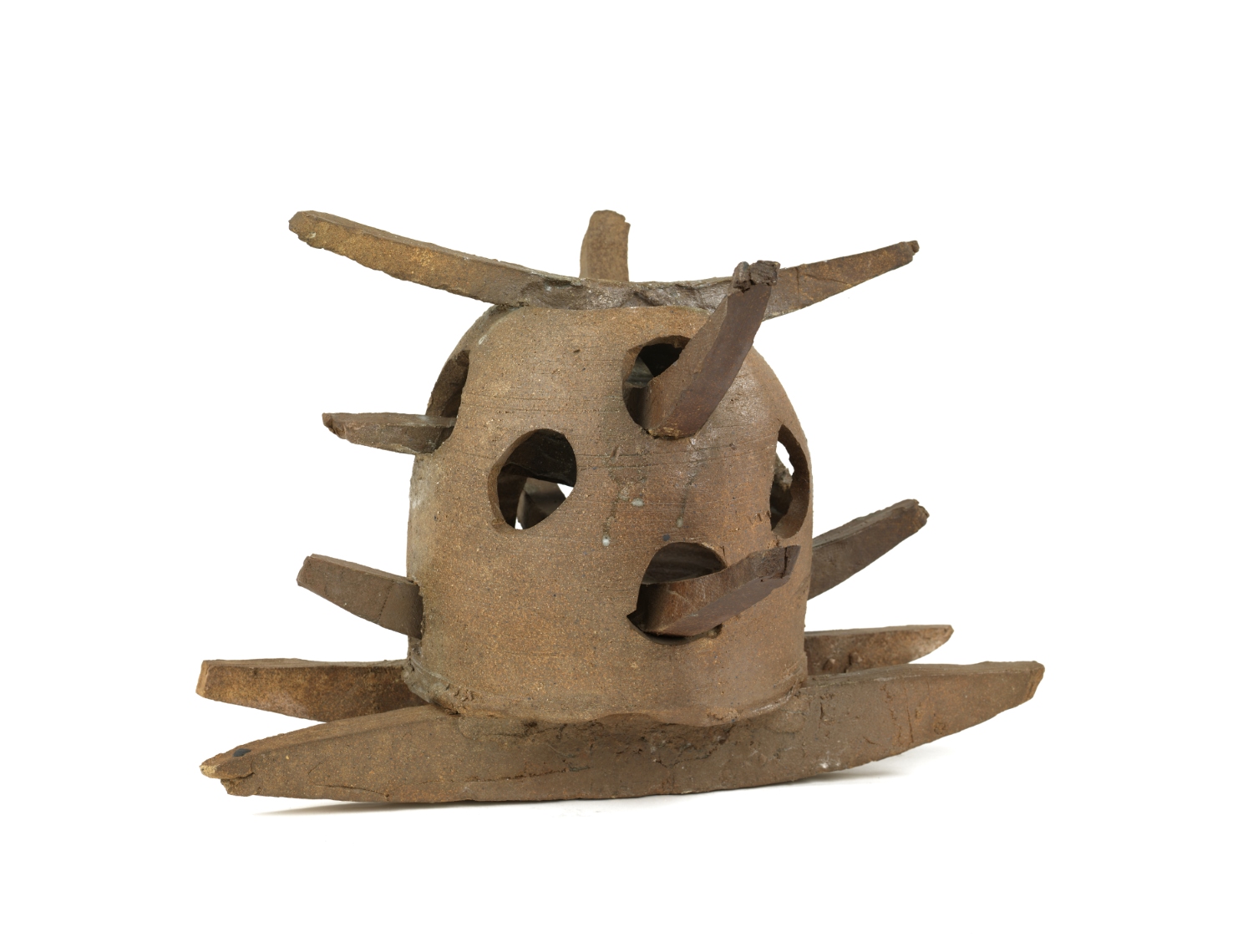
If we accept that “vessel” and “sculpture” are institutional categories rather than material truths, we must examine how artists have historically navigated them. The dominant Western narrative of the 20th century was one of rupture. The American ceramic revolution, led by Peter Voulkos in the 1950s, was predicated on a violent rejection of the vessel to achieve the status of sculpture. Voulkos did not transform the field by revealing the ontology of clay; he transformed it by mobilising the critical framework of Abstract Expressionism. His strategy was oppositional. To make a work like Rocking Pot (1956) read as art, he had to physically attack its utility. He slashed, stacked, and punctured the clay, treating the vessel as a prison from which the “art” had to be liberated. This approach, while historically significant, reinforced the very binary it sought to escape. By defining his sculpture through the destruction of the vessel, Voulkos inadvertently confirmed the category mistake. He accepted the premise that a pot could not be art unless it was broken. In the language of Ryle, it was as if Voulkos believed the University could only be found by burning down the colleges.
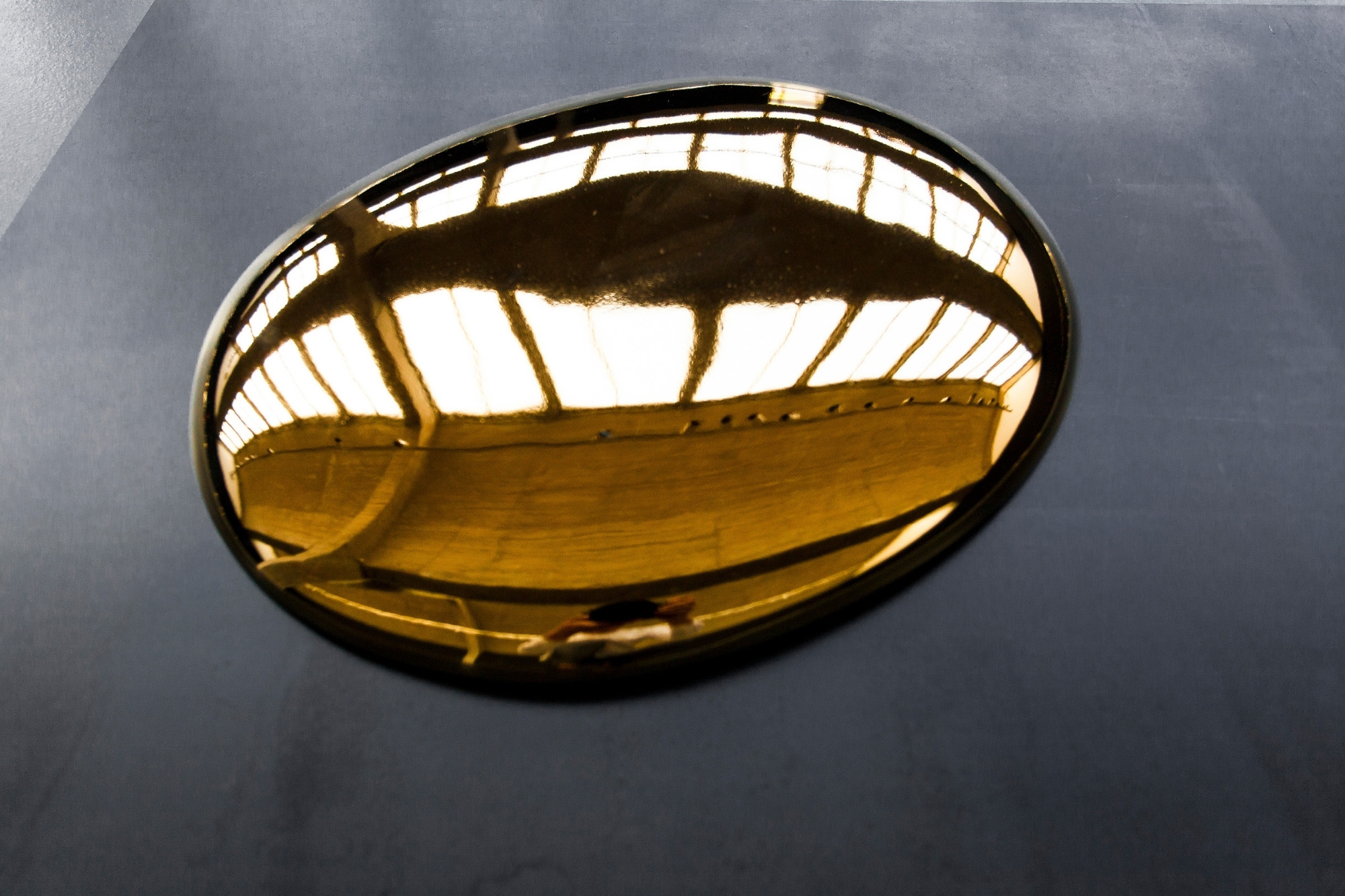
Contrast this with the more recent response of Liu Jianhua. Working within the lineage of Jingdezhen, the historic centre of global porcelain production, Liu does not seek to break tradition but to liquefy it. In his Square series, pools of porcelain are presented on industrial steel squares, luminescent with gold lustre. Unlike Voulkos, who imposes his ego onto the clay through gestural violence, Liu steps back to allow the material its own agency. He utilises porcelain, the most rigid and historically loaded of ceramic materials, but denies it a fixed form. In Square, the porcelain appears as a liquid spill, a molten golden pool that seems to have just arrived on the steel surface. There is no vessel to break because the material has refused to become one. It exists in a state of ontological suspension, capturing the moment the slip spreads under the laws of fluid dynamics before it is immortalised by the heat of the kiln.
What theoretical vocabulary do we have for this relationship between human intention and material behaviour? Karen Barad, a feminist theorist and physicist, offers one in her book Meeting the Universe Halfway (2007). She develops the concept of intra-action to challenge our ordinary assumptions about how things relate. In standard interaction, two separate entities meet and affect each other while remaining fundamentally distinct. Intra-action is more radical: the entities themselves do not precede their encounter but emerge through it. Subject and object, maker and material, come into being together.
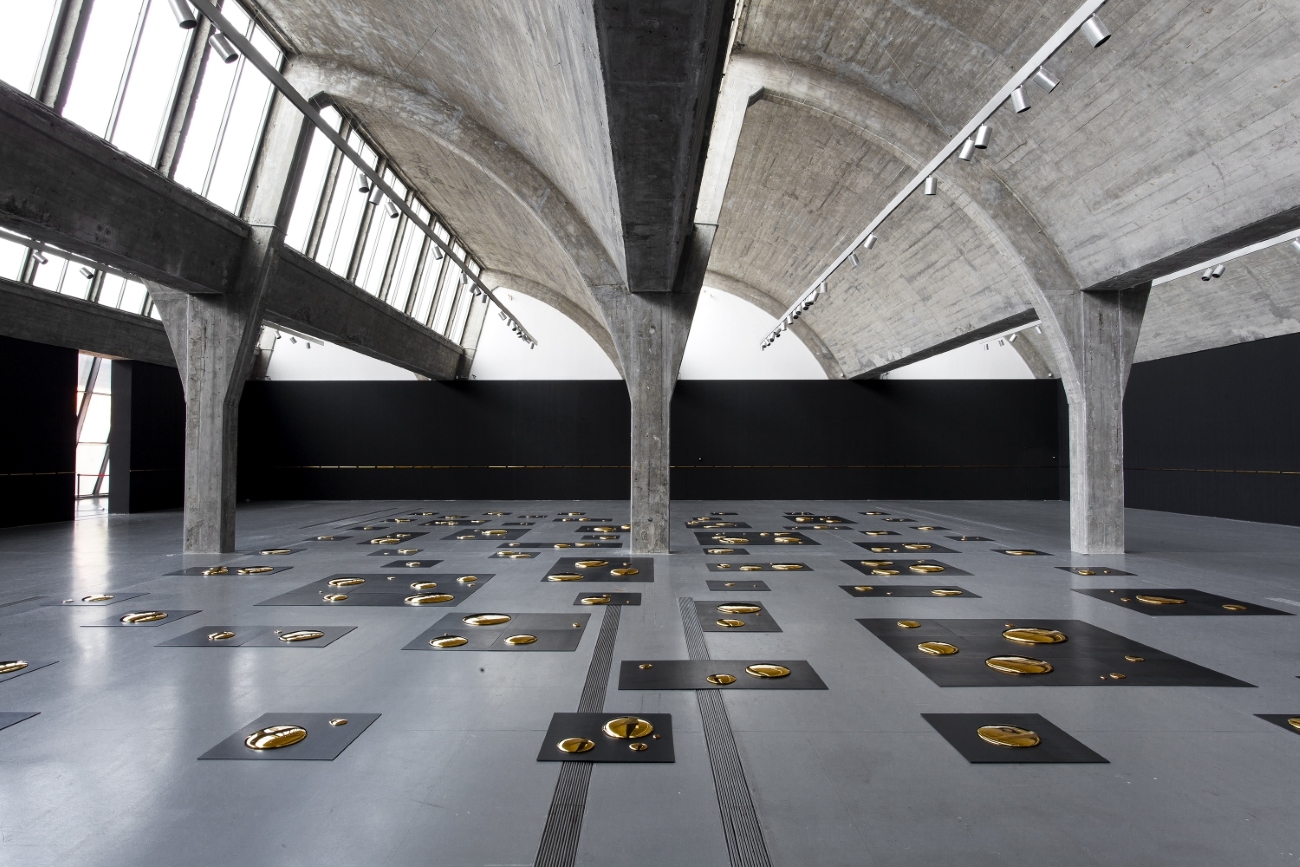
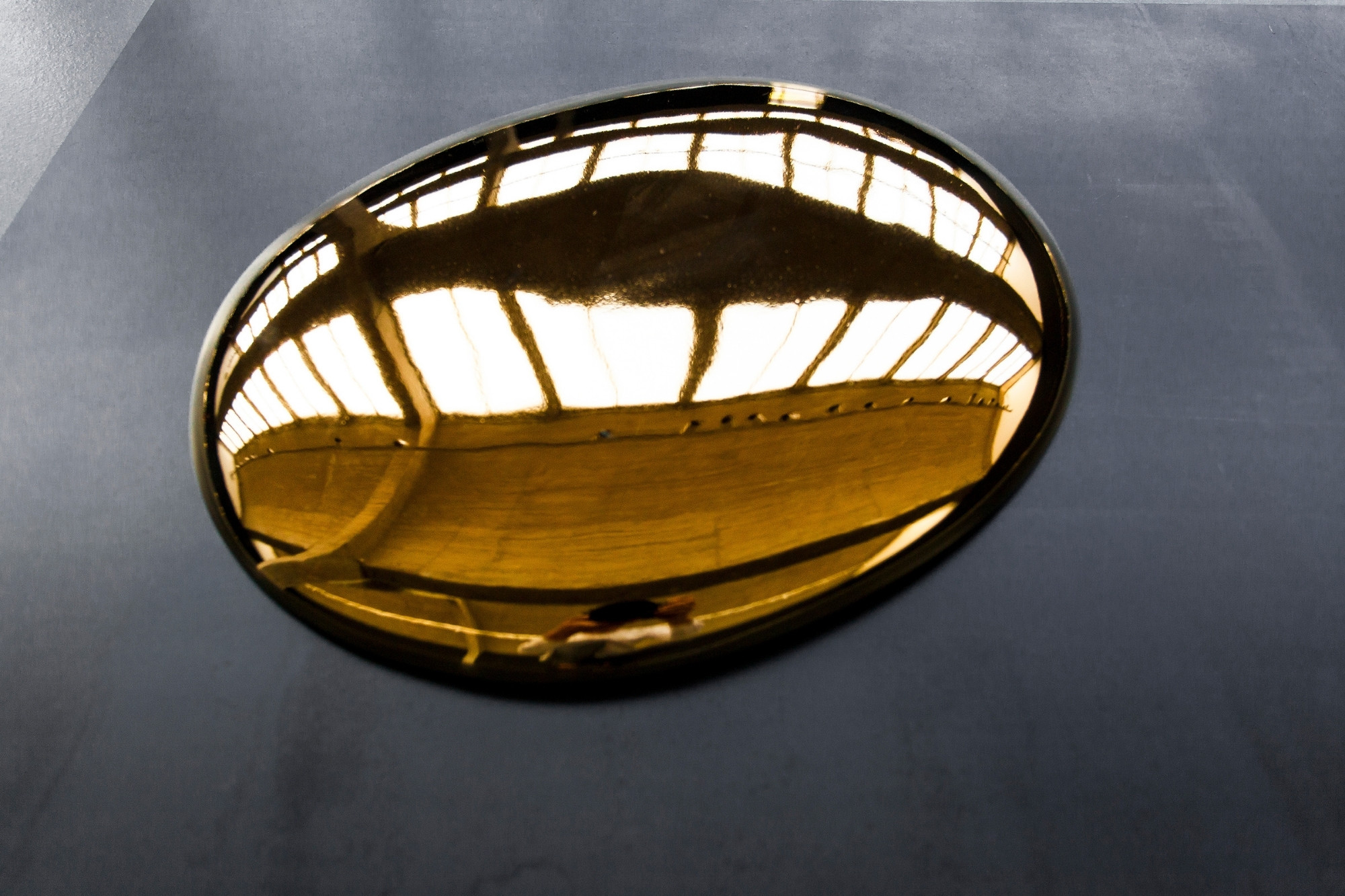
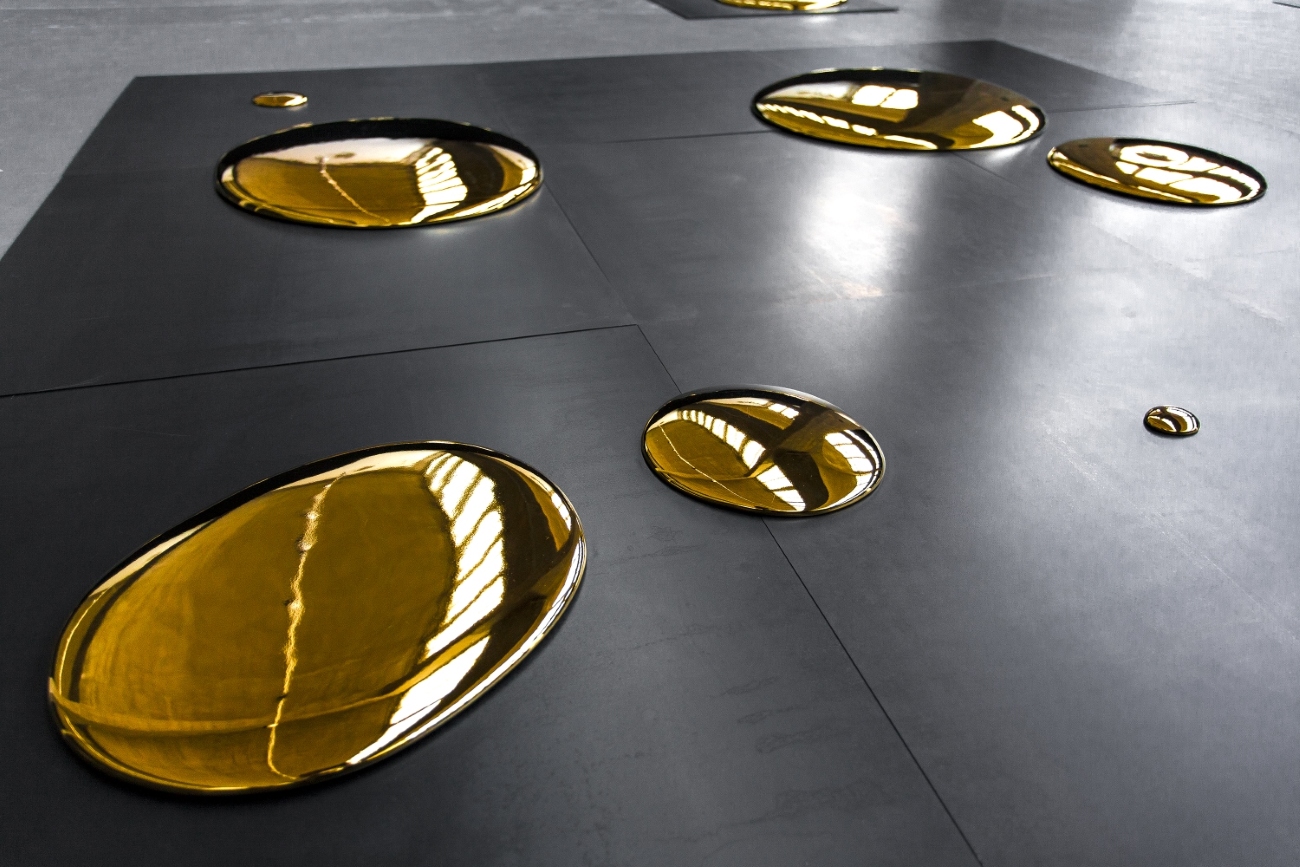
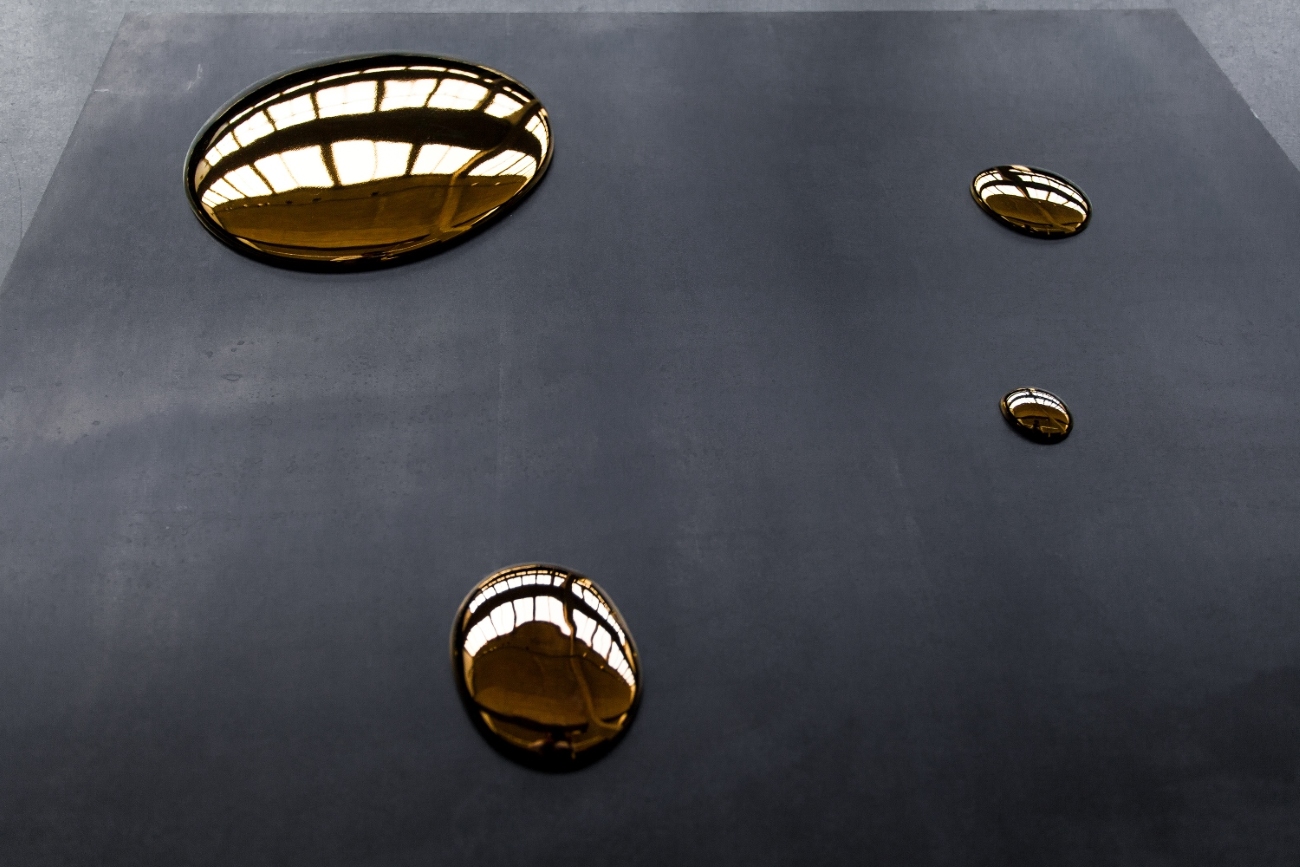
Liu’s Square series is intra-action made visible. The artist does not impose form onto passive porcelain. Instead, he creates the conditions: the slip, the steel surface, the pull of gravity, and then withdraws. What emerges is not Liu’s design but the record of an encounter: porcelain and gravity and surface tension negotiating a form that none of them could produce alone. The golden pool is not shaped; it is what happened.
But Barad’s framework extends further. She argues that the apparatus of observation is never neutral; it participates in producing what it claims to merely describe. Applied to our question, this means that the museum department, the gallery label, the critical language we use, these are not transparent windows onto a pre-existing object. They are themselves part of the apparatus that produces “vessel” or “sculpture” as seemingly stable categories. When a curator places a tea bowl in a vitrine labelled “ceramics” and a slashed Voulkos in a gallery labelled “modern sculpture,” the institution is not recording a difference that exists in the clay. It is making that difference through the act of framing. When we view ceramics through the lens of intra-action, the category mistake dissolves completely. The question is no longer “Is this a vessel or a sculpture?” because those categories assume stable, pre-existing identities. Instead, we ask: how is the matter acting, and what apparatus are we viewing it through?
If Voulkos attacked the vessel to make it sculpture, and Liu dissolved the vessel to reveal the material, contemporary practitioners like Takuro Kuwata and Magdalene Odundo prove that the vessel can possess the intellectual density of sculpture without renouncing its identity. They do not ask “Is this a vessel?”; they force us to ask, in the words of Bill Brown, “What is this Thing?”
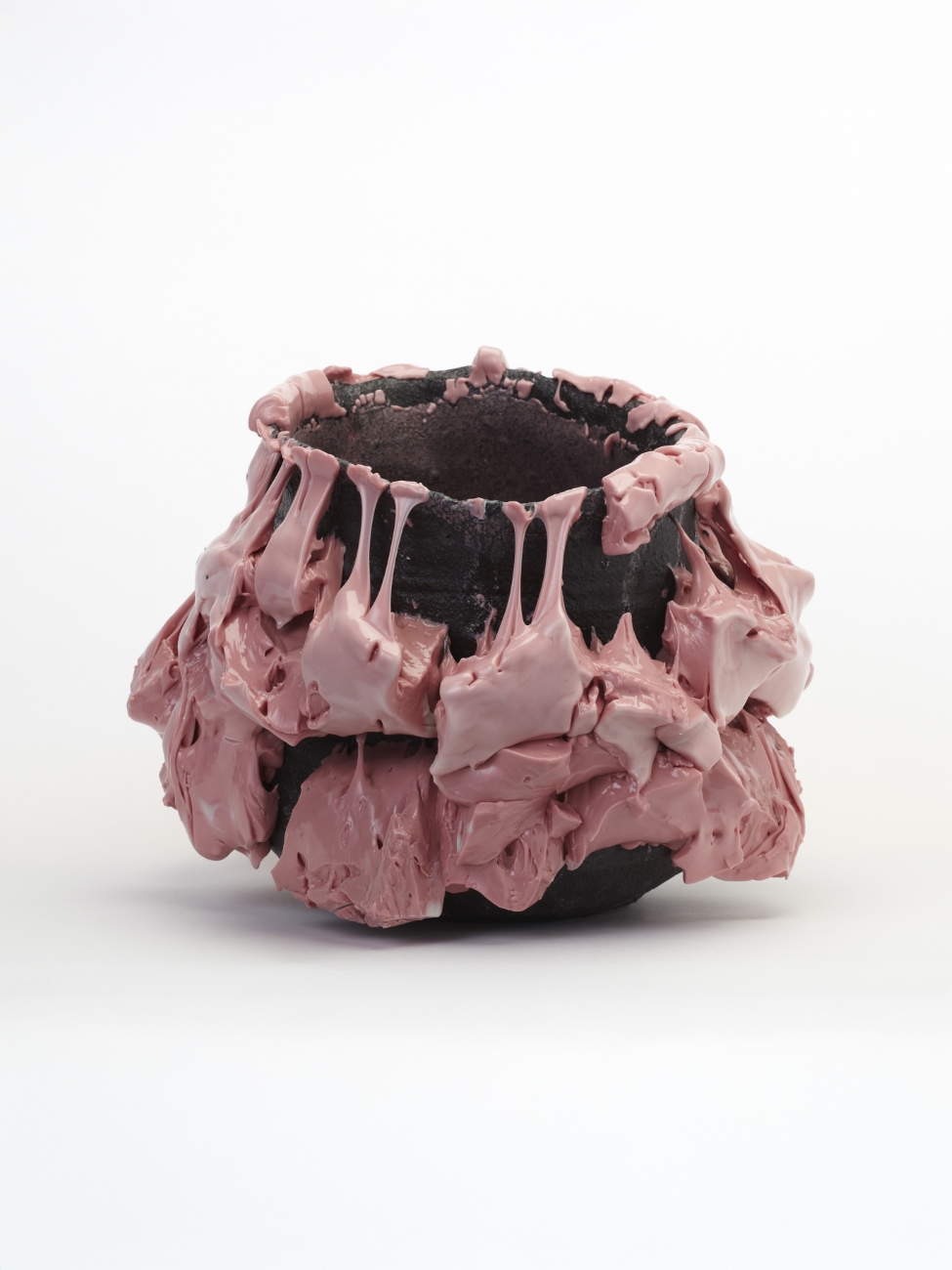
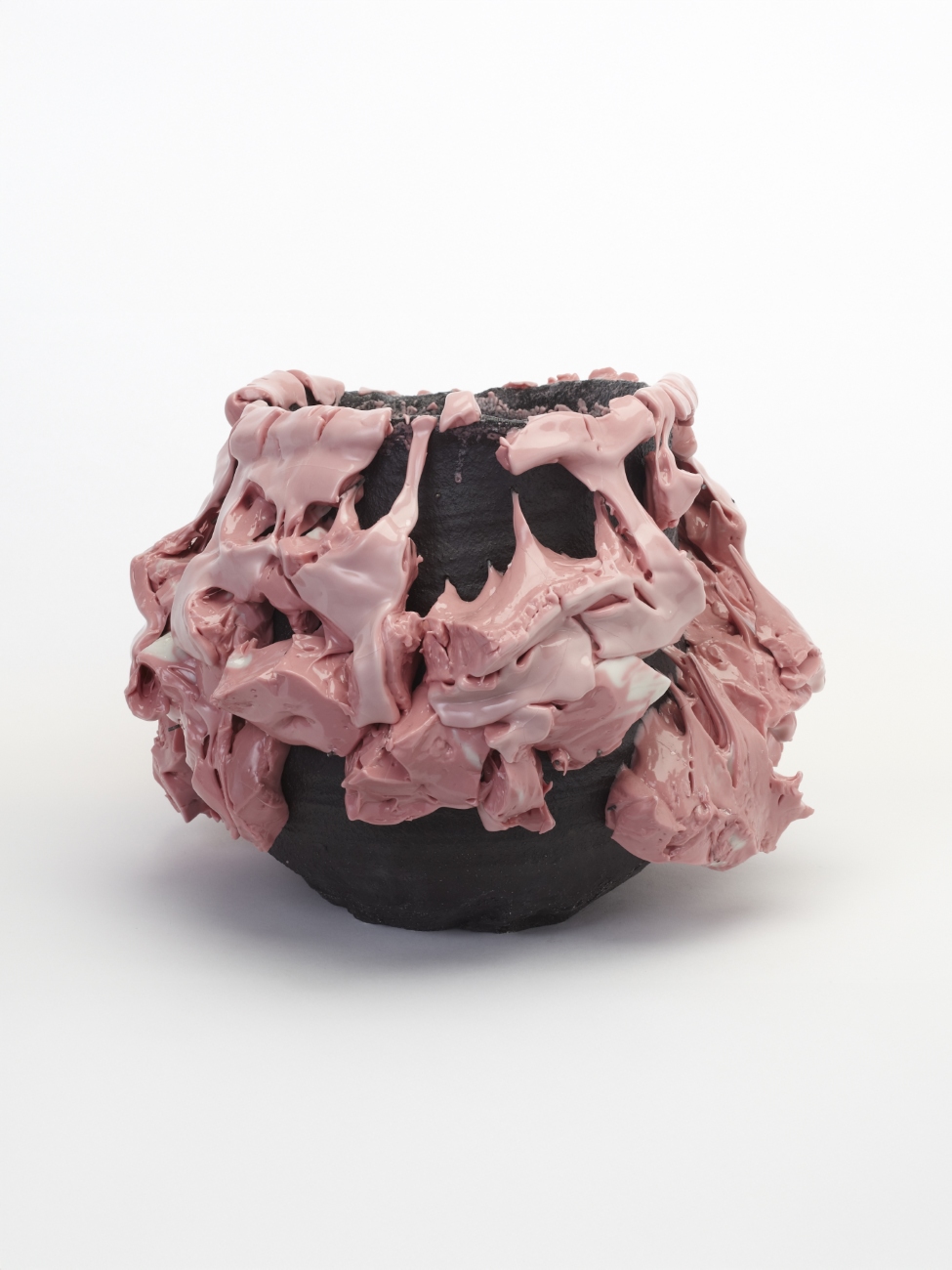
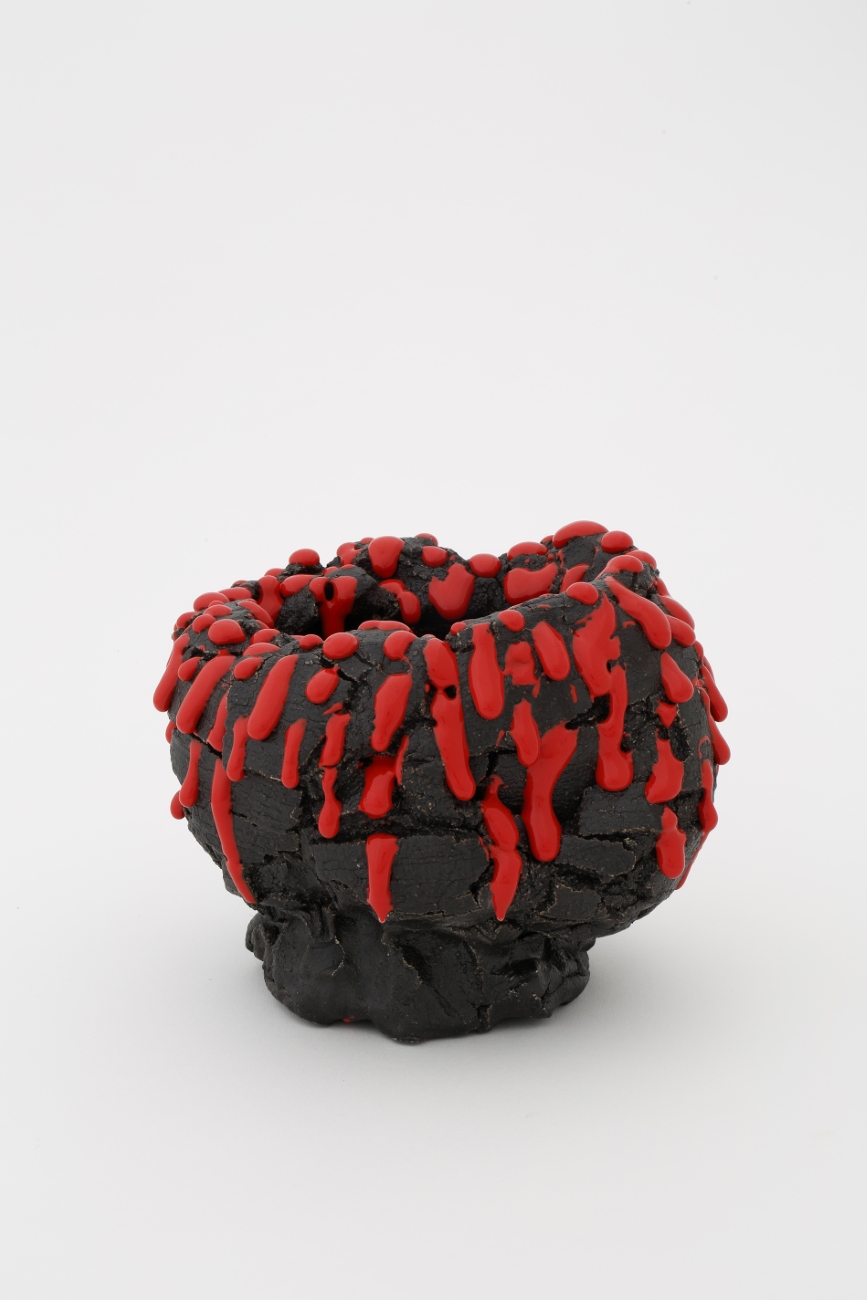
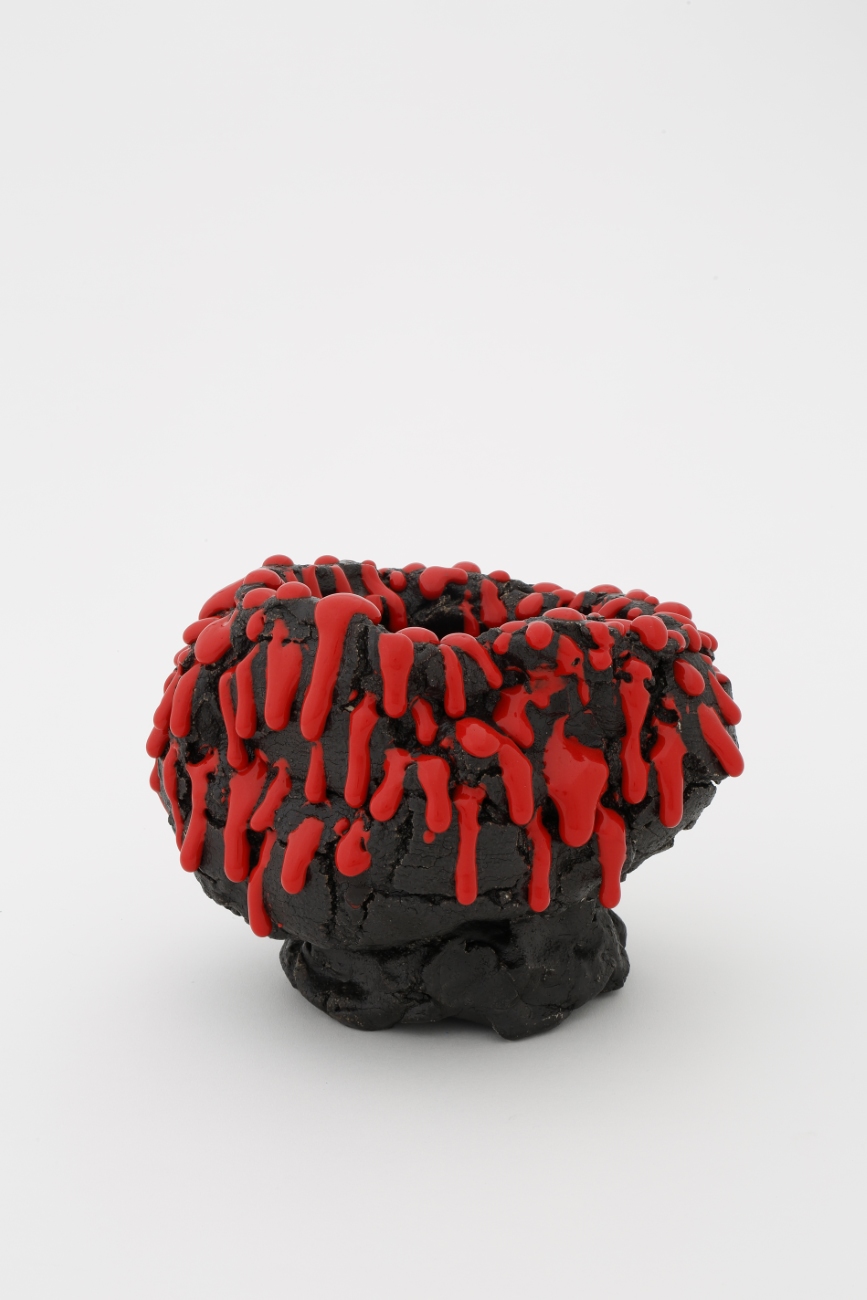
Takuro Kuwata’s work inhabits the strictest of all ceramic institutional filing systems, the Japanese tea ceremony, which is the spiritual heart of the Mingei folk craft tradition. In this context, a bowl is traditionally expected to be quiet, humble, and earthy. Yet, Kuwata’s bowls appear to be exploding, forcing the sober spirituality of the tea room into a collision with the synthetic, technicolour excess of contemporary Japanese Pop culture. He utilises the ishihaze or “stone explosion” technique, allowing stones within the clay to burst through the surface during firing. He also applies thick, molten glazes in metallic golds or vivid neon pinks that slip and crack, purposefully defying the maker’s control. This is wabi-sabi amplified to a state of hyper-materiality.
Under the traditional binary, we might try to categorise these as failed vessels or abstract sculptures. However, applying Bill Brown’s “Thing Theory” (2001) offers a more precise reading. Brown argues that we look through objects when they function for us, like the transparent vessel, but we confront them as Things when they stop working, such as when a tool breaks or a car stalls. Kuwata’s bowls hover in this disruption. The glaze does not coat the form; it overwhelms it. The stones do not support the wall; they rupture it. This is not merely an aesthetic choice, it is an ontological one. Richard Sennett’s book The Craftsman (2008) offers a vocabulary for this disruption. Sennett argues that skilled making is not the elimination of resistance but a dialogue with it, that “salutary failure,” where things go wrong in instructive ways, is central to how craft knowledge develops. Kuwata’s practice embodies this principle at an extreme register. By inviting the clay to rupture and the glaze to overwhelm, he engages in what Sennett, building on the foundations David Pye (1995) laid when coining the phrase, calls the “workmanship of risk” that forces the material to assert its agency. The resulting object is neither just a cup nor just a statue. It is a material event. It refuses to be a transparent vehicle for tea, having instead become a “Thing” that asserts its own volatile presence.
If Kuwata disrupts the vessel through rupture, Magdalene Odundo disrupts it through silence. Standing before her work at Thomas Dane Gallery in London in 2024, I found myself gripped by a forbidden impulse: I wanted to touch them. The burnished surfaces had the quality of those bronze sculptures that punctuate European squares, boars, saints, lucky toes, rubbed gold by generations of hopeful hands. I noticed the knobs on the forms registering in my body before my mind could name them, some read as vertebrae, others as navels. The angled, looping necks created a negative space where a head should be. I caught myself imagining what it would feel like to scream into one of these openings, and then, stranger still, the sense that they might already hold the exhalations of others. The gallery had become, without announcement, a spiritual site. I was not asking whether these were vessels or sculptures. The question had simply become unavailable to me. I was too busy being experiencing the work.
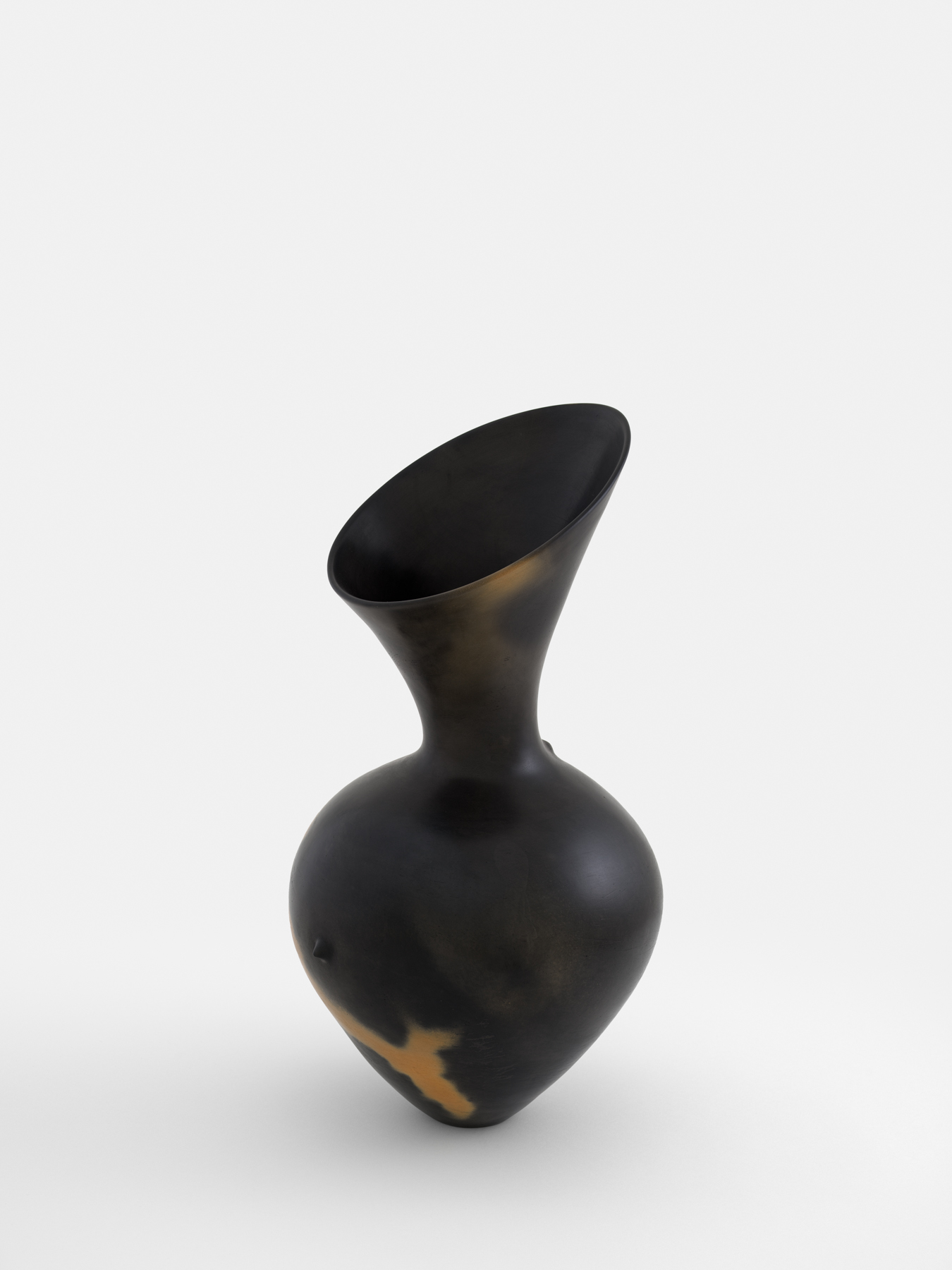
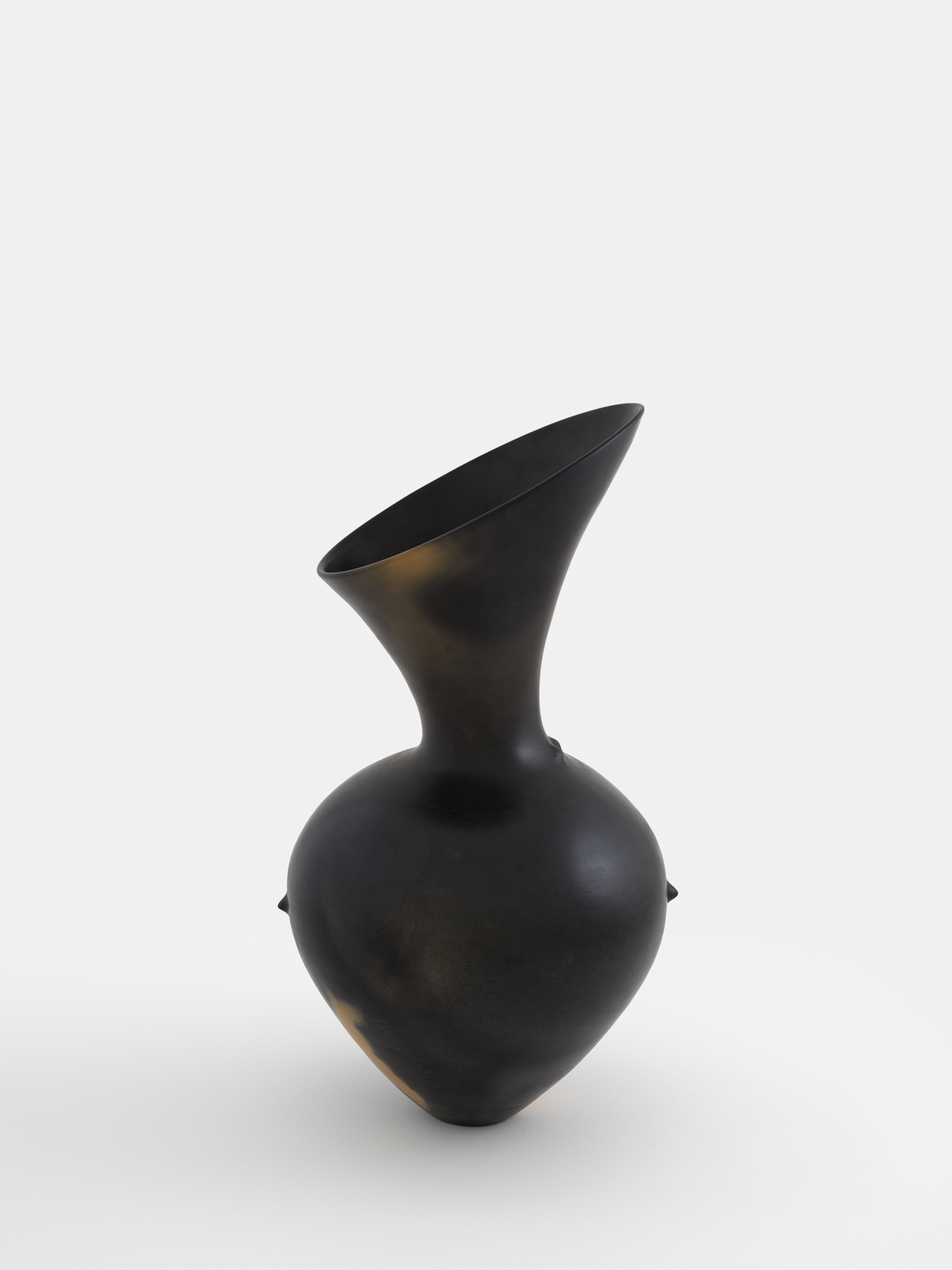
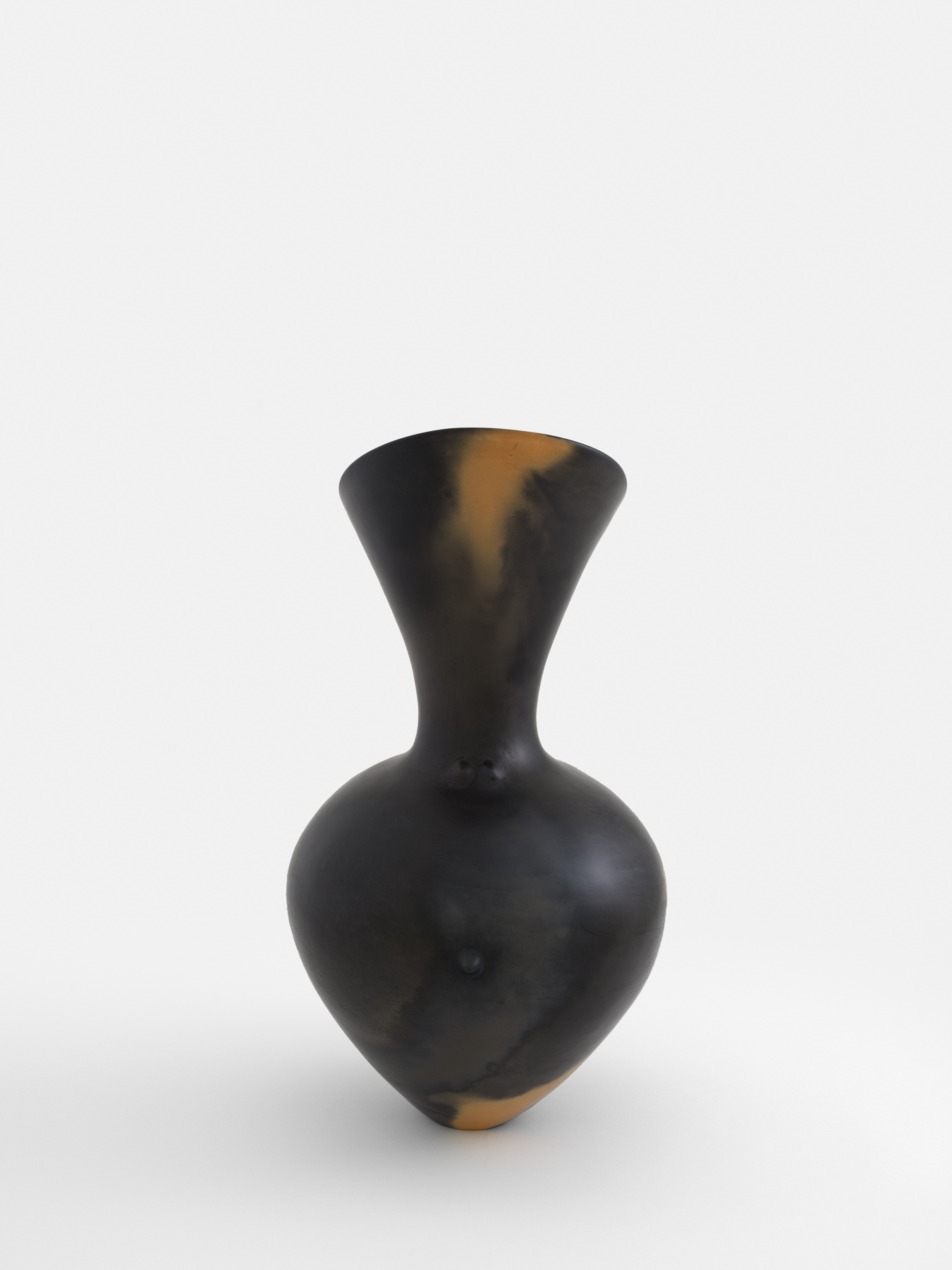
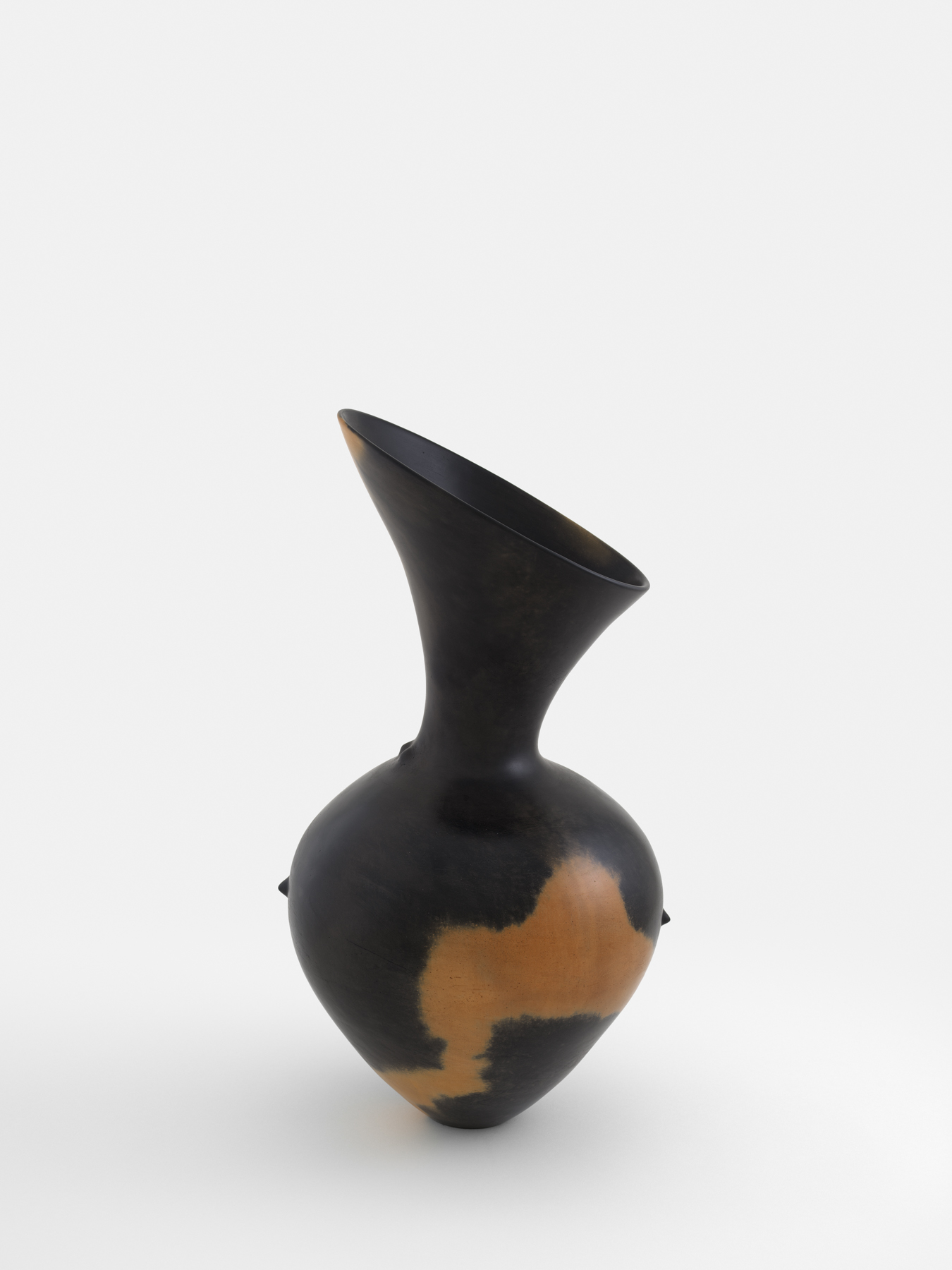
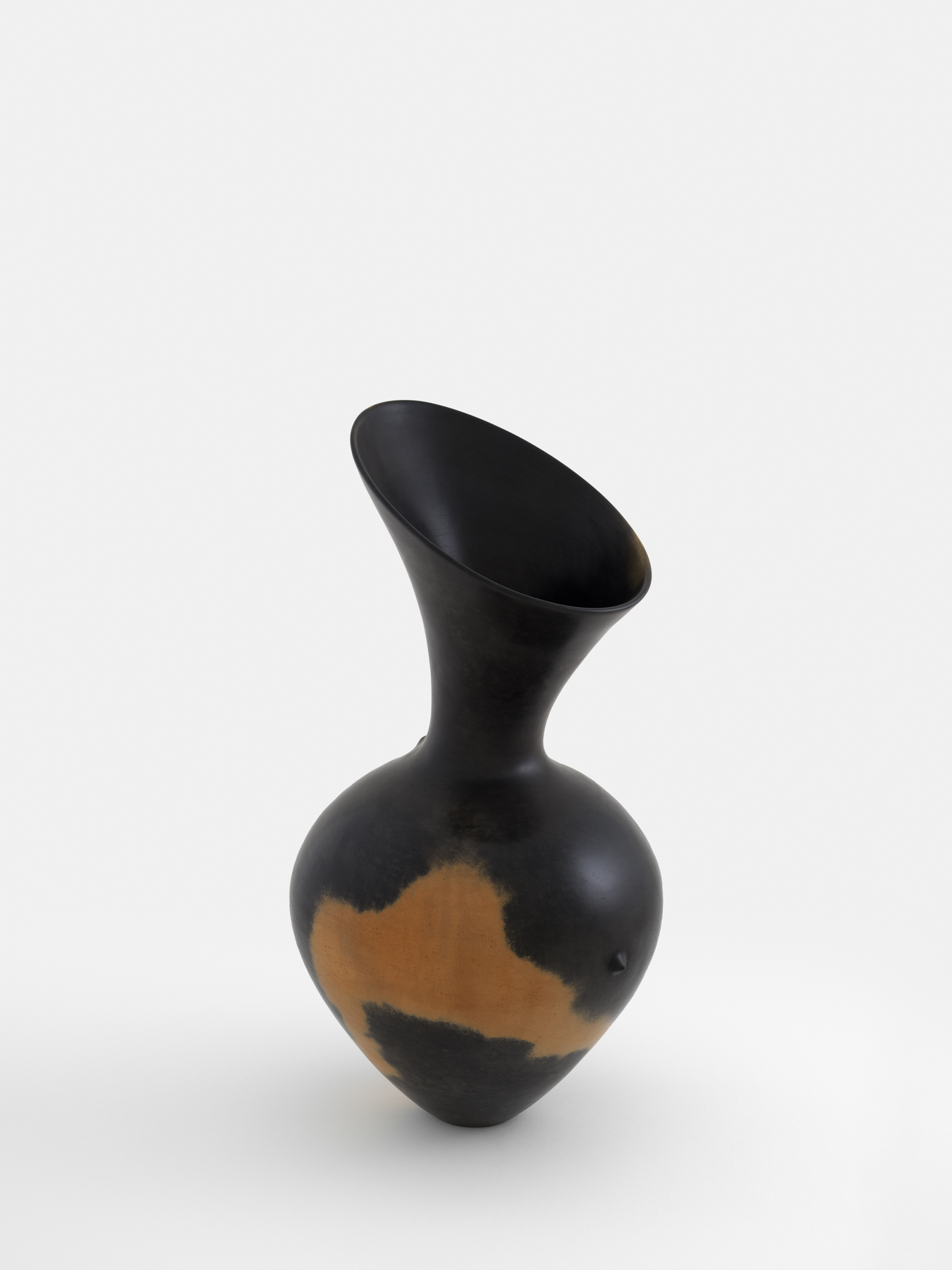
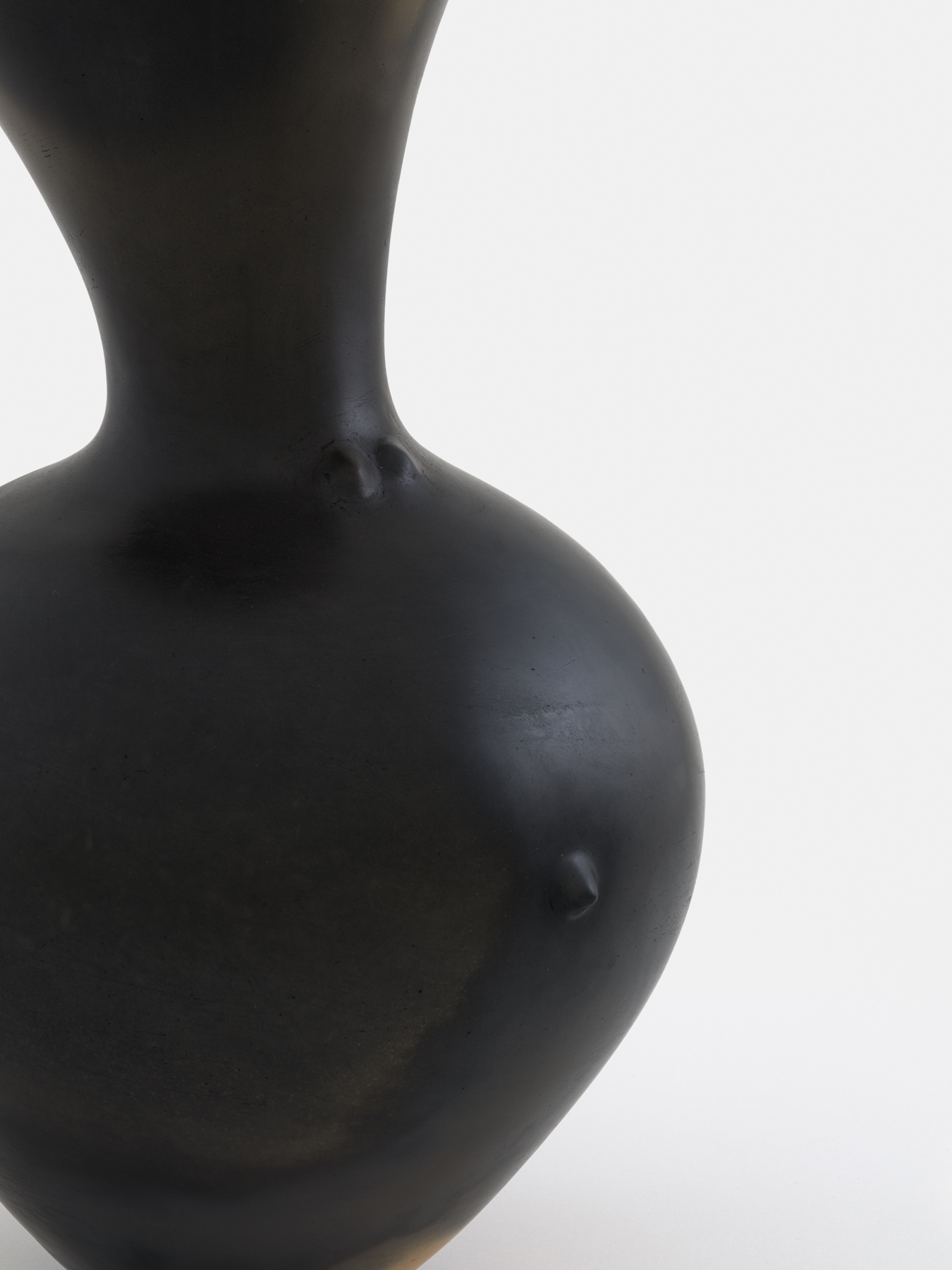
Odundo’s coiling forms are undeniably vessels; they possess interiors, lips, and bellies. Yet to categorise them as craft due to their hollowness, or as sculpture due to their form, is to commit Ryle’s category mistake once again. Odundo’s work operates through what Richard Sennett describes as anthropomorphosis, the projection of the human body into the material, not as a picture, but as a presence. This is achieved through her refusal of glaze. Instead of masking the clay with a glassy layer, she painstakingly burnishes the surface by hand using a stone or pebble. This repetitive, labour-intensive compression of the clay platelets aligns the material itself rather than coating it. It forces the skin of the vessel to become the primary site of interaction, creating a surface that feels as vulnerable and porous as the human body.
This focus on the vessel-as-body is deeply rooted in West African ceramic traditions, particularly those of the Gbagyi people of Nigeria and the potting communities of Kenya and Uganda. In these narratives, the vessel is not a mere domestic tool; it is a repository for spirit, a surrogate for the human form, and a participant in ritual transition. Within many African and Islamic lineages, the distinction between a ritual framework and an aesthetic framework simply does not exist. Where Western art history sought to separate the functional from the contemplative, these traditions understand the vessel as the highest form of sculptural expression precisely because of its utility and its relationship to the body.
In this context, the aniconic tradition, where the depiction of sentient beings is often restricted, elevates the vessel to a position of profound symbolic weight. The pot does not need to represent a person because it already intra-acts as one. When we stand before an Odundo vessel, we are not looking for the University, the institutional label of Art, to validate the experience. We are confronting the building, the undeniable physical reality of the object itself. It establishes what Sennett calls a politics of presence, a work declaring “I exist” without needing the validation of a Western gallery label to confirm its status.
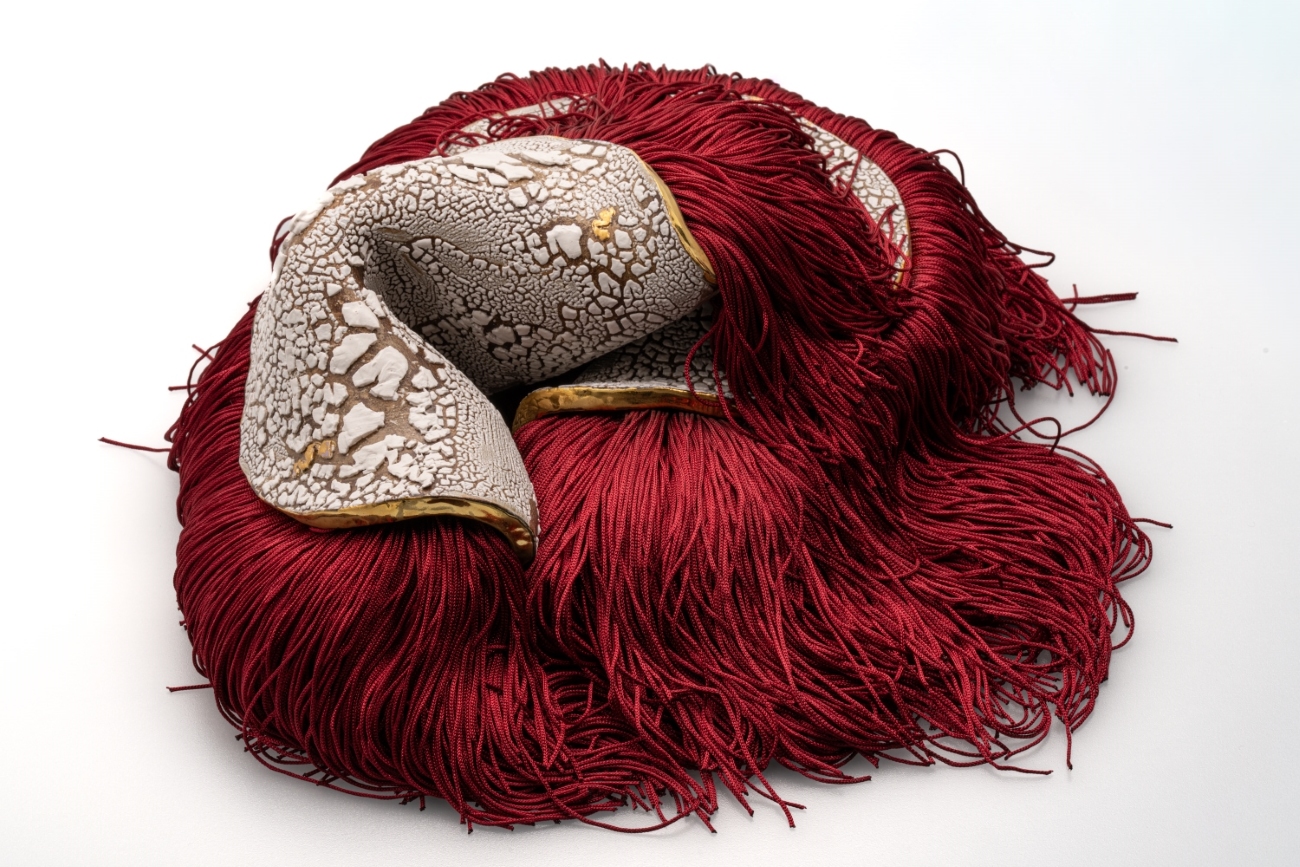
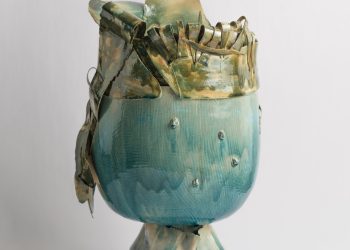
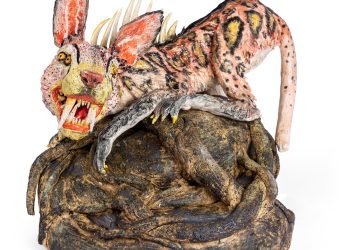
My own practice operates in this contested space. In Health, Wealth, Virtue, Long Life and an Easy Death, I make fortune cookie sculptures, forms that cite the vessel’s ritual logic while refusing its containment. The fortune cookie is already a category mistake made material: an American invention persistently misrecognised as Chinese, a food that exists to be broken, a container whose purpose is to release language rather than hold substance. My versions split open like mouths, white crawl glaze cracking across their surfaces, red fringing spilling from the interior; hair, entrails, the unspoken remainder. They are vessels; they possess interiors, lips, openings, but they hold prophecies rather than tea. The blessing of the title asks for everything; what emerges is something else entirely. Like Kuwata’s tea bowls, they inhabit a ritual framework, but one borrowed, translated, and deliberately misread.
The long-standing preoccupation with the vessel-versus-sculpture debate has often served as a distraction from the material reality of the entangled encounter. By applying Gilbert Ryle’s concept of the category mistake, we can see that these terms are not inherent properties of the object but are instead institutional filing systems that we project onto them. Whether we are looking at the Abstract Expressionist ruptures of Peter Voulkos, the golden liquid ontologies of Liu Jianhua, the material events of Takuro Kuwata, or the silent presence of Magdalene Odundo, the clay itself remains indifferent to our labels. The identity of the ceramic object is not a fixed state but a site where multiple frameworks co-exist. The ritual power of a West African form, the industrial history of Jingdezhen porcelain, the aesthetic demands of the contemporary gallery, and the domestic intimacy of the tea bowl are not mutually exclusive. They are layers of meaning that can be activated simultaneously.
In this light, the vessel didn’t die; it simply became a quantum state, an object capable of being many things at once depending on the framework through which it is viewed. This reframing demands a new curatorial language, one that can juxtapose old and new, east and west, functional and non-functional, without requiring objects to declare allegiance to a single category. In July I will be in Jingdezhen, where seventy-two trades once collaborated on a single object and the vessel/sculpture question never needed asking. Perhaps it never needed asking anywhere.
Olivia Fero is a ceramicist-theorist whose practice exposes the vessel/sculpture divide as a category mistake. Through making, writing, and curating, she demonstrates how ceramics operate as material philosophy, challenging Western hierarchies while opening space for multiple ontologies to coexist. Her work, influenced by YBA provocations and new materialist theory, uses clay to think through false binaries that limit both ceramic discourse and broader cultural narratives.
Fero graduated from Goldsmiths, London in Fine Art and History of Art in 2009, and she is currently studying for an MA in Ceramic Design at the University of Pécs in Hungary, and intends to pursue doctoral studies in practice-led research. She is represented by Ancora Gallery, Pécs.
Subscribe to Ceramics Now to read similar articles, essays, reviews and critical reflections on contemporary ceramics. Subscriptions enable us to feature a wider range of voices, perspectives, and expertise within the ceramics community.
References
- Barad, K. (2007) Meeting the Universe Halfway: Quantum Physics and the Entanglement of Matter and Meaning. Durham, NC: Duke University Press.
- Bonacina, A. (ed.) (2019) Magdalene Odundo: The Journey of Things. London: InOtherWords. [Exhibition catalogue, The Hepworth Wakefield]
- Brown, B. (2001) ‘Thing Theory’, Critical Inquiry, 28(1), pp. 1–22.
- Miller, S. (2024) Magdalene Odundo. Princeton, NJ: Princeton University Press. [Published in association with the Gardiner Museum of Ceramic Art, Toronto]
- Perchuk, A. and Adamson, G. (eds.) (2016) Voulkos: The Breakthrough Years. New York: Black Dog Publishing. [Exhibition catalogue, Museum of Arts and Design]
- Pye, D. (1995) The Nature and Art of Workmanship. Revised edn. London: The Herbert Press
- Ryle, G. (1949) The Concept of Mind. London: Hutchinson.
- Sennett, R. (2008) The Craftsman. London: Allen Lane.