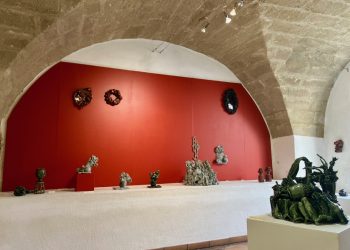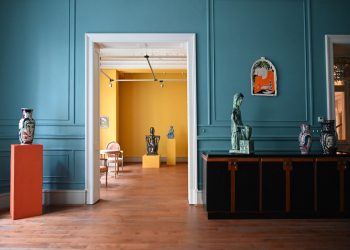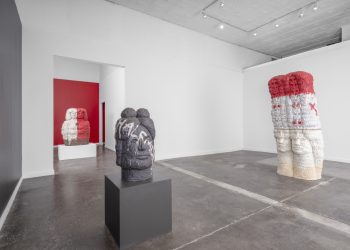


Danish Ceramics: Beyond Blue and White is on view at the Museum of Danish America, Elk Horn, IA
November 16, 2024 – April 20, 2026
The Museum of Danish America is pleased to announce the opening of Danish Ceramics: Beyond Blue and White, a retrospective of Danish ceramic design from 1775 to the present. The exhibition features pieces by over forty designers including Bodil Manz, Jørgen Haugen Sørensen, Alev Siesbye, Per Linnemann-Schmidt, Bjørn Wiinblad, Jais Nielsen, Axel Salto, and Oluf Jensen.
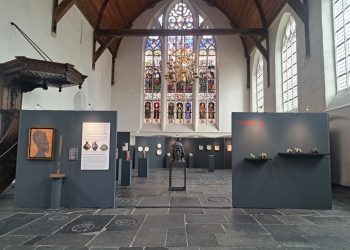
Over the course of 84 objects, the exhibition outlines the development the Danish ceramic industry since the founding of Royal Copenhagen in 1775. The exhibition is divided into four main time periods, each characterized by distinctive materials and design philosophies. The oldest pieces in the gallery date to the late 1700s and early 1800s and explore how Royal Copenhagen became enmeshed with European elite culture. Borrowing freely from both Danish and international artists, Royal Copenhagen thrived under a royal monopoly for generations. Already in this period a core theme of the exhibition, the blurred lines between fine and decorative arts, emerges in pieces like the Flora Danica service.
The gallery then explores how the more accessible Art Nouveau movement established Danish studios as masters of natural forms and colors. Starting in 1884, Danish ceramics studios including Royal Copenhagen, Bing & Grøndahl, and Kähler Keramic thrived on an international market. Giants of American design like Louis Tiffany became collectors and dealers of Danish ceramics, including the remarkably detailed figurines developed in the 1890s and beyond.
New materials and the proliferation of independent workshops characterized the Danish Modern period. Following the 1925 Exposition internationale des arts décoratifs et industriels modernes in Paris, France, stoneware quickly came to dominate ceramic innovation in Denmark. Alongside the new material came renewed interest in the physical properties of glaze and pigment. Nowhere is this more evident than the work of Axel Salto, whose budding, biomorphic shapes are accentuated by bold blues and greens appearing where the glaze pools in the form. It can also be seen in the hare’s fur and rustic production of the studio Palshus, who is featured heavily in the exhibition.
The independent studios of the period are also united by a shared culture of exhibition and collaboration. Artists like Jais Nielsen or Frode Bahnsen worked on commission for larger workshops and developed a congenial network of fellow artists. These artists also served as tastemakers, as they selected pieces for exhibition and sale through committees. Workshops therefore sought to innovate and raise the standards for the industry, resulting in a variable, yet stylistically coherent, artistic milieu.
Over the course of the 1970s, changing public tastes in the international market, combined with the death and retirement of many important designers, caused the studio structure of the previous decades to collapse. Artists primarily began working under their own name, either solo or in very small teams. Royal Copenhagen and Bing & Grøndahl merged in 1984, and by 1993, most industrial workshops had closed, unable to compete against a global market.
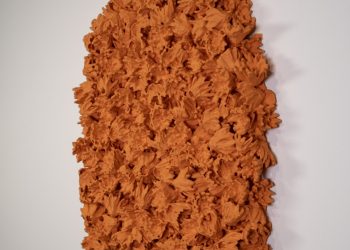
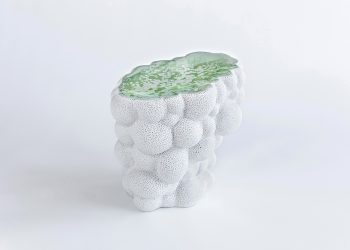
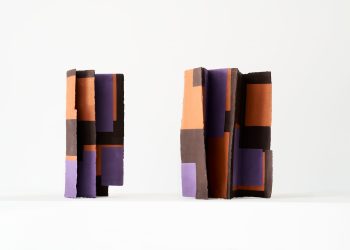
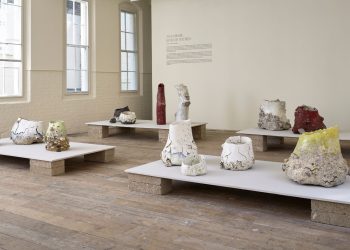
The end of the industrial workshop did not mark the end of Danish ceramics as an artform. The final section of the exhibit showcases contemporary Danish ceramic production. These pieces speak across time to earlier eras; many of the same interests in form, glaze, and material are visible, though taken to the extreme. The paper-thin porcelain of Bodil Manz explores how light affects color, while the craggy, rough sculpture by Jørgen Haugen Sørensen reaches at the very core of how humans and clay interact to create meaning. Such variety fully dismantles a divide between a utility piece and an art piece, leaving an endless array of possibilities open for future production.
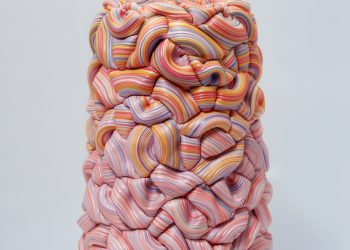
Danish Ceramics: Beyond Blue and White is an exploration of both artistic prowess and cultural tradition. The exhibition asks visitors to explore what makes Danish ceramic art uniquely Danish. Visitors are repeatedly confronted by non-Danish symbols, particularly from China, Japan, and Persia. Some pieces were designed by non-Danes living in Denmark, or by Danes living around the world. Even Royal Copenhagen’s production now is largely based in Thailand, disrupting any material connection between designer, molder, and painter. Nevertheless, by contextualizing pieces from across the past 250 years through proximity, certain shared ideas emerge. A cream jug from the 1790s has a greyish body due to a quirk of impure porcelain clay. Nearby, a vase from 1917 intentionally replicates that greyish color as an artistic statement, while the same off-white appears in Sandra DaVolio’s “White Frills” from 2006. Small connections like these build a sense of a shared tradition and ethos of ceramic art that extends deep into the past. Danish ceramics is not an isolated, unique tradition, but it is without a doubt one that continues to engage with its own history.
About the Museum of Danish America
The Museum of Danish America is the only national museum dedicated to preserving and promoting Danish culture in America. The museum cares for a collection of over 30,000 artifacts, photographs, and archival materials that document the experience of Danish immigrants and their descendants, and the ongoing expression of Danish-American cultural identity. Since 1994, the museum has welcomed visitors to its facility in Elk Horn, Iowa, while also engaging in an active national outreach effort that brings the museum to communities from Washington, DC, to Los Angeles, California.
Contact
Adam Bierstedt, Albert Ravenholt Curator of Danish-American Culture, info@danishmuseum.org
The Museum of Danish America
2212 Washington St
Elk Horn, IA 51531
United States
Photos courtesy of the museum