





Marie Ducaté. Simultanés is on view at Musée Ariana, Geneva
February 20 – November 29, 2026
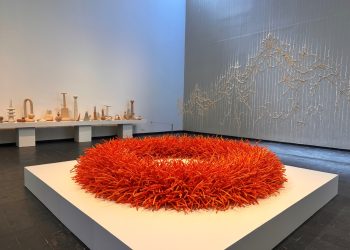
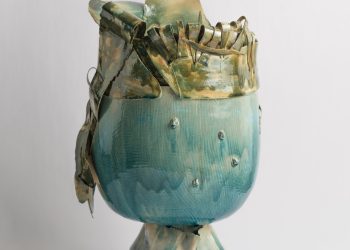
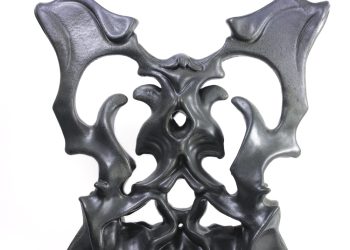
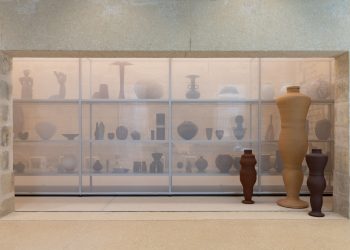
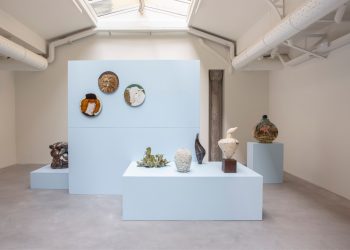
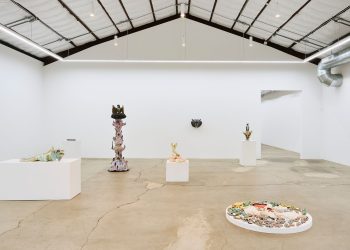
From 20 February to 29 November 2026, Musée Ariana presents a monographic exhibition dedicated to Marie Ducaté, on view in the temporary exhibition space on the first floor. Titled Marie Ducaté. Simultanés, it brings the spirit of the artist’s studio into the museum, offering a joyful and vibrant dialogue between works in ceramic, tracing paper, watercolour, textile and glass.
For more than thirty years, Marie Ducaté has explored the world around her through a wide array of works, actions, and objects, many of which feature in her studio in Marseille. For this solo exhibition, the artist has taken up the playful challenge of showcasing selected elements—and the singular spirit—of that unique environment to visitors. This shift is part of a broader questioning of the ideas and functions traditionally attributed to the artist’s studio—questions that have been circulating, reshaped and reinvented over the past two centuries, according to the individuals who inhabit them.1
A porous boundary between the public and the private, between the presentation of the artwork and the intimacy of a work-laden everyday life, runs through Marie Ducaté’s practice. Although she describes herself as a painter, her output extends well beyond painting, migrating across different media and blurring the lines between references to art history and interventions closer to interior decoration.
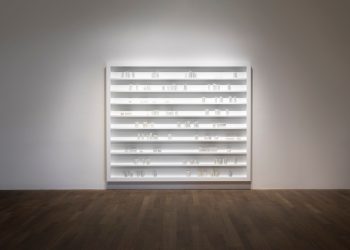
Thrifted cabinets, where she stores her collection of glass and glazed ceramic vases, are gradually coated with successive layers of paint, their appearance evolving between 1995 and 2017. In one instance, a pink base remains faintly visible as a redacted mark against a pale blue ground, sketching the frame of a ghostly composition. Ducaté’s interest in what surrounds and conditions the image emerged as early as the 1980s, when she began producing frames with resin-enhanced ornamentation, such as the one surrounding her triptych Paradis à la Télé (1985).
This painted work, the first in Marie Ducaté’s corpus to place her figurative subject in the open air, features a fluid movement between the interior and the exterior. Up until that point, her male nudes reclined in interior settings, offering a feminist alternative to the long tradition of the “male gaze”. Continuing her irreverent play with the canon of Western art history, Marie Ducaté challenges the founding myth of Adam and Eve, a narrative that has long shaped notions of beauty, gender construction, and morality. The serpent—tempting creature of the biblical story and an animal symbolically linked with women in various older pagan cultures—takes its place in the central panel, equidistant from the two human protagonists. This positioning can be read as a levelling of the sexual charge between their bodies, an alternative to the age-old figure of the “femme fatale”, signalled in art history by the serpent coiled around Eve. Here, Eve straddles a playful tiger that shares the scene with a host of other mischievous creatures, all set against a savannah backdrop punctuated with pieces of designer furniture.
Adam, modelled on the artist’s dancer partner, takes up a Cranach-like tilted stance,2 while Eve appears in the guise of a self-portrait of Marie Ducaté, created from a photograph. This reference to the work of the Renaissance painter Lucas Cranach the Elder (1472–1553) aligns with a lineage of twentieth-century reinterpretations, beginning with a photograph by Man Ray capturing Marcel Duchamp as Cranach’s Adam, accompanied by Brogna Perlmutter. This tableau vivant, conceived as part of Francis Picabia’s ballet Relâche (1924), with music by Erik Satie (1866–1925),3 was later re-enacted in 1967 by the American artists Elaine Sturtevant (1924–2014) and Robert Rauschenberg (1925–2008).4
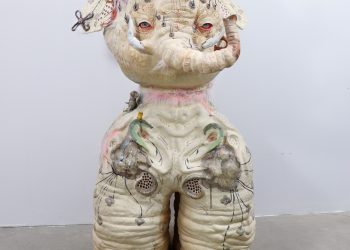
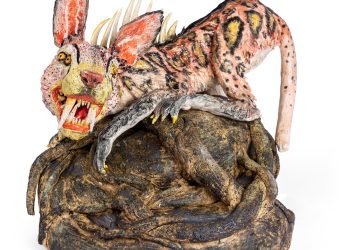
Erik Satie reappears in a series of faience pieces created by Marie Ducaté in 2011, inspired by his work Uspud, un ballet chrétien (1892). This score, by the inventor of “furniture music” and a forerunner of Dadaism, was only published after his death. The ballet, with a libretto by Contamine de Latour (1867–1926), had been commissioned by Miquel Utrillo (1862– 1934), director of a shadow theatre at the Auberge du Clou in Montmartre, but was rejected on delivery. Ducaté’s series draws on the strange repertoire of “spiritualities”—a blending of animals and imaginary creatures—encountered by Uspud, the ballet’s “sole character”:
“Demons appear, only to vanish at once; they take the form of misshapen men with the heads of animals: dog, jackal, tortoise, goat, fish, lynx, wolf-tiger, ox, sea woodcock, unicorn, sheep, antelope, ant, spider, wildebeest, serpent, agouti, blue billy goat, baboon, cuckoo, crab, albatross, shrew, ostrich, mole, secretarybird, old bull, red caterpillar, mite, hermit crab, wild boar, crocodile, buffalo, and so on…
Terrified, Uspud tries to flee, but the demons surround him and pull him in every direction…”5
Elsewhere, the bodies of Adam and Eve reappear, shaped in pâte de verre (Adam et Ève, 1994) or on a ceramic vase (Adam et Ève, 2018). The softening of their forms is set against the tactile hardness of these materials—an ambiguity with which Marie Ducaté delights, guided by a malleability that also revisits the abstraction of the modern avant-gardes. From the streamlined contours of Le Corbusier’s Cité radieuse, a landmark of Marseille’s architectural heritage, Ducaté draws inspiration in the way colour seeps into the very mass of the concrete (Corbusiade and Corbusiade 2, 2017).
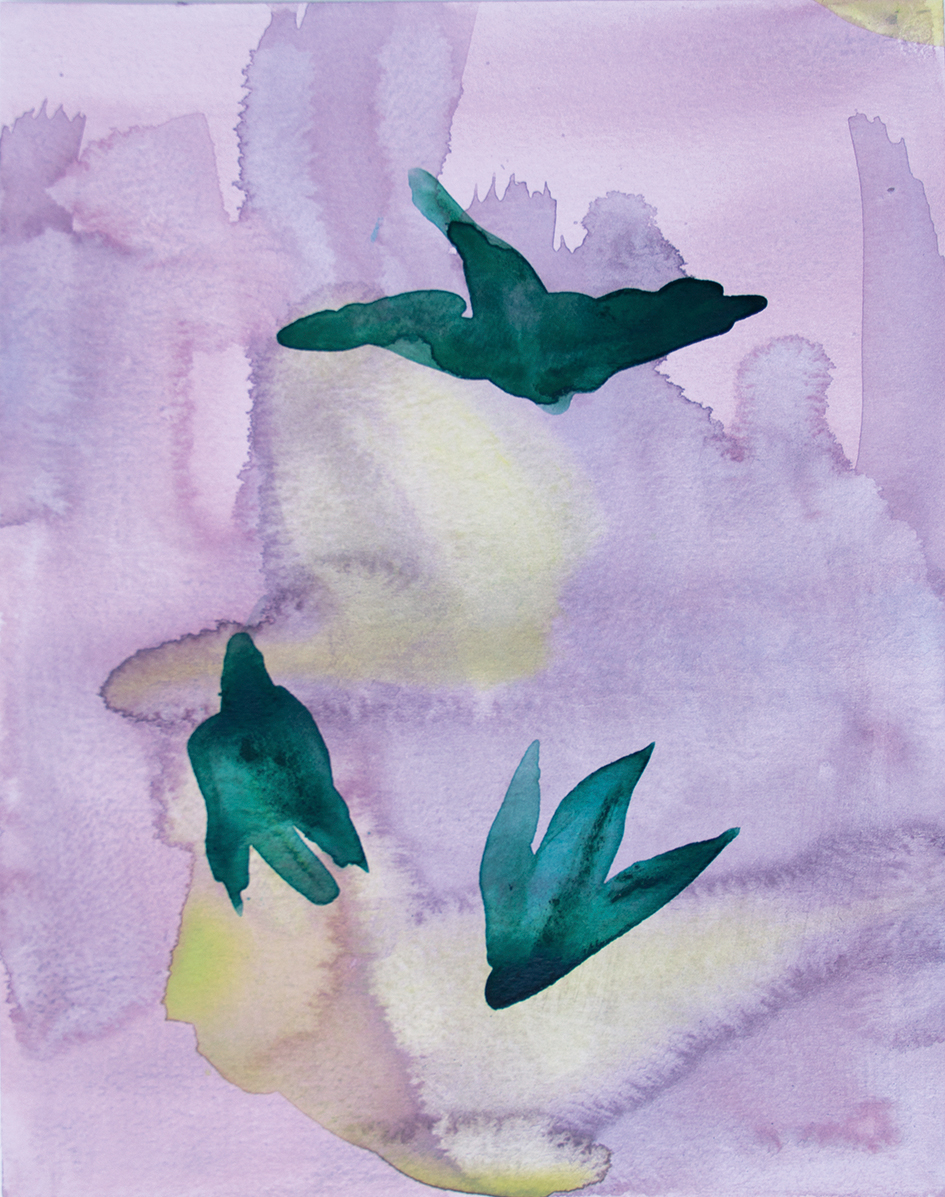
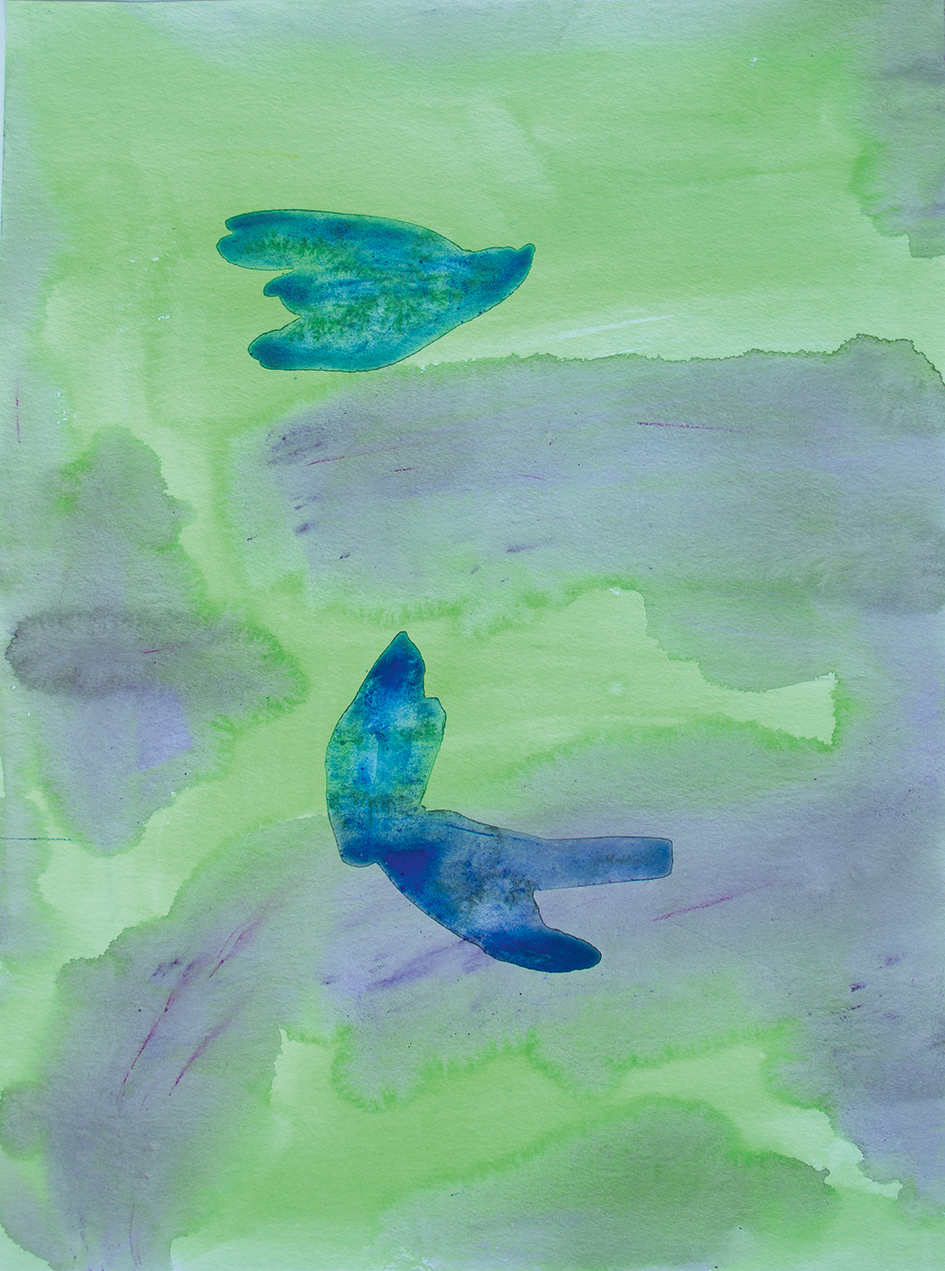
The figurative painting of her early years gradually loosens its contours on contact with water, which softens the edges of the motifs in her watercolours on paper—motifs that, elsewhere, seep into diaphanous fabrics. Finally, the gentle transparency of the pastel tones in her recent glass works reveals a desire to preserve softness and fluidity, both in form and in her way of moving through the world.
Born of an abundant creative energy, and an equally abundant array of works, the exhibition Marie Ducaté. Simultanés invites visitors to adorn themselves with necklaces (2023–2025) and brooches (2020–2024), or even to don a tracing-paper hat (2025, reproduction), before the Miroir Delaunay (2020). Like Danseuse Sonia (2015), one is encouraged to inhabit, all at once, simultaneous ways of rethinking how to integrate pattern and decoration into form, and life into art.
Text by Claire FitzGerald, chief curator of Musée Ariana
Contact
ariana@ville-ge.ch
Musée Ariana – Swiss Museum for Ceramics and Glass
Avenue de la Paix 10
1202 Geneva
Switzerland
Captions
- Cheminées roses, 2017, Modelled and glazed ceramic. Photo © Marie Ducaté
- En colère, 2021, Modelled and glazed ceramic. Photo © Marie Ducaté
- Rouge, bleu, jaune, verts, 2017, Modelled and glazed ceramic. Photo © Marie Ducaté
- Broches, 2020–2024, Ceramic. Photo © Marie Ducaté
- Penché gris, 2017, Glass, blown by Petr Janecký. Photo © Marie Ducaté
- Table araignée, 2023, Glass, metal. Photo © Marie Ducaté
- Voilé bleu et blanc, 2025, Glass, blown by Petr Janecký. Photo © Marie Ducaté
- Paradis à la Télé, 1985, Oil on canvas, resin frame on wood. Photo © Marie Ducaté
- Oiseaux verts n°1, 2021, Watercolour on paper. Photo © Marie Ducaté
- Selected Drawings. Photo © Marie Ducaté
- Crocodile en pantoufles, 2011, Modelled and glazed earthenware. Photo © Marie Ducaté
- Oiseaux, 2021, Watercolour on paper. Photo © Marie Ducaté
- Carreaux en plis, 2025, Tracing paper. Photo © Marie Ducaté
- Photograph portrait of Marie Ducaté. Photo © William Hereford
Footnotes
- Dawn Ades, Iwona Blazwick, Inês Costa, Richard Dyer, Hammad Nasar, and Candy Stobbs, The Artist’s Studio: A Century of the Artist’s Studio 1920–2020 (London: Whitechapel Gallery, 2022); Kirsty Bell, The Artist’s House: From Workplace to Artwork, Sternberg Press, 2013; Véronique Rodriguez, “L’atelier et l’exposition, deux espaces en tension entre l’origine et la diffusion de l’œuvre”, Sociologie et Sociétés, vol. XXXIV.2 (Autumn 2002), pp. 121–138.
- See the paintings by Lucas Cranach the Elder, Uffizi Galeries, Florence and Adam and Eve, 1533, collection of the Museum of Fine Arts, Leipzig
- The tableau vivant was staged during a New Year’s Eve party organised by Picabia, which included a cine-sketch directed by René Clair that was later released under the title Entr’Act. [P. Achard, “Soir de Paris, les derniers moments de 1924”, Paris-Midi (3 January 1925)]. Subsequently, a series of nine engravings was produced by Marcel Duchamp to illustrate Arturo Schwartz’s catalogue raisonné, The Large Glass and Related Works, vol. 2 (Milan: Galleria Schwarz, 1967).
- Ramsay Burt, Judson Dance Theater: Performative Traces (London: Routledge, 2006), p. 35.
- Erik Satie and J.-P. Contamine de Latour, Uspud, Christian Ballet in Three Acts, in Erik Satie, Complete Works for Piano Published by Éditions Salabert (Paris, Salabert, 1989), pp. 82–83.