By Heidi McKenzie
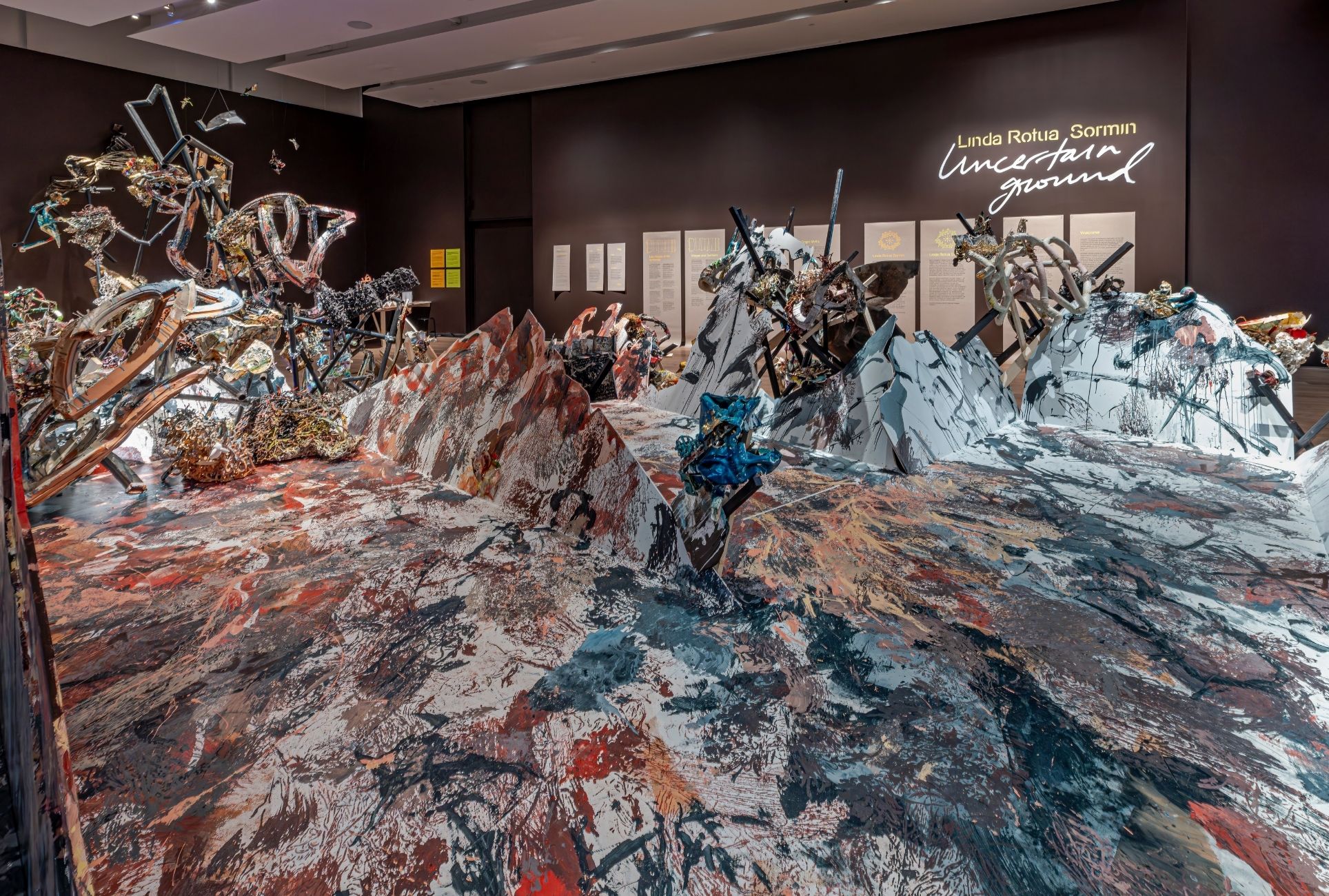
Uncertain Ground is Linda Rotua Sormin’s first solo museum exhibition and a culmination of a lifetime of being: of being the daughter of mixed Thai/Indonesian parents; of being brought to live in small town Ontario from Bankok at the age of five; of being curious and encouraged to be creative and to make a difference in the world; of being able to pursue post-secondary studies in English Literature; of being a community development worker in Laos; of being a student of ceramics at Sheridan College and Alfred University; and of being entranced by the goddess of clay, and being able to take this path and spin an international career.
I am writing this reflection on the work of Linda Rotua Sormin as presented at the Gardiner Museum in Toronto (November 6, 2025–April 12, 2026) as a fellow diasporic mixed-race artist who has meandered towards the path of untangling the fraught colonial past of our ancestors. I am writing as a former student of Sormin’s, while she taught at Sheridan College in 2010/2011. I am writing from the subjective point of view of an artist who studied the craft of critical writing and curatorial practice, and as someone who can relate to blending the alteration of moving image and soundscape as part of the storytelling with, and through, ceramic installation.
Before I became versed in the didactics about Uncertain Ground, or heard Sormin speak with Senior Curator, Sequoia Miller, I allowed myself to experience the space which the work inhabits and spend time with it over four visits. What I felt was a sense of voyeurism into the subconscious mind of not only the artist, but the intergenerational trauma of the artist’s ancestors. It is messy, in parts it is ugly. In parts it is surprising in its brokenness, it’s seeming haphazardness, and yet, the marriage of experimental video collage with the visual collage of the ceramic installations laced with found objects work together in a unify the whole.
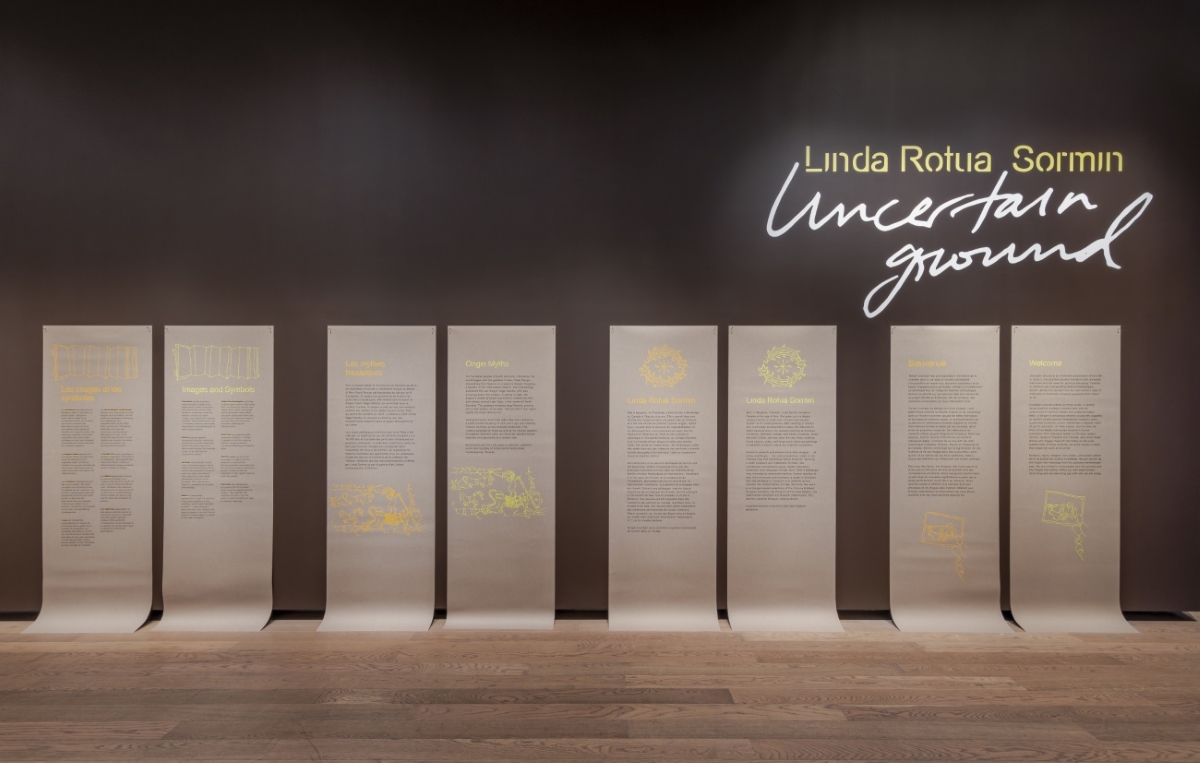
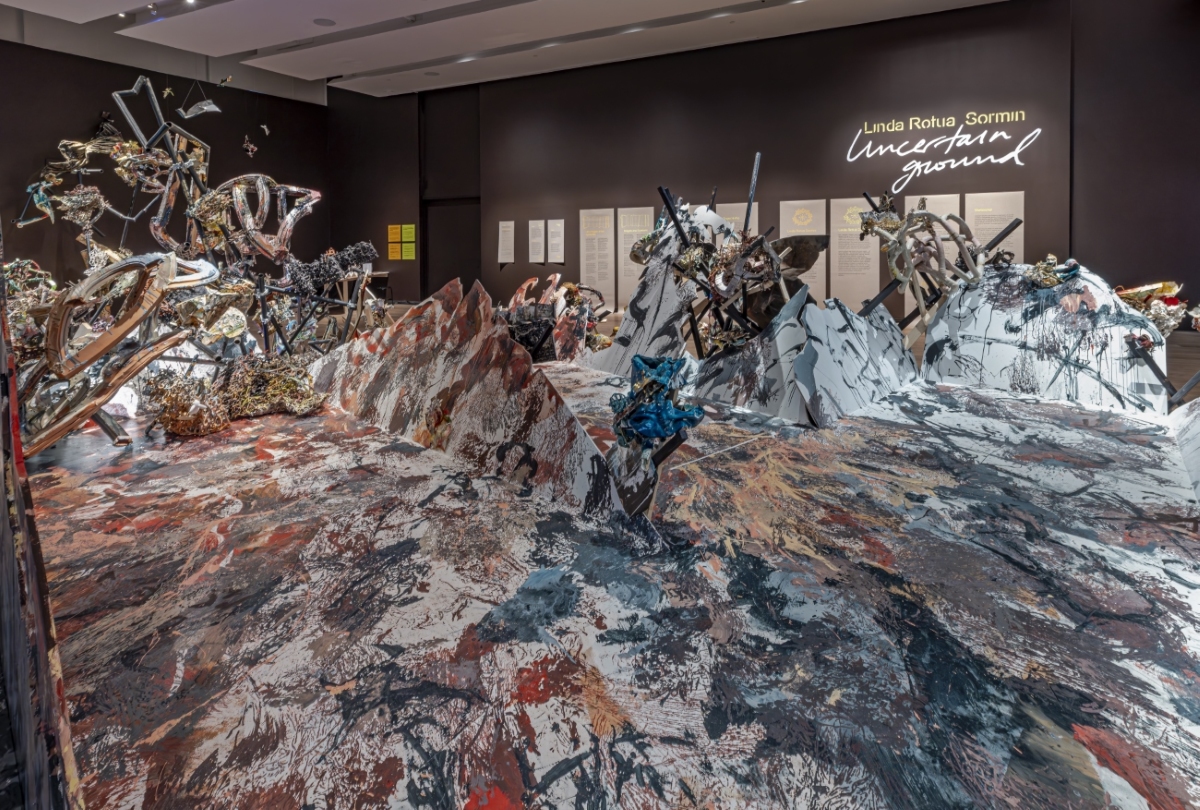
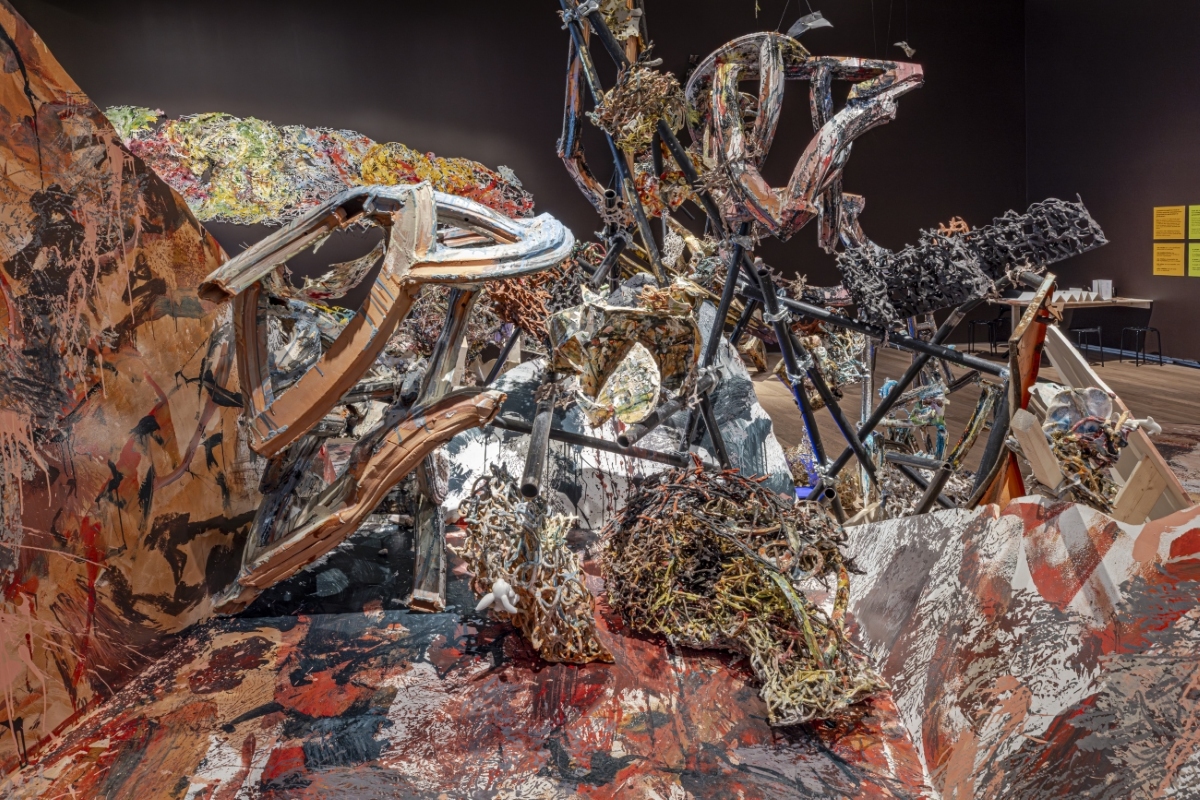
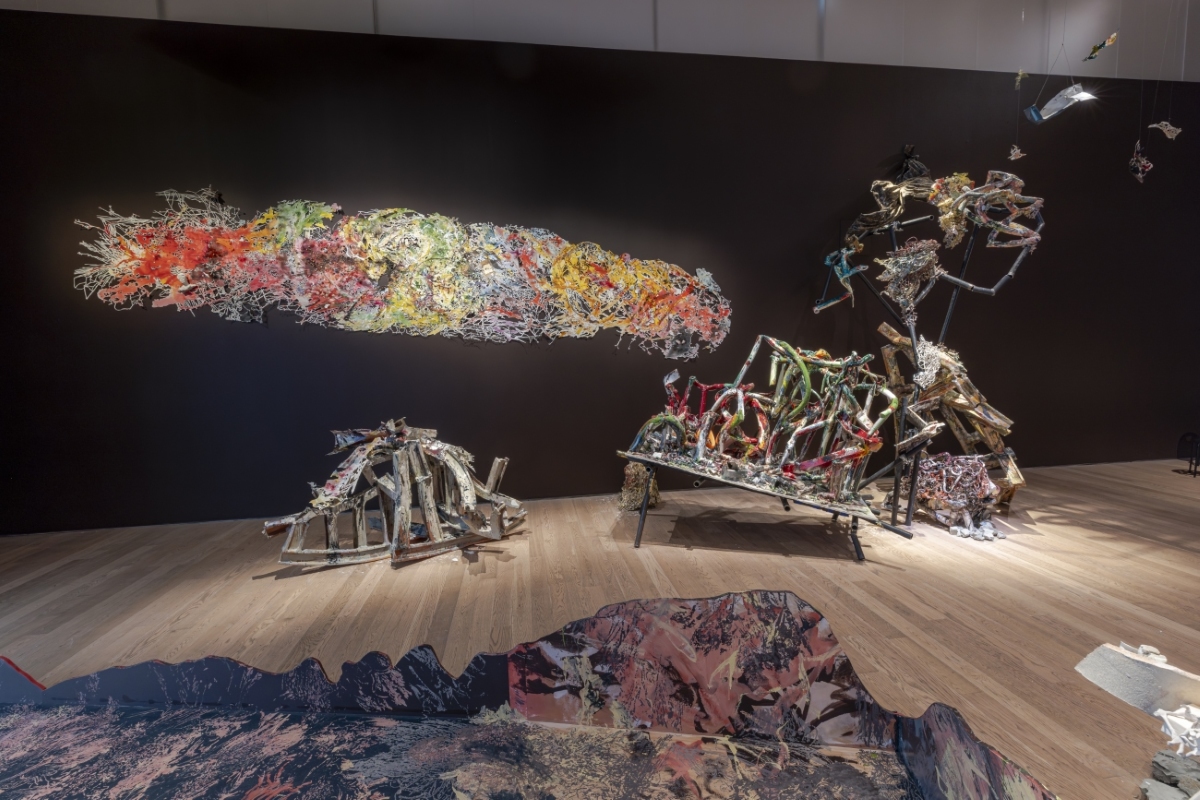
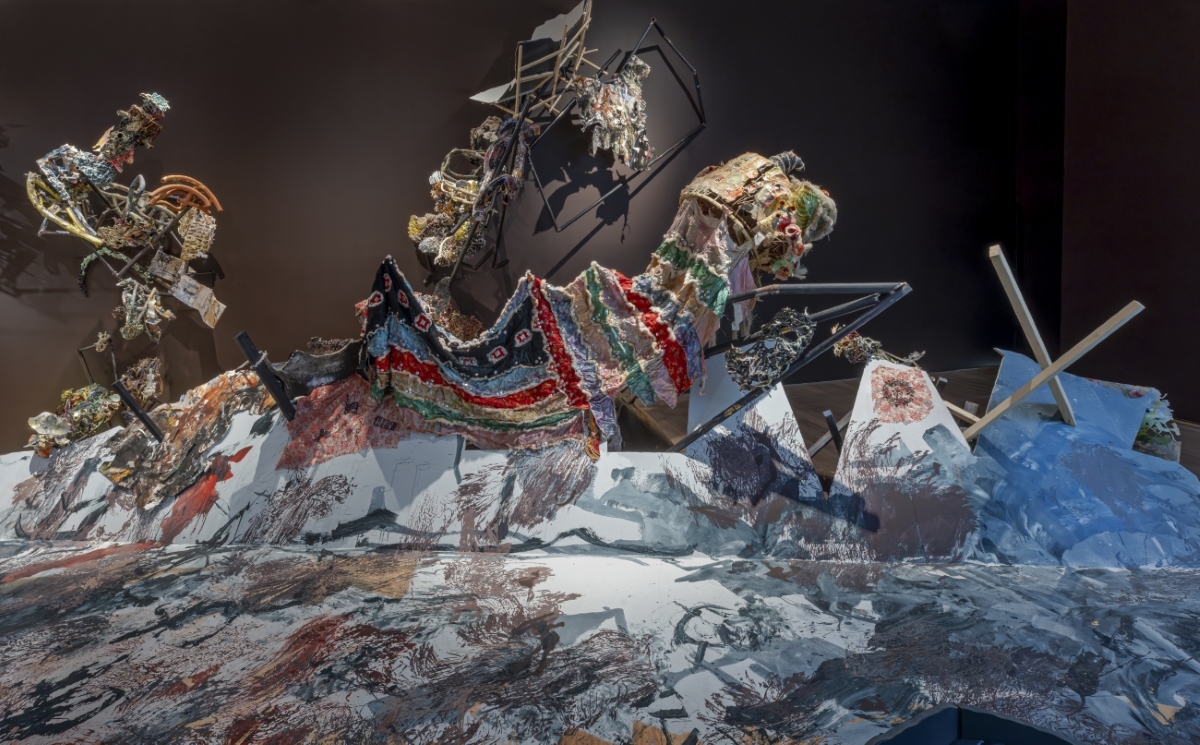
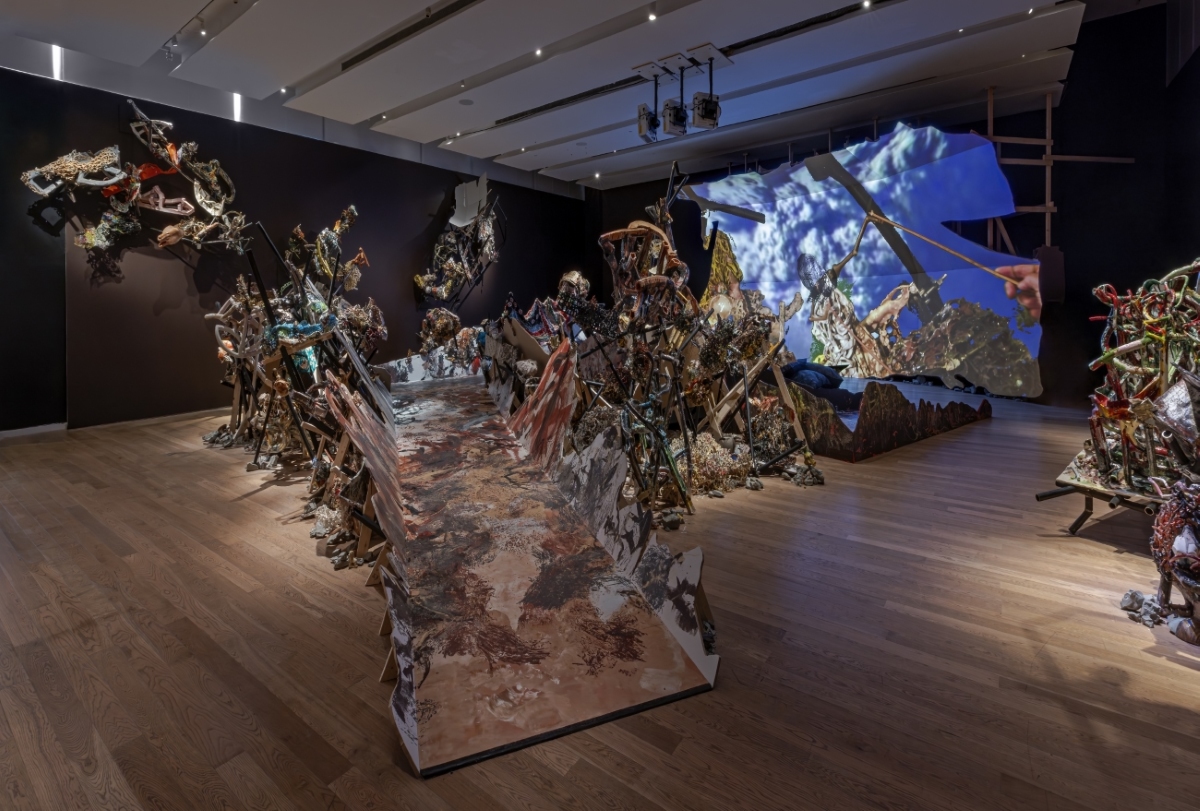
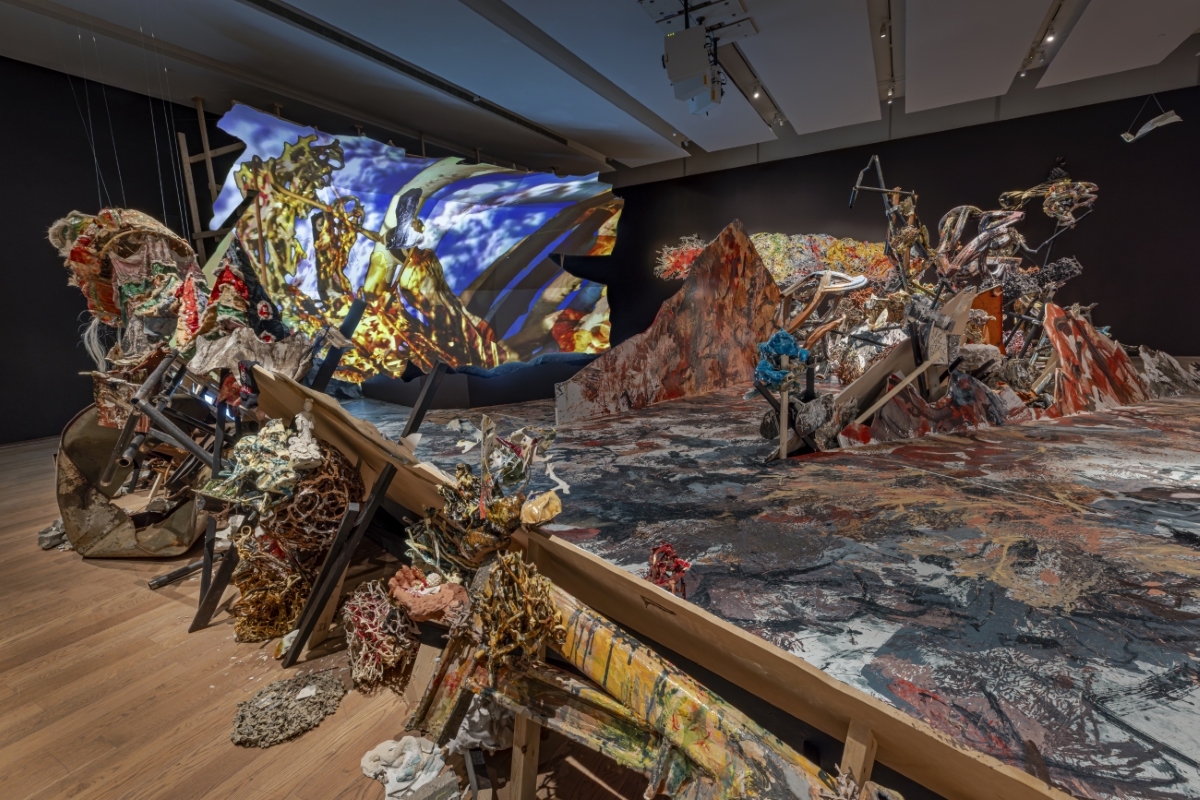
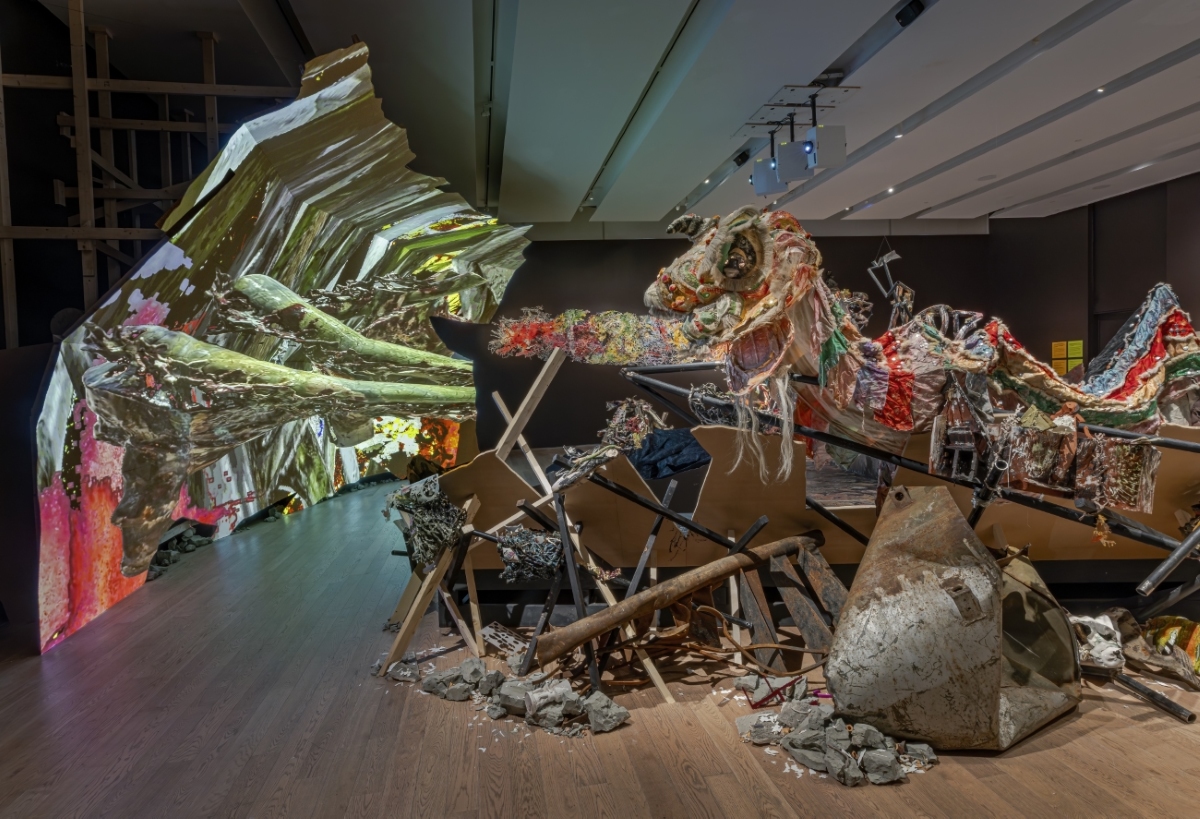
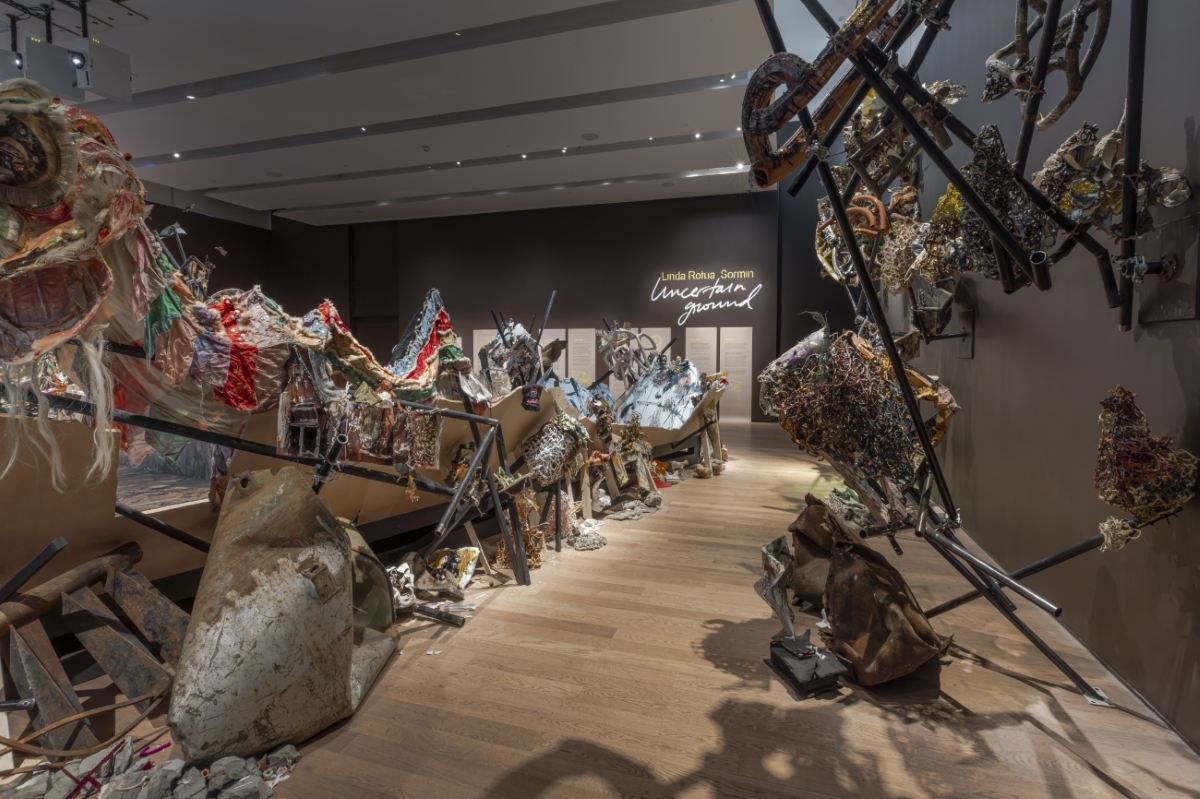
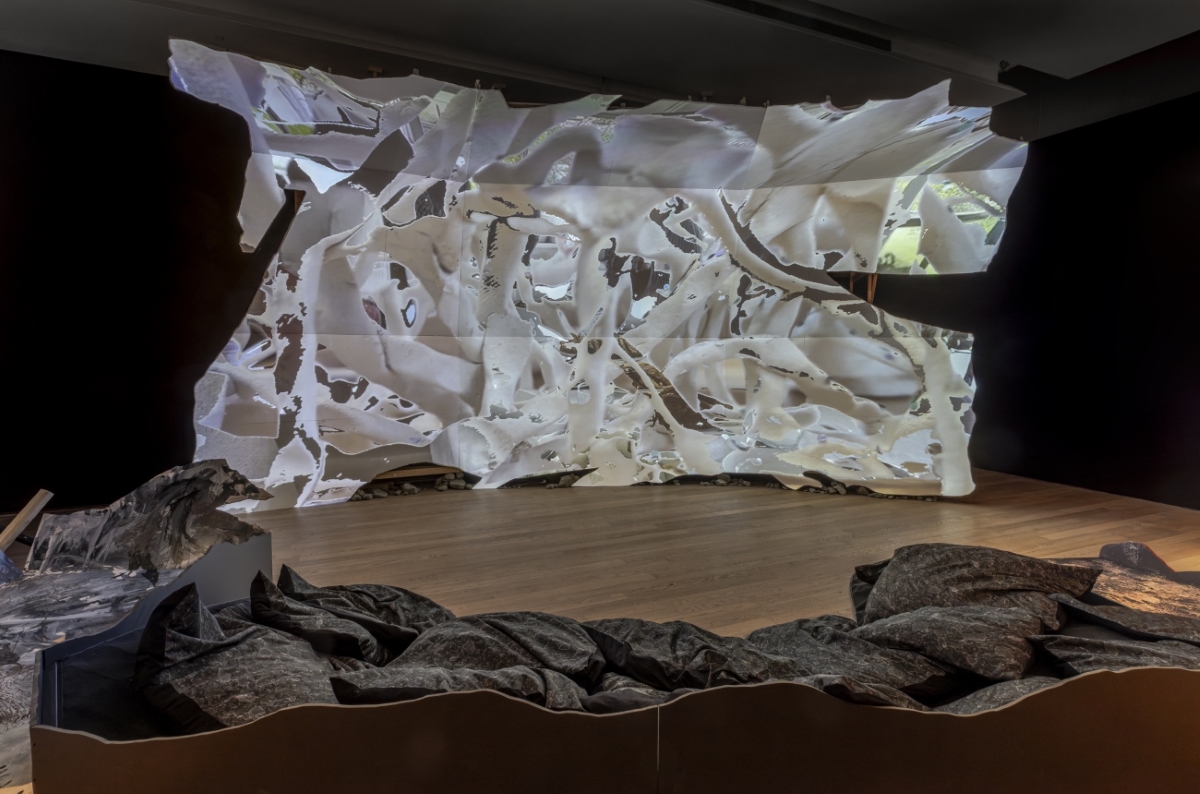
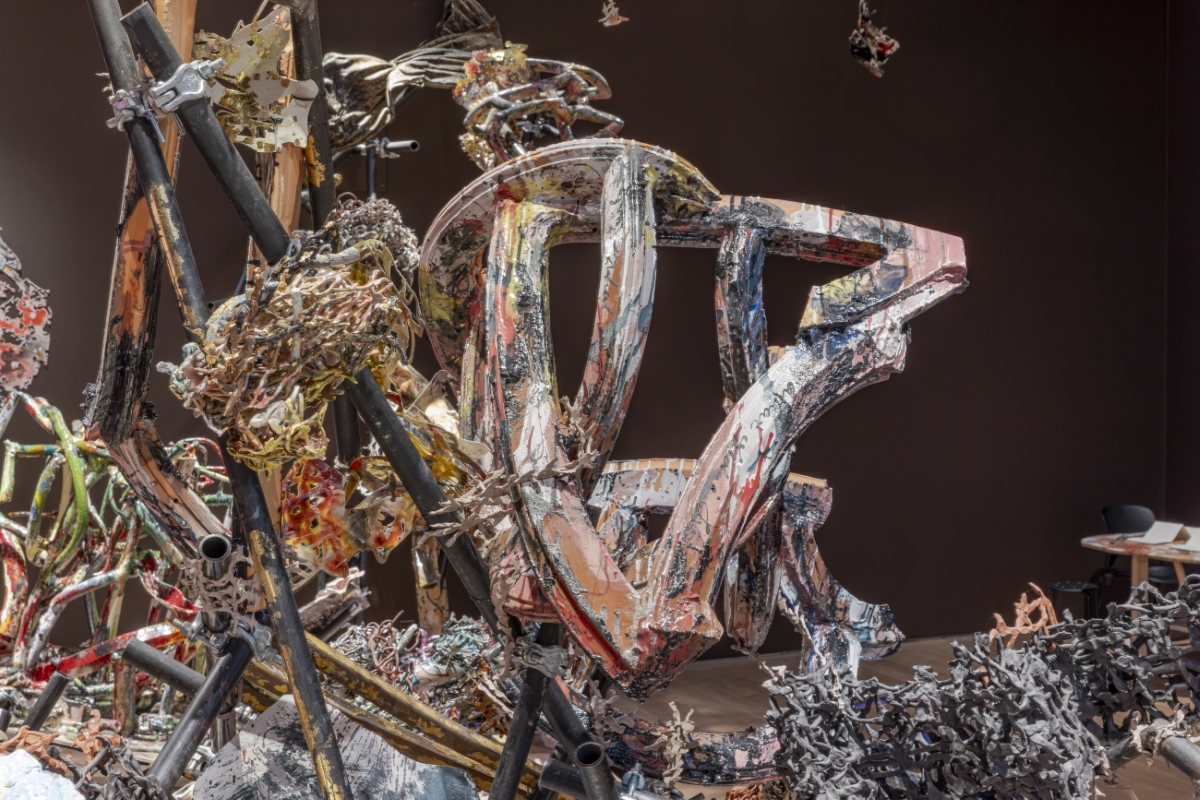
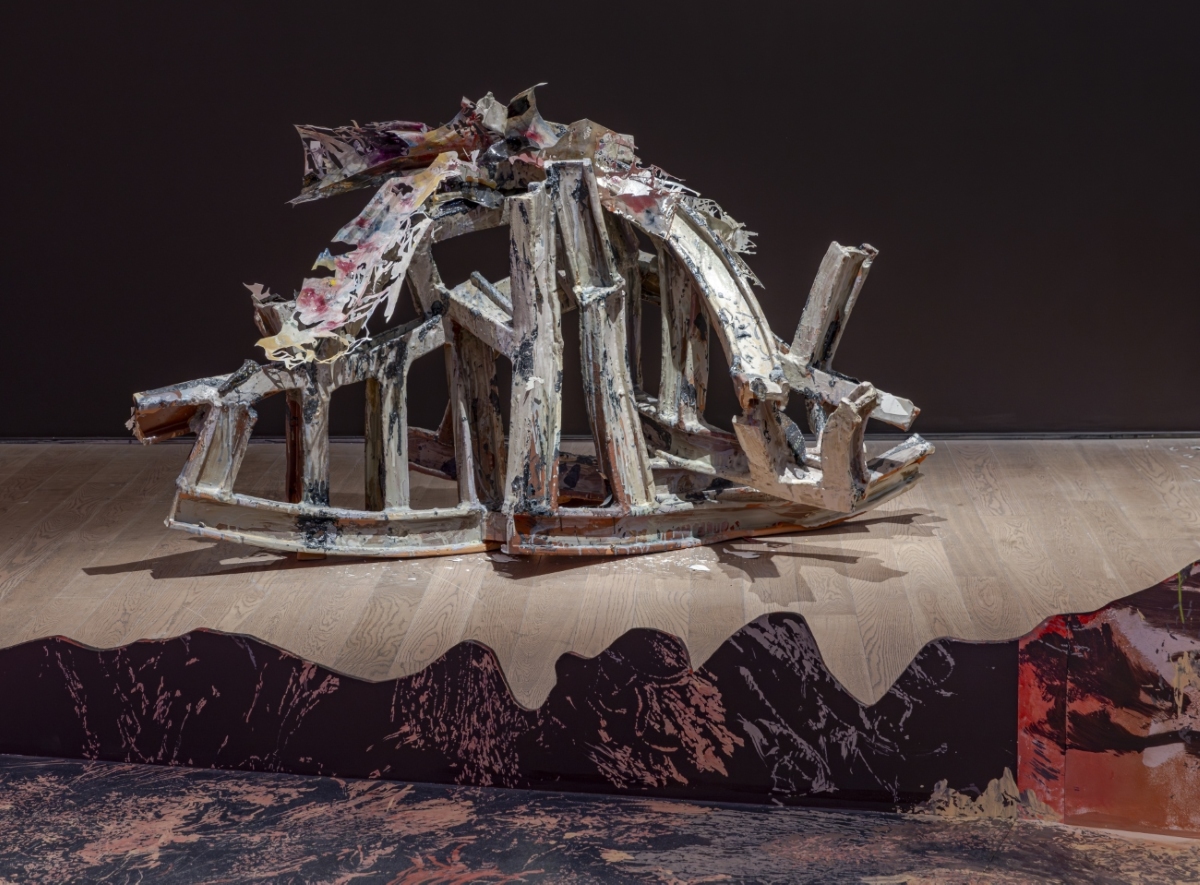
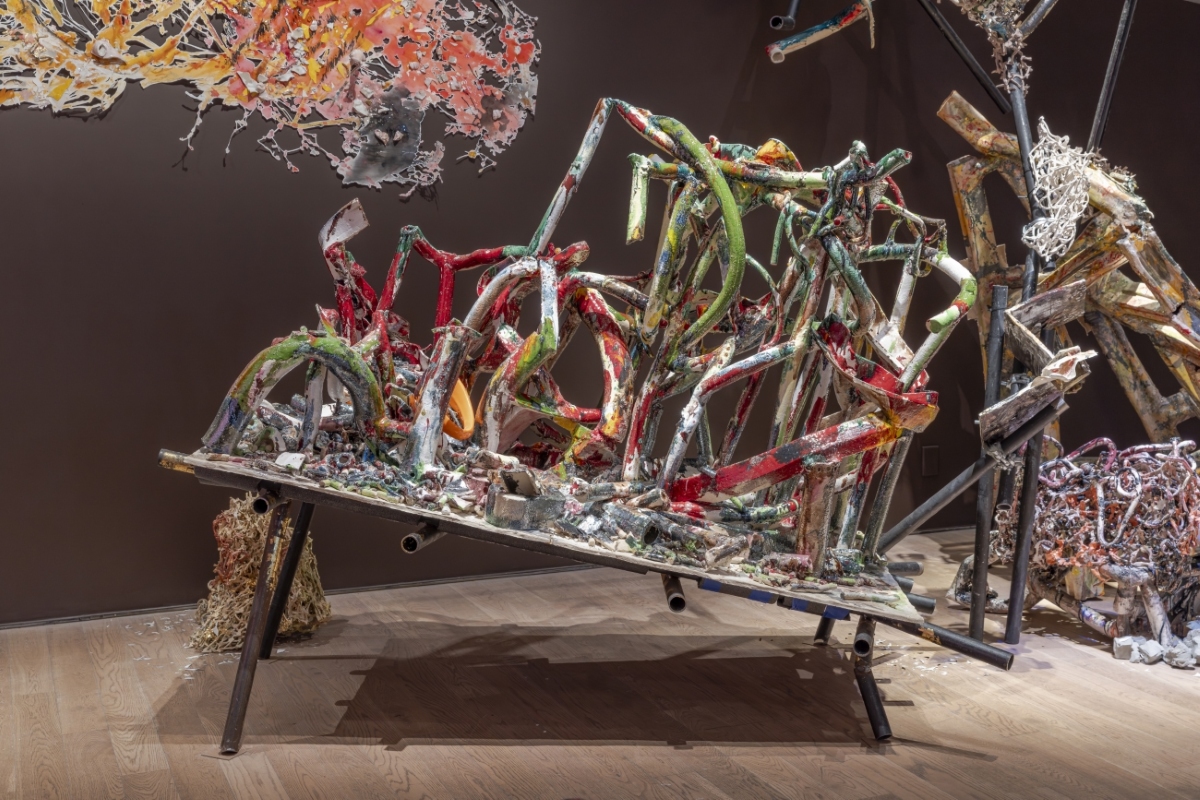
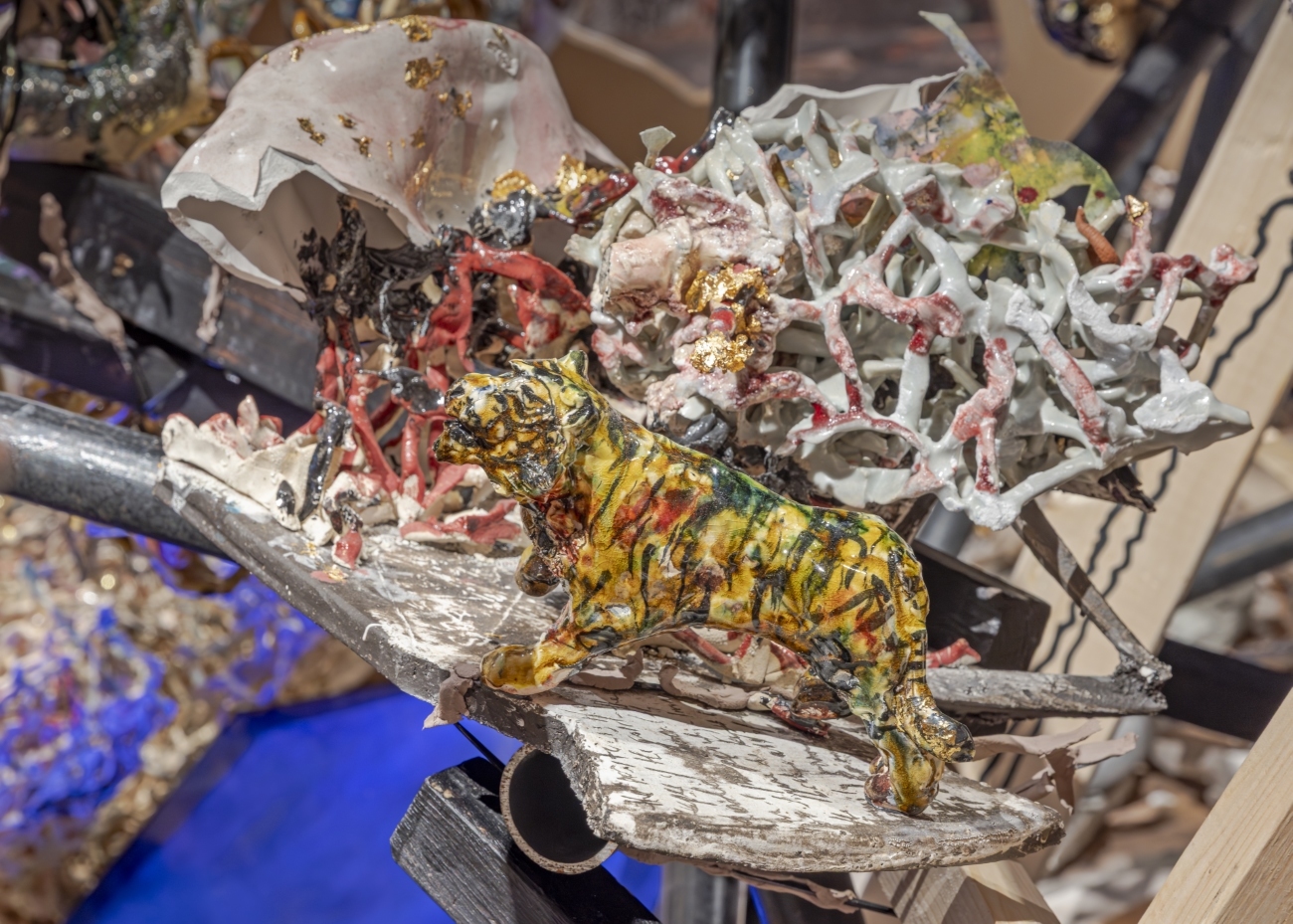
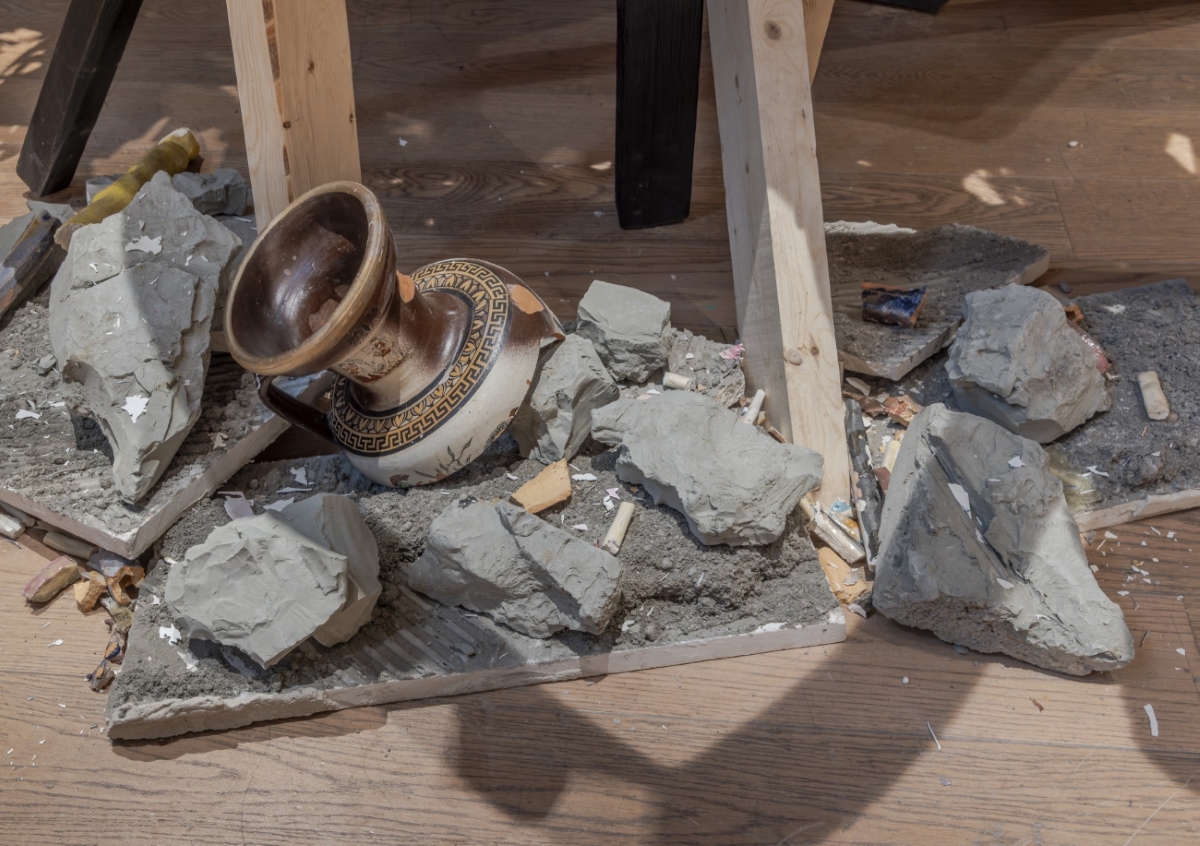
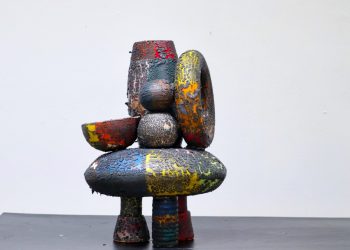
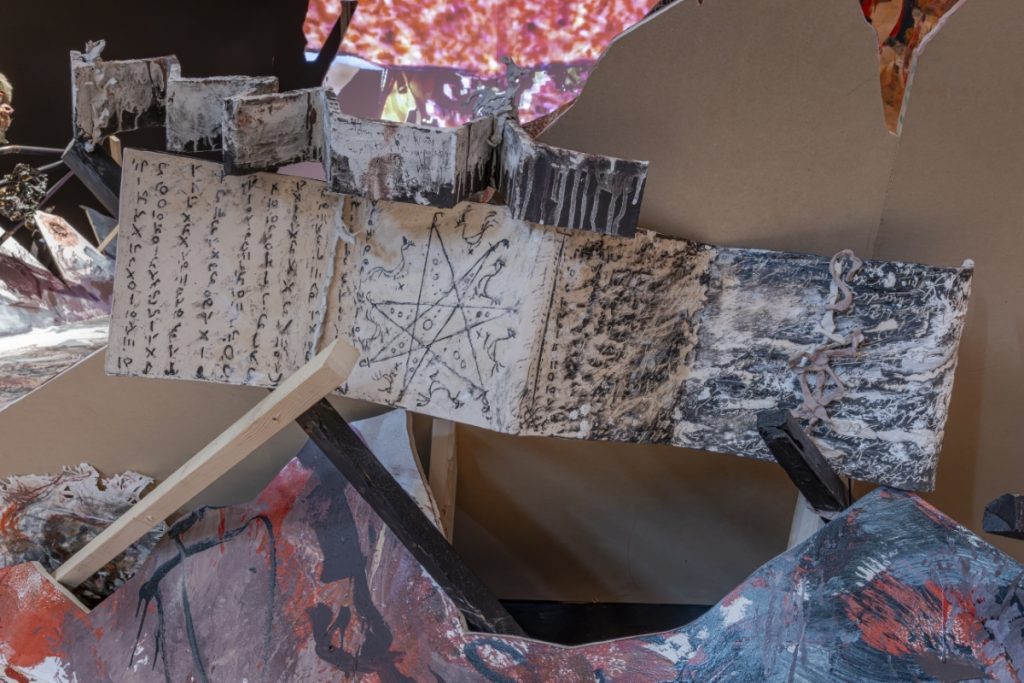
What we are faced with as viewer/voyeur in Uncertain Ground unfolds on three levels: a central raised platform evokes a volcanic lake with an underworld of mythical beasts and coded divination texts; a tangle of precarious ceramic sculptures suggests an earthly middle ground inhabited by humans; and a large-scale projection that references a celestial realm of spirits and birds with snippets of interviews, voice and visual collage. Sormin recounts the story of her Batak Indonesian grandfather whose hair was violently shorn and his subsequent forced conversion from shamanic leader to Christian pastor.
I have been familiar with Sormin’s impetus to create intuitively, building hand-rolled and/or pinched pieces into lattice-like structures for many years. She encouraged many of her students to do likewise, in their own ways, to break free of the constraints of expectations and allow the soul to speak through the hands.
Sensual bombardment is never stagnant in this work. Clusters of what might be described as ‘nests’ of multi-coloured ceramic 3D latticework contain the disjointed objects. I love the fact that Sormin seems to embody the ritual knowing and tradition of her ancestors, at times by osmosis, or channelled through her DNA, over and beyond her family and personal research into both Thai and Indonesian cultures.
My use of the word culmination is specific insofar as much of Uncertain Ground is repurposed from previous installations or exhibitions, over the span of Sormin’s 20+ year career. Ceramic components were shipped from storage and galleries and studios in New York, Brooklyn, Los Angeles and Toronto. The works were fired in various kilns in studios including Medalta in Alberta, RISD in Providence, RI, Toronto, Sheridan, Alfred, NYU, EKWC, and her Brooklyn studio. The video installation, textile viewing areas and wooden structures, boardwalks were newly created for the exhibition. The boardwalk that allows viewers to meander through the 3000 square foot installation struck me as camouflage. Sormin was aiming to reflect the kinetic qualities and colours and textures of the ceramic and paper work. She salvaged fragments of tile on the floors from the Gardiner Museum’s recent renovation. The installation took three weeks to complete, I can imagine, with greater resources and time, Sormin might have drawn on the volcanic rock-like ash of Indonesia to evoke ancient times, as walk-ways upon which the viewer could literally tread between the mythical spaces of the spirit world, the earthly world, and the underworld.
Re-use and innovative reincarnation abound in the work. The late, great Canadian potter, Robin Hopper’s classic textbook caught my eye. It appeared to be clear-glazed. Sormin layered it over a Garth Clark book (perhaps the most well-known American ceramic critic and former gallerist), filled the books with recycled packing foam, sliced them “like a layer of cake” to create stacks, and clear-coated them with non-toxic resin. A good example of Sormin’s extraordinary attention and commitment to detail-oriented process.
Nearby, what looks like an oversized flat-screen tv monitor lay askew amidst the debris-like ceramic jungle scattered on the floor’s surface. Repurposed from Sormin’s 2023 Museum of Fine Arts Boston installation, Boru Sibaso Paet [on the foam of the primordial sea] plays one of three videos in a loop, adding to the multi-sensory experience of the show. Sormin summarizes the video’s content as “Handling shards from the teaching collection of Winn Burke, our ceramic history professor at Sheridan for many decades, overlaid with images of my family’s diasporic experience – including a photo of the cardboard boxes my parents brought with us when we immigrated from Bangkok to Ontario in the 1970’s.”
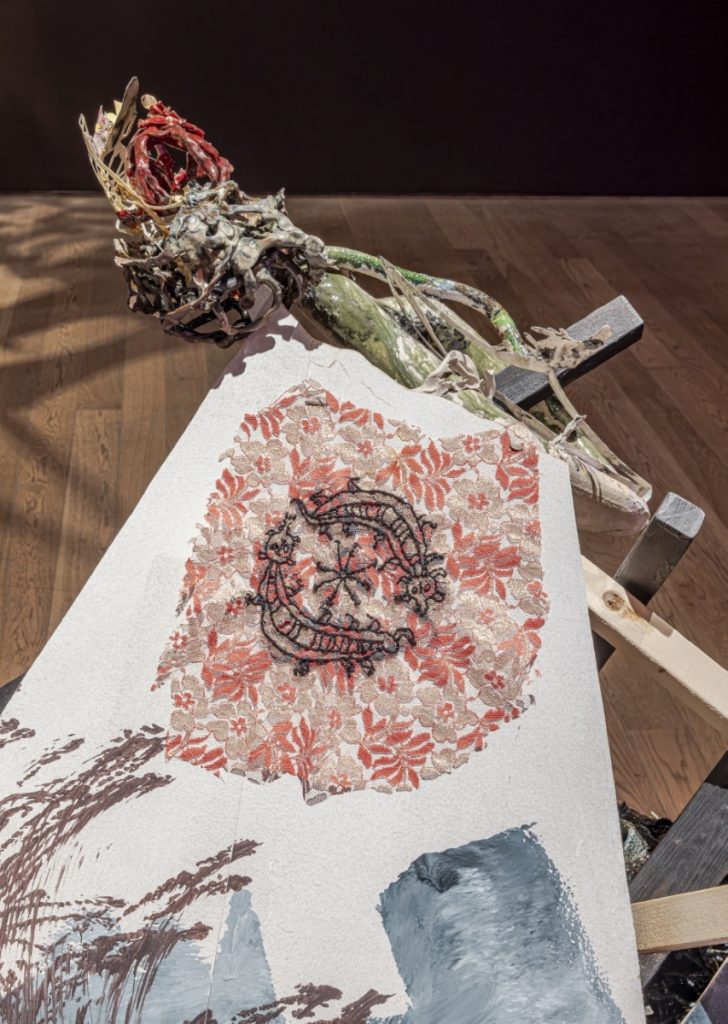
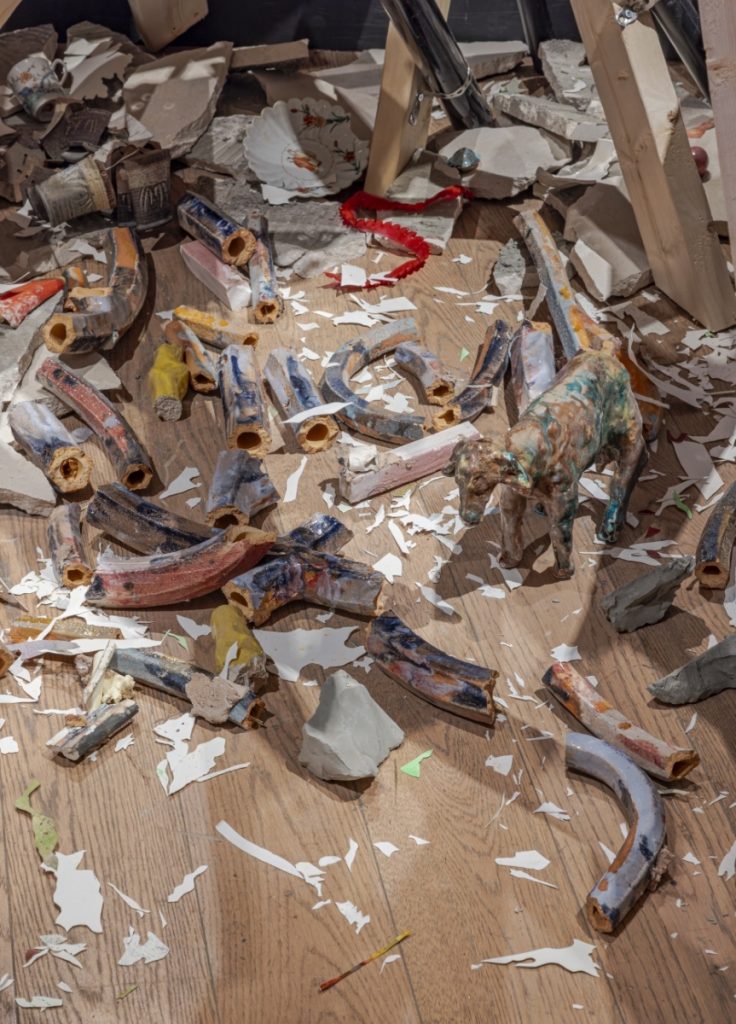
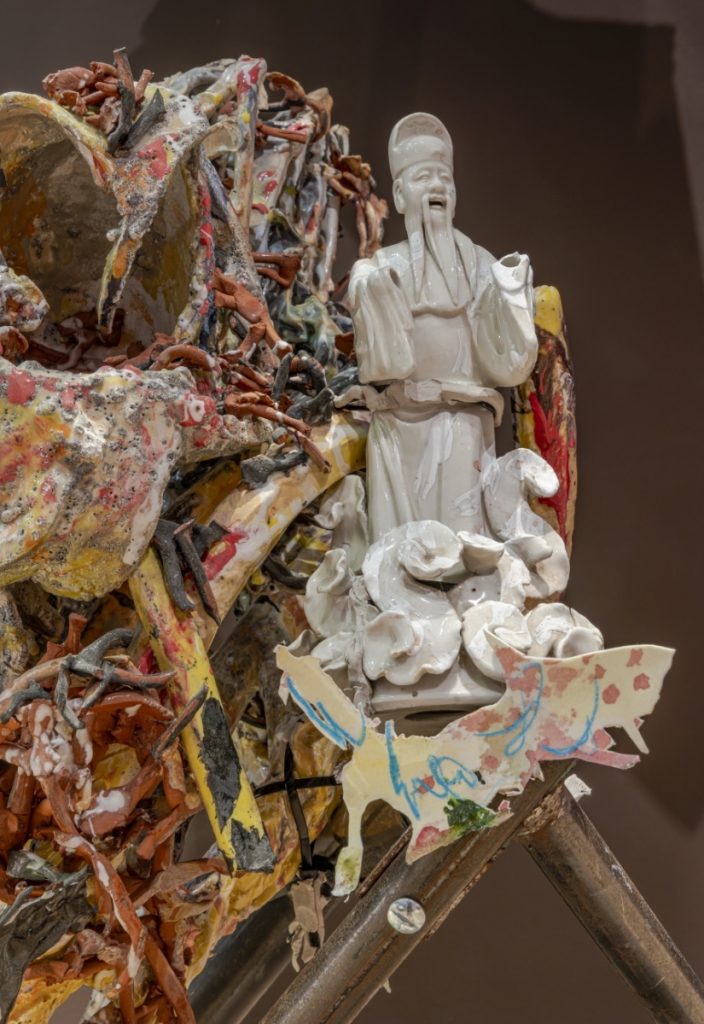
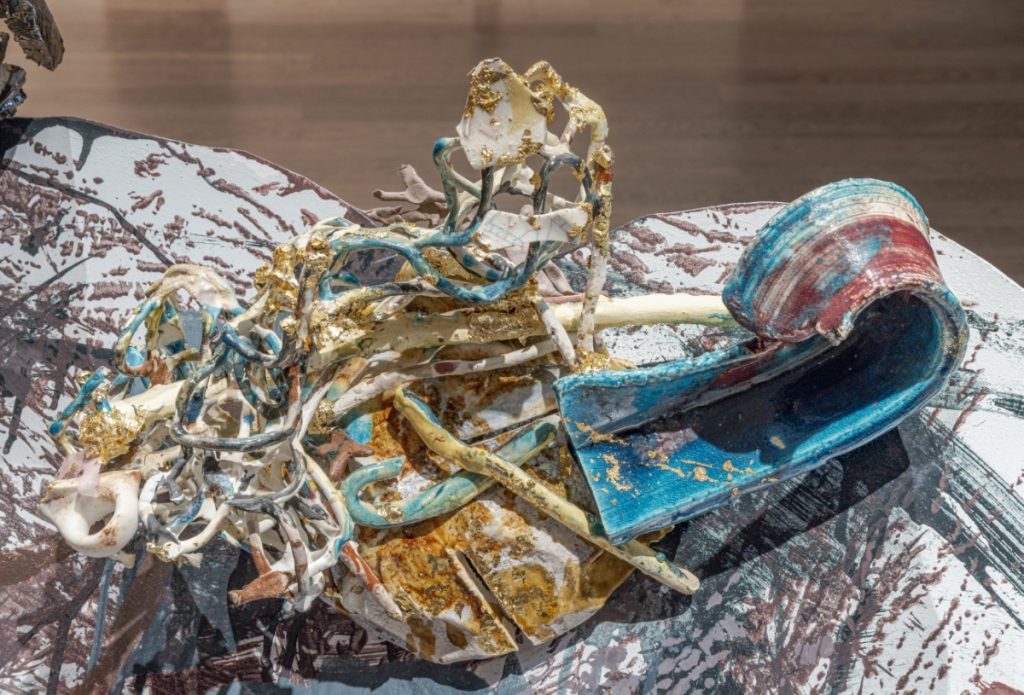
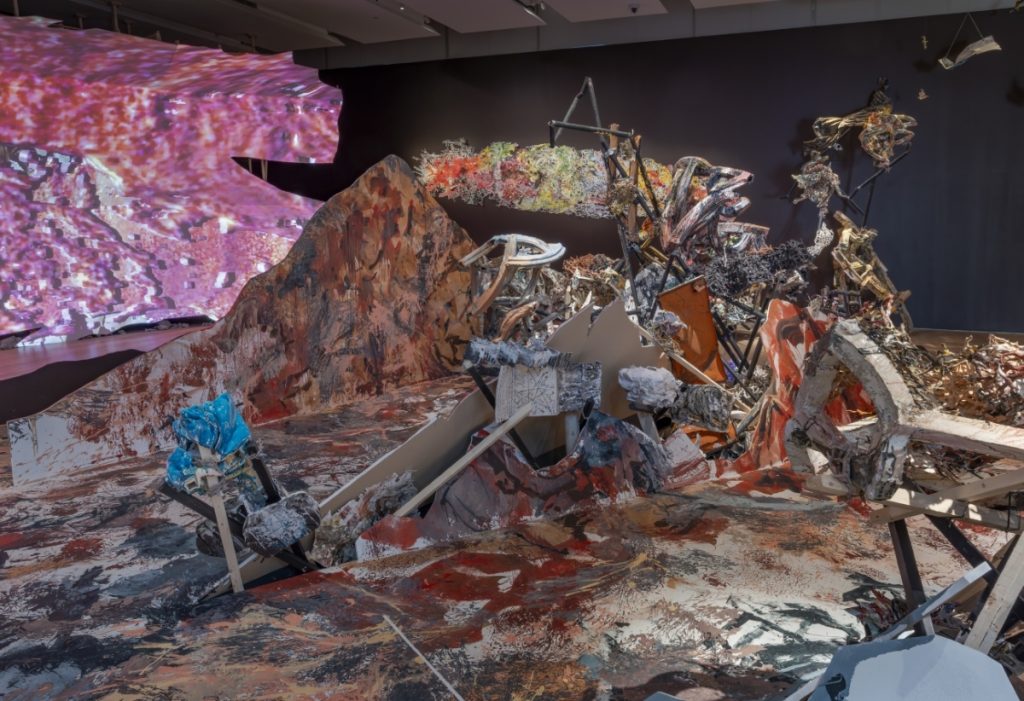
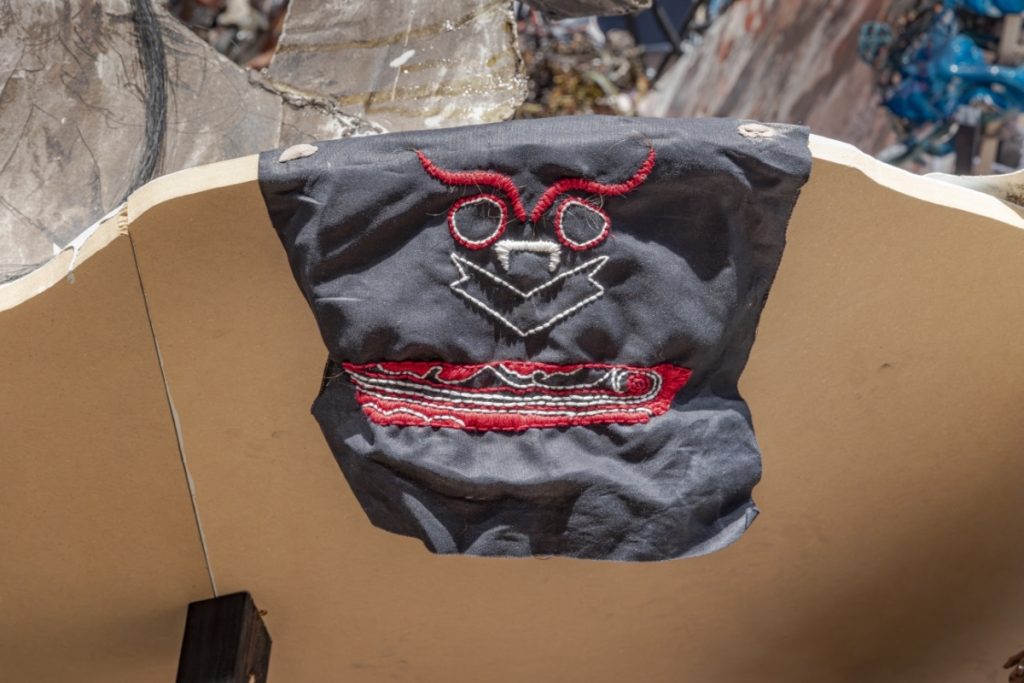
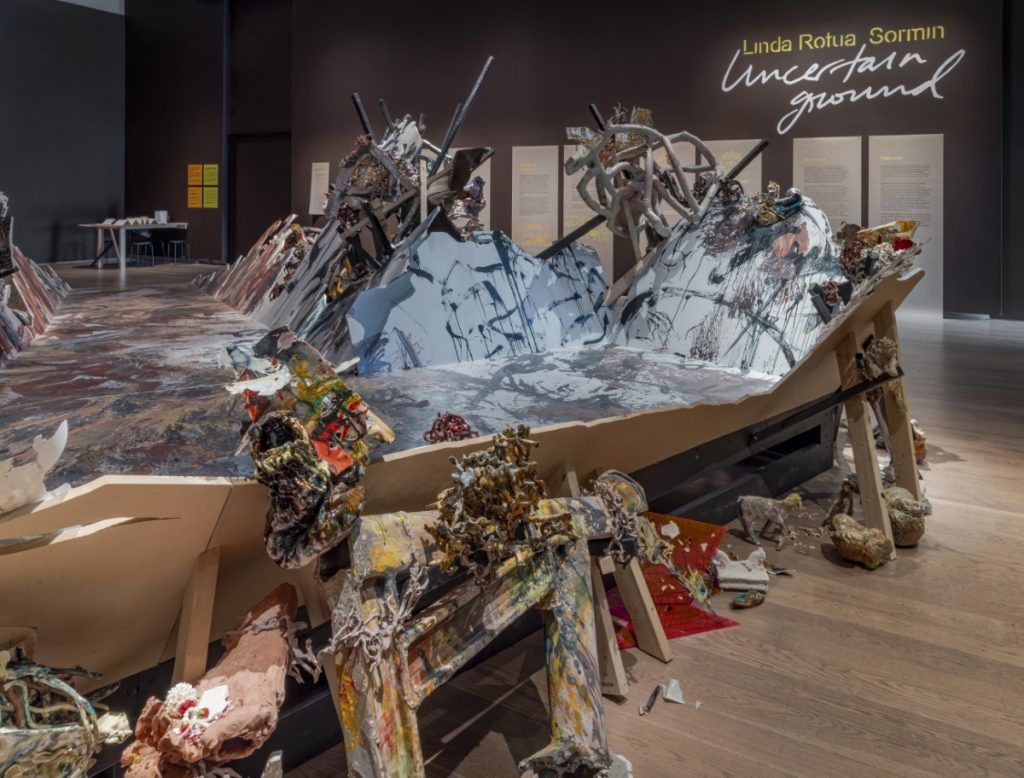
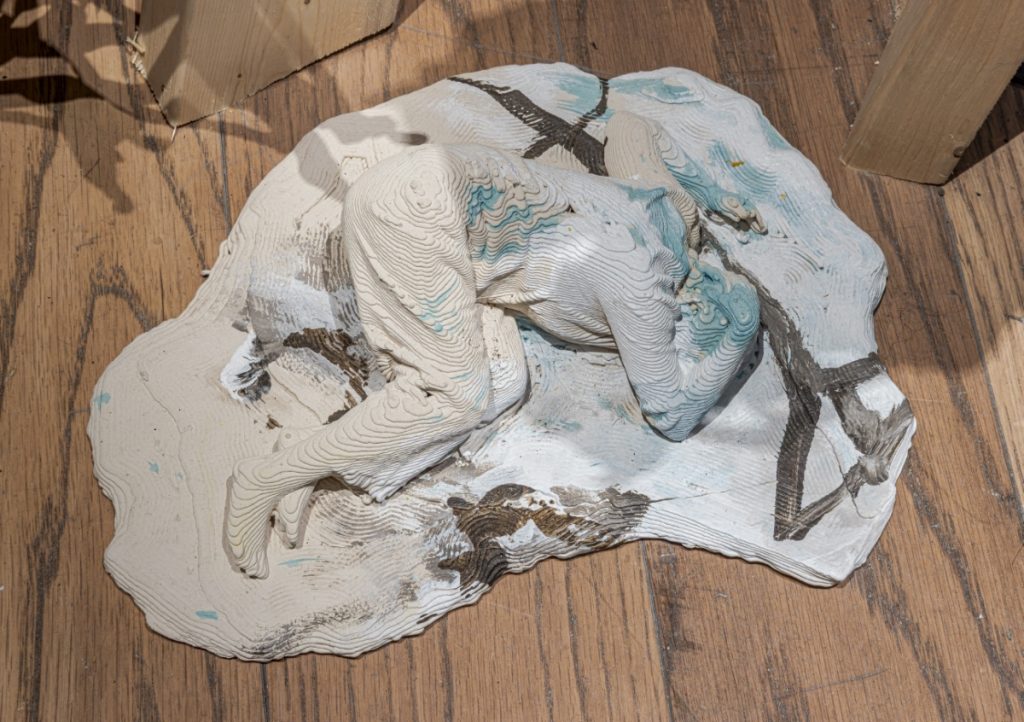
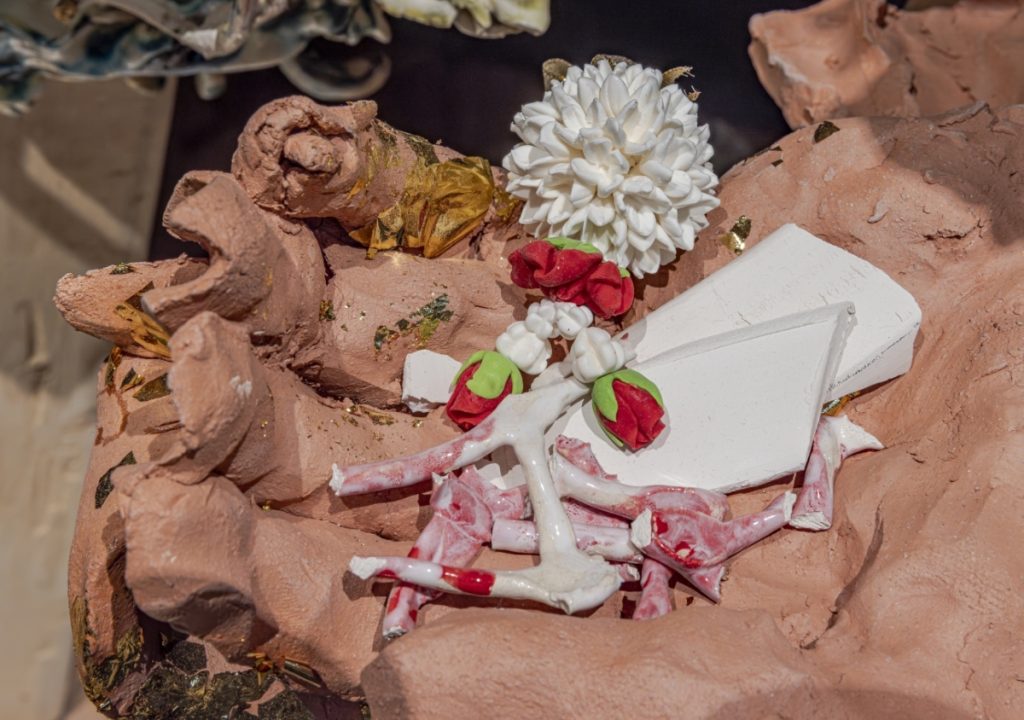
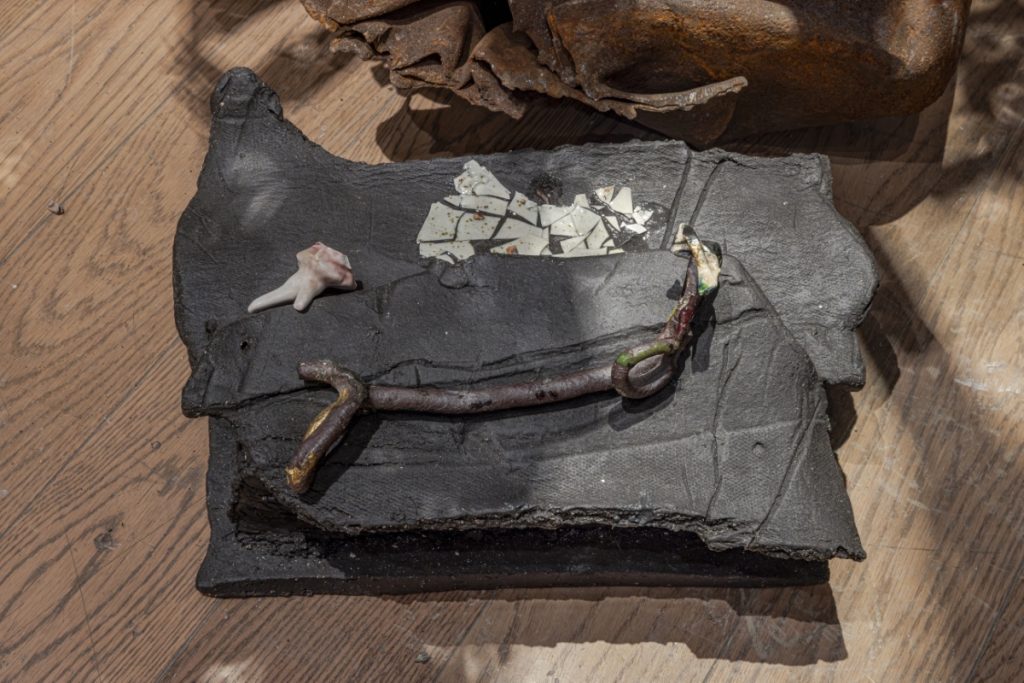
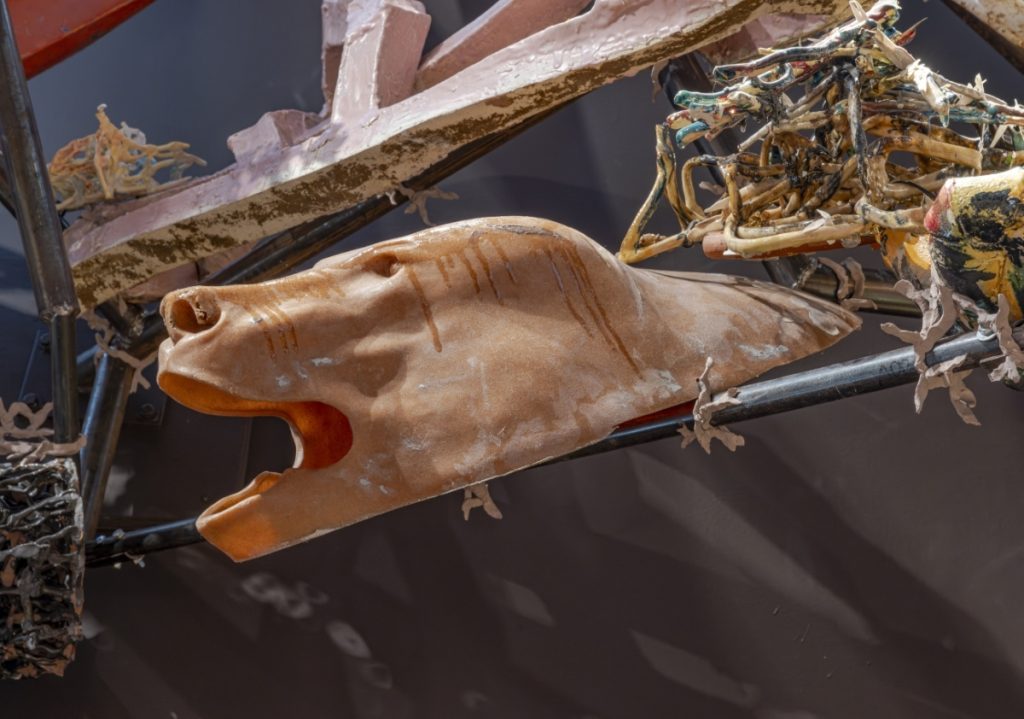
The work contains many creatures within its web. Most sizable and perhaps most impressive is the large Chinese dance lion costume that reigns over the west side of the exhibition. It is ‘lifted up’ by the ceramic structure in such a way that one might imagine human beings carrying it over their heads in a busy street. Upon first sighting this, I assumed it was related to Sormin’s Indonesian roots, and mistook it for a dragon-like Naga head that might be commonly found in Hindu-Buddhist-influenced regions like Bali, Java, and Sumatra. Sormin shapeshifts material culture through the suggestive juxtaposition of identifiable objects and/or animals: roosters, tigers, dragons, the unsettling vision of Sormin found it in a thrift shop in Golden Colorado and included it in her installation “mine (I hear you unclip me)” in 2011 at the Denver Art Museum. Suspension of belief occurs when global elements are fused with such intensity. Sormin recounts that she first spotted the lion’s head in a thrift shop in Pennsylvania. It was tattered, dusty, and lightbulbs bulged out of its eyes. She describes being drawn to it, returning to subsume it into her collection of cultural memory under “to be used at some point” confident in the knowing that it had witnessed more than she could begin to imagine. The piece became part of Stream for her 2021-23 installation at MASS MoCA, and was repurposed for Uncertain Ground. The costume sparked vivid memories of her aunt Irene taking her as a child to Chinese New Year’s events in downtown Toronto.1
One of the parts of the whole in this multi-media exhibition, that might be easily overlooked by the ‘onlooker’ is the poetry that Sormin wrote that not only accompanies the work, it is integral to her meaning making. Sormin returned to her earlier passion for words. True to her modus operandi, she dove deeply into her writing, and participated in an artist residency at Banff in order to glean guidance and inspiration in the creation of her tome, that shares the exhibition’s title, Uncertain Ground. The writing is not surprisingly fragmentary, it is at times lexicon, at times poetry in motion, sculpted on the page with words, at other times diary-like, disjointed memories, evocative, personal yet universal mythologies. Sormin worked with a Batak language coach, and spent hours excavating cultural memory at the Musée du quai Branly, the Wereldmuseum, the British Library, New York University, the European Ceramic Workcentre.
Since COVID, Sormin participated in the renown Holland-based artist residency, EKWC Sunday Morning. This is where she developed and created the ceramics books. Yet again repurposing, the third floor at the Gardiner Museum includes “Slant”, 2021, one of her largest sculptures to date.
Another way into Sormin’s creation is through the large-screen experimental video with animation and soundscape that looms large nearly covering the expanse of the far wall. The video work itself is over an hour in length, and Sormin garnered the help and expertise of a number of collaborators to realize this feature-length video debut. I loved the seating area, and repeatedly nearly stumbled over onlookers, nestled at the foot of the wooden volcano. Like the exhibition, the video is deeply personal, fragmentary, evocative, realistic yet distorted and at times near hallucinogenic. The unraveling of her ancestor’s traumatic forced conversation is pieces together, and a tiger looms digitally present in the background. Wearing my contemporary art curatorial hat, I found this work to be riveting, once I paused to get past the initial alienation inherent in the ‘mid-stream’ entry into its viewing. Uncertain Ground is Sormin’s opus magnus, a behemoth of creation to behold, return to and revisit. One can only begin to imagine what comes next in the creative output of this prolific Canadian contemporary artist.
Heidi McKenzie is a ceramic artist and arts journalist based in Toronto, Canada. She completed her MFA at OCADU in 2014. Working across ceramics, photography, digital media, and archive, her practice draws on her Indo-Trinidadian and Irish-American heritage to explore ancestry, race, migration, colonization, and healing.
Linda Rotua Sormin: Uncertain Ground was on view between November 6, 2025 and April 12, 2026 at the Gardiner Museum, Toronto.
Subscribe to Ceramics Now to read similar articles, essays, reviews and critical reflections on contemporary ceramics. Subscriptions enable us to feature a wider range of voices, perspectives, and expertise within the ceramics community.