
You’ve been working with ceramics for over twenty years now. Do you remember your first works? How did you evolve in time?
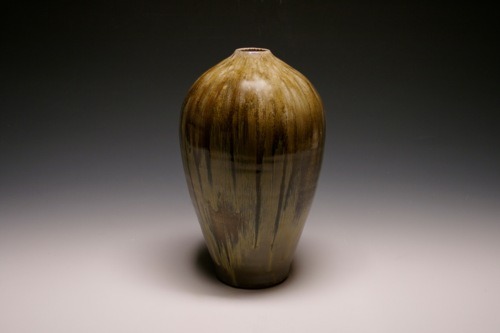
It has been just over 20 years since I started in the field of ceramics. I remember my first works very well I know at every point in my career I strived to produce the best possible work I could, going against any business plan and striving to be the best artist I could. I threw away many of my works because in my opinion they just did not meet the mark. I felt it better to show and sell only what I felt was the finest quality I could produce at any point of my development as an artist. My first works were refined shapes as I was trying to get to the root of the form. Most were based on early American folk pottery that of, Edgefield South Carolina, Central North Carolina stonewares and slip-trailed earthen wares.
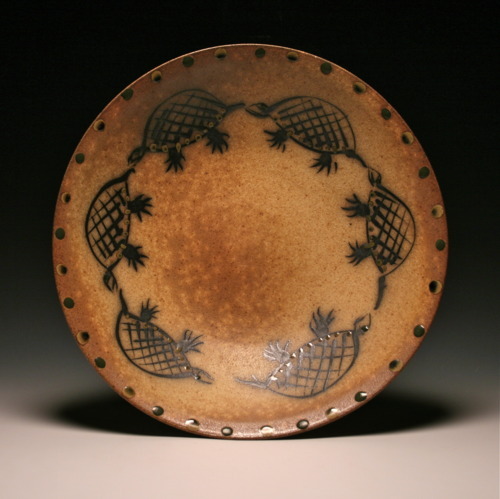
These first works were simply glazed or left unglazed and fired in a wood-fired salt glazing kiln. In my early work I wasn’t ready to decorate the surface, I was only concerned with the root of the form; once I felt that I had achieved mastery of this, only then was I able to begin to think of working with surface design, by adding patterns a zoomorphic imagery. However, some forms still call me to show their true essence.
You work with great delicacy when using patterns and symbols of ancient cultures on your works. How do you choose these patterns?
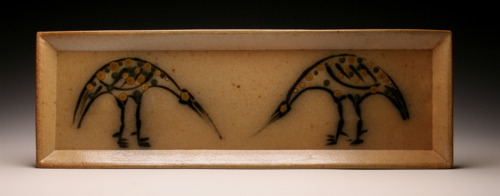
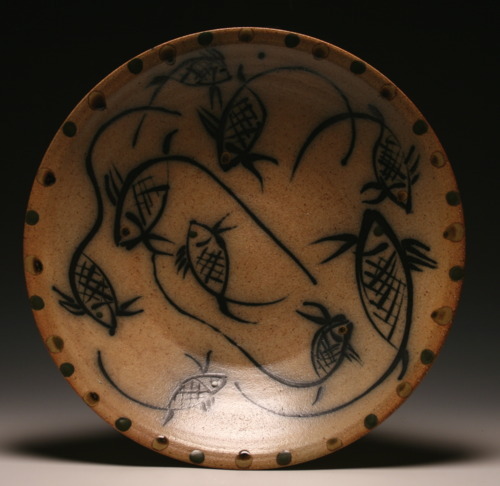
I began looking at my surroundings, taking patterns and imagery from nature. So much inspiration can be found in nature if you just pay attention to its rhythm and symmetry. With other designs, I do look back on many cultures, taking from them what I feel is relevant to me in this time and place. I first started looking at early American ceramics of the 1600’s forward, then from there I began studying pre-Columbian ceramics and folk art from around the world. There is a common thread that links all ancient cultures, a trueness and simplicity that I feel drawn to. I also study textile patterns for many ideas as in nature there is a rhythm, a symmetry and a repetition that calls to me. Sometimes, I take only one small part of a pattern and cover the pot with it, repeating the process over and over; repetition can be very powerful if done correctly.
You recently held a workshop at the University of South Carolina, Columbia. What did you learn from this experience? Do you intend to hold more workshops in the near future?
I was a Visiting Artist At the University Of South Carolina, Columbia this past September and presented a workshop over two days. I have conducted several workshops over the years, and I truly enjoy sharing my work, techniques and ways of thinking with others. It is a joy to be in a place in my career, where my work is respected, and I am asked to do so. Whenever I teach a workshop, I learn a little more about myself and work through the dialogue with the participants. There is nothing like having to verbally explain your thoughts, and ways of working, to help me think deeply about where I came from, and what I am trying to express in my work. Sometimes I come away with a deeper understanding of myself and place in the world of ceramics, and feel the participants do too. Presently, I don’t have any workshops planned, but this is something I intend to do more of and would welcome invitations as they arise.
How long does it take for a new set of works to be completed? Do you make many preparations?
I work in a cycle that lasts between two to three months. It begins with wet mixing my clay body to a slip, then letting it air dry to the correct consistency. This is done weeks before I begin creating the forms.
I work in small sets, I am not a production potter, I make no more than a dozen of any shape at a given time, then I decorate those pieces with several different patterns or imagery. The decorating process is what I have begun to enjoy the most, thinking of how the decoration can complement and enhance the form, becoming an integral part of the piece. After I have enough works to fill the kiln, I load it – which takes one full day and then fire the next day. I currently fire with propane, the firing last about 36 hours; then the kiln cools for three full days before unloading can begin.
Nowadays, it’s getting harder to sustain a family and have a decent living as an artist. Where does your ambition come from?
I have always taken the approach of making what I want and need to make, in order to feel happy and fulfilled, and then finding the market for it. This may not be a good business practice, but it’s good for my heart and has worked for me.
I have always felt that if you put your heart and soul into your work, it will shine through. There is a trueness that I can feel when the work comes from the heart, throughout and genuine. The educated public can feel this. Thus, I am lucky to live in a state (North Carolina) that has a rich tradition in ceramics. Because of this, we have an educated audience, so this helps a lot when it comes to making a living as an artist.
What motivates me more than anything is to change and grow. Change comes to me very slowly, but I am always looking to the next firing thinking of what I can add to my work, or maybe take away be it form or surface design to refine it and progress forward. If I was making the same pots, I made fifteen or even five years ago I would not be happy. I am not trying to say there aren’t elements that were there earlier in my career that still shine through, but I fell that they had grown and progressed to a cohesive body of work.
What are your plans? Where can we see your works in the near future?
I am planning on teaching more workshop in the future, it is fulfilling for me to share with others, and it gets me out of the studio for a change, and change is good. I am also hoping to build a new kiln in the next few years, to get back to wood firing. I also have been working on new tiles that I will have out early next year; that will carry most of the imagery on my pots to a three-dimensional line of tile.
My work is included in the exhibition at the Mint Museum, Charlotte NC, A Thriving Tradition: 75 Years of Collecting North Carolina Pottery, an exhibition commemorating The Mint Museum of Art’s dedication to North Carolinian pottery, November 12, 2011, through January 5, 2012.
By Vasi Hirdo.
Published in Ceramics Now Magazine Issue 1.
View Blaine Avery’s profile on Ceramics Now.
Visit Blaine Avery’s website.