By Alessandra Lami
At the core of Gordon Baldwin’s practice lies a tireless curiosity: among the most original voices in modern British ceramics, the artist was able to transform a traditional language into a territory of formal and poetic experimentation. After his demise in May 2025, Baldwin leaves behind a vast body of work. His practice is nourished by a continuous dialogue with art history, especially that of the later twentieth century. In a life spent between teaching – at Eton College as well as Goldsmiths College and the Royal College of Art – and artistic research, Baldwin began experimenting by directing his practice toward works with a functional character, until shaping the traits of a fully autonomous sculptural investigation that reveals him as a multifaceted artist, capable of weaving sculpture, drawing, poetry and music into a single coherent vision.
The exhibition Little Hard Clouds Becoming Vessels, held at Fondazione Officine Saffi and organised in collaboration with Kunstverein in Hamburg and Corvi–Mora, London, presents itself as a retrospective dedicated to Baldwin’s rich practice. Since its founding in 2011, the Milan-based foundation represents a key institution for ceramic research, fostering dialogues between historical perspectives and future-oriented experimentation, so it is no coincidence that Baldwin’s first exhibition takes place here in particular. The project investigates the wide range of visual and conceptual styles the artist developed over many decades, moving between abstraction, reflection, and a deep attention to how materials behave. Word, form and silence are in constant dialogue, creating compositions where inner experience and outside reality come together.
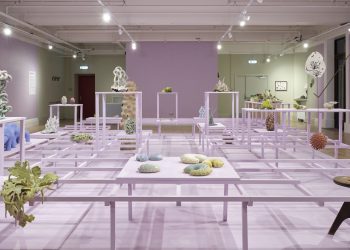
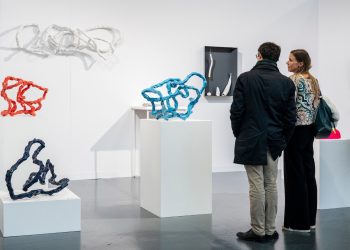
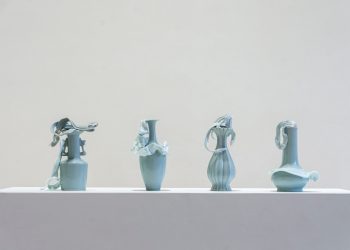
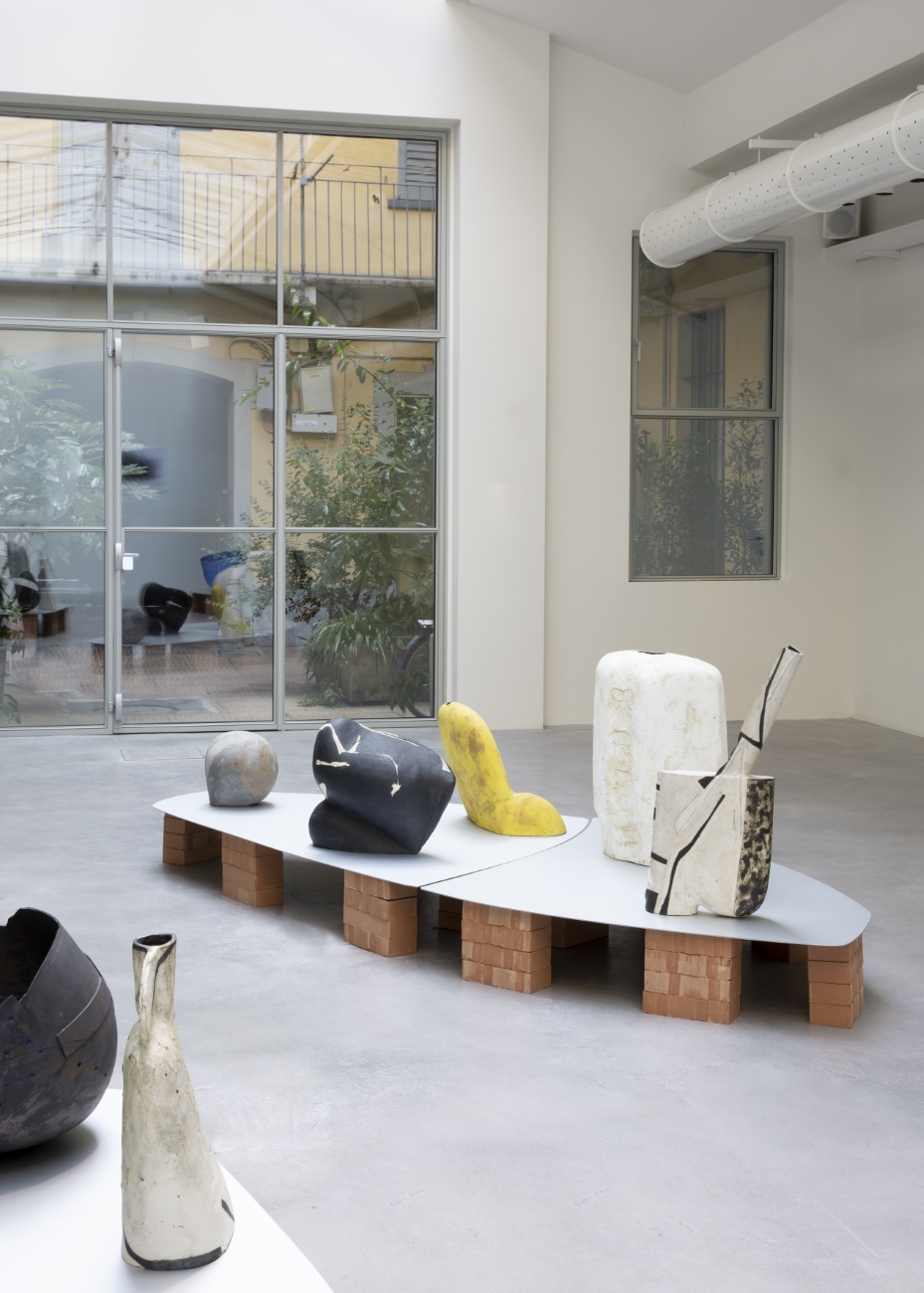
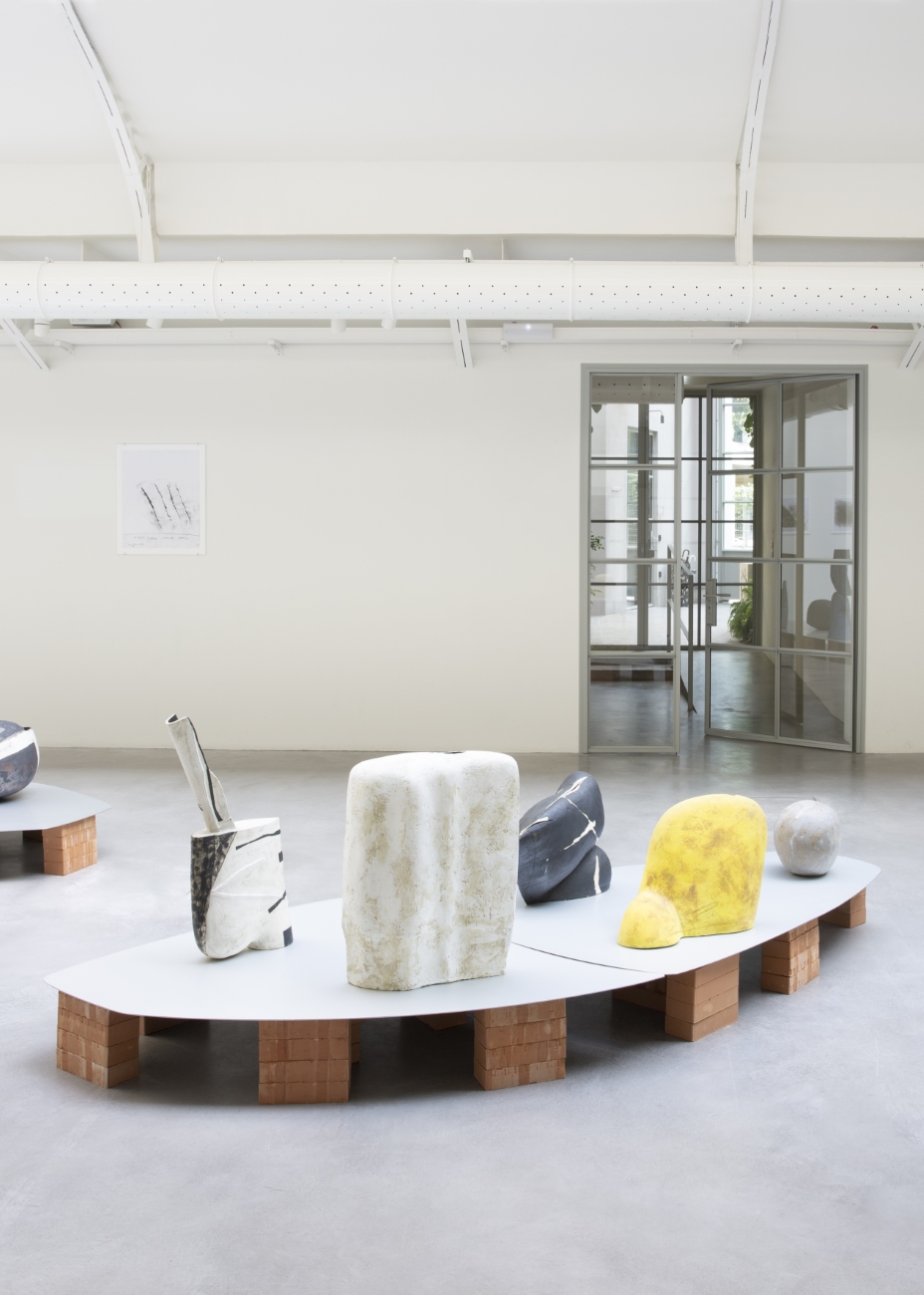
The display presents a large selection of ceramic sculptures arranged without chronological order across three central platforms, each composed of steel plates supported by bricks. This simple arrangement gives the works an almost floating quality, letting their shapes and shadows seem suspended, like small clouds or pieces of a hanging landscape. Alongside the sculptures, a concise group of drawings from 2016–2017 introduces a second register of Baldwin’s late production, revealing how drawing eventually became his primary form of expression.
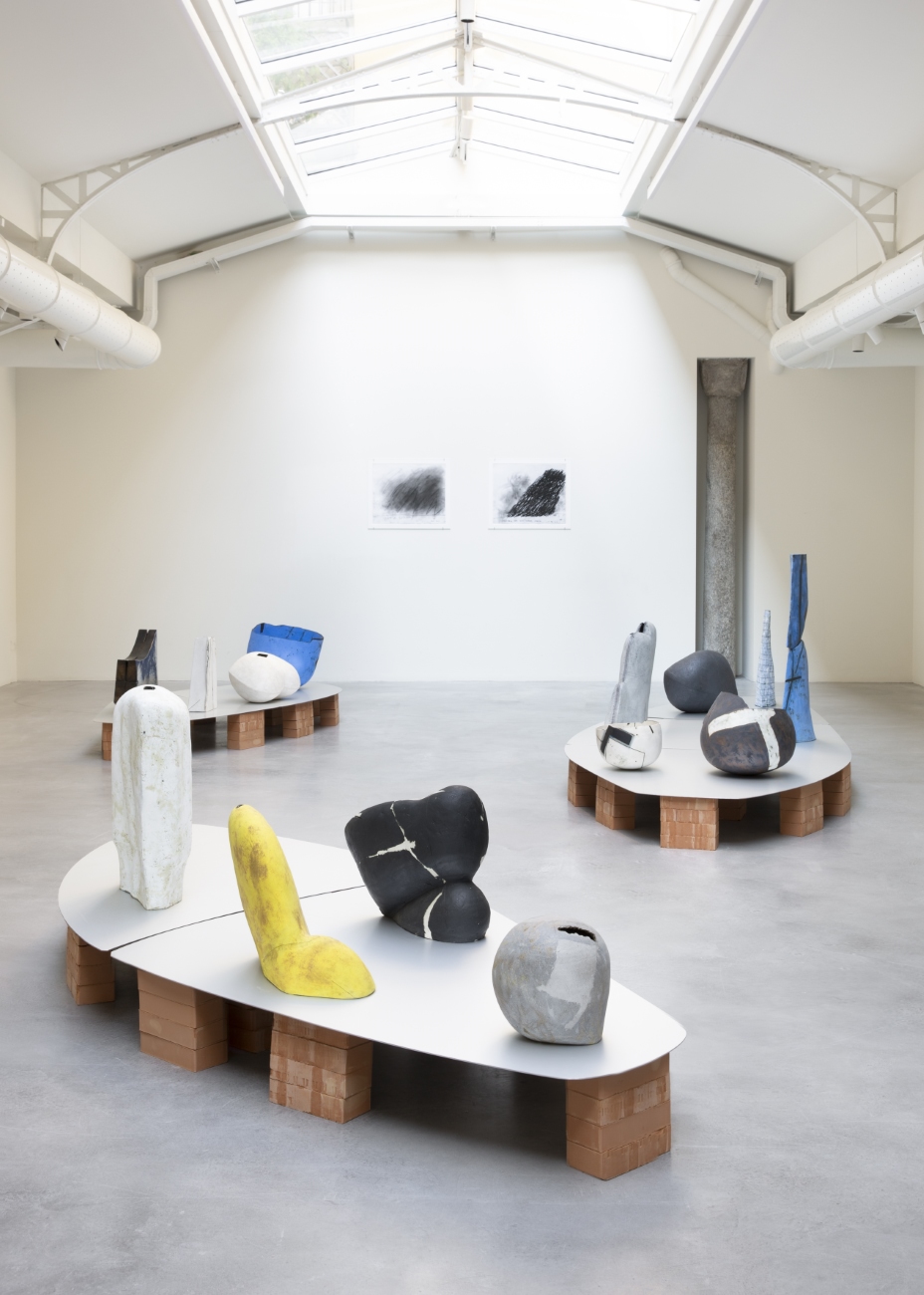
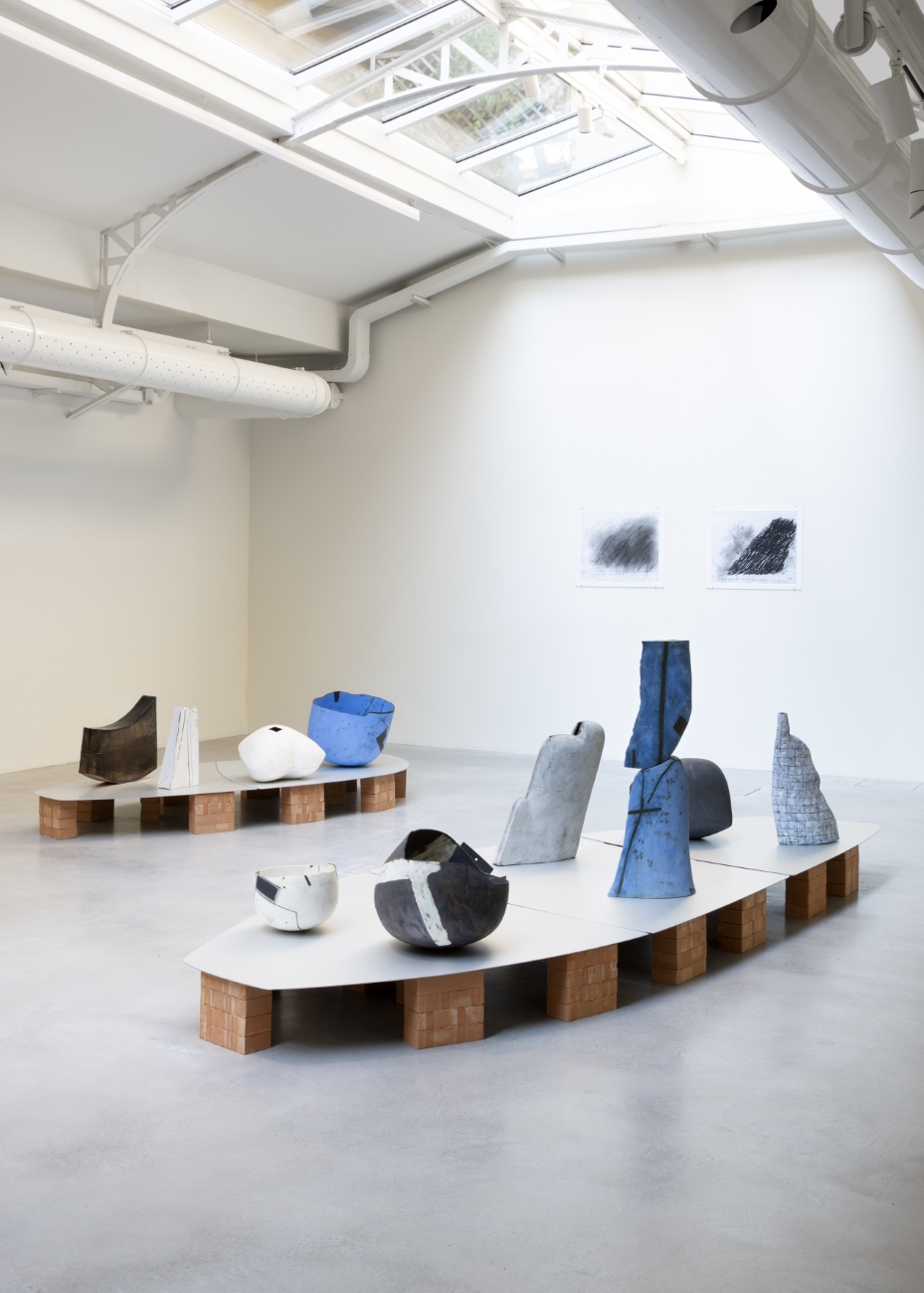
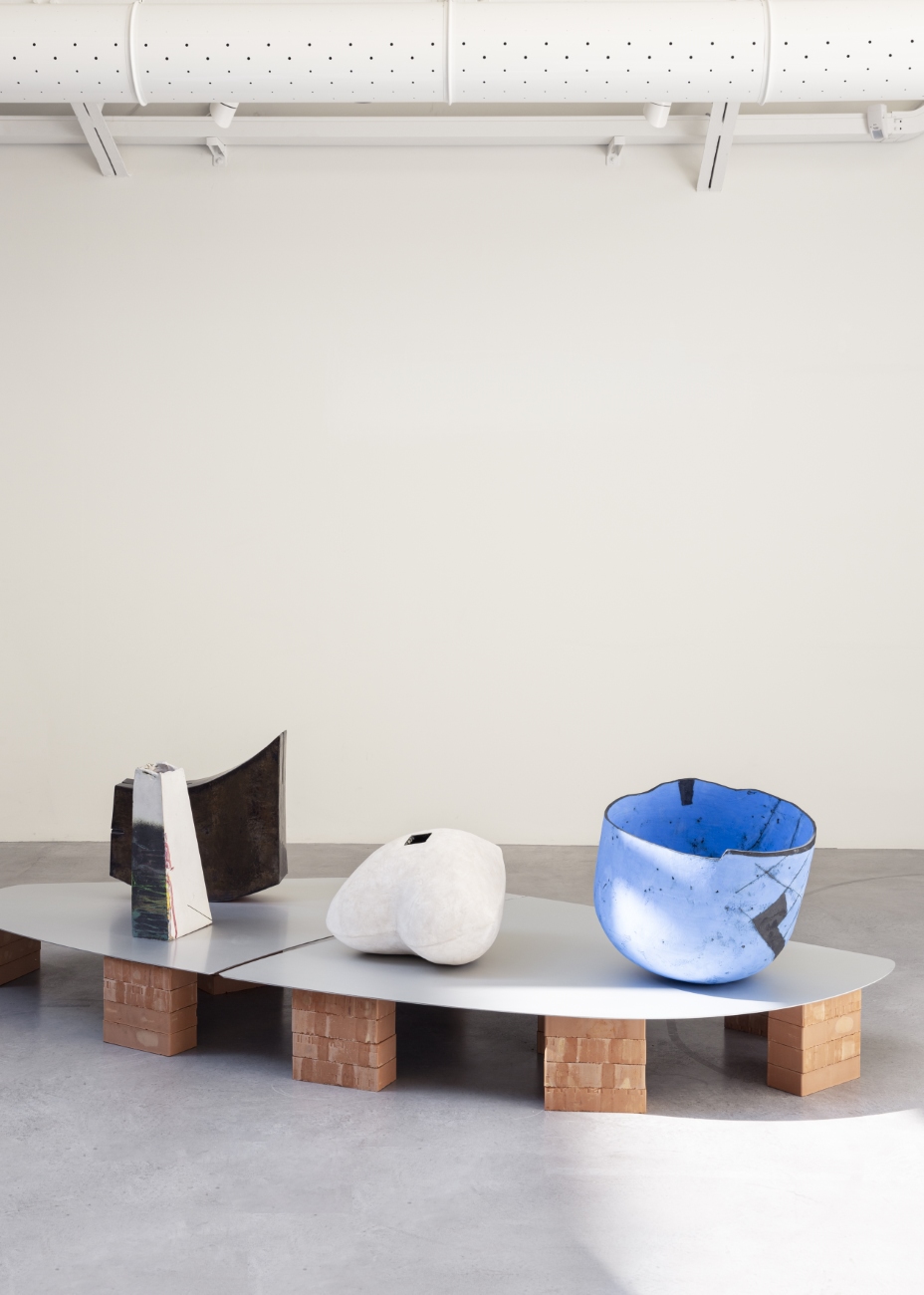
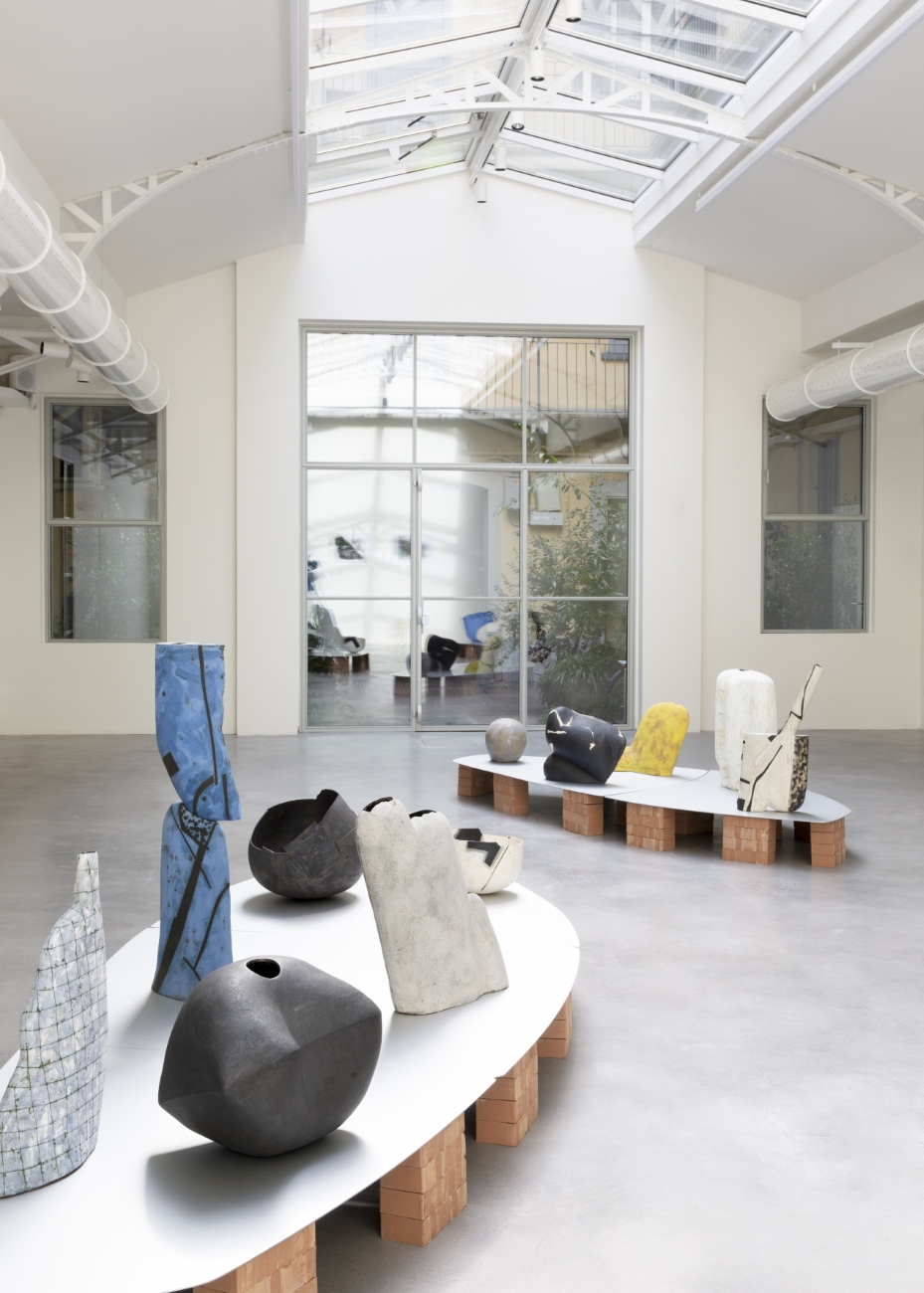
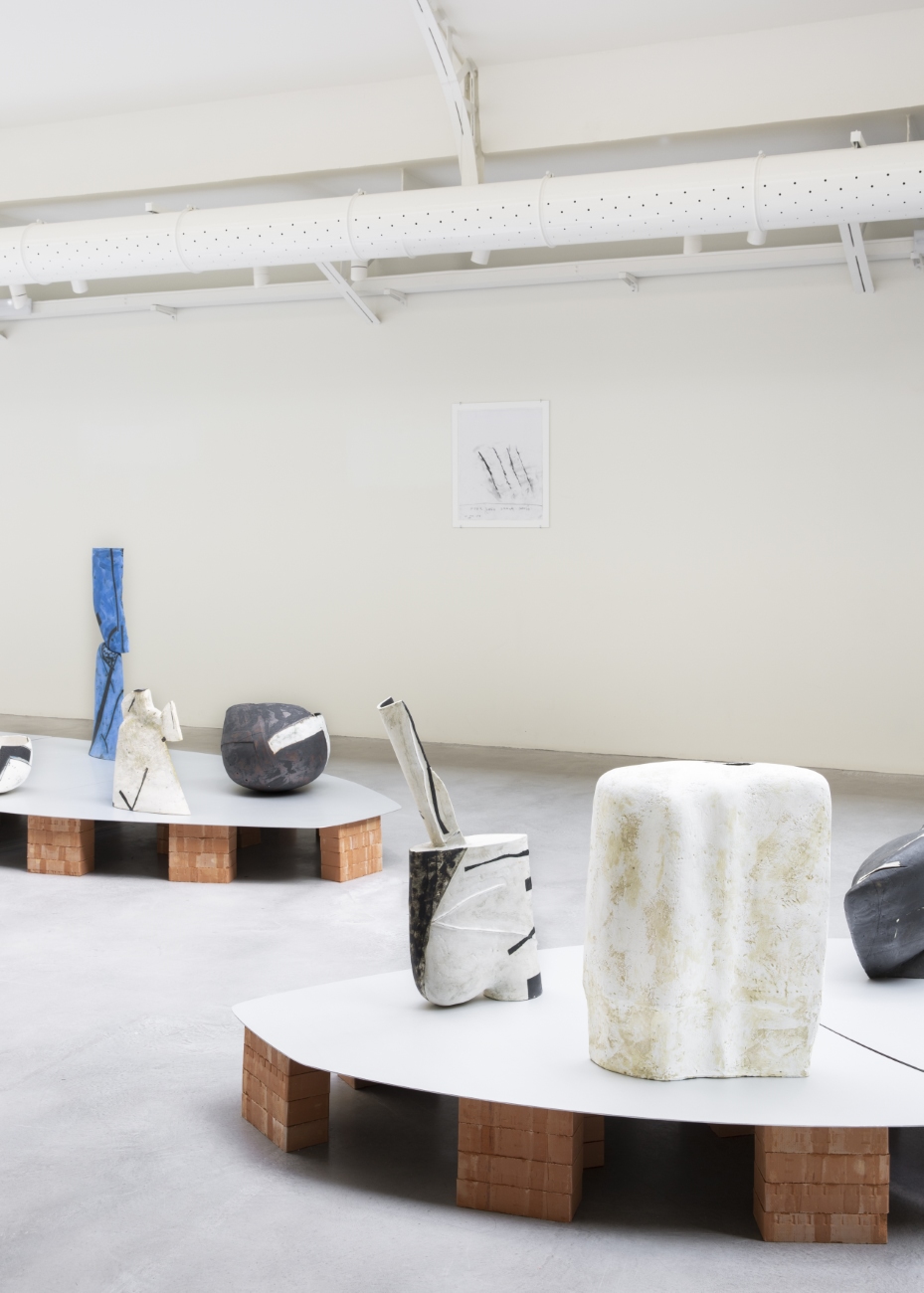
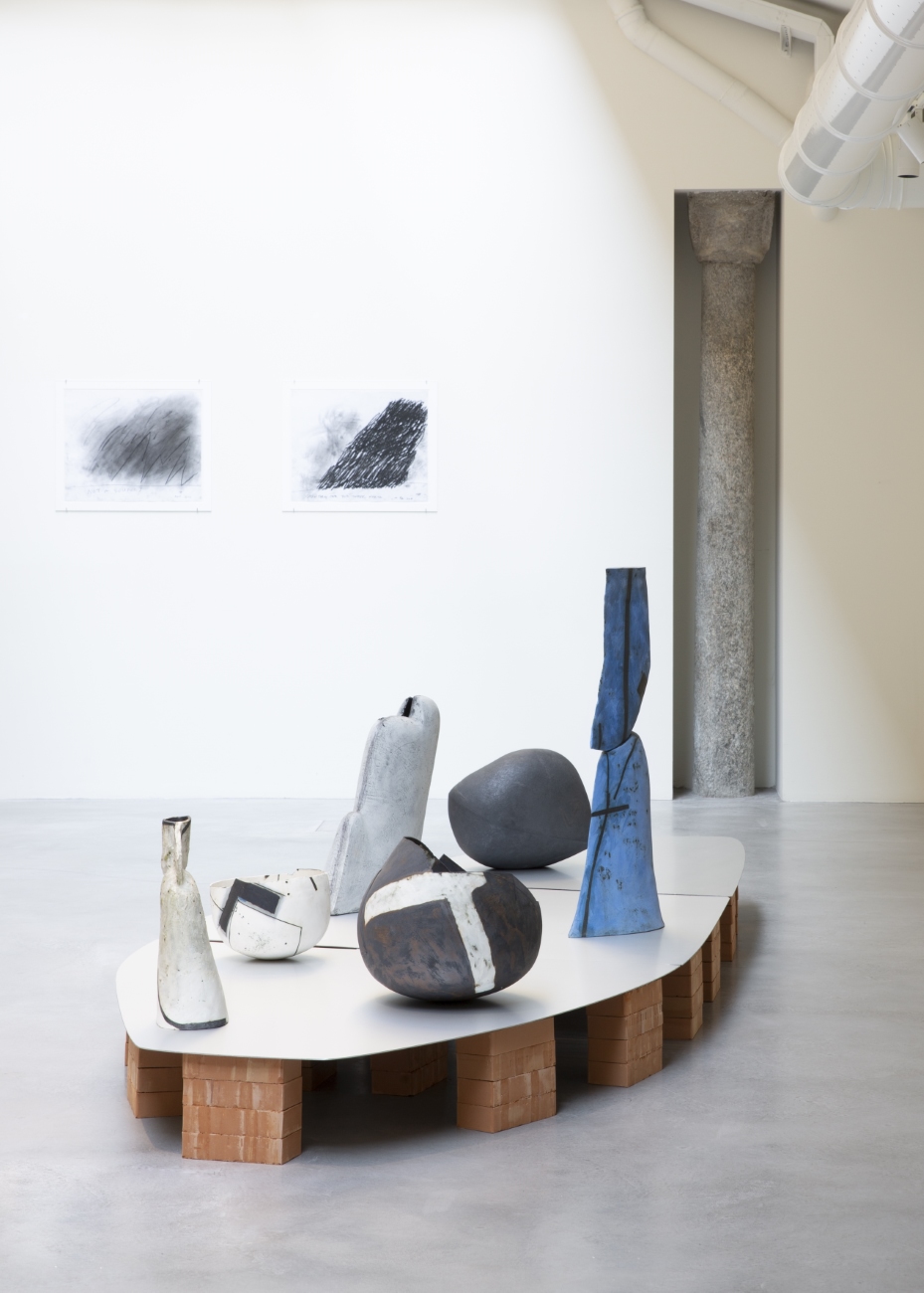
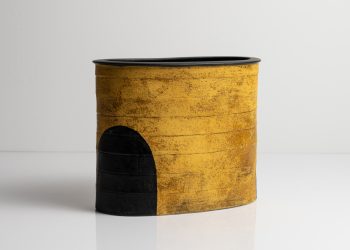
Varying in shape and size, the structure of the ceramic works recalls the typical shape of the vase or container, with surfaces marked by holes, gaps, and narrow openings, giving the impression of an interior that is partly exposed and partly concealed. This repeating morphology represents a basic key element, to the point of becoming a key theme of the artist’s research: the so-called vessel, which appears in many titles of his works, and corresponds with a hollow structure embodying the idea of inner and inhabited space. Often glazed in black, the heart of the sculptures becomes a fragile space where thoughts and emotions gather, forming the protected and complex center of the human experience.
While black evokes secrecy and introspection, accessible only through fine splits in the surface, it also generates a sense of protection and quietude. The dark core becomes a welcoming space, capable of absorbing complexity and sheltering vulnerability. The outer surfaces, on the other hand, often feature neutral or bright glazes and traces of decorative or gestural marks, which lighten the heaviness of the dark interior. This contrast between the dark inside and the bright outside highlights the boundary between what is personal and what is shared, between hidden depth and visible form. Baldwin’s works often evoke an ambivalent response. While the viewer is free to project personal visual memory onto the forms, they may also consciously inspire a second, darker, and more mysterious voice. Baldwin himself acknowledges this emotional duality:
“All my work over the last few years has been wrested out of a darkness. It is more sombre and challenging […] Vessels hold materials, this vessel holds dark air. The forms of these vessels are awkward and I find them menacing. They filled my studio with their dark silences.”1
Silence, in particular, is understood by the artist as a form of creative suggestion: where silence exists, form has not yet emerged, and it is precisely in that suspension that the possibility of creation lies. This idea is vividly embodied in a 1988 photograph by Fi McGhee, published in Crafts magazine alongside an interview by Tanya Harrod. The image depicts Baldwin surrounded by his works in his studio, absorbed in quiet dialogue with the objects that, in turn, seemed to guide his hand. The atmosphere reflects the thoughtful approach behind his work, showing how each piece developed from a careful connection between the material, the space, and his inner rhythm.
Throughout his career, Baldwin cultivated a close bond between visual form and written word: from his earliest studies, poetry was an enormous reference, leading him to produce a significant number of poetic texts presented in the new catalogue Inscape, published by Kunstverein in Hamburg and Edward Hutchison, which for the first time places side by side the two art forms that most inspired him.
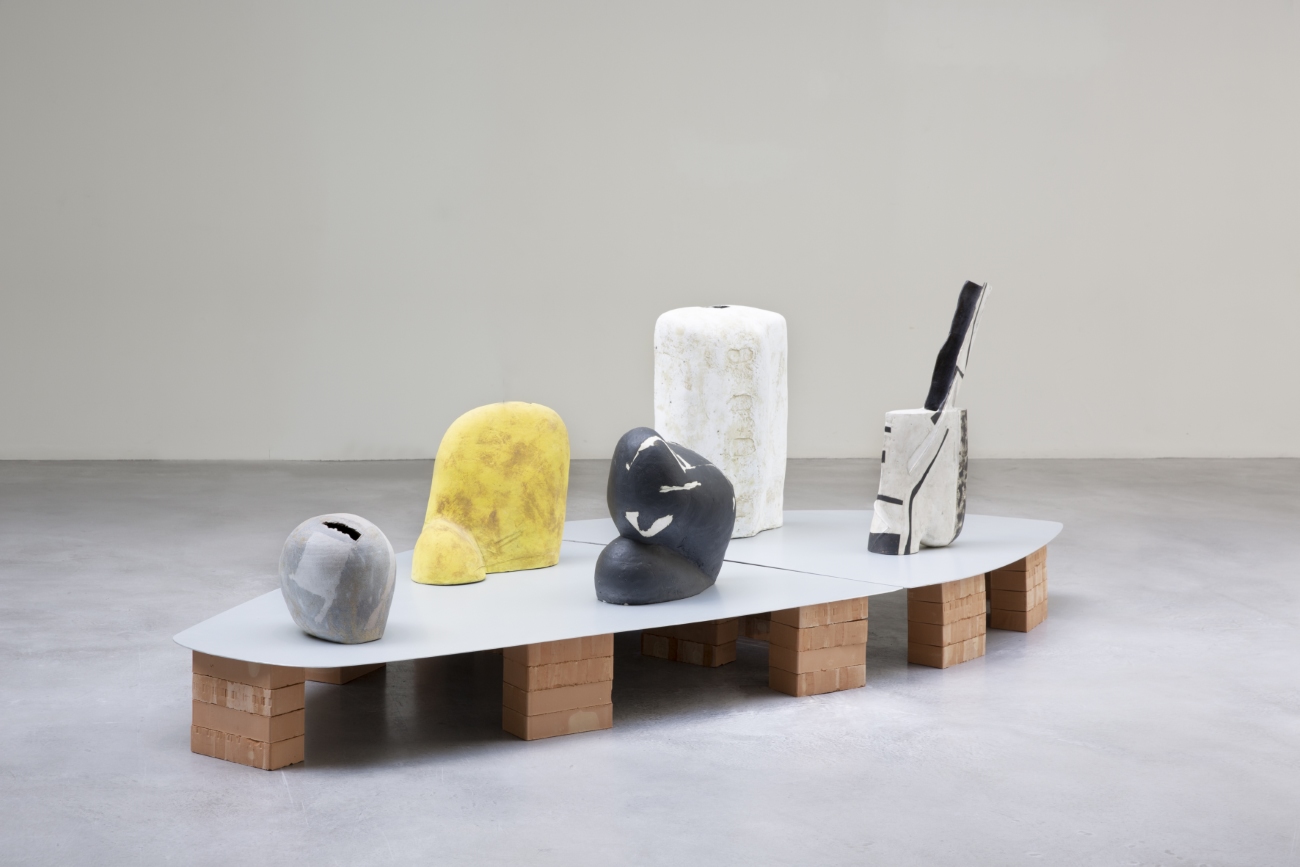
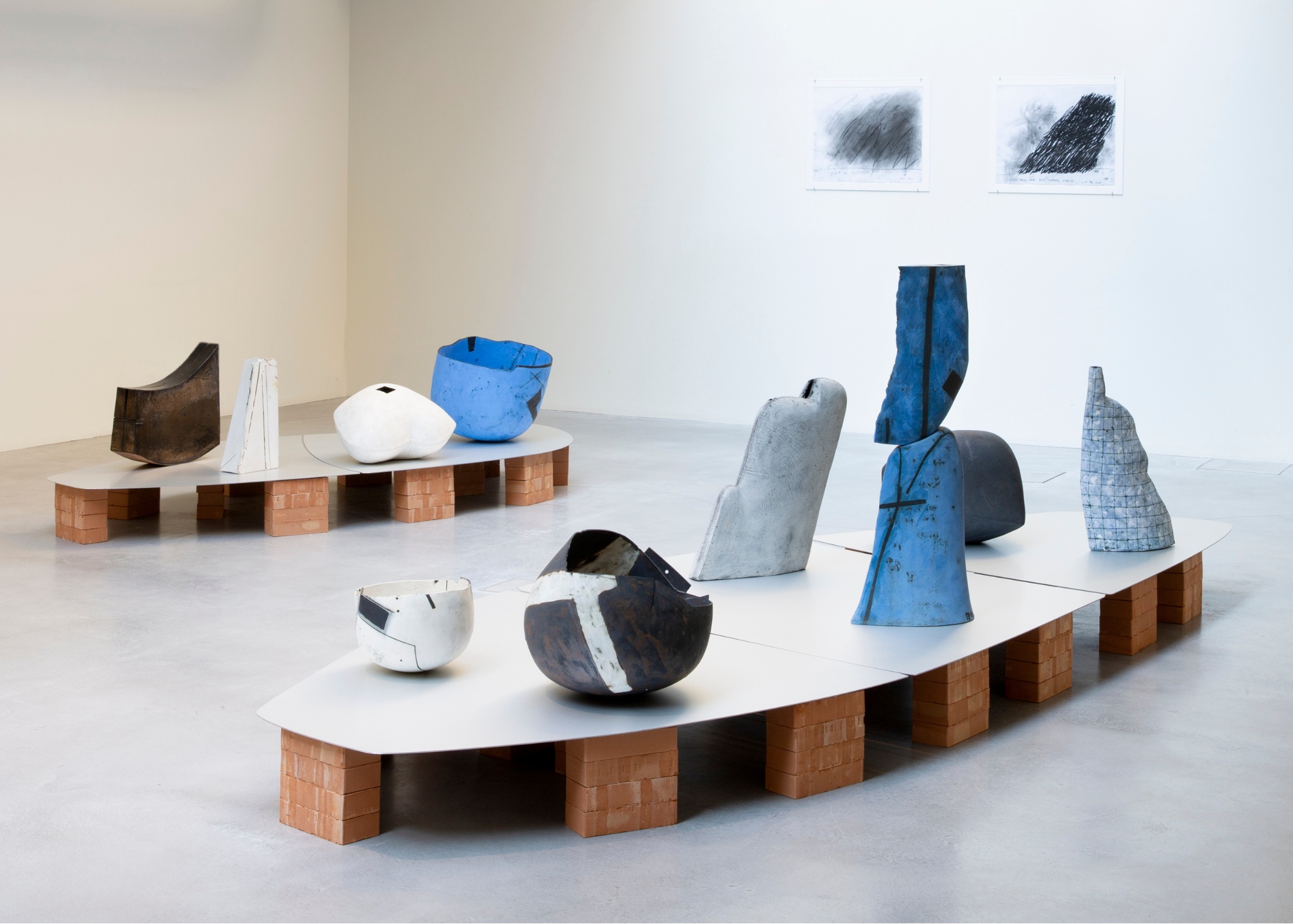
Nature plays a central role in this dialogue between poetry and form: Baldwin’s early writings often evoke the sea, wind, rocks, and coastal landscapes. These elements later return in his sculptures through smooth shapes, textured surfaces that recall worn stone, or dark glazes that suggest volcanic cliffs. The landscape becomes both a real and symbolic starting point, a place where the outer world meets inner reflection. It is no coincidence that the context of the United Kingdom, where Baldwin lived and worked throughout his life, plays a decisive role in his research. Among the most significant places is a beach in North Wales, renamed by him The Place of Stones, discovered almost by chance but destined to become a pivotal point of his creative vision: the rocks, of murky and sinuous forms and large dimensions, serve as mirrors for the creation of various shapes; the dark, volcanic color of the cliffs inspired his important exploration of black glazes, whose shiny or matte finishes create different effects, making the works look as if they were made from different materials.
Baldwin’s works, particularly those with more rounded shapes, were usually made by hand first and then further shaped with molds. The firing process was often repeated many times, as he fired the piece and then added new layers of glaze or pigment, and put it back in the kiln, repeating this until he achieved the material and visual qualities he wanted. Central to this methodology is the concept of inscape, coined by the poet Gerard Manley Hopkins and adopted by Baldwin as a conceptual pillar. Defined by the Oxford English Dictionary as “the unique inner nature or essence of a person, place, or thing”, the inscape describes how inner essence manifests outwardly in a tangible form. Baldwin’s works, whether sculptural or written, can be seen as physical manifestations of inner landscapes: containers for what is most intimate, complex and irreducible.
Every surface of the sculptures bears traces of his creative process: rather than smooth or polished, they keep incisions, cuts, faint lines that testify to their making. These marks record the artist’s total abandonment of functionality in his objects. From the late 1950s onward, Baldwin moved decisively away from functional pottery toward an approach that embraced an art-oriented gaze. His artistic formation took place during a period of significant transformation in British sculpture. In the early 1950s, Herbert Read described a new generation of postwar sculptors under the label Geometry of Fear, identifying works distinguished by tension, fragmentation and existential unease. Teachers such as Eduardo Paolozzi and William Turnbull exposed Baldwin to this environment, which encouraged him to see ceramics not as a separate craft tradition but as a medium capable of engaging directly with contemporary sculptural concerns.
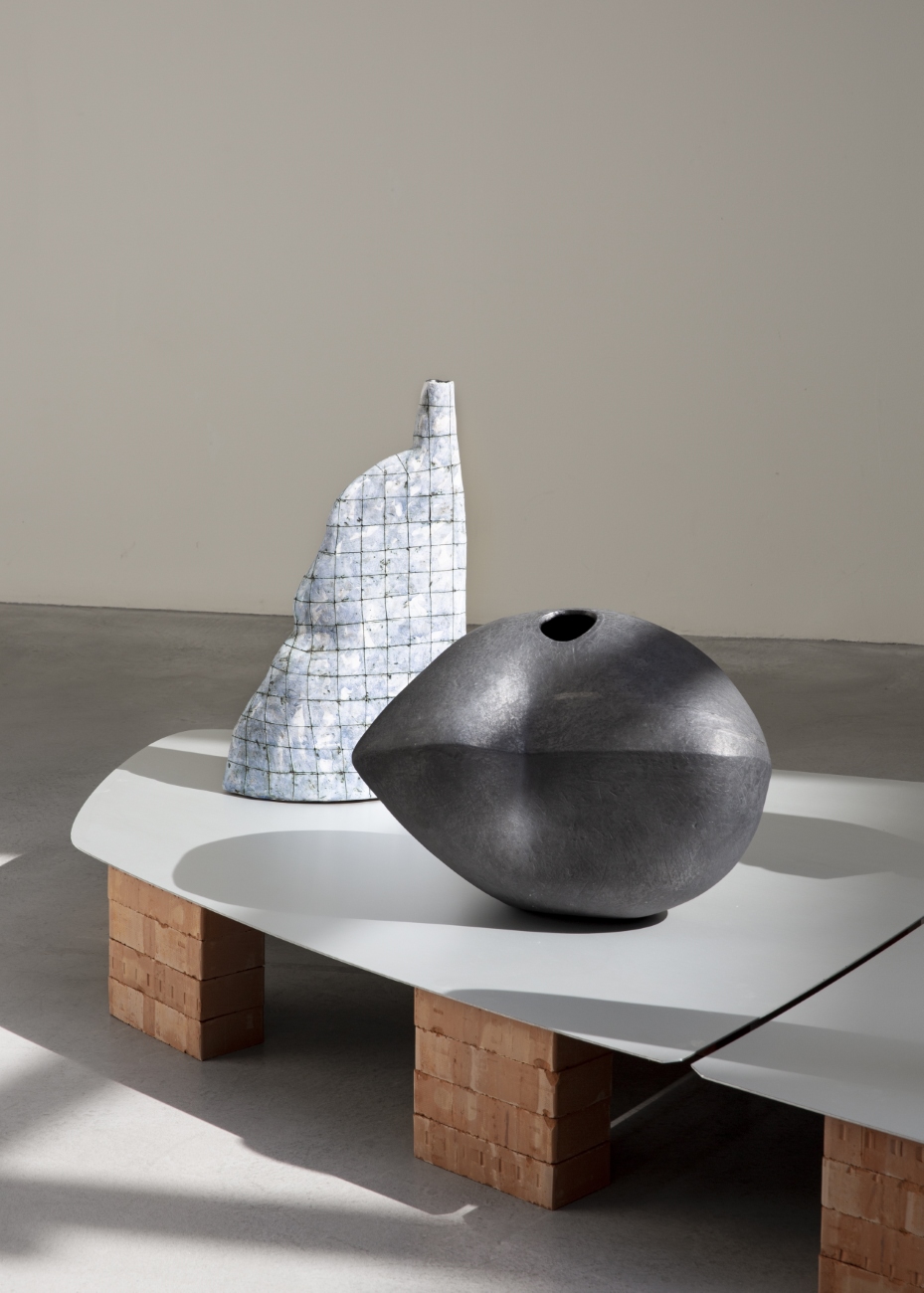
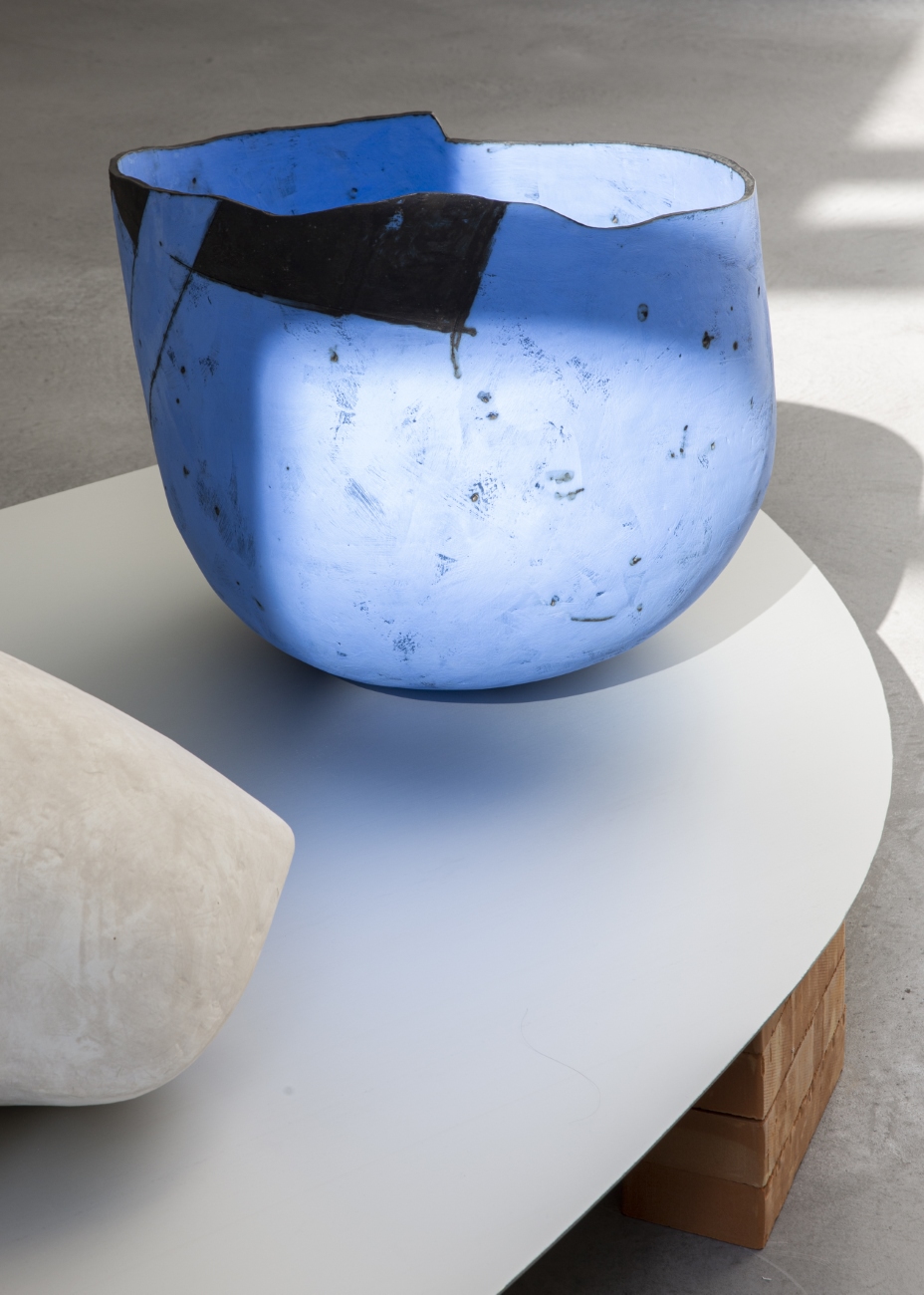
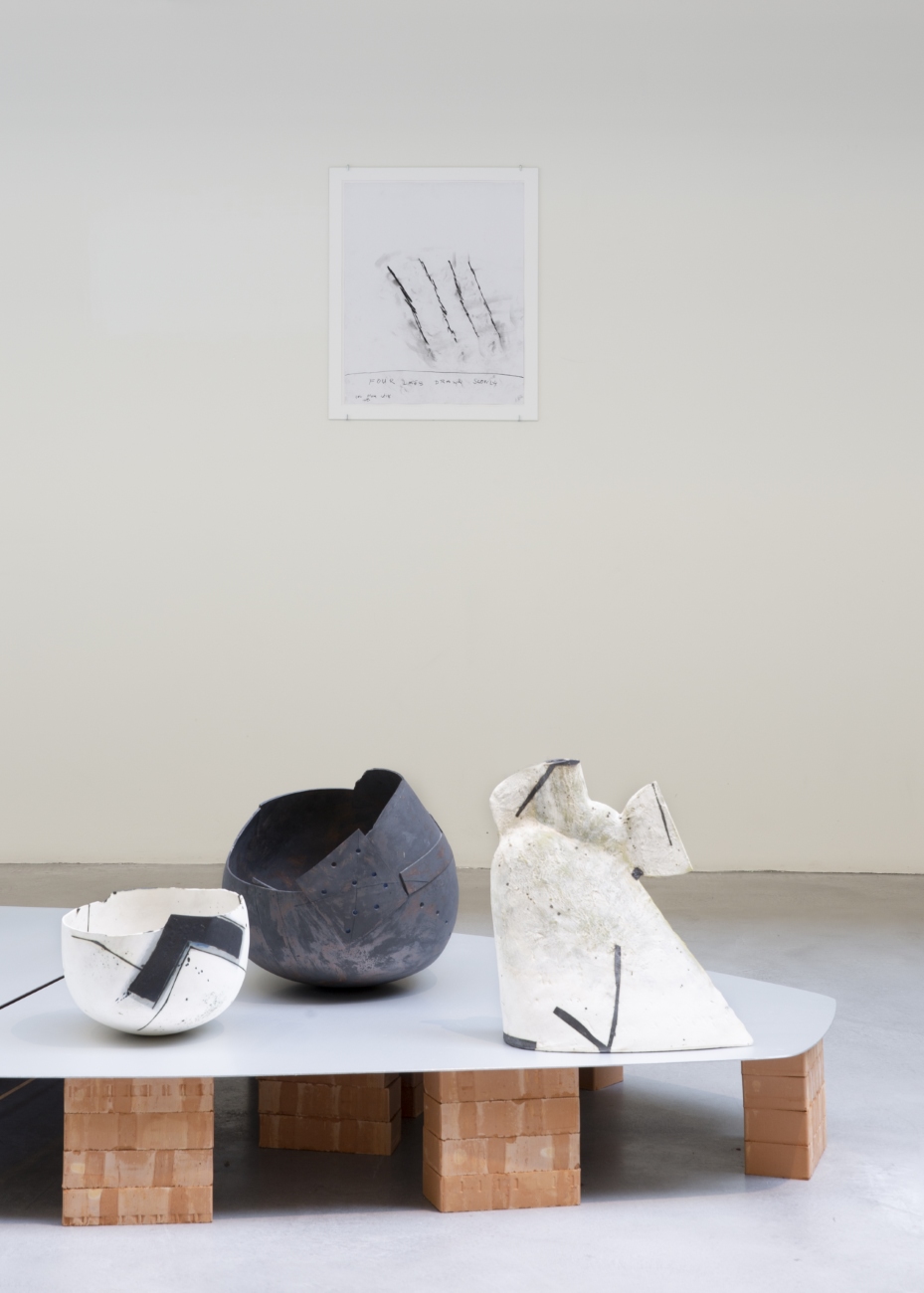
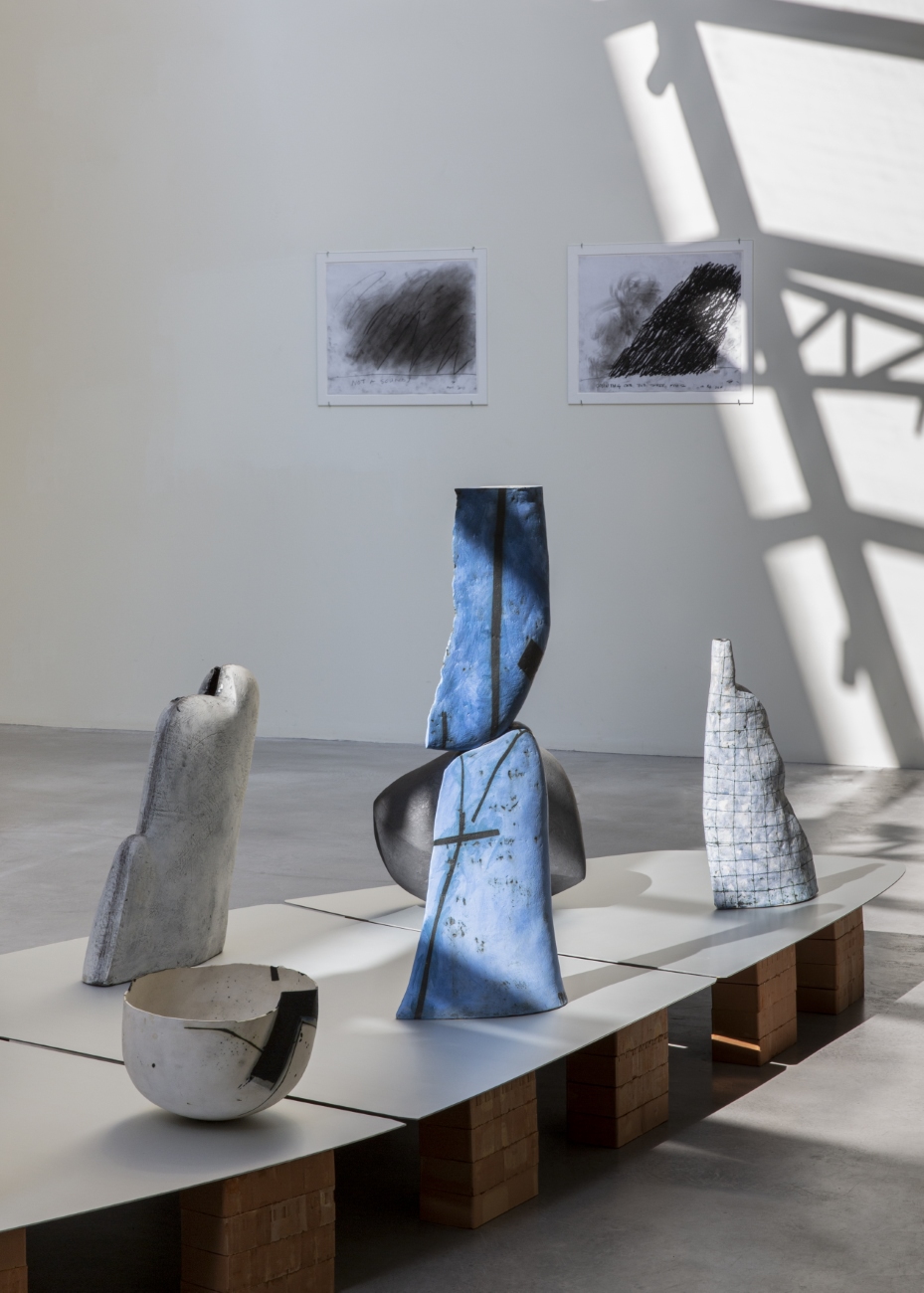
Among the works on display, Tall Standing Form, signed and dated 1985, exemplifies these influences with particular efficiency: with its vertical tension and deep blue glaze, the work assumes an anthropomorphic presence, almost recalling a totem. The work Developed Bottle (1989), part of a series begun in the 1960s, engages explicitly with Umberto Boccioni’s Sviluppo di una bottiglia nello spazio (1912). While Boccioni’s Futurist object dissolves into the surrounding environment through its dynamism, Baldwin’s interpretation keeps a clarity of outline, maintaining the vessel as a self-contained yet expressive form. Several works belong to the series Painting in a Form of a Bowl, began in the 1980s, where Baldwin further explores the boundary between ceramics and painting. Here, the vessel becomes a support for marks, colours and gestures, blurring distinctions between the two media and reinforcing the harmony between surface and structure.
In Little Hard Clouds Becoming Vessels, the sculptures engage in dialogue with a group of charcoal drawings on paper. The graphic production, although often preparatory, always joined his creative path, eventually becoming his main expressive language in later years as his eyesight deteriorated, leading him to abandon ceramics and continue creating by drawing. The drawings are distinguished by abstract creations composed of pencil lines, material gestures and shades made with fingertips. Brief verbal notes accompany most drawings like marginal annotations to the visual composition.
The charcoal drawings reveal a close connection between the artist and contemporary music: word, action and musical rhythm enter perfect harmony; the rhythmic graphite gesture creates a visual musicality made of signs and words that follow each other like improvised scores. His final phase of research echoes the silent melodies of John Cage (as in the celebrated piece 4’33’’), and the minimalism of Philip Glass and Terry Riley was a major source of inspiration.
Not a Sound (2017) shows this contrast: the silence suggested by the words coexists with a rhythmic and almost musical gesturality. Again, in Counting One Two Three (2016), the act of counting introduces a temporal sequence similar to rhythm, and the fingerprints, though they may seem casual, reveal a musical structure.
With the loss of one of the most important senses for an artist, sound and gesture became in his final years the privileged expressive channels, allowing suspension and silence to become active spaces of emotional and conceptual resonance, places in which meaning settles and amplifies.
Alessandra Lami is an independent art historian based in Milan, Italy, with a specialisation in contemporary art. Holding a degree in History and Criticism of Art from Università degli Studi di Milano (2024), her research centres on current artistic practices and the critical frameworks that inform today’s visual culture.
Gordon Baldwin: Little hard clouds becoming vessels was on view at Officine Saffi, Milan, between October 3 and December 3, 2025.
Subscribe to Ceramics Now to read similar articles, essays, reviews and critical reflections on contemporary ceramics. Subscriptions enable us to feature a wider range of voices, perspectives, and expertise within the ceramics community.
Captions
- Gordon Baldwin. Little hard clouds becoming vessels, installation view at Fondazione Officine Saffi. Courtesy Fondazione Officine Saffi. Photo: Alessandra Vinci