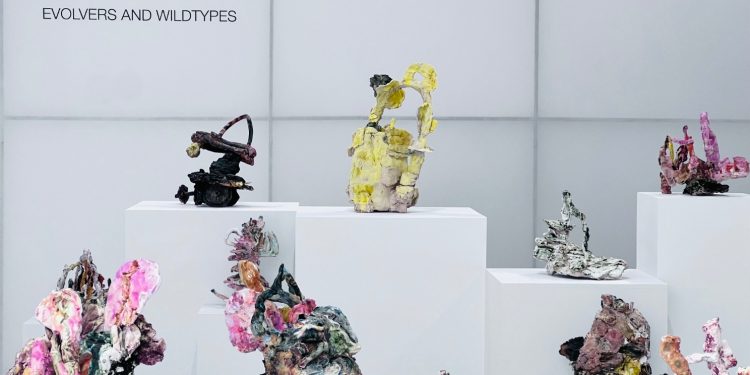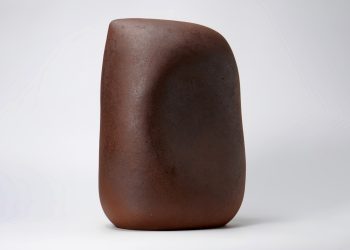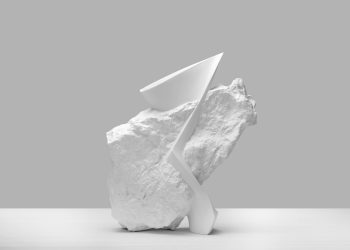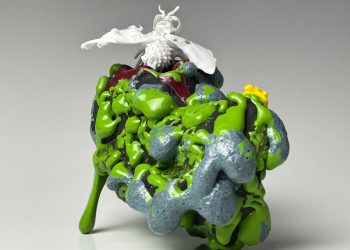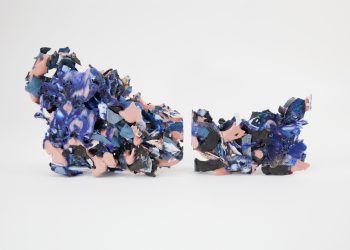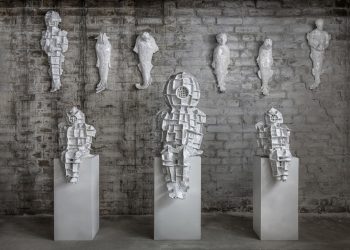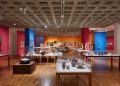

New York-based scholars and gallerists Garth Clark and Mark Del Vecchio have been leaders in the ceramics field for three decades, assembling one of the most important private collections of contemporary ceramics in the world. In 2007, the MFAH acquired the Garth Clark and Mark Del Vecchio Collection of some 475 artworks, as well as the accompanying library and artist archive.
Shifting Paradigms presents nearly 160 objects—ceramics and works on paper—from this richly diverse collection, which includes major international figures such as Kenjiro Kawai, Jean-Pierre Laroque, Adrian Saxe, Peter Voulkos, and Beatrice Wood, many of whom are represented in depth, as well as examples by Anthony Caro, Lucio Fontana, Claes Oldenburg, and Grayson Perry.
The exhibition is accompanied by an illustrated catalogue, copublished by the MFAH and Yale University Press.
Generous funding is provided by:
Sara and Bill Morgan
Friends of Contemporary Ceramics
Michael W. Dale
The Schissler Foundation
The Susan Vaughan Foundation
Supporters of Garth Clark and Mark Del Vecchio
The Shartle Symposium is also presented in conjunction with the exhibition Shifting Paradigms in Contemporary Ceramics: The Garth Clark and Mark Del Vecchio Collection.

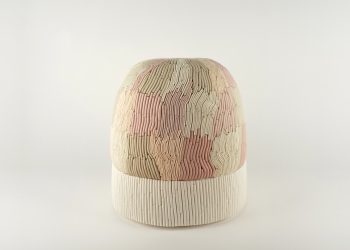
“Everyone, even animals and plants, accustoms to new environments and new circumstances as time goes by. In order to understand and get used to a new environment, one only needs time. My previous work was about figuring out my identity, understanding different cultures and establishing myself in new environments (the transition from Korea to America). I am now in a constant process of adjusting new situations as a female artist, a wife and further more - as a mom. I want to present my Korean cultural background through new objects that illustrate the natural and architectural landscape.” Hae-Jung Lee
Korean born Haejung Lee received her first Master of Fine Art concentrating on ceramics at Kyung Hee University in South Korea in 2002 and a second master’s degree in ceramics at Louisiana State University in 2008. She has been an Artist-in-residence at The Banff Centre in Canada and at Guldagergård-International Ceramic Research Center in Denmark in 2003 and 2004. She presents her work internationally and has been awarded several remarkable prizes such as best of show, award of distinction, silver prize as well as others in both Korea and USA. In summer 2009 she participated in the 5th World Ceramic Biannual Show Korea (CEBIKO) and directed the exhibition “Affinity” which also included many American ceramic artists.

Presented in conjunction with the exhibition Shifting Paradigms in Contemporary Ceramics: The Garth Clark and Mark Del Vecchio Collection.
Welcome and Opening Remarks
- Cindi Strauss, MFAH assistant director, programming; curator, modern and contemporary decorative arts and design; organizing curator of the exhibition
Sealed Capsule
- Garth Clark, scholar, gallerist, and collector
Is the 20th-century ceramics movement over? In the 21st century, is ceramics a fully accepted fine-arts material but no longer an autonomous discipline? If so, is this a good thing? Garth Clark examines a turning point in this millennia-old medium.
On Conscripting Mugs and Other Ceramics into Life’s Battles for Independence
- Ezra Shales, associate professor of art history, New York State College of Ceramics at Alfred University
In the field of ceramics, a distinction is often made between “functional” objects and “art” objects—a binary opposition that is both reductive and misleading. Ezra Shales critiques the validity of the term “functional” and investigates how drinking vessels remain key tools in the assertion of one’s identity.
The Well-Wrought Urn
- Jenni Sorkin, assistant professor, contemporary art and critical studies, School of Art, University of Houston
This talk reconsiders Garth Clark’s groundbreaking exhibition American Ceramics, 1876 to the Present against the backdrop of mid-20th-century formalism, in particular Cleanth Brooks’s The Well-Wrought Urn (1947), Herbert Read’s criticism on modern sculpture, and the Syracuse Annuals exhibition series.
From Postmodernism to Postindustrialism
- Jorunn Veiteberg, professor of curatorial studies and craft theory, Bergen National Academy of the Arts, Norway
A re-evaluation of the decorative and a reuse of historical forms were central to ceramics in the 1980s, the key decade of Postmodernism. But what has happened since? Are contemporary ceramics still Postmodern, or have new paradigmatic shifts taken place?
Panel Discussion
- Mark Del Vecchio joins the speakers. Moderated by Cindi Strauss.
Reception
- The audience is invited to a wine reception with the speakers in the lobby of the Beck Building, and to view the exhibition.
This event is open to the public. Seating is limited. Free with general museum admission. MFAH Members always receive free general admission.
Bogdan Teodorescu’s profile on Ceramics Now Magazine - View his works
“It seems like I’m always trapped in a style beyond a heterogeneous appearance of my work. It isn’t bad advertising, but if you really want to feel a connection with my works, you need to be patient and to look closely to more than twenty images. And perhaps contrary to my statement, my style wouldn’t be so difficult understand. Everywhere there is a sort of a struggle between fantasy and at least one kind of realism. I also admit that the manner is as important as the idea itself. Some say that the substance of a style is nowadays just a literary, philosophical concern - mostly when it has something to do with the more popular social involvement. I think that someone’s style doesn’t have to be interconnected with anything social and one can always choose to seek for inspiration in its inner self.
As far as I can say at this moment, my experience with ceramics has two aspects (or constraints). First is the period of apprenticeship, which numbers the last year of my high-school and the years in the University of Arts and Design in Cluj. The other one is my collaboration with Wagner Porcelains. If high-school was rather a period of independence - ceramics was a very late decision. The academic years were a continuous fight with a conservatory approach and, sometimes more frustrating, with the lack of technical possibilities. With Wagner, the limitations went only in the commercial direction. Despite all of this, I totally agree with (some) constraints, which can provide a wide range of surprising solutions.
My porcelain works have a high decorative touch, more in the sense of fashion with all its aspects. Collages and technical varieties are also present in my work, replacing the limitation of the material. With Wagner I only work with white porcelain, though adding my pictures. I am not trying to follow any precise trend, nor Romanian or International; I am only constantly paying attention to everything interesting and meaningful around me.” Bogdan Teodorescu
Bogdan Teodorescu: Folkloric Hypnosis, 2011, decal and painted porcelain, diam c. 20 cm
Bogdan Teodorescu: Pizza François, 2011, decal and painted porcelain, diam c. 25 cm
Bogdan Teodorescu: Pizza François, 2011, detail
Bogdan Teodorescu: Pizza François, 2011, alternative view
Bogdan Teodorescu: Plate, 2010, decal and painted porcelain, c. 25 x 25 x 5 cm
Bogdan Teodorescu: Plate, 2010, detail
Bogdan Teodorescu: The Portrait of Yo-Yo Ma (Do you Play Yo-Yo?), 2009, painted porcelain, c. 18 h
Bogdan Teodorescu: Cup & Plate, 2010, decal and painted porcelain, var. dim.
Bogdan Teodorescu: Plate, 2011, decal and painted porcelain, diam. c. 25 cm
Bogdan Teodorescu: Plate, 2011, detail
Bogdan Teodorescu: Jar, 2011, decal and painted porcelain, c. 16 cm h

A Tale of Two Baghdads / Cairo Undone
Eloquent and prescient. Graceful and gripping. His death on Thursday, from an...
The Tate Modern has just opened it’s newest exhibit of the work of Yayoi Kusama. From found object art to vivid flickering light installations,...
“Twist” by Aakash Nihalani
Trash bag sculptures by Khalil Chishtee