


Magazine
Ceramic artists list
> Ceramic artists list 97. Ryan Blackwell 96. Ellen Schön 95. Francesco Ardini 94. David Gallagher 93. Elizabeth Shriver 92. Jason Hackett 91. Patricia Sannit 90. Bente Skjøttgaard 89. Steve Belz 88. Ruth Power 87. Jenni Ward 86. Liliana Folta 85. Kira O'Brien 84. Annie Woodford 83. Kwok-Pong Bobby Tso 82. Bogdan Teodorescu 81. Kimberly Cook 80. Paula Bellacera 79. Debra Fleury 78. Cindy Billingsley 77. David Gilbaugh 76. Teresa & Helena Jané 75. Marianne McGrath 74. Suzanne Stumpf 73. Deborah Britt 72. Kathy Pallie 71. Els Wenselaers 70. Kjersti Lunde 69. Brian Kakas 68. Marie T. Hermann 67. Mark Goudy 66. Susan Meyer 65. Simcha Even-Chen 64. Barbara Fehrs 63. Shamai Gibsh 62. Natalia Dias 61. Bethany Krull 60. Amanda Simmons 59. Arthur Gonzalez 58. Chris Riccardo 57. Akiko Hirai W 56. Johannes Nagel 55. Rika Herbst 54. Liza Riddle 53. Chang Hyun Bang 52. Virginie Besengez 51. Jasmin Rowlandson 50. Chris Wight 49. Wim Borst 48. Rafael Peréz 47. Guðný Hafsteinsdóttir 46. Cathy Coëz 45. Merete Rasmussen 44. Carol Gouthro 43. JoAnn Axford 42. David Carlsson 41. Margrieta Jeltema 40. David Roberts 39. Patrick Colhoun 38. Abigail Simpson 37. Signe Schjøth 36. Katharine Morling 35. Dryden Wells 34. Antonella Cimatti 33. Cynthia Lahti 32. Carole Epp 31. Blaine Avery 30. Ian Shelly 29. Jim Kraft 28. Wesley Anderegg 27. Connie Norman 26. Arlene Shechet 25. Young Mi Kim 24. Jason Walker 23. Peter Meanley 22. Shane Porter 21. Jennifer McCurdy 20. Yoichiro Kamei 19. Debbie Quick 18. Ian F Thomas 17. John Shirley 16. Grayson Perry 15. Vivika & Otto Heino 14. Georges Jeanclos 13. Daniel Kavanagh 12. Nagae Shigekazu 11. Matthew Chambers 10. Tim Andrews 9. Claire Muckian 8. Adam Frew 7. Maciej Kasperski 6. Roxanne Jackson 5. Keith Schneider 4. Celeste Bouvier 3. Tim Scull 2. Kim Westad 1. Sara Paloma

Ceramics magazine

Brian Kakas

Brian Kakas Contemporary ceramic artist

Brian Kakas’ profile on Ceramics Now Magazine - View his works

Appropriate means of creatively adapting to continual changes have been expressed though practices of art, architecture, science and technology. In this new body of ceramic works, entitled “Tectonic Perceptions”, the intentions are incorporating methodologies and theories from the mentioned practices to create a “new nature” in structural design for ceramic objects. The pieces seek to celebrate the versatility of clay with an aim of fostering new realizations of architectural space. Travels throughout Asia and an array of rich cultural experiences in China have brought about new realizations within the artist’s mind and perceptions of cultural identity, history and space.

These relationships have allowed the artist to explore relationships between the strong elements of tradition and modern identities rapidly evolving around the world. Explorations of these interrelationships and the intentions of the maker and his material have led to the new structural ceramic designs. Through his aspired process of invention, it is the artist’s intent to find a natural form by staying true to chosen materials and their inherent properties. The artist is in pursuit of finding and establishing a formal vocabulary that allows sculptural vessels to exhibit qualities of both unique and handcrafted objects of traditional cultures with that of machine made and mass-produced objects of our contemporary society.

Brian Kakas is an Assistant Professor of Ceramics at Northern Michigan University. He received his MFA in ceramics from The University of Notre Dame in 2007.

Read More

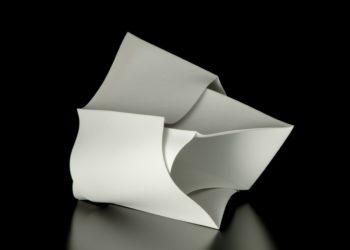
  • Brian Kakas: Dimensional Transitions Series #4, 2008
    White Stoneware, slab built, 44” H x 34”W x 37”L, Cone 7 Reduction

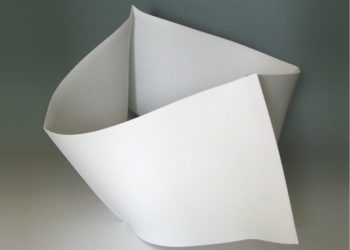
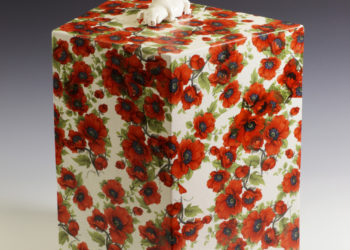
  • Brian Kakas: Tectonic Perceptions #4, 2010
    White stoneware, slab built, 32”H x 25”W x 23”L, Cone 9 Reduction

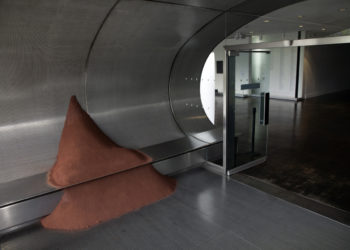
  • Brian Kakas: Architectonics – Nautilus Improv 2, alternative side view, 2011
    White stoneware, slab built, 26”L x 23”W x 33”H, Cone 04 Oxidation

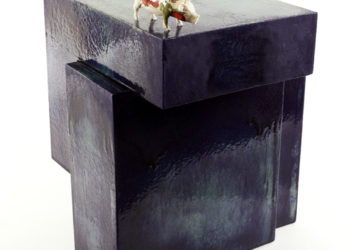
  • Brian Kakas: Architectonics – Improv 2, 2011
    White stoneware, slab built, 21”L x 13”W x 8”H, Cone 04 Oxidation

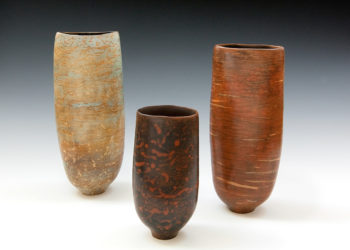
  • Marie T. Hermann: Liminal #2,  Stoneware and thread, 2011. 18 x 13 x 4 in.

  • Marie T. Hermann: Shades of days #B, 2011. Ceramic and thread. 18 x 12 x 7 in.

  • Marie T. Hermann: You are my weather #A, 2011. Stoneware. 18, x 7,3 x 7 in.

  • Interview with Arthur Gonzalez, Front-cover of Issue One and Artist of the month - October 2011

    Interview with Arthur Gonzalez, front-cover of Ceramics Now Magazine - Issue One
    Artist of the month, October 2011

    → Subscribe to our monthly newsletter if you want to receive news and interviews with ceramic artists.
    → The full interview with Arthur Gonzalez is featured in Ceramics Now Magazine - Issue One / Winter 2011-2012.

    Ceramics Now Magazine
    : You are one of the most assiduous ceramic artists in the world, with hundreds of exhibitions over more than thirty years. Why did you choose this career path?

    Arthur Gonzalez: If by career path you mean, “why did I choose to be an artist?” I was one of those guys who always knew that they wanted to be an artist. I honestly cannot remember a time that I did not draw. I remember drawing in kindergarten. I took my first oil painting class with my mother at age 7. I identified with being an artist my whole life so the path was “written on the wall” so to speak. Also, times were different thirty years ago when I graduated from UC Davis. The word “career” was subject to interpretation. I remember that all I wanted to do once I graduated was to do whatever I needed to do to keep making art without needing to work a “regular” job. This was a huge factor, because if one wants to make art their whole life they need to be creative in terms of how to do that. As a consequence, I learned how to make a career instead of only making a lot of things.

    Arthur Gonzalez Contemporary Ceramics - Interview Ceramics Now MagazineEverything, 2007, ceramic, glaze, rope, blown glass, ink, epoxy, gold leaf, gut, pollen, 40”x42”x12 - View Arthur Gonzalez’s works

    When did you realize that ceramic art was important for you?

    My relationship with ceramics has always been a double-edged sword, because I originally didn’t identify with ceramics or sculpture. In the beginning, I used clay to make a better painting!

    My formal undergraduate art education at American River College in Sacramento and later California State University was as a photo-realist painter, this was the art movement of the time and all my teachers were photo-realists. I, although formally trained with all the exactitude and precision of a realist, was extremely frustrated. I wanted my paintings to be more expressionistic, spontaneous and “rule breaking”, but the training and dictum of “painting the right way” was so hardwired that I needed to change the very physicality of the painting’s object-ness. I realized that when addressing the white geometric canvas, specifically when the paintbrush approached the edge of the canvas, my gestures would be stilted and choked. I was too intimidated by its rigidity. I remember thinking that if I was too influenced by the edge, then I needed to change that edge.

    Meanwhile, at California State University, at the opposite side of campus from the painting lab, was the ceramic department. Two of the professors there were Peter Vandenberge and Robert Brady, both were UC Davis alumni and former students of Robert Arneson. It was by watching them make their clay sculpture and witnessing the ways that they both treated the clay as a mud that did their bidding, that first attracted me to it. This was an epiphanous moment. I remember thinking that clay was the perfect replacement for canvas on stretcher bars. Upon returning to my studio, I slung a number of clay slabs and stretched them on the floor and then fired them, resulting in “bisque canvases” of non-geometric shapes, like a stack of so many pancakes. Then, using oil paint, I reacted to the silhouette of the shape by painting-in imagery that would co-relate to the swells and dips of the randomly shaped ceramic slabs. In my eyes, clay was a remedy not a historical material.  Ironically, I later dispassionately applied to graduate school at UC Davis to study ceramics sculpture under Robert Arneson knowing that I was competing against real ceramic artists who knew more about clay than slinging slabs, which literally was all I knew! It was those first experiments with oil paintings on ceramic slabs that got me into graduate school. My education of clay as a material didn’t start until my time with Robert Arneson. The one thing that I loved about clay was how I now could make things that could distance me from the confines of oil on canvas and, as a result, lifting the weight of the ‘History of Painting’ off my shoulders. When I thought of ceramics, I didn’t see “History” or “Tradition” or “right and wrong”. In fact, I didn’t even think of it as “ceramics”, I thought of it as clay that you made hard. To me the material was only material, and because I came to it through the back door it represented to me to be absolute freedom, a kind of sanctuary from the rules of painting and, as a result, pure invention.

    Read More

  • Interview with Ian F. Thomas, Ceramic Installation - October 2011

    Interview with ceramic artist Ian F. Thomas - Ceramic Installation, October 2011

    → Subscribe to our monthly newsletter if you want to receive news and interviews with ceramic artists.
    → The full interview is featured in Ceramics Now Magazine - Issue One, Winter 2011-2012.

    Ceramics Now Magazine
    : You are a very creative artist, working with large scale installations, ceramic objects, sculptures, vessels and various drawings. When do you have time to transpose all your emotions and ideas into them?

    Ian F. Thomas: Thank you. I obsess about ideas. My methodology for making, for creating, has me developing many works at the same time, not just in the beginning phases, the thought process, but also during the construction phase. Mold making, throwing, painting, welding, drawing, functional, non-functional—everything that happens, it all develops simultaneously. I enjoy working right up to, and, sometimes, past my limit. I view making work on all of these different platforms, using different materials, and incorporating as many ideas as I can ideas in the same way that I see conversations. Each day I have vastly different types of conversations with many different people; from humorous to serious, political to chit chat and minutiae. When an idea surfaces, the process may demand a particular size, finish, or material. Following the concept and its needs supersedes the necessity of conforming to a particular style or material. 

    As a father of two, husband and professor, it is difficult to manage time. My wife, Lori, who is not an artist, has an amazing tolerance for the creatively obsessed mind. If it were not for her support, I would never find the time to work on so many projects. Working with clay, I can take advantage of the timing/drying constraints, and toggle between works, maximizing my available studio time. I have also recently taken on an assistant, Eli Blasko, to help better manage my time so that I can focus more in the studio.

    Ian F Thomas Contemporary Ceramic Installation Art

    Di-analytic Variables - View Ian F. Thomas’ works
    Wheel-thrown, altered, hand-built, earthenware, electric fired cone 02, steel, paint, gold leaf / 38x37x30 inches, 40 lbs

    How do you see this relationship between idea/intuition and the final work itself? Is it always continuous or sometimes gap comes through?

    The final work is an entity all of its own. An idea starts the work and then intuition supports that idea during the development of the piece. I keep true to a cautious respect for the moment. While I’m in the process of working, my intuition may shift the work’s original intentions, or trigger a new idea(s) that can rearrange the work while I’m still in the process of making it. My idea can fluctuate as much as the physical object I’m making. Using this method, gaps occurs naturally and when that happens, I embrace that.

    Read More

  • Interview with Antonella Cimatti, Spotlight - October 2011

    Interview with Italian ceramic artist Antonella Cimatti - Spotlight - Recognized artist, October 2011

    → Subscribe to our monthly newsletter if you want to receive news and interviews with ceramic artists.
    → The full interview with Antonella Cimatti is featured in Ceramics Now Magazine - Issue One / Winter 2011-2012.

    Ceramics Now Magazine
    : You are a very consequent artist, having worked with ceramics all your career. Why did you embark on this journey?

    Antonella Cimatti: I was born in Faenza, I studied in Faenza at the “Ballardini” Art Institute and I have been teaching at this same school for over 30 years. It has just been so natural to work with this material in this city, because it’s so well known throughout the world for its ceramics.

    The techniques and subjects you are approaching are very different - paperclay, fibre optic installations and low temperature. Working with so many different materials may be difficult, how do you manage to combine them?

    Well, I come from Italy, a country where the artists feel the weight of our history and ceramic traditions, but where there are also many new influences from the world of design and fashion!

    In fact, in the last few years, in the design and fashion sectors there has been a notable trend regarding lightness and attention to detail, which is so incredibly in line with my way of being and working.

    I believe that the greatest undertaking of the artist is that of professional maintenance. As a matter of fact, along with spontaneous creativity, you indissolubly must add an elevated professional competence regarding technique; through reading and observation, the joy of experimentation, of combining, and of moving forward.

    Antonella Cimatti Contemporary Ceramics

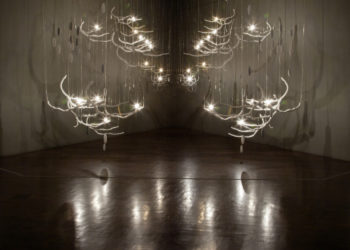
    Trame di luce (Weft of Light), detail, 2008 - View Antonella Cimatti’s works
    Installation with translucent porcelain paperclay, fibre optics and handbuilt  flowers in glazed porcelain, temp. 1250°C.
    Exhibited at the 54th International Art Exhibition at the Venice Biennial, in the Italian Pavilion, for the Emilia Romagna Region. Photographed by Bernardo Ricci

    Your attention to detail makes your paperclay works unique and pure within their shadows. Tell us about the constructing process.

    I’ll tell you how you can, while having an idea in mind, transform and tame my technique. 
    My way of working is not traditional. My objective is to create a lightness in ceramics- not only regarding weight but also visually. I need to discover the right combination of materials in order to obtain the results you see.

    Read More

  • ©2013 Ceramics Now. All Rights Reserved. Website by Thomas Cullen. Powered by Tumblr.