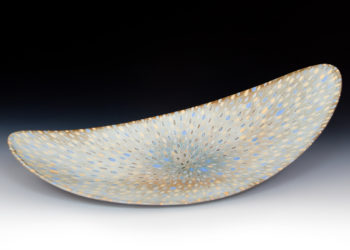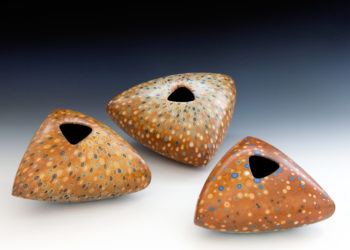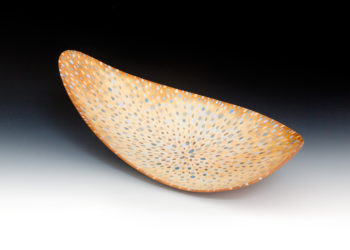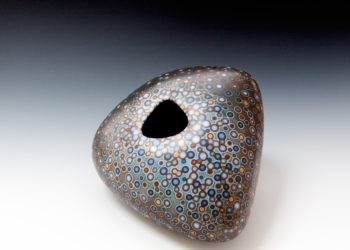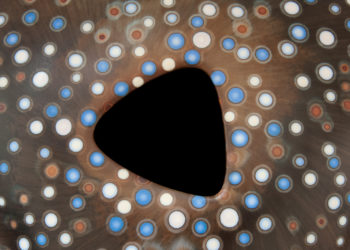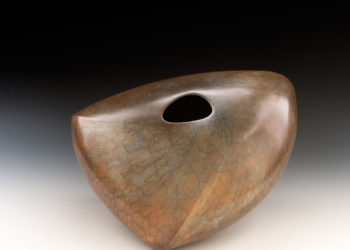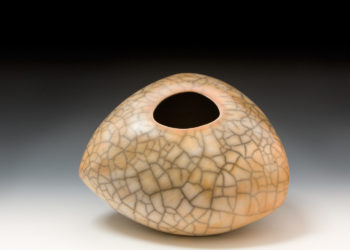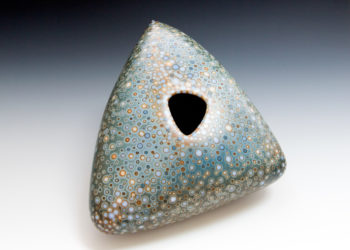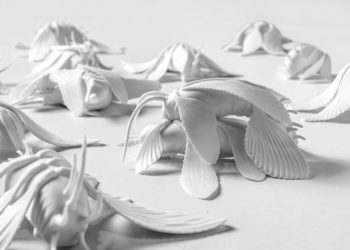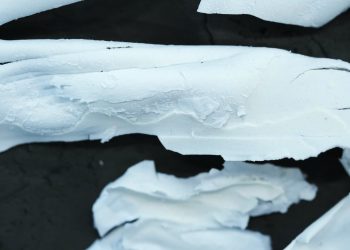
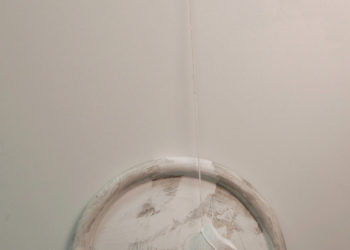


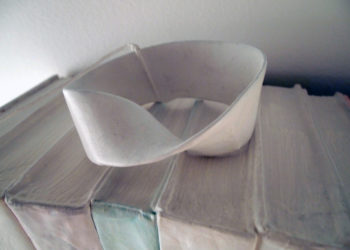
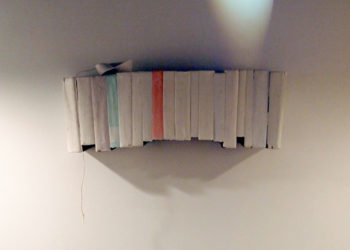
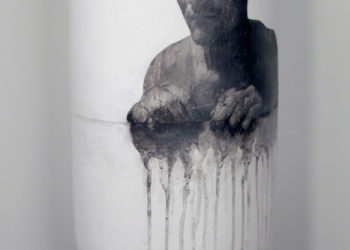
Jason Hackett: Pollinator, 2012, Ceramic, 9” x 9” x 3”
Contemporary Art
Summer Exhibition 2012 / Erskine Hall & Coe Gallery, London

Summer Exhibition 2012 / Erskine Hall & Coe Gallery, London, UK
25 July - 30 August, 2012
Artists: Sebastian Blackie, Claudi Casanovas, Peter Collingwood, Tanya Gomez, Matthew Harris, Deirdre Hawthorne, Steven Heinemann, Shozo Michikawa, Gustavo Pérez, Tim Rowan, Anna Vannotti
Erskine, Hall & Coe specialise in 20th Century and Contemporary ceramics. The gallery is in central Mayfair, off Bond Street, at 15 Royal Arcade.
The gallery carries an extensive stock of ceramics, often including works by, Lucie Rie and Hans Coper, Jennifer Lee, Gwyn Hanssen Pigott, Shozo Michikawa and Sara Flynn. Its ten annual exhibitions feature the work of British and international artists, in some cases exploring the interplay between ceramics, sculptures and paintings.
Gallery Hours: Monday - Friday: 10 am - 6 pm, Saturday: 10 am - 6 pm (during exhibitions only).
Wouter Dam exhibition / Galerie NeC, Hong Kong

Wouter Dam exhibition / Galerie NeC, Hong Kong
28 June - 18 August, 2012
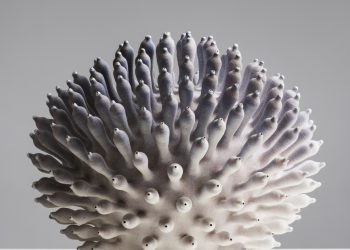
“The ceramic sculptures I make, do steadily develop along a clear line, this last group of sculptures here on show are slightly larger and with more unbroken circles incorporated into the sculpture, in this way slowly revealing more of its origins, the vase and bowl shape.
The sculptures are closed and curled on to itself and in this way, keeping more of it’s secret, enticing you to explore the almost hidden inside of the sculpture.
They are covered with a coloured engobe, the latest colours I have introduced are the soft pink, a light porcelain blue, and a grey tone. All these colours are specifically chosen to enhance the shape and to give a good contrast in between light and shade.
The sculptures are built up of elements made on the potterswheel, assembled when leatherhard, every one of them becoming a unique sculpture, although clearly belonging to the same family of shapes.
The sculptures are like drawing lines in space, making the clay seem weightless. The edges are refined and cut through the air in contrast to the soft voluminous exterior surfaces that bask in the light.” Wouter Dam, 2012
Gallery Hours: Monday to Saturday, 11 am - 8 pm. Sunday 1 pm - 6 pm.
Interview with Kimberly Cook - Artist of the month, May 2012
ARTIST OF THE MONTH, May 2012: Kimberly Cook
/ Read the full interview in Ceramics Now - Issue Two
Ceramics Now Magazine: Do you remember your first encounter with ceramics? What made you choose this particular way of expressing yourself?
Kimberly Cook: My first encounter with ceramics was when I was a child. During my family’s summer holiday, my parents would take my sister and I on a very long drive from Texas to Ohio, to visit my father’s family. I remember being so excited when we arrived in Ohio, because it meant that I was going to be able to visit my aunt Coby’s ceramic studio. She had an incredible ceramic studio set up in her basement, where she taught workshops. I remember loving the smell of the wet clay, being surrounded by an endless array of colorful glazes, china paints, gold, silver, and pearl lusters, and tools that enabled her students to create anything they wanted out of this wondrous natural material that was easy to form and smelled sweetly of the earth. I was enthralled with the medium, and wanted to learn the techniques of creating both my own sculptural and functional forms.
Another vivid childhood memory of being exposed to ceramics was seeing the traveling King Tut exhibit. I was drawn to the ceramic Bes deity pots and their use in the home as a protector of women and children. For the first time, even in mynaiveté, I realized that there could exist a “conceptual” aspect to creating these forms. What also intrigued me were the marl ceramics of the second Naqada period, which were decorated with reddish-brown drawings that developed from the early geometric forms to less abstract images. Among some of my favorite are those that depicted oared boats transporting what has been interpreted as deities, and the decorations that included people and animals.
Working in clay has become a cathartic way of expressing myself, and because of this, I will never stop using it as my primary mode of self-expression. From these early childhood memories and tangible encounters, I found a palpable love of ceramic materials, which sustain me to this day.
[…]
Trophy, 2011, Ceramic, mason stain, gold luster, 35” x 23” x 20” - View her works
Your works are figurative and often have a narrative quality. But trying to convey a certain message without using words can be difficult for an artist. Do you sometimes fear that people will fail to understand the meaning of your works? How outspoken should a work of art be?
I use to be concerned that viewers would fail to understand my work, but not anymore. After your work has been censored and removed from a gallery, you start to understand that that is actually a compliment. You have struck a nerve; a message got across to a viewer, understood or misunderstood, doesn’t matter. What created that shift in thought for me was the fact that I realized that everyone is going to have their own experience viewing my work, their own perception, and their own opinions. I am okay with that – to me that is what good art is about. If it moves someone, great; if it disturbs someone, great – I want my work to encourage people to go inside of themselves and ponder and reflect before reaching any hard and fast conclusions.
[…]
Ehren Tool: Production or Destruction / Craft and Folk Art Museum, Los Angeles

Ehren Tool: Production or Destruction / Craft and Folk Art Museum, Los Angeles, USA
May 27 – September 9, 2012
Former Marine and ceramist Ehren Tool exhibits war awareness work at CAFAM.
Opening reception: Saturday, May 26, 6 – 9 pm.
“The best way to destroy your enemy is to make him your friend.” – Abraham Lincoln
Coinciding with Memorial Day, the Craft and Folk Art Museum (CAFAM) presents Ehren Tool: Production or Destruction, a solo exhibition of ceramist and former Marine, Ehren Tool. Emblazoned with the haunting imagery of armed conflict, Tool creates handmade ceramic cups as a medium to address war and the violent rhetoric and imagery used to perpetuate it. The exhibition will feature 1,000 handcrafted cups, video, installation, photographs, and printed materials.
Twenty years after his service in the first Gulf War, Tool’s firsthand contact with the reality of war is manifest in the thousands of cups he dutifully produces. The cups will be exhibited at CAFAM in “units” based on military formations of “squads” (13), “platoons” (55), and “companies” (225), serving as a visual reminder of each Marine within a military unit. Each cup is uniquely crafted, decorated with ceramic decals of soldiers’ photos, propaganda, war porn, and sculptural reliefs shaped like bombs, guns, or medals.
Recent events such as the Occupy movements and the incendiary language of current election campaigns figure strongly in his new work, as well as veteran suicides and stories of U.S. Marines desecrating bodies of the deceased. Other imagery alludes to the culpability of video games, toys, and pornography in desensitizing the public to the emotional toll of war.
Tool insists that his art is not anti-war, and prefers to characterize it as “war awareness” work. “It is not my intention to teach or preach. It is not possible to communicate the pain, waste, or intensity of war. My work deals with the uneasy collision, and collusion, between military and civilian cultures,” he says.
By putting people in contact with the imagery of war through an everyday household item, he hopes to make people think more often about war and it’s consequences in a meaningful way. “Letter to President Obama” (2009) is among the several letters he wrote to national and corporate heads urging them to consider the outcome of supporting continued war efforts. He also sent a cup to each of these leaders, which elicited responses from politicians such as Karl Rove.
Though the cups are functional drinking vessels, they are also memory objects that contain unspoken stories about fallen soldiers and wounded survivors. The installation “393” (2004) is a striking display of 393 shattered cups that represent the number of U.S. combat casualties during the first year of the second Gulf War. In the video “1.5 Second War Memorial,” a different cup is shot to pieces every 1.5 seconds, each signifying a soldier or civilian who has died in a war.
Tool will be on-site at CAFAM for an artist residency between June 1 and June 15, where he will set up a ceramic studio in the courtyard to encourage public conversations and share his work in progress. He will be giving away all the cups he makes at CAFAM.
Oh la la - Majolica… a Pottery Slam, by Peder Rasmussen and Michael Geertsen / Copenhagen Ceramics

Oh la la - Majolica … a Pottery Slam, by Peder Rasmussen and Michael Geertsen / Copenhagen Ceramics, Denmark
May 24 - June 16, 2012
Artists talk: Saturday, 26 May at 2 pm.
With their common educational background in the now almost vanished pottery tradition, Danish ceramists Michael Geertsen and Peder Rasmussen are challenging themselves and each other in an exhibition-tour-de-force within a classic ceramics discipline, the Majolica – tradition. Not only have they produced their individual works – but occasionally they have left the decorating of their own pieces to the other.
Michael Geertsen and Peder Rasmussen both belong to the small group of contemporary ceramists, who also apprenticed as potters – in their certificates termed as free-hand-throwers.
As young they found themselves in a world of age-old crafts and were thus among the last links in a very long chain.
Speaking of this, they say: ’We both share great love of classic pottery; of the idea of the vessel and the ceramic figure as artistic medium, even in a world being ever more technological, as far from our starting point as can be imagined. Does this show in our work? Is there any reminiscence of something archetypical still present in our otherwise highly contemporary expression? In our own opinion, yes! We actually insist that our education within a tradition-bound craft has imbued us
with a deep respect for professionalism. It has also provided us with a reservoir of references – possibilities for ’professional quoting’. Anything goes. With the apprenticeship-certificate as baggage, we know that there are lots of unoccupied seats within the space of tradition’.
This time both ceramists work with Majolica, the age-old technique of white-glazed and decorated earthenware, known especially from the Italian renaissance. From the great artists of the Della Robbia dynasty or the Deruta-workshops. Hispano-Mauresque faience, too, has been in their view with its ornamentation, lustres and other metallic effects. The technique itself tempts with a richness of colour unequalled in other techniques, thus offering possibilities for new stories, stylistic approaches and quotes.
Langenthal retrospective / Musée Ariana, Geneva, Switzerland

Langenthal retrospective / Musée Ariana, Geneva, Switzerland
May 23 - November 25, 2012
Opening reception: Wednesday, May 22 at 6.30 pm.
#1
The Langenthal porcelain manufactory. From industrial design to Sunday china
The fascinating history of the only 20th century Swiss porcelain factory began in 1906 in the Bernese town of Langenthal. Deeply rooted in the Swiss identity, the porcelain manufactory Langenthal SA – affectionately known by its workers as the “Porzi” – became noted for its cutting-edge technology, the diversity of its products as well as the quality of its porcelain. The artistic output followed the dominant aesthetic currents of the century while still preserving its local character. From Art Nouveau and Art Deco to the deliciously “vintage” designs of the 1950s and 1960s, from pseudo-rustic to avant-garde propositions, from collaborations with artists and designers to the influence of the artistic directors of the manufactory, the history of Langenthal is closely linked to the evolution of taste.
This collaboration with the Langenthal manufactory has been an opportunity to update the rich archives : hand-painted design books, catalogues of forms and motifs, publicity leaflets and brochures, archive photos. Loans from public and private institutions enrich and complete the important collection of the Musée Ariana (over 1000 pieces). All the conditions have been met to allow a portrait to be drawn of 20th century industrial porcelain in Switzerland.
The History of A Courageous Project
When some notables of the Bernese town of Langenthal decided to found a porcelain manufactory in July 1906, they were armed with a good dose of courage and staunch enthusiasm. Indeed, after a century without any porcelain manufacture in Switzerland, there were no raw materials and, more particularly, no specialized local workforce available. They had to start completely from scratch in order to rewrite Switzerland into the porcelain history books.
After a chaotic start, production became more organized and the manufactory began displaying its goods in specialized exhibitions and fairs with encouraging success. The outbreak of the First World War curbed this momentum. In 1937, in order to reduce its dependence on imported coal, the manufactory constructed the first 24-hour electric tunnel kiln. This technological breakthrough allowed the company to increase and diversify its production.
After the Second World War, the manufactory enjoyed a heyday. The remarkable quality of the Swiss-made products enabled it to fight off the competitors. In 1964, the firm recorded the highest number of employees in its history, with 950 workers.
Mircea Cantor – Special Event at Transilvania International Film Festival 2012 / Cluj-Napoca, Romania
June 1-10, 2012
The Romanian artist often compared with Marcel Duchamp and scouted by the world’s distinguished galleries and museums, Mircea Cantor, will star in one of TIFF 2012’s special events.
For the first time, a few of his video works will be screened in Romania, outside the space they were initially conceived for – the gallery. The artist will attend the screening, giving the audience in Cluj a chance to meet him and take part in discussions.
„Mircea Cantor is on the gallery of Romanian artists who are far more known and valued abroad than in their home country. (…) The screening of his video short films in a cinema is a special program at TIFF by which we try to fix this abnormality”, says the artistic director of the festival, Mihai Chirilov.
The audience will be able to view at Cluj eight of his video works, already included in the prestigious galleries and museums of the world as part of other exhibitions: 9+1=10? (2003-2005), Dead Time (2003), Departure (2005), Double Heads Matches (2002-2003), Nulle part ailleurs (2000), Sic Transit Gloria Mundi (2012), The Snow and the Man (2005), Tracking Happiness (2009).
Mircea Cantor creates images that are at once crystalline in their clarity, yet deeply paradoxical. They are concerned with issues of memory, history, oppression, and the futility—and necessity—of hope. While his thematic concerns may reflect his identity as a Romanian-born artist, his work is also accessible and universal. As he has said, refusing to be pigeonholed by identification with one nation, “art is my country.”
Mircea Cantor was born in 1977 in Oradea and, at the moment, lives in Paris. After moving to France in 2000, four years later Cantor won the most important award granted to young French artists – the Paul Ricard Award, one of his works being purchased by the Museum of Modern Art in Paris. In 2011, the Romanian artist received the prestigious Marcel Duchamp Award and this year he will host his own exhibition at Pompidou Centre in Paris.
David Claerbout. the time that remains / Parasol unit, London

David Claerbout. the time that remains / Parasol unit foundation for contemporary art, London
May 30 – August 10, 2012
Preview: 30 May 2012, 6.30 – 9 pm.
On 30 May 2012, Parasol unit foundation for contemporary art will preview a solo exhibition dedicated to the filmic works of the Belgian artist David Claerbout. The exhibition features works spanning Claerbout’s practice from 2000 to the present. The time that remains will be the artist’s first solo exhibition in a London public gallery.
Claerbout situates his striking work between the complex worlds of digital photography and film, investigating this intermediate area in concise and thought-provoking installations. Claerbout’s films often depict everyday activities or events, which once digitally manipulated negate the linear passage of time. His work questions the viewer’s conventional ideas of time and narrative processes.
Filmed in a house designed by contemporary architect Rem Koolhaas and using the same episode shot at ten-minute intervals from 5:30 a.m. to 10 p.m., Bordeaux Piece, 2004, lasts nearly fourteen hours. Three actors repeat flat dialogue and use dramatic gestures. They seem to be the protagonists of the work, but as time goes by the narrative slowly collapses into the movement of the sun and the changing light of day. A different sense of time is created and the protagonist is now the natural world. This work contains Claerbout’s first use of dialogue.
The Algiers’ Sections of a Happy Moment, 2008, is set on a small soccer pitch on a roof of the Algiers casbah. Young men, surrounded by a group of elderly people, pause in their game as one of the players feeds a flock of eager seagulls. The succession of images in this ‘happy moment’ provides a reflection on what Claerbout terms ‘the suspicious gaze’. The artist uses the passage of time as a tool for moderating that suspicious gaze, and more generally as a means of reconsidering what we see.
Set within the rigorous architecture of Skywood House, near Denham in the UK, Sunrise, 2009, takes the viewer into near-total darkness. The film depicts a nocturnal scene inside the villa, where a maid goes about her usual routine while the inhabitants sleep. The camera follows her through the course of her work and finally films her as she cycles home along a country road under the rising sun, accompanied by an imposing piece of music by Rachmaninov.
James Tower and Contemporary Ceramics / Gimpel Fils, London

James Tower and Contemporary Ceramics / Gimpel Fils, London
April 26 - June 9, 2012
Private View: Thursday 26 April, 6-8 pm.
Uniting art, design, sculpture and craft, James Tower holds a unique position in the history of British ceramics. As an artist who consistently challenged the perceived limits of his medium, throughout his career Tower explored the sculptural and painterly potential of ceramic forms. His vessels, plates and sculptures are exhibited here alongside recent works by six contemporary artists in order to demonstrate that the questions he grappled with have yet to be resolved.
This exhibition explores the continuing problem of how artists who work in ceramics are classified: ceramist; sculptor; painter; artist. The relevance of these definitions is actively tested by the artists included in this exhibition, all of whom explore their ideas in multiple mediums. At Brighton Polytechnic Tower was Head of Sculpture, and yet his ceramic works were not regarded as such. Indeed, his sculptures and drawings were overlooked during his lifetime. Displaying objects and drawings together, Nicholas Lees explores what he regards as the porous membrane between ceramics and sculpture in order to demonstrate their reciprocity.
Placed side by side works by Tower, Gordon Baldwin and Ken Eastman encourage a dialogue between sculptural shape, painterly surfaces and, indeed between sculpture and vessel. Like Tower, Baldwin has utilized both sculptural form and abstract marks in his work, while Eastman’s engagement with colour, and Martin Smith’s exploration of light and surface demonstrate that to work in ceramics, is also to be a painter. The scratched designs, the striated lines and dashes over the concave or convex surfaces of Tower’s vessels and plates are indicative of his desire to create a synthesis between the form and surface.
Like his contemporaries, William Scott and Peter Lanyon, Tower sought to refine an abstracted style based on natural forms. The sea and its inhabitants provided motifs and compositional models that Tower adopted and adapted according to his artistic ideals; in Snow Forest, 1982, Tower’s use of textured surface is reminiscent of a shell, mollusc or crustacean. The universality of these natural forms find commonalities in Edith Garcia’s recent body of work Absence and Presence. In a series of pressed clay forms she considers our ability to find the human form in the most minimal of shapes, objects and natural phenomena. Caroline Achaintre has also looked to Lanyon in recent work; but her interest in modern art and its legacies defy categorical boundaries and as such might be understood as uncanny hybrids of utopian ideas and human emotions.