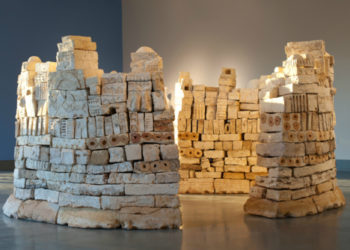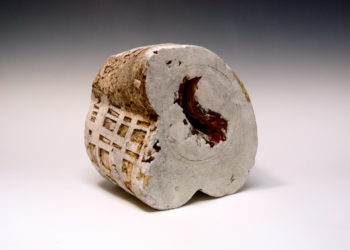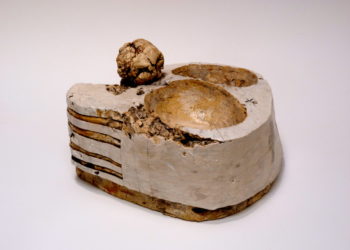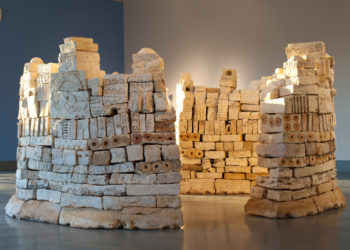


Ellen Schön: Five Hills Font, 2011, Smoke-fired clay, 15” x 22” x 22”
clay
Francesco Ardini: Envelope - Acid Green, 2012, Stoneware (1100°C), Acid Android glaze (990°C), approx 44-55 cm.
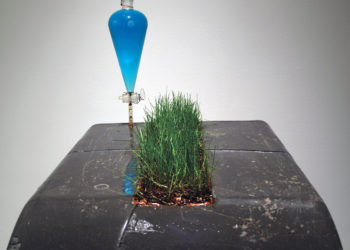
David Gallagher: Specific Ubiquity (Green Space), 2010, Portland Cement, Lab Glass, Miracle Grow, Unfired Iron Rich Clay, Grass
Contemporary Clay Invitational / j fergeson gallery, Farmville, VA

Contemporary Clay Invitational / j fergeson gallery, Farmville, VA
October 5 - December 15, 2012
Opening Reception: Saturday, October 13, 5:00 pm.
The latest show at the j fergeson gallery in Farmville, VA, explores the diverse possibilities of what can be done with clay. This show, the gallery’s largest of the year, features works from 30 national artists. Here one will find both sculptural and functional pieces, but perhaps most interesting is the way the artists have settled somewhere in between.
The show is an extraordinary collection of ceramic work by artists working at the top of their field. Co-curators Andréa Keys Connell, lead professor in clay at Virginia Commonwealth University, and Adam Paulek, lead professor in clay at Longwood University, chose the artists for their commitment to fine craft, progressive thought, sensitivity to material and humor.
Artist A. Blair Clemo, inspired by the ornate history of European Decorative Arts, creates vessels that are functional, but also ridiculously opulent, as if ready to serve royalty. John Oliver Lewis presents two sculptures inspired equally by architecture, natural land formations, cartoons, and candy - think Monument Valley out of salt water taffy. And then there’s Darrin Ekern’s “potasaurus”: a sculpture of a T-Rex in a studio throwing a pot.
Featured artists:
A. Blair Clemo, Kurt Anderson, Tom Bartel, Jason Hackett, Hiroe Hanazono, Mike Jabbur, Bethany Krull, John Oliver Lewis, Richard Nickel, Nathan Prouty, Debbie Quick, Dave Smith, Mikey Walsh, Trent Berning, Kelly Berning, Jeff Campana, Sam Chung, David Eichelberger, Darrin Ekern, Misty Gamble, Meredith Host Kowalski, Nicole Aquillano, Frank Martin, Dan Molyneux, Chris Picket, Adrian Sandstrom, Amy Santafararo, Shawn Spangler, Kendra Sparks, Adero Willard.
This variety of work isn’t often seen in small galleries, and the curators are excited to present it to an audience that may be unfamiliar with just how adventurous contemporary clay has become.
Interview with Max Cheprack, Clay extrusion - Techniques, May 2012
TECHNIQUES, May 2012: Max Cheprack
/ Read more articles in Ceramics Now - Issue Two
Ceramics Now Magazine: You are studying Industrial Design at the Holon Institute of Technology, Israel, and recently you underwent a research project on clay extrusion. What are its concepts? Tell us about the technical process.
Max Cheprack: The extruding clay project started in the third year of my studies, for B.design in industrial design, when I first met the manual extruder in ceramics course. After learning various techniques in the field of ceramic design, I was fascinated by the option to create clay objects using replication. The Semi-industrial process of extruding clay enables the creation of precise and complex objects easily and quickly. Extrusion allows me to design the inside of the object, something that the rest of the techniques do not allow. Extruding technology allows to produce a closed and complex object, and therefore very strong. This allows the expansion of production beyond the products we know today. In addition, this technology brings new aesthetic to the ceramic field.
As an Industrial designer who is interested in manufacturing technologies, I moved away from the dies that come with the manual extruder Kit, and I began to assemble a set of basic dies with complex shapes. Later, I have built an extruder which works on pneumatic piston, in order to free both of my hands. This allows me to make variety of manipulations on the objects like bending and cutting.
In order to explore the limits of this technology, I decided to make a stool. The stool is a challenging product for extruding clay process because it is a relatively big product, which must be strong enough to bear persons weight, and should be able to connect with other materials.
My inspiration is taken from a local element of the Middle East - Mashrabiya. Though the project ended as part of my design studies, for me he is a starting point to new possibilities in ceramic design.
Max Cheprack, Chairs made with the extruding machine
What was the most difficult part in creating the necessary tools for the project? Did you get any help?
The hardest part in this project was to understand the size relation between the size of the die and the amount of power that needed to push the clay. First I played with the manual extruder that we have in our workshop and then I made different dies to check how complex things can be. After realizing clearly how things are working I wanted to make the next step towards an extruder that will free both my hands to make manipulations on the objects while it is being extruded. I consulted with an engineer who just gave me a headache with schemes numbers and stuff that I couldn’t understand, so I decided to use a pneumatic piston as my base for the machine and after many trails with different pistons and die sizes I made one small extruder and one big extruder.
Patricia Sannit
Patricia Sannit’s profile on Ceramics Now Magazine - View her works
“The impulse to decorate is strong. The push to create a border or impose a structured order on the already beautiful order of the (chaotic) natural world is compelling. Humans have always done so.
My work draws from and responds to visual idioms found throughout human history. Visual languages flow from culture to culture and through time; I explore how the changes of motifs and technologies show development and transformation in societies. I draw from our species’ long and intimate relationship with our surroundings, both natural and man-made. To that end, I use a variety of mostly found and repurposed clays to refer to both the contributions of previous makers in our collective art history and the stratigraphy of the Earth. My work is influenced by archaeology, geology, industry and the commonality of human experience through time and across culture.” Patricia Sannit
Born in Cleveland, Ohio, Patricia Sannit received her BA in ceramics, Art History and Norwegian from the University of Minnesota and her MFA from the California College of Arts. She now lives in Phoenix, Arizona. Sannit’s work is influenced by her experiences excavating in the Near East and Ethiopia. Sannit’s most recent project is a large-scale ceramic installation, Citadel, based on an archeological site in Iraq. “I am interested in the story of the earth, our species, and pots. History is manifest in the scarred and worn surface of our planet and in a pot well made and well used.”
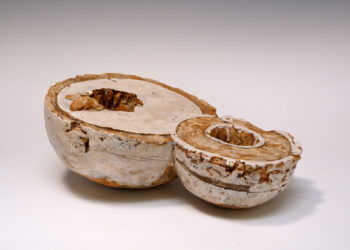
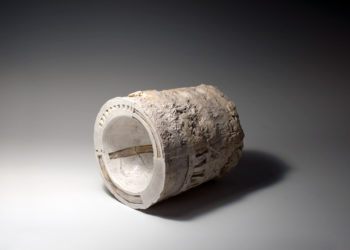
Patricia Sannit: Eroded Poles, 2012, 12”x9”x11”, cast, carved and incised found and reclaimed clays, slip and stain
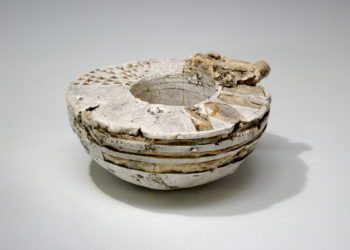
Patricia Sannit: Ely glacier, 2012, 6”x12”x11”, cast, carved and incised found and reclaimed clays, slip and stain
Patricia Sannit: Double Crater 212, 2012, 6”x13”x7”, cast, carved and incised found and reclaimed clays, slip and stain