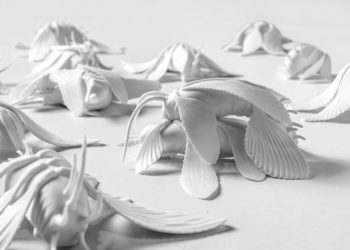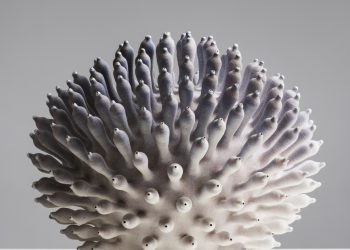
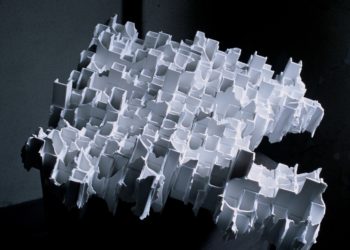


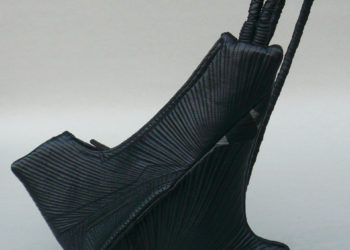
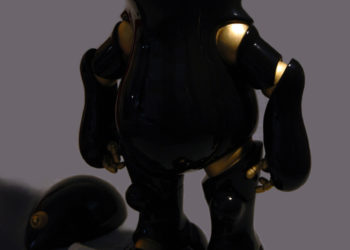
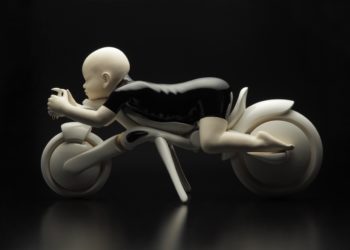
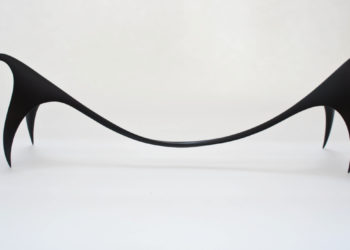
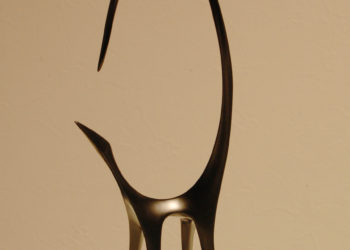
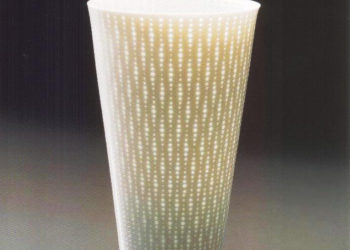
Kimberly Cook: Last Straw, That’s All, That’s It, 12” x 6” x 4” (variable), porcelain, slip, 2011
contemporary artist
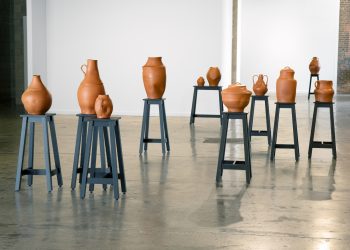
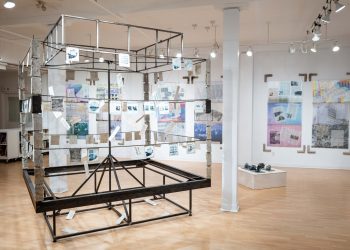
Marianne McGrath: Thoughts on Long Drives (gallery shot), 2009, porcelain, earthenware, plywood, steel rod, plaster, dimensions variable
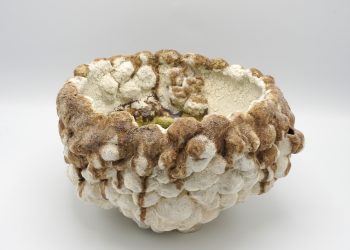
Brian Kakas: Tectonic Perceptions #9, alternative view, 2010. White stoneware, slab built, 31”H x23”W x 33”L, Cone 9 Reduction
Brian Kakas: Architectonics – Nautilus Improv 1, side view, 2011
White stoneware, slab built, 26”L x 23”W x 33”H, Cone 04 Oxidation
Interview with Ian F. Thomas, Ceramic Installation - October 2011
Interview with ceramic artist Ian F. Thomas - Ceramic Installation, October 2011
→ Subscribe to our monthly newsletter if you want to receive news and interviews with ceramic artists.
→ The full interview is featured in Ceramics Now Magazine - Issue One, Winter 2011-2012.
Ceramics Now Magazine: You are a very creative artist, working with large scale installations, ceramic objects, sculptures, vessels and various drawings. When do you have time to transpose all your emotions and ideas into them?
Ian F. Thomas: Thank you. I obsess about ideas. My methodology for making, for creating, has me developing many works at the same time, not just in the beginning phases, the thought process, but also during the construction phase. Mold making, throwing, painting, welding, drawing, functional, non-functional—everything that happens, it all develops simultaneously. I enjoy working right up to, and, sometimes, past my limit. I view making work on all of these different platforms, using different materials, and incorporating as many ideas as I can ideas in the same way that I see conversations. Each day I have vastly different types of conversations with many different people; from humorous to serious, political to chit chat and minutiae. When an idea surfaces, the process may demand a particular size, finish, or material. Following the concept and its needs supersedes the necessity of conforming to a particular style or material.
As a father of two, husband and professor, it is difficult to manage time. My wife, Lori, who is not an artist, has an amazing tolerance for the creatively obsessed mind. If it were not for her support, I would never find the time to work on so many projects. Working with clay, I can take advantage of the timing/drying constraints, and toggle between works, maximizing my available studio time. I have also recently taken on an assistant, Eli Blasko, to help better manage my time so that I can focus more in the studio.

Di-analytic Variables - View Ian F. Thomas’ works
Wheel-thrown, altered, hand-built, earthenware, electric fired cone 02, steel, paint, gold leaf / 38x37x30 inches, 40 lbs
How do you see this relationship between idea/intuition and the final work itself? Is it always continuous or sometimes gap comes through?
The final work is an entity all of its own. An idea starts the work and then intuition supports that idea during the development of the piece. I keep true to a cautious respect for the moment. While I’m in the process of working, my intuition may shift the work’s original intentions, or trigger a new idea(s) that can rearrange the work while I’m still in the process of making it. My idea can fluctuate as much as the physical object I’m making. Using this method, gaps occurs naturally and when that happens, I embrace that.
Hayashi Shigeki: KOZO, 2008 (installation), Glazed porcelain, 12” x 12” x 24” (H)
/ Keiko Gallery - Japanese artists
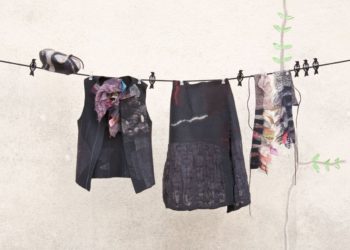
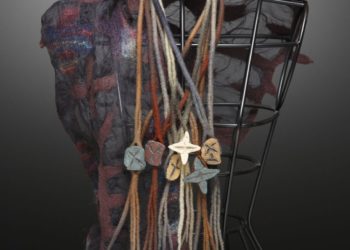
Jorie Johnson (Joi Rae): Jorie Johnson Spring Collection 2011 (beret, vest, skirt, neck wraps), wool, novelty yarn, silk fabric, linen lace fabric, silk cord. Photo by Toyoda Yuzo.
/ Keiko Gallery - Japanese artists
Amanda Simmons
Amanda Simmons’ profile on Ceramics Now Magazine - View her works
Amanda Simmons makes kiln formed and cameo engraved glass vessels - tall, sculptural, thin walled columns - from her studio in Corsock. She is fascinated in the forms created by gravity within the kiln, the vessels becoming more complex as she perfects the slumping method. She has worked with glass for the past 9 years, studying at Central St Martin’s School of Art & Design in London, before re-locating to Dumfries & Galloway in 2005.
She combines these techniques with her interest in making marks in glass with diamond point engraving and a diamond wheel lathe. Her work involves many processes of firing, coldworking (working with diamond tools to shape and smooth) and sandblasting. She recently exhibited at the Crafts Council show for contemporary applied arts, COLLECT with Craftscotland and has since become a member of Contemporary Applied Arts in London. A winner of the Gold Award for Innovation, Creativity and potential to export at Origin 2010, she has just returned from a research trip to investigate the applied arts market on the East and West coast of USA funded by the Crafts Council and Uk Trade & Investment.
A keen supporter of the contemporary craft scene, she has just been selected to become the Creative Business Advisor (for Crafts) by Dumfries & Galloway Council, to stimulate, strengthen and support the creative industries sector across the region.
Katharine Morling
Katharine Morling’s profile on Ceramics Now Magazine - View her works
Katharine Morling is a ceramic artist best known for her life-size black and white sculptures full of quirky, graphic details of domestic objects such as tables, chairs, ladders and lockers. Although she calls herself a ‘3D person’, drawing is very important to Katharine because her sculptures are sketches of furniture items which plays with the viewer’s preconceptions about material and functionality. She crates animated scenes with an unusually dynamic appearance for the medium of ceramics.
The objects can be described as 3 Dimensional drawings, but at first the true nature of the material is not clear: paper or fabric? However, it is clearly ceramic. The eye then re-adjusts within the context of the memories which the material holds. The tactile experience grounds the viewer with the materials solid, cold, hard and fragile reality.
The pieces work together in a tableau staging still lives of everyday objects: table and chairs, tools and cases. Stories start to unravel in the viewer mind: the box that is locked the keys in an open draw. Toys in a case resonate with nostalgia and fantasy. A ladder propped agents a wall suggests that these toys could spring to life and lead an independent existence. A slightly surreal experience is crates when one walks amongst this strange life-sizes tableau.
The monochrome works are mainly porcelain or crank covered in a porcelain slip, before firing a black slip is painted on outlining the works with some details such as a handle or lock painted in.
Ian Shelly
Ian Shelly’s profile on Ceramics Now Magazine - View his profile
“In my work, a tangible place exists where the fields of art making, weapons manufacturing and scientific research converge. This latest work is composed of these subjects existing in the same atmosphere, constantly crossing and colliding with one another as if part of the same charged electron cloud. This work as an endless equation of variables, values, formulae and solutions. Like the system and language of chemistry, these subjects are always around us and the characters, materials and scenarios of this equation and chain reaction are in constant motion.
In an effort to reflect on the early presence that these subjects have in our lives, this connectivity is expressed through a language specific to childhood and is punctuated with objects that reference my early education and play. The childish language in this work comments on two conclusions that stoke the fires of my work; the omnipresent nature of science in our daily lives and the similarity between objects used to discover and nurture and those used to destroy and capitalize.
I see this work as a mechanism to evaluate conflict as the direct result of two kinds of perennial human activities: misunderstanding – willful or otherwise – and the heroic yet flawed effort to understand through research and classification. The activities in my work show the nature of human relationships as seen through the lenses of our societies researchers and artists.” Ian Shelly