By Amy Gogarty
In Vancouver, Jig Art has a reputation for presenting art, including ceramics, that builds cultural bridges. While the gallery showcases artists from diverse backgrounds, much of their focus in on ethnically Chinese artists. The Greater Vancouver Region is one of the most multi-cultural in North America, with visible minorities representing over 50% of residents. Approximately 20% of the population identifies as Chinese-Canadian, including immigrants from mainland China, Taiwan, Hong Kong, and those whose families have lived here for generations. This makes for a very lively and complex cultural mix, but ceramics practice in the province of British Columbia continues to be understood largely in terms of traditions deriving from Bernard Leach and European Modernism. Jig Art’s promotion of equally important influences and artists from the Chinese diaspora contributes an important and much-appreciated addition to our understanding of BC ceramics.
The exhibition Where Form Meets the Boundless includes work by five Taiwanese artists, Ming-Shun Cho, Yu-Ying Huang, Ming-hsiang Hsu, Shanyin Lee, and Chen-Long Lin. Four Canadian artists, Amy Chang, Wei Cheng, Ying-Yueh Chuang, and Debra Sloan provide a local component. Chang and Chuang were born and raised in Taiwan, while Cheng was born and raised in mainland China. Sloan was born and raised in Canada, although she has family connections to the Chinese community, and her work is currently included in the 2026 Jingdezhen International Ceramic Art Biennial. This diverse collection allows viewers to note influences and divergences between the two groups, encouraging a more nuanced understanding of the role of culture in shaping artistic production.
Much of the Taiwanese work focuses on function, with an emphasis on tea wares. Curator Yumeng Li explains that the focus on tea wares reflects the educational system, which promotes historical appreciation, technical knowledge, and skill, and on the importance of tea in Chinese culture. The works on view are mostly functional, but their importance extends far beyond function to embrace history, memory, family, and culture. Tiny, perfectly formed teapots, cups, and saucers exemplify the importance of tea in the artists’ work, but many pieces also embrace conceptual concerns, and engage material realities, social issues, and the body.
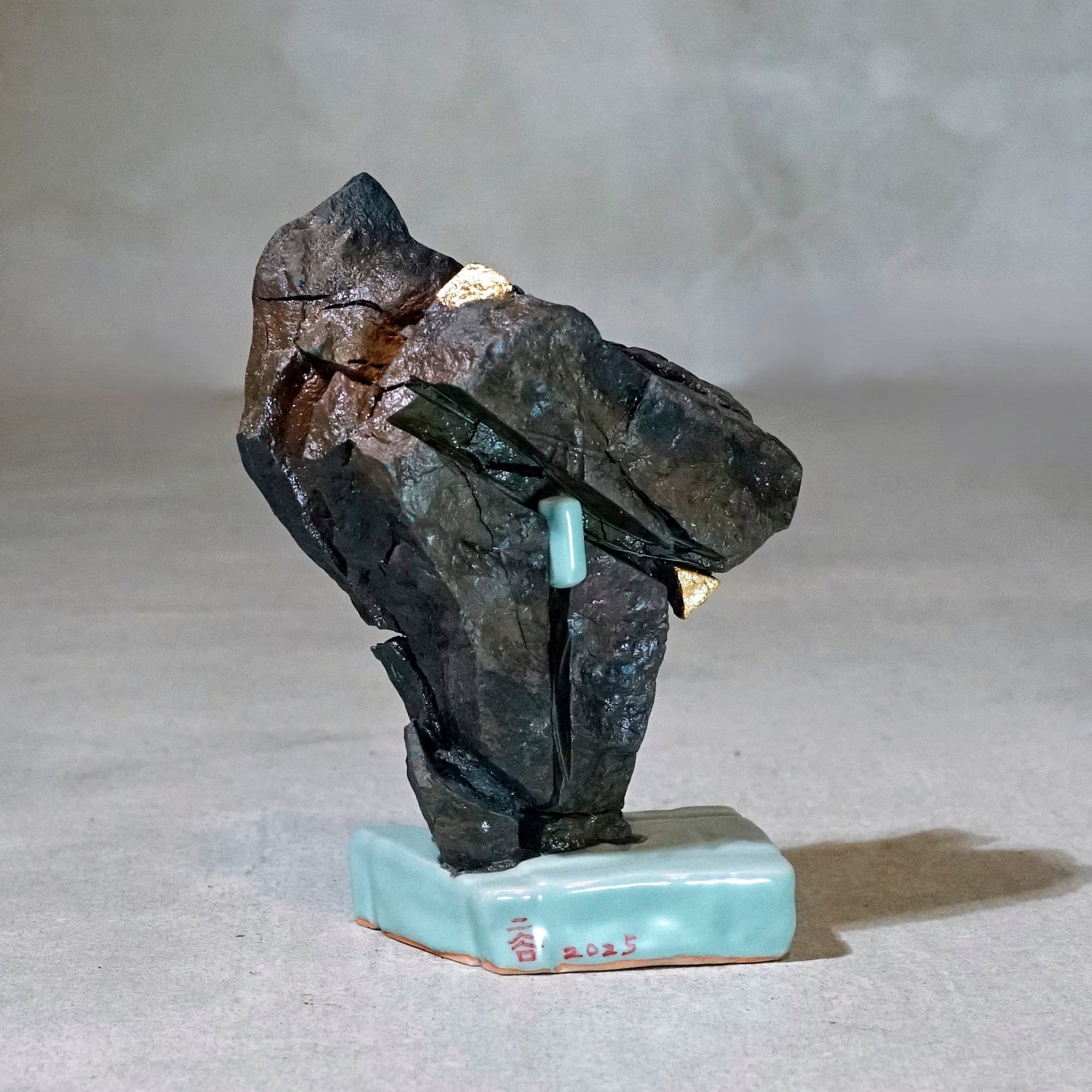
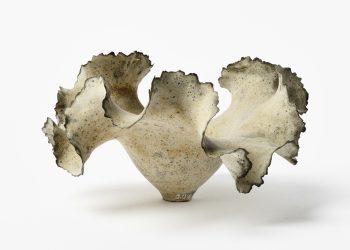
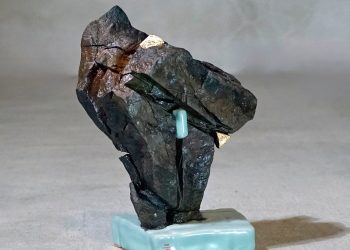
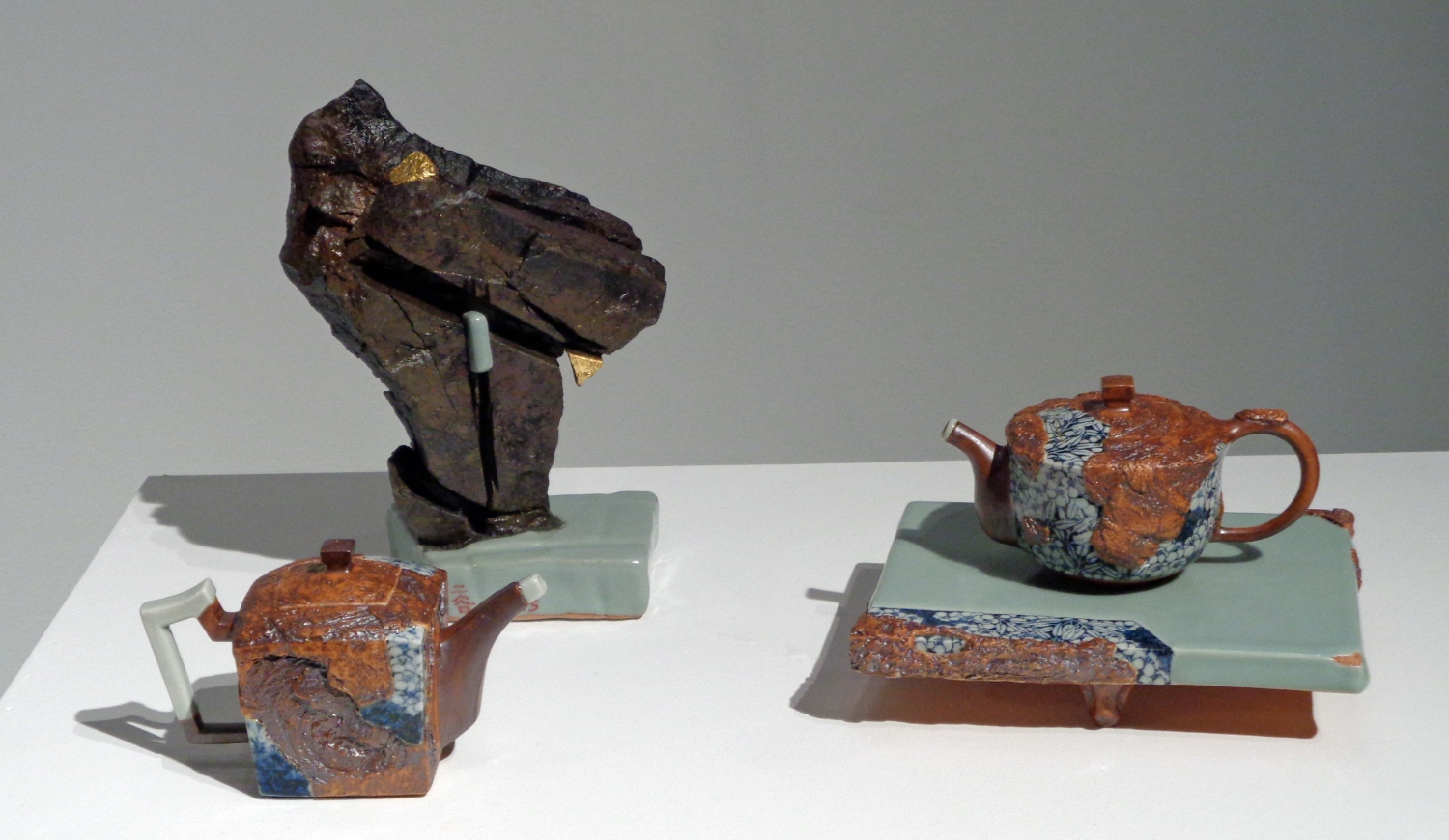
Chen-Long Lin is well-known outside Taiwan as a respected teacher, artist, and glaze master. He studied with important Taiwanese artists and established his own studio in 1979. In the 1980s, he was influenced by the Taiwanese democratic movement, and his work shifted to reflect the turmoil he observed in society around him. He became interested in geology and rock forms, the landscapes of nature. Vessels from his Earth Series and Clay Rhythm series incorporate generous porcelain forms glazed in luminous, silky celadons. Teapots and small vessels include areas of blue-and-white patterning in tribute to traditional Chinese wares. Rough, dark clay outcrops encircle the glazed areas. The roughness of the dark clay mimics crevices and cracks in the earth’s surface and contrasts with the watery celadon. Carrying the geological reference further, Lin subjects selected rocks to the heat of the kiln, transforming them in much the way tectonic forces might. Celadon fragments tucked within the rough folds or serving as bases make connections between ceramics and the earth. The resulting sculptures appropriately titled Stone Reborn are powerful, iconic, and conceptually intriguing in that they speak about material transformation and processes of becoming.
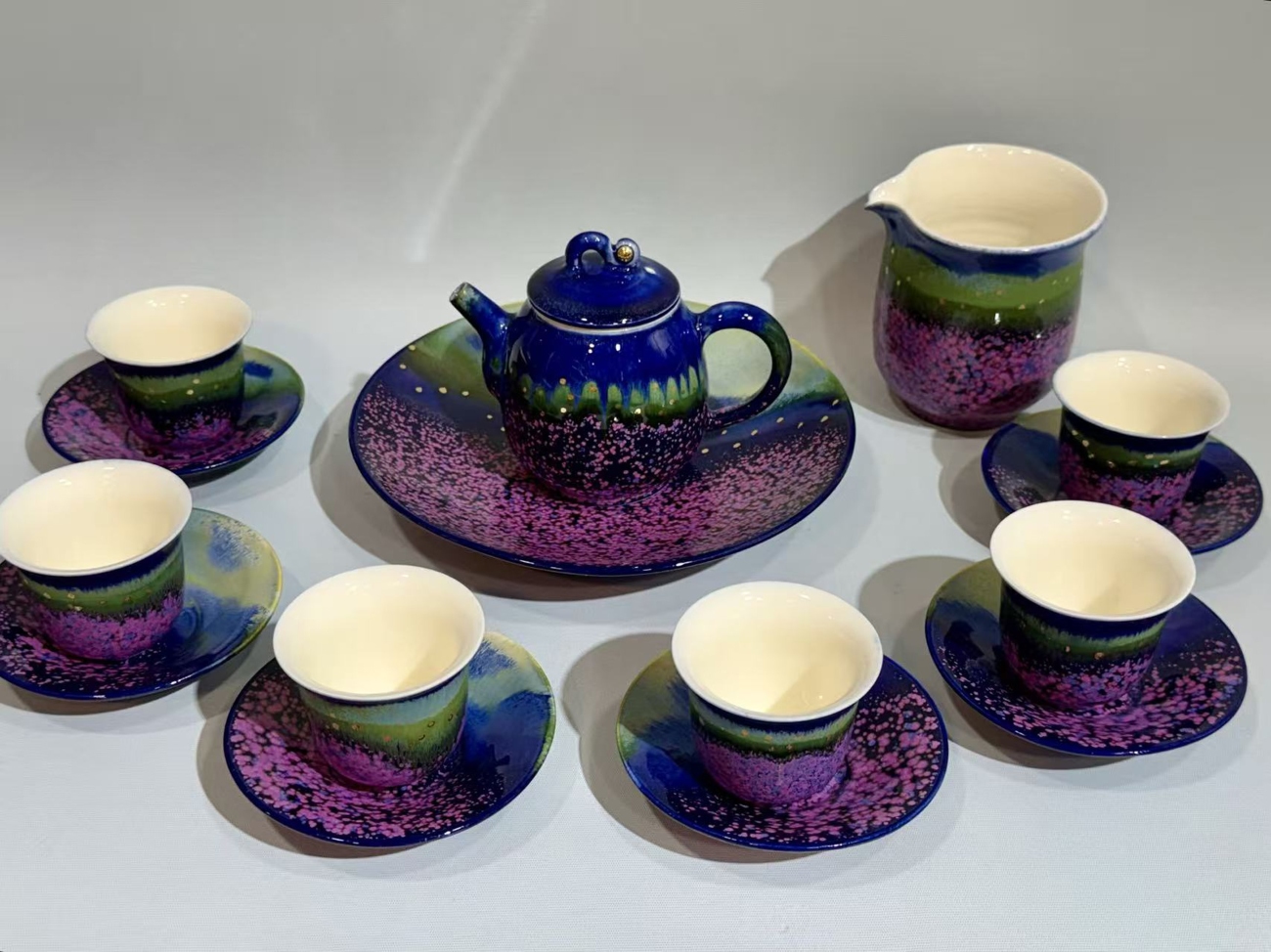
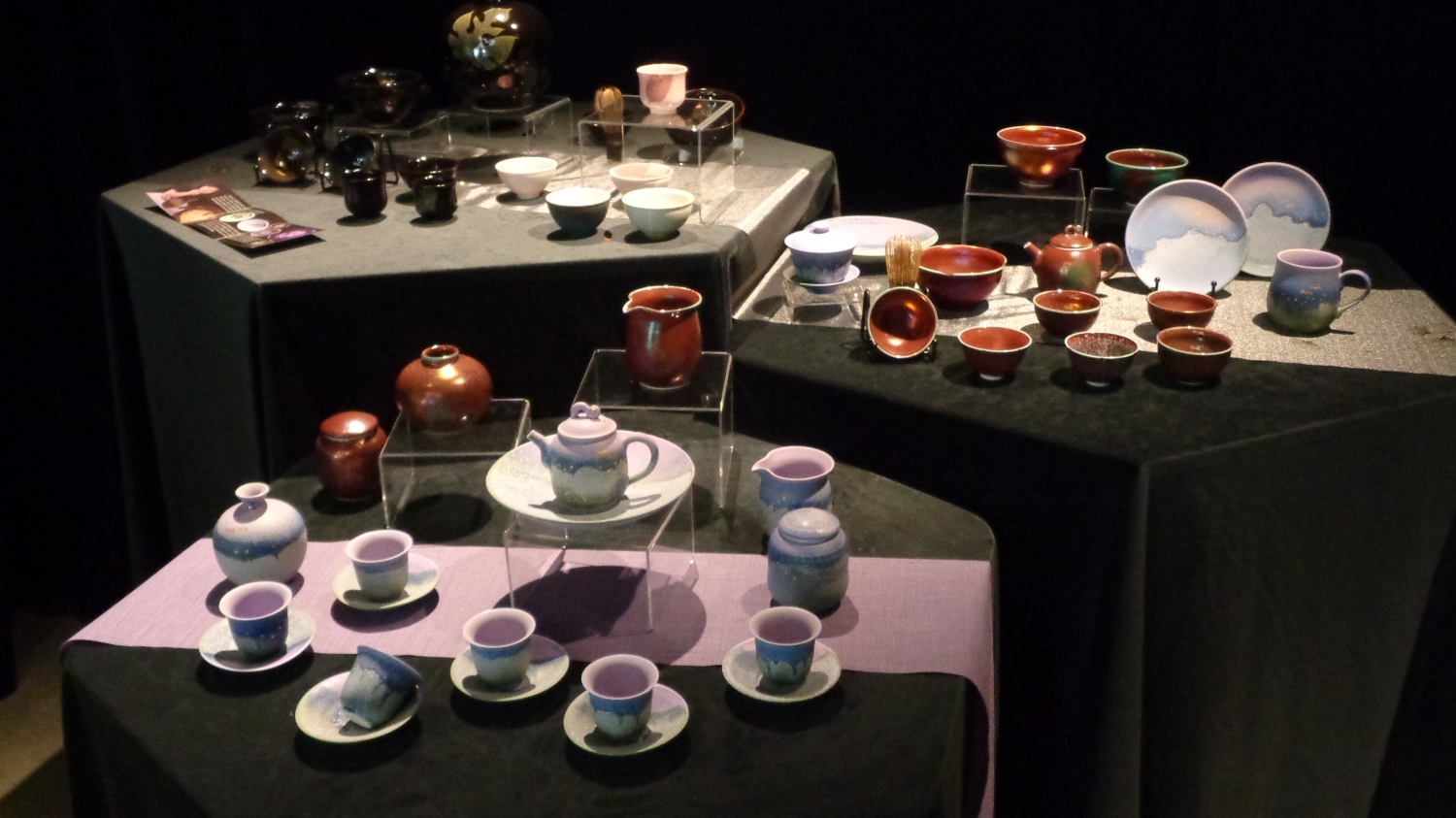
Another important teacher with the group is Yu-Ying Huang, who presents a range of functional tea wares and vases. Huang has revived the technique of “leaf tenmoku,” a practice dating back to the Song Dynasty, which has, with a few exceptions, largely disappeared. The technique involves carefully applying leaves to wet glaze and firing the pot, which results in a ghost image of the leaves appearing in startling detail. While tenmoku is traditional, Huang also creates examples in pink and ivory, which better reveal the colours of tea. Another series for which she is recognized is “Lavender Fields,” inspired by fields of lavender she encountered in France. The glaze consists of eye-popping drops of lavender floating against a dark ground, with bands of midnight blue and green suggesting landscape. This dramatic colour combination appears on vases, tea pots, covered bowls, and complete sets of tea ware. Other forms are glazed in iridescent, metallic colours that shift with the light, creating subtle effects that are best appreciated when holding and using the unique pieces.
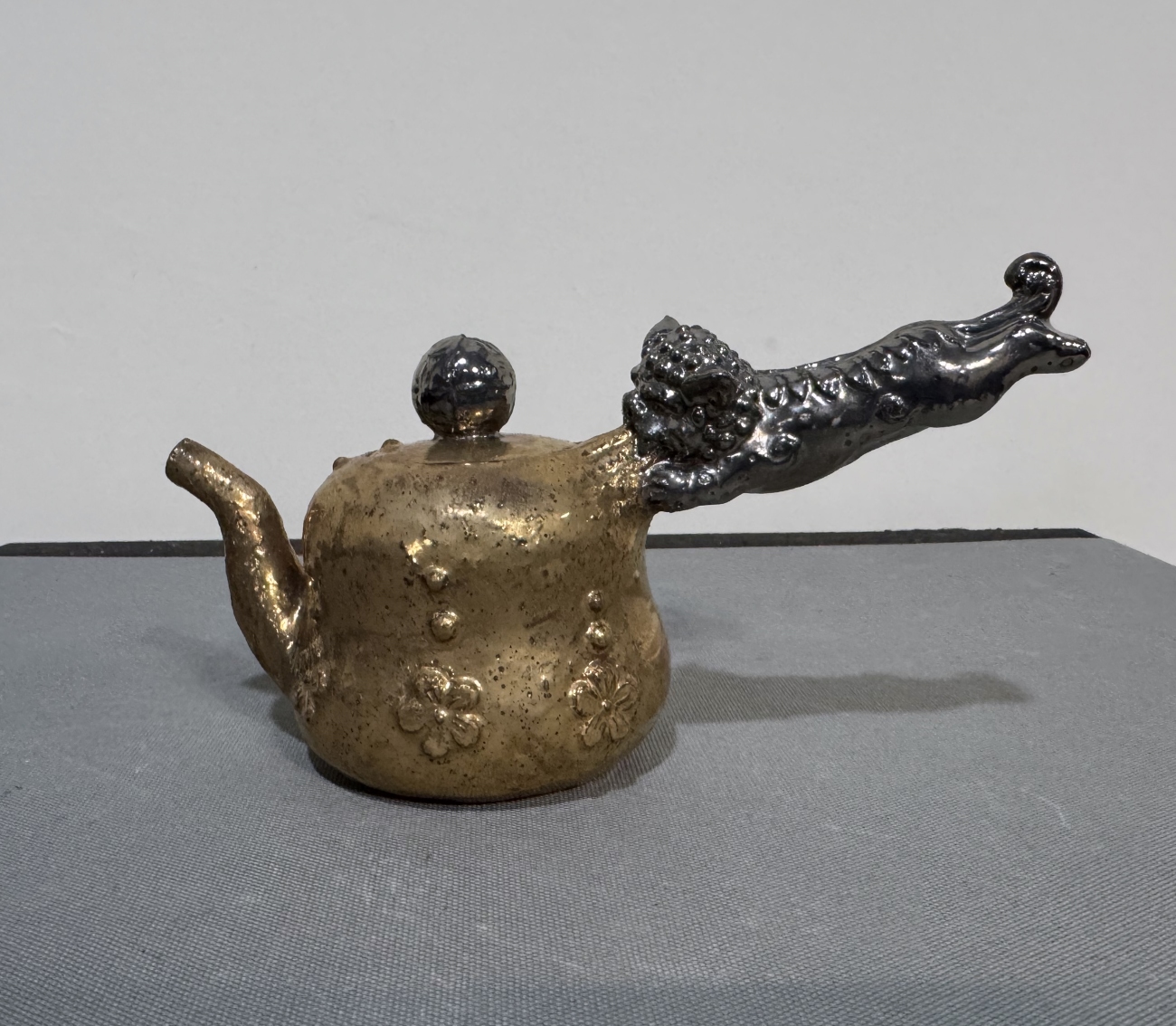
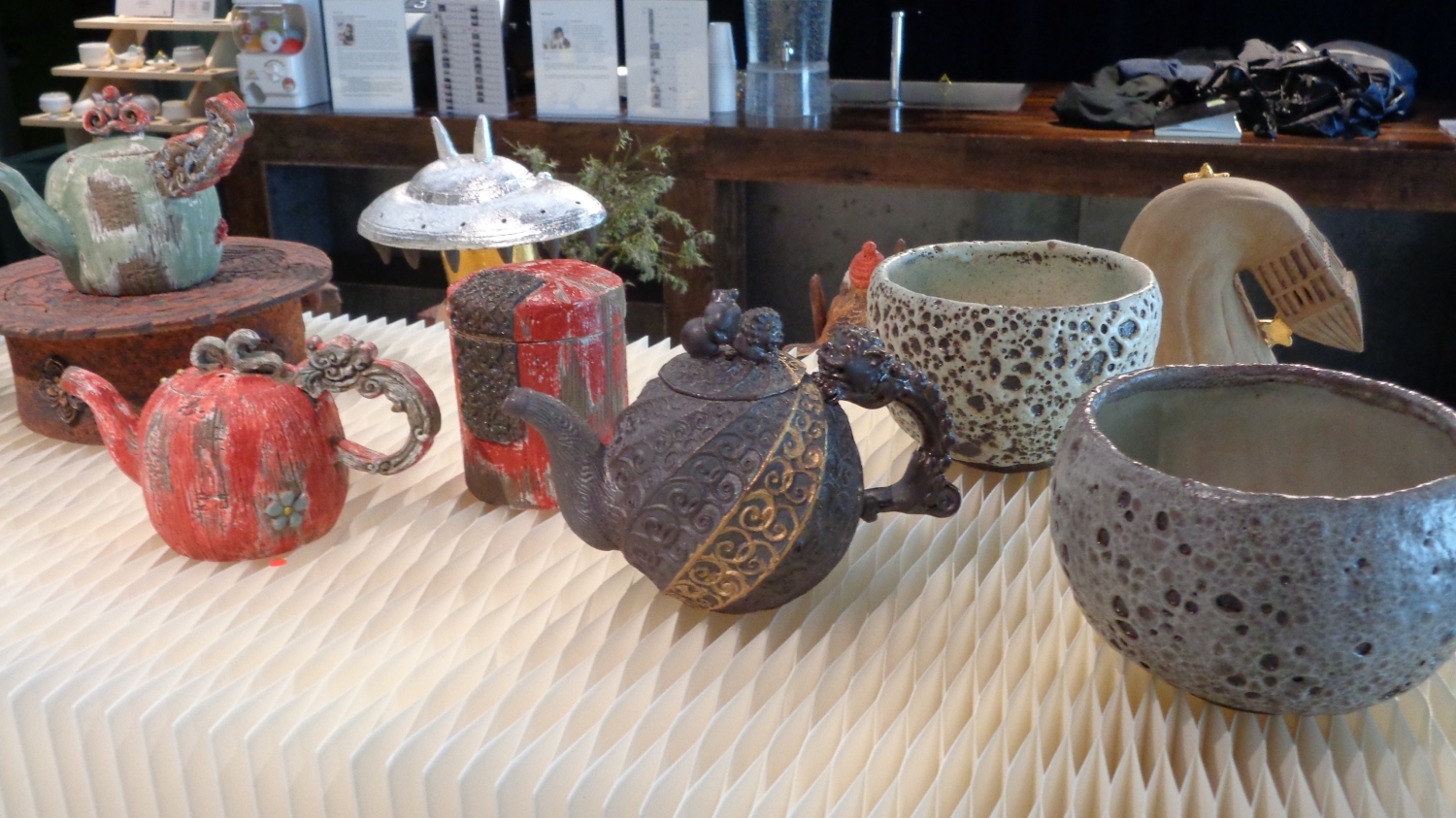
Ming-Hsaing Hsu takes her inspiration from traditional architecture, using the language of city gates, arches, tiles, and bricks to connect the ancient and contemporary worlds. She has constructed entire apartments from ceramic, including couches and sanitary ware, and made ceramic replicas of handbags, shoes, socks, and other everyday items as a way to signal the continuity of culture. In this exhibition, rough-textured vases with stamped or carved fragments suggesting wooden beams and architectural tiles introduce the themes of structure and history. A small teapot is textured with tile patterns and graced with a knob and handle based closely on architectural fragments. Her most spectacular works, however, are small teapots covered in silver and gold lacquer, which strongly resemble metal forms. The applied decoration is based on pairs of lions and lionesses found guarding Buddhist temples. On one, a beautifully modelled lioness cuddles her cub to form the knob. On another, a fierce lion races to save the world; the knob is a tiny globe, and the handle, a lion. The pots are exquisite examples of imaginative sculpture, and, at the same time, functional objects informed by traditional Chinese culture.
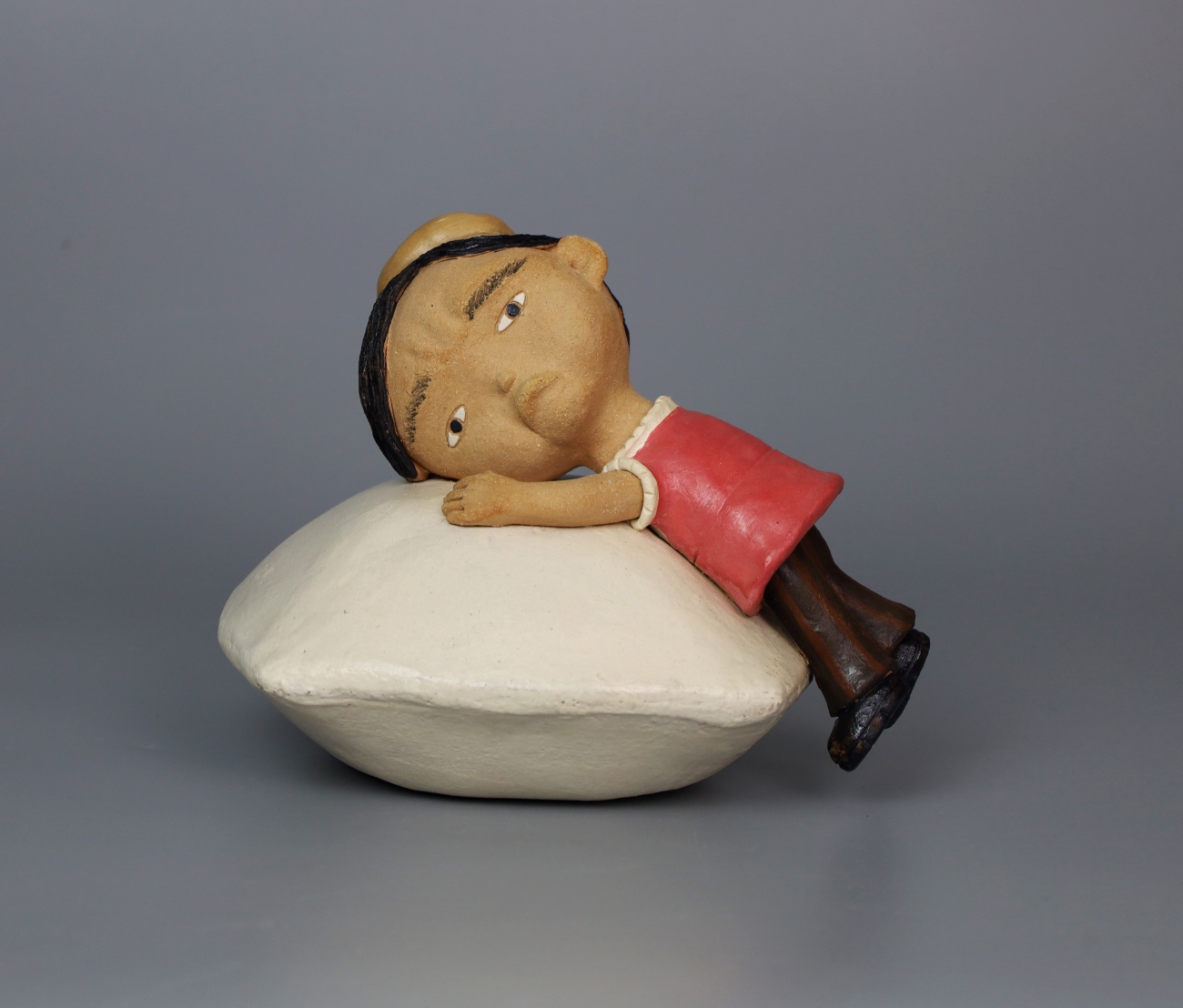
The younger generation is represented by Shanyin Lee, who grew up in a family of ceramic artists. While she exhibits some functional objects, her most interesting work comes from a 2021 series of sculptures Xian Xian Doesn’t Want to Move. “Xian Xian” is both the Hokkien pronunciation of her name and a phrase meaning “lazy” or “listless.” Her sculptures consist of cartoon-like figures of children and cats, who lie prone on pillows or on the floor, dejected expressions on their faces. In Switch, a figure holds a mask in front of her face, suggesting the need to always appear happy and positive in public, while privately suffering from anxiety and despair. The series reflects the experience of many young people around the world facing uncertain prospects for meaningful work, the cost of housing, and the general exhaustion brought on by the frantic pace of contemporary life. In this, Lee’s work bears a connection to the Japanese concept of Kawaii, or cuteness, which evolved as a means to create joy and emotional connection in a world marked by stress, excessive demands, and pressures to conform.
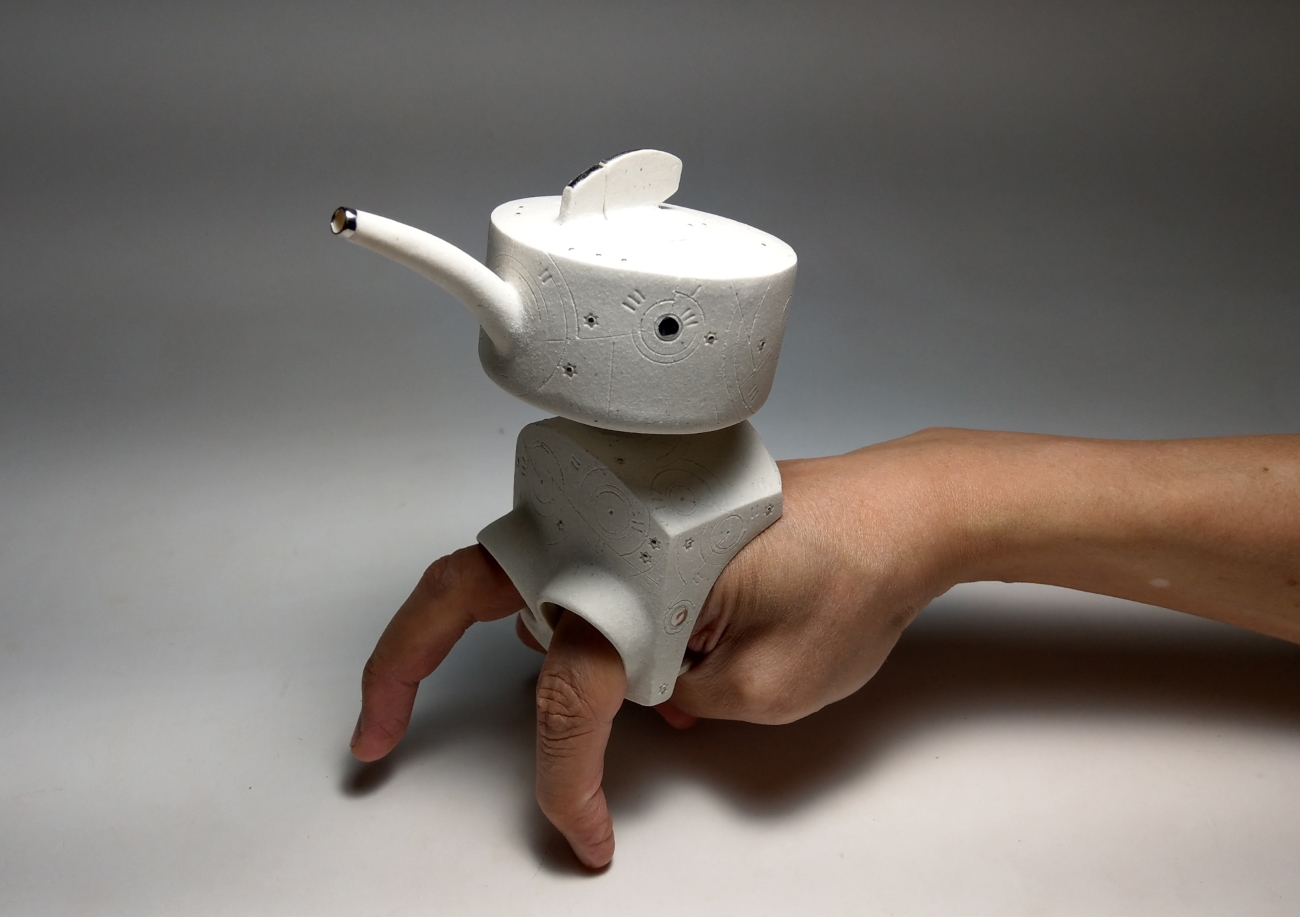
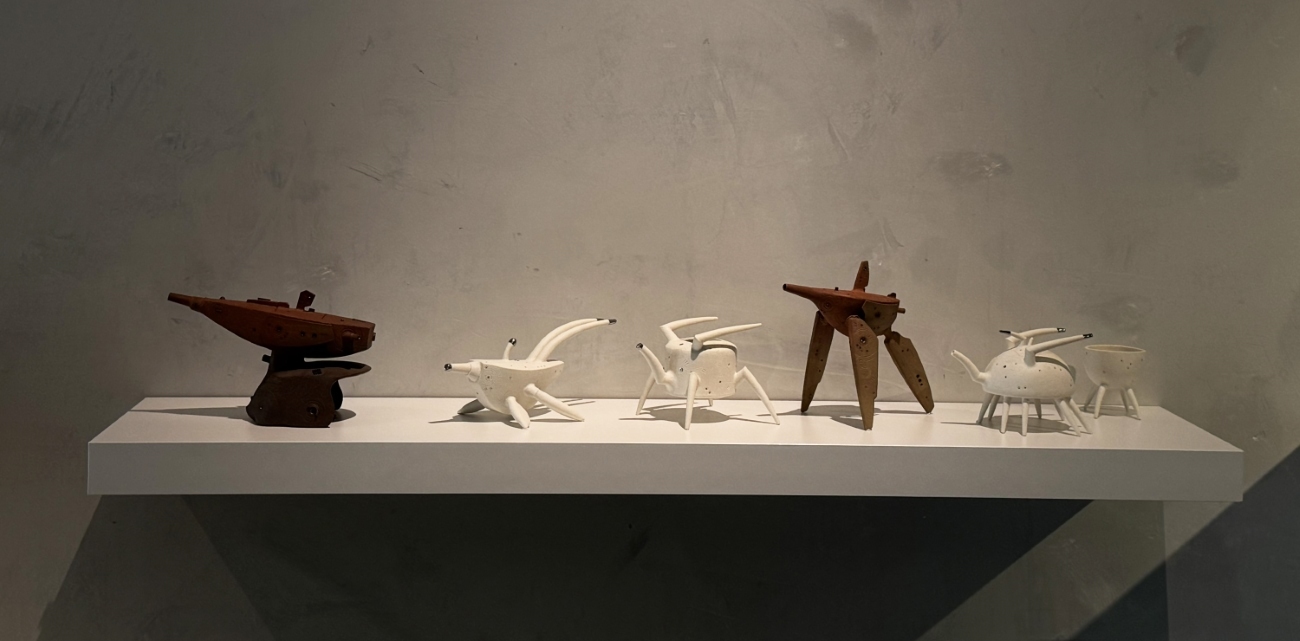
The conceptual dimension of Ming-Shun Cho’s work is not immediately apparent. Cho is as much a conceptual and performance artist as a master ceramicist whose playful teapots are performative. He is deeply engaged with issues of the body, and constructs some of his work to fit his own body. Let’s Play consists of a red clay scaffold within which the tea basin balances like a seesaw on an axis. A cup can be placed on a lever below the basin, which causes the pot to tip and pour the tea. Platinum Cyborg Y, a porcelaneous white pot that resembles a mutant creature, has an opening through which a hand can be inserted. In an accompanying video, Cho “walks” on his fingers, inching the pot towards a cup to pour the tea. Other pots resemble ships, crustaceans or small animals. All are beautifully formed, with precisely fitted components, their delicate surfaces inscribed with circular patterns and dots of lustre. Technical marvels of craftsmanship, Cho’s teapots are humorous and provocative in their invitation to interact with objects, and to consider the role objects play in shaping our experience of the world.
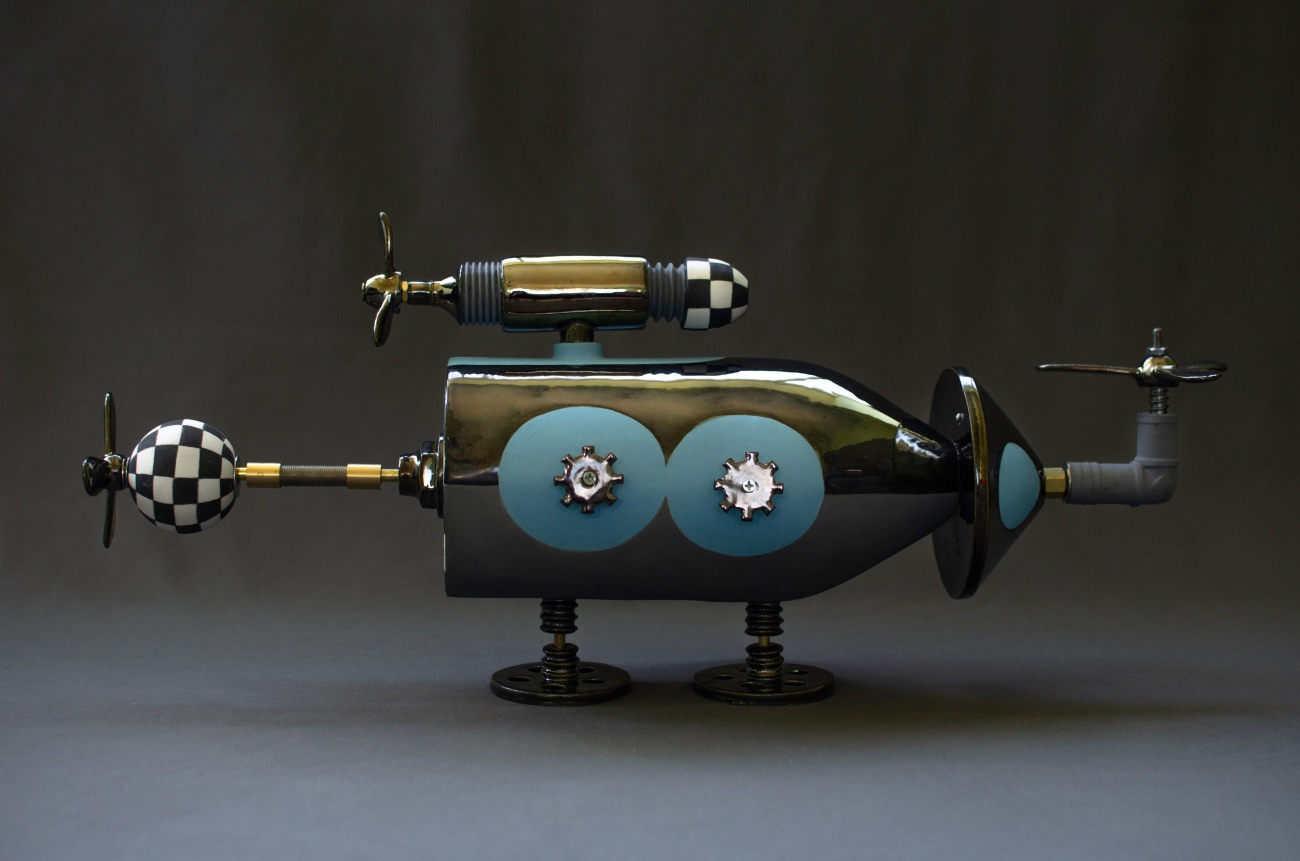
The four Canadian artists provide an interesting foil to the Taiwanese work, especially as both Chang and Chuang were born and raised in Taiwan, and both return frequently for visits. However, both studied ceramics in Canada, and thus their aesthetic interests reflect both cultures. Amy Chang creates imaginative sculptures of hybrid creatures that fuse organic and mechanical parts. Her work seems closest to Cho’s in its detail, precision, and animation, although her creatures sport lively colours and metallic surfaces. Components of her sculptures such as propellers and wheels move, implying travel and change. Her long-term interest in Surrealism, artificial intelligence, and cyborg narratives manifests in works such as Aircraft no. 1 and no. 2, hybrid bullet forms with propellor appendages. Faucet 1 drips a cloud formed from fine metal mesh, while octopus arms emerge from Faucet 2. Components that might be mistaken for metal are entirely ceramic, which adds to the intrigue and playfulness of the pieces.
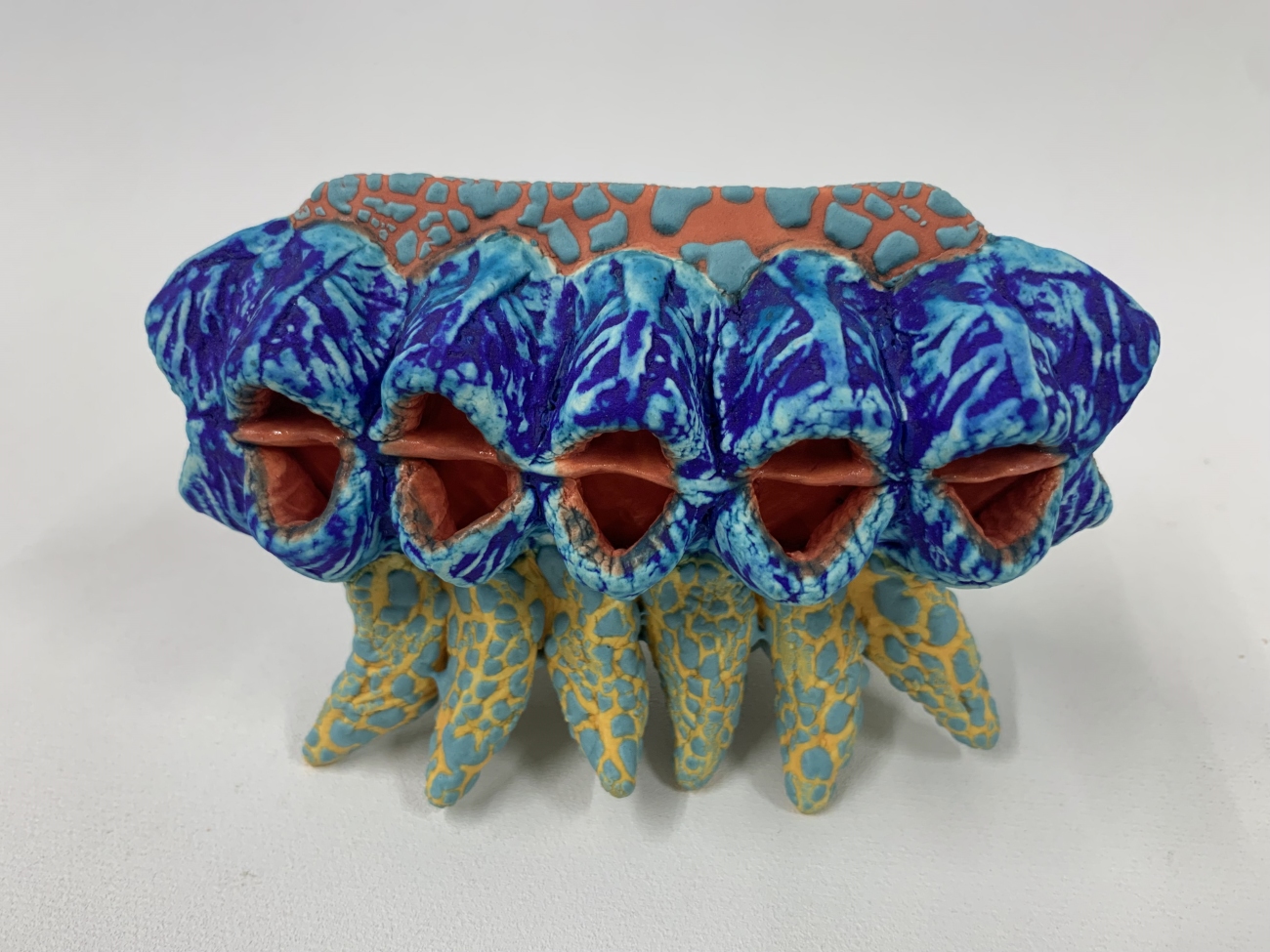
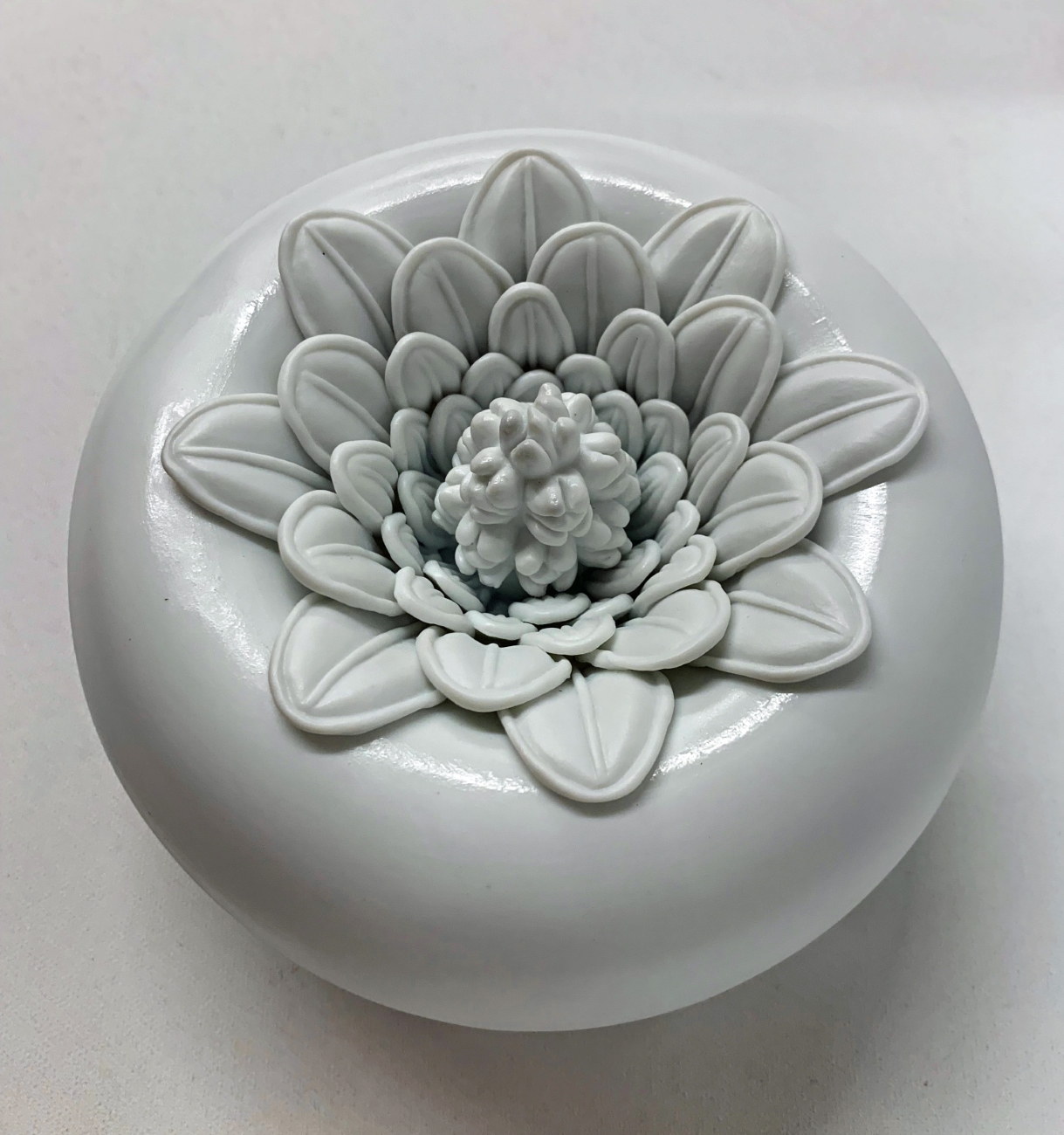
Ying-Yueh Chuang presents two distinctly different bodies of work, both of which reveal her interest in the natural world. Inspired by the abundance of sea life and flowers she remembers from her home country, Chuang’s Seed Creature and Plant Creature pieces are constructed from numerous brightly coloured slip-cast components. The hand-sized pieces can be arranged in a number of positions and invite play. A contrasting series of flower pods molded from Chinese Imperial Porcelain, which she produced while in residence in Jingdezhen, are starkly formal, their beauty deriving from the lustrous white clay and detailed, symmetrical representation of flowers. The precision of her craftsmanship relates her to her Taiwanese colleagues, but her use of colour is more closely aligned to North American norms. Deeply aware of her hybrid nature, Chuang navigates both Chinese and Western influences to create works that engage both cultures.
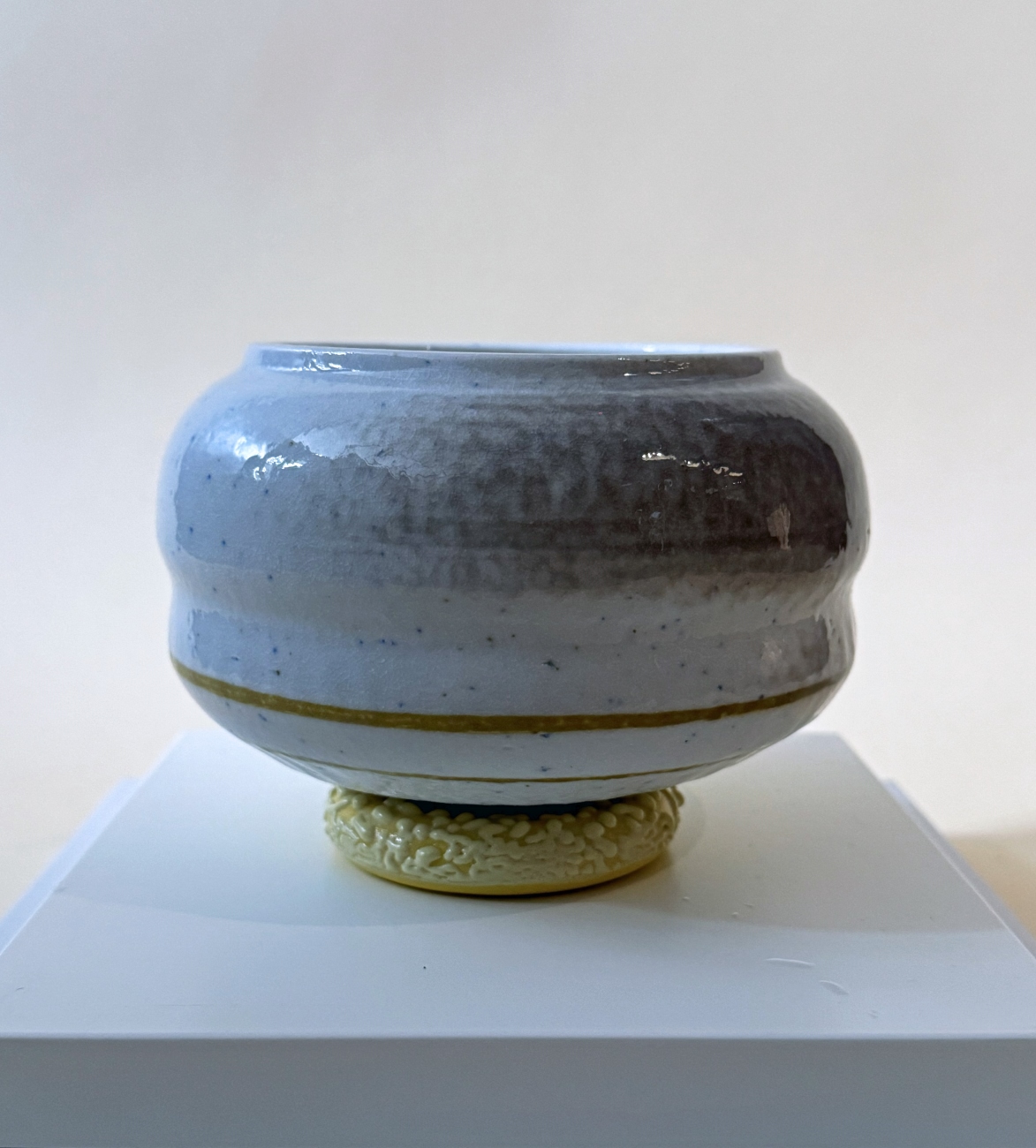
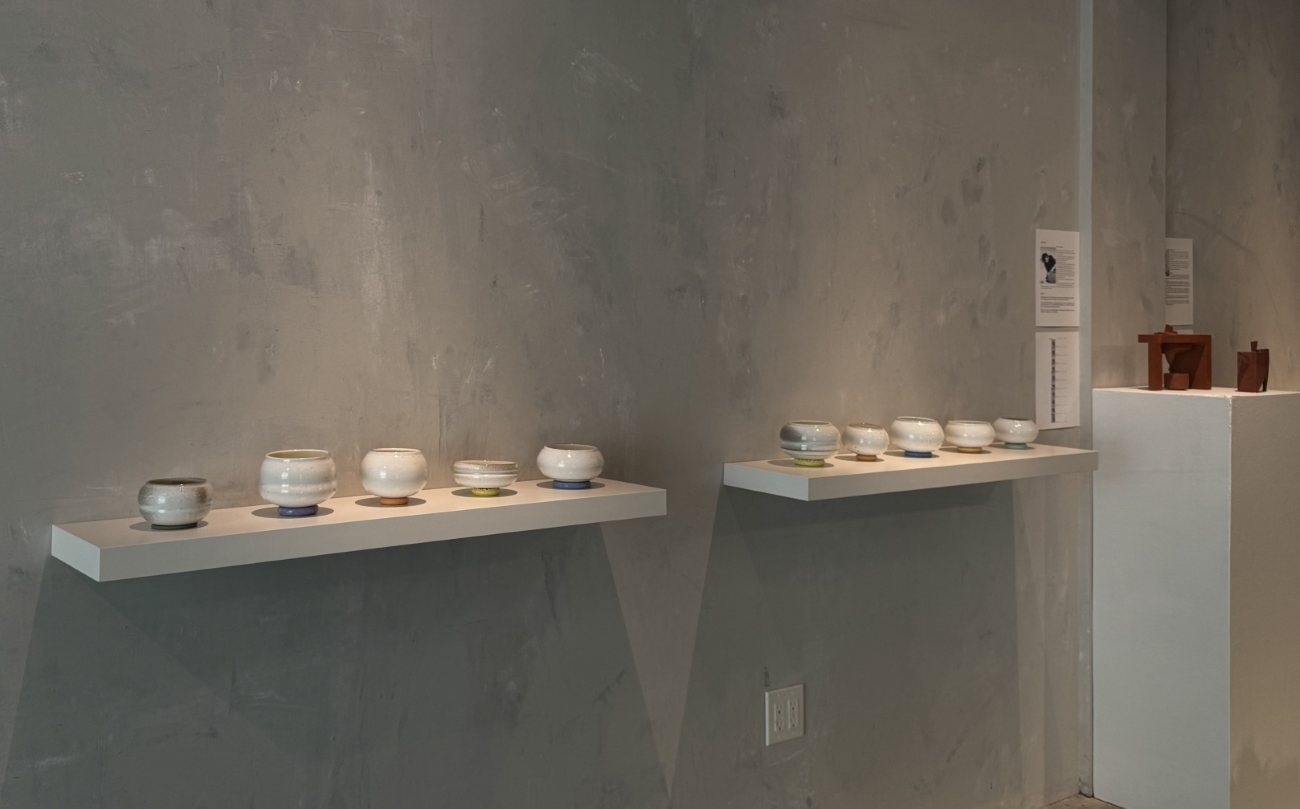
Wei Cheng’s practice includes functional wares, sculpture, and public performance, as she is constantly searching for new ways to direct her attention and imagination. Here she presents ten loosely thrown, soda-fired bowls under the collective title Catch the Unicorn. Unicorns are mythical beasts representing goals towards which one might aspire. Each of Cheng’s bowls has a different shape, but each contains finely ground coloured grit, which imparts tiny spritzes of colour into the body of each bowl. The bowls are rounded at the bottom and set on coloured rings or “doughnuts.” The colour from the rings reflects gently onto the bottom of the bowls, giving them a subtle glow. The bowls can be placed askew on the rings, encouraging play and increasing the sense of dynamism. At once functional and sculptural, Cheng’s work invites touch and use.
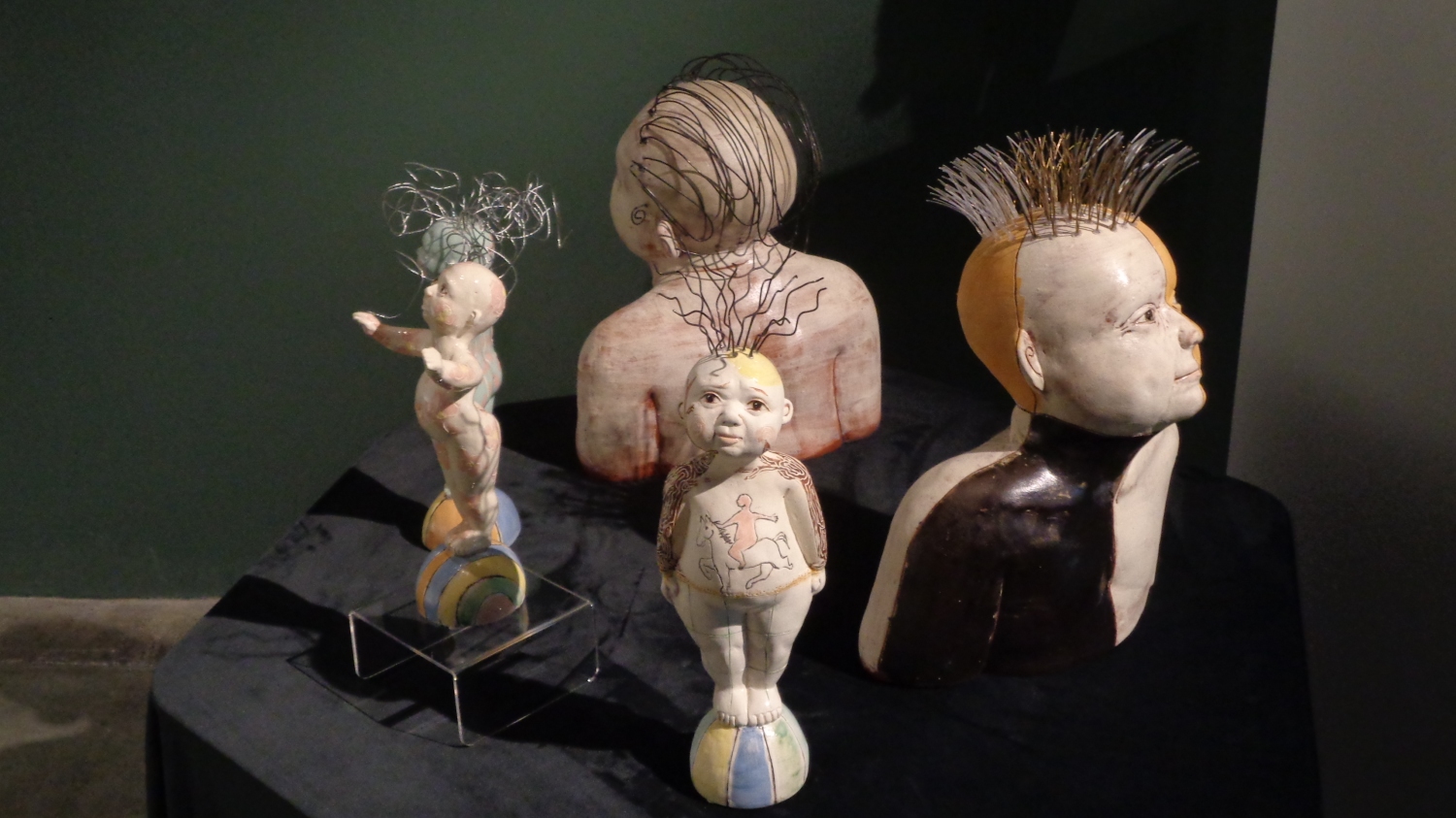
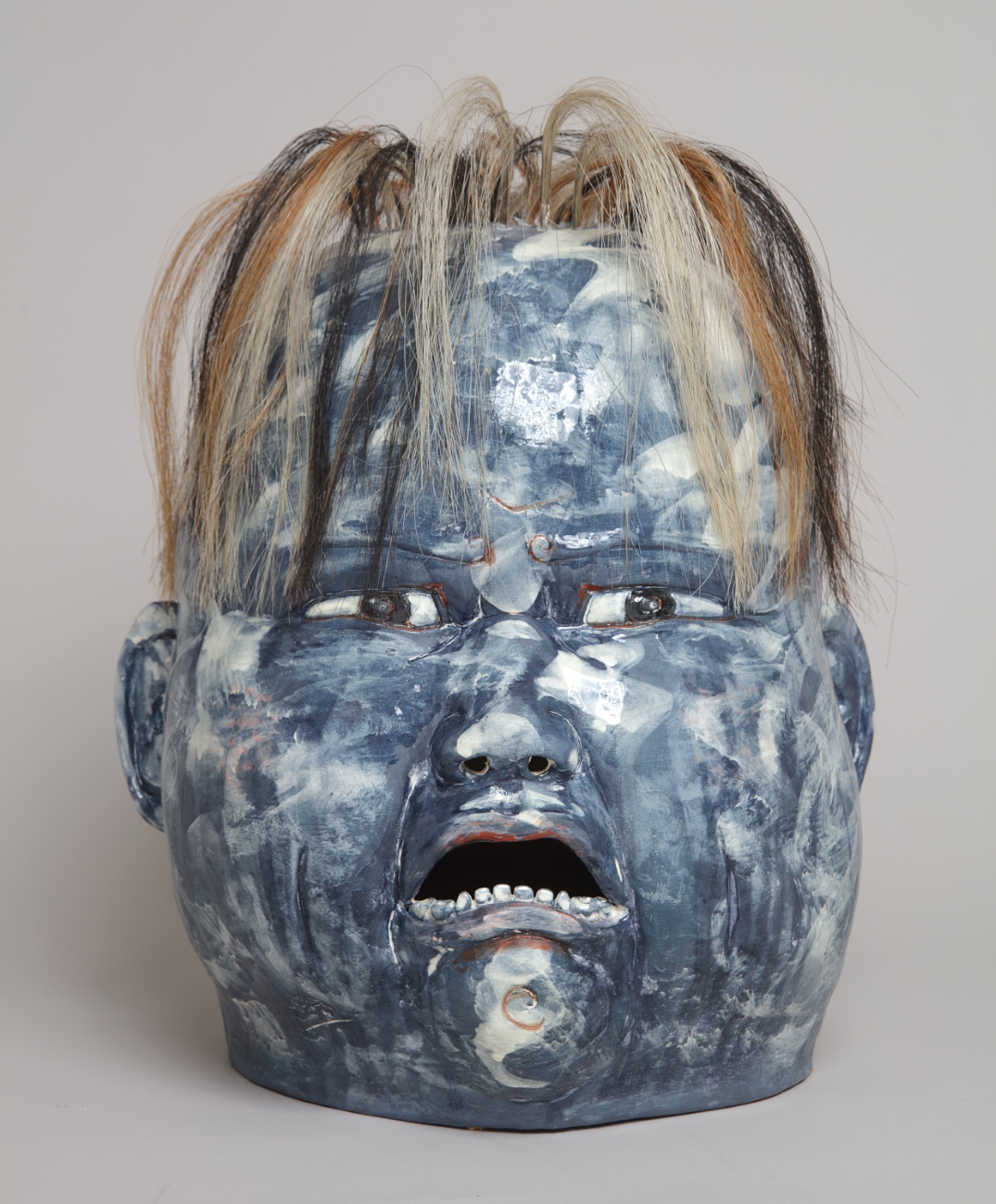
Most of Debra Sloan’s pieces are charming standing figures of young children whose expressive gestures are emphasized by wildly curling wire hair and patterned bodies. Most impressive are two heads, each approximately 50 cm. tall, which glare up at viewers from the floor. Colour Cascade sports colourful drips that run down the head from a crown of coloured wires. Covered in dark blue splotches and with teeth bared, a terrifying Blue in the Face groans ferociously. Sloan has used the figure throughout her career to explore human emotions and conditions. One can only imagine Blue in the Face responding to the ever-more-alarming news of the world that assaults us daily, but this angst is countered by the joy and vulnerability expressed by the smaller figures.
It is tempting to characterize Taiwanese artists one way and Canadians another. The truth, however, is more nuanced. We live in a global community, where artists travel and exhibit widely, and social media allows us to view work from anywhere in the world. Nonetheless, exhibitions such as Where Form Meets the Boundless are invaluable for forging connections between artists and communities. Similarities such as the sense of humour, humanity, and play in the work of Debra Sloan, Wei Cheng, and Shanyin Lee, or the precision, imagination, and animation shared by Amy Chang and Ming-Shun Cho encourage us to see widespread if not universal impulses shaping contemporary art. The respect for history, architecture, nature, and ornament in the work of Ming-Hsaing Hsu and Ying-Yueh Chuang underscores the importance of cultural knowledge and understanding. The psychological resonance of social rituals such as the sharing of tea deepens our admiration for the work Yu-Ying Huang, and the sense of awe in the face of fire’s power to transform both rock and ceramics sharpens our appreciation for the iconic works of Chen-Long Lin. Exhibitions such as this expand our appreciation for the role of ceramics in the world today.
Amy Gogarty lives in Vancouver on the unceded shared traditional territories of the Coast Salish Peoples. She earned her MFA in Painting from the University of Calgary and taught for 16 years at ACAD (now AUArts) in Calgary. She exhibited her work across Canada and contributed over 130 critical essays to journals and symposia in Canada and abroad. In 2006, she relocated to Vancouver, where she works as an artist and writer about ceramics, visual art, and craft.
Where Form Meets the Boundless was on view at Jig Art, Vancouver, Canada, between May 22 and June 3, 2026. Featured artists: Ming-Shun Cho, Yu-Ying Huang, Ming-hsiang Hsu, Shanyin Lee, Chen-Long Lin, Amy Chang, Wei Cheng, Ying-Yueh Chuang, Debra Sloan. Curated by Yumeng Li and Rachel Chen.
Captions
- Chen-Long Lin, Stone Reborn, 2025, 15 x 9.5 x 20 cm
- Yu-Ying Huang, 2026, tea set with Lavender Fields glaze
- Ming-Hsaing Hsu, Flying Lion Teapot, 2026, 14 x 19 x 14 cm
- Shanyin Lee, I don’t want to get up, 2025, 18 x 16 x 17 cm
- Ming-Shun Cho, Platinum Cyborg-Y, 2023, 15 x 7 x 14 cm
- Amy Chang, Air Craft no. 2, 2026, 52 x 23 x 13 cm
- Ying-Yueh Chuang, Seed Creature (Blue, Red, Yellow), n.d. 13 x 5 x 9 cm
- Ying-Yueh Chuang, Flower Pod 1, n.d. 16 x 16 x 10 cm
- Wei Cheng, Catch the Unicorn (detail), 2026, 13.5 x 13.5 x 9.5 cm
- Debra Sloan, Blue in the Face, 2025, 56 cm H by 114 cm C
- Chen-Long Lin, selected works. Left to right: Clay Rhythm–Square Teapot, 2018; Stone Reborn, 2025; Clay Rhythm—Round Teapot on Earth Series—Tea Tray, 2025-26.
- Yu-Ying Huang, general view of tea wares, various glazes, 2025-26.
- Ming-Hsaing Hsu, general view of work, 2020 – 2026.
- Ming-Shun Cho, general view of work. Left to right: Alchemy—F, 2020; Mountain Tree—Rise, 2025; Free Roaming—Ineffable, 2021; Cruise—Ti, 2020; Free Roaming—Stability, 2023.
- Wei Cheng (left), Catch the Unicorn, 2026; and Ming-Shun Cho (right), Download, 2010 and Sail Silhouette, 2017.
- Debra Sloan, general view of work. Left to right: Head in Clouds, Blossoms, Head and Shoulders 1, Horse & Rider, Head and Shoulders 2.