By Sarah Walko
Roxanne Jackson’s ceramic sculptures and installations are created as singular forms, some composed of multiple parts, yet they are not singular objects. They function more like words within a larger narrative: together they form a sentence, a paragraph, a chapter, and ultimately an exhibition that unfolds as a complete mythological tale. It is a narrative filled with birth and death, destruction and resurrection, sacred objects and trash, violence and rapture. If this exhibition were a book, it would belong equally on the shelves of fantasy, horror, dystopian fiction, history, and magical realism.
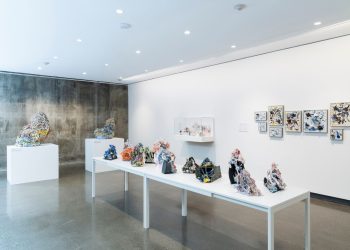
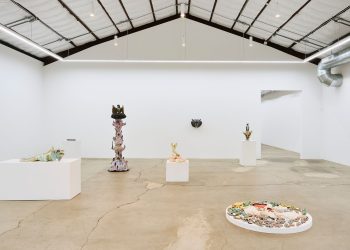
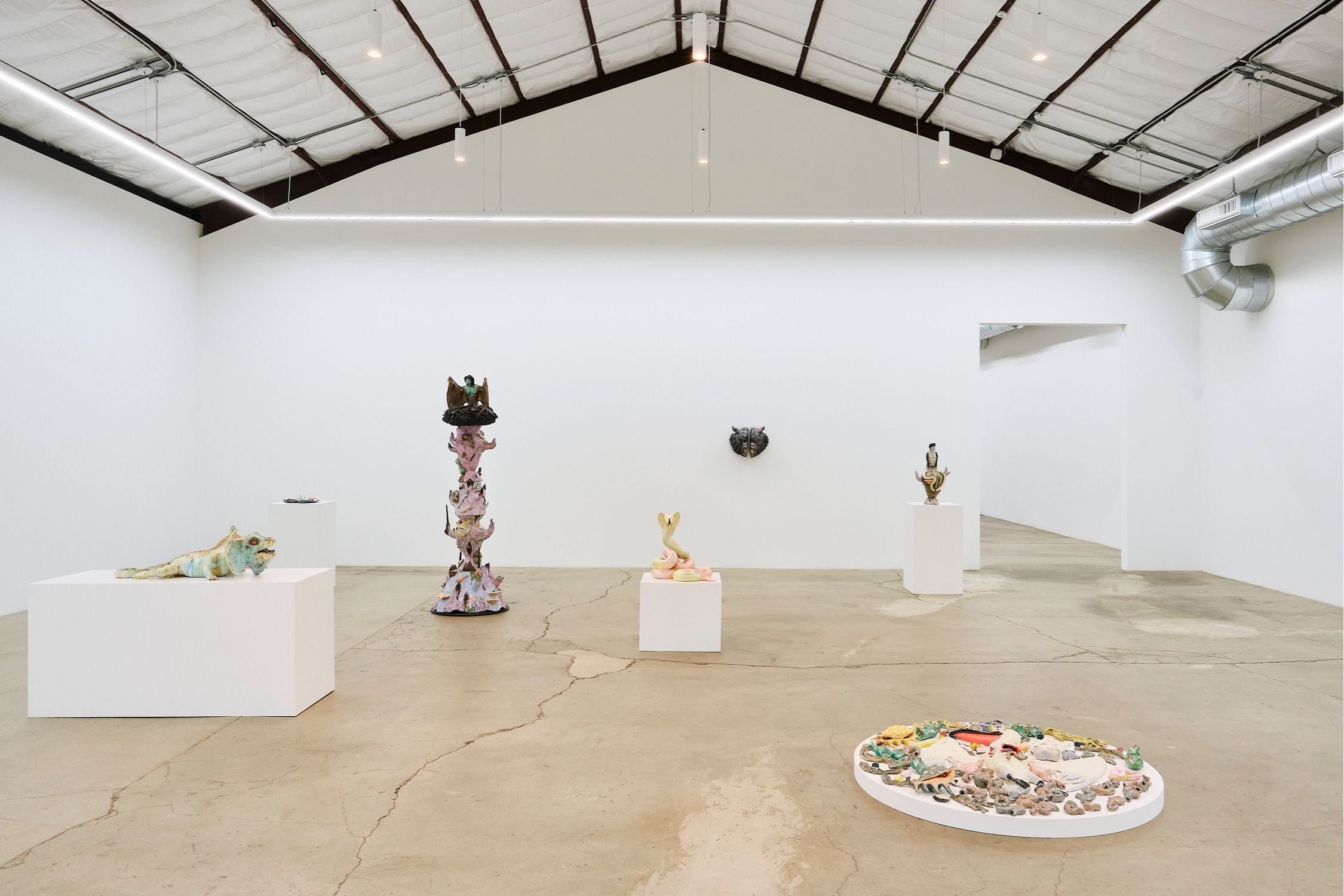
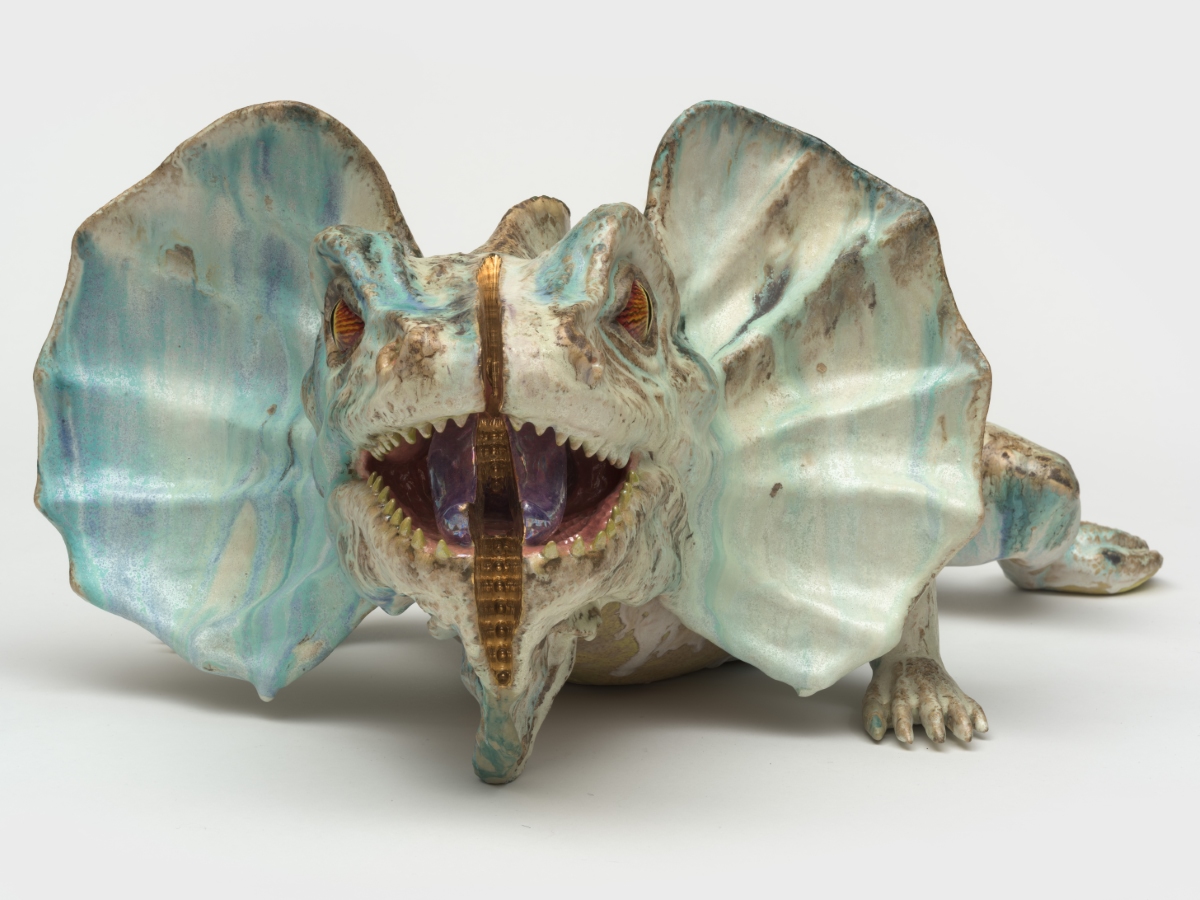
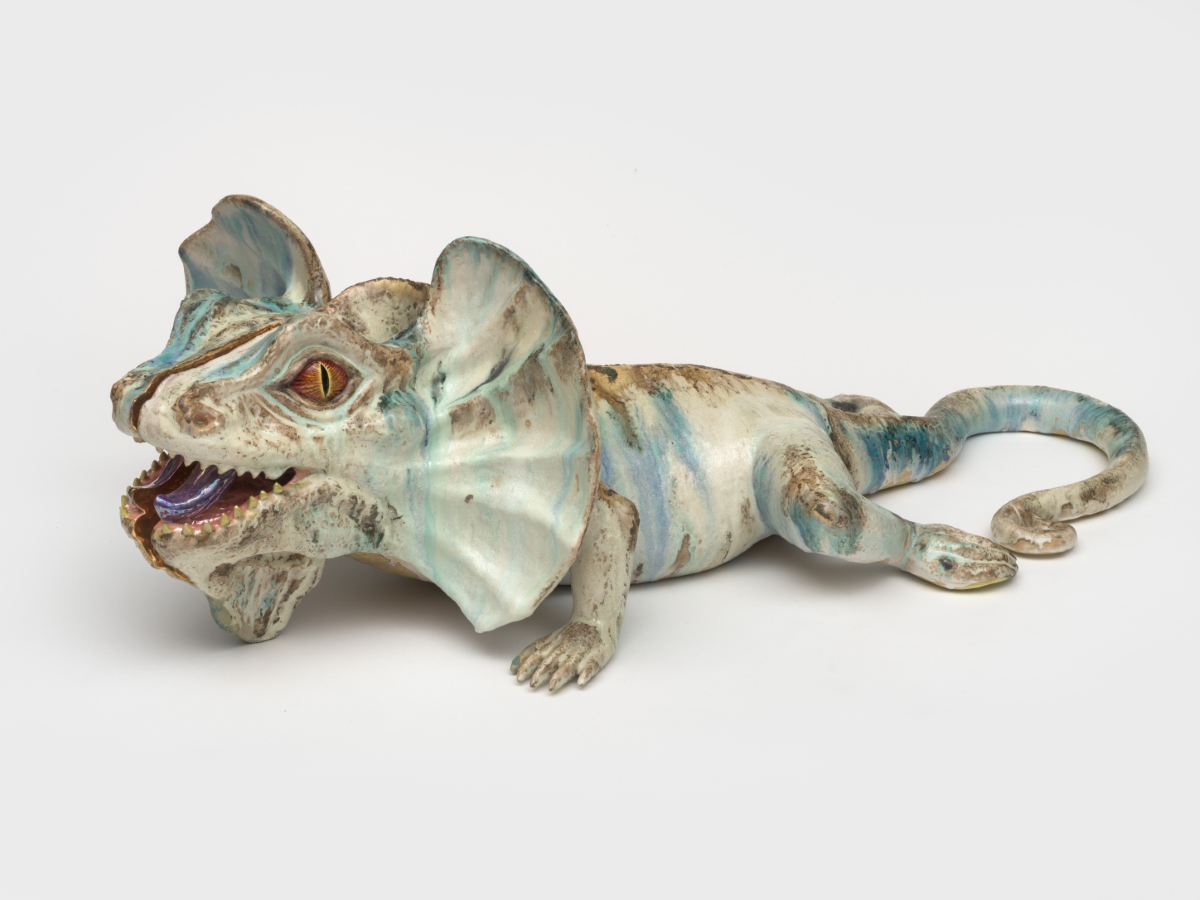
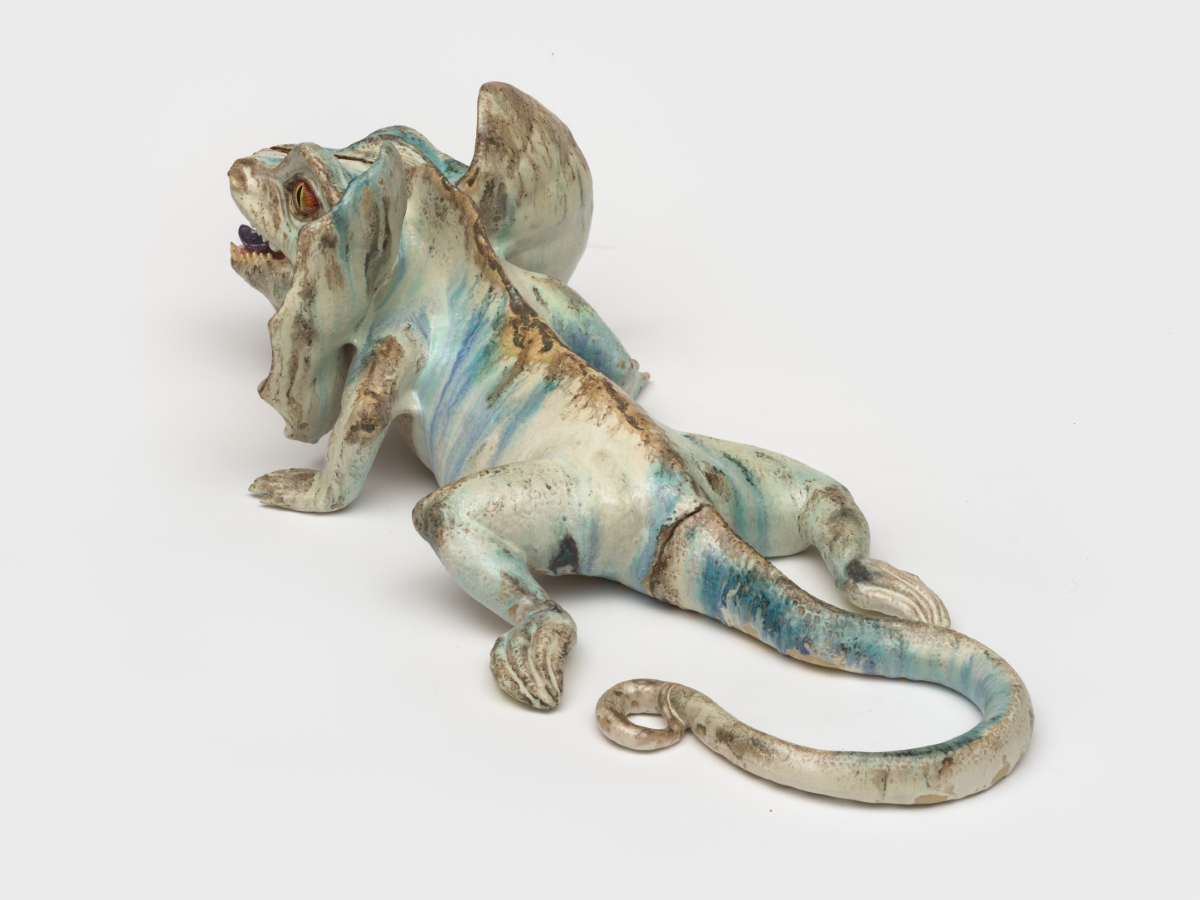
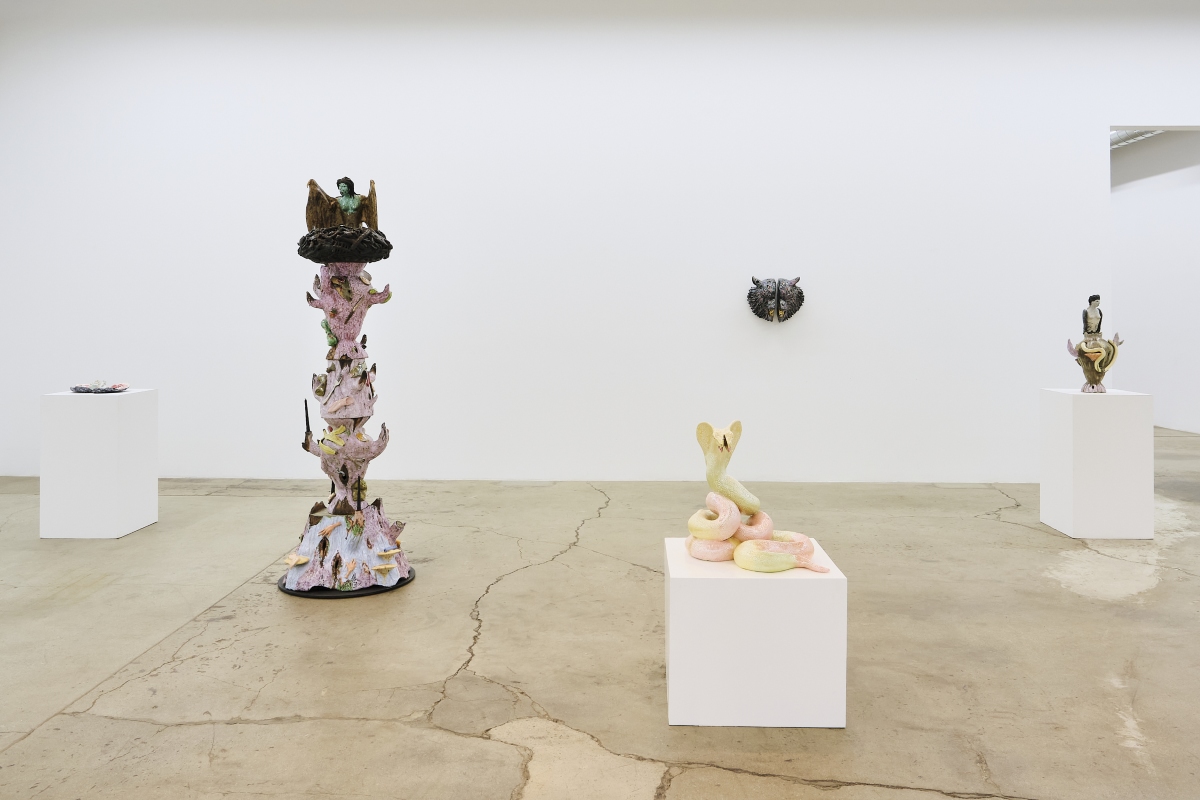
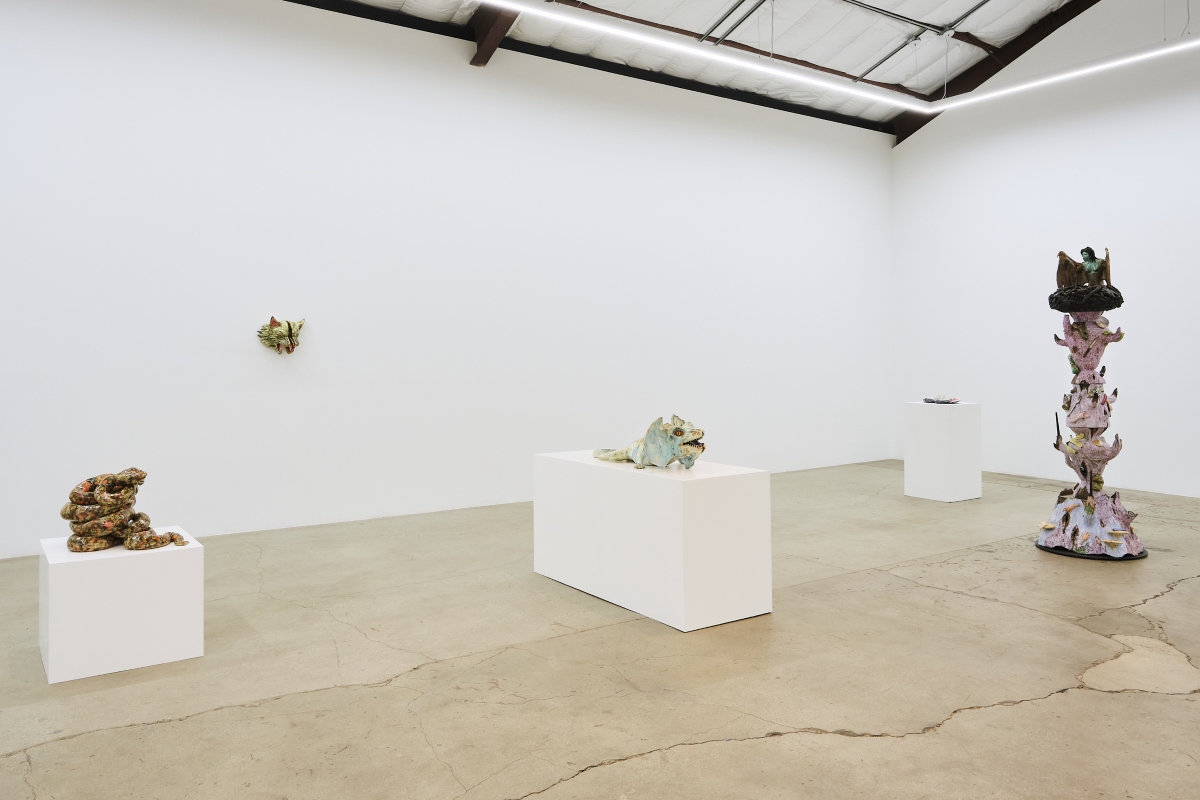
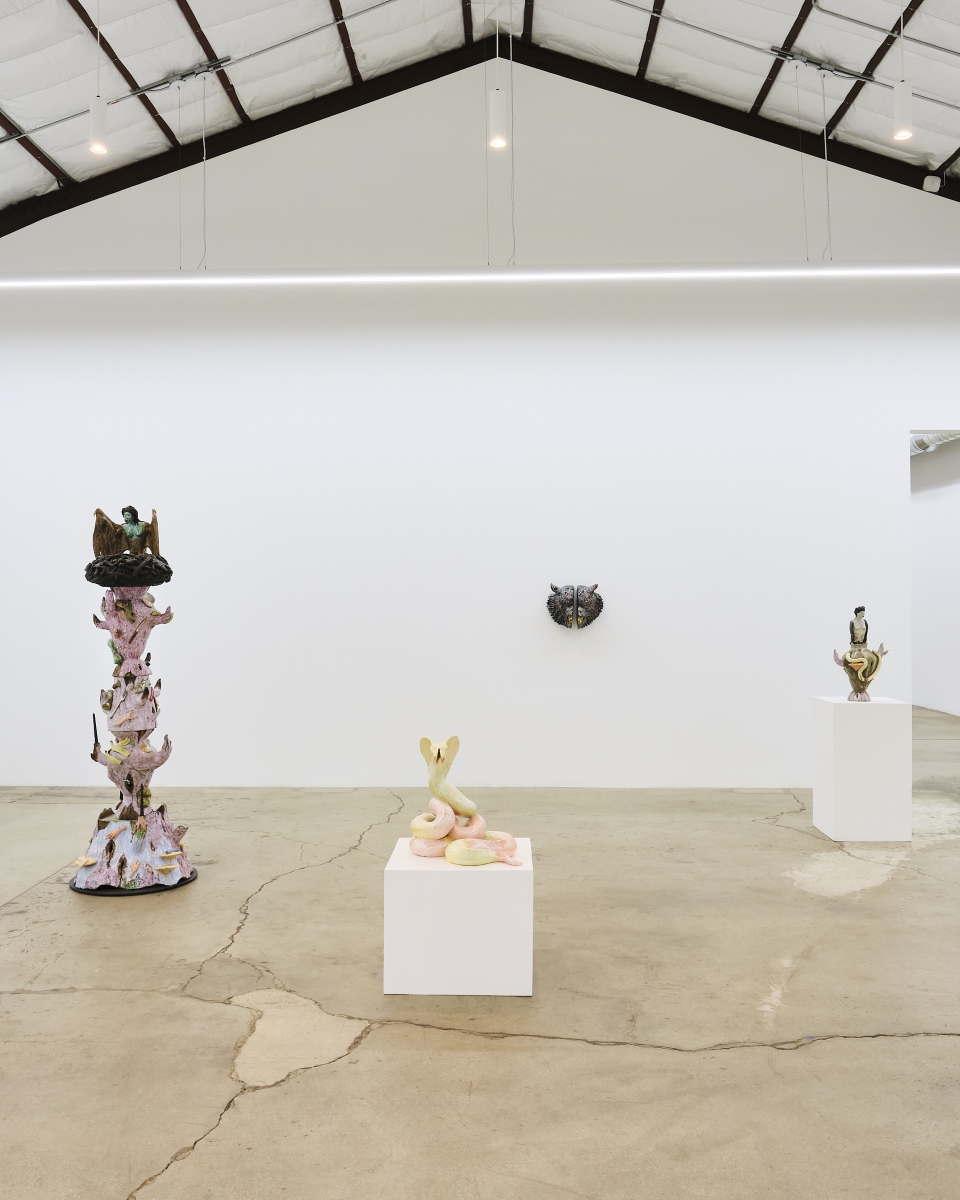
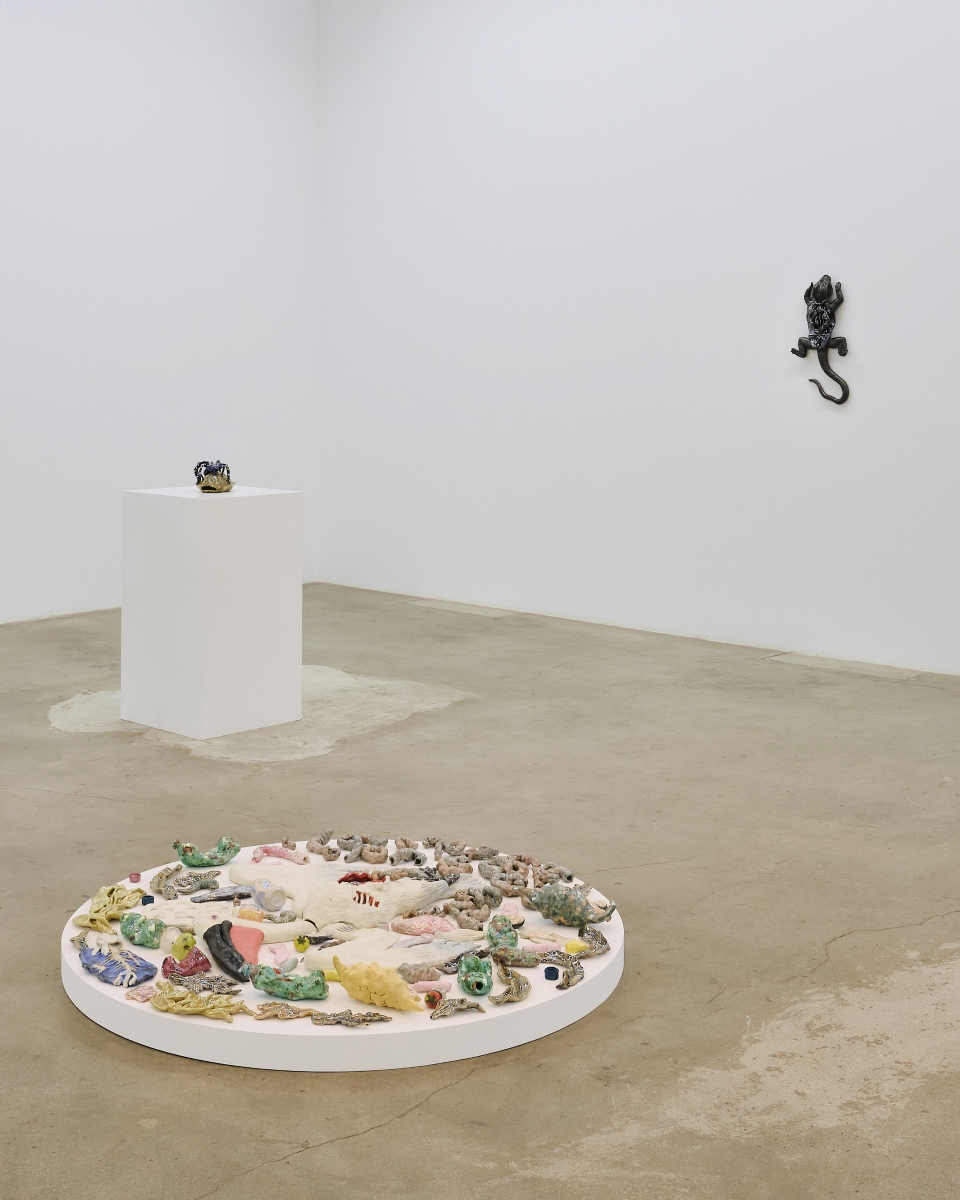
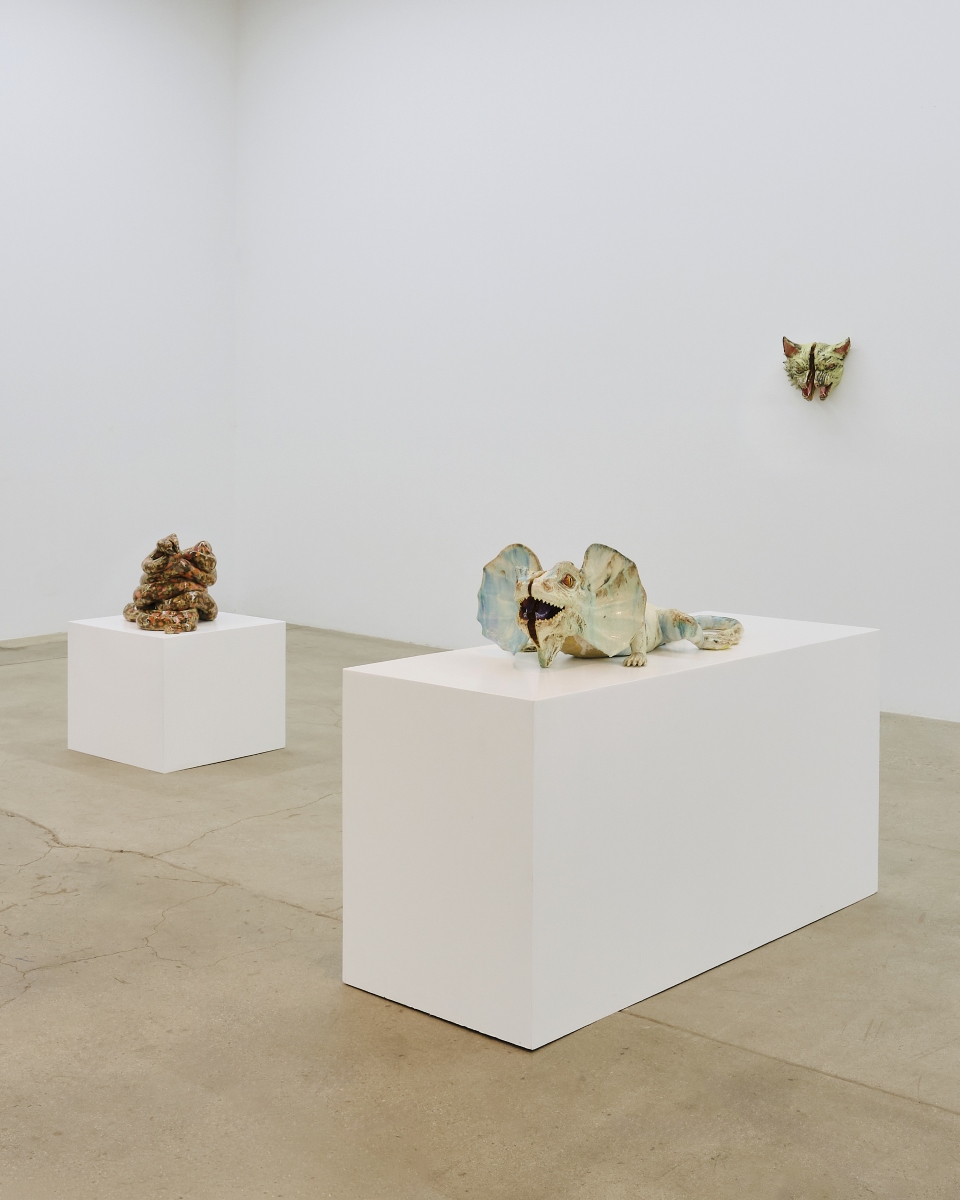
Most of the sculptures, depicting various animals, objects, and a monster drawn from Greek mythology, are displayed on pristine white pedestals, creating a stark contrast to the elaborate, ornate, and maximalist aesthetic for which Jackson is known. A flayed lizard and two split feline heads hang on the wall, while a floor sculpture rises to seven feet in height. As viewers move among these works, countless questions emerge, perhaps the most central being: What happened here? The story is presented and the spaces left for interpretation are marvelously expansive. The exhibition invites us to inhabit those gaps, imagining our own connections, causes, and consequences within Jackson’s constructed world.
Any consideration of a Roxanne Jackson exhibition must also contend with her craftsmanship. The lustrous glazes that shimmer across the surfaces of vessels and creatures, the ambitious complexity of the sculptural forms, and the painstaking attention lavished on even the smallest details all speak to an artist deeply attuned to her material. Whether rendering a monumental creature or a seemingly incidental object, Jackson brings the same level of care and precision, creating works whose technical sophistication equals the richness of their narrative worlds.
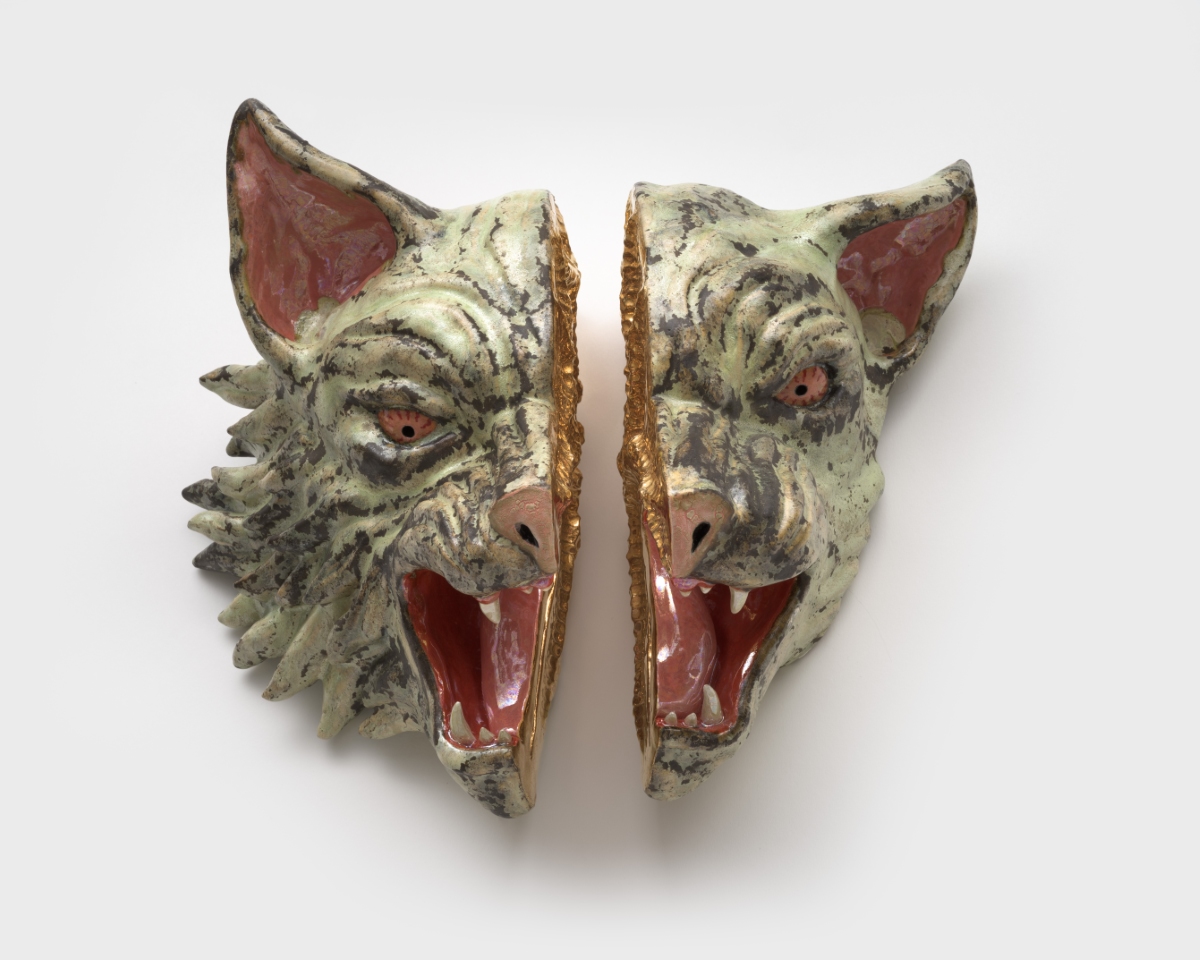
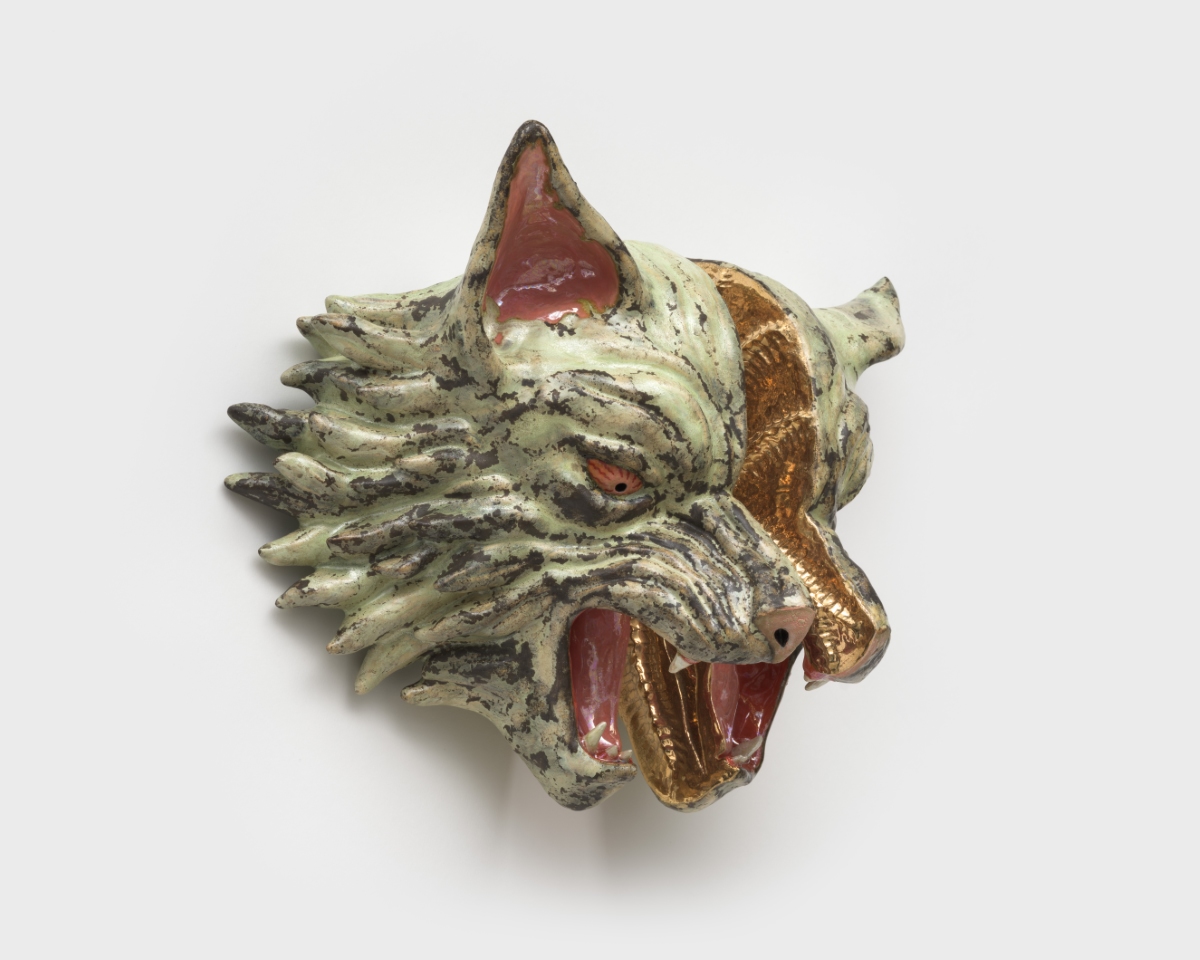
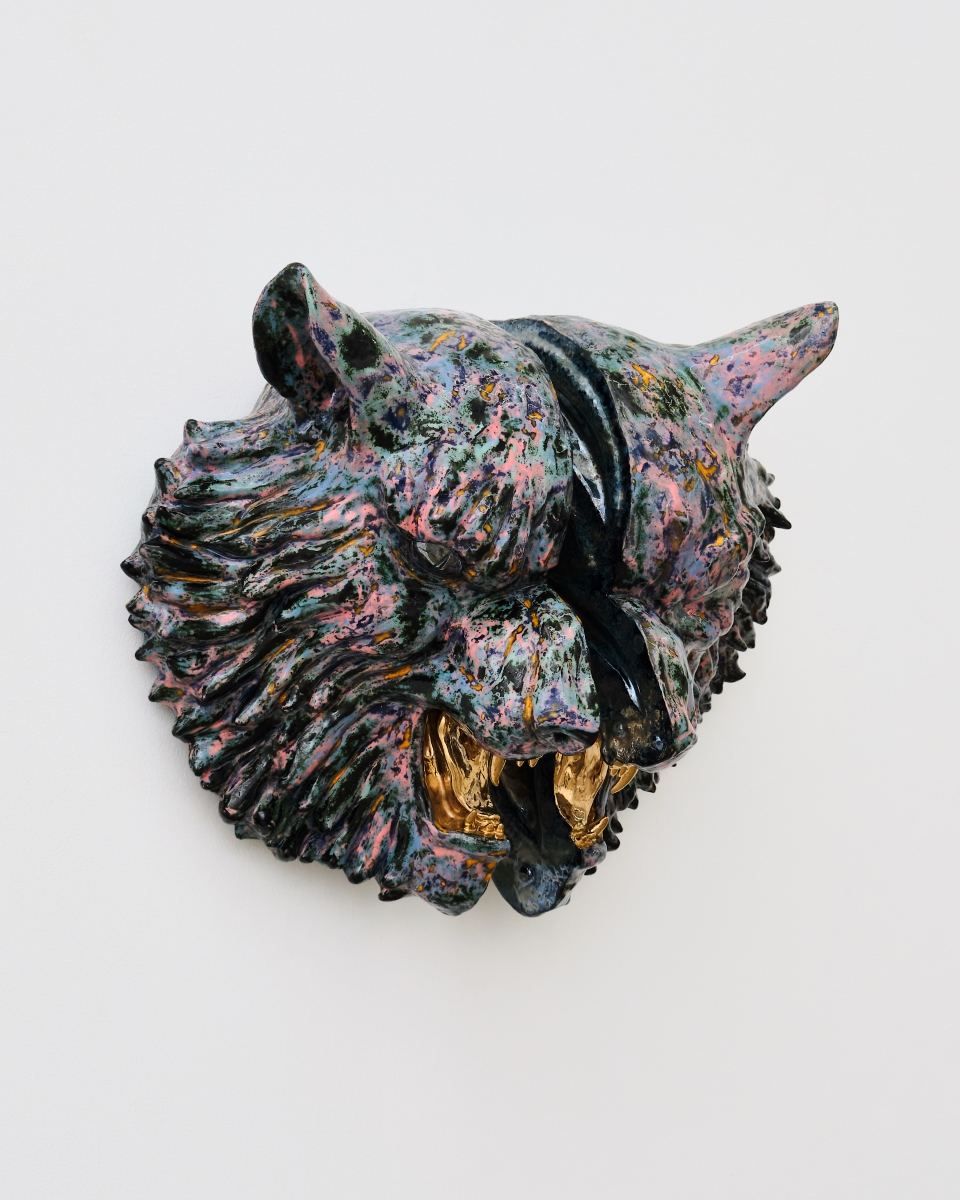
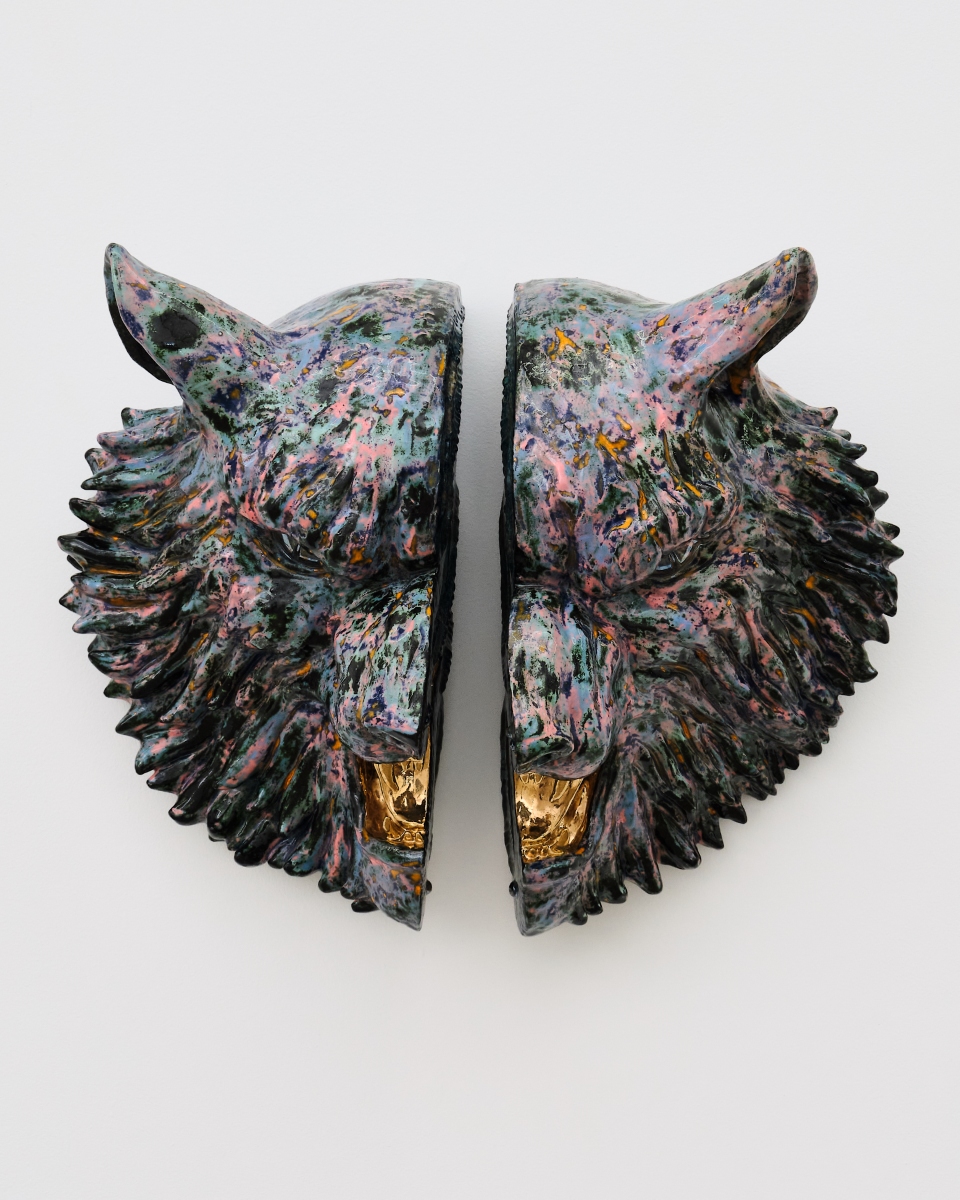
The two split-skulled feline sculptures, Split Feline and Gilded Maw, depict fractured heads suggesting both fissure and revelation: a volatile transformation, or perhaps something long dormant breaking through from within. They appear as creatures caught in a state of becoming, neither fully alive nor entirely extinct. At the same time, they evoke guardians of hidden knowledge, their consciousnesses forcibly opened to expose what would normally remain concealed. The exposed interiors invite us to consider what lies beneath the surface, whether memory, trauma, wisdom, or instinct. The sculptures also call to mind the severed head of Medusa, which retained its power even after death. Like that ancient relic, these felines seem to possess an enduring agency, their wound transformed into a source of potency rather than defeat. The savageness of their division is inseparable from their authority, suggesting that knowledge, transformation, and power often emerge through acts of rupture.
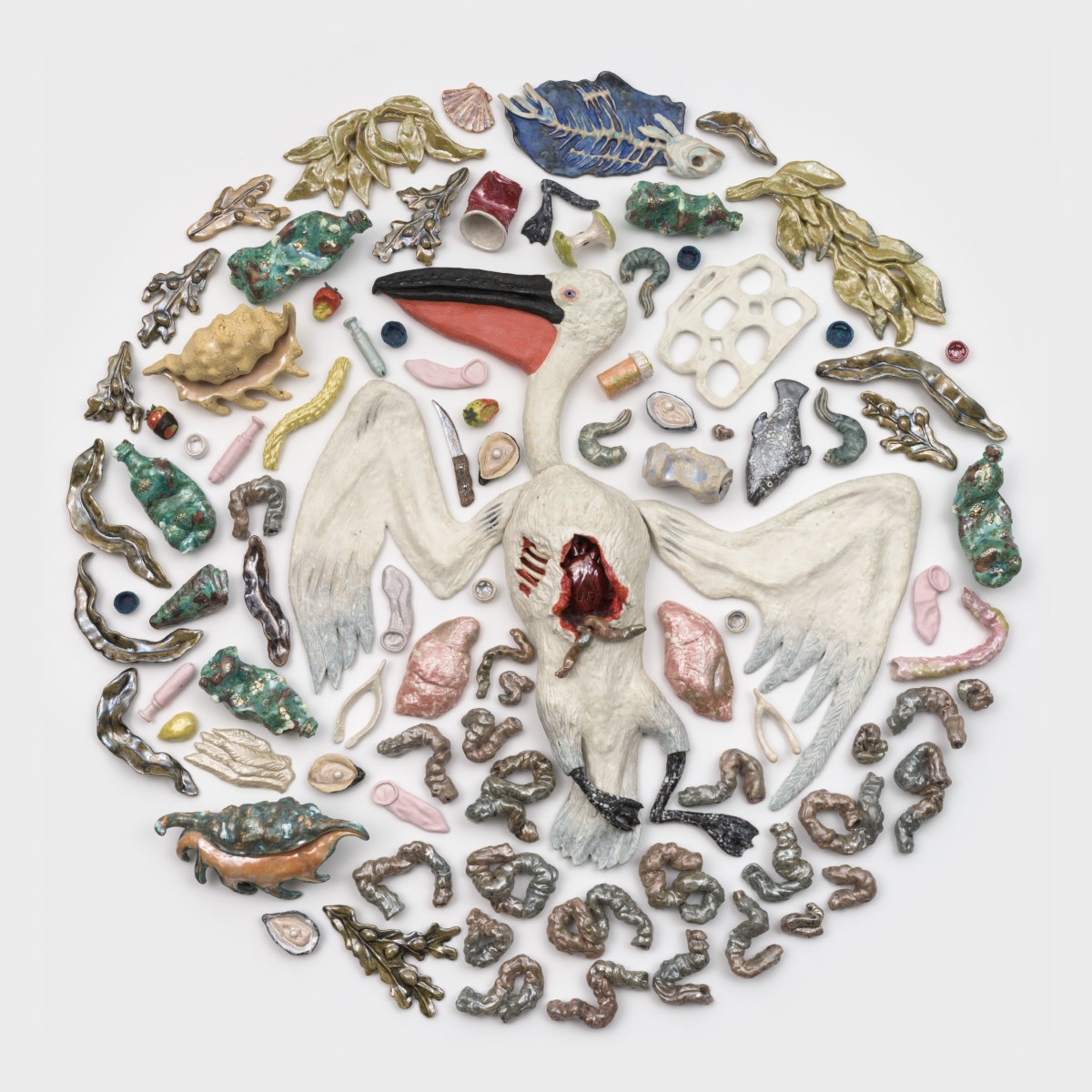
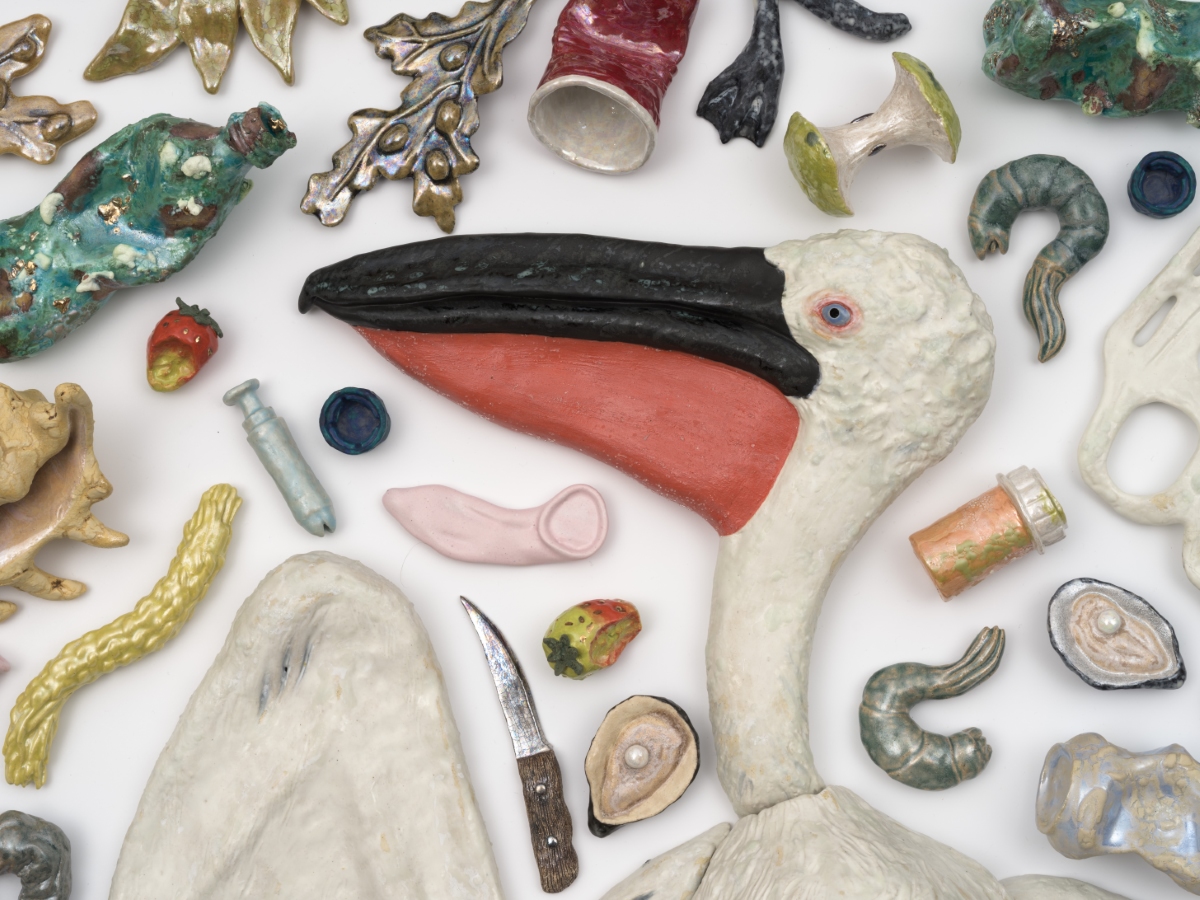
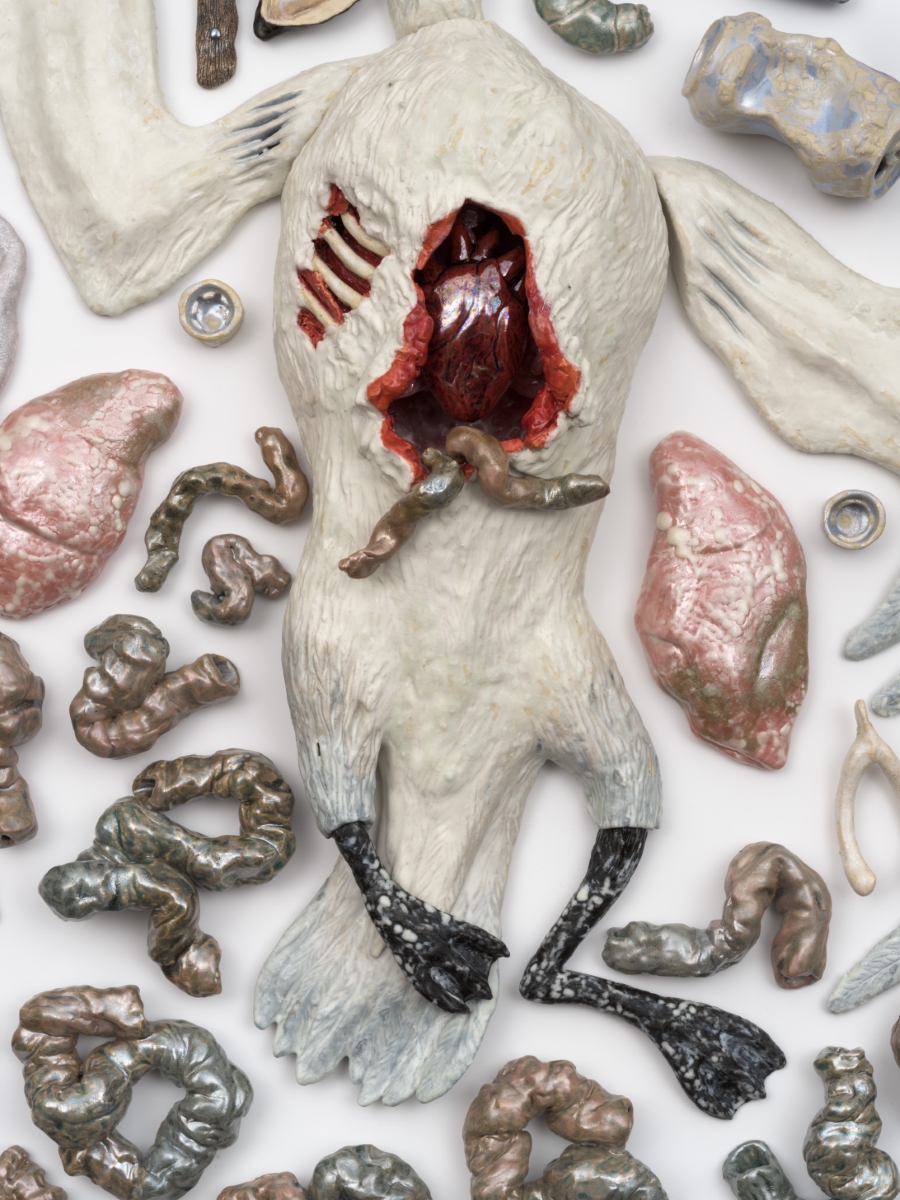
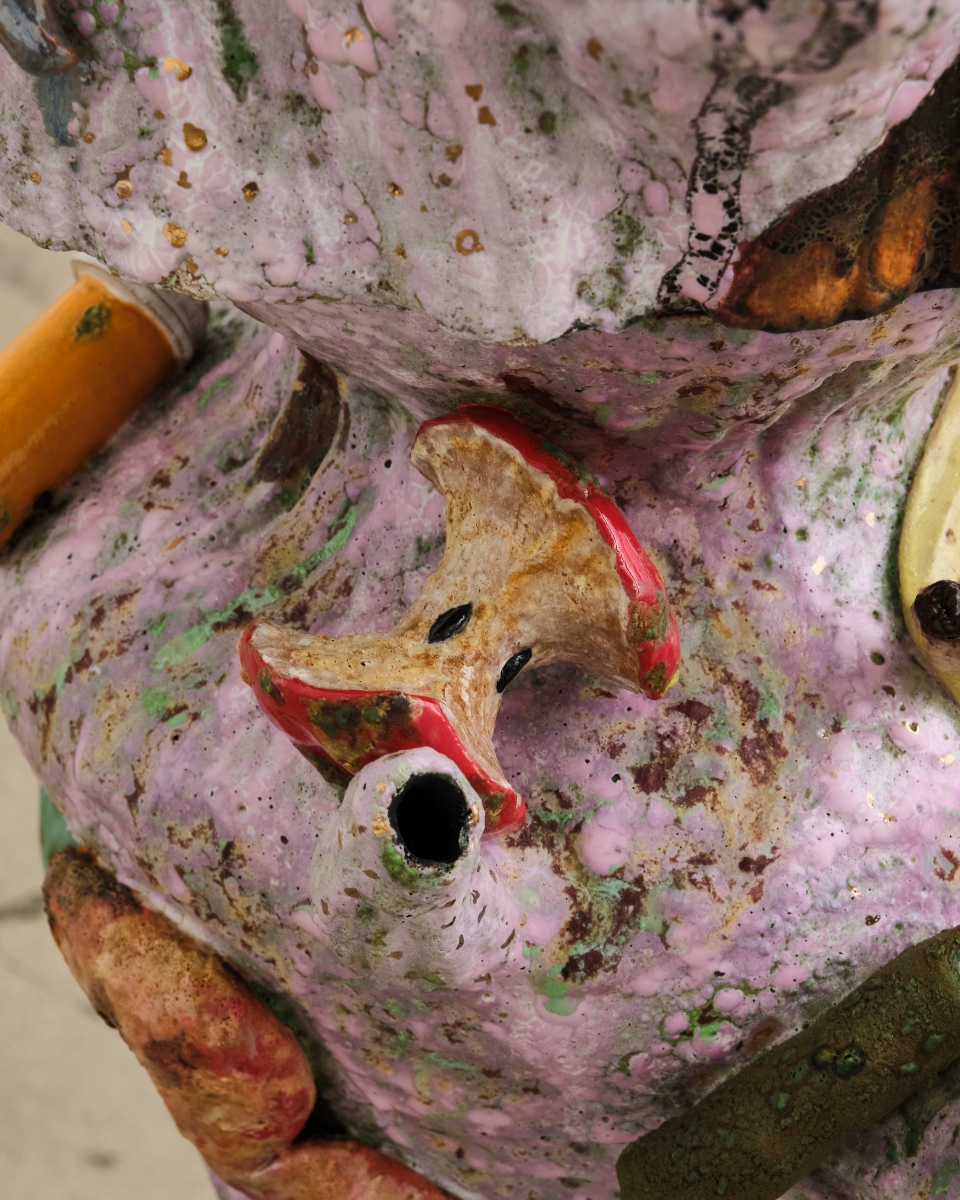
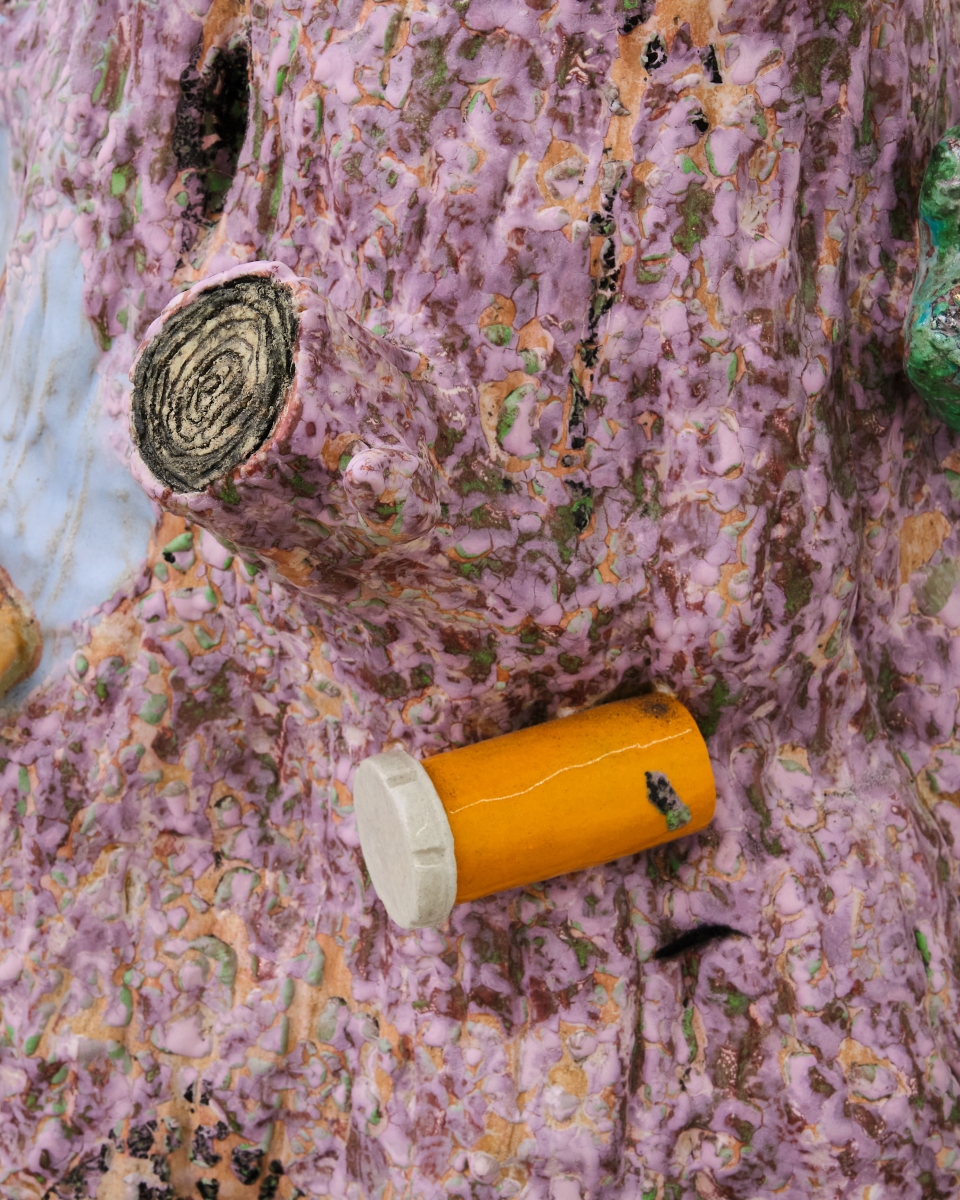
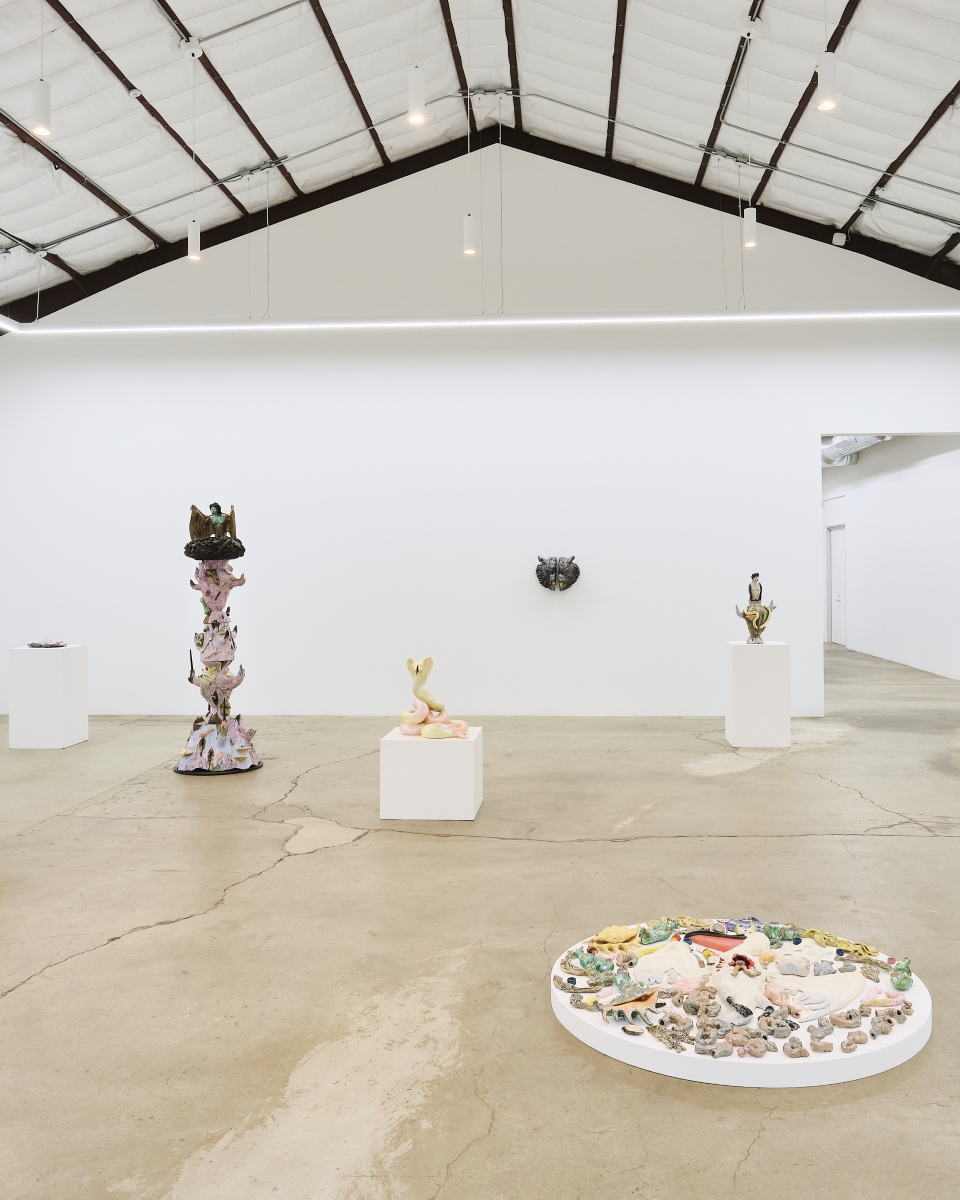
One particularly arresting installation centers on a pelican whose body has been opened, its innards spilling across the surface of a low circular pedestal. Surrounding the bird are objects one might expect to find in or near the water: a seashell, a fish, a fish skeleton, shrimp, seaweed, and oyster shells. Interspersed among them are the traces of human presence: an eaten apple core, plastic bottles, fragments of packaging, aluminum cans, empty medicine bottles, tampon applicators, condoms, and partially eaten strawberries. Completing the tableau are objects that suggest a more sinister narrative, including a knife and additional organs placed alongside the pelican’s exposed viscera.
The pelican occupies the center of the composition while the surrounding objects are carefully spaced around it, transforming the pedestal into something akin to an altar, an archaeological display, or the site of a funerary ritual. Refuse, animal remains, consumer debris, and sacred offerings are granted equal status. Nothing appears ancillary. Each object seems imbued with significance, as though participating in a ceremony whose meaning has been forgotten but whose power remains intact. The piece resonates with what author Sophie Strand describes as “the animate everything,” a worldview in which animals, objects, bodies, histories, and myths are not inert symbols but active participants in a living network of relationships. The sculptures possess an uncanny agency. The pelican is not simply a victim, nor merely an ecological allegory. It becomes a conduit through which multiple stories converge: consumption and waste, sacrifice and desecration, mortality and renewal. The fish skeleton, the oyster shell, the discarded needle, and the plastic bottle all seem equally alive within the narrative logic of the work.
Also in this installation, the boundaries separating nature from culture, the sacred from the profane, and life from death are dissolved. The pelican’s opened body functions almost as a portal, exposing a world in which all things are connected through cycles of use, decay, transformation, and rebirth. It presents a mythology of entanglement, where every object, whether organic or manufactured, carries its own history and participates in a larger story about what humans leave behind and what the world remembers and asks us, startlingly, to slash our human superiority complex, as it’s creating quite a mess.
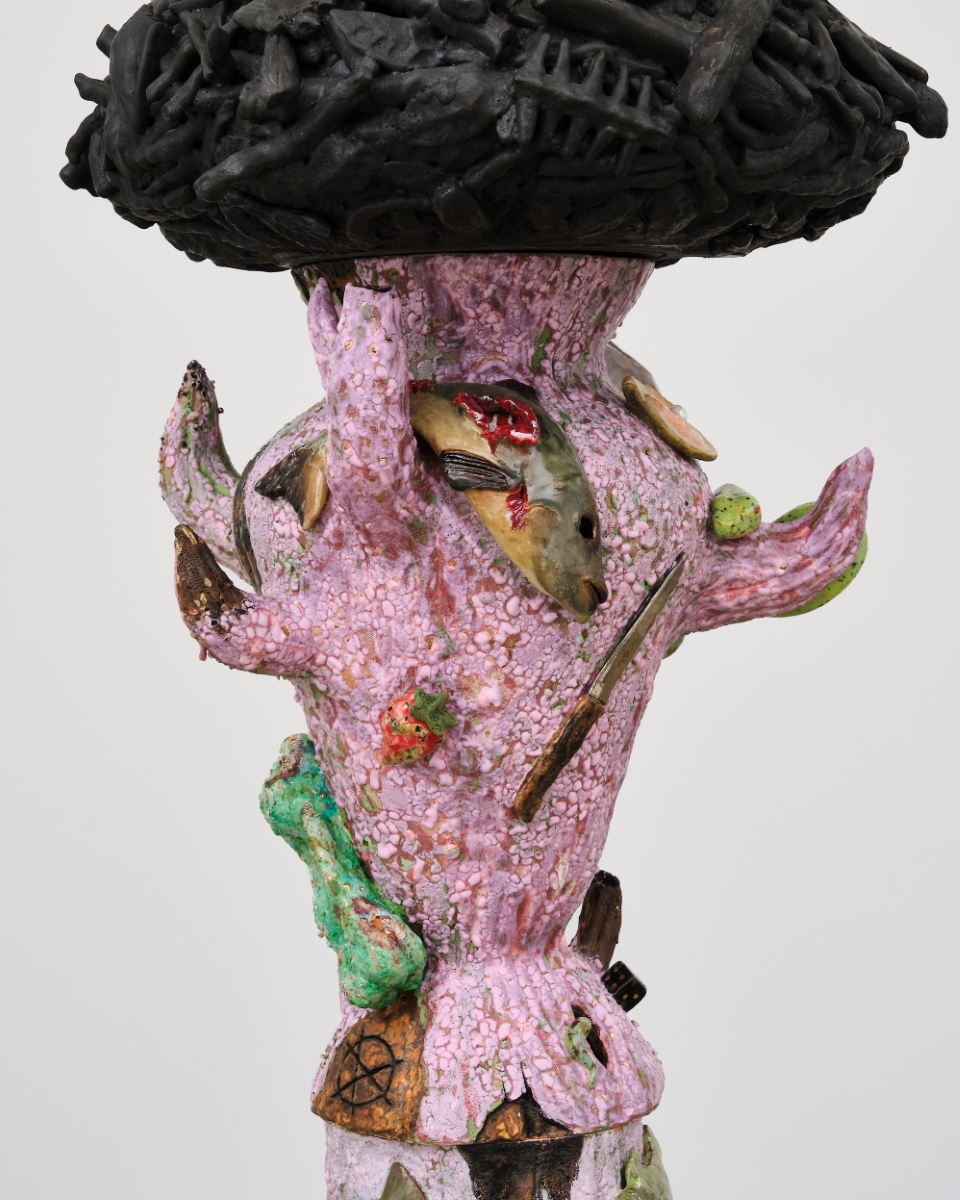
Perched atop the exhibition’s seven-foot-tall sculpture is a harpy in her nest, one of the most infamous creatures of Greek mythology. Traditionally depicted as part woman and part bird, harpies occupied a liminal position between the earthly and divine realms, serving as agents of punishment, messengers, and beings associated with sudden disappearance and ferocious transformation. Their names reinforce these associations: Aello, storm-swift, Ocypete, swift-wing, and Celaeno, the dark one. Like personifications of weather itself, they embodied forces that could not be controlled, only endured. In Ovum, however, the harpy feels less like a monster than a sentinel. Elevated above the other sculptures, she occupies a position of watchfulness, surveying the strange landscape that unfolds below. Her presence brings together many of the exhibition’s recurring themes: flight and earth, life and death, destruction and renewal, myth and material reality. The harpy is resonant within an exhibition populated by wounded creatures, discarded objects, relics, and evidence of transformation. In Greek mythology, harpies often arrived in moments of transition, carrying away souls, food, or even people. They functioned as intermediaries between worlds. Jackson’s harpy appears to serve a similar role, bridging different states of being. It overlooks a mythology where creatures are split open, shells are abandoned and reoccupied, and bodies continually shift between decay and regeneration.
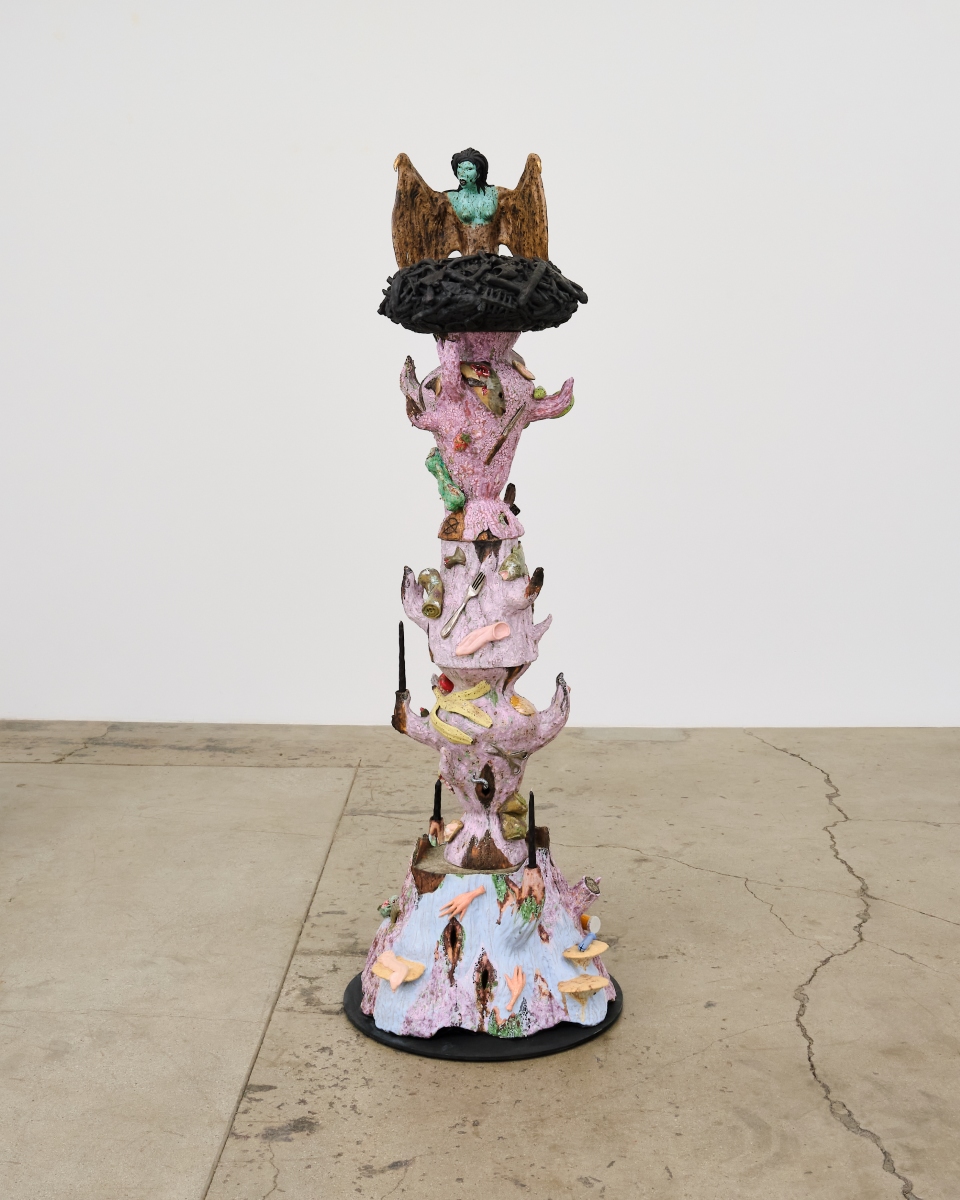
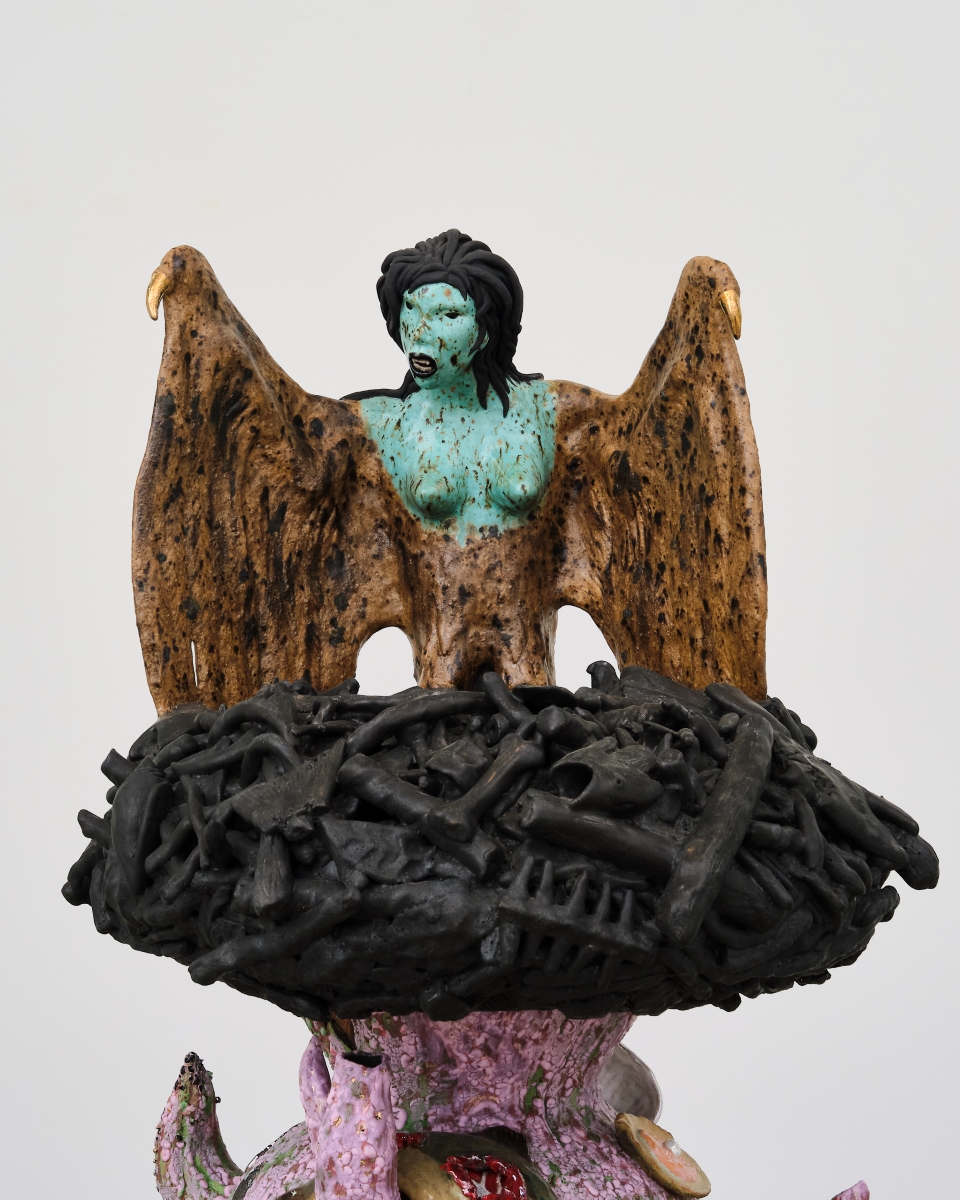
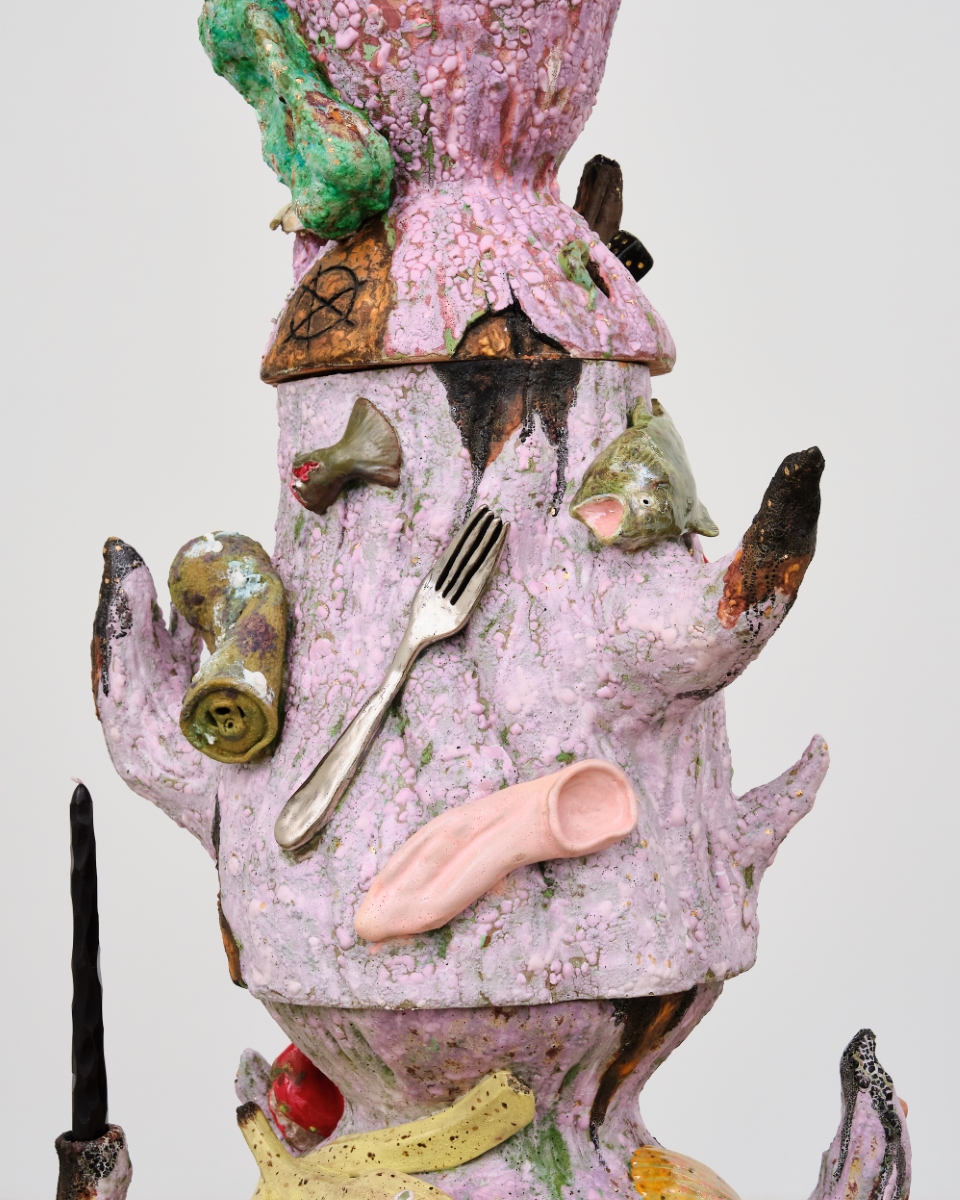
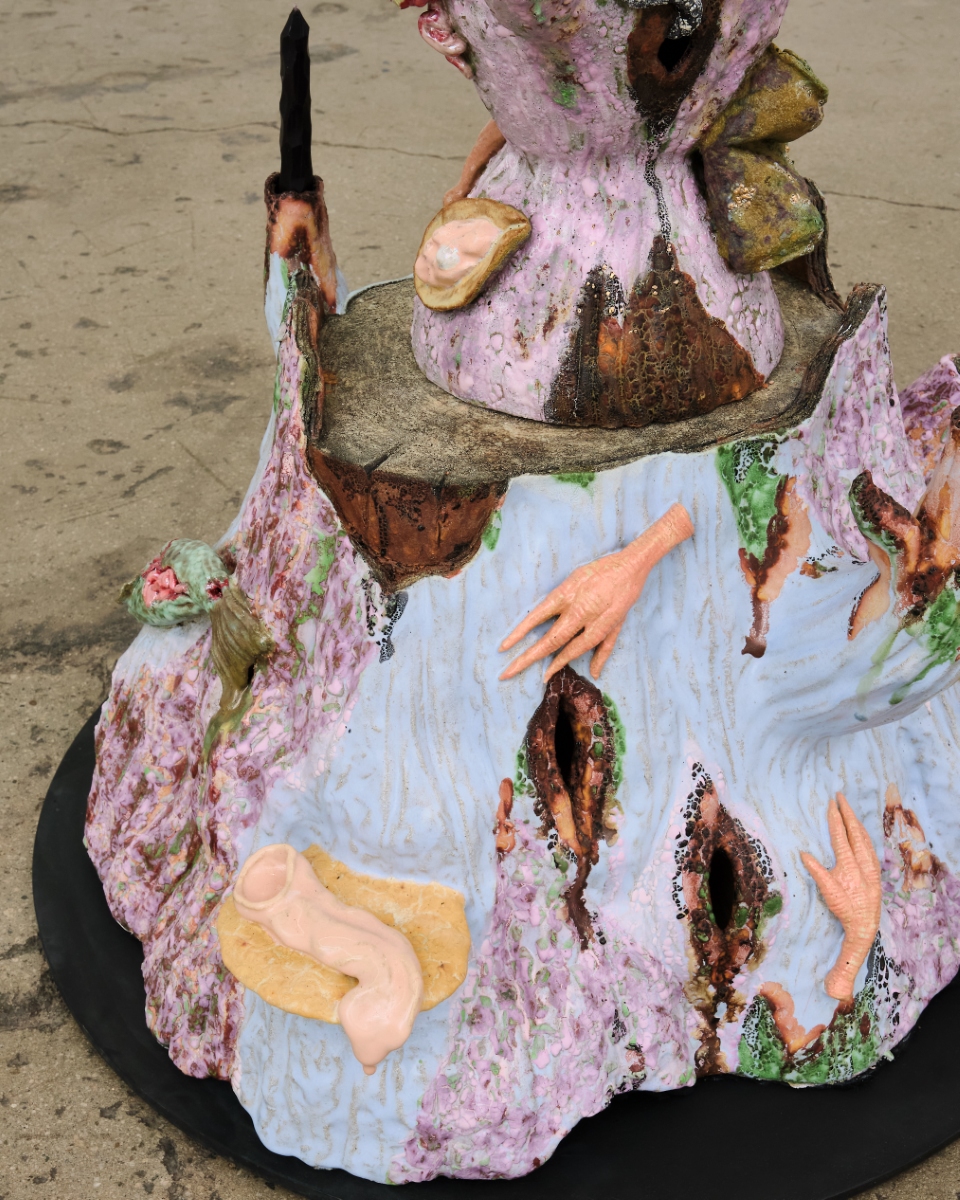
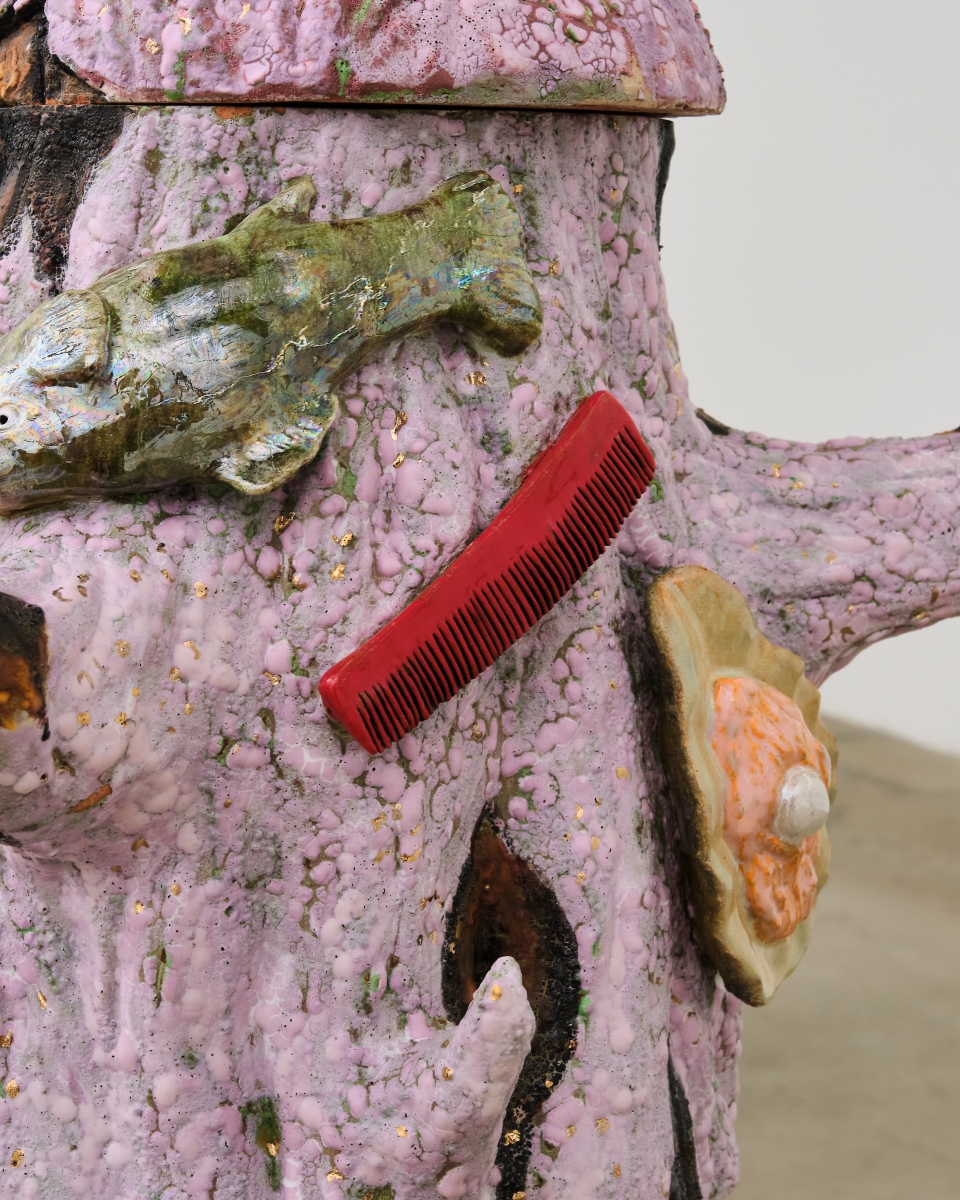
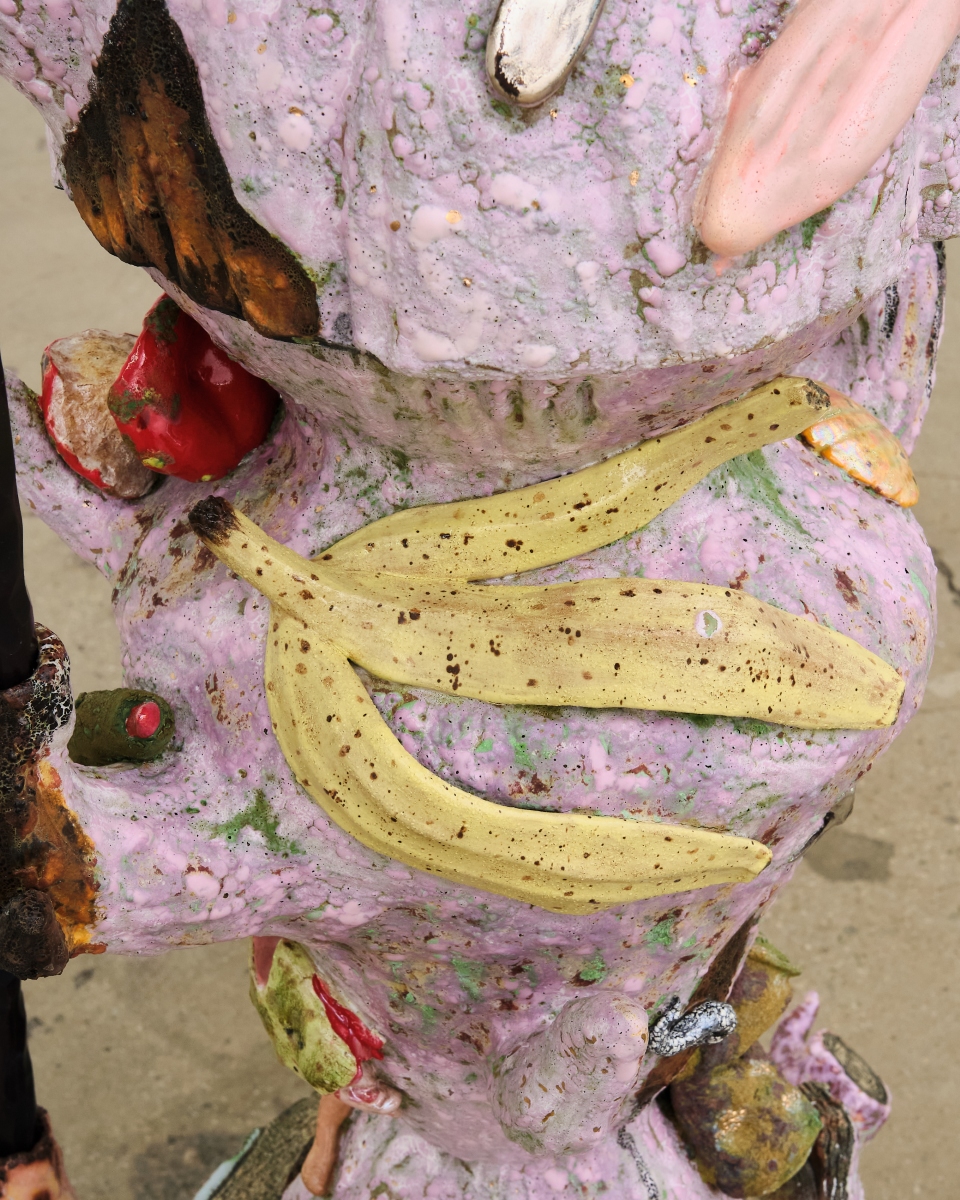
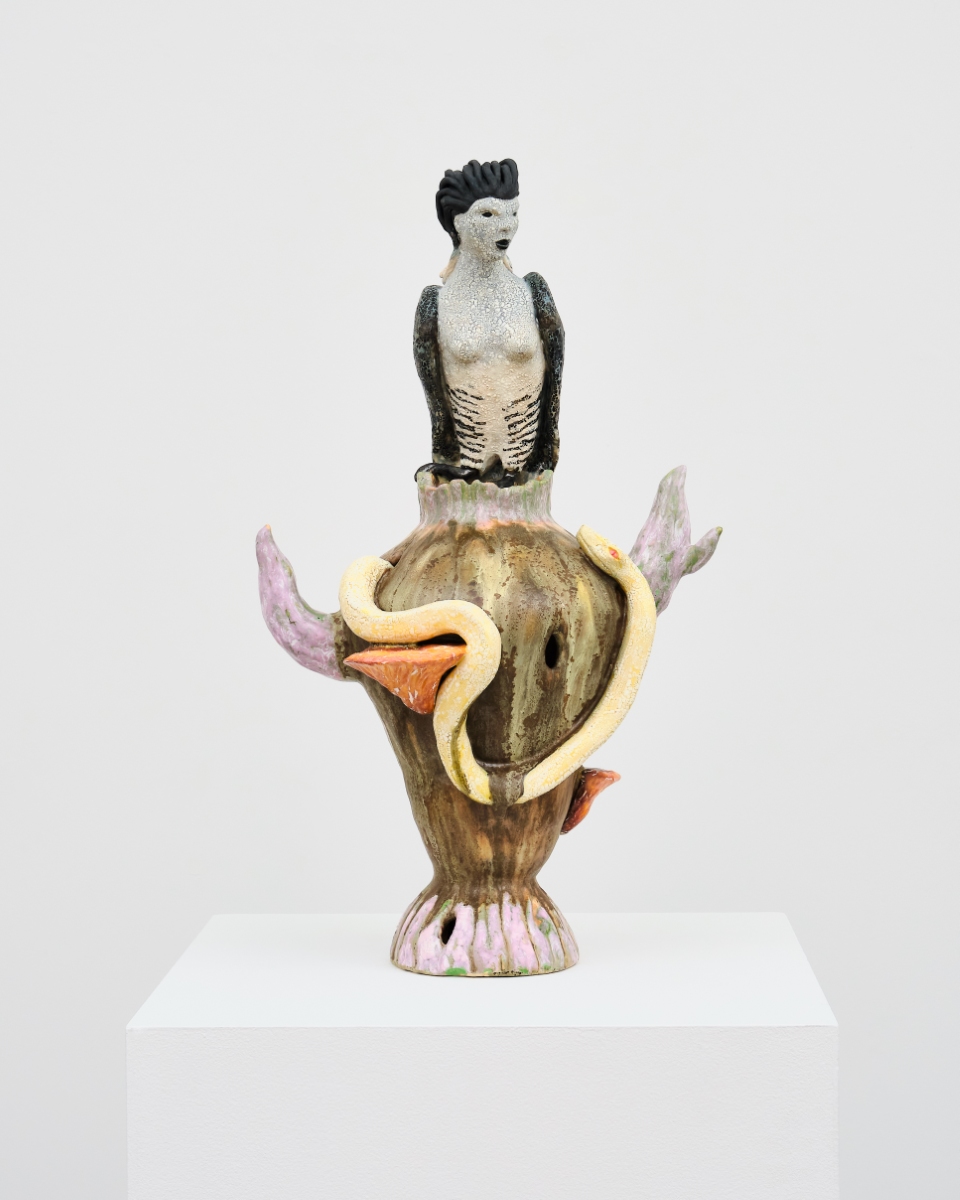
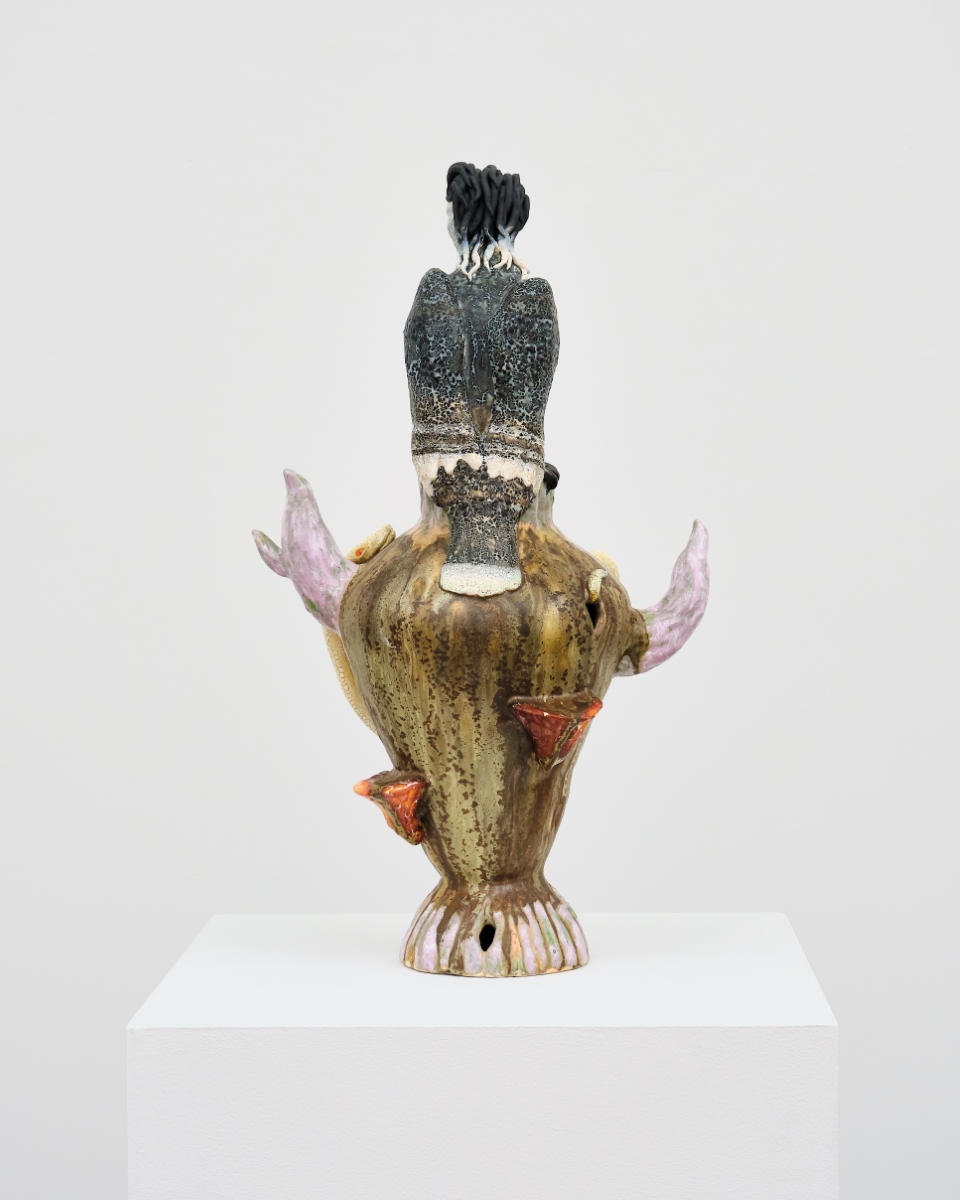
Seen in relation to the exhibition’s broader themes, the harpy may also be interpreted as a guardian of deep time, arriving from a past that remains strangely alive in the present. Its perch atop the sculpture transforms it into a kind of witness, surveying the cycles of creation and destruction that animate this world. Neither entirely benevolent nor threatening, it embodies the exhibition’s refusal of clear distinctions. If the Ovum suggested by the exhibition’s title represents the potential for life and creation, the harpy seems to represent the midwife here for what emerges after birth: the unpredictable forces that shape destiny, transformation, and survival. Positioned at the apex of the exhibition, she becomes both messenger and oracle.
Another compelling work features a tarantula perched atop an empty turtle shell. Across cultures, the spider is associated with fate, weaving, hidden knowledge, and the unseen forces that connect all things. The tarantula in particular carries an added sense of unease, evoking fear, mystery. As a maker of webs, it becomes both architect and storyteller, spinning connections between disparate worlds. The turtle shell beneath it, associated with creation myths, endurance, protection, and longevity, often symbolizes the earth itself, a being that inhabits both land and water and mediates between realms. Here, however, the shell is empty. Its former inhabitant is absent, leaving behind only a protective architecture, a home transformed into a relic. The relationship between the two forms suggests a cycle of succession rather than extinction. The spider occupies the abandoned shell not as a conqueror but as a continuation, repurposing an old world as the foundation for a new one. The sculpture evokes an image of something emerging after catastrophe, patiently weaving fresh connections across the remains of the past. Together they embody a recurring theme throughout the exhibition: that endings are never absolute. What appears abandoned, broken, or extinct remains available for reimagining. Like many of Jackson’s creatures, this hybrid pairing seems to exist between worlds, part archaeological remnant, part mythological messenger, quietly spinning a future from the materials of the past. It also brings to mind the author Rebecca Solnit quote on climate change, “People have always been good at imagining the end of the world, which is much easier to picture than the strange sidelong paths of change in a world without end.”
The exhibition’s title, Ovum, is one of humanity’s most enduring symbols. As the cellular beginning of life, the egg is associated with birth, fertility, transformation, and the possibility of worlds yet to emerge. The egg is both container and threshold, holding within it the tension between what is known and what has yet to come into being. Jackson’s sculptures too inhabit a state of perpetual becoming. Like an egg, many of these works seem poised at the boundary between interior and exterior worlds. Breaking becomes a generative act rather than a destructive one.
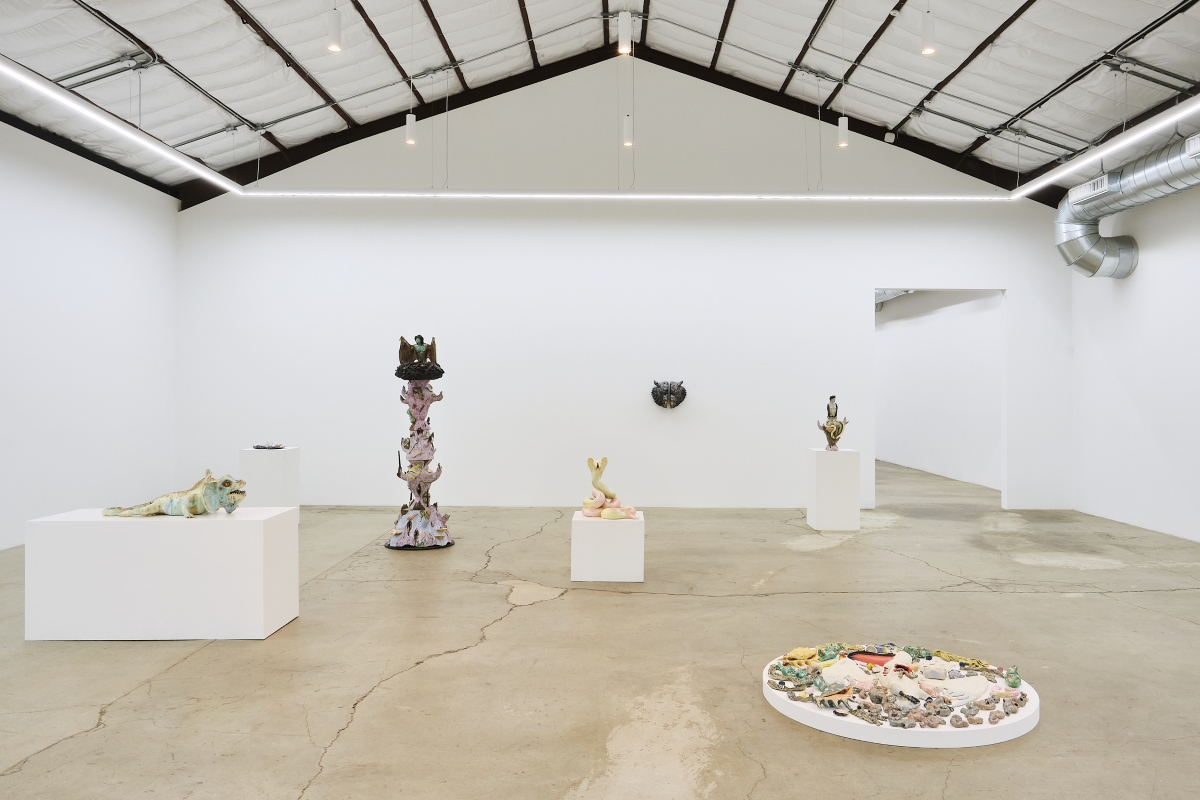
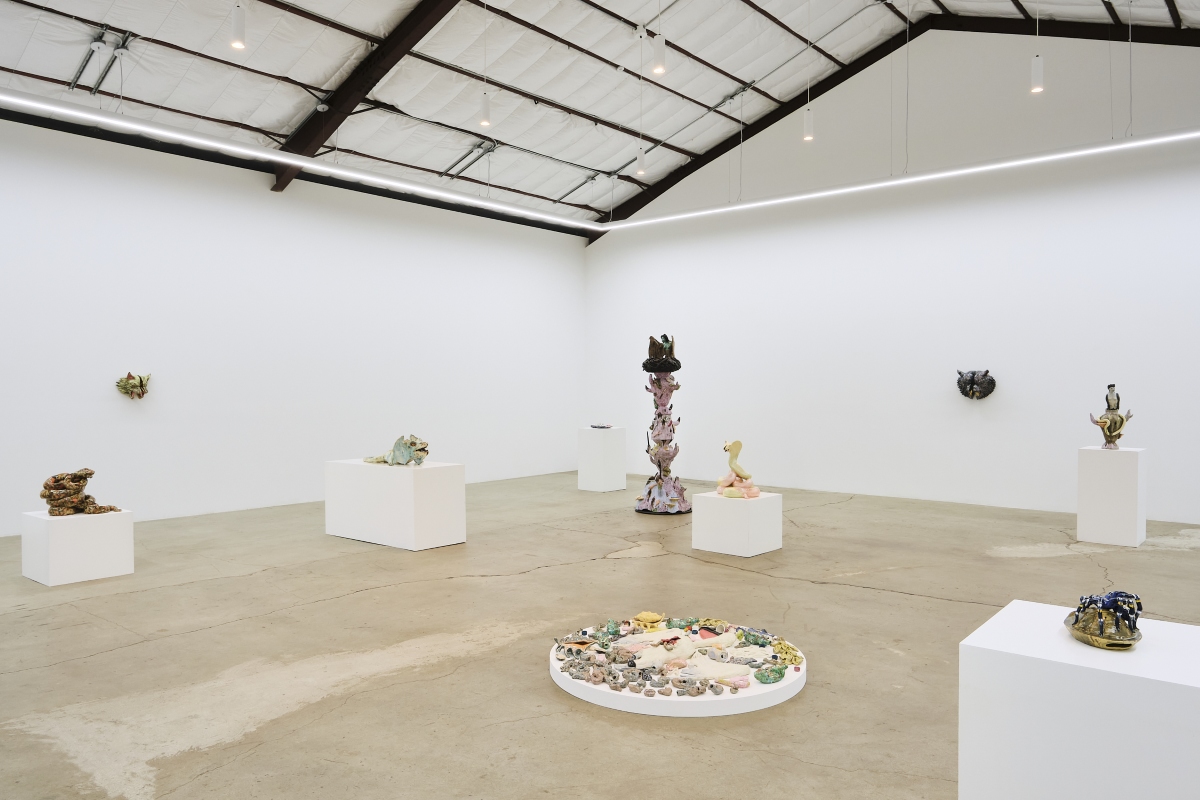
Within this context, clay itself functions as a kind of cosmic egg. It is the substance from which the entire mythology emerges. Every sculpture carries the possibility of transformation, stating creation is not a single originating event but an ongoing process of beginning again, metamorphosis, and regeneration. Endings and beginnings are inseparable, every fracture contains potential and the work resists any single interpretive framework. They can be understood as mythological narratives, archaeological remnants, personal symbols, ecological allegories, or feats of ceramic craftsmanship all at once. They are objects where multiple histories remain active simultaneously, where the ancient and contemporary, the spiritual and material, coexist without cancelling one another out.
The power of myth lies not in its factual accuracy but in its capacity to endure, gathering new meanings as it passes through different eras and cultures. Jackson’s creatures, vessels, and relics seem to operate in this way. They feel both newly made and impossibly old, carrying stories that continue to evolve each time they are encountered. Clay, in this context, becomes more than a medium but rather a repository of time, holding together geology, history, belief, and imagination in material form. In addition to being the egg, the clay is also the bedrock. The sculptures seem less constructed than unearthed, as though they have risen from geological depths.
As permafrost melts across Arctic regions, long-buried remains of woolly mammoths, ancient horses, and other Ice Age animals are emerging from the earth, startlingly preserved after thousands of years. What was once accessible only through fossils, stories, and imagination is reentering the present. Visually, it’s like the earth itself appears to be remembering. Jackson’s sculptures evoke a similar sensation. Excavated rather than invented, surfaced from a forgotten epoch carrying traces of extinct creatures, sacred narratives, and ancestral knowledge. The exhibition suggests that the boundary between history and mythology is more permeable than we imagine. Fashioned from clay, itself a material drawn from the earth and transformed by fire, Jackson’s beings embody the possibility that what has been buried is never entirely lost. Ultimately, one must walk out of the exhibition but the story continues, both in our minds and seemingly, in the gallery as well. The exhibition answers another, quite satiating question too. What is always in a clay vessel? Nourishment.
Sarah Walko is an artist, director, curator and writer. She is currently the Director of Visual and Performing Arts at Lenox Hill Neighborhood House.
Roxanne Jackson: Ovum is on view at The Pit, Los Angeles, September 12-October 22, 2026.
Subscribe to Ceramics Now to read similar articles, essays, reviews and critical reflections on contemporary ceramics. Subscriptions help us feature a wider range of voices, perspectives, and expertise in the ceramics community.
Photos courtesy of the artist and The Pit, Los Angeles. Photography: Chris Hanke
Captions
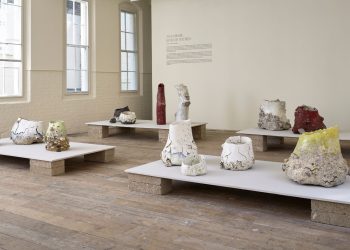
- Installation views, Roxanne Jackson: Ovum, The Pit, Los Angeles, 2026
- Roxanne Jackson, Split Feline, 2025, Ceramic, glaze, luster, 12.5 x 15 x 7 inches, 31.75 x 38.10 x 17.78 cm
- Roxanne Jackson, Gilded Maw, 2026, Stoneware, glaze, luster, 14 x 20½ x 9 in., 35.56 x 52.07 x 22.86 cm
- Roxanne Jackson, Pelican, 2026, Ceramic, glaze, luster, 4 x 48 x 48 in., 10.16 x 121.92 x 121.92 cm
- Roxanne Jackson, Frilled Dragon, 2026, Ceramic, glaze, luster, 12 x 40 x 19 in, 30.48 x 101.60 x 48.26 cm
- Roxanne Jackson, Harpy Candelabra, 2026, Ceramic, glaze, luster, carved black candles, steel base, 84 x 30 x 30 in., 213.36 x 76.20 x 76.20 cm
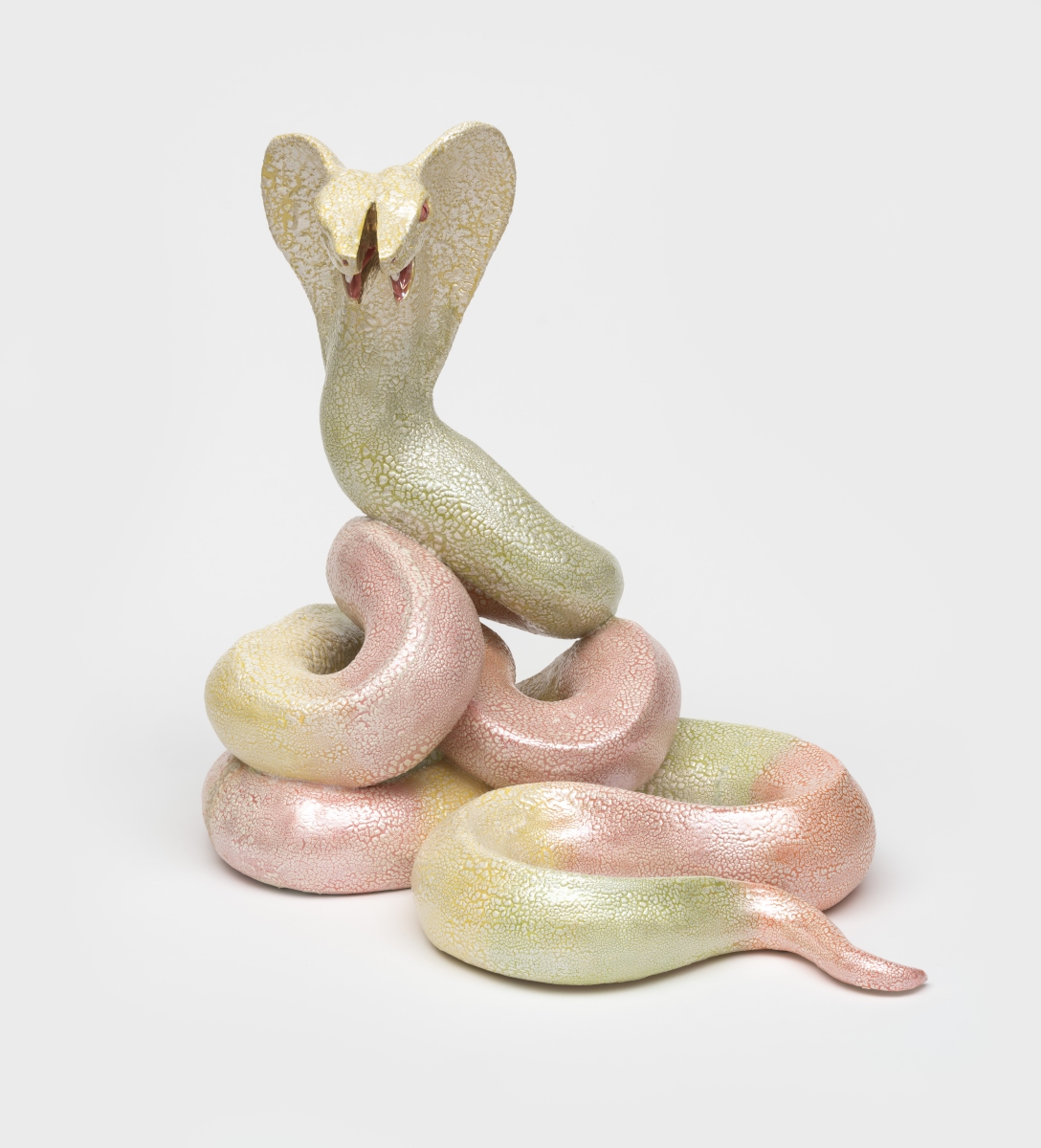
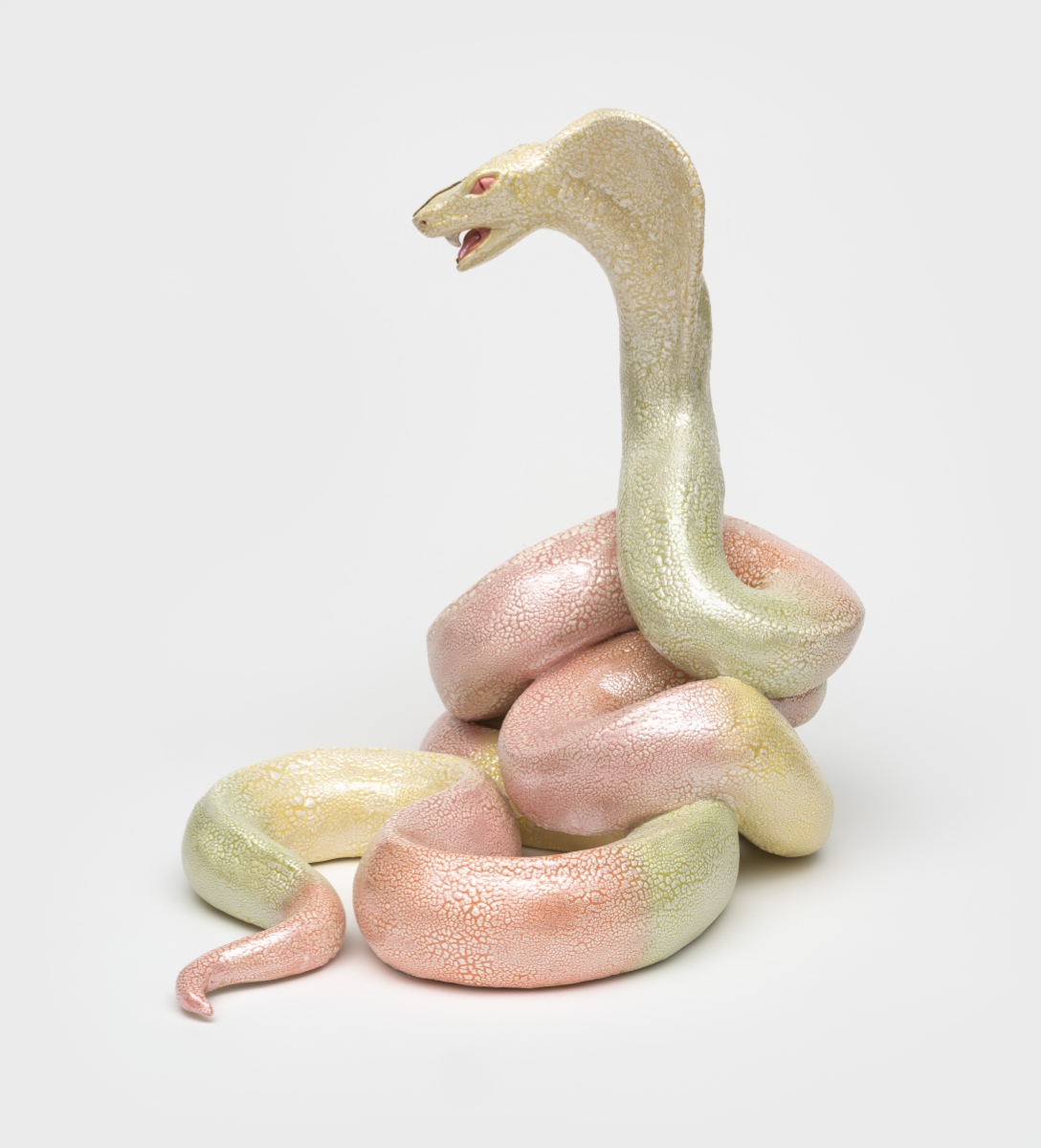
- Roxanne Jackson, Disco Snake, 2026, Ceramic, glaze, luster, 20 x 23 x 16 in, 50.80 x 58.42 x 40.64 cm
- Roxanne Jackson, Trixie’s Vessel, 2026, Ceramic and glaze, 26 x 14.5 x 10 in, 66.04 x 36.83 x 25.40 cm