By Unu Sohn
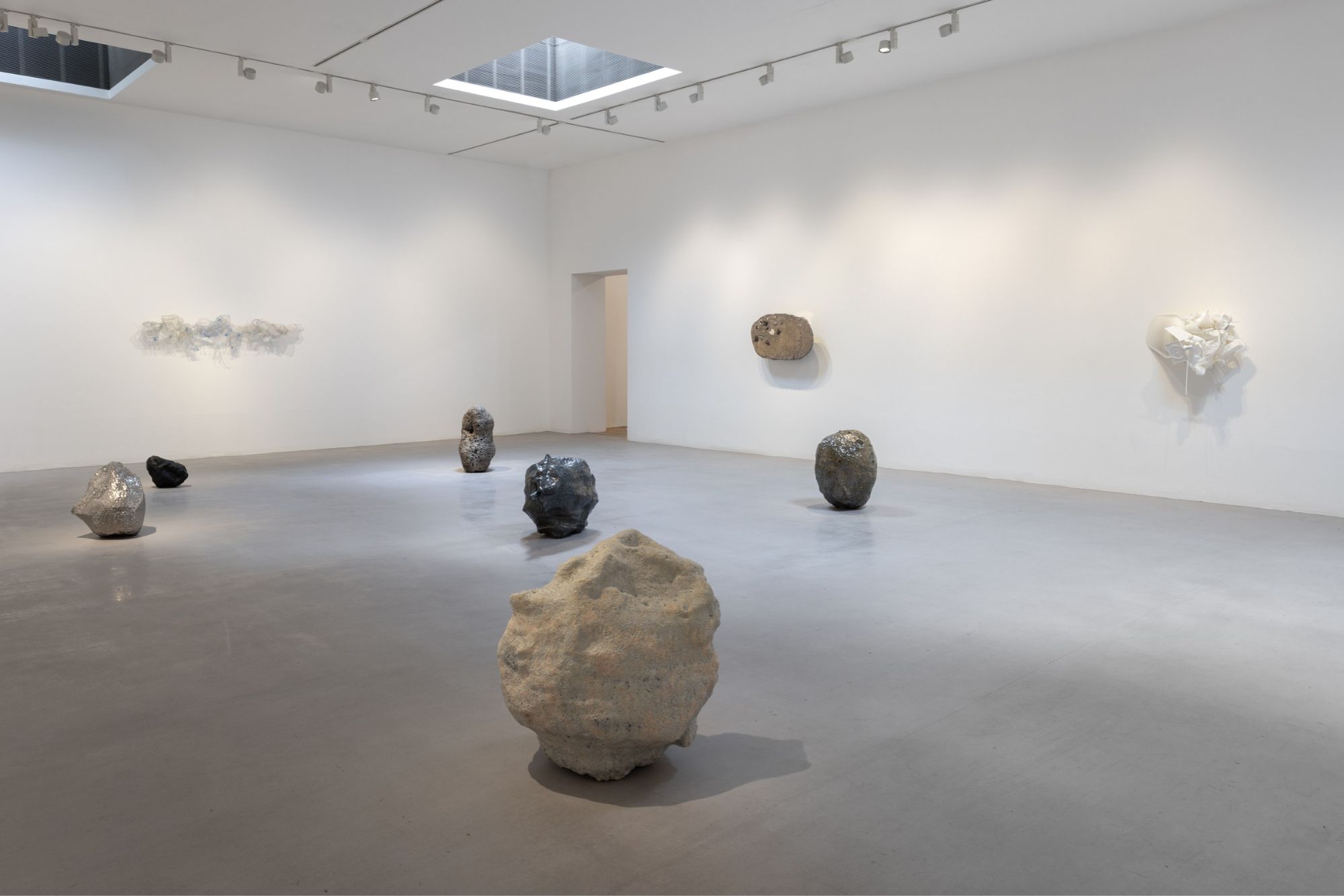
The cosmic and the mundane play footsie in Liz Larner’s first major institutional exhibition in the UK at Camden Art Centre. Now through the 17th of January 2027, A hard line to bend brings together works composed of plastic waste and zip ties alongside asteroid-like forms made in ceramics. In addition to the array of materials, candy colors in works like Marthe hold as much gravitas as darker and deeper hues. It is unsurprising that a sculptor like Larner would gravitate towards the medium of ceramics in which the same copper produces vibrant emerald greens and earthy browns while thickening into pools of metallic black.
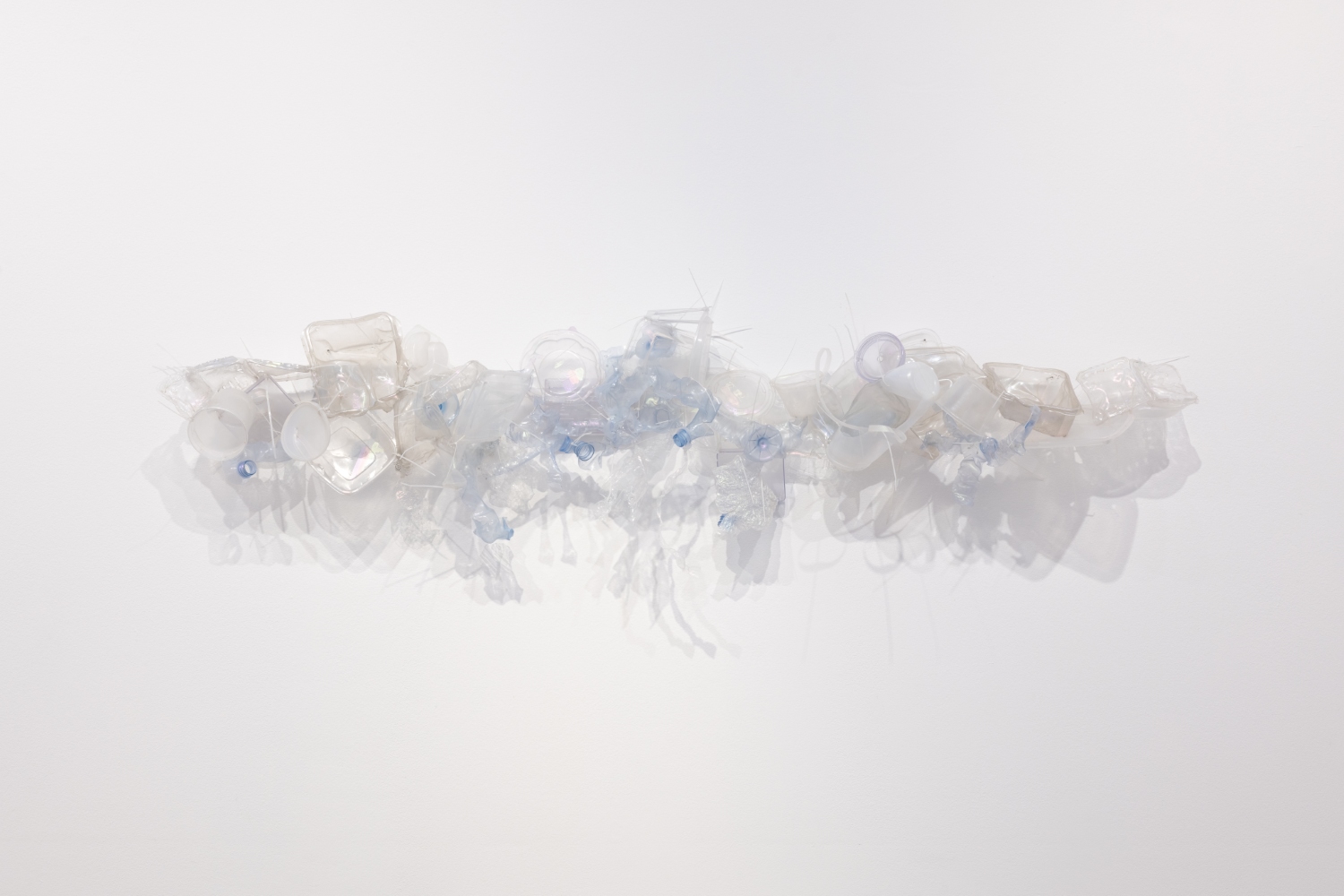
There is a slash across the gallery wall, like a trail of smoke behind something propelling through the air. It has a fluid quality though it is in fact a static sculpture. This work titled hard bubble is not the trace of an unidentified flying object but vestiges of a contemporary life. This tangle of dissected water bottles, berry containers, coffee cup lids, plastic wrap is all too familiar up-close. Printed text like “H5B07 09:40” is legible but incomprehensible, imbuing even logical systems of language and numbers with mystery. From across the gallery, the translucent plastic mass casts a ghostly shadow and the aura of an alien life-form. It reminds me of an angel that appeared in my bathroom window. An ethereal humanoid form encased in a ring, glowing red and sometimes bathed in warm golden color, would greet me in the evenings. Upon opening the window one day, I discovered the light of a construction crane in the distance was refracting through the textured glass. A reminder that form is merely contingent on its conditions.
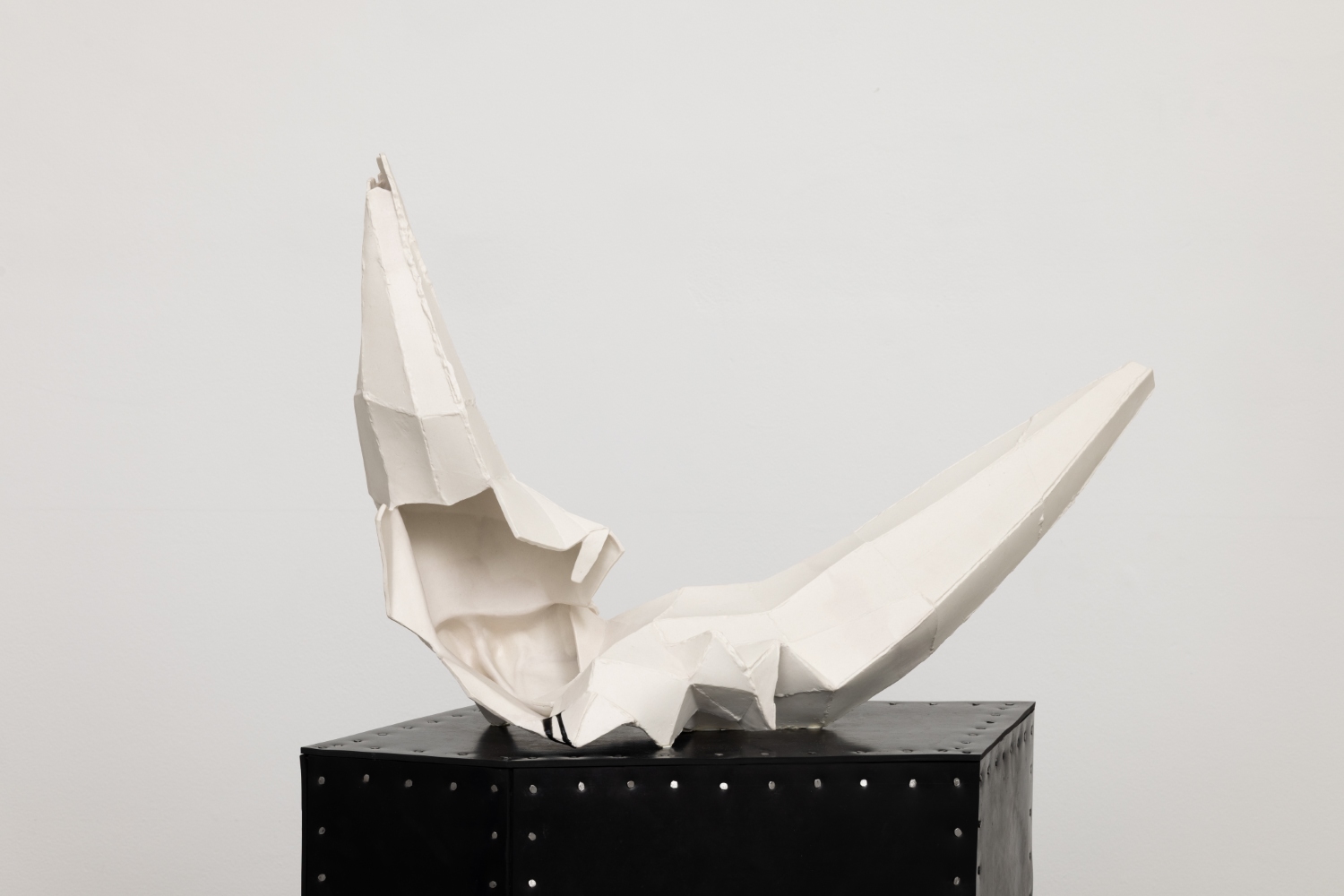
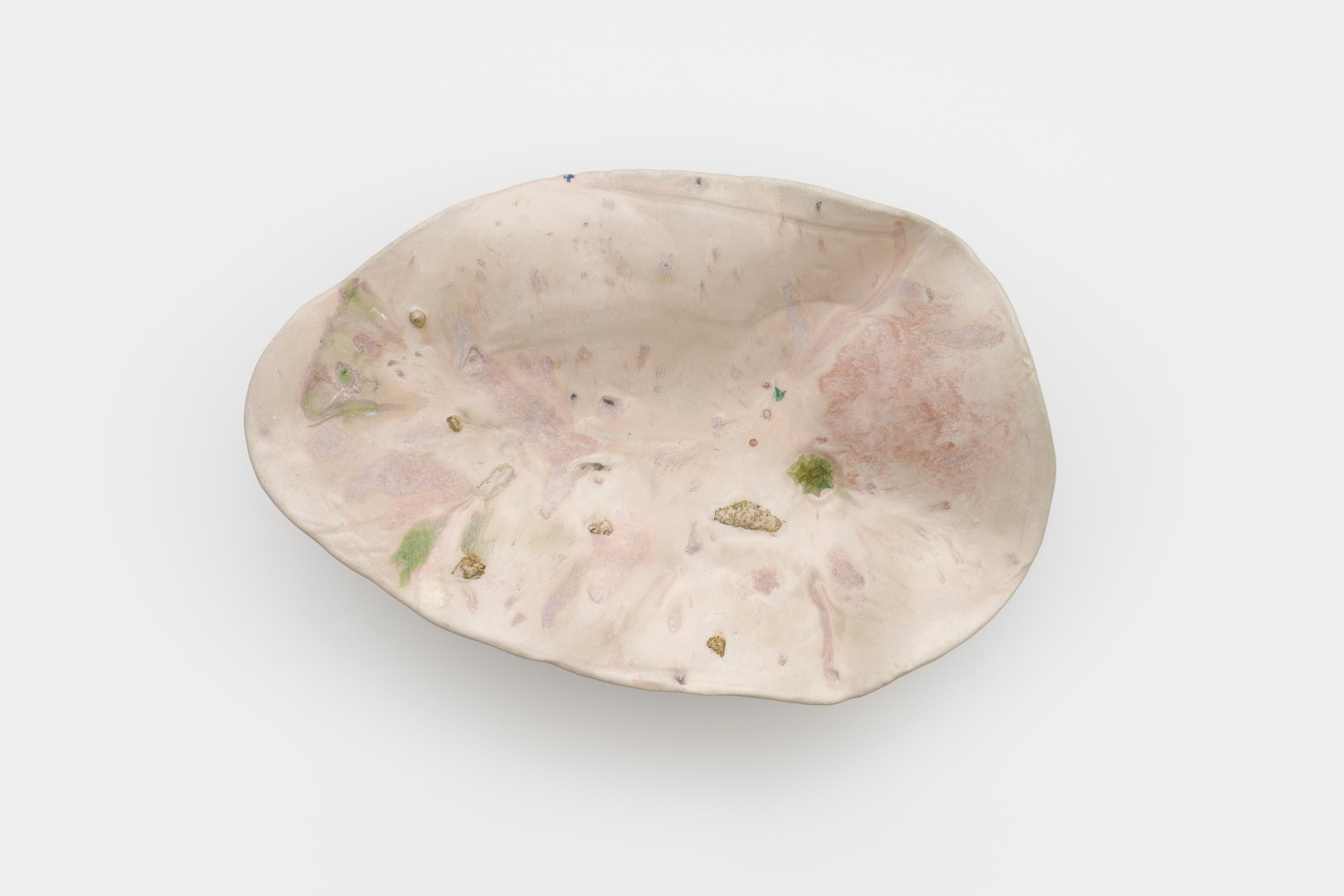
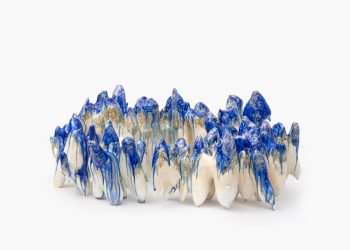
This theme also runs through visually dissimilar works smile (fangs) and smile (abiding) from the artist’s earliest explorations in the medium of ceramics. In this series, Larner was inspired by how the descriptions of a smile in stories and novels often come with a variety of modifiers. A smile is a complex expression, baring an innately utilitarian and questionably violent part of the body to indicate inner feelings and motivations. The smile works literarily and literally demonstrate her ongoing relationship with the assumptions around form.
In the wall-based slab sculptures that occupy a large portion of the exhibition, the artist again plays with preconceptions. The undulating surfaces exposed to visitors hide intricate yet beautifully considered installation constructions. There are structural arches in clay, striking metal shelves, and industrial bolts. This aspect is easy to dismiss as purely functional since it allows for the slab to sag and gives glazes movement in the kiln. Viewed as they are installed is an aerial viewpoint that hides the architectural elements through which the sculptures read as sacred spaces. These works question the hierarchy between front and back, inside and outside. In the “Artists’ Studio” room of Camden Art Centre, Lux Interior (Gold plated) subverts the idea of negative space by casting in bronze and gold the unseen or contained.
A further clue to the importance of internal structures, or the unseen, is revealed in a small work from Larner’s asteroid series. This work sitting on the floor is titled Lil’ 2019 OK. This work’s title references the smallest—little or lil’—sculpture and also references Lilith who is said to be Adam’s rebellious first wife in Mesopotamian and Jewish stories. 2019 OK is the asteroid that flew by incredibly close to our planet in July 2019. It was the largest known asteroid to pass so close yet was only detected a few hours before. This work in the gallery could have simply been made by coiling a vessel. Flashing a light into an opening near the top reveals that the sculpture is instead a solid form with an organic internal structure that is impossible to perceive without cracking it open like an egg.
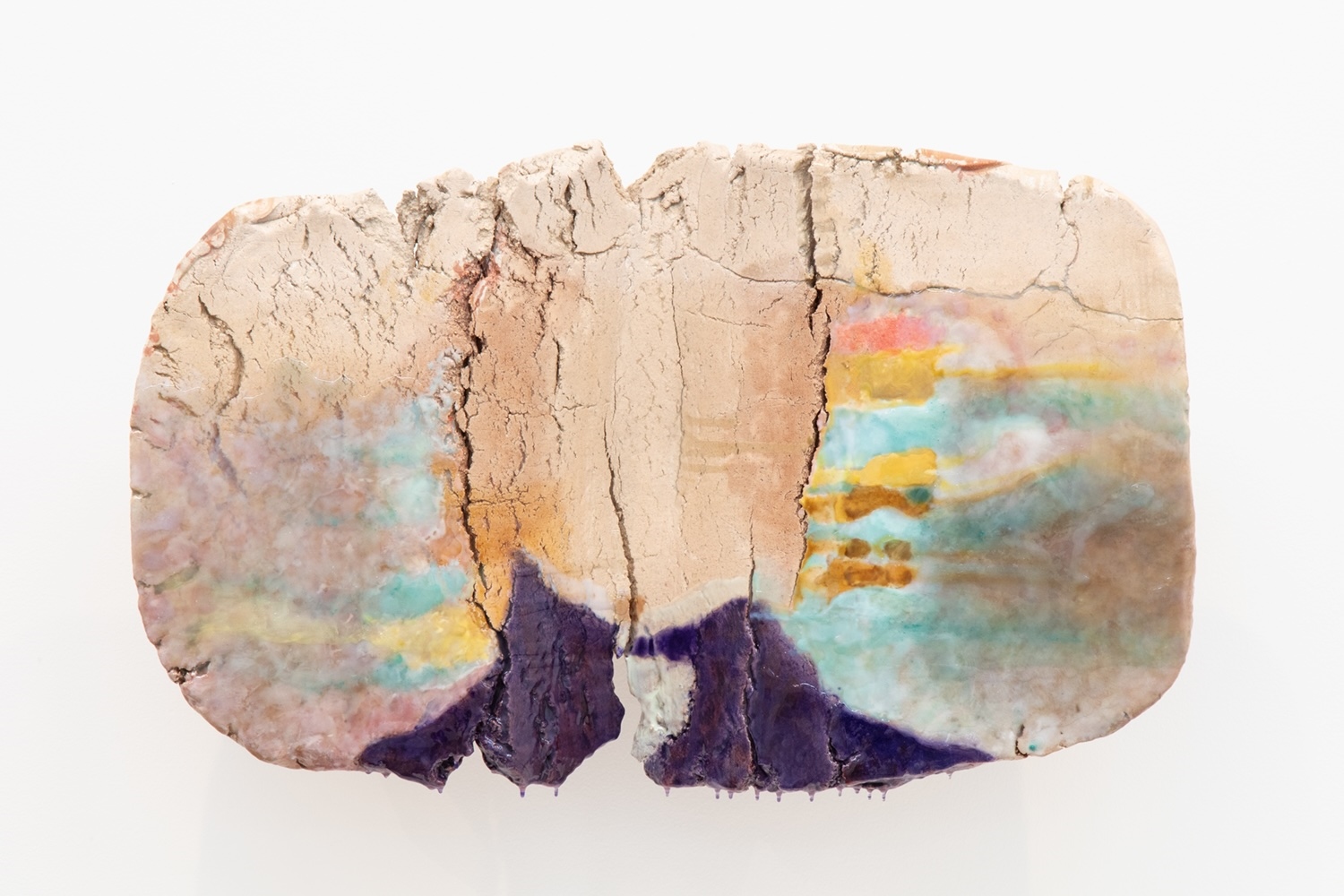
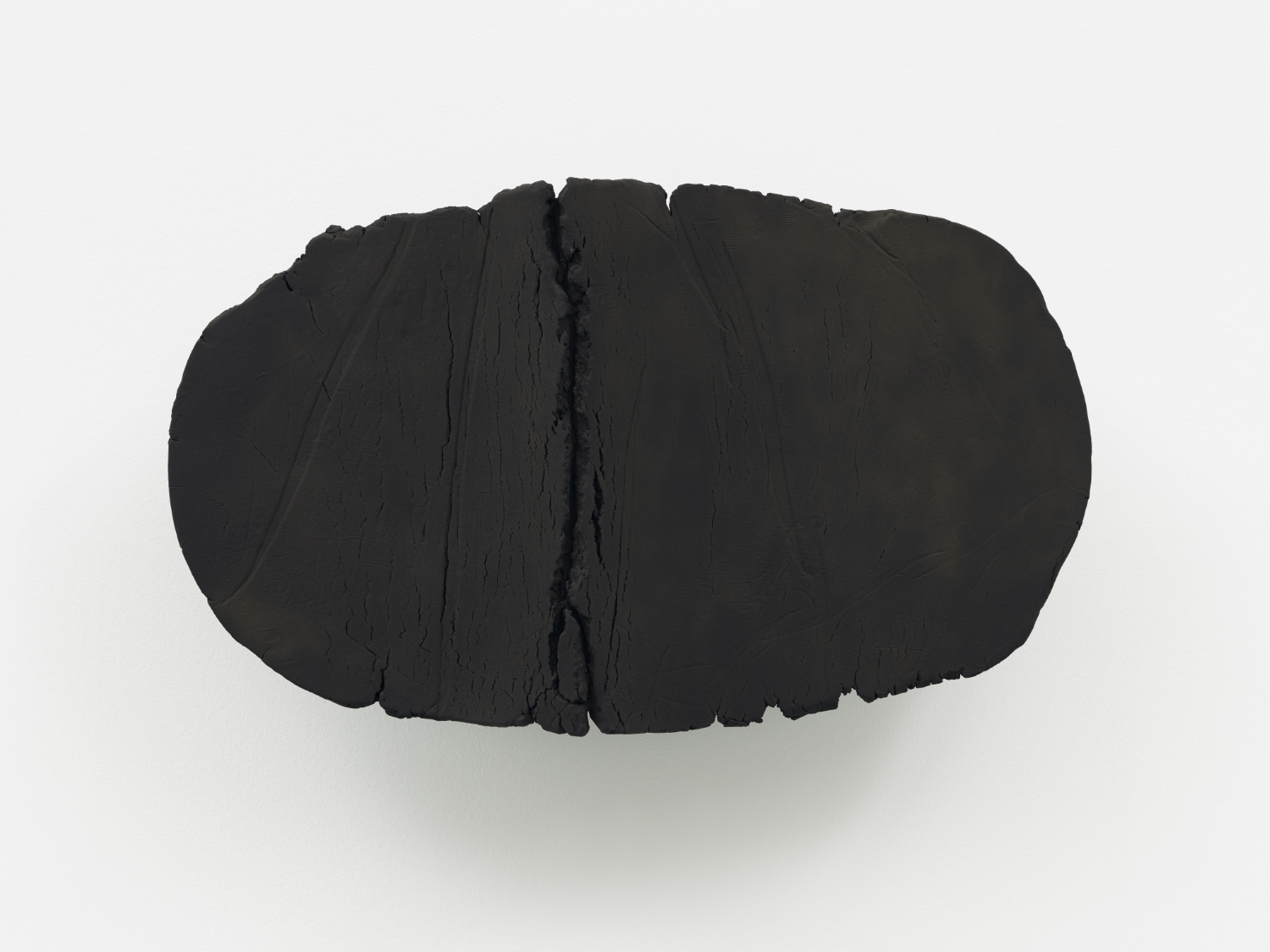
The desire to see the works break open is not foreign to this collection of artworks that feature crevices and ruptures. The wall-based ceramic sculptures that dominate A hard line to bend are not paintings, and this is emphasized particularly in the pieces that split into two like vii (caesura) in the gallery or works of the the same nature such as Blown across the divide shown at the recent Frieze London fair with The Modern Institute. Such works from Larner’s oeuvre emphasize the tension involved in manipulating clay, how form is a result of pushing and pulling. Since a “caesura” is an emphatic break or pause, it’s interesting to interpret the clay splitting and cracking as contributing to the overall work rather than identified as a fault. Songs and poems contain moments of rest and absence. In Larner’s practice, rupture punctuates sculpture like a valley or crest.
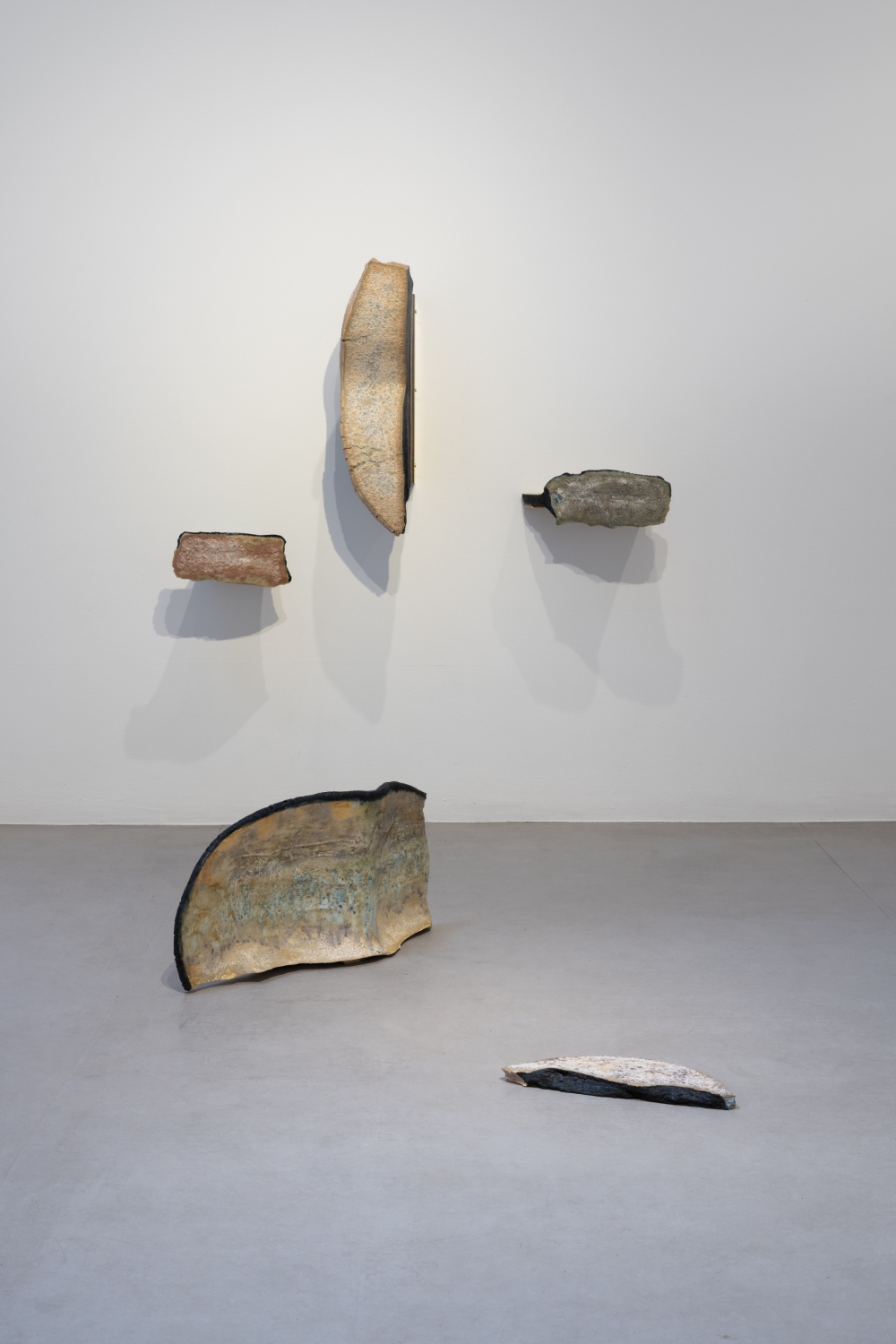
As is often the case for artists working with clay, Larner submits to the material and incorporates its tendency to split, crack, and even explode. The work titled Still and all consists of five sections of a piece that broke apart in the firing. Installed across the wall and floor, the fragments appear to be not only separated but continuing to float away from each other seemingly adrift in space. By using a black glaze to highlight some of the edges of each part, Still and all casts dramatic shadows. One floor-based piece is grounded by a black shadow-like edge while the other piece is indeed grounded on the floor by an actual shadow.
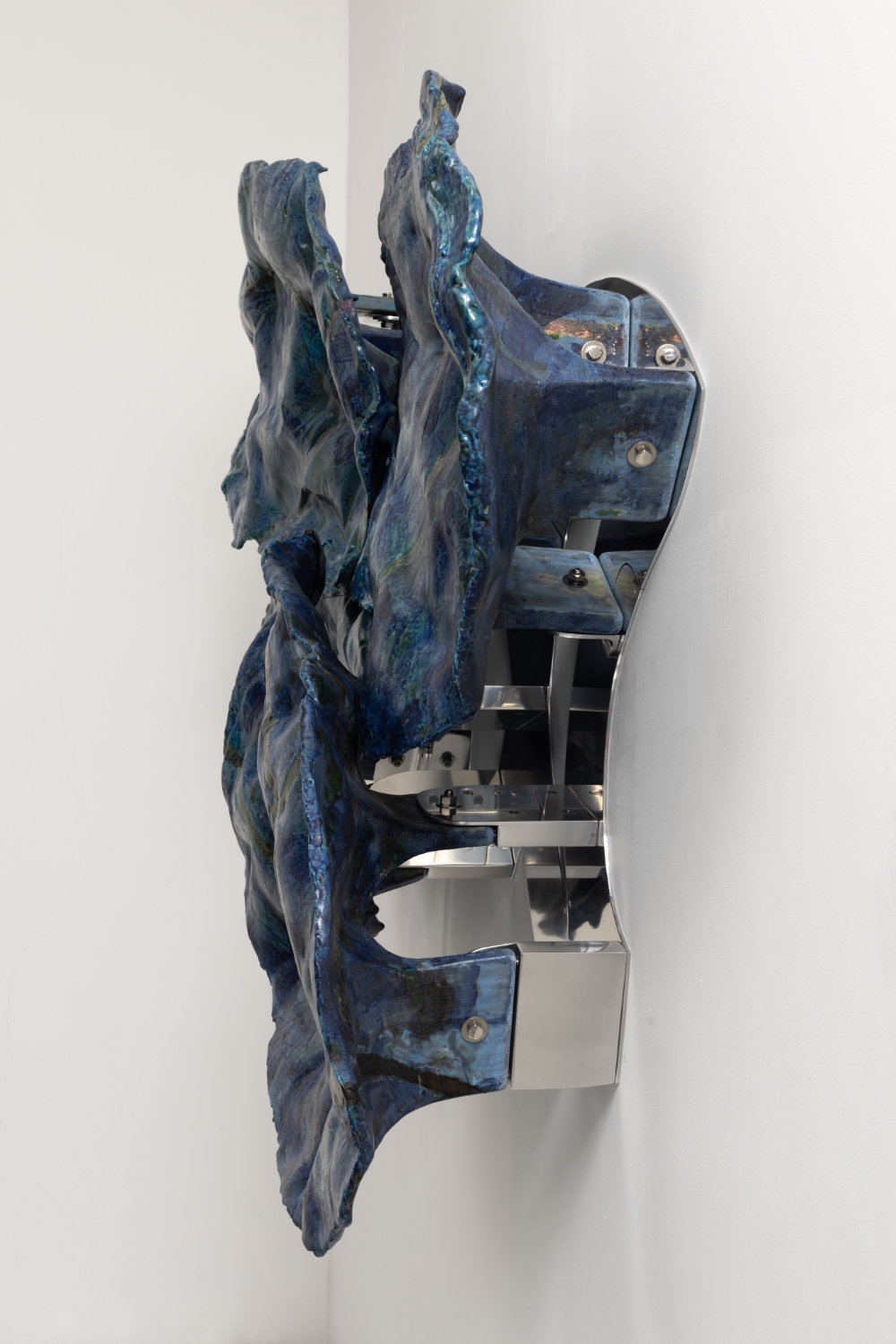
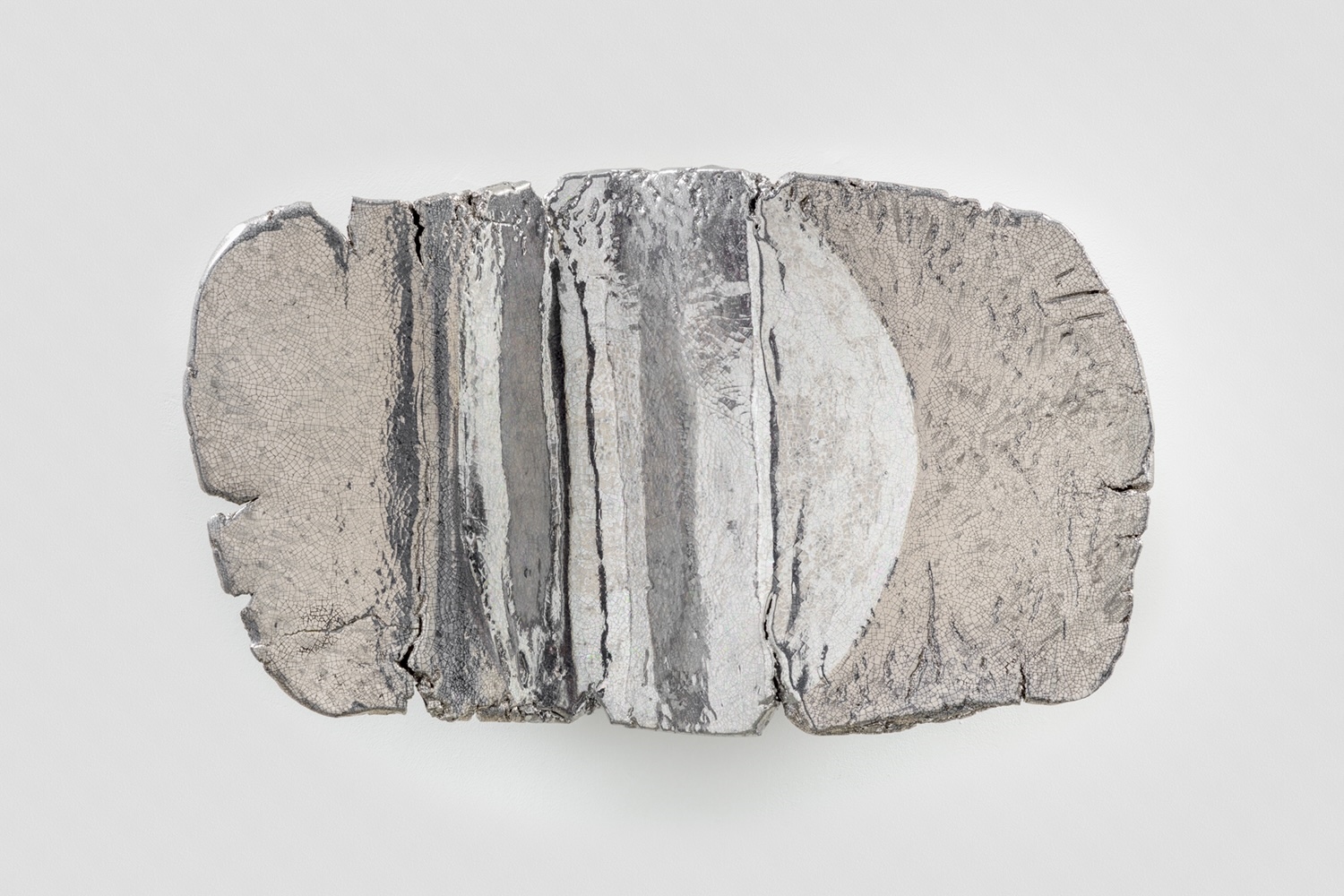

The artist masterfully manipulates light through her sculptural practice with shiny brass and bronze, mirror-finish epoxy, and the reflective wall-facing polished metal installation structures. Perhaps these elements are linked to the artist’s immediate exposure to the Light and Space movement in Los Angeles that was characterized by what curator John Coplans called the “fetish finish.” Light and Space artists in Southern California were then using declassified substances such as acrylic, resins, fiberglass, and plastics that were developed by the US military for their reflective and optical qualities. The internal movement created through the optical nature of these materials heightens the viewer’s awareness of their own embodied looking in relation to time and space. The works that incorporate these features literally change as they are seen. Like electrons that behave as a wave or particle depending on observation, Larner’s sculptures respond to the environment. Shifting weight from one foot to another in front of the work titled DIFFRACTOR, the visitor is aware of their haptic participation in the works.
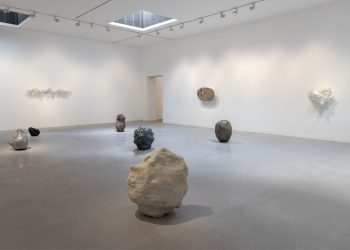
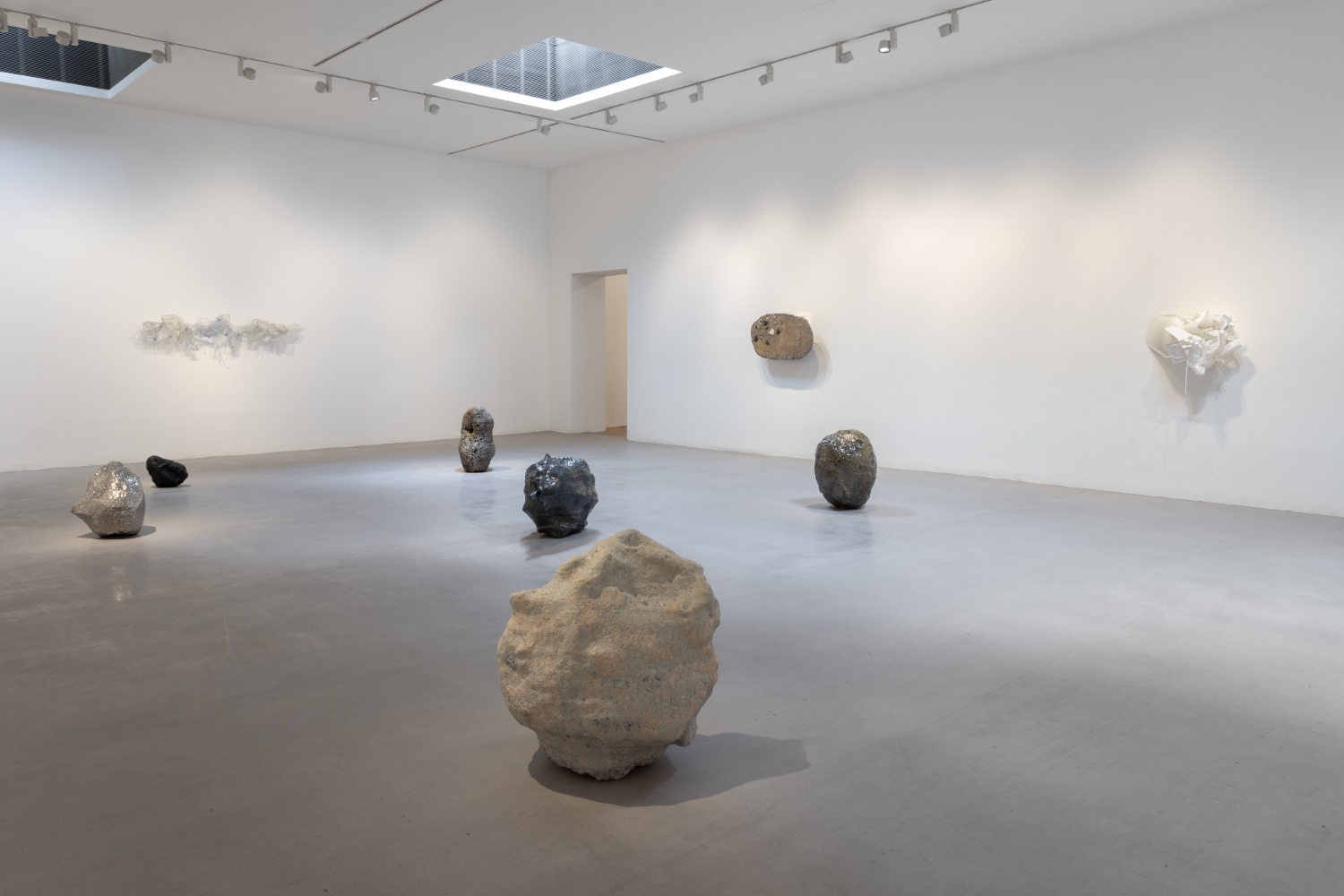
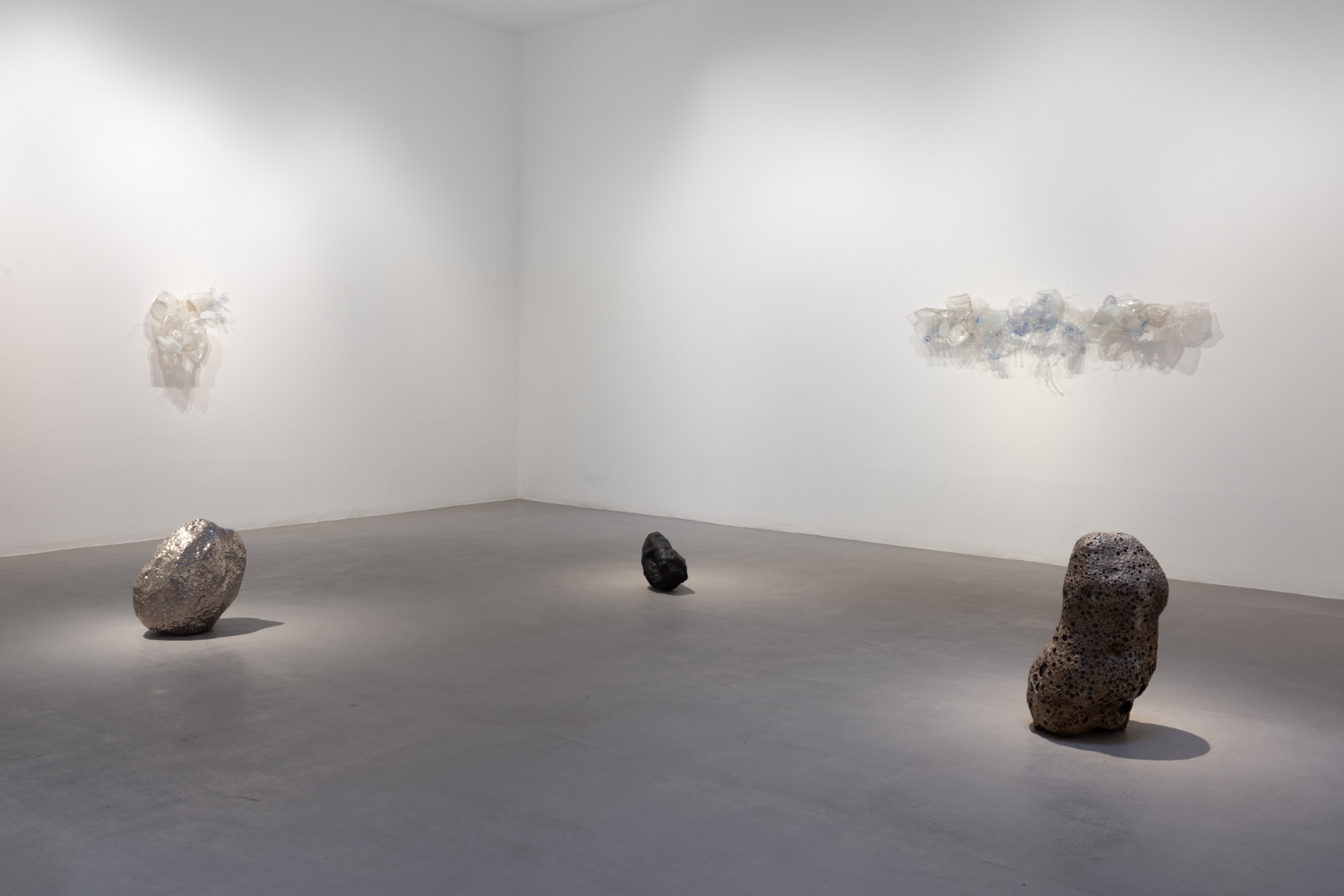
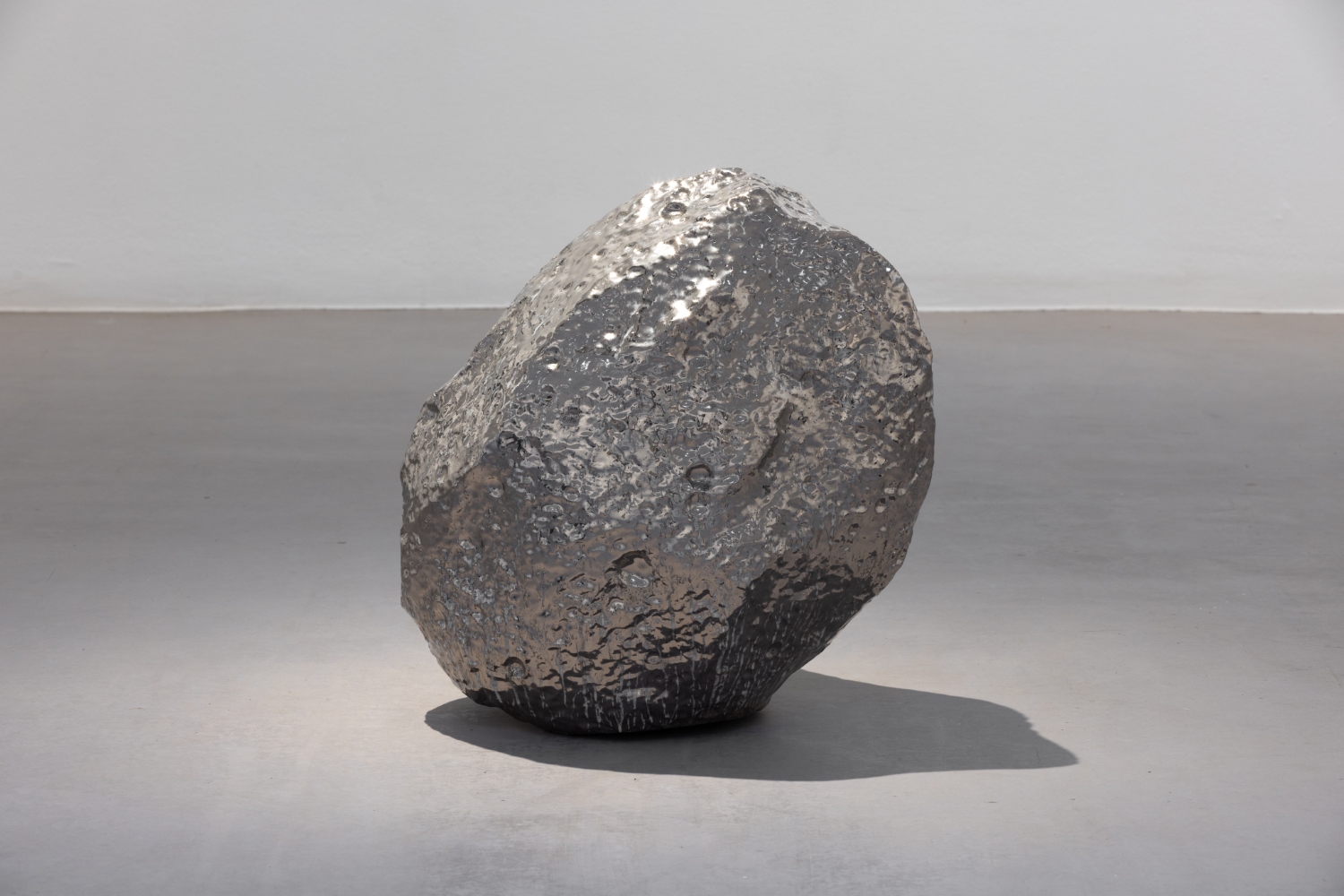
In Gallery 1B, Larner’s asteroid sculptures are placed directly on the floor so the viewer weaves paths walking through and amongst them. Circling around the sculpture titled Asteroid Osiris in order to experience the dynamic reflection brings this viewer into the intimate proximity of other equally exposed works on the neighboring walls and ground. The reference to Osiris, god of fertility and also the dead, conveys the bridging of duality present throughout the exhibition. As aptly summarized by painter Jane Dickson during an interview with Liz Larner for Bomb, “You don’t revel in the physical exclusively, you use the physical–it’s like tantra–to express the metaphysical.”
Working across several polarities, A hard line to bend at Camden Art Centre encompasses the full expanse of the artist’s practice spanning the abstract and representational. The works are unpretentious although they engage in dialogue with the Anthropocene. A more didactic artist would drive in the message about the impact of humans on the environment. Larner instead incorporates heaps of plastic waste and nearly world-destructing asteroids as paradoxically aesthetic entities.
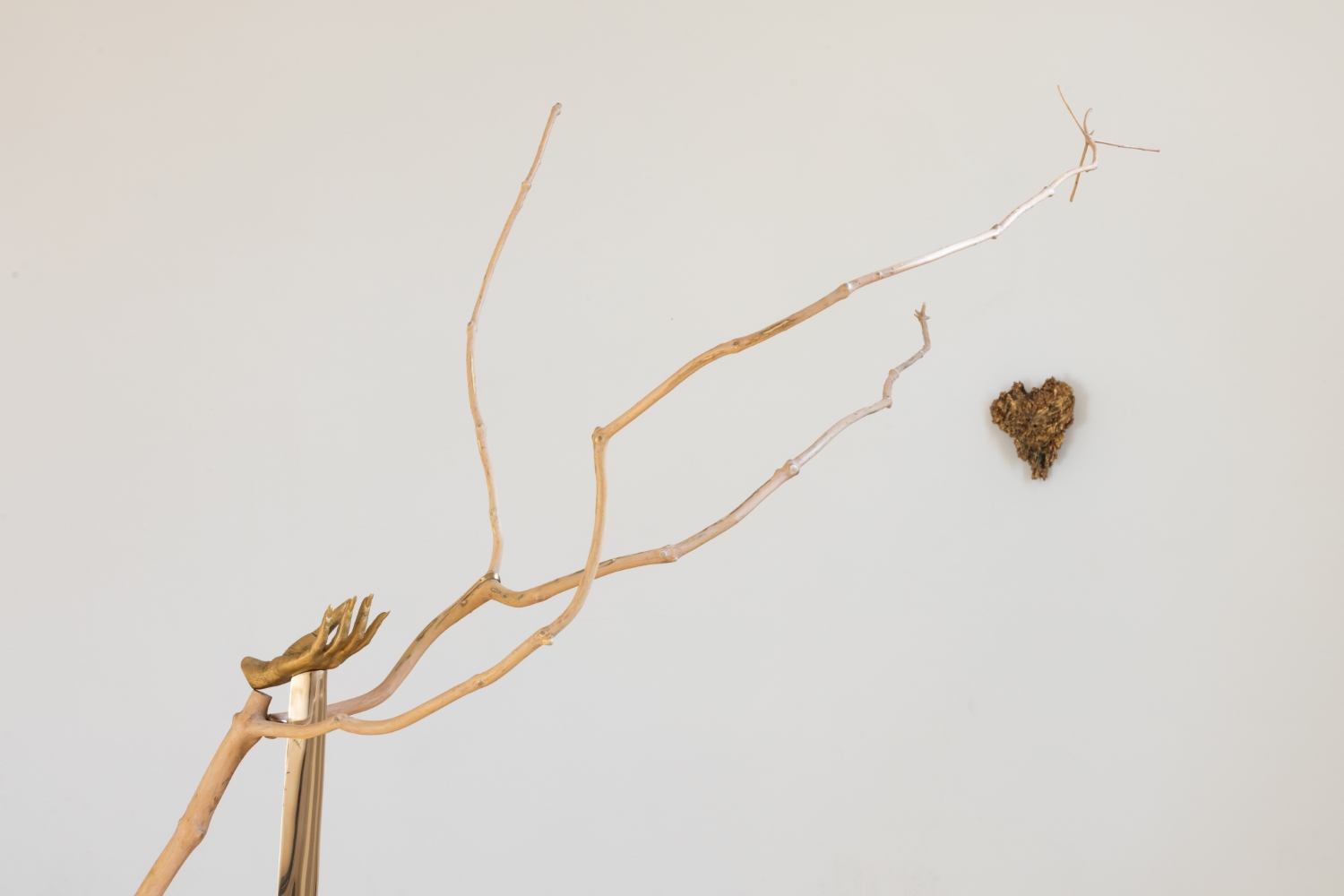
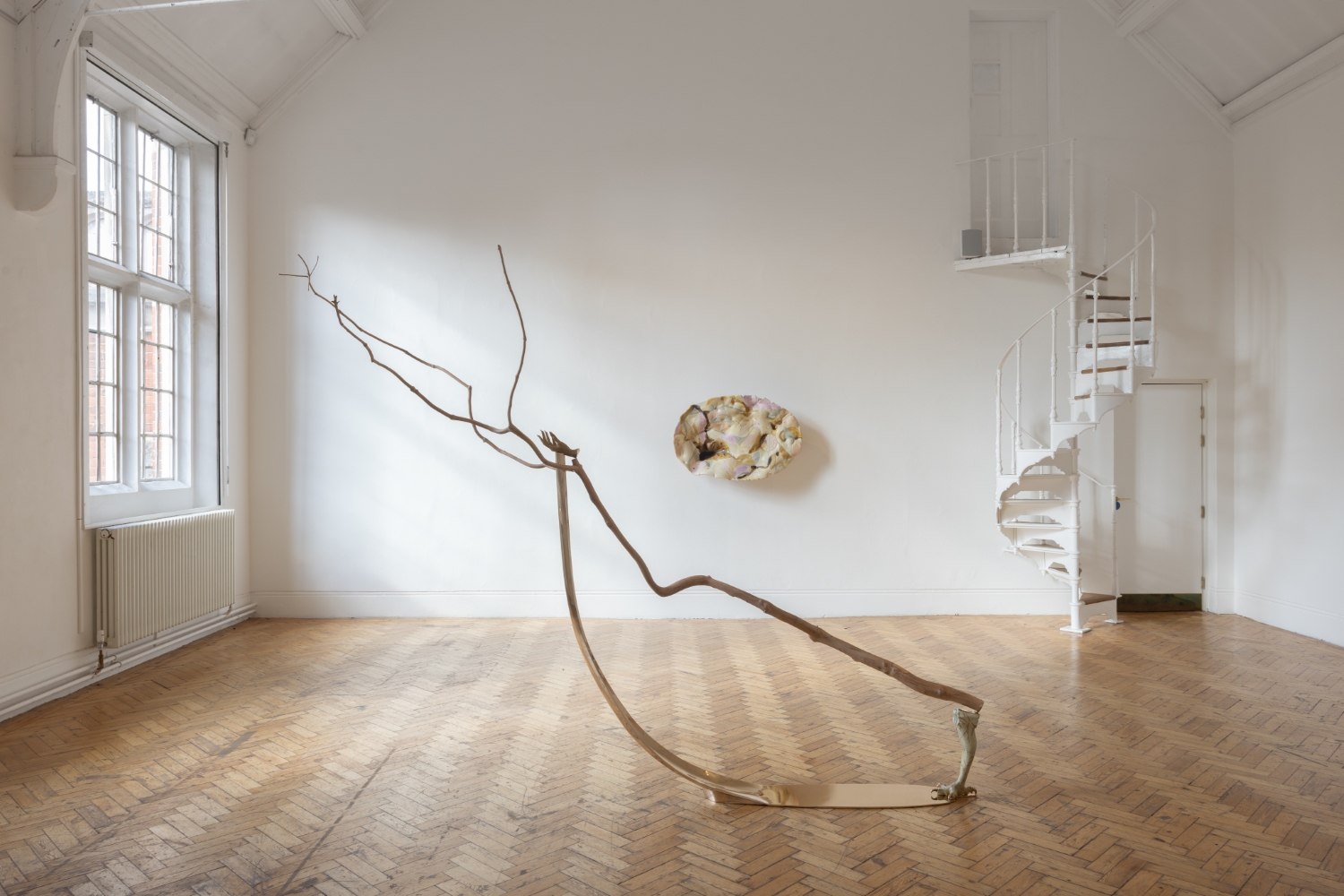
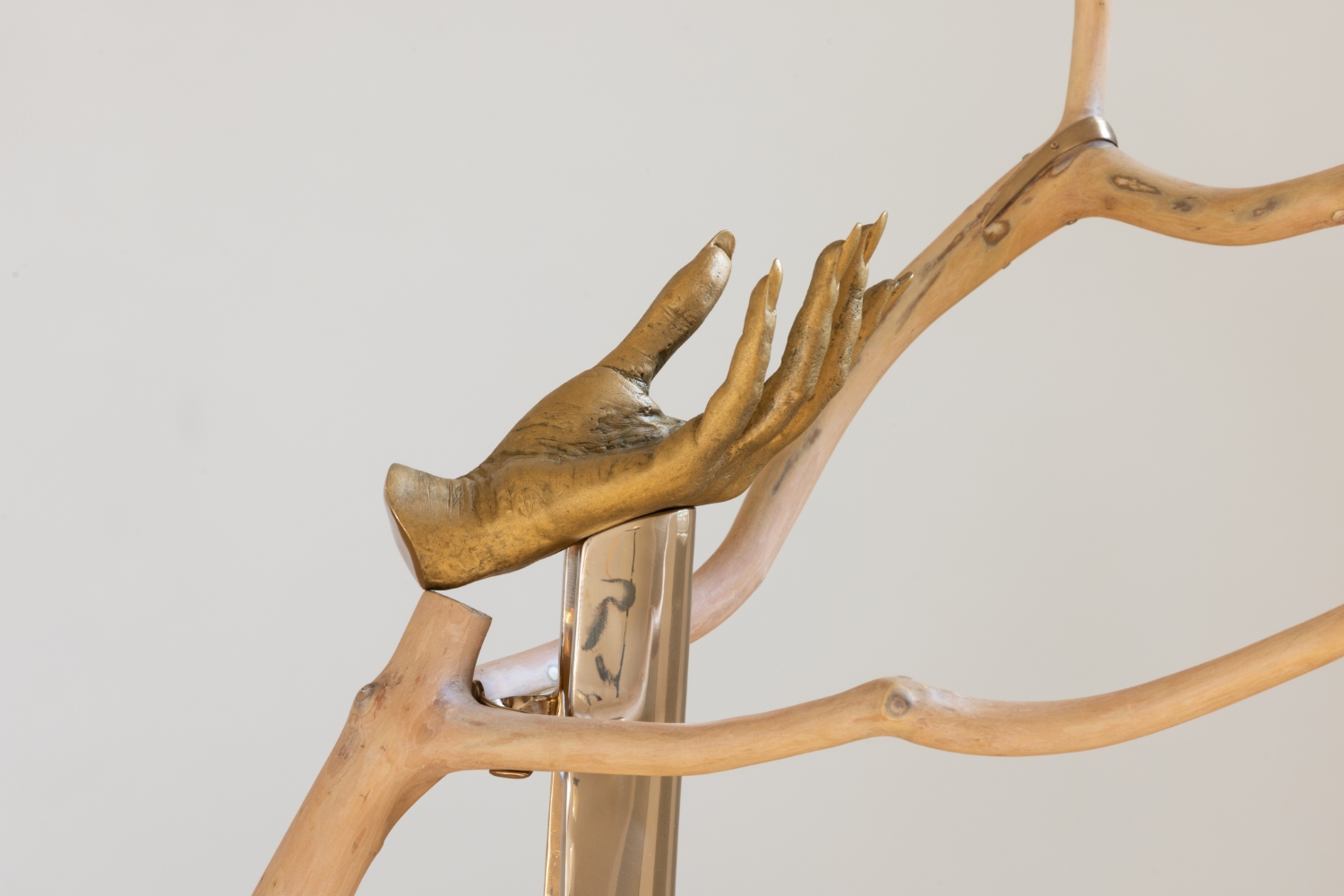
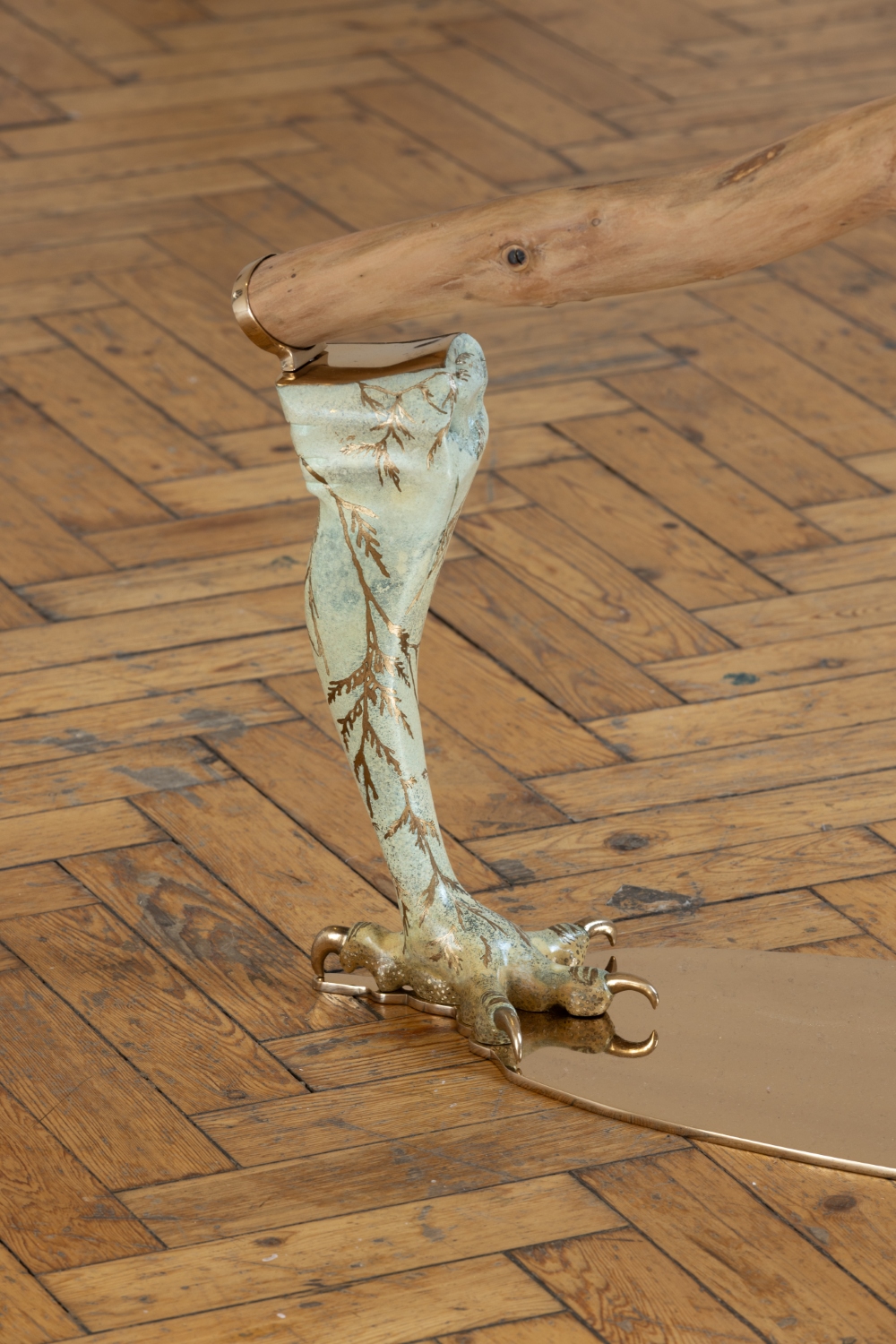
Her most recent sculpture made in 2026, which the exhibition takes its title from, is the least abstract as it features a foot with talons and a human hand reaching towards the gallery windows. She made this work to reimagine Lilith, the female figure that was made like Adam as his equal, and refused to be his subordinate. Larner explained in her artist talk in conversation with novelist Joanna Kavenna that the imagery of this version of Lilith is based on the Burney relief, Queen of the Night, housed in the British Museum that depicts a “lilitu” with bird’s feet and owls flanking her sides. The sculpture at Camden Art Centre incorporates a Madrone branch, which is notoriously hard to bend, alluding to this mythical woman and her resistance. A bronze structure supports the wooden component, running across the floor like a shadow, connecting the human and bird. It is dramatically curved as if it will tip over yet it is also strong like a ship’s prow that cuts through choppy waters. The hand expresses yearning and there is a tenderness to this line that will not bend.
Alongside this work plays musician Cosmo Sheldrake’s composition Evening Chorus (Live in the Bluebell Woods) that was improvised and recorded in collaboration with the songs of endangered British birds like the nightingale, short-eared owl, tawny owl, bittern, and cuckoo in Dorset. Evening Chorus activates exclusively in the last ten minutes before the gallery closes each day near a set of windows showing the darkening winter sky. The beauty of Sheldrake’s song sits in contrast with the fact of its circumstance, arguably enhanced by the delicate nature of the very same context. Through A hard line to bend, Liz Larner presents her poetic practice over three decades dealing with fundamental philosophical considerations of a contemporary life in its all intensity and strangeness.
Unu Sohn is an artist and ceramicist based in London. She holds a master’s degree in ceramics from the Royal College of Art.
Liz Larner: A hard line to bend is on view between September 11, 2026 and January 17, 2027 at Camden Art Centre, London.
Subscribe to Ceramics Now to read similar articles, essays, reviews and critical reflections on contemporary ceramics. Subscriptions help us feature a wider range of voices, perspectives, and expertise in the ceramics community.
Captions
- Liz Larner, Marthe, 2019, ceramics, epoxy, 55.9 x 88.9 x 27.9 cm
- Liz Larner, hard bubble, plastic,59 x 208.3 x 36.8 cm Installation view. Camden Art Centre, 2026. Photo Rob Harris
- Liz Larner, smile (fangs), 1996-2010, porcelain, epoxy, lead shot, 50.5 x 78.7 x 21 cm, Installation view, Camden Art Centre, 2026. Photo Rob Harris
- Liz Larner, Searching for a better feeling, 2024, ceramic, glaze, aluminium, bronze, stainless steel, 96.5 x 64.8 x 29.2 cm
- Liz Larner, Lux Interior (Gold plated), 2010, cast bronze with gold patina, Installation view, 27.9 x 21.6 x 15.2 cm. Camden Art Centre, 2026. Photo Rob Harris
- Installation view, Liz Larner, A hard line to bend. Camden Art Centre, 2026. Photo Rob Harris
- Liz Larner, Different shade of green, 2025, ceramic, glaze, aluminium, stainless steel, 131.4 x 201.6 x 38.1 cm Installation view, . Camden Art Centre, 2026. Photo Rob Harris
- Liz Larner, Still and all, 2022, ceramic, glaze, Installation view, Liz Larner, A hard line to bend. Camden Art Centre, 2026. Photo Rob Harris
- Liz Larner, caesura (xvii), 2015 Ceramic, epoxy and oil paint 55.2 x 94.6 x 26 cm. Photo credit © Liz Larner. Courtesy Galerie Max Hetzler, Anton Kern Gallery, The Modern Institute, Regen Projects
- Liz Larner, DIFFRACTOR, 2017, ceramic, glaze, 53.7 × 175.3 × 24.8 cm
- Liz Larner, Asteroid Osiris, 2021, ceramic, glaze, 61 x 94 x 76.2 cm Installation view, Liz Larner, A hard line to bend. Camden Art Centre, 2026. Photo Rob Harris
- Liz Larner, pearl, 2021, plastic. Installation view, Liz Larner, A hard line to bend. Camden Art Centre, 2026. Photo Rob Harris
- Liz Larner, A hard line to bend, 2026, bronze, Madrone branch, Installation view, Liz Larner, A hard line to bend. Camden Art Centre, 2026. Photo Rob Harris