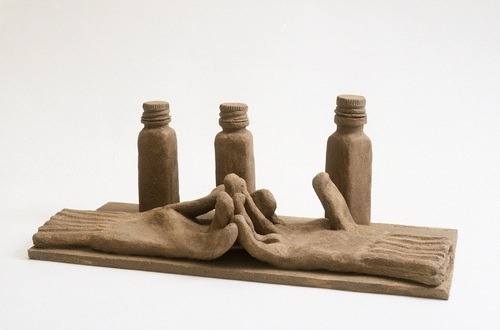

Gail Goldsmith: Everyday Weapons / William Holman Gallery, New York
February 19 – March 22, 2014
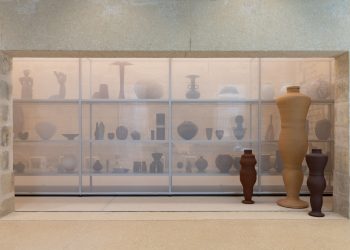
William Holman Gallery is pleased to present Everyday Weapons by Gail Goldsmith and Times and Places by Richard Barnet, two concurrent solo exhibitions that are installed at the gallery through mid-March.
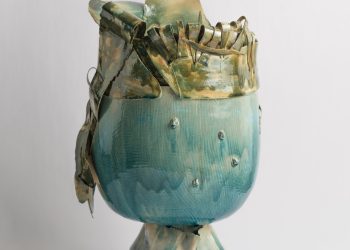
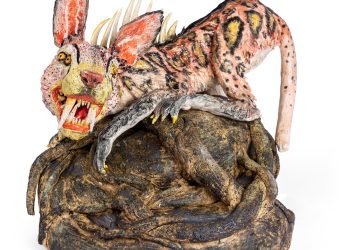
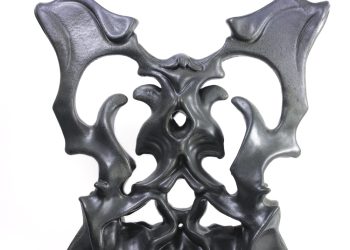
Featuring eight clay sculptures, Gail Goldsmith’s Everyday Weapons series reflects on death and mourning. Made in the aftermath of her husband’s suicide twenty-five years ago, the sculptures are cathartic, revealing how his death altered everyday objects in Goldsmith’s life. From a series of broken bottles to an ominous corkscrew lying next to a pair of women’s shoes, these quotidian objects reverberate with pain and anger, seeming ominous as thinly-veiled weapons. With the distance of time since their creation, Goldsmith has come to see these sculptures as theatrical; each work is an archetype, both personal and universal.
“After my husband’s suicide, I found myself immersed in the need to express complicated inarticulate feelings- anger and rage, pain, fear, revenge, and also grief. When I was finally able to return to my studio, I began a clay figure of a standing woman. It was almost finished when, walking along the street; a large kitchen knife appeared in my mind’s eye. Back in my studio, I made a clay knife. I unclasped the woman’s hands, put the knife in her hands, and reclasped her hands around the knife as she appears today in the exhibition. At that moment, I didn’t understand why she needed the knife.
That woman led me to the Everyday Weapons sculptures. Soon after, I made another, larger clay knife and placed it lying across a clay hammer. Because the two pieces had to be secured, I quickly rolled out a slab of clay. The knife lies across, corner to corner, occupying the space. Its upturned point holds down the claws of the hammer, which, immobilized, can’t strike without a hand to lift it. This clay slab made a significant place for the objects. I rolled out another piece of clay and looked around. The next piece I made was a lineup of bottles. A few years earlier my husband had bought several cases of Perrier water, in anticipation of an expected water shortage. From somewhere in my mind, I remembered a street story I’d been told in which someone who was being followed, broke the top off a bottle, sat down in a doorway holding the broken bottle and waited. I took out a bottle from the case and wrapped it in a thin piece of clay. When the clay became firm but not too hard to work with, I peeled it off, joined the edges and put it on the clay slab. I took out a second bottle, looked at it, broke off the top and repeated wrapping the glass with clay. Then I added a third and a fourth and lined up a group. Because I found the objects beautiful, and because breaking bottles for a purpose was extremely satisfying, I broke more bottles and made a second sculpture of only broken bottles. After making that sculpture, I found that objects in my home, literal and domestic, became ambiguous: a pair of shoes, a rolling pin, the keys to my house. One night in a dream, I saw a man’s work glove rising up out of the earth, which eventually inspired the work titled Apparition. I made these works almost twenty-five years ago, a very long time ago. Although I remember the violent emotions I felt when I made the pieces, I can also look at them objectively today. I see this work as dramatic. Each clay slab presents an individual piece of theater. The sculptures can be read in sequence as a narrative.
The first work, the knife over the hammer begins the unfolding drama, followed by the bottles. These are survivors, taking their stand. A man enters next – he is represented by an inert and empty pair of gloves, hands with the palms facing up. The gloves rest in front of a row of bottles, the sleeping pills with the potential for harm. This work is followed by a man’s glove, a woman’s pair of shoes, and a corkscrew. The corkscrew could be for romance, to open a bottle of wine, but could also be a weapon. This ambiguity is contained in all the objects. In this particular piece none of the objects touch each other. Each sits in its own space within the larger space that contains them, raising questions about the relationships between the objects. In the final two pieces some objects come together and touch. In the first, a man’s boot is blocked and held in place by the weight of a rolling pin. In the second of these two final pieces, a single bottle, the top broken off as in the earlier sculptures, sits sheltered inside an ordinary mug. The edges at the top of the bottle point up, as do the keys which rest beside it. In this smaller clay square, the objects are at peace.
In the Everyday Weapons series, objects and spaces are made of the same monochromatic color and texture, giving each piece unity and strength. The static objects belie the emotions which inspired them. These sculptures are transpersonal as well as personal; they exist as archetypes. The monochrome color and the dry texture of the clay remind me of the desert and objects buried, then excavated. Because clay is an ancient material, this work could have come from a remote past. Because these pieces originated in my experience, the work represents the archaeology of my past. Because clay has this quality of timelessness, the represented actions of violence and rage can be imagined now or in the future.”
– Gail Goldsmith, January 2014
Gallery Hours: Tuesday to Saturday, 10.30 am to 6.00 pm.
CONTACT
info@wholmangallery.com
Tel. 212 475 1500
William Holman Gallery
65 Ludlow Street
New York, NY 10002
United States
www.wholmangallery.com
Above: Gail Goldsmith, Everyday Weapons No. 4, 1990, Clay, 24 x 12 x 9 inches.
> More exhibitions / View the list of ceramic art exhibitions