

By Unu Sohn
It has been a busy mid-October week in London with Frieze coinciding with neighbouring PAD, located a short 20-minute walk away from Regent’s Park in Berkeley Square, and newer programming like Minor Attractions. You may be unfamiliar with this younger London-specific art fair, “Minor Attractions,” now in its third year, that aims to connect contemporary art and nightlife. Its current and previous editions took place at The Mandrake, with both local and international galleries exhibiting artworks in rooms on several moody levels of this eccentric luxury hotel. I visited all four of the other fairs (four rather than three, as I will be differentiating between Frieze London and Frieze Masters) and found the ceramic works at Frieze London 2025 the most exciting.
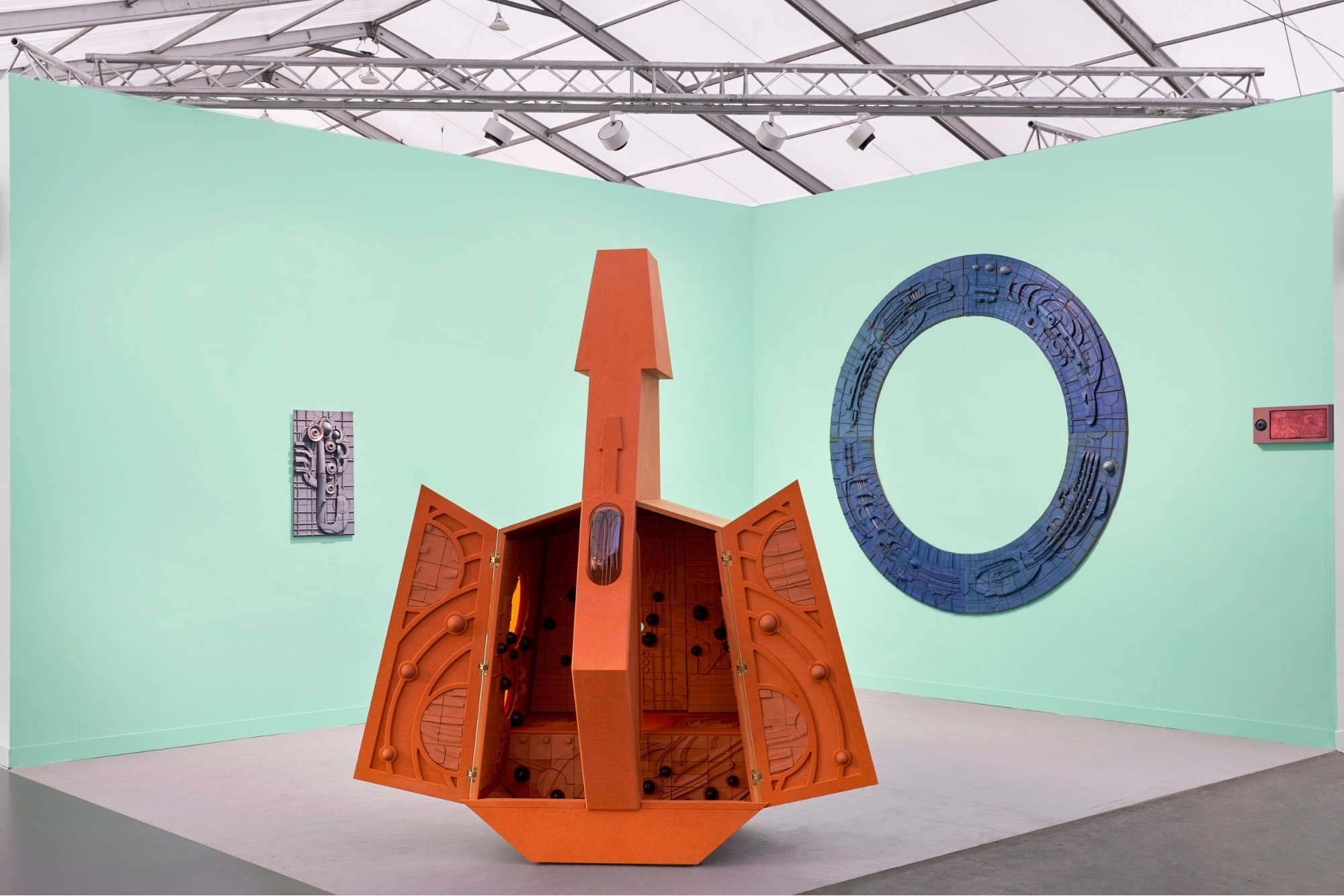
One of the booths there, as part of the ‘Focus’ selection that forefronts young galleries, was Stockholm-based Coulisse, which made a statement with mint-green walls accompanying a solo presentation of punchy works by artist Rafał Zajko. I had previously visited two of Zajko’s solo exhibitions in London: Clocking Off at Queercircle and Song to the Siren at Cooke Latham Gallery. While Zajko would definitely not be identified as a potter or ceramicist, his practice chiefly features ceramic components in recent years. He employs many types of sculptural materials and this background comes through in the works at Frieze. Blue Origin (2025) and the Kosmos series (2025) move beyond a simple tile-based format. Metal fittings and brass components thread through the ceramic forms and there are several layers that create an overall depth to the composition.


His work speaks a clear mechanical and architectural language that feels simultaneously retro and futuristic. Each of Zajko’s works is like an alien weapon begging you to press a button that will trigger the launch of a missile, or maybe just launch into song. It is therefore fitting that one of his large sculptures, Amber Chamber III (2025), that features a terracotta-tile interior, was activated throughout the fair’s duration by the artist himself and fellow artist Agnieszka Szczotk.
Another strong solo presentation of ceramic works was made by the gallery Modern Art and artist Sanya Kantarovsky. The booth was occupied by a Goliath plinth to bolster and guard the freestanding vessel-sculptures with slab paintings hung on the surrounding walls. Kantarovsky’s practice centers on painting while working across various materials, but his works here were exclusively in clay. He masterfully demonstrates how to best make use of the innate characteristics of simple oxides. His painted figures are such a perfect balance of eerie and tender that I can imagine Tim Burton on a waitlist for these works except that, according to curator and journalist Judith Benhamou, they all sold on the opening day.


I was not surprised to find Modern Art promoting ceramics as they represent several sculptors working in clay, such as Ron Nagle, Eva Rothschild, and Nicolas Deshayes. I am surprised, however, to find such wonderful ceramic works by a painter who is a new disciple to the kiln gods. I may be mistaken, as this is just from my Internet sleuthing, but it seems that Kantarovsky first exhibited similar ceramic vessel-sculptures alongside works by other artists with Modern Art at Art Basel only a few months earlier. Modern Art describes their Frieze London offering as a solo presentation but it’s possible that the wheel-thrown forms may have been made by a ceramicist named Aleah Taylor, who is credited as a collaborator and teacher to Kantarovsky in a recent post on the painter’s Instagram. If I had been given the opportunity to pick up one of the larger pots, I would have had a better grasp of whether Taylor threw them or if a talented painter like Kantarovsky is a natural at throwing on the wheel (unfair!).
Three other booths at Frieze London featured almost exclusively ceramics. London’s own Corvi-Mora often exhibits contemporary ceramics, and their Frieze booth included works by Sam Bakewell and Matthew Warner. The Pit came from Los Angeles to present works in clay by Maryam Yousif, Jennifer King, and Viola Frey alongside a painting and drawing by Frey. Richard Saltoun Gallery took a similar approach by presenting works by nine women artists working in clay and a pair of watercolor paintings by Jacqueline Poncelet. By showing 2D works on paper or canvas alongside an otherwise ceramic-specific presentation, The Pit and Richard Saltoun Gallery highlight the dialogue between the medium of clay and a larger art practice.


This is akin to how Lucio Fontana’s works were exhibited at Frieze Masters this year and the year before (as well as possibly in prior years, but I cannot vouch for these renditions). There was a strong connection made between his ceramic plates and his famous slashed paintings. I personally enjoy seeing how an artist’s voice develops across decades and mediums. On the topic of Fontana, Robilant+Voena presented some lovely examples of his work across painting and sculpture at Frieze Masters. I think this was also the gallery that had a breathtaking Fontana made of polystyrene, a 3 x 4 panel of twelve tiles accompanied by a photograph that depicted how the work had once been installed on a ceiling.
Other treats at Frieze Masters included several works by Lucie Rie presented by both Offer Waterman and Erskine Hall & Coe, and a vase titled Kaze (Wind) (1990s) by Fukami Sueharu shown with Thomsen Gallery. Kaze features a flawless application of a seihakuji glaze that pools on a rectangular ledge, the only horizontal face on an otherwise cylindrical form, while crisp porcelain edges peek out from beneath the glaze like icy mountain ridges.


Similarly, skillful craftsmanship was found at PAD London, a fair occurring here and in Paris that showcases art and design. Some galleries at PAD will showcase more art pieces but visitors would likely agree that PAD is generally geared towards selling designed objects. There is a lot of furniture, mirrors, and lighting, so it’s easy to just find yourself dreaming of an alternate universe in which your home is free of Ikea and Dunelm.
Perhaps this is the reason I find myself disassociating more at PAD than at Frieze. The art world tends towards a more spare display, allowing the viewer to appreciate a singular work for its aesthetic, process, and meaning. Most of the booths at PAD are showrooms and they are selling you a package: this patinated silver-leaf table would pair exquisitely with a stained oak cabinet with blown-glass details. I think the objects and my nervous system need more room to breathe. This silver leaf table also contains multiplicities of aesthetic, process, and meaning!
The quality of work at PAD is undeniably impeccable. You will not see ceramic glued to anything here, which I did see at Frieze London… And when speaking about quality ceramic art objects, we must make sure to mention Adrian Sassoon, who was representing leading contemporary ceramicists such as Felicity Aylieff, Pippin Drysdale, and Kate Malone in their booth. I visited Adrian Sassoon’s space in Belgravia ahead of PAD with a friend visiting from out of town to see their relatively new space. We learned that Sassoon has long-standing connections with Australia, which helps explain his strong ties to the ceramics and glass scene there, despite operating primarily in the UK and his specialized background in French Vincennes and Sèvres porcelain.


Meanwhile at Minor Attractions, an award for expertise in ceramic works would most definitely be given to Scottish artist Becky Tucker, a sculptor represented by the gallery Fabian Lang. I have seen Tucker’s signature forms, humanoid figures with outfits of armor and wiggly tongues, around London. She was exhibiting several new sculptures at Minor Attractions. My favorite was a lizard with only three pairs of ears for facial features titled Reverb (2025).
Due to the nature of the venue, Minor Attractions has some limitations with installation. That being said, there were ambitious takeovers by London’s Plicnik Space, which exhibited a life-size cabin occupying almost their entire room at The Mandrake Hotel, and Estonian Kogo Gallery presenting photographs by artist Kristina Õllek that are crusted in natural salt from Camargue, France. These sculptural photographs were hung from medical tubing in the bathroom and shower stall. The most successful exhibitors at Minor Attractions get creative with site-specific presentations, making use of the limitations involved in temporarily installing work in a five-star hotel.


In the process of writing about these fairs and the works I saw, I have been interrogating my own reactions and opinions. I am spoiled for choice when it comes to seeing art here in London, as well as in Seoul, so I gravitate towards what I find original. So what makes an artwork exciting? It’s funny that as a hands-on maker, or perhaps because I am a maker, I find it appealing when everyday objects are appropriately used within an artwork to amplify its meaning. A work that exemplifies this for me is a wall-based blown-glass work titled Stem (IV) (2025) by artist Gabriele Beveridge, which was shown at Seventeen Gallery at Frieze London.
I could not imagine a twin-slot shelf strip and bookends being used the same way at PAD despite the high technical finish of this work, and let me be clear, that is a pity. If everything at PAD is bespoke, then it therefore loses its connection to the world. Beveridge’s practice, on the other hand, employs found objects such as shop fittings and posters with blown glass in order to explore the relationship between human bodies and the cosmetic industry of contemporary urban environments. The message behind her work is more potent because it employs pre-existing structures. I do not implement this strategy in my own practice (yet!) so do as I say, not as I do.
With time to reflect as I transition back into my regular routine, I can appreciate the benefits of having so many art events clustered into a short amount of time in central London. I overheard someone, likely a collector, at PAD complaining about all these fairs and having to zip off to Art Basel Paris soon after. This spiel is not new as it seems that the value of art fairs is not what it used to be. I like to think that the art fair format is kind of like a party: it’s good to be able to see all your friends at once, efficient for sure. But as an introvert, I’d rather meet a friend at a quiet cafe (gallery) and talk one-on-one.
Unu Sohn is an artist and ceramicist based in London. She holds a master’s degree in ceramics from the Royal College of Art.
Frieze London, Frieze Masters, PAD London, and Minor Attractions all took place in London in October 2025.
Subscribe to Ceramics Now to read similar articles, essays, reviews and critical reflections on contemporary ceramics. Subscriptions enable us to feature a wider range of voices, perspectives, and expertise within the ceramics community.
Captions
- Coulisse Gallery, Frieze London 2025. Images courtesy of the artist and Coulisse. Photographed by Graysc studios.
- Sanya Kantarovsky, Modern Art, Frieze London 2025. Courtesy the artist and Modern Art © Sanya Kantarovsky. Photo: Modern Art
- Sanya Kantarovsky, Bonehead, 2025, stoneware, oxides, glaze, 30.5 x 24.1 x 24.1 cm / 12 x 9 1/2 x 9 1/2 in. Courtesy the artist and Modern Art © Sanya Kantarovsky. Photo: Modern Art
- Sanya Kantarovsky, Parasol, 2025, stoneware, oxides, glaze, 20.3 x 19.1 x 19.1 cm / 8 x 7 1/2 x 7 1/2 in. Courtesy the artist and Modern Art © Sanya Kantarovsky. Photo: Modern Art
- Sanya Kantarovsky, Luda, 2025, stoneware, oxides, glaze, 20.3 x 17.1 x 17.1 cm / 8 x 6 3/4 x 6 3/4 in. Courtesy the artist and Modern Art © Sanya Kantarovsky. Photo: Modern Art
- Corvi-Mora, Frieze London 2025. Artists: Sam Bakewell, Alvaro Barrington, Brian Calvin, Che Lovelace, Jennifer Packer, Jem Perucchini, Anika Roach, Tomoaki Suzuki, Matthew Warner and Lynette Yiadom-Boakye. Courtesy Corvi-Mora, London
- The Pit, Frieze London 2025. Photos by Damian Griffiths
- Richard Saltoun, Frieze London 2025. Courtesy of Richard Saltoun London, Rome and New York (c) Kristof Jeney.
- Robilant+Voena, Frieze Masters 2025. Photo: Chloe Rosser
- Lucio Fontana, Soffitto: Concetto Spaziale, 1957, tempera, engravings and holes on polystyrene, 200 x 300 cm. Robilant+Voena at Frieze Masters 2025. Photo: Chloe Rosser
- Lucio Fontana, Robilant+Voena, Frieze Masters 2025. Photo by Hugo Glendinning. Courtesy of Frieze
- Robilant+Voena, Frieze Masters 2025: ceramics by Lucio Fontana. Photo: Chloe Rosser
- Fukami Sueharu, Kaze (1990s). Courtesy of Thomsen Gallery
- Adrian Sassoon at PAD London 2025. Images courtesy of Adrian Sassoon, London. Photography by Yosuke Kojima.
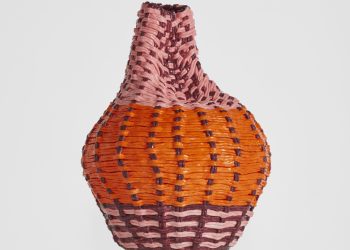
- PIK’D, PAD London 2025. Images courtesy of PIK’D, Beirut
- Becky Tucker, Reverb, 2025, Glazed stoneware, 7.00 x 50.00 x 24.00 cm, 2.76 x 19.69 x 9.45 in. © The artist. Courtesy of the artist and Galerie Fabian Lang. Photo: Becky Tucker
- Kogo Gallery at Minor Attractions with a presentation by Kristina Õllek, London, 2025. Photo by Kristina Õllek
- Kristina Õllek, Evaporating Sea no. 1, 2024. Inkjet prints with grown sea salt from Camargue (pigments, transparent hose, sea salt). Edition of 1/3 + 2 AP, 40 × 33 cm. Kogo Gallery at Minor Attractions with a presentation by Kristina Õllek, London, 2025. Photo by Kristina Õllek
- Gabriele Beveridge, Stem (IV), 2025. Hand-blown glass, steel bookends, 150 x 40 x 40 cm. Photo by Damian Griffiths. Copyright Gabriele Beveridge. Courtesy of Seventeen, London.



Comments 1