



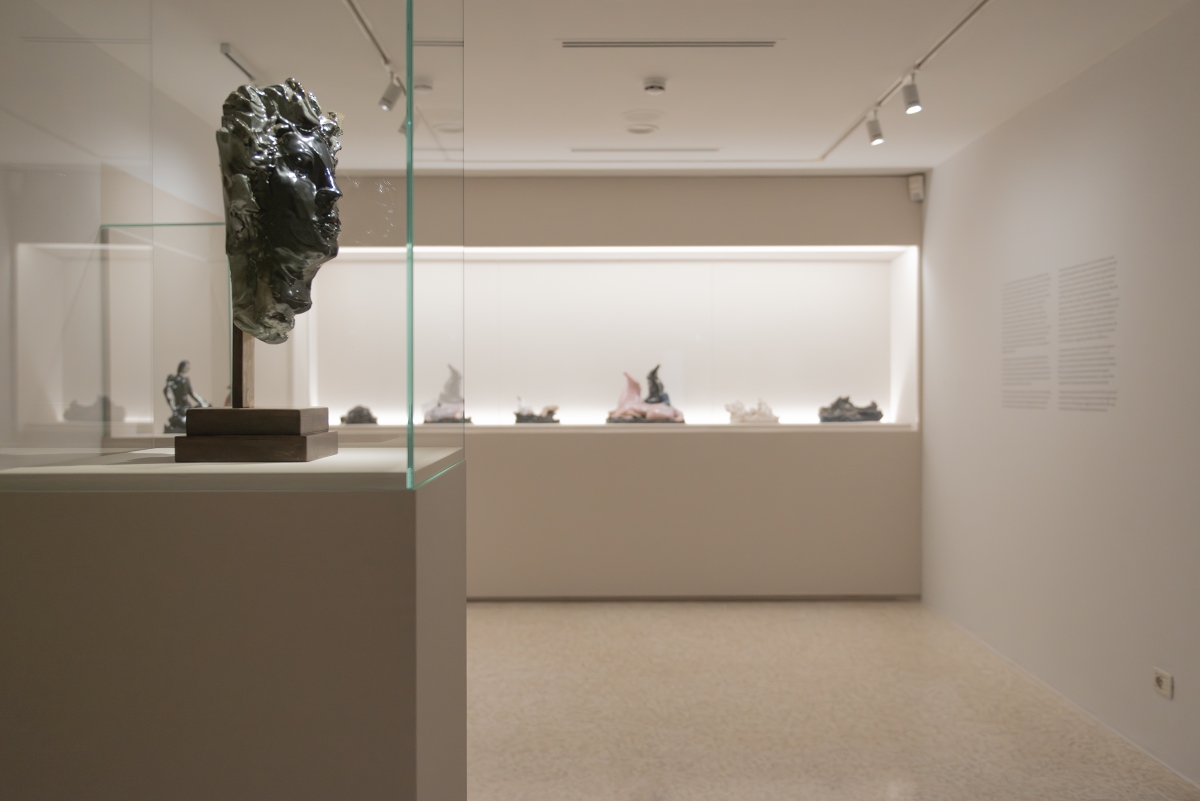
Manu-Facture: The Ceramics of Lucio Fontana is on view at the Peggy Guggenheim Collection, Venice
October 11, 2025 – March 2, 2026
Organized by Sharon Hecker
From October 11 through March 2, 2026, the Peggy Guggenheim Collection presents Manu-Facture: The Ceramics of Lucio Fontana, the first museum exhibition dedicated exclusively to the ceramic work of Lucio Fontana (1899–1968), one of the most innovative, and in his unique way irreverent, artists of the twentieth century. While Fontana is best known for his iconic, slashed and punctured canvases of the 1950s and ‘60s, this exhibition casts a spotlight on a lesser-known but essential part of his oeuvre: his work in clay, which he began in Argentina in the 1920s and continued to explore throughout his life. Organized by art historian Sharon Hecker, this is the first solo show to offer an in-depth examination of Fontanaʼs ceramic production. As Hecker notes: “Long associated with craft rather than fine art, today Fontanaʼs ceramics are receiving attention due to the resurgence of interest in the medium within contemporary art.”
Between suicide and travel, I chose the latter because I hope to still make a series of ceramics and sculptures that give me the pleasure or feeling of still being a living man.
Lucio Fontana
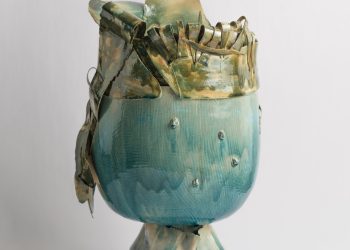
Through over seventy works, including several never previously exhibited, on loan from renowned public and private collections, the show seeks to illuminate the full scope of Fontanaʼs sculptural vision in clay, revealing how over the years he regarded it as a rich, generative site of experimentation. Fontanaʼs ceramic output is notable for its diversity of forms, techniques, and subject matter: from figurative sculptures of women, sea creatures, harlequins, and warriors to abstract forms, his approach to clay recaptured the age-old ritual of ceramic making combined with experimentation. His ceramic practice unfolded across several decades and different contexts: from his early work in Argentina to his return to Fascist Italy, to another long stay in Argentina, and again in Italy after World War II during reconstruction and the later economic boom. Fontana also made objects for private interiors, from plates to crucifixes, fireplaces, and doorhandles, often in collaboration with leading designers. Working with prominent Milanese architects, he created ceramic friezes for building facades and sculptures for churches, schools, cinemas, hotels, sports clubs, and tombs that still adorn the city today. The selection of works on view features both unique handmade works and serially produced objects, some of which blur the boundaries between the two categories.
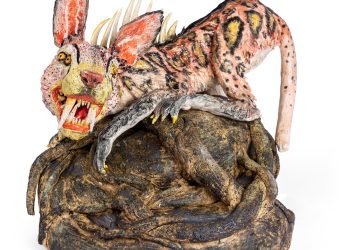
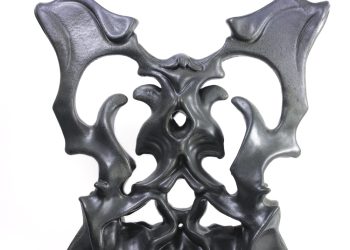
The exhibition traces Lucio Fontanaʼs ceramic practice across two continents and four transformative decades, unfolding through a dynamic interplay of chronology and sculptural themes. His protean production ranges from expressive figurative sculptures—women, harlequins, sea creatures—to radically abstract forms, reflecting the diverse historical, social, political, and geographic contexts in which he lived and worked. Beginning with a first work made during his return to Argentina in 1926, following the trauma of fighting in World War I as a young man among the ragazzi del ‘99, the exhibition follows Fontana back to Fascist Italy where, in the early 1930s, he produced small, intimate terracottas—unglazed and dabbed with paint—like Ritratto di bambina (Portrait of a Girl, 1931) or Busto femminile (Female Bust, 1931), and then to his explosion of experiments with glazes thanks to his collaboration with local artisans in Albisola. Works from this period include the fascinating Coccodrillo (Crocodile, 1936–37), Medusa (1938–39), Donna seduta (Seated Woman, 1938), and the monumental Torso Italico (Italic Torso, 1938). During World War II, he again returned to Argentina and continued to make ceramics, before settling once more in postwar Italy, where the countryʼs reconstruction and economic boom paralleled his conceptual expansion in ceramics, including plates, crucifixes, and abstract sculptural forms that explored the origins of ceramic-making. A dedicated gallery presents Fontana’s deeply personal portraits of women in his life—from his wife, Teresita Rasini, and author and intellectual Milena Milani, the only woman to sign the Manifesto dello Spazialismo, to ceramicist Esa Mazzotti—revealing his intimate relationship with both his sitters and the medium itself. The exhibition emphasizes Fontanaʼs embrace of clayʼs physicality—smooth, rough, incised, raw, painted, glazed—highlighting his innovative mixing of the languages of art and craft, design and artisanship. Archival photographs capture the artist at work, offering a portrait of a collaborative maker deeply attuned to material, process, and place.
The show is accompanied by Lucio Fontana Ceramics in Milan, an original short film commissioned especially for the exhibition and created by Argentinian director Felipe Sanguinetti. Conceived as an integral part of the exhibition, the film takes viewers on a cinematic journey through different places in Milan—the Monumental Cemetery, the Church of San Fedele, the Istituto Gonzaga, the Museo Diocesano, Villa Borsani, as well as apartment buildings—examining the ceramic works that Fontana created in collaboration with leading Italian architects, including Osvaldo Borsani, Roberto Menghi, Mario Righini, and Marco Zanuso. Since these site-specific works are integrated into the cityʼs architectural and urban fabric, they cannot be exhibited in museum galleries. They are brought to life through this filmʼs powerful and captivating imagery.
Manu-Facture: The Ceramics of Lucio Fontana invites visitors to reconsider Fontana not only as a pioneer of Spazialismo and Conceptual Art but also as a materially engaged artist deeply attuned to the tactile and expressive potential of clay. The exhibition also raises new historical, material, and technical questions about Fontanaʼs ceramic practice, which one early critic defined as the artistʼs “other half” and “second soul.” In contrast to the prevailing, familiar image of Fontana as a lone, hypermasculine, heroic figure violently slashing his canvases, the exhibition reveals a more informal, intimate, collaborative side of the artist—rooted in clayʼs soft physicality and shaped by enduring relationships, such as the one with the ceramist and poet Tullio dʼAlbisola and the Mazzotti ceramic workshop in Albisola. As Hecker puts it, “clay emerges as a vessel for life-affirming experimentation, multiplicity, and generativity.”
A fully illustrated catalog, published by Marsilio Arte, features essays by curator Hecker, as well as Raffaele Bedarida, Luca Bochicchio, Elena Dellapiana, Aja Martin, Paolo Scrivano, and Yasuko Tsuchikane, all dedicated to Fontanaʼs ceramic practice and its historical, social, and cultural contexts. A rich program of free collateral events also accompanies the show, exploring and interpreting the artistʼs practice and visual idiom, organized with the support of Fondazione Araldi Guinetti, Vaduz. Manu-Facture: The Ceramics of Lucio Fontana is supported by Bottega Veneta.


Lucio Fontana was born February 19, 1899, in Rosario de Santa Fé, Argentina. His father was Italian and his mother Argentine. Fontana lived in Milan from 1905 to 1921 before moving back to Argentina, where he worked as a sculptor in his brother’s studio. In 1926, he participated in the first exhibition organized by Nexus, a group of young Argentine artists working in Rosario de Santa Fé. Upon his return to Milan in 1928, Fontana enrolled at the Accademia di Belle Arti di Brera, which he attended for two years, studying under Adolfo Wildt. In 1930 he held his first solo exhibition at the Galleria Il Milione in Milan
In Paris in 1935, he joined the Abstraction-Création group. The same year, he developed his skills in ceramics in Albisola, Italy, and later at the Sévres factory, near Paris. In 1939, he joined Corrente, a group of Milanese expressionist artists. In 1940, Fontana moved back to Buenos Aires where, in 1946, together with some of his students, he founded the Academia de Altamira and published the Manifiesto Blanco. Back in Milan in 1947, in collaboration with a group of writers and philosophers, he signed the Primo manifesto dello Spazialismo. He subsequently resumed his ceramic work in Albisola to explore these new ideas with his Concetti spaziali (1949–60).
The year 1949 marked a turning point in Fontanaʼs career. He created the Buchi, his first series of paintings featuring punctured canvases, as well as his first spatial environment, a combination of shapeless sculptures, fluorescent paintings, and blacklights to be viewed in a dark room. The latter work soon led him to employ neon tubing in ceiling decoration. In the early 1950s, he participated in Italian Art Informel exhibitions. During this decade, he experimented with various effects, such as slashing and perforating, in both painting and sculpture. The artist visited New York in 1961 during a show of his work at the Martha Jackson Gallery. In 1966, he designed opera sets and costumes for La Scala, Milan. In the last years of his career, Fontana became increasingly involved in the staging of his work in the many exhibitions that honored him worldwide, as well as in the idea of purity achieved in his last white canvases. These concerns were prominent at the 1966 Venice Biennale, for which he designed the environment for his works, and at the 1968 Documenta in Kassel. Fontana died on September 7, 1968, in Comabbio, Italy.
Contact
info@guggenheim-venice.it
Peggy Guggenheim Collection
Palazzo Venier dei Leoni
Dorsoduro 701
I-30123 Venice
Italy
Captions
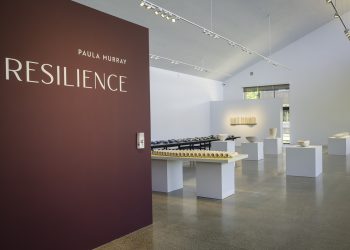
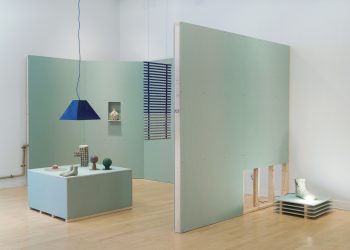
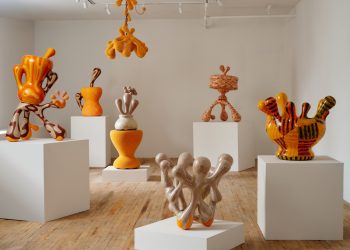
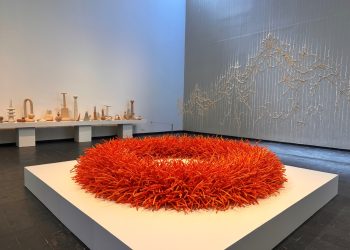
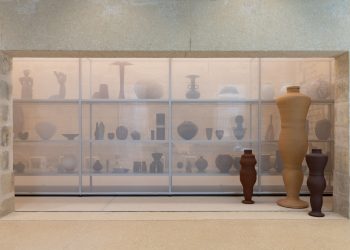
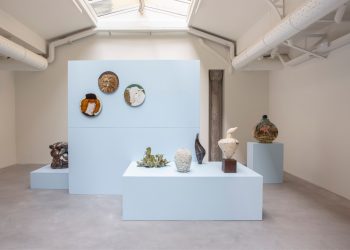
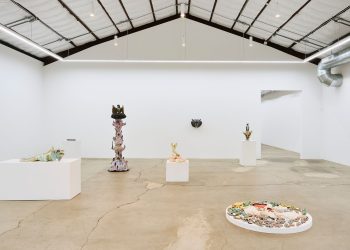
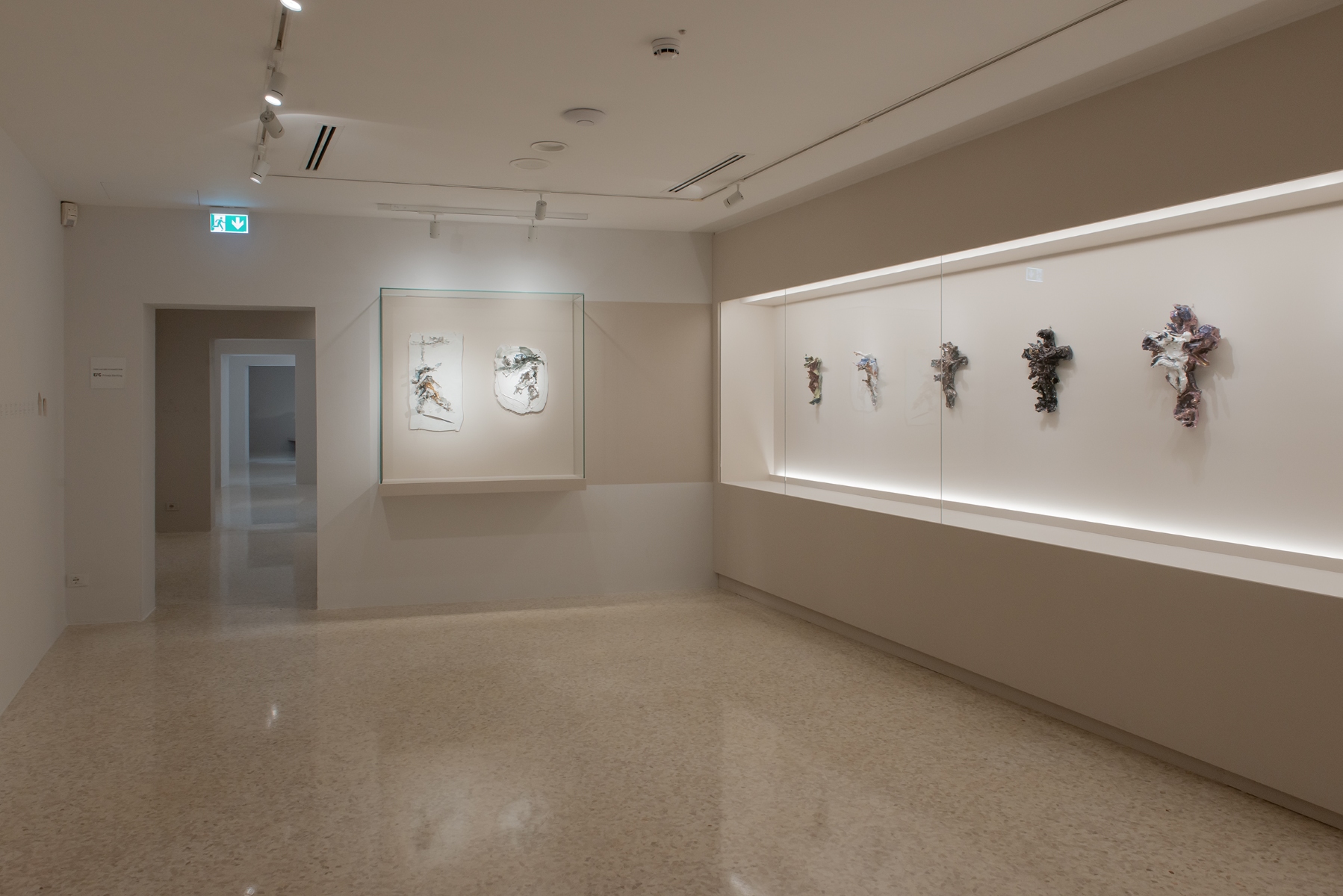
- Installation views, Manu-Facture: The Ceramics of Lucio Fontana, 11.10.2025 – 02.03.2026, © Peggy Guggenheim Collection. Photos by Claudia Corrent
- Lucio Fontana, Medusa, 1938-1939, Glazed ceramic: black and gray, 38 x 28 x 15 cm. Verona, Palazzo Maffei Fondazione Carlon © Fondazione Lucio Fontana, Milano, by SIAE 2025
- Lucio Fontana, Crucifix, 1951, Glazed ceramic: black, amaranth, white and yellow, 50 x 35 x 18 cm. Karsten Greve, St. Moritz © Fondazione Lucio Fontana, Milano, by SIAE 2025
- Lucio Fontana, Portrait of Esa, Glazed ceramic: white, brown and pink, 57 x 43 x 27 cm. Collezione privata © Fondazione Lucio Fontana, Milano, by SIAE 2025
- Lucio Fontana, Crocodile, 1936-37, Glazed ceramic: green, red and yellow, 18 x 130 x 42 cm. Karsten Greve, St. Moritz © Fondazione Lucio Fontana, Milano, by SIAE 2025
- Lucio Fontana, Spatial Concept, 1962-63, Slip-painted and painted terracotta with gash, 28 x 21 cm. Fondazione Lucio Fontana, Milano © Fondazione Lucio Fontana, Milano, by SIAE 2025
- Lucio Fontana, Battle, 1947, Glazed ceramic: amaranth, light blue and turquoise, 15 x 39 x 21,5 cm. Karsten Greve, St. Moritz © Fondazione Lucio Fontana, Milano, by SIAE 2025