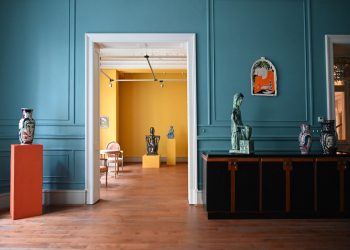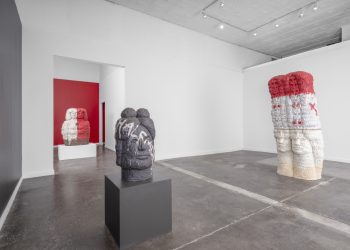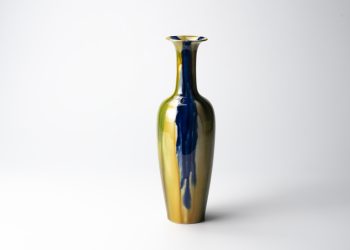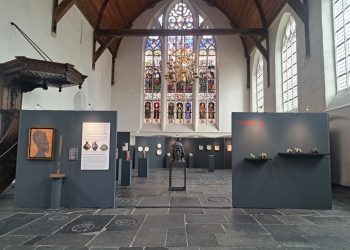
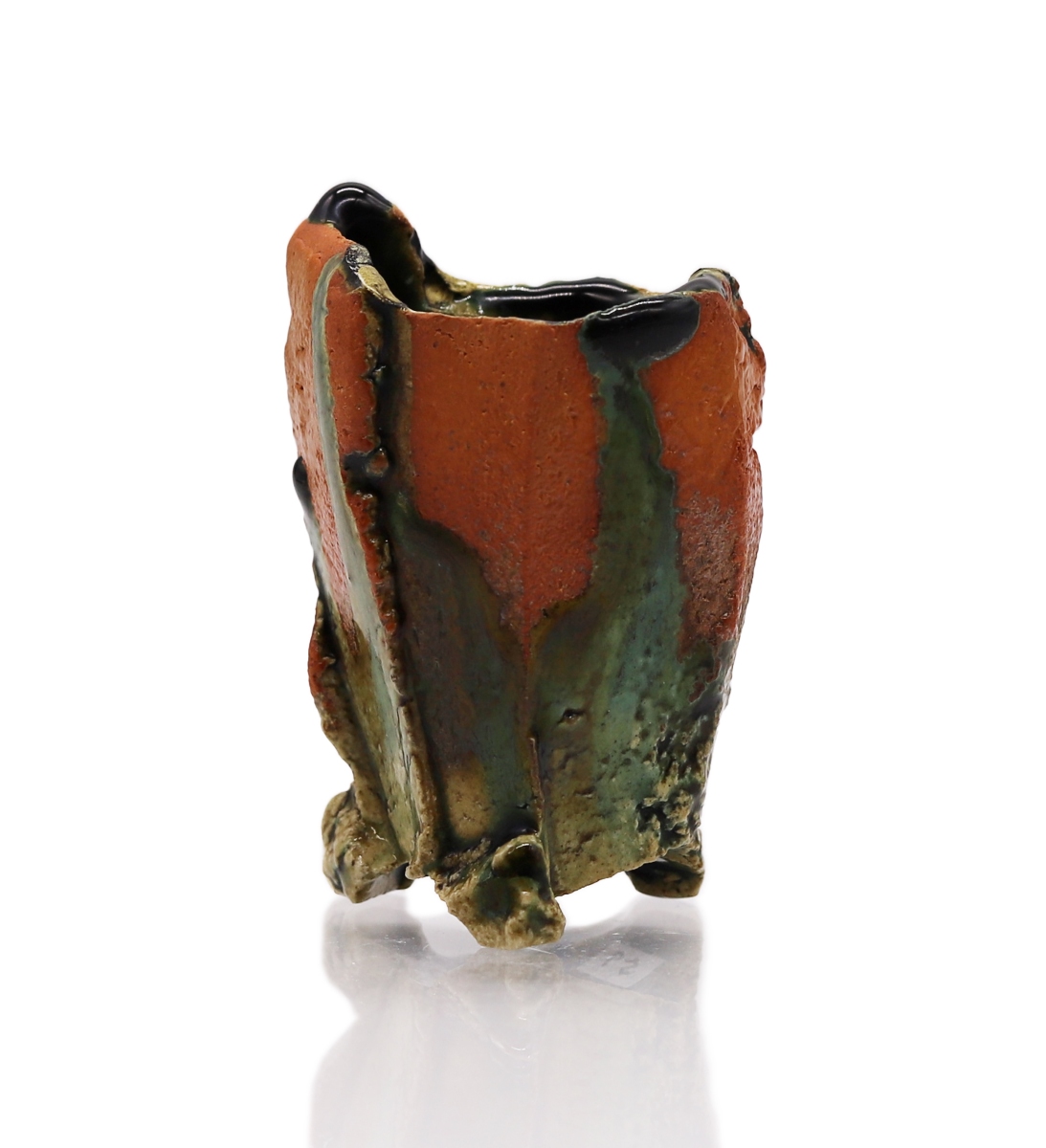
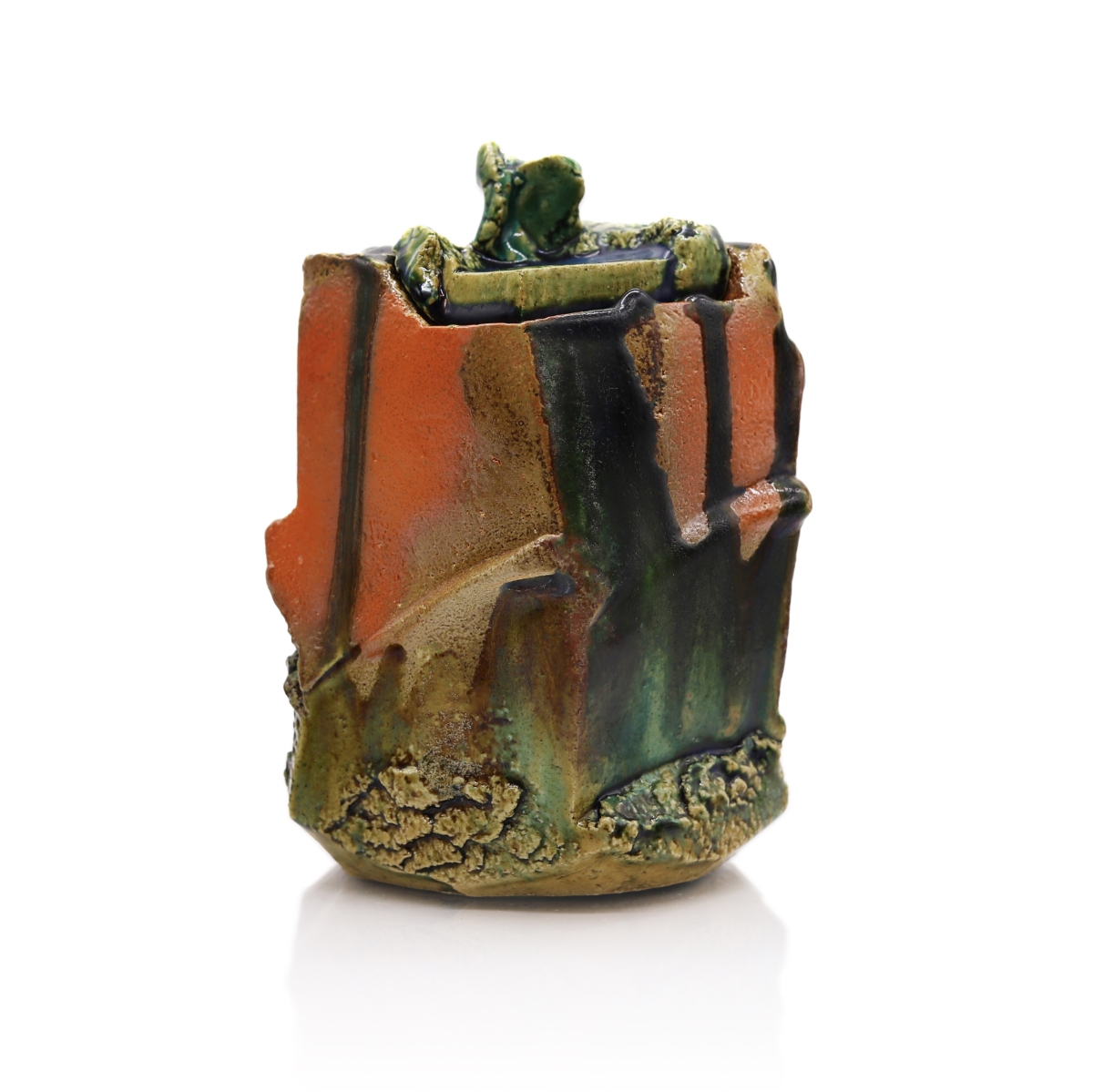
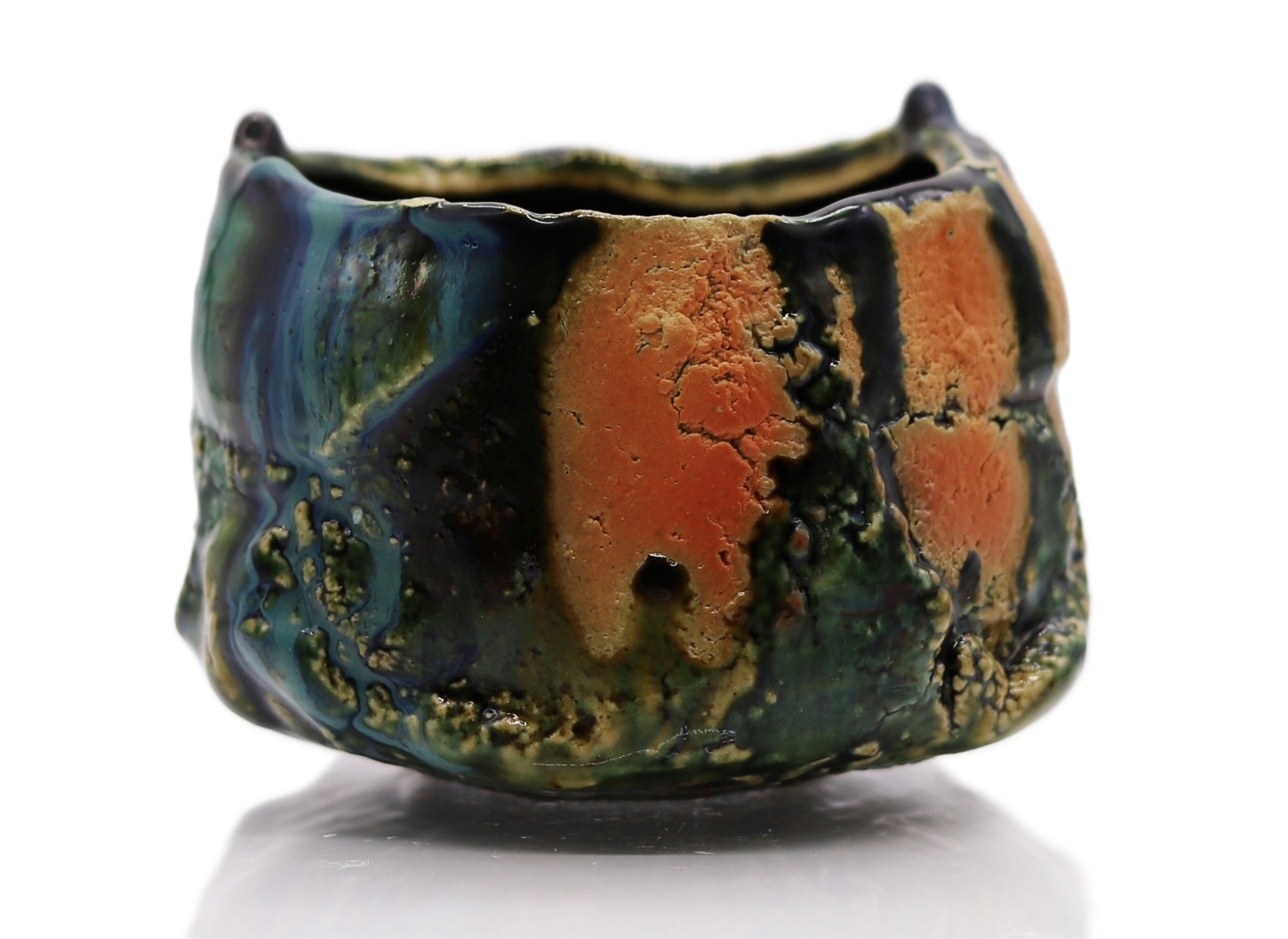
Shigemasa Higashida: Master of Tokyo opens this week at The Stratford Gallery in Broadway, Worcestershire
November 3-14, 2023
The exhibition opens online at 7pm GMT on Friday, November 3rd, 2023, and in gallery from 2pm on Saturday, November 4th. Higashida san is joining us from Tokyo for the opening.
Essay by Anna Clegg
We arrive early to meet Higashida Shigemasa, and spend 30 or so minutes waiting outside the North entrance of Musashi-Ko- ganei station. The January cold is somewhat displaced by a curious afternoon sun that hangs low in the sky to the West, its rays not piercing as winter light so often is but milky, ill-defined. The sky is veneered with slight, unmoving altostratus clouds and the street is hushed. Teenagers in school uniform stagger around each other, stifling guffaws behind their masks; commuters’ briefcases swing against dark woollen overcoats as they walk home, push bicycles or lean against bus stops. Pale yellow light enfolds white tiles, brown painted wood, taut vinyl banners and the multicoloured plastic reliefs of shop signage in soft, blushing peonies.
Higashida san meets us at the station and drives us to his home, located 5 minutes west of the station. His front door is accessible only via a narrow stone path that winds around two adjoining sides of the house. The path is flanked by dense masses of shrubby ferns, fat-leaved Loquat plants and Red Cedar, out from which stretch the gnarled, silvery limbs of Japanese Pine and Maple. Sunlight flickers across washed concrete and sleek corrugated iron behind.
Stepping through a sliding door, we remove our shoes and pad down a quiet, polished corridor. At its end is a door with a slim glass panel to its left hand side, through which two black and white cats survey us charily. We turn into Higashida san’s studio. To the right is a small work bench, its grain filled with tiny rivulets of dried white clay, a table-top wheel, gas heater, large square window partially covered by a traditional shoji, and a small sink surrounded by neatly arranged hand-tools and a portable bluetooth speaker. To the left are two large wooden wheels built into a raised wooden platform, a flat cushion positioned in front of each. Higashida San motioned to the large levers jutting out of the floor next to them, explaining that one would pull them to maintain momentum in the wheels whilst kneeling on the floor.
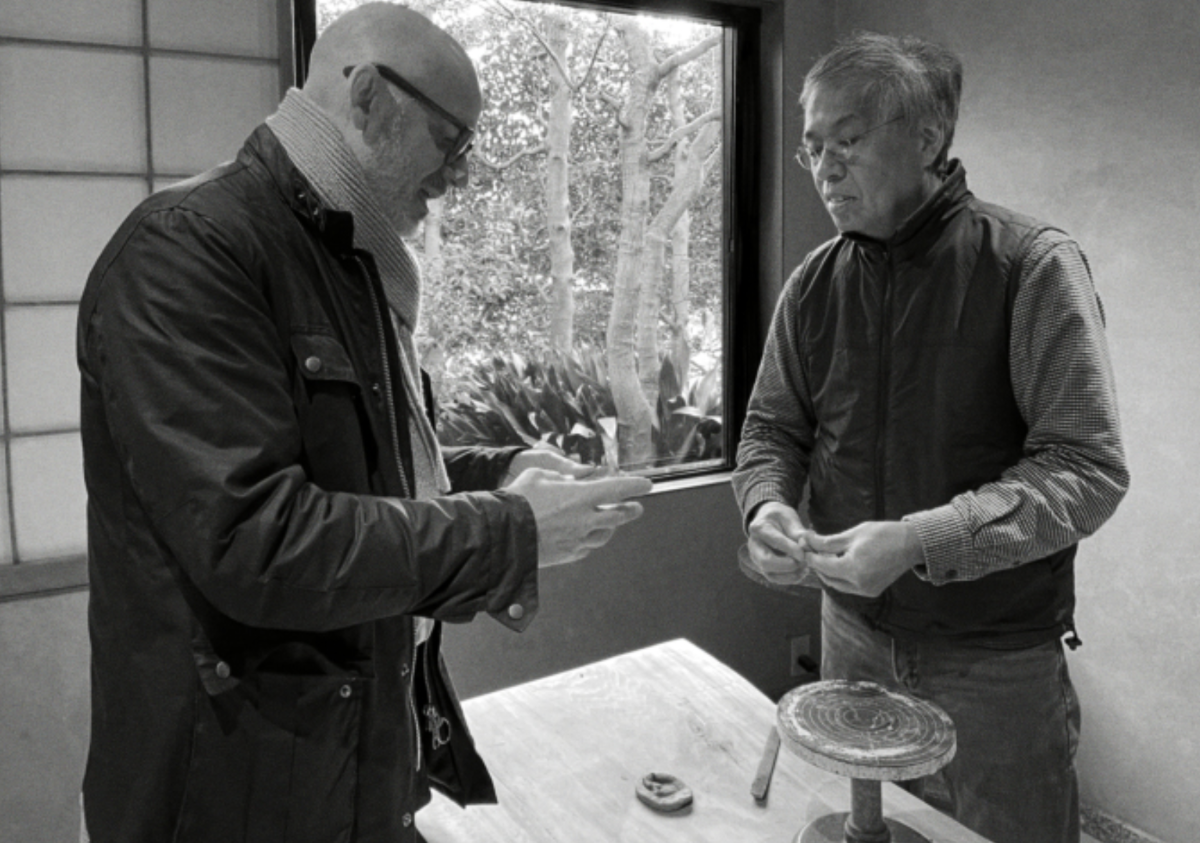
Under the warm light of the studio, he reaches for a bag of clay and pulls a small piece from it. “I use only one clay, for the texture and for the way the glaze travels over it,” he muses. Pushing his thumb into the clay to make a small well, he starts fanning it out slowly. “The way the glaze behaves depends on whether the clay contains iron or not. This one contains Iron.” He studies the small, lens-shaped piece of clay for another moment before gently setting it down on the table. He reaches down again to take a larger piece of clay and sets it on the small, hand-operated wheel and politely asks us if we would like to see a demonstration. We agree enthusiastically, and with a nod he proceeds to turn the wheel and draw the mass of earth upwards into a cylindrical vessel. His face is placid, eyes moving softly behind his frameless glasses and head tilting fractionally as the pot turns. Having smoothed the pot’s form with a thin steel rib, Higashida san flips the tool on its side and pushes it into the pot to create a deep groove halfway up its side, surplus clay spilling on either side in a jagged lip. He then takes a rounded block of wood and, supporting the pot gently from the other side with his free hand, uses it to buckle the clay. He starts turning the wheel slowly, slowing to gouge sheets of clay from three sides. The vessel warps and undulates, its central engraving interrupted, diverted. Higashida san reaches for another wooden tool, similar to a spoon in shape, and begins evening out the sides from within. After a couple of motions, he sets the tool down and starts using his four fingers instead, cemented into a single plane, to perfect it. Laughing quietly, he murmurs, “this clay…not soft…” but continues to turn the wheel and, after one whole slow rotation, nods again in finality. We thank him repeatedly with an almost breathless eagerness, and he is modest and gracious in his response. “This one turned out looking quite natural.”
I readjust microphone input levels in my camera whilst Higashida san washes his tools and chats with Howard, and after a couple of minutes he invites us to his kiln room across the corridor. As we leave the studio, I glance once more at the newly completed ceramic on the work bench and think back to Higashida san’s comment about the stubbornness of the material. It had jolted me like an electric shock: I had found it unfathomable that he could be frustrated with a substance that he was working so effortlessly with, as though it was an extension of his own body. I wonder whether the term ‘dancing’ might be apt enough to override its clichéd status, but Higashida san’s muted control over the material seems more like a conversation between the two, an agreement between hand and earth that is not without emotion but logical, almost intellectual, in its subtleties.
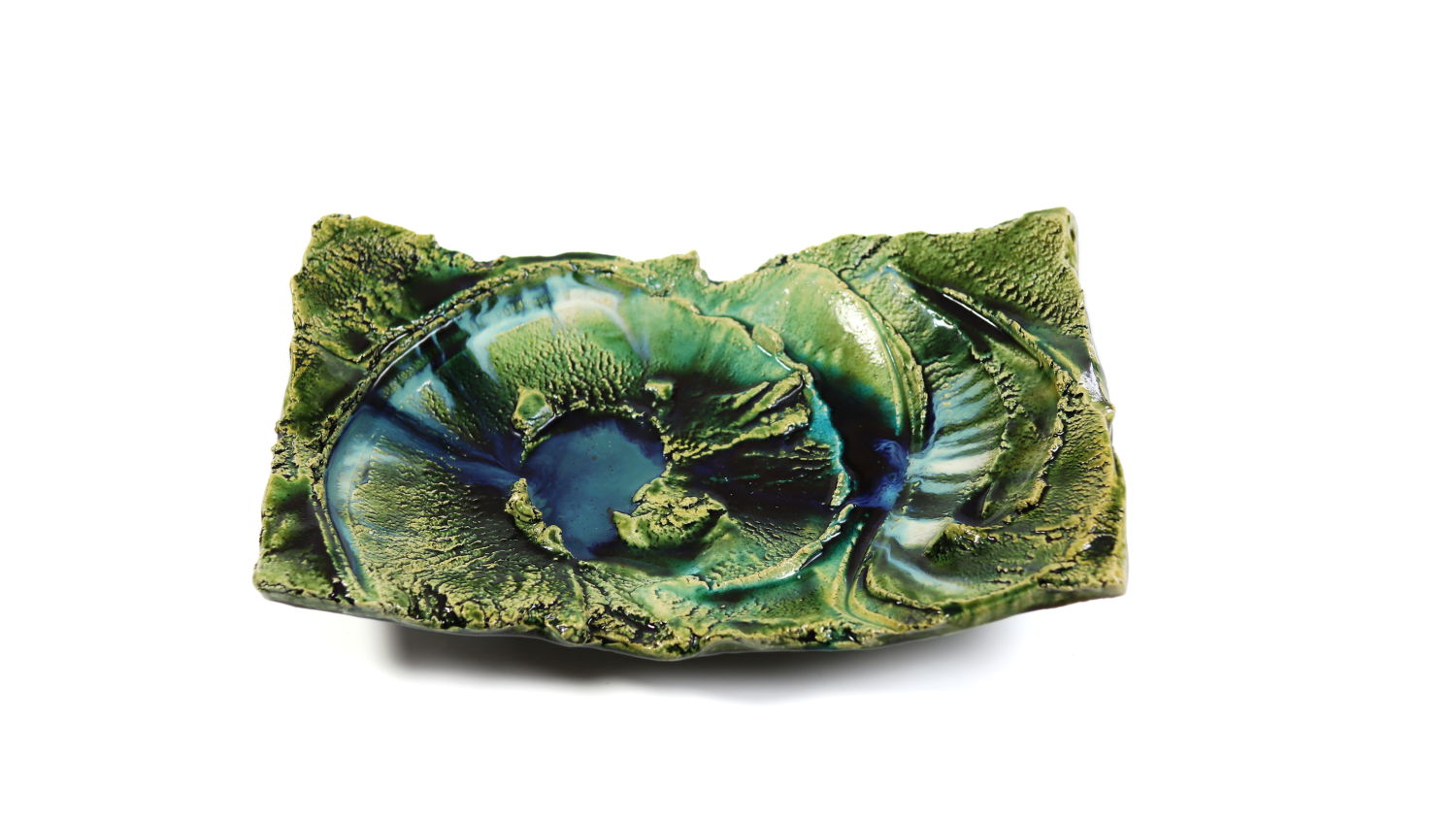
Higashida san’s kiln room, flanked by the same stylish concrete facades as outside, is bright and lofty. Howard remarks that it is the most beautiful studio he has ever seen and with smile Higashida san excitedly beckons us over to one of the walls. Screwed into the incremental tie holes, positioned at head height every metre or so, are small, glazed ceramic studs. They range from deep blue to aquatic green, strong ochre to peat black. For the exterior walls, Higashida san tells us he has crafted 737 of them. A larger, marbled iris constitutes the front door handle. For both these small plugs and his primary output, Higashida san uses Oribe glaze, which is traditionally made by blending a copper salt with feldspathic and wood ash glaze, and one Soro ash glaze. Higashida san uses five original variations of the former, each of which he tweaks through repeated testing until the formula presents to him the required result.
Opening a wide shutter at the back of the studio, he gestures to a gravel littered with glossy, white-rimmed shards of green and blue. They look like a cross between gemstones and teeth.
“This is where I destroy the pieces that come out as failures,” he laughs, “80% are destroyed.”
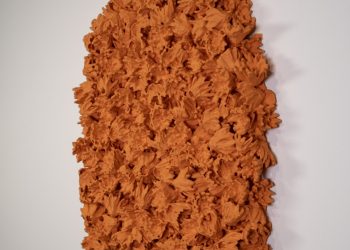
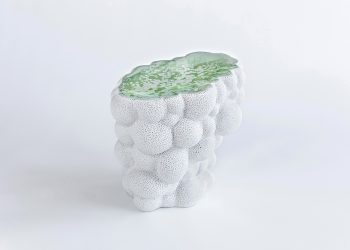
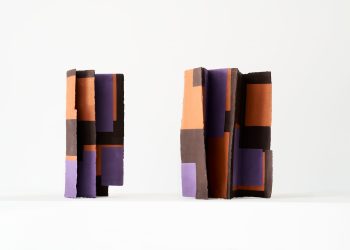
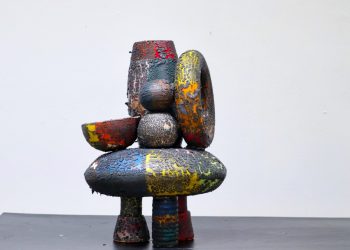
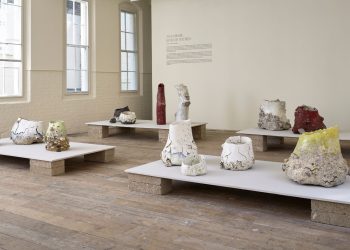
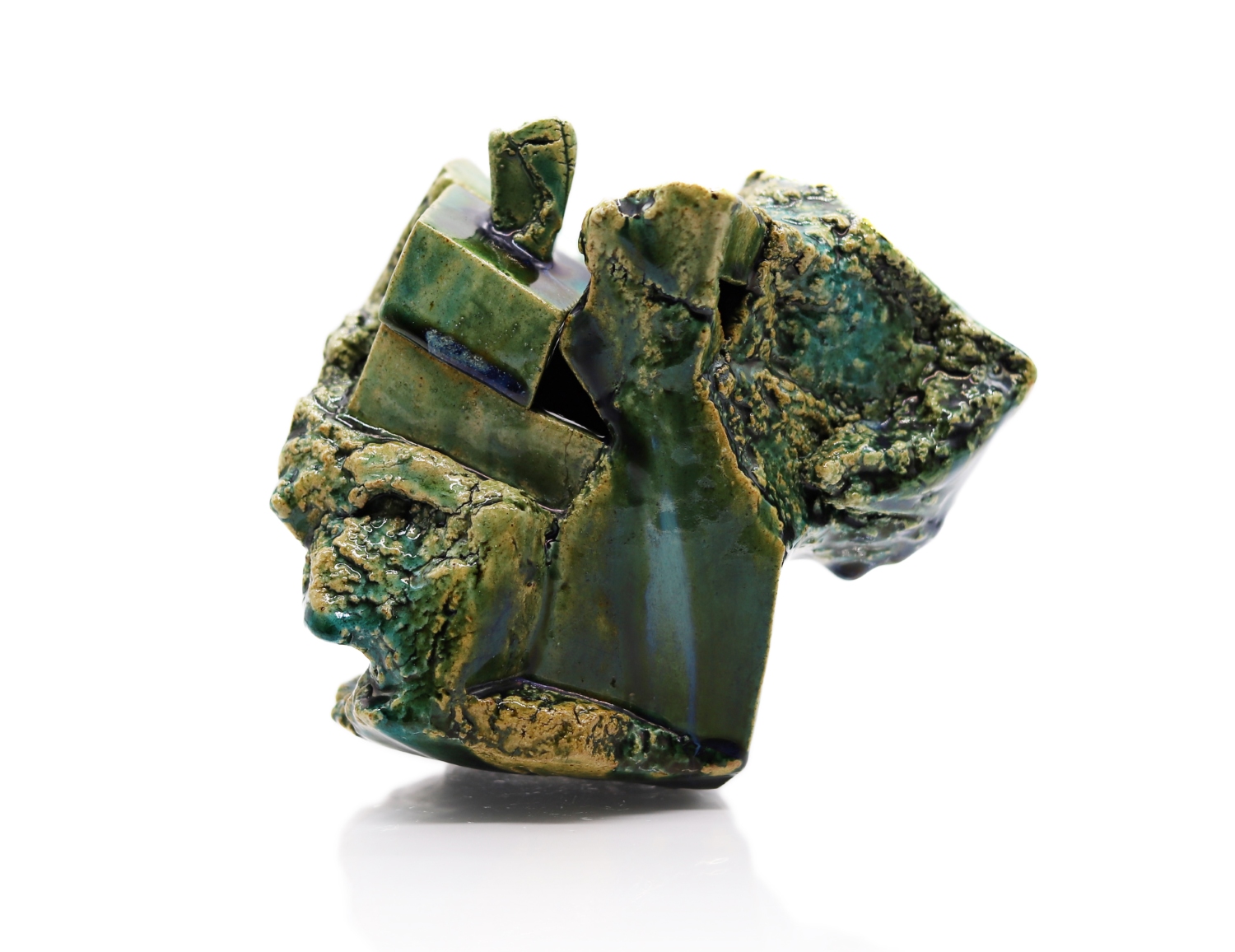
Higashida san again leads us out of the larger studio, past the monumental gas-fired kilns, and down the house’s central corridor to an inbuilt show room with some of his newer works. On low, marble-topped rows of cabinets sit two large vessels and around eight smaller pieces. I pick up one of the smaller works and turn it carefully in my hands. Its upper section is impossible geometric, smooth cubic slabs, almost architectural that jostle and slot amongst each other. Crashing at their foot are great swells of sublimely textured gnarls and juts, resembling something in between rock and wave. The piece is swathed in deep green Oribe glaze, which at its edges and crests peters-out into a smokey yellow, the material’s contrasts heightened by tiny pools of thicker glaze in between. I am mesmerised. It reminds me a little of a later Vincent Fecteau sculpture, if the conditions of that sculpture were that it had been made under, and possibly by, the ocean.
We don’t have much time left before we must leave for dinner on the very Western edge of Tokyo, but before we do we are offered matcha in a beautifully designed chashitsu. The room is carpeted, neutral, and empty save for a very low table built into a recess in the floor, into which one swings their legs to comfortably simulate the more traditional tatami-and-cushion seating used in tea ceremonies. Higashida san emerges wordlessly from the kitchen with chawan filled with carefully portioned, steaming matcha, cut fruit, and a delicate, flower-shaped Wa- gashi. As we drink together, he tells us that he originally studied economics at Yamaguchi Prefecture University, with plans to be a corporate economist. However, soon after graduating, he realised that this career path was leaving him feeling deeply unfulfilled, describing himself as ‘a lost sheep’. Unsure of where to turn, he visited a fortune teller. They told him that he would find success in carpentry or ceramics, so he chose ceramics. An unusual departure from the more common generational origins to the craft that we would encounter amongst other ceramists later in our trip, Higashida san’s stumbling into ceramics via psychic medium felt incredible, almost preternatural, and yet, looking around and down at the masterful creations before me, an act of unquestionable fate.
Contact
art@thestratfordgallery.co.uk
The Stratford Gallery
62 High Street,
Broadway,
Worcestershire, WR12 7DT
United Kingdom
Photos courtesy of the gallery