Magazine
Ceramic artists list
> Ceramic artists list 97. Ryan Blackwell 96. Ellen Schön 95. Francesco Ardini 94. David Gallagher 93. Elizabeth Shriver 92. Jason Hackett 91. Patricia Sannit 90. Bente Skjøttgaard 89. Steve Belz 88. Ruth Power 87. Jenni Ward 86. Liliana Folta 85. Kira O'Brien 84. Annie Woodford 83. Kwok-Pong Bobby Tso 82. Bogdan Teodorescu 81. Kimberly Cook 80. Paula Bellacera 79. Debra Fleury 78. Cindy Billingsley 77. David Gilbaugh 76. Teresa & Helena Jané 75. Marianne McGrath 74. Suzanne Stumpf 73. Deborah Britt 72. Kathy Pallie 71. Els Wenselaers 70. Kjersti Lunde 69. Brian Kakas 68. Marie T. Hermann 67. Mark Goudy 66. Susan Meyer 65. Simcha Even-Chen 64. Barbara Fehrs 63. Shamai Gibsh 62. Natalia Dias 61. Bethany Krull 60. Amanda Simmons 59. Arthur Gonzalez 58. Chris Riccardo 57. Akiko Hirai W 56. Johannes Nagel 55. Rika Herbst 54. Liza Riddle 53. Chang Hyun Bang 52. Virginie Besengez 51. Jasmin Rowlandson 50. Chris Wight 49. Wim Borst 48. Rafael Peréz 47. Guðný Hafsteinsdóttir 46. Cathy Coëz 45. Merete Rasmussen 44. Carol Gouthro 43. JoAnn Axford 42. David Carlsson 41. Margrieta Jeltema 40. David Roberts 39. Patrick Colhoun 38. Abigail Simpson 37. Signe Schjøth 36. Katharine Morling 35. Dryden Wells 34. Antonella Cimatti 33. Cynthia Lahti 32. Carole Epp 31. Blaine Avery 30. Ian Shelly 29. Jim Kraft 28. Wesley Anderegg 27. Connie Norman 26. Arlene Shechet 25. Young Mi Kim 24. Jason Walker 23. Peter Meanley 22. Shane Porter 21. Jennifer McCurdy 20. Yoichiro Kamei 19. Debbie Quick 18. Ian F Thomas 17. John Shirley 16. Grayson Perry 15. Vivika & Otto Heino 14. Georges Jeanclos 13. Daniel Kavanagh 12. Nagae Shigekazu 11. Matthew Chambers 10. Tim Andrews 9. Claire Muckian 8. Adam Frew 7. Maciej Kasperski 6. Roxanne Jackson 5. Keith Schneider 4. Celeste Bouvier 3. Tim Scull 2. Kim Westad 1. Sara Paloma

Danish contemporary ceramics

Emmanuel Boos and Esben Klemann: Systematic Uncertainty / Copenhagen Ceramics

Emmanuel Boos and Esben Klemann: Systematic Uncertainty exhibition Copenhagen Ceramics

Emmanuel Boos and Esben Klemann: Systematic Uncertainty / Copenhagen Ceramics, Denmark
February 28 - March 28, 2013

In ceramics the unknown is a fate for the practitioner. Emmanuel Boos and Esben both welcome unpredictability. Moreover they are provoking it. They share a playful and experimental approach to the ceramic material and their works are bred from a great curiosity towards the processes of the material.

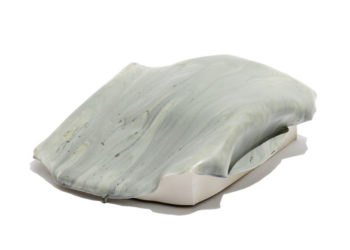
Emmanuel Boos, now living in London, was born and grew up in France. He trained with Jean Girel, one of the big names in French ceramics, known for his works with beautiful textural glazes. Emmanuel Boos equally places the glazes at the centre of his artistic practice, but goes further. He questions the classic hierarchy, where the materials as such are regarded as undifferentiated, depending on being given form, morphe, which traditionally is considered the essential part.

For Boos form is often a pretext, a playground for glazes to develop on. His interest lies with the poetic character and sensuality of the glaze, both in a direct sense as the fusion of basic materials and in the symbolic potential of this. His works are not conceptually based; rather they express a search for beauty, that strives for a form of aesthetic contemplation appealing firstly to our senses and our emotions.

For his first show in Denmark, Emmanuel Boos will be showing both plinth and wall pieces. His intent is to draw the viewer into the glaze, inviting us to meander in its depth through poetic reverie. His forms oscillate between mysterious enclosed objects – minerals with an underlying organic presence – and thin sheets of porcelain like canvases gently folding and developing into space.

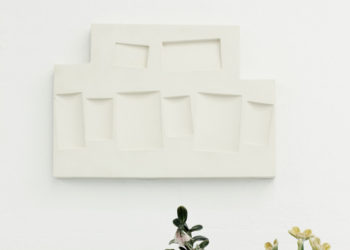
The expressive heartland in Esben Klemann’s work is clearly defined by his interest in architecture, construction and material, and a constant urge to further develop the making-processes, that are essential for the expression of the final works.

On ceramics, he states: “People envisage a lot of different things when you use the word ceramics. Images of ordinary domestic items, giant-sized-vessels, reliefs by Asger Jorn, etc. Through changes in work-methods, tools and placements, I strive to add new images to the picture, believing that ceramics has the potential to offer something more and different. I purposely draw my experiences from other sculptural areas into the ceramic process, to push it all into new directions.

You may label my work non-thematic or abstract, or see it as a formal language which communicates by establishing artistically elaborated spaces and objects, that in contrast to the ordinary, inject vitality into things.”

Read More

  • Anne Tophøj and Marianne Nielsen: Elitist Folklore / Copenhagen Ceramics

    Anne Tophøj and Marianne Nielsen: Elitist Folklore exhibition Copenhagen Ceramics

    Anne Tophøj and Marianne Nielsen: Elitist Folklore / Copenhagen Ceramics
    October 25 – November 17, 2012

    Artist talk: Saturday, October 27, at 2 pm.

    The dish, the plate, the table and the flower. These common everyday objects and the most beloved iconic shapes from nature are framing in the lives of most people. For their shared exhibition at Copenhagen Ceramics Marianne Nielsen and Anne Tophøj are investigating why and how we value these universal expressions of culture and nature. But what is elitist folklore? What does it look like from their point of view?

    Marianne Nielsen occupies a very special position in Danish Ceramics. She takes interest, in an almost nerdy way, in the role of nature in our culture. In recent years her work often has concluded in definite renderings of natural subjects: mountains, feathers, leaves and now flowers and plants. As a kind of souvenir they refer to something beyond ourselves, being continuous, universal and something which, through its authenticity, contains an essential beauty. Yet, the representations of nature are about ourselves, since they only acquire their meaning through our very own gaze.

    Marianne Nielsen articulates this: ’Flowers hold a modest position in the arts as something banal, soft, often assigned the subordinate part. For these pieces I have let the flower be on its own, allowing it to make up the entire work. The works are about what is not directly present – the references linked to flowers, both as representatives of beauty and natural souvenirs. But they also deal with that particular application that has worn down the flower-motif and turned it into a cliché.’

    In a similar way Anne Tophøj is working with the values and inherent meanings of things. Either because the artifacts contain specific images or symbols that pass on a story or message, or by suggesting a particular use or way of handling.

    Characteristic of her work she investigates the dish and the plate, objects that we are all very familiar with and make daily use of. As she herself puts it:The plate and the dish are signs of human culture and how we raise ourselves above the animals; they are pivotal in all eating rituals and our daily meals. Artefacts that we all have in common – universal, banal, indispensable tools helping us to sustain life. They are beloved and treasured objects that different cultures and times have shaped endlessly for use and for ornamentation, for the table and for the wall.”

    Read More

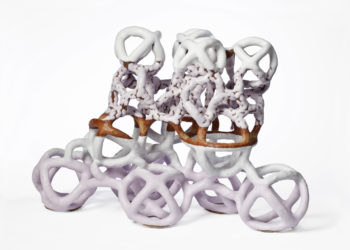
  • Bente Skjøttgaard: Clouds, Purple white cloud no 1002, 2010, Stoneware and glaze, hand built, 37 x 55 x 27 cm. Photo: Ole Akhøj

  • Bente Skjøttgaard: Traces – Art along Hærvejen, At the ancient road Hærvejen nature trail, close to the village of Bække in Central Jutland DK, approx. 40 m2. A project by the Danish Arts Foundation, 2010.


  • Bente Skjøttgaard: The “Hærvejen” Art Project under construction at Gråsten Agricultural College, February 2010. Petersen Tegl A/S in Broager has sponsored 10 tons of red brickwork clay.

  • ©2013 Ceramics Now. All Rights Reserved. Website by Thomas Cullen. Powered by Tumblr.