We recommend

Mircea Cantor – Special Event at Transilvania International Film Festival 2012 / Cluj-Napoca, Romania
June 1-10, 2012

The Romanian artist often compared with Marcel Duchamp and scouted by the world’s distinguished galleries and museums, Mircea Cantor, will star in one of TIFF 2012’s special events.

For the first time, a few of his video works will be screened in Romania, outside the space they were initially conceived for – the gallery. The artist will attend the screening, giving the audience in Cluj a chance to meet him and take part in discussions.

„Mircea Cantor is on the gallery of Romanian artists who are far more known and valued abroad than in their home country. (…) The screening of his video short films in a cinema is a special program at TIFF by which we try to fix this abnormality”, says the artistic director of the festival, Mihai Chirilov.

The audience will be able to view at Cluj eight of his video works, already included in the prestigious galleries and museums of the world as part of other exhibitions: 9+1=10? (2003-2005), Dead Time (2003), Departure (2005), Double Heads Matches (2002-2003), Nulle part ailleurs (2000), Sic Transit Gloria Mundi (2012), The Snow and the Man (2005), Tracking Happiness (2009).

Mircea Cantor creates images that are at once crystalline in their clarity, yet deeply paradoxical. They are concerned with issues of memory, history, oppression, and the futility—and necessity—of hope. While his thematic concerns may reflect his identity as a Romanian-born artist, his work is also accessible and universal. As he has said, refusing to be pigeonholed by identification with one nation, “art is my country.”

Mircea Cantor was born in 1977 in Oradea and, at the moment, lives in Paris. After moving to France in 2000, four years later Cantor won the most important award granted to young French artists – the Paul Ricard Award, one of his works being purchased by the Museum of Modern Art in Paris. In 2011, the Romanian artist received the prestigious Marcel Duchamp Award and this year he will host his own exhibition at Pompidou Centre in Paris.

ACGA National Clay & Glass Exhibition: Call for entry

ACGA National Clay & Glass Exhibition: Call for entry

ACGA National Clay & Glass Exhibition: Call for entry
Entry Deadline: October 31, 2012

Dates: January 26 - March 1, 2013

The ACGA National Clay & Glass Exhibition will take place January 26 – March 1, 2013 near Los Angeles at the City of Brea Art Gallery. The exhibition will showcase a wide range of handmade ceramic and glass artwork from across the United States.

The juror is Carol Sauvion, Executive Director of Craft in America, Inc., a non-profit organization dedicated to presenting the history, practitioners and techniques of craft in the United States, and their impact on our nation’s cultural heritage. The centerpiece of the Craft in America effort is its production of a nationally broadcast documentary series celebrating American craft and the artists who bring it to life. The Peabody Award winning Craft in America series airs nationwide on PBS.

The competition is open to all forms of handmade clay and glass: functional, decorative and sculptural. The deadline for submission is October 31th. The entry fee is $30 for three pieces of artwork. Awards will be given. The online entry form is available at www.acga.net.

The Association of Clay and Glass Artists of California (ACGA) is a non-profit membership organization begun in 1945. It is dedicated to establishing and maintaining high standards of craftsmanship and design in clay and glass.

Eligibility
This competition is open to artists residing in the United States, 18 years or older. Artwork must be composed of at least 75% clay, glass, or a combination of the two, and may be functional or sculptural. All entries must be original and executed by the artist within the past two years. Works may not have been previously shown at the City of Brea Art Gallery.

1st Santorini Biennale of Arts: Open Call for Applications

The Inaugural Santorini Biennale of Arts: Open Call for Applications 2012

The Inaugural Santorini Biennale of Arts: Open Call for Ceramic Art
Submissions: March 6 - May 19, 2012

Dates: July 1 - September 30, 2012

Within the framework of the 1st Santorini Biennale of Arts in 2012, ceramic artists and potters are invited to send in their artworks for consideration for this international exhibition at which a meeting of artists from all over the world will present their latest achievements.

The 2012 theme, ‘The Past: Memory and Nostalgia’, will examine intrinsic experiences and social relationships, inspired by how humanity accumulates a catalog of our personal fabric and how these collected manifestations shape the patterns of our lives. The subject ‘The Past’ is an integral part of Ceramics. The medium reflects the Past by default. But we are asking for more than the obvious reference of technique, we want interpretations of scenarios, memories or objects from the Past, contemporary or otherwise. We want to forge pathways of communication linking the Past and Present. Special consideration will be given to artworks relating to Ceremony & Ritual and also to those that will form a connection with the space they will be presented within.  

The mission of the Biennale is to promote both emerging and established artists through a wide variety of disciplines; from Drawing, Graphic Design, Illustration, Collage and Comics, through Paper, Painting, Glass, Sculpture and Ceramics, to Photography, Short Film, Video Art, Installation and Industrial Design.
By means of an advanced framework of outreach activities the Biennale will also seek to cultivate the emerging spirit of the island, inviting all participants into an open dialogue concerning new ideas for social change.

The curatorial team
Dimitra Bratika and Michael Vlavianos (Photography), Sara Falanga (Glass Art and Graphic Art), iLya (Comics), Rajesh Punj (Sculpture and Installation), Alexa Kusber (Industrial Design), Tracey Holt Walkden (Ceramic Art), Tomas Poblete (Collage), Paola Gentili (Paper), Nicky Peacock (Illustration), Simon Tarrant (Painting), Anneca York (Drawing) and Holly Bynoe (Video Art and Short Film).

The open call for artist submissions is from March 6 through May 19, 2012.

For further information visit Santorini Biennale’s website.

Patience EP by Lights Out!

“Patience” EP is a series of six ambitious voyages through rock grooves and deep, blissed-out psychedelia. Warm, dreamy guitars creating sweeping soundscapes and a voice that will haunt you during your waking hours, stir you from your deepest sleep - let them drill themselves into your subconscious and broodingly melt you.

Formed in February 2010, Lights Out! are a four-piece psychedelic/indie rock band. Consisting of high school students and friends Teo Retegan (vocals and keyboards), Andrei Bobiş (guitars), Andrei Sîncrăian (guitars), Oana Pop (drums) and former bass-player Alex Bondor, all from Cluj-Napoca, the band made its debut on the musical scene of this Northern Romanian city late April, the same year. A few months later, in November, Lights Out! managed to record their first demo, a song called “Inside Out”, that marked their first breakthrough as young musicians: the band won the popularity award at the 2nd edition of byron|Rock Your High School.

The beginning of 2012 saw Lights Out! entering the studio to record a debut EP. Their first discographic effort, called “Patience” is to be released on April 7th.

Teodora Retegan: Vocals / Keys
Andrei Bobiș: Guitar / Bass
Andrei Sîncraian: Guitar / Bass
Oana Pop: Drums

Follow Lights Out! on Facebook, Twitter, Last.fm and Soundcloud.

Shartle Symposium - Shifting Paradigms in Contemporary Ceramics / Museum of Fine Arts, Houston

Shartle Symposium - Shifting Paradigms in Contemporary Ceramics at Museum of Fine Arts, Houston

Shartle Symposium - Shifting Paradigms in Contemporary Ceramics / Museum of Fine Arts, Houston

Saturday, March 03, 2012
1:00 PM - 5:00 PM

Presented in conjunction with the exhibition Shifting Paradigms in Contemporary Ceramics: The Garth Clark and Mark Del Vecchio Collection.

Welcome and Opening Remarks
- Cindi Strauss, MFAH assistant director, programming; curator, modern and contemporary decorative arts and design; organizing curator of the exhibition

Sealed Capsule
- Garth Clark, scholar, gallerist, and collector
Is the 20th-century ceramics movement over? In the 21st century, is ceramics a fully accepted fine-arts material but no longer an autonomous discipline? If so, is this a good thing? Garth Clark examines a turning point in this millennia-old medium.

On Conscripting Mugs and Other Ceramics into Life’s Battles for Independence
- Ezra Shales, associate professor of art history, New York State College of Ceramics at Alfred University
In the field of ceramics, a distinction is often made between “functional” objects and “art” objects—a binary opposition that is both reductive and misleading. Ezra Shales critiques the validity of the term “functional” and investigates how drinking vessels remain key tools in the assertion of one’s identity.

The Well-Wrought Urn
- Jenni Sorkin, assistant professor, contemporary art and critical studies, School of Art, University of Houston
This talk reconsiders Garth Clark’s groundbreaking exhibition American Ceramics, 1876 to the Present against the backdrop of mid-20th-century formalism, in particular Cleanth Brooks’s The Well-Wrought Urn (1947), Herbert Read’s criticism on modern sculpture, and the Syracuse Annuals exhibition series.

From Postmodernism to Postindustrialism
- Jorunn Veiteberg, professor of curatorial studies and craft theory, Bergen National Academy of the Arts, Norway
A re-evaluation of the decorative and a reuse of historical forms were central to ceramics in the 1980s, the key decade of Postmodernism. But what has happened since? Are contemporary ceramics still Postmodern, or have new paradigmatic shifts taken place?

Panel Discussion
- Mark Del Vecchio joins the speakers. Moderated by Cindi Strauss.

Reception
- The audience is invited to a wine reception with the speakers in the lobby of the Beck Building, and to view the exhibition.

This event is open to the public. Seating is limited. Free with general museum admission. MFAH Members always receive free general admission.

Seiko Mikami - Desire of Codes

This installation by Seiko Mikami, consisting of three parts, is currently set up in YCAM - Yamaguchi Center for Arts and Media. Large number of tentacles-like devices with built-in cameras are placed across a huge wall, while six robotic “search arms” equipped with cameras and projectors are suspended from the ceiling tracking the visitors. Data is collected and assembled, presenting elements of past and present back to the viewer. Video

The performance of Highly Strung featuring the giant 14 meter puppet took place on the night of October 28th 2011 during the Nati Frinj festival. The puppet took ten people to operate and had animation (largely created by the children at the local primary school) projected onto it from projectors mounted both on the ground and in the head of the puppet itself. Music by Stephen Oakes.

Filmed by, Jacqui Schulz, Dave Jones, Gareth Llewellin and Cindi Drennan.

More making of / behind the scenes stuff at theartofdave.blogspot.com.au/

With so many other forms of entertainment the puppet shows of today may seem like an already dead medium. However, you’d be wrong in thinking this, since Australian filmmaker Dave Jones shows us that there is still a fair amount of life in the ancient form of storytelling with his highly ambitious piece, “Highly Strung.”

Performed on the back of grain silos, “Highly Strung” features an enormous 45-foot tall puppet that took 10 people to operate. The giant work of art was bolstered by projected animation done largely by local school children, giving the production an eerie Tim Burton vibe. This particular performance took place at the Nati Frinj festival in Natimuk, Australia.

Jones said of the animation, “For the mouth we actually mounted a projector inside the puppets head and gaffer taped it to an iPod which we could control wirelessly from the ground 20 meters below.” Though it is just a five minute edit of the whole performance, the clip is captivating, immersing the viewer in a bizarre, but ultimately innocent world of dreams and wonderment. (via the Huffington Post)

Sharjah Art Foundation Open Call: Production Programme 2012

Sharjah Art Foundation Open Call: Production Programme 2012

Sharjah Art Foundation Open Call: Production Programme 2012

Sharjah Art Foundation announces the 2012 Production Programme Open Call for grants to artists working in a range of media. Up to $200,000 is available in this application cycle. Deadline: 24 February 2012.

The Sharjah Art Foundation (SAF) Production Programme broadens the possibilities for the production of art in the MENASA region through a commitment to support innovation and excellence in artistic practice by encouraging risk and experimentation. This commitment places artists at the core of the Foundation’s mission by offering grants and professional support for the realization of projects selected from an open call for proposals.

The past decade has seen an extraordinary rise in artistic activity throughout the Middle East, resulting in an increased visibility for artists both regionally and internationally. Within this context, the Foundation hopes to promote and encourage an environment of public and private patronage for the highest level of artistic endeavour. This programme focuses on supporting artists in their individual attempts to create work on a scale they have perhaps never imagined possible.

Arts practitioners are invited to propose imaginative, ambitious and inspirational projects that will transform our understanding of what art is and how it can be experienced. With this initiative we hope to engage and challenge the artists, our audiences and ourselves aesthetically, intellectually, emotionally, socially, politically or in ways new and unexpected.

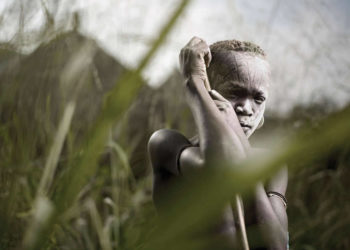
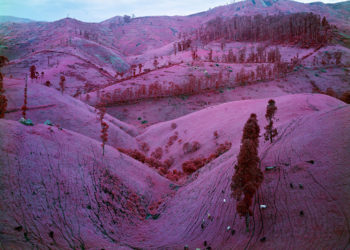
Aerochrome photographs of the Congo by Richard Mosse

Extruding Clay by Max Cheprack, student at the Holon Institute of Technology in Israel

“My research examined the extrusion process in a new material - clay. For this purpose, I built two pneumatic extruders (for two different die sizes) that push clay through the die. The semi-industrial process enabled me to manipulate the material, with never-before-seen precision and complexity. My research led to the creation of various objects that illustrate the many possibilities of this technology. Finally, I chose to express the result of my research process in a new design for a stool. The final result is inspired by the material culture of the Middle East so as to express time and place. The research opens up new possibilities in ceramic design and shows great promise as a method of production and design.”

Max Cheprack on Etsy and Behance.

On the eve of a major retrospective at Tate Modern, Gerhard Richter talks about his life and work with Nicholas Serota, Director of Tate. / 11.10.2011

Gerhard Richter: Panorama, Tate Modern
6 October 2011  – 8 January 2012

Spanning nearly five decades, and coinciding with the artist’s 80th birthday, Gerhard Richter: Panorama is a major retrospective exhibition that groups together significant moments of his remarkable career.

Since the 1960s, Gerhard Richter has immersed himself in a rich and varied exploration of painting. Gerhard Richter: Panorama highlights the full extent of the artist’s work, which has encompassed a diverse range of techniques and ideas. It includes realist paintings based on photographs, colourful gestural abstractions such as the squeegee paintings, portraits, subtle landscapes and history paintings.

Midnight City by M83

Directed by Fleur & Manu (Division/Les Télécréateurs)

Midnight City is the first single of the new M83 album, Hurry up, We’re Dreaming.

We are here for our children - Survival International
On every continent, from the green depths of the Amazon basin to the icy  reaches of the Arctic tundra, children raised in tribal communities are  taught the skills and values that have ensured the survival of their  peoples for generations.
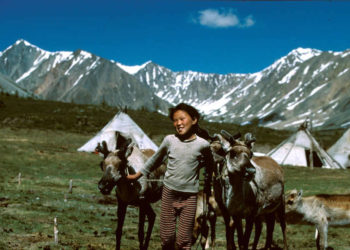
In Malaysia, Penan children help to build homes from tree saplings and giant palm leaves; beneath the blue-green surface of the the Andaman Sea, Moken children learn to catch dugong, crab and sea-cucumber with long harpoons; in Mongolia, Tsaatan children are taught the ancient herding skills of their parents by corralling reindeer on the grasslands.Tribal children are the inheritors of their territories, languages and unique ways of seeing the world; human repositories of their ancestors’ knowledge. As they are typically brought up in communities where the solidarity of the group is crucial to survival, children are taught that life is about ‘we’, not ‘I’, and balance with nature, not destruction.Over recent decades, however, many tribal children have witnessed – and experienced – dispossession, disease and despair due to land theft, forced assimilation into mainstream societies and ‘development’ schemes. If their homelands continue to be threatened by destructive external forces; if their values and ways of life are not granted greater respect, the the future of tribal children will be as precarious as their childhoods have often been traumatic.


We are not here for ourselves, said Roy Sesana, a Gana Bushman from Botswana. We are here for our children, and the children of our grandchildren.
I want them to be able to see the stars, but not through industrial smoke, he said. I want them to drink the stream-water without falling ill, and wake to the call of the piha bird, instead of miners’ motor pumps.

Picture © Livia Monami/Survival

We are here for our children - Survival International

On every continent, from the green depths of the Amazon basin to the icy reaches of the Arctic tundra, children raised in tribal communities are taught the skills and values that have ensured the survival of their peoples for generations.

In Malaysia, Penan children help to build homes from tree saplings and giant palm leaves; beneath the blue-green surface of the the Andaman Sea, Moken children learn to catch dugong, crab and sea-cucumber with long harpoons; in Mongolia, Tsaatan children are taught the ancient herding skills of their parents by corralling reindeer on the grasslands.

Tribal children are the inheritors of their territories, languages and unique ways of seeing the world; human repositories of their ancestors’ knowledge. As they are typically brought up in communities where the solidarity of the group is crucial to survival, children are taught that life is about ‘we’, not ‘I’, and balance with nature, not destruction.

Over recent decades, however, many tribal children have witnessed – and experienced – dispossession, disease and despair due to land theft, forced assimilation into mainstream societies and ‘development’ schemes. If their homelands continue to be threatened by destructive external forces; if their values and ways of life are not granted greater respect, the the future of tribal children will be as precarious as their childhoods have often been traumatic.

We are not here for ourselves, said Roy Sesana, a Gana Bushman from Botswana. We are here for our children, and the children of our grandchildren.

I want them to be able to see the stars, but not through industrial smoke, he said. I want them to drink the stream-water without falling ill, and wake to the call of the piha bird, instead of miners’ motor pumps.

Picture © Livia Monami/Survival

Barry Flanagan was one of the most radical sculptors of his generation. Though best known for his statues of bronze hares, his earlier work, in materials as varied as cloth, plaster, and sand, show how he challenged the very idea of what sculpture could be. Fellow artist Peter Randall-Page shares his memories of his close friend. Download this video.

Barry Flanagan: Early Works 1965-1982, Tate Britain

Barry Flanagan: Early Works 1965-1982, Tate Britain
27 September 2011 - 2 January 2012

Barry Flanagan was one of Britain’s most original and inventive artists and a key figure in the development of British and international sculpture. He is best known for the large-scale bronze hare sculptures that he began producing in the early 1980s and that can be seen in many galleries and public spaces around the world. The success of these pieces has tended to obscure the equally important and very different work that characterised his early period. Made from materials as varied as cloth, plaster, sand, hessian and rope, these works highlight a concern with material properties and processes - a concern that is at the heart of his practice.

A contemporary of Gilbert & George, Flanagan studied sculpture at St Martin’s School of Art from 1964 to 1966. The exhibition takes this period as a starting point and reveals the impact of this early work on his later development towards casting in bronze, which he began in 1979. This is the first major retrospective of Flanagan’s work in London since 1983, and by focusing on his early works, shows how this radical and imaginative artist challenged the very nature of sculpture in his time.

Halocene by Bon Iver, official music video | filmed around Vík, Iceland

Director: NABIL
DOP: Larkin Sieple
Editor: Isaac Hagy
Producer: Jill Hammer
Production Company: NE Direction