By Anisio Veloso
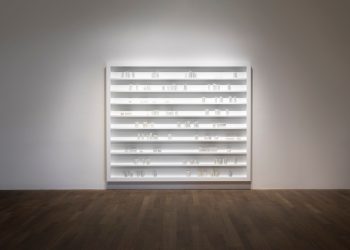
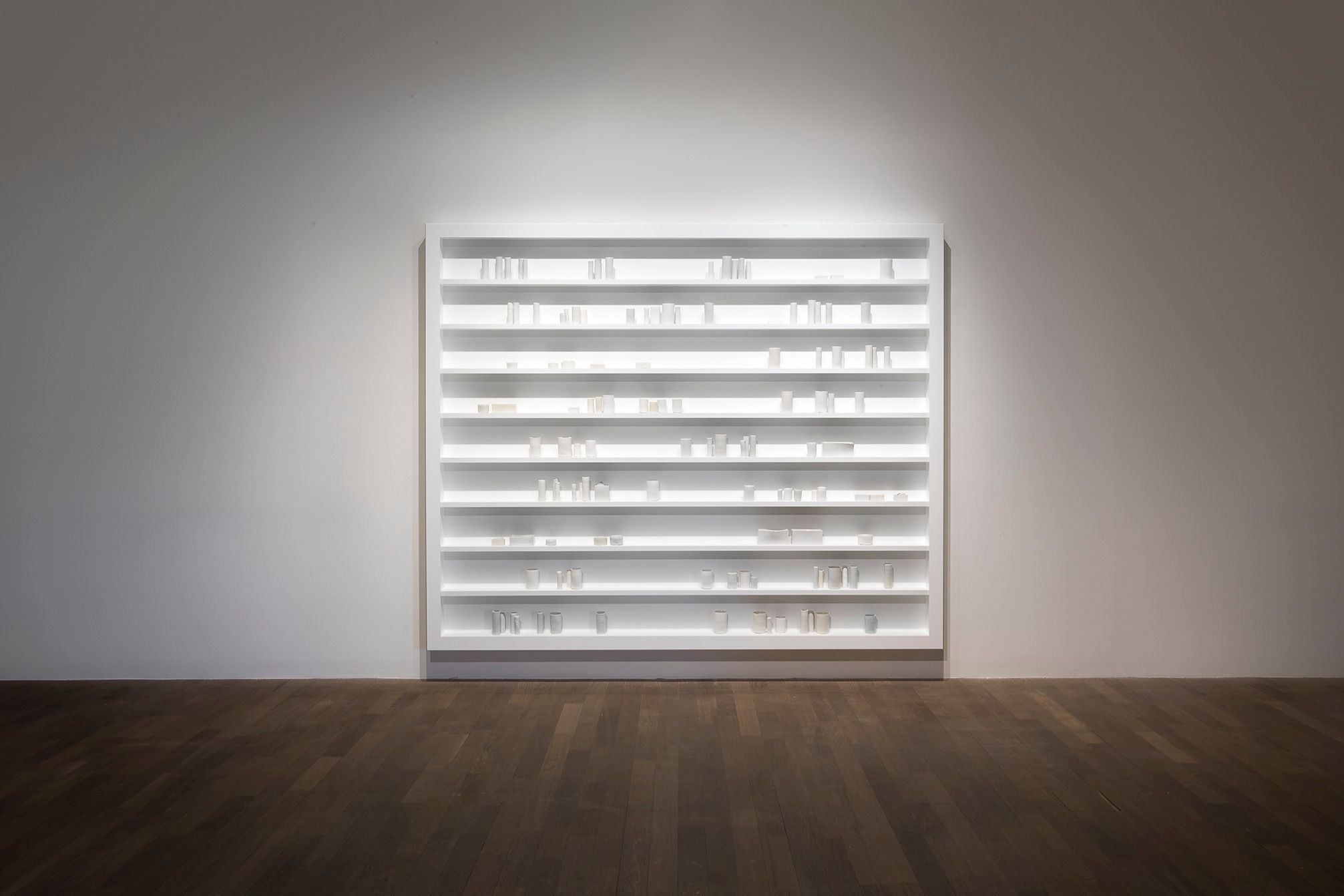
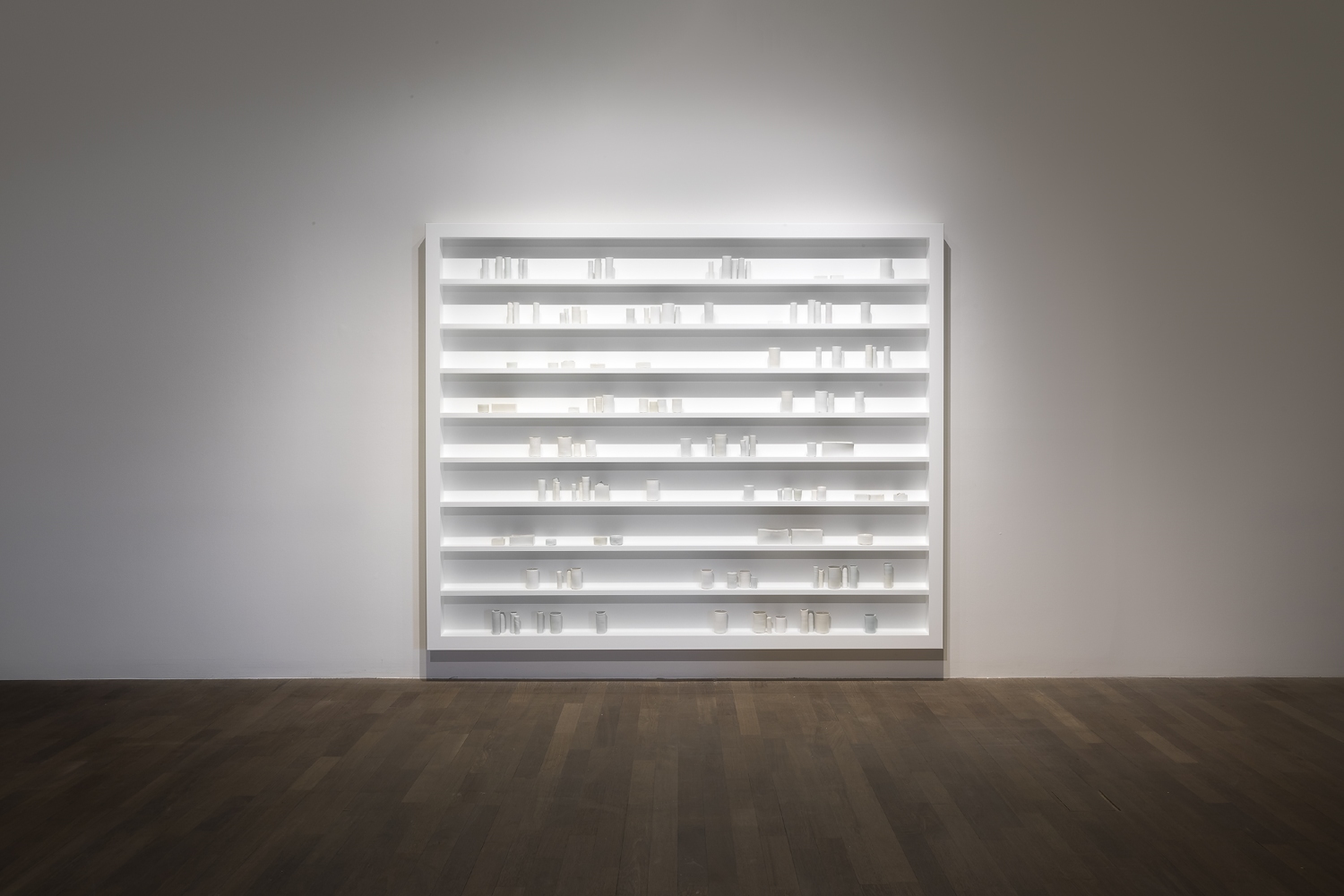
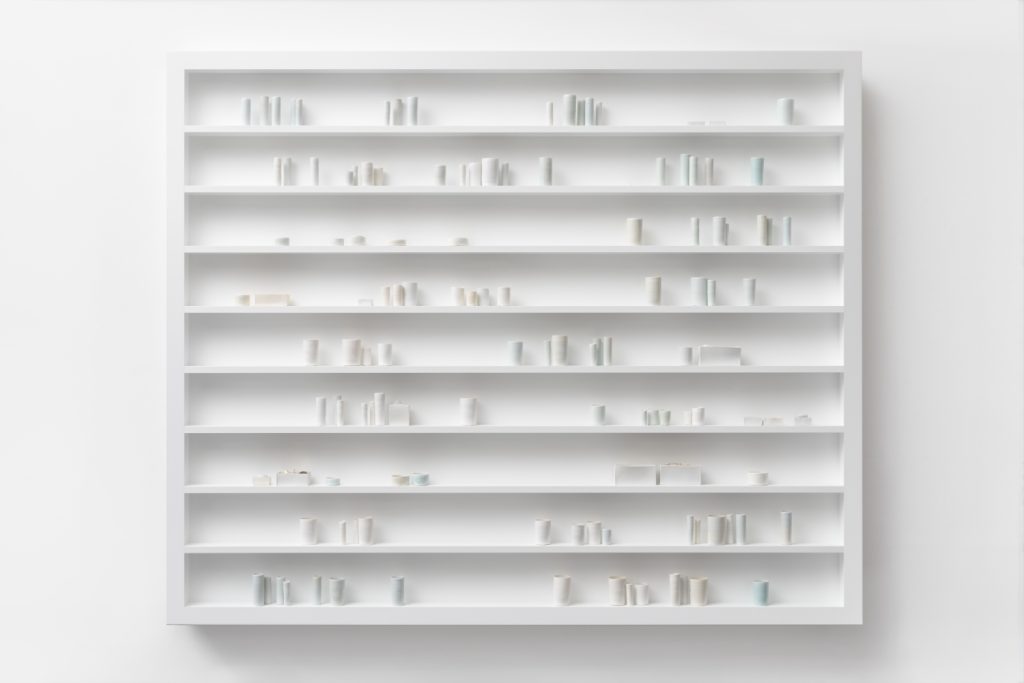
Photographs can make Edmund de Waal’s nine tiered white structure appear almost weightless, a pale field of vessels suspended in architectural calm. In the gallery, however, the shelving occupies the wall with the authority of architecture, and only afterwards do the cylinders, bowls, boxes and pale movements of celadon begin to detach themselves from the structure around them.
The title work (rain diary), made in 2025, contains 118 celadon-glazed vessels and fourteen porcelain boxes holding ceramic and silver fragments. Quantity sounds important when stated numerically, yet space dominates the experience. Forms gather and disperse across nine shelves, and a small change of height, rim or glaze becomes conspicuous because so little else competes with it. From a distance, the work is architectural; up close, it repeatedly returns to the dimensions of the hand.
Porcelain begins much earlier than the shelf. Before the vitrine and calibrated interval, there has been throwing, trimming, drying, firing and vitrification. Glaze has melted and moved, and forms may emerge subtly altered by heat. De Waal has spent decades making this difficult material history appear almost weightless. At Gana, the ceramics resist that impression. One cylinder inclines, another carries a softer lip, a low bowl opens unevenly, and pale surfaces change as the light moves. Repetition is disciplined but not mechanical. His pots belong to families rather than identical multiples.
The importance of the shelving needs to be stated precisely. Every exhibition arranges objects, but de Waal makes the enclosure itself part of the artwork. Move a pot, alter a gap or change the proportions of the shelf and the composition changes. The individual vessel no longer carries the whole burden of meaning within its rim, wall, foot and interior because part of that meaning migrates into the space around it. This has been one of de Waal’s most consequential contributions to contemporary ceramics. A solitary cup gains authority from surrounding emptiness, while grouped vessels begin to behave like a gathering. The shelf becomes part of the ceramic composition, and that achievement also creates a difficulty. Once the architecture becomes so important, it can begin to speak more forcefully than the vessels it contains. De Waal’s language is now highly recognisable, with pale cylinders, clusters, fragments, black and white enclosures and carefully judged intervals. The work is extraordinarily fluent, but in a mature practice even irregularity can begin to feel anticipated when every object enters such a resolved system.
rain diary gains force whenever fired material pushes against that fluency. A fractured edge, a broad bowl, a metallic plane, a black ceramic body or an awkward historical fragment prevents the work from settling into an elegant grammar of pause. These moments remind us that the objects entered the vitrine carrying events that occurred before arrangement began. Fire, chemistry and history have already acted upon them.
De Waal’s own account of the exhibition makes Korea central rather than incidental. He describes rain diary through ideas of home, sanctuary, migration, poetry and the movement of people, ideas and objects. Showing the work in Korea, he says, is both special and daunting because this is a culture of “a thousand whites and celadons”, with a ceramic history extending over many centuries. His relationship with Korean ceramics reaches back to his first studio. At twenty-one, he kept a postcard of a white Korean tea bowl above the wheel. He remembers its energy as if it were rising from the ground like a bird. “Its whiteness was plural,” he says, one hue moving into another, like dawn. That idea of plural whiteness provides one of the best ways into the exhibition. The newer white works make the point clearly because their whiteness is neither uniform nor confined to one vessel type. Tall cylinders appear beside squat forms, broad low bowls, compressed ovals and boxes filled with broken porcelain. White becomes a range of temperatures, surfaces and volumes rather than a symbol of purity.
The low bowls are especially revealing because their generous openings pull the eye into interior space in a way the upright cylinder does not. Nearby fragment boxes offer another interior, crowded with broken material rather than emptiness. One form holds space; the other holds remains. Elsewhere, upright porcelain forms are interrupted by an irregular reflective plane and a small metallic block. Porcelain absorbs light softly while metal returns it, disrupting the continuity of the white field and sharpening differences of weight and surface. De Waal’s description of Korean whiteness as plural therefore extends beyond hue. White appears as cylinder, bowl, box and shard. Thin walls sit beside thicker ones, upright forms encounter open vessels, and reflective metal disturbs absorbent porcelain. The exhibition is strongest when whiteness contains these differences rather than becoming an atmosphere of immaculate calm.
De Waal says that one has to reach towards poetry to come near the Korean bowl he remembers. Ceramics asks for another movement, towards clay, firing and glaze. Poetry may describe what colour feels like; ceramic history asks how it became possible. Celadon makes that distinction unavoidable. De Waal’s pale greens lend themselves easily to mist, stillness and restraint, yet celadon is first a technological achievement. Clay body, glaze composition, iron content, atmosphere and firing determine the colour that eventually appears. Its gentleness depends upon difficult material conditions. In Seoul, those conditions carry particular historical weight. Goryeo celadon belongs to one of the defining achievements of Korean ceramic culture, involving sophisticated kilns, glaze chemistry, courtly patronage and the refinement of sanggam inlay. The green therefore arrives carrying a history far denser than an atmospheric metaphor permits. To describe it simply as tranquil risks allowing technical knowledge to disappear behind mood.
The gallery lighting helps resist that simplification. Some surfaces appear cooler and greyer, while others become more aqueous. Glaze catches light differently from vessel to vessel, revealing variations in thickness, reflection and tone. The eye begins by seeing celadon as colour and gradually starts to see a sequence of fired surfaces. De Waal’s engagement with Korean ceramic history is most convincing when the material does not dissolve into his established visual language. Ceramic technologies have always travelled, so the issue is not cultural purity. The harder question is what happens when these histories enter the language of a major contemporary European artist. The strongest works preserve that unease rather than treating celadon as simply another available colour.
The broken celadon fragment in clouds over the river become rain sharpens this argument. Pale cylinders and rectilinear forms sit beside an irregular shard whose fractured edge exposes the ceramic body beneath the glaze. What had appeared as surface becomes structure. Wall thickness appears, colour separates from clay and the object reveals something about how it was made.
Ceramic culture has become remarkably comfortable assigning moral significance to breakage. A shard quickly becomes a symbol of survival, loss, resilience or healing before anyone asks what material has broken or what the fracture reveals. De Waal is more convincing when he leaves the fragment unresolved. There is no repair promising emotional closure, and the break remains a break. The fragment-filled boxes elsewhere in the exhibition complicate this further. Pieces that might normally occupy the floor beneath a studio bench or the bin beside a kiln are gathered, contained and placed alongside intact vessels. Their status changes through selection. A studio shard may be failure, evidence or rubbish; inside de Waal’s architecture it becomes protected material worthy of attention.
Kilns continually produce losses, most of which never acquire a biography. The vitrine distinguishes one fragment from thousands that remain unchosen, so preservation is also editing. The Joseon scholar Yi Ha gon adds historical depth to this question. His 1709 account of the royal Bunwon kilns admires finished porcelain while recording some of the circumstances beneath that refinement, including the movement of clay, significant rejection and compulsory labour. Such accounts restore process to objects whose perfection can make production invisible. Ceramics is unusually good at concealing the sequence that produced it. An immaculate surface can hide centring, throwing, trimming, drying, firing and selection. De Waal’s repeated throwing preserves some evidence of that sequence because his vessels resemble one another without becoming identical. The hand survives repetition.
The installation can then perform a curious reversal. Those deviations are absorbed into an architecture of exceptional precision. The pot retains evidence of bodily making while the shelf gives that evidence a controlled position. Two forms of order coexist, one produced through the uncertainties of making and another through arrangement.
In my own porcelain practice, developed alongside medical work, I have become increasingly attentive to the difference between error as harm and error as information. A warped rim, a glaze that breaks unexpectedly or a form that moves in firing can disappoint, but it can also reveal something about material, heat and judgement that a predictable result may conceal. This is partly why de Waal’s disciplined repetition interests me. His vessels retain small deviations, yet those differences are gathered into an architecture of remarkable precision. The question I bring from my own studio into rain diary is whether that architecture leaves enough of the kiln’s unpredictability visible. For a maker, error becomes meaningful not when it is romanticised, but when it teaches something the intended form could not.
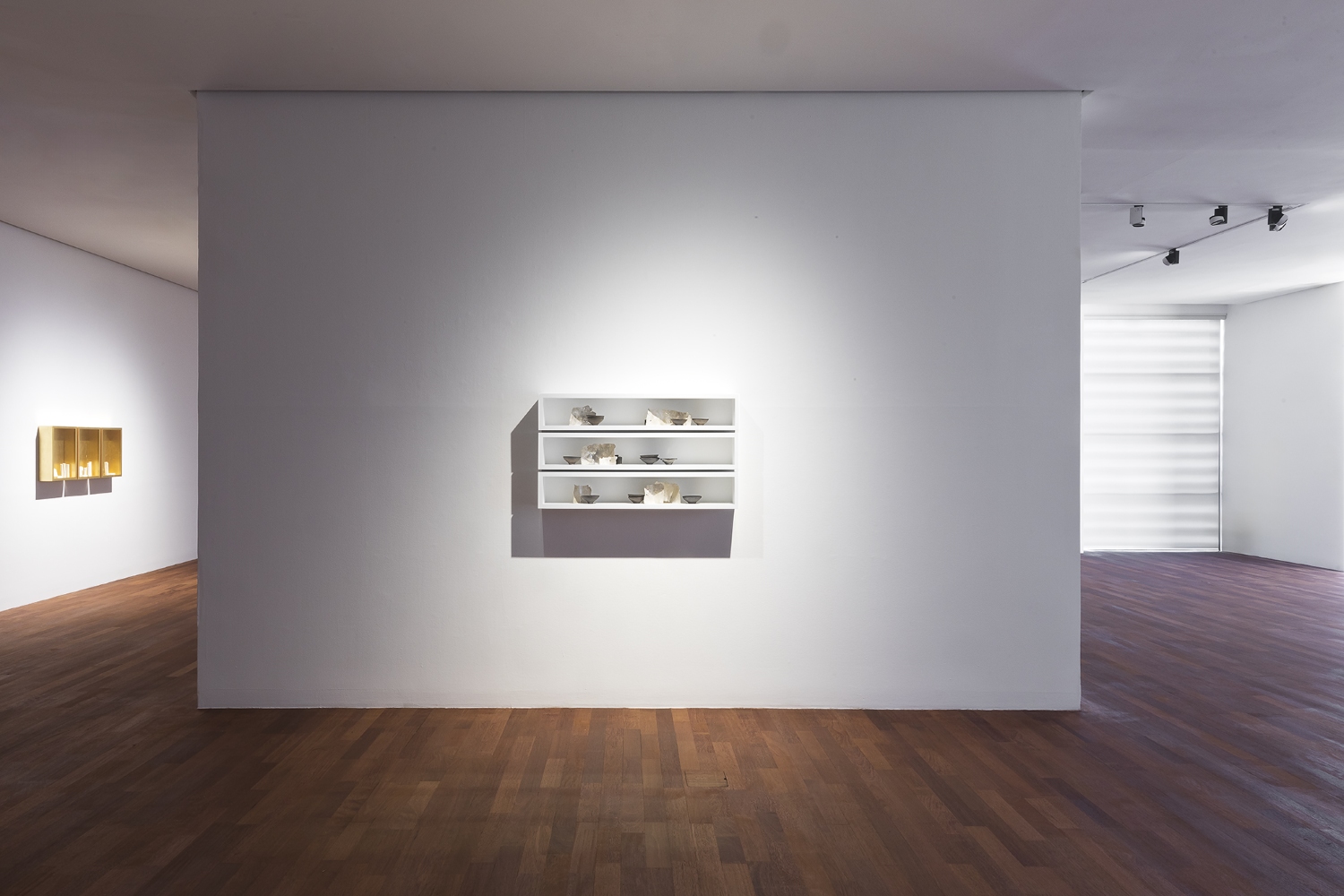
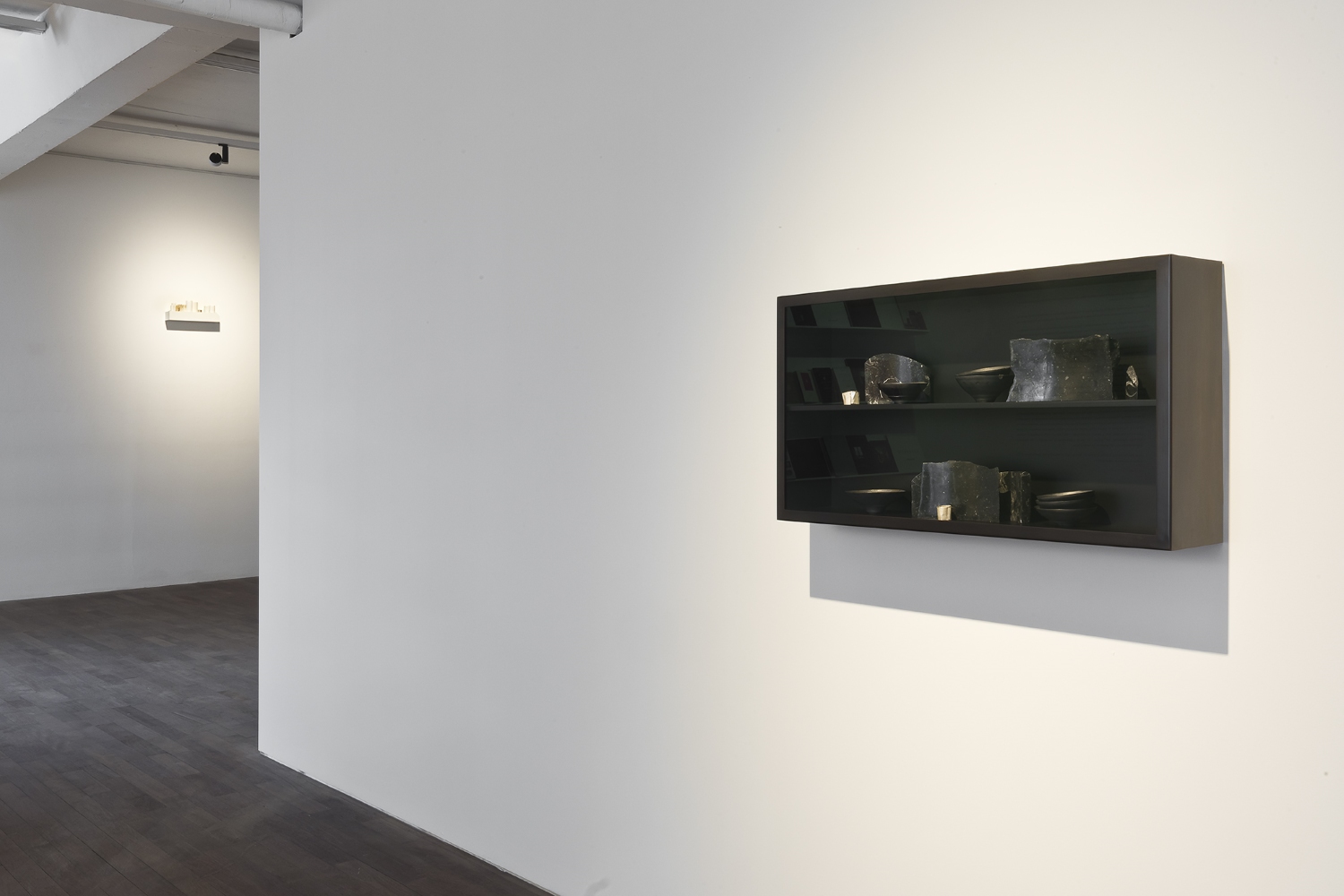
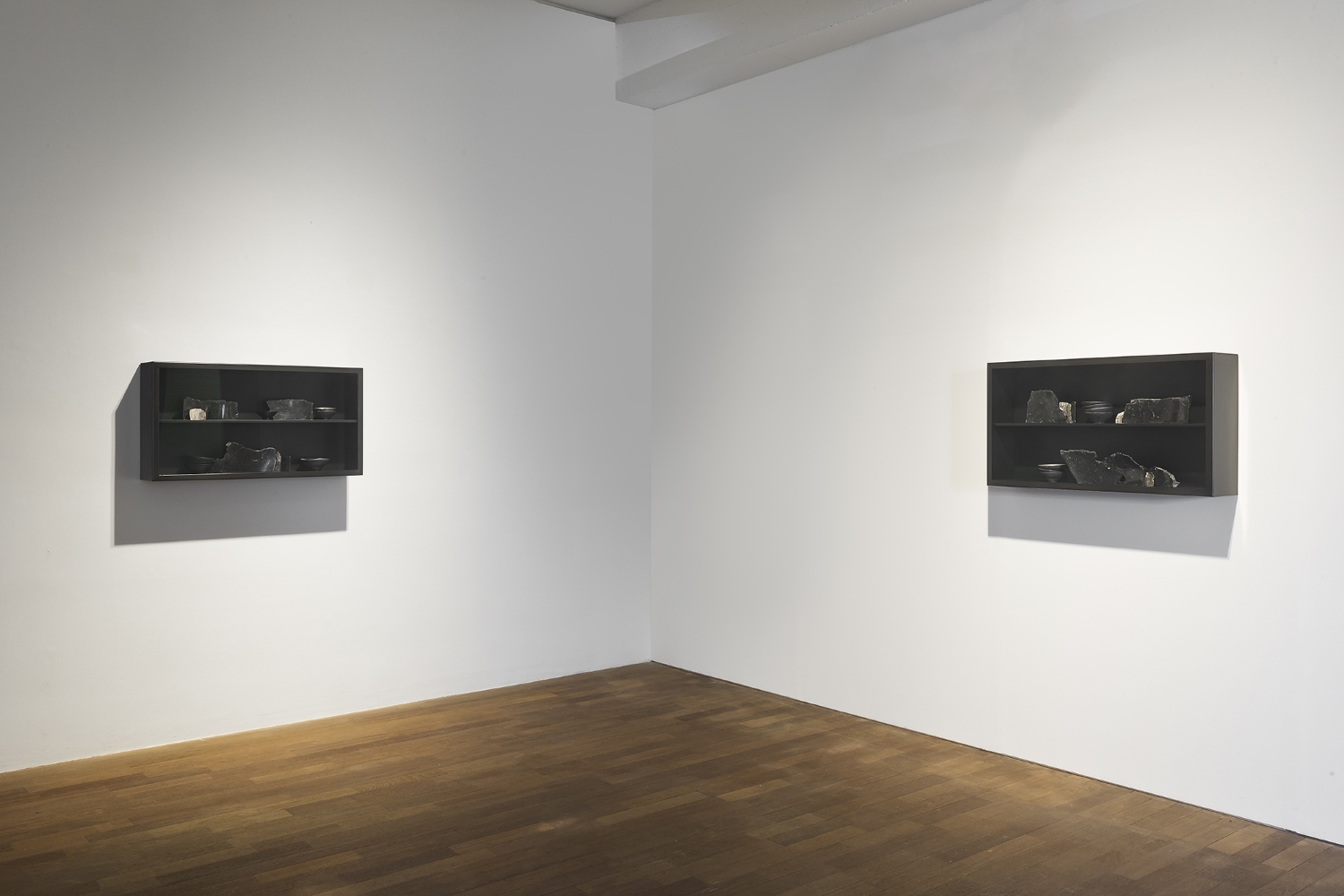
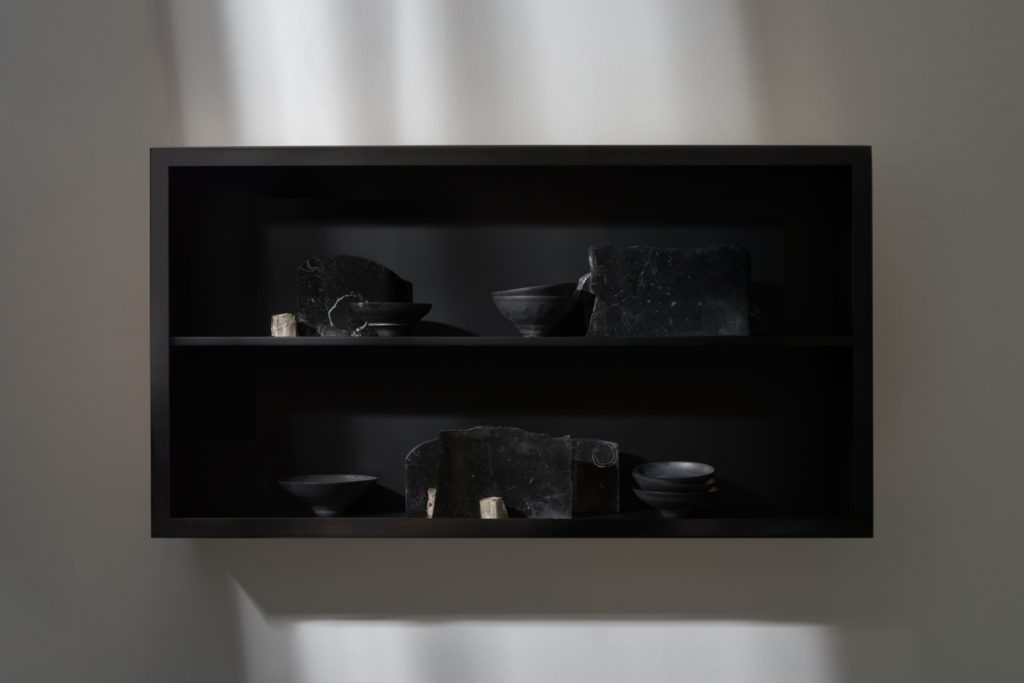
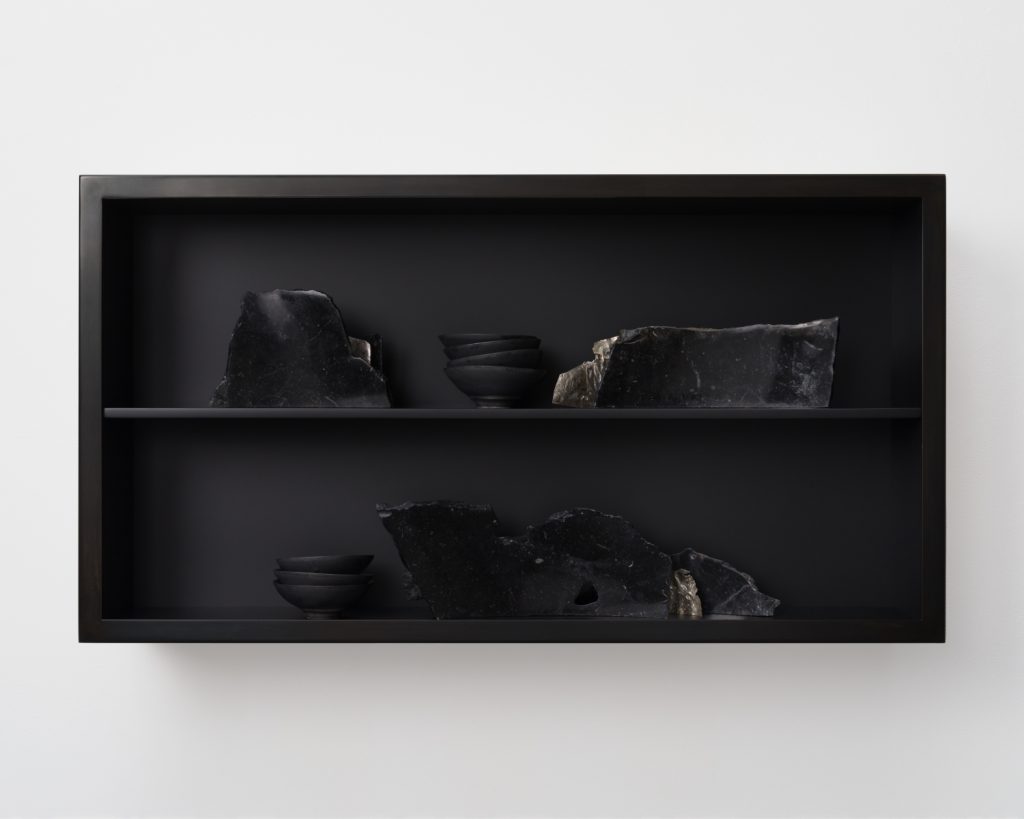
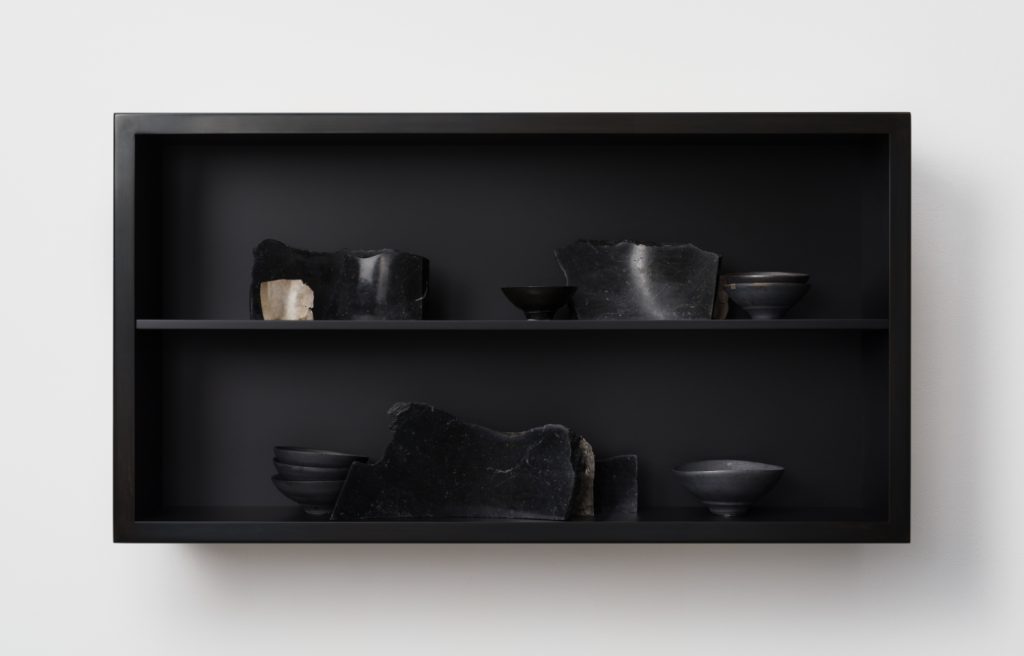
The black vitrines intensify this question. They sit beautifully against the white works, but their role is more than chromatic. White disperses the eye across a bright field; black concentrates it. Forms emerge through contour, reflection and density, and the rhythm of the exhibition changes from expansion to compression. Coptic Light, I places dark porcelain, silver and Kilkenny stone inside a low black enclosure. Against darkness, ceramic forms cannot disappear easily into their surroundings. Curved vessels sit beside fractured mineral planes and small metallic elements catch the limited light. Another work from the Coptic Light group places a broad dark bowl before fossil-bearing stone, its pale geological trace appearing behind the vessel like an incomplete circle. The contrast lies between fired clay and geological duration, curved containment and fractured mass, human making and material formed on a vastly different timescale. Black brings de Waal’s porcelain back towards body and weight. White porcelain can approach optical disappearance, while the darker works insist that the vessel remains matter.
Kilkenny limestone pushes that argument further. Fossils persist without memory or an archive. For a potter, the encounter is resonant because clay is geological before it is cultural. Porcelain may reach the studio as a prepared body, but its constituents belong to processes far older than the maker.
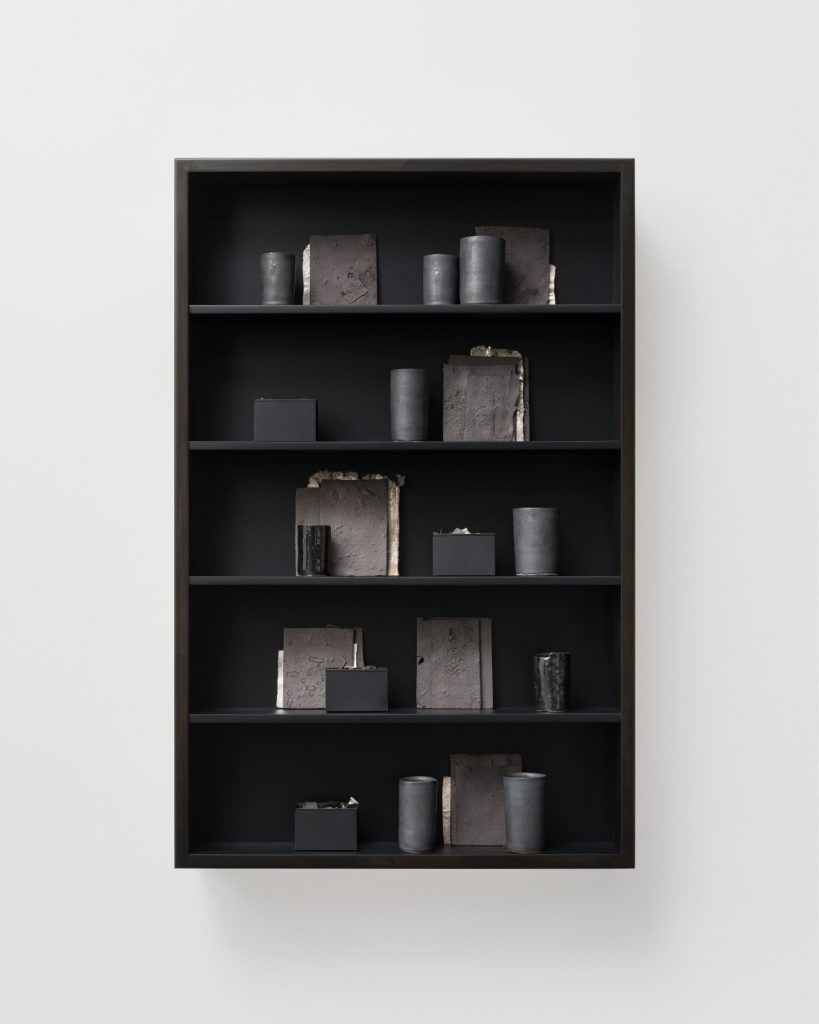
The tall black cabinet precious beyond measure introduces another problem of historical distinction. Contemporary black porcelain appears with Song dynasty ceramic fragments and eighteenth-century Wedgwood Black Basalt. Their shared darkness creates immediate visual affinity, yet they are not one ceramic family. Wedgwood Black Basalt is a refined stoneware associated with Josiah Wedgwood’s technical and commercial ambitions. Song ceramics carry different histories of clay, kiln, glaze, circulation and connoisseurship. De Waal’s contemporary porcelain belongs to another technological and economic context. Blackness can create visual agreement, but it cannot create historical equivalence. The cabinet is strongest when those differences survive its elegance. De Waal is exceptionally skilled at producing coherence through spacing, tone and repetition. Objects separated by centuries can appear naturally suited to one another. Sustained looking disrupts that first harmony because the eye sees resemblance while material knowledge continues to insist upon difference.
Museums understand the power of adjacency: place two objects together and interpretation begins before the label is read. De Waal makes that mechanism part of the artwork itself. Lucie Rie concentrated intensity within the individual vessel, Hans Coper pushed the pot towards sculpture, and Alison Britton allowed constructed ceramics to remain unstable and visibly made. De Waal’s decisive move has been to distribute part of the ceramic argument beyond the vessel. Shelf, sequence, box and interval become active. The pot remains a pot, but it is no longer sovereign. The harder challenge for such a mature practice is whether refinement can continue to leave room for surprise.
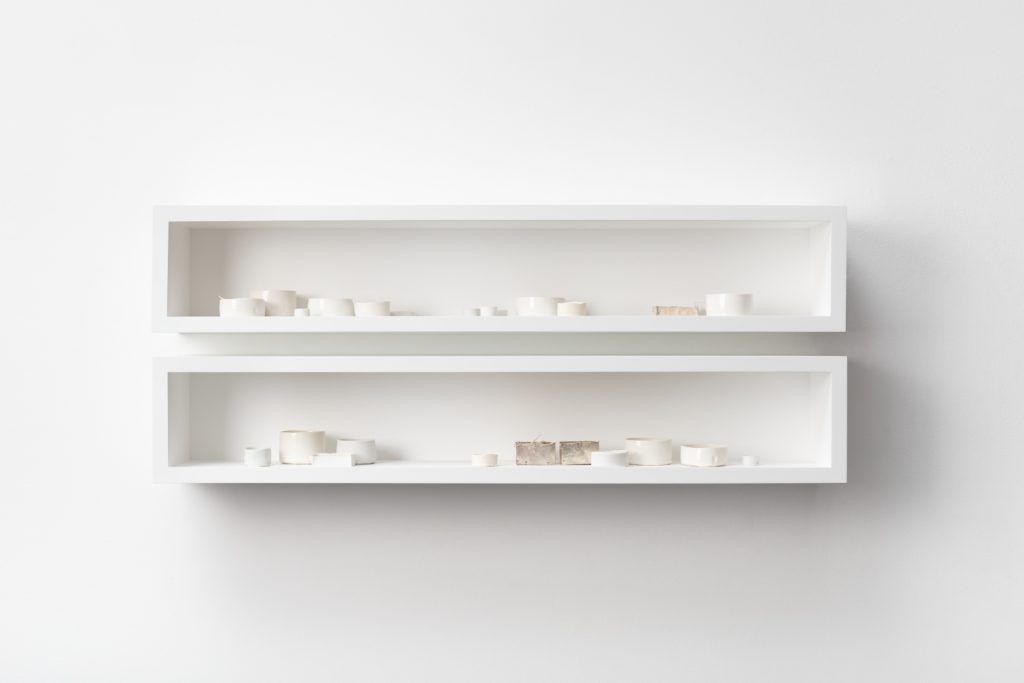
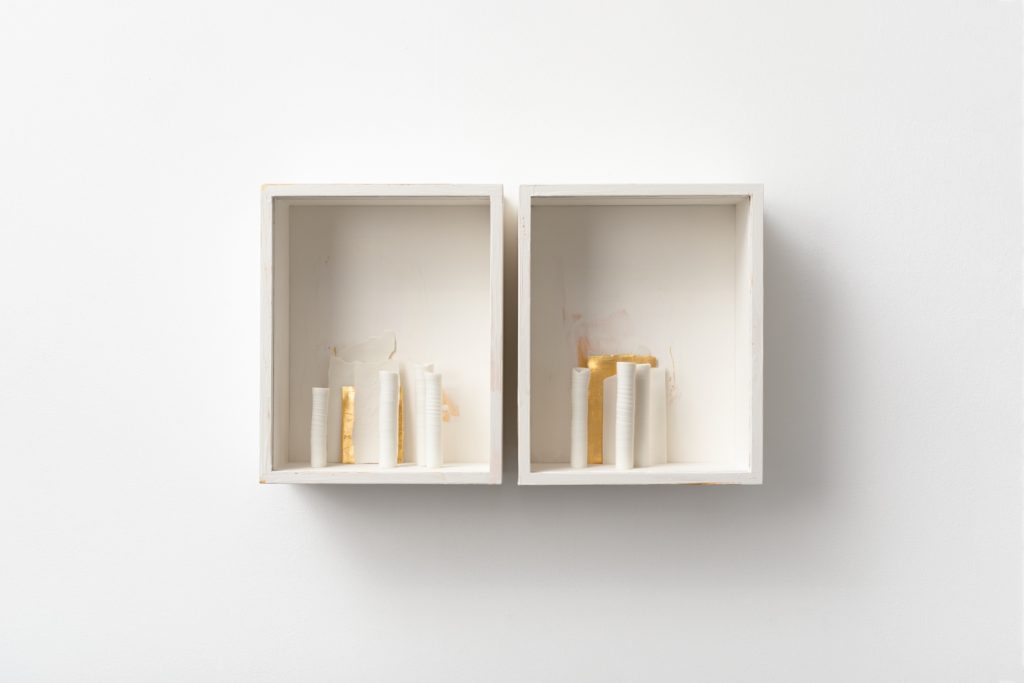
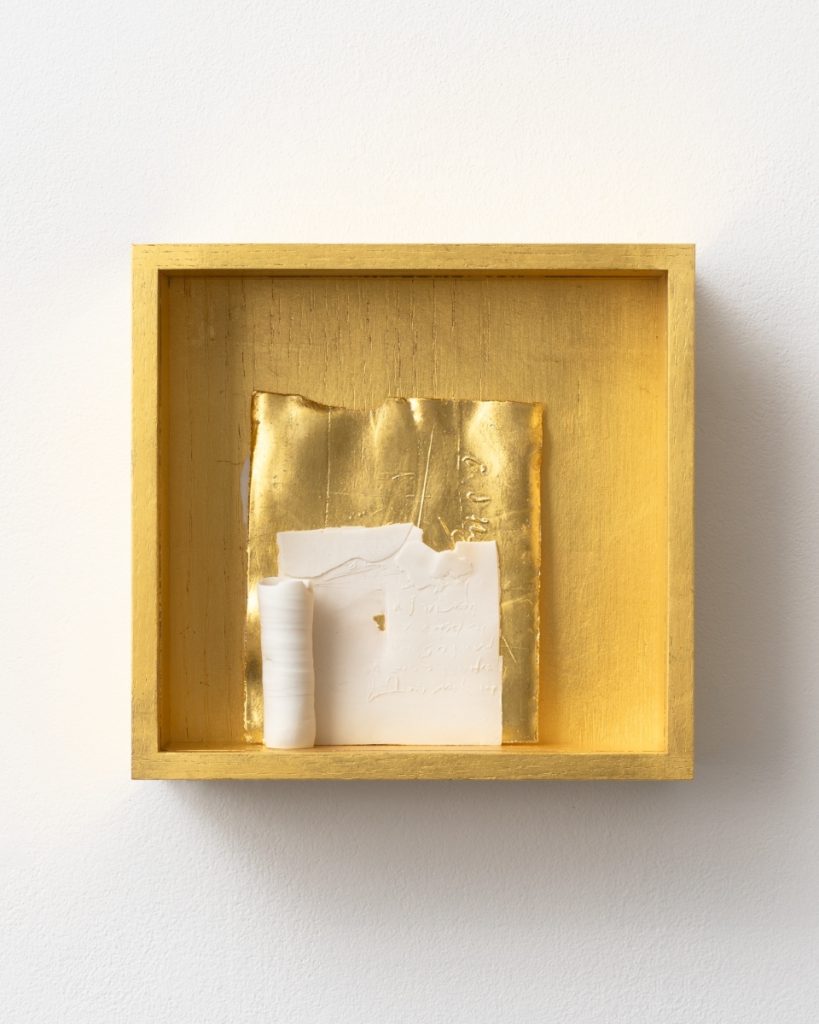
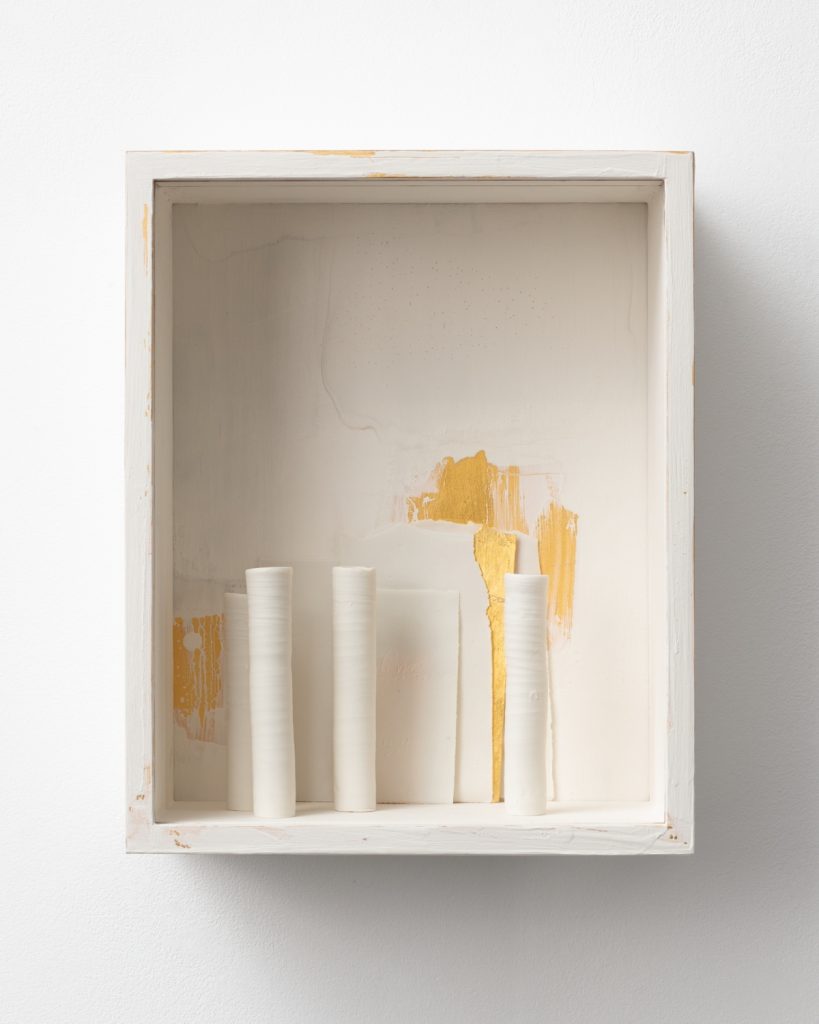
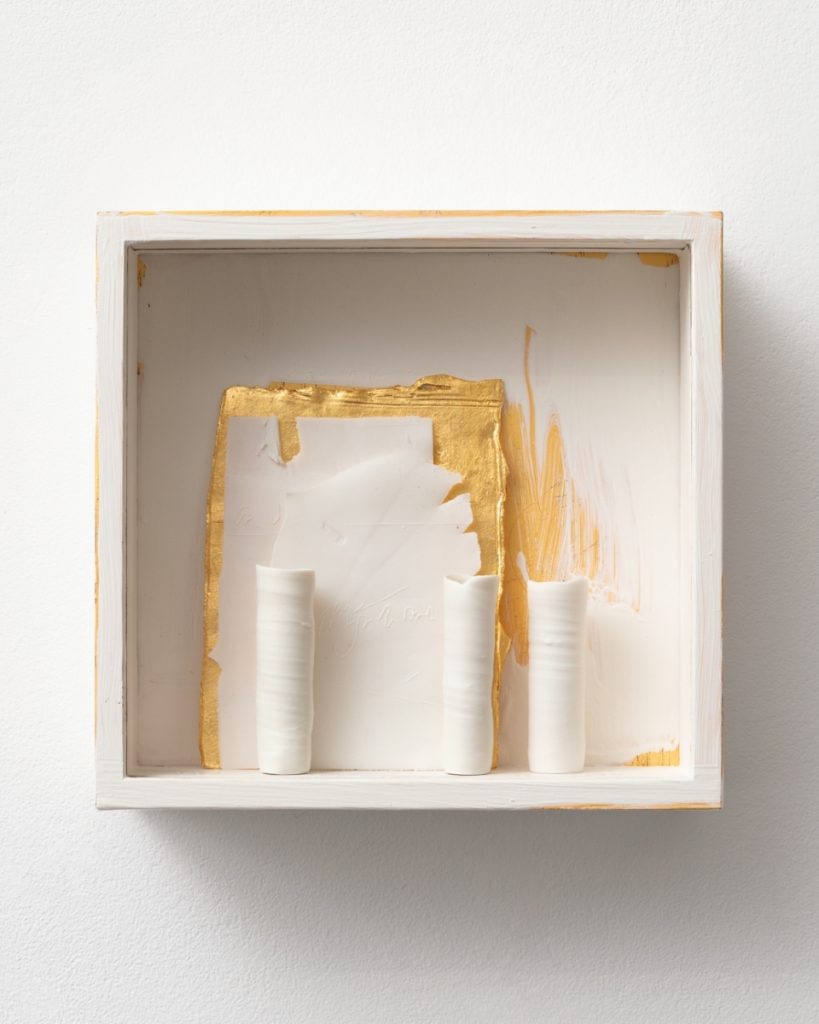
The newer white and gold works offer one answer. Upright porcelain forms occupy pale box vitrines while narrow flashes of gold interrupt the field. Gold sometimes behaves as background and sometimes as punctuation, forcing the eye to search for it between porcelain forms. In Crevole, emptiness operates differently across two horizontal vitrines, with porcelain, silver and gold occupying a disproportionately large architectural field. Under the gallery lighting gold alters the temperature of porcelain, sharpening pale edges and making forms more corporeal. Its devotional associations are unavoidable, but so are scarcity, money and prestige. Reverence and wealth occupy the same material.
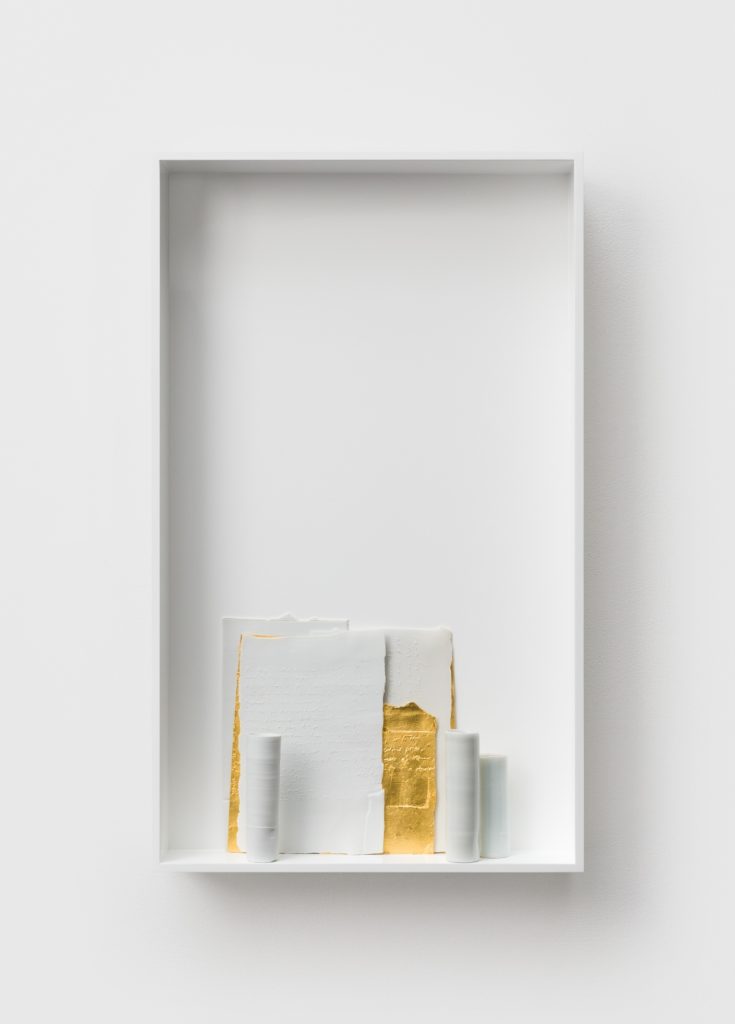
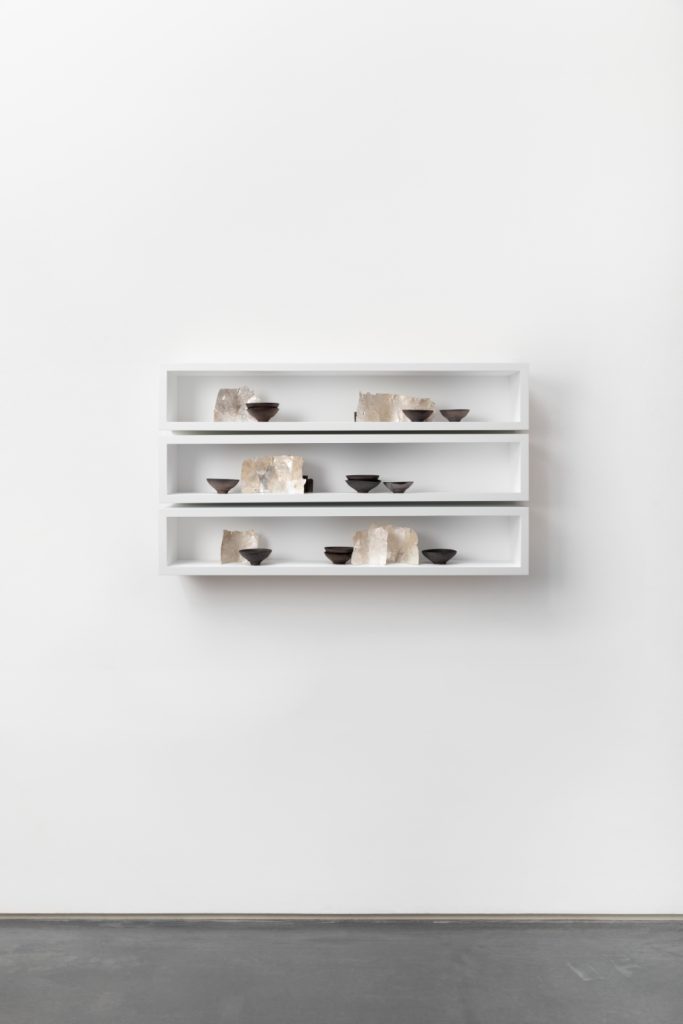
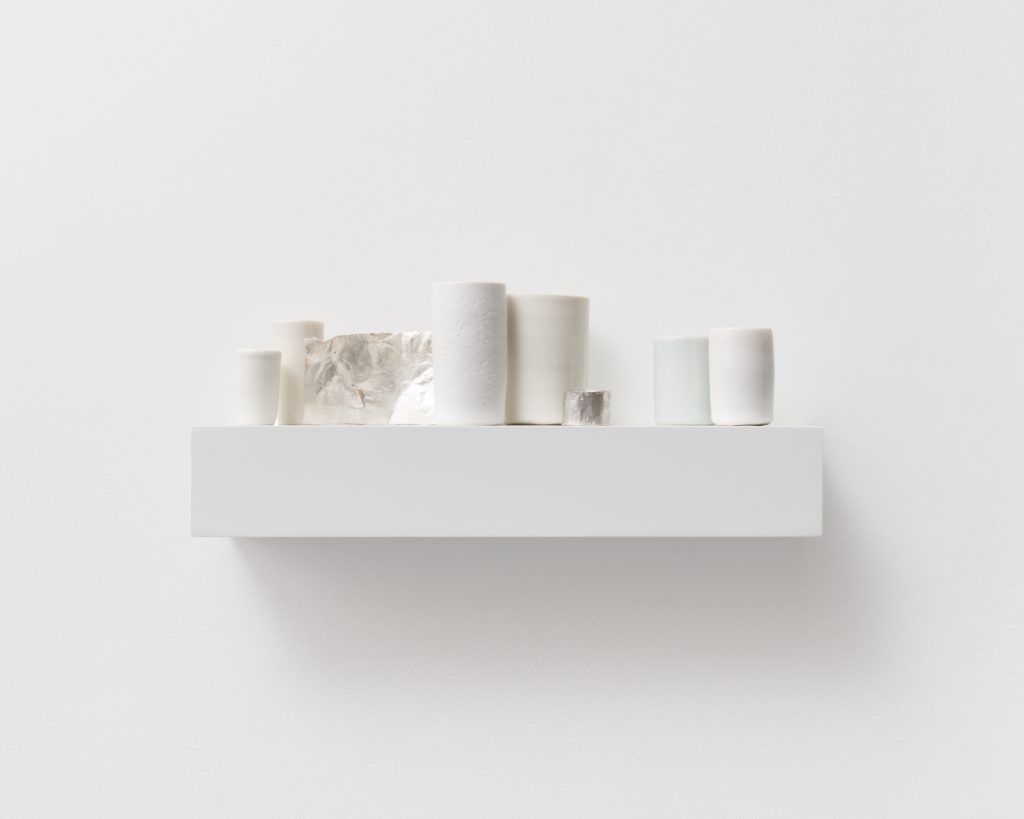
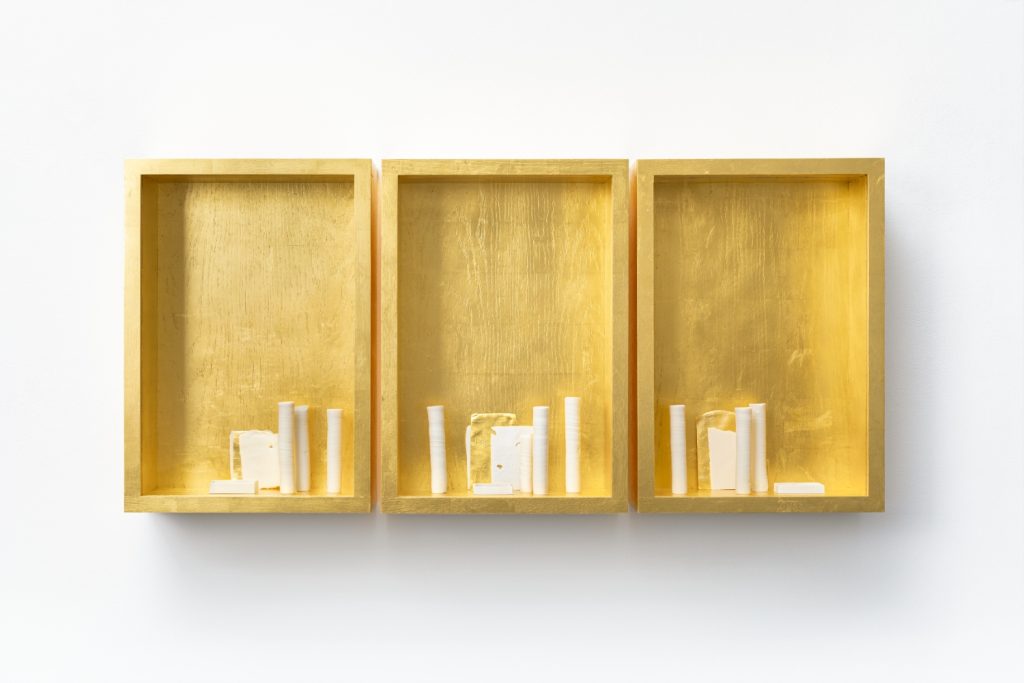
De Waal hopes the exhibition will encourage “slow looking” at the way histories and journeys weave together. The invitation is worth accepting, but slow looking also needs to become material looking. The poetry of a white bowl does not remove its clay body. Migration does not erase the technologies, labour and trade systems through which porcelain travelled. Sanctuary cannot be separated completely from enclosure, and gold does not cease to carry economic value because it enters a devotional language. This does not invalidate de Waal’s concern with vulnerability. Art has always existed within economies of patronage and collecting. The more useful issue is the relationship between protection and value. A fragment behind glass becomes important partly because someone has chosen to protect it; distance and rarity can intensify attention.
The title rain diary also changes when returned to ceramic process. Rain suggests atmosphere, journey, memory and home, yet water belongs to clay before metaphor begins. Too much water and a vessel may collapse, too little and clay becomes resistant. Throwing is a continuous negotiation between moisture and structure. A wet pot remains capable of becoming otherwise. Firing changes that condition because it is irreversible. Clay becomes ceramic, glaze melts into surface and small deviations become permanent. The vitrine performs another kind of fixing by determining where the fired object sits, what surrounds it and how it will be seen. The kiln changes matter; the vitrine changes relations.
Perhaps the exhibition’s most persuasive form of plurality lies in the way these different materials remain distinct. De Waal speaks of histories and journeys weaving together, but weaving does not require difference to disappear. The best works allow materials to remain recognisably themselves even while placing them in intimate relation. The danger is that silence becomes too perfectly composed. rain diary avoids that whenever material becomes difficult enough to interrupt the system. A shard exposes its body, a low bowl opens the architecture horizontally, metal breaks the continuity of porcelain, black ceramic gathers weight, fossil-bearing stone introduces time without memory, and celadon brings a history the contemporary artist can enter but cannot own.
These tensions are the reason to spend time with the exhibition. De Waal asks for slow looking, and the longer one looks the less serene the work becomes. Beneath its immaculate surfaces lie technical knowledge, rejected material, historical collisions, geological time, systems of value and the uncertainties of firing. The shelf determines how the vessel is encountered, but not everything it brings with it. Before reaching the gallery, the pot has already been changed by hand, water, atmosphere and fire. Historical ceramics have already travelled through production, trade and collecting, while stone predates the vitrine entirely.
That distinction gives rain diary its strength. De Waal has transformed arrangement into a ceramic medium without making arrangement all-powerful. His shelves can regulate pace, proximity and attention, and they can give a small vessel great presence or make a broken fragment newly precious. They cannot erase the material histories carried by what they contain. At Gana, the strongest arrangements understand that limit. They give each object a precise place while allowing something of its previous life to remain unresolved. The exhibition may begin in silence, but sustained looking fills that silence with glaze, fracture, labour, geology, memory and fire.
Anisio Veloso is a Brazilian-born British doctor, ceramic artist, and independent visual arts scholar based in the UK. He is currently working on a book, Where Error Does Not Injure: Medicine, Porcelain, and the Ethics of Attention.
Edmund de Waal: rain diary is on view at Gana Art Center, Seoul, between August 28 and October 4, 2026.
Subscribe to Ceramics Now to read similar articles, essays, reviews and critical reflections on contemporary ceramics. Subscriptions help us feature a wider range of voices, perspectives, and expertise in the ceramics community.
Captions
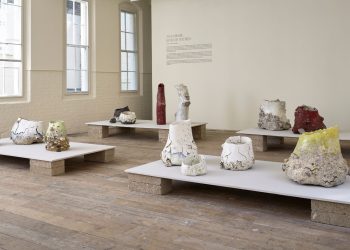
- Installation views, Edmund de Waal: rain diary at Gana Art Center, Seoul, 2026. Courtesy of the artist and Gana Art Center
- Edmund de Waal, rain diary, 2025, Porcelain, silver, wood, aluminium and glass, 214.4 × 260 × 13.5 cm / 84.4 × 102.4 × 5.3 in. © Edmund de Waal. Photo: Alzbeta Jaresova. Courtesy Gagosian
- Edmund de Waal, Crevole, 2025, Porcelain, silver, gold, wood, aluminum, and glass, in 2 parts, 43.5 × 110 × 20 cm / 17.1 × 43.3 × 7.9 in. © Edmund de Waal. Photo: Alzbeta Jaresova. Courtesy Gagosian
- Edmund de Waal, Coptic Light, I, 2026, Porcelain, silver, Kilkenny stone, wood, aluminium and glass, 51.4 × 95 × 20 cm / 20.2 × 37.4 × 7.9 in. © Edmund de Waal. Photo: Alzbeta Jaresova. Courtesy Gagosian
- Edmund de Waal, Coptic Light, II, 2026, Porcelain, silver, Kilkenny stone, wood, aluminium and glass, 51.4 × 95 × 20 cm / 20.2 × 37.4 × 7.9 in. © Edmund de Waal. Photo: Alzbeta Jaresova. Courtesy Gagosian
- Edmund de Waal, Coptic Light, III, 2026, Porcelain, silver, Kilkenny stone, wood, aluminium and glass, 51.4 × 95 × 20 cm / 20.2 × 37.4 × 7.9 in. © Edmund de Waal. Photo: Alzbeta Jaresova. Courtesy Gagosian
- Edmund de Waal, if you came this way, III, 2025, Porcelain, gold, kaolin, wood and glass, in two parts, 37 × 61.4 × 14.9 cm / 14.6 × 24.2 × 5.9 in. © Edmund de Waal. Photo: Alzbeta Jaresova. Courtesy Gagosian
- Edmund de Waal, if you came this way, IX, 2025, Porcelain, gold, wood, and glass, 20 × 21 × 7.2 cm / 7.9 × 8.3 × 2.8 in. © Edmund de Waal. Photo: Alzbeta Jaresova. Courtesy Gagosian
- Edmund de Waal, if you came this way, V, 2025, Porcelain, gold, kaolin, wood, and glass, 37 × 30 × 15 cm / 14.6 × 11.8 × 5.9 in. © Edmund de Waal. Photo: Alzbeta Jaresova. Courtesy Gagosian
- Edmund de Waal, if you came this way, VIII, 2025, Porcelain, gold, kaolin, wood, and artglass, 20 × 21 × 7.2 cm / 7.9 × 8.3 × 2.8 in. © Edmund de Waal. Photo: Alzbeta Jaresova. Courtesy Gagosian
- Edmund de Waal, precious beyond measure, 2026, Porcelain, Wedgwood black basalt shards, Song Dynasty (960–1279) shards, silver, tin, steel, wood and artglass, 94 × 61 × 12.5 cm / 37 × 24 × 4.9 in. © Edmund de Waal. Photo: Alzbeta Jaresova. Courtesy Gagosian
- Edmund de Waal, from yourself to yourself, 2026, Porcelain, gold, aluminium and glass, 70 × 42 × 10 cm / 27.6 × 16.5 × 3.9 in. © Edmund de Waal. Photo: Alzbeta Jaresova. Courtesy Gagosian
- Edmund de Waal, I stood at that window, 2025, Porcelain, silver, wood, aluminum, and glass, 63 × 110 × 20 cm / 24.8 × 43.3 × 7.9 in. © Edmund de Waal. Photo: Alzbeta Jaresova. Courtesy Gagosian
- Edmund de Waal, natura morta con sei oggetti, 2026, Porcelain, silver and aluminium, 19 × 45 × 12 cm / 7.5 × 17.7 × 4.7 in. © Edmund de Waal. Photo: Alzbeta Jaresova. Courtesy Gagosian
- Edmund de Waal, if you came this way, XIV, 2025, Porcelain, gold, kaolin, wood, and glass, 53 × 77 × 13.5 cm / 20.9 × 30.3 × 5.3 in. © Edmund de Waal. Photo: Alzbeta Jaresova. Courtesy Gagosian