

Magazine
Ceramic artists list
> Ceramic artists list 97. Ryan Blackwell 96. Ellen Schön 95. Francesco Ardini 94. David Gallagher 93. Elizabeth Shriver 92. Jason Hackett 91. Patricia Sannit 90. Bente Skjøttgaard 89. Steve Belz 88. Ruth Power 87. Jenni Ward 86. Liliana Folta 85. Kira O'Brien 84. Annie Woodford 83. Kwok-Pong Bobby Tso 82. Bogdan Teodorescu 81. Kimberly Cook 80. Paula Bellacera 79. Debra Fleury 78. Cindy Billingsley 77. David Gilbaugh 76. Teresa & Helena Jané 75. Marianne McGrath 74. Suzanne Stumpf 73. Deborah Britt 72. Kathy Pallie 71. Els Wenselaers 70. Kjersti Lunde 69. Brian Kakas 68. Marie T. Hermann 67. Mark Goudy 66. Susan Meyer 65. Simcha Even-Chen 64. Barbara Fehrs 63. Shamai Gibsh 62. Natalia Dias 61. Bethany Krull 60. Amanda Simmons 59. Arthur Gonzalez 58. Chris Riccardo 57. Akiko Hirai W 56. Johannes Nagel 55. Rika Herbst 54. Liza Riddle 53. Chang Hyun Bang 52. Virginie Besengez 51. Jasmin Rowlandson 50. Chris Wight 49. Wim Borst 48. Rafael Peréz 47. Guðný Hafsteinsdóttir 46. Cathy Coëz 45. Merete Rasmussen 44. Carol Gouthro 43. JoAnn Axford 42. David Carlsson 41. Margrieta Jeltema 40. David Roberts 39. Patrick Colhoun 38. Abigail Simpson 37. Signe Schjøth 36. Katharine Morling 35. Dryden Wells 34. Antonella Cimatti 33. Cynthia Lahti 32. Carole Epp 31. Blaine Avery 30. Ian Shelly 29. Jim Kraft 28. Wesley Anderegg 27. Connie Norman 26. Arlene Shechet 25. Young Mi Kim 24. Jason Walker 23. Peter Meanley 22. Shane Porter 21. Jennifer McCurdy 20. Yoichiro Kamei 19. Debbie Quick 18. Ian F Thomas 17. John Shirley 16. Grayson Perry 15. Vivika & Otto Heino 14. Georges Jeanclos 13. Daniel Kavanagh 12. Nagae Shigekazu 11. Matthew Chambers 10. Tim Andrews 9. Claire Muckian 8. Adam Frew 7. Maciej Kasperski 6. Roxanne Jackson 5. Keith Schneider 4. Celeste Bouvier 3. Tim Scull 2. Kim Westad 1. Sara Paloma

Ceramic art

When I Woke / Llantarnam Grange Arts Centre, Cwmbrân, UK

When I Woke exhibition Llantarnam Grange Arts Centre, Cwmbran, Wales

When I Woke / Llantarnam Grange Arts Centre, Cwmbrân, Wales, UK
October 6 - November 18, 2012

When I Woke – an exploration of the human condition curated by Claire Curneen and Lowri Davies.

When Llantarnam Grange Arts Centre invited celebrated ceramicists Claire Curneen and Lowri Davies to curate an exhibition as part of the centre’s “Makers to Creators” series both artists relished the opportunity to expand their artistic horizons and provide a completely different perspective to their practice.

Inspired by Dylan Thomas’ poem ‘When I Woke’, the exhibition is full of questions about life, death and change. Each of the exhibitors examine the gritty questions which surround the human dilemma. The body and the figure are central to these artists and the exhibitors explore issues in relation to beauty, the visceral body, myth, folklore and tradition. The subject matter is complex and in very different ways they strive in search for something hidden or lost.

Artists: Tamsin van Essen, Sam Bakewell, James Page, Lina Peterson, Audrius Janusonis, Sophie Woodrow.

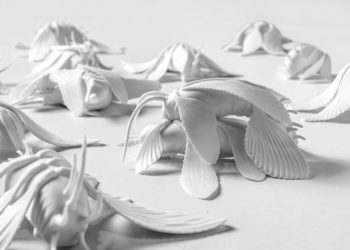
Tamsin van Essen explores the cultural obsessions with perfection and beauty. There is a tactile beauty in the objects surface and form yet they talk about the visceral decaying body which leaves us somewhat unsettled.

The visceral is also evident in Sam Bakewell and James Page’s work. Bakewell uses solid masses of clay to suggest the body, the objects are dense and immediately physical. These objects are not static forms, they are in a state of flux and are bursting with life.

James Page asks us to reassess our perception of our own bodies. His work is a celebration of the physical nature of the human body with an affirmation of our earthly connection.

Lina Peterson is a jeweller that tells a human story. Her work has a sense of the ritual, in some instances drawing inspiration from Roman artifacts. Peterson response to ancient artifacts is to ‘fill the gap’ and to put back what is missing, in turn creating a new and original narrative.

Audrius Janusonis and Sophie Woodrow use traditional figurative modes of practice. They explore a sense of place, often mythical and sometimes untangible. Janusonis is Lithuanian whose work is known across Europe but has never before been shown in  UK. His figures have a strong allegorical message often referencing the texts of Ovid’s Metamorphoses. His understanding of the human form is extraordinary.

Sophie Woodrow entices us in to a strange world where the relationship between animal and human are blurred. Her figures stare out at us revealing some sinister folk story. They are reminisent of staffordshire flatbacks, domestic in scale yet subversive in nature.

Read More

  • In memoriam Eugenia Pop / Interview

    ROMANIAN CONTEMPORARY CERAMICS, October 2012

    In memoriam Eugenia Pop
    Eugenia Pop lived and worked in Cluj-Napoca, Romania, where she graduated from the Ceramics Department of “Ion Andreescu” Arts Institute in 1971. Over the course of 40 years, she had exhibited in many countries and has been awarded for her career by the Romanian Government (Order of Cultural Merit) and the Fine Arts Union.

    Eugenia Pop Romanian ceramic artist

    Two days after our meeting in February, Eugenia Pop went to the Copăceni alms house, near Turda, to read in peace a book by Zhi Gang Sha. She wanted to learn how to communicate better with her guardian angel. She told us that the spirit must be cleaned more frequently.

    We thank Jeni Pop from our hearts and promise to carry her optimism out in the world.

    Interview by Alexandra Mureşan and Vasi Hîrdo for Ceramics Now Magazine, Issue Two
    February 2012

    How did the fascination for ceramics started?

    I graduated Ceramics at the Fine Arts Highschool in Cluj. In the twelfth grade I had an excessive curiosity to do work as much as possible, that’s why I chose ceramics. I was a colleague with Arina Ailincăi for 6 years. We were also six in the department. Our personalities were very different, and they remained the same. A sculptor inoculated me the idea of versions. He gave me a theme, a ceramic piece in an architectural environment. After a few sketches, he told me to do more versions. I didn’t like the idea – why make more versions when the first one was good enough? But, if the master told me, I had to do it. I did lots of versions and sketches, from bad to worse. He chose from the first two, and I remained very sad because I worked so hard on so many. After a while, the seed sprouted in my mind. I was at a Communist party meeting, and I got very bored. I had my sketchbook at me and I was doing all sorts of sketches and drawings. The expression was changing with little diversity if terms of form. I showed the sketches to my professor. It remained my method over the years.

    Now I stopped doing more versions on a theme. I read books, for example those written by Rudolf Steiner, and I make illustrations on the pages. When reading a book twice, the images speak to me a lot more and I feel the text very differently when it’s illustrated, just like a plastic commentary.

    What are your main sources of inspiration?

    I broke up with the illustrative image of the exterior form. I adhered to the archetypal forms, which are interior forms of the soul, forms that kids use when drawing, but also used in the antic culture.

    Mihai Oroveanu said “Look how monumental your works are,” even if they were very small. Dan Hăliucă said the contrary: “That’s how it should be – plenty and small.” I used this thing with plenty and small a lot, because that’s how the image of the soul is. The soul is very capacious. From it’s ampleness you can make plenty and small.

    A moment of crystallization appeared when I found my personality – when I said that this is how I want to express myself. It was the humanity theme, the man. The mother man, the old man, the child man. Mother Earth. These are themes that I feel I synthesized.
    When I was young, my mother used to call me “little golden thorn” – she couldn’t tell me that I was not right, but I was also very determined. I was telling the truth.

    Eugenia Pop - Mother Earth, ceramics
    Eugenia Pop, Mother Earth, 1985, Soft porcelain

    What is your dearest part in elaborating a new work?

    Each part has its own magic. The first one is sketching the idea and choosing the right drawing, then follows the modeling and making the negative. After that, the fascination of the firing starts. It is like when a mother gives birth – she doesn’t know how the child will look like or what color his eyes will be. It is just like that after the firing, when you remain charmed by an object, and you say to yourself that this is mine! – its color has changed and it shrank. After you inspect it for a while, you adopt it or not. Sometimes you have to say I’m sorry – this is not mine.

    Read More

  • In relief: German Op-Art Ceramics, 1955-75 / University of Arizona Museum of Art, Tucson

    German Relief Porzellan Exhibition, University of Arizona Museum of Art, Tucson

    In relief: German Op-Art Ceramics, 1955-75 / University of Arizona Museum of Art, Tucson
    September 28, 2012 – January 27, 2013

    Opening Reception: October 4, 5-7 pm.

    A first-ever exhibition of a mid-century movement of German ceramics, known as relief-porzellan, debuts at the University of Arizona Museum of Art. Entitled: In Relief: German Op-Art Ceramics, 1955-75” the exhibition opens on September 28 and runs through January 27, 2013. Both the exhibition and reception are open to the public.

    Lawrence Gipe, UA Associate Professor of Studio Art, has been collecting mid-century German ceramics known as relief-porzellan for a number of years. Little was known about these beautiful objects until Gipe undertook to discover the history of their production. This exhibition presents his fascinating research, bringing to light the stories behind the factories and individual artists who created the objects.

    “Several years ago, I became aware of this unique genre of German ceramics,” says Gipe. “These mass-produced objects were made in “biscuit” porcelain – a matte-white or black finish that leaves the shape unglazed and naked, unadorned in its starkness.”

    Between the years of 1955-1980, more than a dozen companies were producing the Relief-Porzellan ceramics, mostly vases. Artisans, working in small Bavarian towns, created hundreds of designs, both geometric and organic. Some of the ceramic objects were stamped on the bottoms with the name of the designer and the trademark of the company that produced them. Gipe’s visit to an archive in Selb, Germany, the venerable Rosenthal and Co., offered a trove of journals and files, revealing artists and providing attributions to previously anonymous pieces.

    Research for the UAMA exhibition, In Relief: German Op-Art Ceramics, was made possible by a grant from the International Affairs Department at the University of Arizona. The University of Arizona Museum of Art includes more than 6,000 artworks in its permanent collection created by artists from the 14th through the 21st centuries. UAMA is one of only twelve museums in Arizona accredited by the American Association of Museums (AAM) and one of only 750 museums of the 16,000 museums nationwide with this highest award for excellence in the museum field.

    Read More


  • Ellen Schön:
    Cycladic Bottle (green comb), 2011, Stoneware, 16” x 7” x 7” (left)
    Cycladic Bottle (green stripe), 2011, Stoneware, 16” x 7” x 7” (right)


  • Ellen Schön: Vortex, 2012, Smoke-fired clay, 13” x 20” x 20”

  • Ellen Schön: Cycladic Bottle (white dash), 2011, Stoneware, 16” x 7” x 7”

  • Ellen Schön: Nargila Pod, 2011, Smoke-fired clay, 16.5” x 21” x 21”


  • Ellen Schön: Embracing Totem, 2011, Stoneware, 18” x 4” x 5”


  • Ellen Schön: Lotus Pod, 2009, Smoke-fired Clay, 9” x 15” x 15”

  • Ellen Schön: Planet #4, 2012, Stoneware, 10” x 10” x 10”

  • Ellen Schön: Planet #11, 2012, Stoneware, 10” x 10” x 10”

  • ©2013 Ceramics Now. All Rights Reserved. Website by Thomas Cullen. Powered by Tumblr.