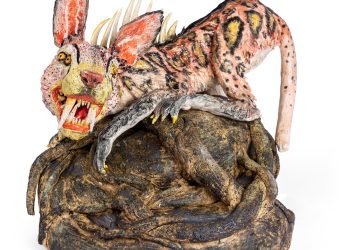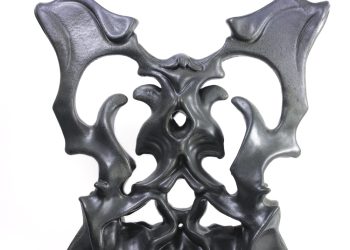
What message or emotion do you want to convey to the observer through your works? Is your artistic undertake based on a certain idea or is it more of a searching process and experimentation?
For me, this process is never conscious, programmed or preconceived. It is more of a constant experiment that is absolutely instinctive. My only guides on this path are those primal, undefined sensations generated by touching and feeling the malleable and permissive clay.
Only afterwards I come to realize with wonder that a kind of actualization takes place – a humble identification, like a translation of some archaic, immemorial message. When I stop and ”read” the pieces that I created, and I analyze the way I created them, I marvel and realize that an actualization was already in me, that that translation was made through me.
Good or bad, this is my path; through it I try to understand, not in a rational way, but rather through sensations and feelings, some of the facts of my existence, trying at the same time to leave some signs behind, signs that have meaning only if they are perceived by others.
Many of your works are created in raku – a technique that is not the most convenient for everybody. Why did you choose this technique? What are the advantages and disadvantages that it presents?
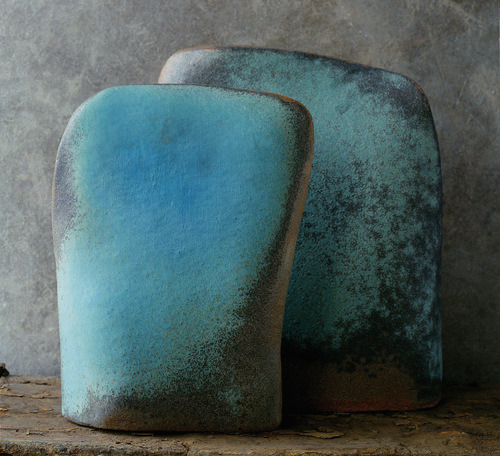
Raku is a technique that allows one to obtain very special and organic effects, both surprising and discreet. The expressive potential of the surface is greatly enhanced and can vary according to time and to different types of materials used in the burning – crumbled paper, sawdust, grass or dry leafs. Because of the strange appearance obtained through the ulterior reductions, the objects that are born through raku seem to me to be part of an ancient world, they appear timeless.
The process of preparing the clay for the object that will be raku fired is special and equally important to me, because this offers just as many possibilities. The preparation involving different salts, oxides, engobes or glazes, in diverse combinations gives the final piece a special and unique visual individuality.
Throughout the years I tested many of these possibilities, and through numerous repetitions I tried to understand and feel the spell of prompt intervention and immediate decision. These interventions can give you the impression that you work directly with the magical proprieties of the ceramic material.
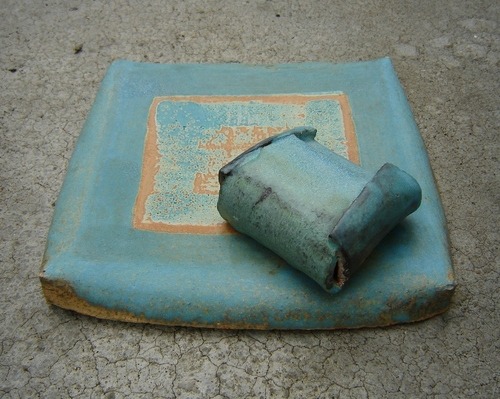
Clay is perceived by many to be a docile and easy to manipulate material, but a real ceramic artist knows its potential and limits. In your opinion, what should be the relation between an artist and the material he uses?
Clay is a material that is very open to the tactile dialog of touches, and this opening is very important to me because it creates a link to a world full of miracles and secrets. Through the material I am capable to connect with messages from ancient times. Clay seems to transport me into a different time, a different dimension. This is the reason why, whenever I find myself face to face with clay I try to reach the highest level of sincerity.
Tell us more about your project Action-Interaction. What was its basic concept and how did it develop?
The action took place in 2000, in a stone pit near the Romanian-Hungarian border. Alongside me, Găina Gerendi Dorel, Găina Gerendi Aniko and Miklos Jakobovits, three artists and friends, assisted and took pictures for documenting the event. That is where the name of the project originates from: INTERACTION G+G and J+J, which refers to the initials of the participants names.
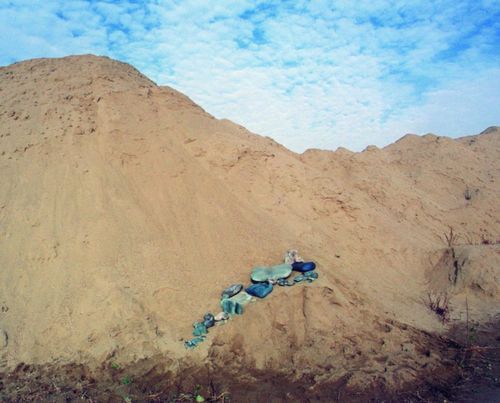
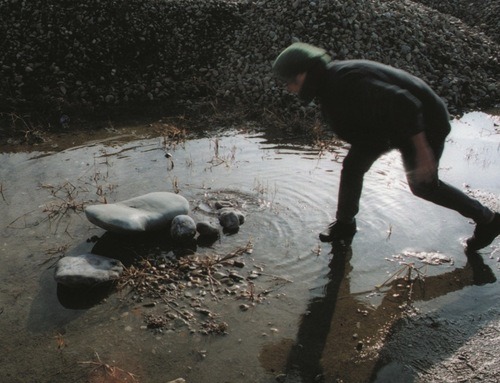
The action was aimed at relocating the art works in nature, observing how they “live” in this environment and, of course, the documenting of every single one of its moments.
Repositioning my works in nature was, and still is a very important personal protocol for me. It is just like a sign of gratitude; a ritual of thanking, respecting and admiring nature and the Great Creator. An homage and in the same time, a sort of dialogue while observing with surprise the way my works respond in nature. I can feel that I received and I continue to receive very much from the natural environment. I have learned and I am still learning from hills, rocks, stones, tree arms, shells, etc. The resetting of my works in nature, as gratitude, homage and thankfulness, has been for me a unique and unrepeatable experience. In this action, of placing the works, I let myself be guided by the sensorial feeling that that place generated, and I tried to respond to these sensorial challenges.
Under the vast sky, in the odd landscape of the stone pit, it was only me and my works; and in the perfect and harmonious silence of the selected surroundings, they seemed to generate new meanings.
The documenting of the creational steps was very important because the photos that my colleagues and friends made as witnesses and participants at the action, reveal the most significant moments. They reflect singular moments, in which something that can be hardly expressed in simple words. In the magnetic atmosphere of that place, an incredible connection was formed between the created works and the natural surroundings, the heaps of sand, those rocks, the pools, the Heavens and the Earth.
What is your next project?
What is coming, the next step, is always very interesting. Because of my instinctive and spontaneous dialog with clay I know only the kind of area I am in, but I never know for sure what could be next. The only thing I know is that the dialog, the pilgrimage will go on.
Interview by Ileana Surducan and Alexandra Muresan, published in Ceramics Now Magazine, Issue 2.
Visit Marta Jakobovits’ website.
View the list of interviews with ceramic artists.