pottery

Interview with Jill Beute Koverman, McKissick Museum - Walter Stephen’s work / Review

REVIEW, May 2012:

/ Read more reviews in Ceramics Now - Issue Two

Interview with Jill Beute Koverman, Chief Curator of Collections and Research, McKissick Museum - Walter B. Stephen’s work

by Vasi Hîrdo

You have been working at the University of South Carolina’s McKissick Museum for over ten years. What are the main responsibilities and attributes of being the Chief Curator of Collections & Research?

Jill Beute Koverman: As Chief Curator of Collections and Research, my responsibilities include overseeing the research and care for the permanent collections. The permanent collections include natural science collections (rocks, minerals, fossils, meteorites and shells) and material culture collections which include fine art, furniture, textiles (clothing, quilts, other domestic textiles, baskets, shoes, accessories), ceramics, glass, metal objects, political materials, silver and objects relating to the history of the University of South Carolina. I guide and implement the collecting activities of the museum in terms of new acquisitions and research, identify long-term care needs of the collections in terms of conservation and storage, and work with my colleagues on various exhibition projects. My research focus is on Southern pottery but I’m knowledgeable about traditional basket traditions of the South, South Carolina history and politics, and University history. In a mid-size institution like McKissick Museum, and particularly at a University, it is important to constantly learn about the various types of museum collections.

During the 26th of May and the 27th of July, USC’s McKissick Museum will host a very important exhibition of rare 20th century ceramics made by Walter B. Stephen. Tell us about the heritage of Walter’s work.

/ Read the press release of the exhibition.
Walter Stephen was born in Nebraska in 1876. His family moved to 100 acres of land in Shelby County, Tennessee in 1897. It was on this property where he discovered layers of pink, white and yellow clay. His intellectual and creative curiosity was fostered by his mother. Nellie Stephen was an amateur artist who taught blackboard art and painting. Walter did not begin working with clay until he was twenty-seven years old (1903). Together, Walter and his mother began experimenting with the clay and the decorating process. It is also possible that the two had seen George Ohr, “the Mad Potter of Biloxi,” demonstrating his pottery skills at the Louisiana Purchase Exposition in 1904. Originally named, “Stephen and Son,” they renamed their pottery “Nonconnah” after the local creek. The forms were typical decorative vases and pitchers of the period. The decoration was different as Mrs. Stephen’s painted layers of porcelain slip onto the wares, often adding colored oxides for leaves and branches. This paste on paste, or cameo, technique was similar to the original method employed by Josiah Wedgwood for his Jasperwares. In 1910, Walter’s parents died and he continued to operate the Nonconnah pottery in Tennessee until 1912. A year later, he moved to the Skyland community of North Carolina, south of Asheville, and established the Nonconnah Pottery in partnership with Mr. and Mrs. Clarence Pine Ryman. At this iteration of the Nonconnah Pottery, Stephen continued to work at the potter’s wheel, creating matte glazed cameo wares until 1916. The Ryman’s operated the Nonconnah until 1918, producing molded and slab constructed wares with simple blue and brown glazes.

Walter B Stephen Ceramics - McKissick Museum

Walter B. Stephen, Three stoneware vases with crackle glaze. Courtesy McKissick Museum, University of South Carolina.

It would be almost a decade after Stephen’s departure from Nonconnah before he established the Pisgah Forest Pottery. During this period, he became closely associated with Oscar L. Bachelder of the Omar Khayyam Pottery. Walter worked for a short time with Bachelder but did not want to make utilitarian pottery. It was also during the early 1920s, that he was experimenting with local clay,glazes and firing techniques. Fragments from his Arden home indicate his interest in the Chinese celadon and red glazes.

Pisgah Forest and Nonconnah: The Potteries of Walter B. Stephen / McKissick Museum

Pisgah Forest and Nonconnah: The Potteries of Walter B. Stephen exhibition / McKissick Museum

Pisgah Forest and Nonconnah: The Potteries of Walter B. Stephen / University of South Carolina McKissick Museum, Columbia, SC, USA
May 26 – July 27, 2012

Some of the most imaginative and beautiful ceramics of the 20th century will be on display in an exhibition of Walter B. Stephen’s pottery May 26 – July 27 at the University of South Carolina’s McKissick Museum.

Titled “Pisgah Forest and Nonconnah: The Potteries of Walter B. Stephen,” the exhibition will feature 76 rare examples of Stephen’s works, from the first pots that he fired near Nonconnah Creek in Tennessee to crystalline vessels produced at Pisgah Forest near Asheville.

Stephen, born in 1876 in Clinton, Iowa, was heavily influenced by his mother, but he  soon began exploring and developing his own creative talents. In 1904, he established the Nonconnah Pottery in Tennessee, where he and his mother produced “paste on paste” cameo wares similar to Wedgwood’s Jasperwares. In 1913, he moved to the Asheville area, where he produced a variety of pottery until his death in1961.

The early Nonconnah pieces are dominated by matte-green glazes with floral designs. The later works made at the Pisgah Forest Pottery range from small, brightly glazed teapots and cups to monumental baptismal fonts. Cameo depictions of the American West include covered wagons, Indians hunting Buffalo and portraits of Bill Cody. Stephen also used imagery of the South such as mountain cabins, fiddlers and Gen. Robert E. Lee. His forms and glazes, particularly the crystalline glaze, were inspired by Asian ceramics.

Two events are planned in connection with the exhibition:

On June 21, from 5:30-7:30 p.m. the museum will host a reception, a gallery talk and a book signing featuring Rodney Leftwich, author of “Pisgah Forest and Nonconnah: The Potteries of Walter B. Stephen.”

From 10 a.m. - 4 p.m. Friday, June 22, McKissick will host a symposium, “The Art of Collecting Southern Pottery.”  Leftwich, Karen Swager of Brunk Auctions, crystalline potter Frank Neef, Winton Eugene and Rosa Eugene of Pottery by Eugene, and Barbara S. Perry, who writes about  American ceramics, will participate.

The symposium is $40 for museum members and $50 for non-members.

Museum Hours: Monday-Friday: 8:30 am - 5 pm. Saturday: 11 am - 3 pm. Closed Sundays and all University and State holidays.
Open to the public free of charge.

Frankoma Pottery / Fred Jones Jr. Museum of Art, Norman, OK

Oklahoma Clay: Frankoma Pottery / Fred Jones Jr. Museum of Art, Norman, OK, USA

Oklahoma Clay: Frankoma Pottery / Fred Jones Jr. Museum of Art, Norman, OK, USA
April 20 - September 16, 2012

Opening reception: Friday, April 20, 7-9 pm.

Works of one of Oklahoma’s favorite potters, John Frank, are featured in a new exhibition, Oklahoma Clay: Frankoma Pottery, opening Friday, April 20, at the Fred Jones Jr. Museum of Art. The exhibit features a selection of work from Frank’s Oklahoma-based pottery factory that manufactured unique and collectable ceramics for more than 50 years. Highlights include a group of individual pieces made by the potter.

“This exhibit gives the University a great opportunity to honor the pioneer contributions made by John Frank to our School of Art, especially our ceramics program,” said OU President David L. Boren. “He came from the Chicago Arts Institute to start the ceramics program at OU. Using Oklahoma clay, he shaped ceramic pieces that would make him well known across Oklahoma and even around the world. Countless Oklahoma dinner tables were graced with his dinner ware.”

“It is a great pleasure to celebrate the life and works of a true Oklahoma artist,” said Ghislain d’Humières, director of the art museum at OU. “John Frank’s legacy continues both in the artistic integrity and the continued collectivity of works created in his factory nearly 80 years ago.”

In 1927, Frank founded a ceramics program at OU, where he taught for eight years. While teaching at the university, he established Frankoma Pottery, using local clays with colors and designs symbolic of the Southwest and Great Plains.

The April 20 opening for Oklahoma Clay: Frankoma Pottery is preceded by a daylong symposium at the museum. Scheduled from 9 a.m. to 4 p.m., Decorative Arts and the American West – the seventh biennial symposium of the Charles M. Russell Center for the Study of Art of the American West – is free and open to the public, with a nominal charge for an optional luncheon. Noted scholars, museum curators and art historians will discuss such diverse topics as ranch-style furniture, regionally inspired pottery and silver-mounted saddles.

Jason Hess: New Work / Plinth Gallery, Denver, CO, USA

Jason Hess: New Work exhibition at Plinth Gallery, Denver

Jason Hess: New Work / Plinth Gallery, Denver, CO, USA
April 6 - 28, 2012

Opening reception: Friday, April 6th, 6-9 pm.

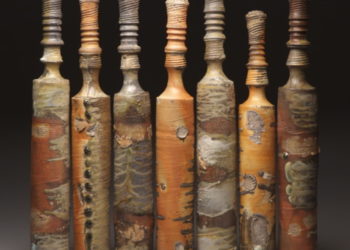
Jason Hess is a professional ceramic artist and professor who lives in Arizona and instructs at Northern Arizona University. As an “avid wood firer”, his research for over 15 years has focused on the alchemy of the process — how the clay color, wood type, kiln design, and ash dispersion at high temperatures work together to “render a surface that is unattainable in other ways.”

A desire to have objects that fulfill specific purposes inspires him to make functional pots. The infinite and elusive variety of texture and color attainable through the various making and firing processes has generated an interest in the notion of presentation. Some of his work is presented so that a viewer might notice and appreciate subtle diversities in form and surface. By grouping similar forms of differing size and color the compositions create a visually dynamic display, which invites the viewer to enjoy the tactile nature of each individual piece and how they relate to one another.

His ceramic art has been featured in over 125 exhibitions worldwide. Jason has participated in residencies at the Archie Bray Foundation, in Montana, and at The Pottery Workshop in Jingdezhen, China. He has also received numerous research grants from Northern Arizona University to research his medium and for the construction of the kilns. Jason’s work is either utilitarian or refers to utility in form while the presentation is more like characters relating to one another. He holds an MFA degree from Utah State University.

Gallery Hours: Thursday - Saturday, 12-5 pm, and by appointment.

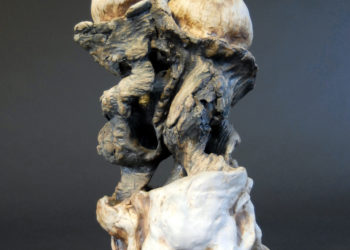
David Gilbaugh: Family Tree, 2007, sculpture, 6.5”(W) x 11.5”(H), hand-built coil, B-mix stoneware with grog, cone 10 reduction, iron, rutile, chrome and cobalt oxide stains

David Gilbaugh: Family Tree, 2007, sculpture, 6.5”(W) x 11.5”(H), hand-built coil, B-mix stoneware with grog, cone 10 reduction, iron, rutile, chrome and cobalt oxide stains

Deborah Britt

Deborah Britt Pottery - Ceramics

Deborah Britt’s profile on Ceramics Now Magazine - View her works

“My work mainly consists of salt-fired Porcelain and Stoneware. The salt-firing process is unique in that salt is introduced into the kiln when it reaches the proper temperature (2345 degrees F for my work). Inside the kiln, the salt vaporizes and settles onto the pieces, forming its own glaze over the clay body. I also use various slips and glazes to further decorate the pots.

In my functional work, my goal is to make the pieces “special”. I hope that everyday users will appreciate being “in the moment” as they sip from their hand-made cup or enjoy soup from their favorite bowl.

My sculptural pieces all have specific meaning for me, but sometimes are just fun! I don’t wish to impose my views of the work upon others, but would rather viewers lend their own interpretation to the pieces within their own contexts and ideas. Most importantly, I hope the sculptures will inspire viewers to pause and consider how the piece relates to their lives.” Deborah Britt

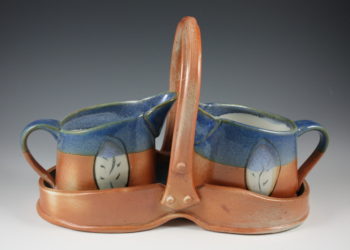
Deborah Britt: Blue Pitcher Set, 8” x 13”, Wheel-Thrown and Altered, Salt-Fired Porcelain with Slip and Glaze Decoration, Cone Ten, 2011

Deborah Britt: Blue Pitcher Set, 8” x 13”, Wheel-Thrown and Altered, Salt-Fired Porcelain with Slip and Glaze Decoration, Cone Ten, 2011

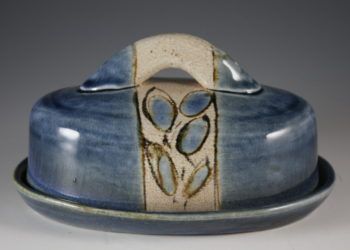
Deborah Britt: Blue Butter Dish, 4” x 6”, Wheel-Thrown and Altered, Salt-Fired Porcelain with Slip and Glaze Decoration, Cone Ten, 2011

Deborah Britt: Blue Butter Dish, 4” x 6”, Wheel-Thrown and Altered, Salt-Fired Porcelain with Slip and Glaze Decoration, Cone Ten, 2011

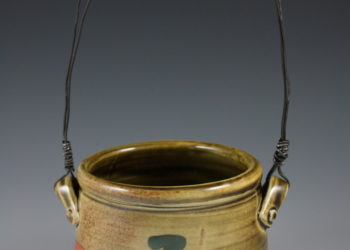
Deborah Britt: Basket, 12” x 6”, Wheel-Thrown with Hand-Built and Wire Handle, Salt-Fired Porcelain with Slip and Glaze Decoration, Cone Ten, 2011

Deborah Britt: Basket, 12” x 6”, Wheel-Thrown with Hand-Built and Wire Handle, Salt-Fired Porcelain with Slip and Glaze Decoration, Cone Ten, 2011

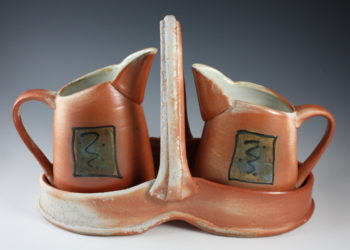
Deborah Britt: Pitcher Set, 9” x 14”, Wheel-Thrown and Altered, Salt-Fired with Slip and Glaze Decoration, Cone Ten, 2011

Deborah Britt: Pitcher Set, 9” x 14”, Wheel-Thrown and Altered, Salt-Fired with Slip and Glaze Decoration, Cone Ten, 2011

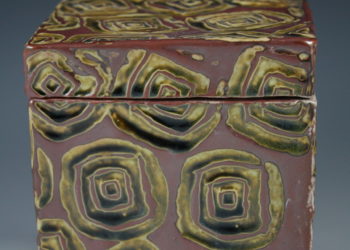
Deborah Britt: Stamped Box, 6” x 4.5”, Hand-Built, Salt-Fired Porcelain with Honey Weiser Glaze and Stamp Decoration, Cone Ten, 2011

Deborah Britt: Stamped Box, 6” x 4.5”, Hand-Built, Salt-Fired Porcelain with Honey Weiser Glaze and Stamp Decoration, Cone Ten, 2011

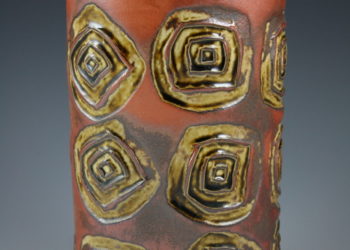
Deborah Britt: Stamped Vase, 9” x 4”, Wheel-Thrown and Altered, Salt-Fired Porcelain with Honey Weiser Glaze and Stamp decoration, Cone Ten, 2011

Deborah Britt: Stamped Vase, 9” x 4”, Wheel-Thrown and Altered, Salt-Fired Porcelain with Honey Weiser Glaze and Stamp decoration, Cone Ten, 2011